
The Noble Hardman Snowbird Mk.IV is a 2-seat high-wing microlight aeroplane powered by a single Rotax 532 engine. The Mk.IVs are built by Noble Hardman Aviation Ltd and test flown at the Cardiff-Rhoose Airport in Wales.
The Noble Hardman Snowbird Mk.IV is a 2-seat high-wing microlight aeroplane powered by a single Rotax 532 engine. The Mk.IVs are built by Noble Hardman Aviation Ltd and test flown at the Cardiff-Rhoose Airport in Wales.
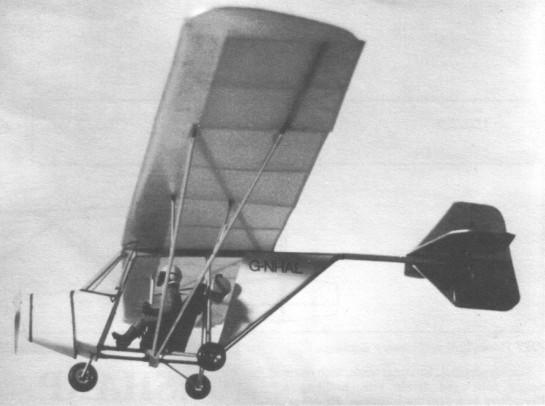
Tandem two seat single engined high wing monoplane with conventional three axis con¬trol. Wing has swept back leading edge, unswept trailing edge and tapering chord; cruciform tail. Pitch control by elevator on tail; yaw control by fin mounted rudder; roll control by half span ailerons; control inputs through stick for pitch/roll and pedals for yaw. Wing braced from below by struts; wing profile NACA 4412 with 2.5 deg washout; 100% double surface. Undercarriage has three wheels in tricycle formation; steel spring suspension on all wheels. Push right go right nosewheel steering connected to yaw control. Brake on nosewheel. Aluminium tube framework partially enclosed. Engine mounted below wing driving tractor prop¬eller.
The Snowbird was a conventional three axis machine with dual controls (including a dual throttle) and tube and Dacron construction. Its wing design uses a quarter chord twin-¬tube main spar with resilient foam D sections and tube aft sections. The ribs are capped with aluminium and all fabric is removable for inspection and maintenance.
A feature of the float kit is that the floats will not be attached rigidly to the aircraft but will be fitted with a suspension system consisting of a front rocker bar and air dampers.
Engine: Robin EC44, 50hp at 6500rpm
Propeller diameter and pitch 62 x 27 inch, 1.57 x 0.69 m
Toothed belt reduction, ratio 2.8/1
Max static thrust 320 lb, 145 kg
Power per unit area 0.28 h p/sq.ft, 3.0hp/sq.m
Fuel capacity main tank 4.8 US gal, 4.0 Imp gal, 18.2 litre
Fuel capacity reserve 1.2 US gal, 1.0 Imp gal, 4.5 litre
Length overall 20.0 ft, 6.10 m
Height overall 7.6ft, 2.32m
Wing span 36.0ft, 10.97m
Chord at root 5.6ft, 1.70m
Chord at tip 4.4ft, 1.35m
Dihedral 2 degrees
Sweepback 3 degrees
Tailplane span 6.6 ft, 2.00 m
Fin height 4.1 ft, 1.25 m
Total wing area 180 sq.ft, 16.7 sq.m
Total aileron area 16.5 sq.ft, 1.53 sq.m
Fin area 12.5 sq.ft, 1.16 sq.m
Rudder area 7.5 sq.ft, 0.70 sq.m
Tailplane area 22.4 sq.ft, 2.08 sq.m
Total elevator area 7.5 sq.ft, 0.70 sq.m
Wing aspect ratio 7.2/1
Wheel track 6.3ft, 1.92 m
Wheelbase 5.2ft, 1.58 m
Nosewheel diameter overall 14 inch, 36 cm
Main wheels diameter overall 16 inch, 41 cm
Optional floats: length 12.0ft, 3.66m, buoyancy 1200 lb, 544kg
Empty weight 300 lb, 136 kg
Max take off weight 696 lb, 316kg
Payload 396 lb, 180 kg
Max wing loading 3.87 lb/sq.ft, 18.9 kg/sq.m
Max power loading 13.9 lb/hp, 6.3 kg/hp
Load factors +6.0, 4.0 design
Max level speed 65 mph, 105 kph
Never exceed speed 80 mph, 129 kph
Stalling speed 28 33 mph, 45 53 kph
Max climb rate at sea level 750 ft/min, 3.8 m/s
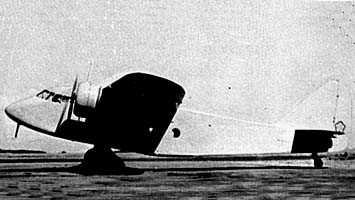
The Teradako-ken TK-3 was a prototype eight-to-ten passenger light transport monoplane built by Nippon Koku Kogyo Kabushiki Kaisha as a short-range transport for civil use at the request of Imperial Japanese Airways to replace its aging fleet of Airspeed Envoys and Fokker Super Universals. The first of two prototypes flew in June 1938, but was unable to meet the required performance requirements and the project was cancelled. In 1939, the Imperial Japanese Army revived the project to meet its urgent requirement for a light transport and liaison aircraft and instructed Nippon to develop the design as the Kokusai Ki-59 (一式輸送機, Isshiki-yusōki).
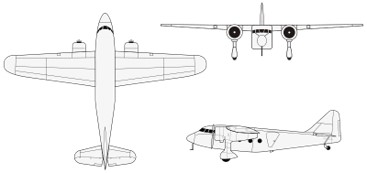
The Ki-59 was a high-wing cantilever monoplane with a fixed tailwheel landing gear and conventional single vertical tail surfaces. It was powered by two 450 hp (336 kW) Hitachi Ha-13a radial engines and other modifications to the design were made to meet Army requirements. The Ki-59 was ordered into production in 1941 with the designation Army Type 1 Transport, and an additional 59 units were produced. After the start of World War II, the aircraft was given the Allied reporting name Theresa. Despite the more powerful engines and modifications sponsored by the Japanese Army, the Ki-59 remained a poor performer and saw little service before being replaced by the more capable Tachikawa Ki-54. A small number were transferred to Manchukuo National Airways.
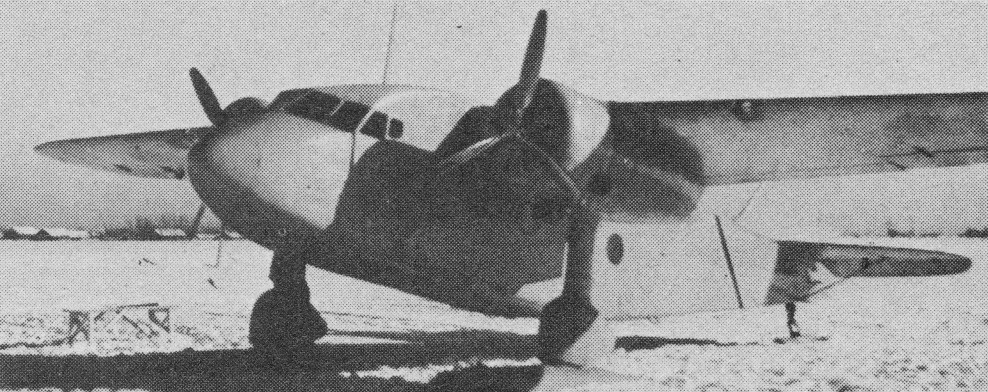
Near the end of 1941 one Ki-59 was modified into a glider with the removal of the engines and the landing gear replaced by underfuselage skids. It was designated the Ku-8-I or Army Experimental Glider.
Variant:
Nippon Kokusai Ku-8
TK-3
Engines: 2 x 640 hp (477 kW) Nakajima Kotobuki 3
two built.
Ki-59 (Army Type 1 Transport) / Theresa
Engines: 2 x 450 hp (336 kW) Hitachi Ha-13a
Wingspan: 17 m (55 ft 9¼ in)
Wing area: 38.4 m2 (413 ft2)
Length: 12.5 m (41 ft 0⅛ in)
Height: 3.05 m (10 ft 0 in)
Empty weight: 2,880 kg (6,349 lb)
Gross weight: 4,120 kg (9,083 lb)
Cruising speed: 300 km/h (186 mph)
Range: 800 km (497 miles)
Crew: 3
Capacity: Eight passengers
59 built.
Japan
Formed in June 1941 by the amalgamation of Nippon Koku Kogyu KK and Kokusai Kokuki KK, this small manufacturer produced sub-components and built the Kokusai Ki 86 biplane trainer, a version of the German Bucker Bu 131 Jungmann.
UK
In 1966 Nipper Aircraft acquired world marketing rights for the Fairey/Tipsy Nipper ultralight aeroplane, which it supplied in completed or kit form. After liquidation in May 1971 Nipper Kits and Components Ltd. was formed to support existing aircraft, and continued to market the aircraft in Mk III form as plans and some components.
1998:
Foxley Blackness Lane
BR2 6HL Kester
Keny
UK

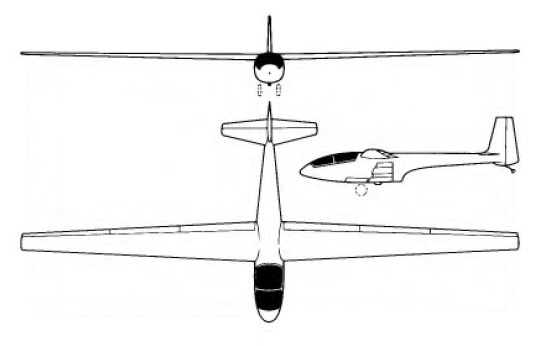
This Japanese side-by-side two-seater motor glider, designed and built by the Nihon Hikoki Kabushiki Kaisha (Japan Aircraft Manufacturing Co Ltd). Of all-metal construction, Nippi began the design of the Albatross late in 1973. The Albatross has cantilever shoulder wings with a single spar and two-section metal skinned flaps on each side that move upwards or downwards; the inner ones can be lowered to 80° for use as air brakes, and there are no spoilers. The fuselage is a semi-monocoque structure, with the forward-retracting twin-wheel main landing gear operated mechanically with spring assistance, and positioned just ahead of the ‘Venetian blind’ air intake doors. There is also a steerable fixed tailwheel linked to the rudder movement. The two pilots are provided with dual controls and sit under a rearward-hinged flush-fitting framed cockpit canopy. The unswept tail unit has conventional elevators and rudder. Powered by a motorcycle engine ‘buried’ in the centre of the fuselage aft of the main landing gear and driving a ducted fan.
The prototype NP-100 made its first flight on 25 December 1975; several modifications were made as a result of the first flight test programme, and a second such programme was to take place during January-March 1978 so as to finalise details of the production version.
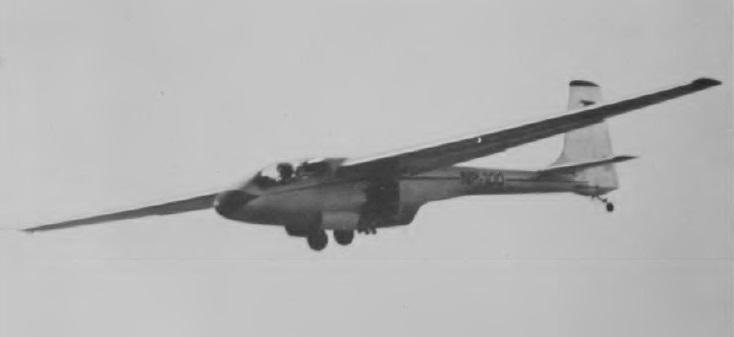
The prototype’s powerplant is a modified 60hp Kawasaki H2 three-cylinder two stroke air-cooled in-line motorcycle engine of 748cc driving a four-bladed wooden ducted fan of 23.5in diameter, the fan duct being under the tail boom. There are triple ‘Venetian blind’-type air intake doors on each side of the fuselage, which are interconnected with the engine starting circuit so as to prevent the engine running when the doors are closed. There is a single fuel tank in the fuselage of 8.8 Imp gallons capacity. It was expected that production aircraft would have a 68hp Nippi ‘flat four’ engine. Planned production is now awaiting the final choice of a type-certificated powerplant.
Prototype
Engine: Kawasaki HZI 748 cc, 44.7 kW (60 hp)
Span: 18.0 m / 59 ft 0.25 in
Wing area: 18.0 sq.m / 193.75 sq.ft
Aspect ratio: 18.0
Wing section: Wortmann FX-67-K-170
Length: 8.0 m / 26 ft 3 in
Height: 2.23 m / 6 ft 7.5 in
Empty weight: 420 kg / 926 lb
Max weight: 600 kg / 1,322 lb
Fuel capacity: 40 litre / 8.8 Imp gall.
Water ballast: None
Max wing loading: 33.3 kg/sq.m / 6.82 /b/sq.ft
Max level speed at sea level: 99 mph / 86 kt / 160 km/h
Max cruising speed: 74 mph
Stalling speed: 35 kt / 65 km/h
Min sinking speed: 0.8 m/sec / 2.62 ft/sec at 51.5 mph / 44.5 kt / 83 km/h
Best glide ratio: 30:1 at 56 mph / 48.5 kt / 90 km/h
ROC: 120m/min / 394 ft/min
Take-off run: 365 m / 1,200 ft
Range with max fuel: 124 miles / 200 km / 108 nm

1937
Best known as Nippi, original Yokohama works date from 1935. Atsugi works followed for maintenance and repair of Japanese aircraft and of U.S. Navy aircraft in region. Yokohama manufactured components/assemblies for Japanese aircraft and Boeing airliners. Has carried out YS-11EA ECM conversions (first flown 1991).
In 1949 Rod Nimmo, of Los Angeles CA., built the single-place cabin, low wing monoplane, Smirnoff Special midget racer N84G, partly from the Nimmo (Argander) Special.
Powered by an 85hp Continental C-85 engine, it was destroyed in practice 1966.
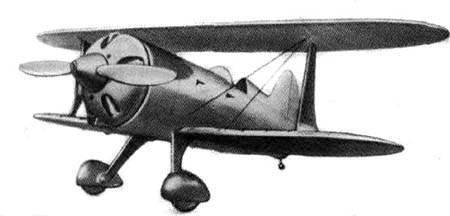
The last of the NV family of trainers was the NV-6 (UTI-6) (Russian: Никитин НВ-6 (УТИ-6)) designed as an advanced aerobatic trainer.
The NV-6 had a biplane configuration with a straight lower wing and an 8º raked upper wing and a slightly larger wingspan. Both wings were braced by a single I-pillar and tension cables. Ailerons were only included on the lower wing.
The construction was mixed. The fuselage featured a welded JMA tube structure, while the wings were made of wood with fabric covering. The center section of the fuselage and the wing of the NV-1 were used, which in this case was installed as the lower wing.
The tail unit was of the monoplane type with the stabilizers constructed of fabric-wrapped duralumin.
The landing gear was of the conventional type, with a tail wheel. The cantilever main landers featured simple balloon wheels with teardrop-shaped streamlined fairings.
The power plant consisted of an MG-11F engine with a special carburettor designed by MA Kossov to be able to perform inverted flight and a two-blade propeller.
The NV-6 was built at the request of the OSOVIAJIM at the OKB-30 facilities during 1939, but it would not be until December 1940 that an engine could be obtained. In that winter several flights were carried out by Nikitin and the pilot VV Shevchenko, which demonstrated good behavior of the aircraft. Unfortunately, the static resistance tests had not been carried out and the TsAGI, under these conditions, did not give authorization for the development of official flights. This problem lasted until the start of the war and from then on it became impossible to pursue further development.
Powerplant: One 165 hp MG-11F
Wingspan: 7.0m
Wing area: 14.0m²
Length: 5.8m
Empty weight: 560 kg
Loaded weight: 750 kg
Wing loading: 53.6 kg/m²
Power Load: 4.5kg/hp
Fuel and oil capacity: 80+20 kg
Speed at sea level: 270 km/h
Landing speed: 75 km/h
Landing run: 170 m
Take-off run: 50 m
Endurance: 2.5 hours
Ceiling: 4500m
Accommodation: 1

