On Mark Engineering Co

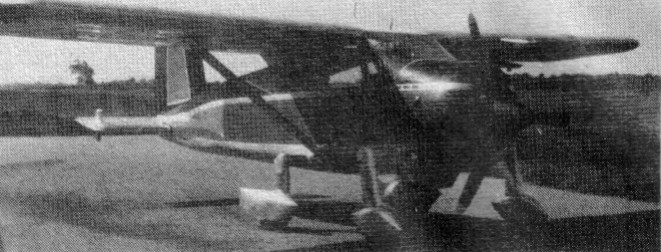
Formed 1954 as a specialist maintenance and modification contractor for Douglas B-26 Invader bombers, developing high-speed executive transport and heavily armed counterinsurgency versions. The On Mark Marketeer was a six/eight-seat corporate transport based on the B-26 airframe. The externally similar Marksman had a pressurized cabin. A B-26K Counter Invader was developed for the USAF’s Tactical Air Command.

In 1962 Mark was responsible for the first Pregnant Guppy conversions of the Boeing Stratocruiser, on behalf of Aero Spacelines Inc, for the transportation of space rockets and other bulky cargo.

At about the time Grumman was casting the Gulfstream in stone, there was a meeting at On Mark to decide upon a new airplane, a turboprop of original design. Although its ultimate price would have been equal to or less than the Gulfstream’s first tag of roughly $800,000, the directors of On Mark decided that nobody would pay such a price for a business airplane. And the company died.
Onishi OS-G3

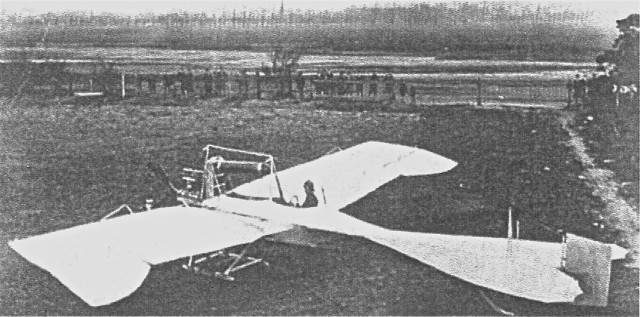
Designed and built by Mr Onishi, a Japanese sailplane pilot, the OS-G3 single-seater is powered by six model aircraft engines, mounted three on each side of the nose on a strut braced boom in line with the front of the cockpit canopy; these engines are intended to overcome the need for winch-launching or aero tows. Each 10cc OS.60 two-stroke glowplug engine drives a 12in diameter two-bladed propeller and develops 1.7hp at 14,000rpm, or 1.275hp at a less noisy 8,000rpm, the six together producing a total of 10.2hp for take-off, or 7.65hp for cruising flight. This is just enough for an unaided take-off, the take-off run being about 500ft when the OS-G3 made its first flight early in 1977. This power output leaves a 3mph margin between the cruising speed of 24mph and the stalling speed. The payload was only 154lb.

The OS-G3 is a cantilever shoulder-wing design with a swept back fin and rudder and the tailplane mounted on top; the engine slipstream is in line with the wing leading edge. There are no flaps or air brakes, and the landing gear consists of a fixed monowheel, a fixed nosewheel and a tailskid. The pilot sits under a one-piece canopy, and has six throttle levers and six cut-out switches for the engines.

Span: 46 ft 3 in
Length: 21 ft 3.5 in
Height: 5 ft 2.5 in
Wing area: 185 sqft
Aspect ratio: 11.6
Empty weight: 143 lb
Max gross weight: 297 1b
Cruising speed: 24 mph
Stalling speed: 21 mph

Onigkeit, Otto

Otto Onigkeit from Magdeburg built four monoplanes before the War; the last one, built in 1914. It was powered by a 50 hp RAW engine.

After the War, in 1921-1923, he built a man-powered plane with crashed at it first taking off in 1923. Otto Onigkeit was heavily injured.

In 1924 he built a little biplane which he flew until 1935.

In 1925-1926 he built a monoplane.

At last, in 1938, he built a new man-powered plane, propelled by pedal-driven swinging trailing edge surfaces, which flew several times.

O’Neill Pea Pod

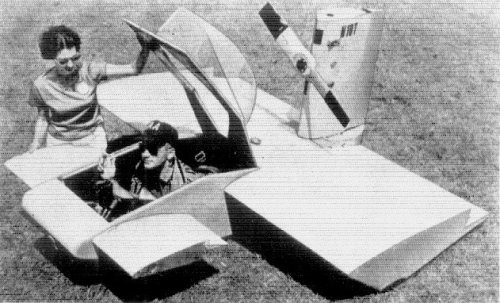
Terence O’Neill’s Pea Pod N10T of 1963 was a diminutive machine in which the pilot lay in a prone position, with most of his body inside the wing. It was powered by a 35 hp Kiekhaefer O-4-35 boat engine mounted inside the vertical fin, and could be carried atop the family car. Taxi tests were performed, but it could not meet FAR 103 requirements and reportedly never flew.

O’Neill Magnum

O’Neill Airplane designed the eight-seat Model J Magnum with unusual four-wheel undercarriage in 1980s. Further developed Magnum V8 six-seater, featuring swing tail for loading cargo, which can be built from plans and some available components.

The Magnum is a bush-type, designed around radial engines like prototype’s 350 HP turbocharged Jacobs R755S, a manufacturer’s modification of the L4M 245HP Jacobs. It features an extra-large cabin 49 inches wide by 102 inches long, plus an additional 68 inches cargo camping gear area. Special features are: stall/spin safety system with wind-wing angle indicator, vertical stabilator with forward-canted axis, and slotted stabilator; instant-droppable fuel tank to avoid post-crash fire hazard; and full-span dive flaps intended to limit airspeed to 185 mph at 3800 pounds gross, combined with structural design strength of 7 G’s yield, the maximum available from full-flapped wing at 185. Super rough-ground stability achieved by dual nosewheels.

Power (optional 245 hp) 350 hp
Gross Wt. 2900-3500 lb
Empty Wt. 1750-2000 lb
Wingspan 30 ft 3 in
Length 23 ft l1 in
Top alt, cruise 200+ mph
SL cruise 140 mph
Stall 60 mph
Climb rate 1000 fpm
Takeoff run 1000 ft
Landing roll 1000 ft
Range 400 mi. plus 45 min. reserve

Magnum V8 Pickup
Engine: Ford 351ci V8, 380 hp
Speed max: 185 mph
Cruise: 140 mph
Range: 800 sm
Stall: 61 mph
ROC: 1200 fpm
Take-off dist: 1000 ft
Landing dist: 1000 ft
Service ceiling: 20,000 ft
HP range: 350-450
Fuel cap: 110 USG
Weight empty: 1900 lbs
Gross: 3800 lbs
Height: 9 ft
Length: 25.8 ft
Wing span: 36 ft
Wing area: 189 sq.ft
Seats: 2+
Landing gear: dual nose wheel

O’Neill Aristocraft

Aristocraft III

After the war, Waco developed a new monoplane, the Aristocraft, but abandoned it in 1947, and the company went out of business. O’Neill Airplane Co. formed 1962 to develop Waco’s last design, the Waco Model W Aristocrat, for which all rights were acquired. Terry O’Neill flew the aircraft for a brief period after he had completed the restoration.

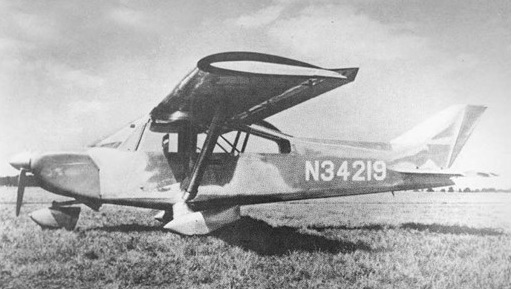
The Waco W was flown for only a brief period as it was converted into the tail dragger Aristocraft II, with the engine mounted in the nose, in this configuration it was flown in October 1963 and retained most of the original fuselage, the wings and horizontal tail of NX34219.

O’Neill Aristocraft II

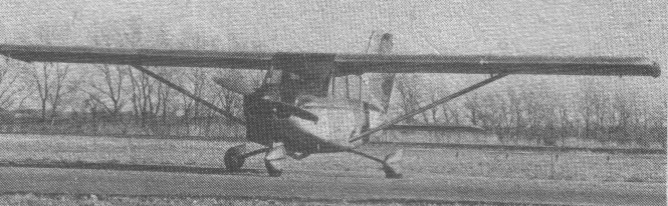
The Artstocraft uses the Waco wing design, simplified for amateur builders. The II design was awarded a Provisional Type Certificate (Al 9CE) by the FAA in 1969. It is one of the largest homebuilts, seating up to six persons. Originally powered by a 200-hp Lycoming IO-360, one amateur builder was adapting the Blanton 220-hp Ford 23 turbo and is using conventional landing gear for more speed and lower cost for cross country use.

In 1968 O’Neill refitted it with six seats, a tricycle landing gear and a single swept fin tail, in this configuration it was flown in October 1968, still registered N34219, but re-designated Model W Winner.

The O’Neill Pea Pod canard design was proposed also, but all activity on the Aristocraft terminated in 1974.

Wingspan 36 ft l0 in
Length 25 ft l0 in
Gross Wt. 2650-3300 lb
Empty Wt. 1600-1800 lb
Top speed 135 mph
Cruise 120 mph
Stall 55 mph
Climb rate 500 fpm
Takeoff run 1000 ft
Landing roll 1000 ft
Range 600 miles

Model W
Wingspan: 37ft 6in
Length: 26.7ft
Height: 8ft 4in
trigear

O’Neill Airplane Co

O’Neill Airplane Co. formed 1962 to develop the Waco Model W Aristocrat design, for which all rights were acquired. Two versions were evolved, the Model W Winner, which was to have been a serious production machine, and the Aristocrat II for amateur construction. The O’Neill Pea Pod canard design was proposed also, but all activity on the Aristocraft terminated in 1974. Designed eight-seat Model J Magnum with unusual four-wheel undercarriage in 1980s. Further developed Magnum V8 six-seater, featuring swing tail for loading cargo, which can be built from plans and some available components.

1996: 791 Livingston, Carlyle, IL, 602231, USA.