Circa 1920.
Circa 1920.
USA
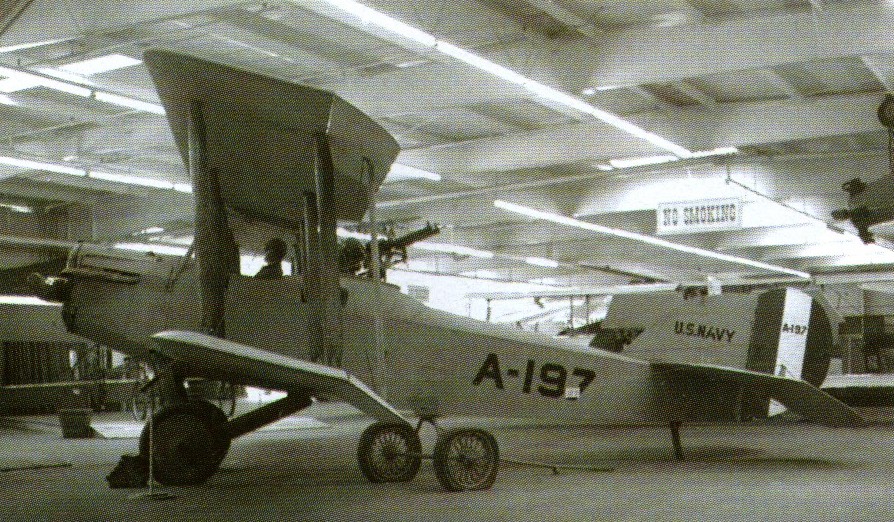
Ordnance Engineering Corporation’s Model ‘D’ single-seat biplane fighter was the first such aircraft of all-American design. Four wooden prototypes powered by 300 hp Wright-Hispano engines were built, followed by 50 production aircraft manufactured under license by the Curtiss company.
Orca Aircraft Ltd purchased SAH-1 trainer from Trago Mills but went into administration 1989. The SAH-1 became Sprint when purchased by Lovaux / FLS Aerospace.
UK
Optica Industries Ltd took over the Optica observation aircraft from Edgley following purchase from receiver by A. Haikney of Aero- Docks in 1985 and formation of this company to restart production in 1986. Fire of January 1987 destroyed seven finished Opticas and hangar.
The company was renamed Brooklands Aircraft Company Ltd from April 1987 and aircraft renamed Optica Scout.
Company ceased trading 1990.
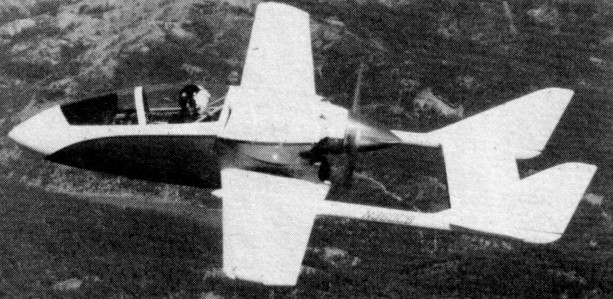
The Acapella is the creation of Carl O. Barlow, president of Option Air Reno, and sprung from his idea in 1977 to “re-do” the no longer available BD-5 design utilizing about 65 percent of the BD-5 hard¬ware including the fuselage from the firewall forward, the nosewheel, canopy and the short wings.
Design of the Acapella began in January 1978 and prototype construction started in June the same year. Registered N360CB, it achieved its first flight on June 6, 1980. After flying the prototype Acapella with both the short and long Bede wings, Barlow recommends using the long wings on the Acapella.
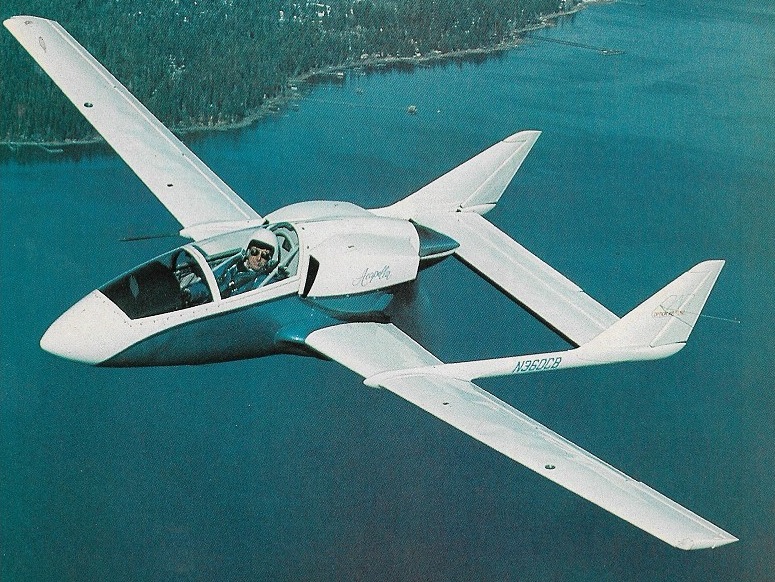
Production of kits began in June 1981, they include an engine mount, glass fiber cowling, new 8 ft (2.44 m) wing center section, tail booms, tail plane, elevator, main landing gear, many smaller components, and all necessary plans for the conversion. The prototype Acapella was powered originally by a 200 hp Avco Lycoming IO-360-A1B engine driving a Hartzell Q-Tip constant-speed pusher propeller, and in this form was known as Model 200-S.
It was re-engined subsequently with an 118 hp Avco Lycoming O-235 and fitted with longer-span wings to become the Model 100-L, with increased fuel capacity. The 200 series aircraft were not being made available to amateur constructors to build from plans or kits. This is because the majority of builders expressed interest in the smaller-engined Acapella 100-L, for which plans, kits and glass fiber components were available.
Work on a second prototype to carry a 118-hp Lycoming and a fixed-pitch propeller with a gross of about 1000 pounds was to be completed.
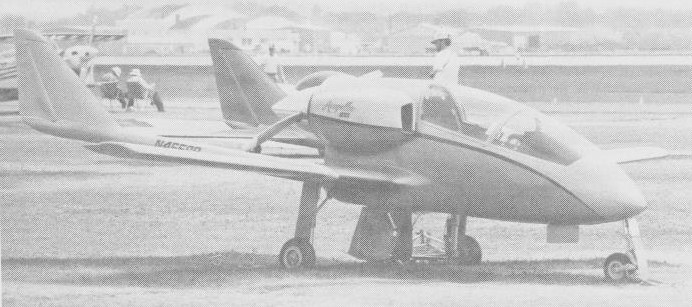
The Option Air Acapella N360CB crashed on July 28, 1982.
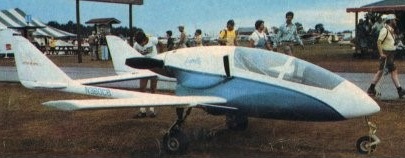

Only two aircraft were finished, the second one was registered N455CB on February 24, 1989, and it was this aircraft which was eventually donated to the EAA AirVenture Museum.
Gross Wt. 1350 lb
Engine 200-hp Lycoming IO-360
Top speed 245 mph
Cruise 214 mph
Stall 81 mph
Climb rate 1800 fpm
Takeoff run 1000 ft
Ceiling 26,500 ft
Single seat single engined high wing monoplane: no tall, canard wing. Pitch control by fully flying canard; yaw control by tip rudders. Wing braced from above by kingpost and cables, from below by cables. Undercarriage has three wheels in tricycle formation; bungee suspension on nosewheel and glass-fibre suspension on main wheels. Nosewheel steering. Optional brakes. Aluminium tube framework, without pod. Engine mounted below wing driving pusher propeller.
This machine was shown in prototype form in 1982 but since that time very little has been heard of its maker’s activities.
Engine: Cuyuna 430, 30 hp
Propeller diameter and pitch 52 x 27 inch, 1.32 x 0.69 m
Belt reduction, ratio 2.0/1
Nosewheel diameter overall 20 inch, 51 cm
Main wheels diameter overall 20 inch, 51 cm
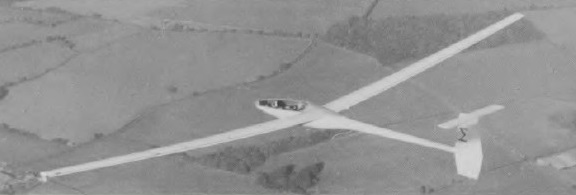
Operation Sigma was set up in 1966 with the object of building a pre-eminent sailplane for the British entry at the 1970 World Championships at Marfa, Texas. Rear Admiral Nick Goodhart was appointed project manager and manufacture of this very high performance sailplane was financially assisted by companies both within and outside the aviation industry.
The idea was that Sigma should have two sets of wings: one for thermalling at low speeds with low minimum sink, and the other for good performance at high speeds for cross-country flying. The two wing sections were specially developed for the project by Dr F.X. Wortmann.
Sigma’s wing consists of a light alloy box structure with full span flaps. These hydraulically operated flaps move in a similar manner to Fowler flaps but the gap between wing and flap is sealed with a flexible closure plate on the lower surface of the wing and spoilers on the upper surface to form a continuous extension of the wing. Each flap carries a full-span trailing edge aileron on the outer panel, and a camber-changing flap on the inner panel. These surfaces remain exposed when the flap is retracted. With the flap extended the circling speed and low sink rate should give a better rate of climb in weak thermals. Forward of the aileron on the upper surface is a light alloy spoiler to assist with lateral control at low speeds. With the flaps retracted the high wing loading and low drag should give a high lift/drag ratio at high speeds. The braking system is operated by lowering the camber-changing flaps and raising the spoilers on the upper surfaces to control the speed.
The fuselage is of the pod and boom type with welded steel tube centre structure faired by the wood framed glassfibre cockpit pod and with the tailboom of light alloy monocoque bolted to it. The long undercarriage is used to ensure that the wing tips have satisfactory ground clearance, necessary due to the large span and the degree of wing flexibility. The retractable sprung tail wheel is mounted in the rudder base and is operated by cables from the main undercarriage. The rudder incorporates a brake parachute. The tail unit is of light alloy construction with an all-moving T-tailplane incorporating a full-span anti-balance trim tab. The flying controls are all manually operated except for the flaps and the undercarriage, which are hydraulically operated. The hydraulic pressure is achieved by the pilot pushing both rudder pedals back and forth to operate the hydraulic pump.
The aircraft flew for the first time on 12 September 1971 with Nick Goodhart at the controls. Many aspects of handling and performance had been developed to a satisfactory level, but it did not prove possible to overcome difficulties associated with the flaps and flexible closure plates.
In 1977 the project was taken over by Prof. David J. Marsden of the University of Alberta, who designed and built the Gemini two-seater sailplane. He proposes to replace Sigma’s present flaps by simple slotted flaps in the course of his research on variable geometry sailplanes.
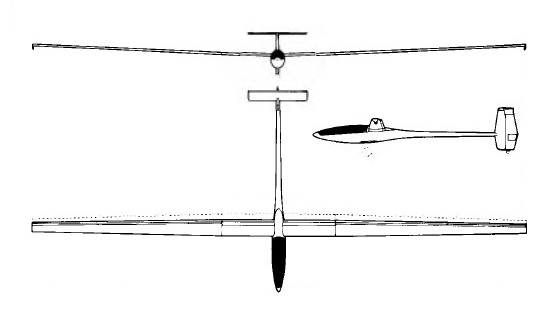
Sigma 1
Wing span: 21.0 m (68 ft 10 in)
Length: 8.81 m (28 ft 10 in)
Height: 1.83 m (6 ft 0 in)
Wing area: 12.2 sq.m (131.3 sq ft)
Wing section: Wortmann FX-67 Series
Aspect ratio: 36.2
Empty weight: 607 kg (1,338 lb)
Max weight: 703 kg (1,550 lb)
Water ballast: None
Max wing loading: 57.6 kg/sq.m (11.79 lb/sq ft)
Max speed: 140 kt (259 km/h)
Stalling speed: 37.5 kt (69.5 km/h)
Max rough air speed: 110 kt (204 km/h)
Best glide ratio: 48 at 63 kt (117 km/h)

The Opener BlackFly is an American electric-powered VTOL personal air vehicle designed by Canadian Marcus Leng and under development by his company, Opener, Inc of Palo Alto, California. It was publicly introduced on 12 July 2018, after nine years of development.
The first proof-of-concept version was flown on 5 October 2011, in Warkworth, Ontario, Canada, by Leng. He flew the next model, named the BlackFly, in August 2014 and then relocated the company to Palo Alto, California in September 2014. In February 2016, the second BlackFly prototype was first flown. By September 2017, the prototype had flown 10,000 mi (16,093 km) in a series of flights of at least 30 mi (48 km) each. The first pre-production aircraft was flown in October 2017.
The design is intended for the FAR 103 Ultralight Vehicles category in the US and the Basic Ultralight Aeroplane category in Canada. The US version and international versions were to have different ranges, speeds and weights to comply with national regulations. The aircraft is intended to be supplied complete and ready-to-fly.
The aircraft is made from carbon-fiber reinforced epoxy with all-electric battery-powered propulsion. It has two 13.6 ft (4.15 m) cantilevered tandem wings, on the front and rear of a short fuselage. The fuselage has a single-seat cockpit under a bubble canopy. The forward wing is low, and the rear wing high, giving the cockpit good forward visibility. Each wing has four tractor configuration contrarotating propellers powered by electric motors. The tractor configuration prevents the flexible propellers from contacting the airframe. Each wingtip has winglets to improve lateral stability and reduce vortex drag. The aircraft weighs 313 lb (142 kg) empty and can carry a pilot and baggage totaling 250 lb (113 kg). It can accommodate a pilot of up to 6.5 ft (1.98 m) in height. A ballistic parachute is optional.
The aircraft is not a tiltwing, tiltrotor or ducted-fan design. Instead, the entire aircraft changes pitch. When the aircraft is parked, both wings and their motors are canted up at about 45 degrees. To ascend vertically, the aircraft pitches up 45 degrees, so that the propellers pull vertically. The wing-mounted tractor propellers move air over the wings, reducing stall speeds. So, at pitch angles near zero degrees, the aircraft can fly slowly with high angles of attack. For efficient horizontal flight, the aircraft pitches down 45 degrees, canting the wings and propellors to an optimal angle of attack. The forward wing has a slightly lower angle of attack to aid stall recovery. At low speeds the forward wing will stall first, causing the nose to fall, increasing air speed and exiting a stall.
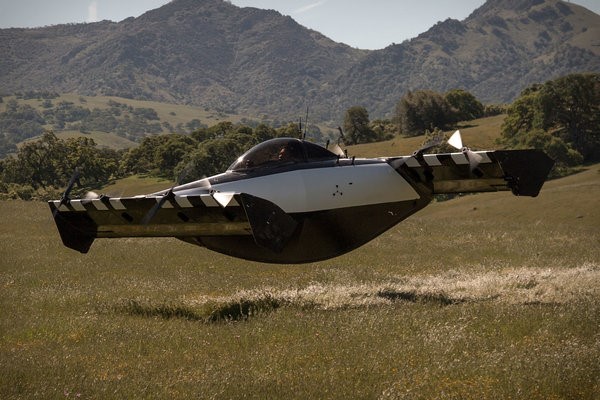
The take-off and landing distances are 36 inches. The landing gear consists of a rub-strip on the bottom of an amphibious hull and a small rubber bumper on the rear of the fuselage. The lower edge of the winglets are skids that limit the vehicle’s roll when parked. The vehicle is designed to fly from a grass surface, but can also be flown from fresh water, asphalt, snow and ice.
Pilot controls are a joystick with a thumb control for altitude. Flight controls are triple-redundant fly-by-wire controlling the motors and dual elevons on the outer edge of both wings. Differential motor speeds provide control authority in pitch, roll and yaw. Elevons also permit control in an efficient unpowered glide mode. The elevons are in the prop-wash of the outer propellers, enhancing their roll and pitch authority at low speeds. Flight stability is software-controlled, with modes for cruise-control, “return-home,” auto-land and geo-fencing.
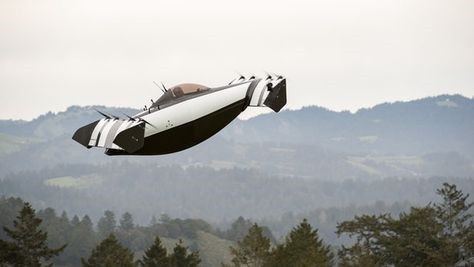
Most flight testing was unmanned, operated by software with a test weight in place of a pilot. Each motor weighs 4 lb (2 kg) and produces 130 lb (59 kg) of thrust. There are two batteries per motor, located in the wing, behind each motor. Adjacent batteries can be cross-connected for redundancy. The batteries are software-monitored. Avionic include Full authority autopilot, Remote controls, and VHF airband radio.
The manufacturer claims that the design is the world’s first ultralight fixed-wing, all-electric, vertical take-off and landing aircraft. Investors in the company include Google co-founder Larry Page.
The craft was still under development in 2018.
Opener has donated a first-generation BlackFly personal ultralight aircraft to the EAA Aviation Museum in Oshkosh, Wisconsin. According to Opener, BlackFly vehicles have flown over 2,300 flights, including 900 made on preproduction models since the aircraft appeared at Oshkosh in 2018.
Opener was displaying the production version of BlackFly at the AirVenture Innovation Showcase from July 22 to July 28, 2019.
Powerplant: 8 × 112 lb thrust/engine electric motors, 42.0 hp (31.3 kW) each
Propellers: 2-bladed, 3 ft (0.91 m) diameter
Wingspan: 13 ft 7 in (4.14 m)
Length: 13 ft 5 in (4.09 m)
Height: 5 ft (1.5 m)
Empty weight: 313 lb (142 kg)
Gross weight: 563 lb (255 kg)
Fuel capacity: 12KWh
Cruise speed: 80 mph (130 km/h, 70 kn)
Range: 40 mi (64 km, 35 nmi) plus reserves
Rate of climb: 1,000 ft/min (5.1 m/s)
Rate of sink: 1,000 ft/min (5.1 m/s)
Crew: one
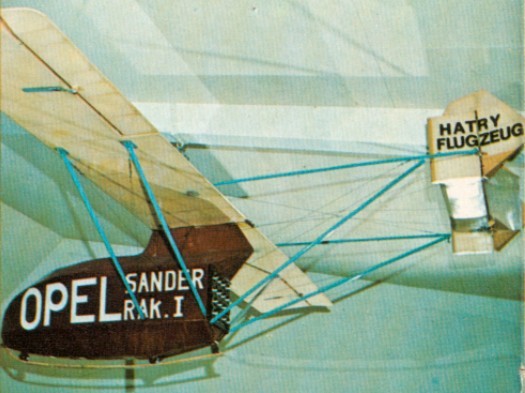
A number of designs were built with money provided to the VfR (Society for Space Travel) in Germany in the late 1920s, by the publicity ¬seeking automobile tycoon Fritz von Opel. First to fly was the tail-first Ente (duck) designed by Professor A M Lippisch, pilotd by Fitz Starrier, it made a rocket propelled flight of about 4,000 ft (1220 m) lasting some 70 seconds, on 11 June 1928. However, it was virtually uncontrollabe and made only two further tests.
Fritz von Opel had performed a number of publicity stunts involving rocket-powered cars for his Opel motor car company. Along with Friedrich Sander, a pyrotechnics manufacturer and Max Valier, a rocketry advocate, Opel concocted a scheme to attach two rockets to an Alexander Lippisch designed tail-less glider. In the summer of 1928, the three men brought the glider, called “Ente” to Wasserkuppe and hired Fritz Stammer to test it.
Two black powder rockets were attached to the skids on the underside of the fuselage. They were to be electronically fired from a switch in the cockpit. In order to adjust the center of gravity as the powder burned, a counterweight system was positioned under the floor. The rockets were timed to be fired one after the other to provide continuous thrust. Each rocket was intended to burn for about thirty seconds.
The Rak.1, designed by Hatry and flown by von Opel, took off from a raised track on 30 September 1929. After one false start, the rocket fired and the aircraft roared across the grassy field and into the air. Stammer reached an altitude of 1,500 meters (4,900 ft.), circled the mountain and landed safely.
On the second flight, the team decided to fire both rockets simultaneously thereby doubling the thrust for a 30 seconds burn. At the instant of launch, one rocket fired, but the other one appeared to sputter and as the plane left the ground, it exploded. The blast tore holes in both wings and set them on fire. Amazingly, Stammer brought the burning aircraft back to ground from an altitude of about 65 feet and quickly abandoned it. The aircraft was a total loss, as was Fritz von Opel’s dream of rocket-powered gliders.
Powered by: Sixteen Sander solid fuel (powder) rockets, each of 55 lb (25 kg) thrust, mounted in four banks of four and fired in stages.
Attained speed: 95 mph (153 kph).
Distance flown: approx 5,000 ft (1,525m).
Accommodation: Crew of 1.
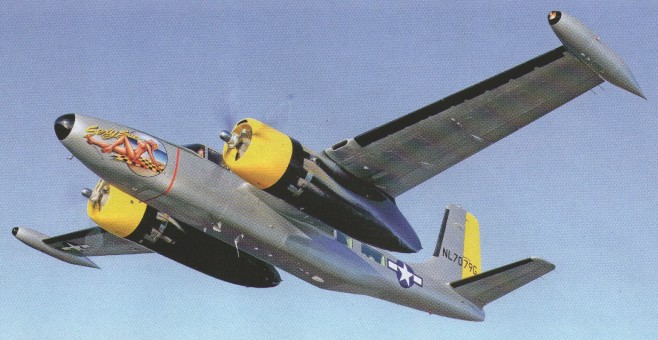
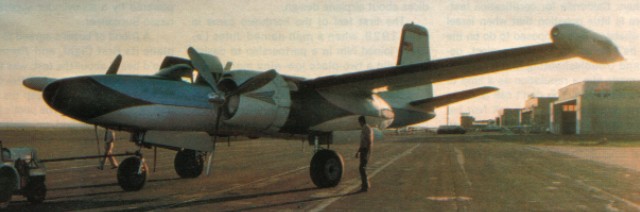
Formed 1954 as a specialist maintenance and modification contractor for Douglas B-26 Invader bombers, developing high-speed executive transport and heavily armed counterinsurgency versions. The On Mark Marketeer was a six/eight-seat corporate transport based on the B-26 airframe. The externally similar Marksman had a pressurized cabin. A B-26K Counter Invader was developed for the USAF’s Tactical Air Command.
The On Mark Com¬pany took in the surplus bombers at Van Nuys, California and turned them out with everything intact but the bomb bay doors and some of the military weapons control gear. They came to the customers in pressurized and unpressurized versions, and they were only for the select few. 45-60 were converted.
The Counter-Invader was a cleaned up, heavily armed version for the USAF’s Special Air Warfare Center.