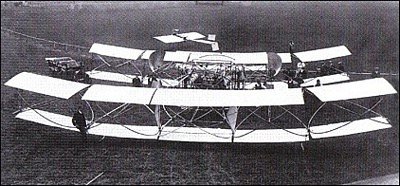
In 1908 Lieutenant John W. Seddon of the Royal Navy was inspired by a flying paper model to design a giant tandem biplane, with which he hoped to win a GBP10,000 prize for the first Manchester to London flight. Convinced that hoops of high-tensile steel tube were much more efficient than conventional wood and wire bracing, he persuaded the Navy to give him leave to work on his project and his mother largely to pay for it. The aircraft, named the ‘Mayfly’, was built in a bicycle factory and used up 610m of steel tubing.
The Seddon “Mayfly” of 1910 was a large and elliptical tube framework tandem biplane flying machine, employing Beedle aluminium sheet propellers, contracted by John W. Seddon to the English engineering company of Accles and Pollock just one year after Blériot’s Cross-Channel flight.
It was intended to take six people aloft – one pilot and five passengers. The aircraft never flew, and achieved nothing more than a high-speed ground-run. On its only high-speed run, a wheel collapsed and the aircraft was damaged. Repairs and modifications were hampered by Seddon’s return to duty and the Mayfly never did fly, eventually being dismantled by souvenir hunters. Often referred to as the Accles and Pollock aeroplane.
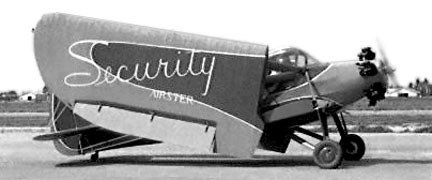
The S-1 Airster designed by Bert Kinner was a folding wing, side-by-side evolution of the Kinner Sportster. First flying on 1 May 1933 (piloted by Lee Brusse) they received ATC 521 and were priced at $1,985.
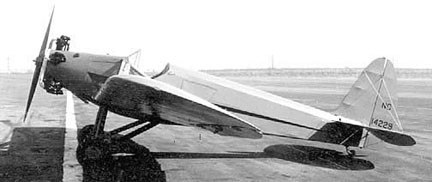
Two were built as S-1, NX217Y and NC13702, and 12 as S-1-A, NC13743, NC13746, NC13792 to 13794, NC14227 to 14232, and NC14293.
Security-National S-1-A NC14229
ATC 2-451 was received for gross weight change on prototype NX/NC217Y and NC13702.
About five 1937 S-1-B Airster were built with ATC 705, including NC15536 and NC18135, priced at $2,995. The prototype, NX/NC18967, was built as a class project at the Warren School of Aviation in Los Angeles
As Security National Aircraft Corporation was established by W. B. Kinner, founder of Kinner Airplane & Motor Corporation in 1933. Company was formed May 1933 by Kinner on acquiring the old Emsco plant in Downey. Downey and Van Nuys CA. USA
1937: Reorganized as Security Aircraft Corp, Long Beach CA. USA
1937: Reorganized as American Aircraft Corp, 2735 E Spring St, Long Beach.
New factory then built at Long Beach, California, to make Airster 2-seat monoplane and Security 5- cylinder radial.
1942: Acquired by National Airplane & Motor Co, Los Angeles.
Société d’Etudes et de Construction d’Avions de Tourisme (SECAT) had been established in the late 1930s, and in 1938 had built the two-seat, high-wing S-4 Mouette, designed by Rémy Goucher, the development of which was interrupted by the hostilities of the Second World War.
Design work on light aircraft was resumed by SECAT in 1946, resulting in the SECAT S-5, the prototype of which was first flown in that year.
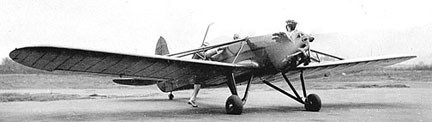
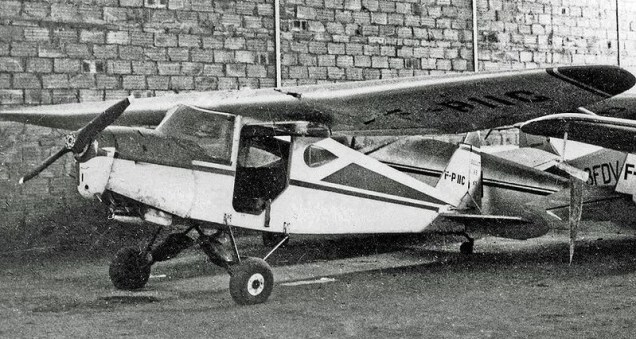
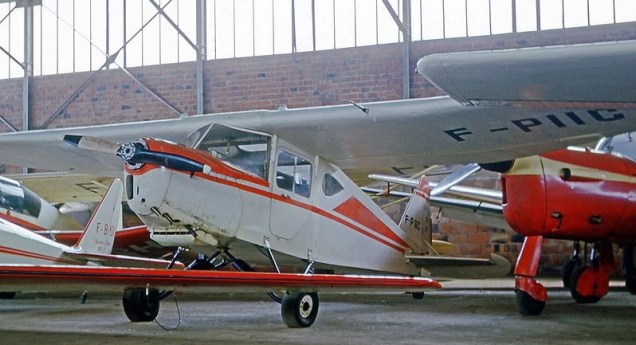
The S-5 was based on the design of the S-4, and was of all-wooden construction and had side-by-side seating for two persons. The cantilever, elliptical high-set wing comprised a wooden box-spar, chordwise ribs and a stressed plywood skin. The trailing edge carried ailerons and flaps. The fuselage was a wooden semi-monocoque and dual controls were fitted. The windscreen was split. A large access door was provided on each side of the fuselage, and all fuel was carried in a 250 l (55 imp gal; 66 US gal) tank installed in the wing.
The SECAT S-5 was a light, high-wing, two-seat touring monoplane aircraft, and only one example of the type was ever built, and it flew for a variety of private owners for several decades.
SECAT S-5 F-PIIC Toussus
After the prototype, no further examples of the type were completed. The sole example of the SECAT S-5, registered F-PIIC, was initially operated from Toussus-le-Noble Airport, near Paris. By 1964, it was owned by M. Rene Dupuis, and it was hangared at Arras Roclincourt Airport. The aircraft was still extant in 1967; however, it was struck off the French civil aircraft register during the 1970s.
Engine: 1 × Regnier 4D.2, 56 kW (75 hp) Wingspan: 8.99 m (29 ft 6 in) Length: 6.15 m (20 ft 2 in) Height: 2.11 m (6 ft 11 in) Empty weight: 350 kg (772 lb) Gross weight: 570 kg (1,257 lb) Fuel capacity: 250 l (55 imp gal; 66 US gal) Maximum speed: 196 km/h (122 mph, 106 kn) Cruise speed: 150 km/h (93 mph, 81 kn) Range: 800 km (497 mi, 432 nmi) Service ceiling: 3,600 m (11,810 ft) Rate of climb: 3.0 m/s (590 ft/min) Crew: 1 Capacity: 1 passenger or student pilot
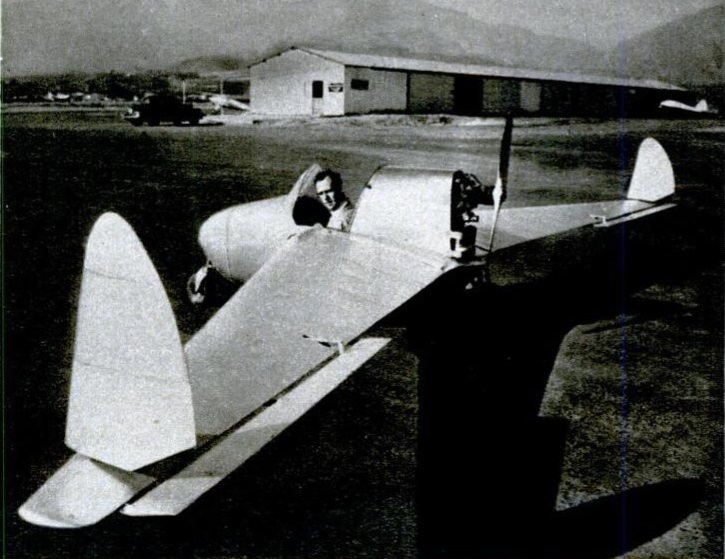
Designed and built by Robert M Sebring over a three-year period, the 1949 Wee Wing was a single-place pusher, the airframe was reportedly built for less than $100. The wing was of bonded plastic plywood. The wood construction aircraft was completed in 1949 and in its structure several composite material parts and components were used. The aircraft had so called wingtip tails and was fitted with one 12hp Richter two-stroke (drone) engine, the Richter company later being acquired by the Nelson Engine company.
Only limited testing of the aircraft took place and further development was soon halted.
Only a single example of the flying wing was built.
Engine: one 12hp Richter (Nelson) two-stroke Wingspan: 22 ft Height: 2.5 ft Empty weight: 150 lb Cruise: 65 mph Seats: 1
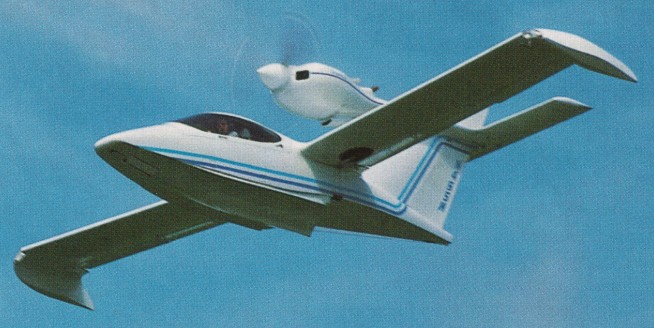
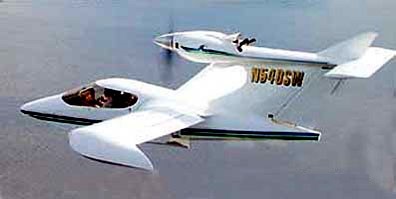
The Seawind 2000 am¬phibian offered by Seawind International of Ontario, Canada, was designed by Rodger Creelman and first flown in 1993.
The pylon mounted engine sits well forward of the fin leading edge, giving an impression that it might part company if subjected to gyroscopic or turbulence loadings. However the mount has been subjected to and survived a 20G test loading, twice the required FAA rertifica¬tion requirements. The Seawind has a wingspan of 35 feet, a MAUW of 3100 lbs and provides a cruise of 145 knots on its fin mounted single Lycoming IO 360 consuming 10 US gal¬lons each hour.
The four seat Seawind 2500 amphibian design is of composite manufacture, and first flown in 1994. The amphib¬ian’s power source is a 200 hp tail-mounted Lycoming IO 360; cruise is noted at 145 knot.
The certified Seawind 300C is manufactured Exclusively by Sea Air Composites, inc, a single engine 4/5 place amphibian.
Initially with tail-mounted 300hp Lycoming IO-540 (prototype with 200hp IO-360), later powered by 400hp Allison 250-B17B turboprop.
Of fiberglass and cellfoam construction the Seawind received the EAA award for craftsmanship in 2000. The standard kit with molded components, less engine sold for $58,980.
Seawind N548SW
Seawind 2000
Seawind 2500 Engine: Lycoming IO-540-T, 300 hp HP range: 250-300 Height: 10.2 ft Length: 27.2 ft Wing span: 35 ft Wing area: 160 sq.ft Weight empty: 2230 lb Gross: 3400 lb Fuel cap: 110 USG Speed max: 187 mph Cruise: 178 mph Range: 1600 sm Stall: 59 mph ROC: 850 fpm Take-off dist: 1010 ft, (1600 ft water) Landing dist: 770 ft (620 ft water) Service ceiling: 14,800 ft Seats: 4 Landing gear: retractable nose wheel
Seawind 3000 Engine: Lycoming IO-540, 300 hp Height: 10.2 ft Length: 27.2 ft Wing span: 35 ft Wing area: 160 sq.ft Weight empty: 2300 lb Gross: 3400 lb Fuel cap: 110 USG Speed max: 200 mph Cruise: 191 mph Range: 1460 sm Stall: 57 mph ROC: 1250 fpm Take-off dist: 820 ft, (1100 ft water) Landing dist: 770 ft (620 ft water) Service ceiling: 20,000 ft Seats: 4 Landing gear: retractable nose wheel
Seawind 300C Engine: Engine Continental IO-550-N. 310 hp Propeller: McCauley 3-blade 76” Constant Speed Wing Area: 163 sq. ft. Wing Span: 35 ft Height: 10 ft 2 in Overall Length: 27 ft 2 in Ground Clearance: 8.5 in Wing Loading: 20.81 lbs/sq ft Power Loading: 10.97 lbs/hp Max Gross Weight: 3400 lbs Std Empty Weight: 2300 lbs Equipped Empty Weight: 2350 – 2400 lbs Useful Standard: 1150 lbs Useful Equipped: 1000 – 1150 lbs Fuel Capacity Mains: 80 US gals Long Range – Aux Tanks: 30 US gals Sea Level Speed 100% Pwr: 200mph / 174 kt. Cruise 75% Pwr (8,000 ft): 190mph / 165kt. Cruise 65% Power (8,000 ft): 180mph / 156kt. Cruise 55% Power (8,000 ft): 169mph / 147kt. Fuel Burn at 55% Power: 12.8 gph Max. Range (no reserve main) 1040sm / 905nm. Extended Fuel Range: 1460sm / 1270nm. Rate of Climb: 1250 fpm B/Rate of Climb Speed: 99mph / 86kt. B/Angle of Climb Speed: 74mph / 65kt. Stall Speed: Clean 72mph / 63kt, Flaps & Wheels: 60mph / 54kt. Service Ceiling: 18,000 ft. Take off Distance 3200 lbs: Land 870 ft / Water 1100 ft Take off Distance 3400 lbs: Land 1175 ft / Water 1400 ft. Over 50’ Obstacle: Land 1175 ft / Water 1400 ft Landing Distance: Land 770 ft / Water 620 ft. Over 50’ Obstacle: Land 1300 ft / Water 1150 ft. Cabin Length: 105” Cabin Width: Front 52″ / Rear 54″ Cabin Baggage: 16 x 48″ wide, 24” high, 10 cu ft Aft Baggage: Opening 19” x 40”, Length 71″, Volume 30 cu ft Nose Deck Forward Storage: 3 cu ft
Designed and built by H.A. Searsby of Nottingham, UK, the Special was a single-seat, wooden, primary glider. It featured wing-warping, and one of the A-frame members was placed in front of the pilot.
Only one was built, which had its first flight on 7 September 1930 at Wirksworth, Derbyshire, UK.