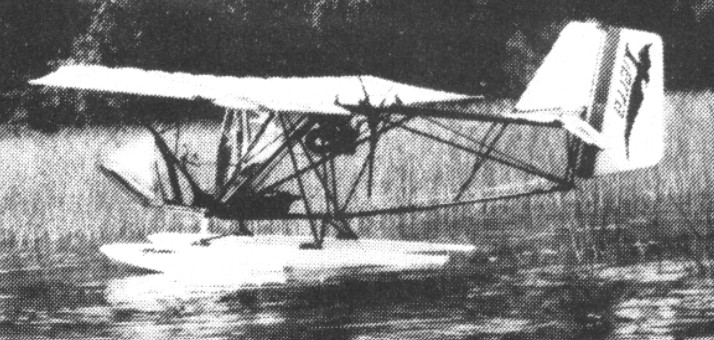
Single or side by side two seat single engined high wing monoplane with conventional three axis control. Wing has unswept leading and trailing edges, and constant chord; cruciform tail. Pitch control by elevator on tail; yaw control by fin mounted rudder; roll control by full span ailerons; control inputs through stick for pitch/roll and pedals for yaw. Wing braced from below by struts; wing profile NC; double surface. Undercarriage has three wheels in tail dragger formation; nylon rope suspension on tailwheel and steel spring sus¬pension on main wheels. Ground steering by differential braking. Brakes on main wheels. Aluminium tube framework, partially enclosed (totally enclosed optional). Engine mounted above wing driving pusher propeller.
One of the revelations of Sun ‘n’ Fun in March 1983 at Lakeland was the prototype Tierra with which Teratorn Aircraft made a spectacular entrance into that section of the ultralight market which is in direct competition with traditional light air¬craft. This machine offers the facility to be used either as a single seat ultralight or to be transformed into a US category experimental aircraft by the addition of a second scat, the problem of centre of gravity shift being resolved by positioning the single seat in the centre of a wide cockpit, so that it only has to be moved sideways to make room for two. The single stick is central and, as the Tierra has two rudder bars, it becomes a dual control machine when fitted with both seats.
The fuel tank is mounted behind the seating low down at the rear of the cockpit which closes with the clever use of zips for the side panels, the windows coming down to the lower longeron of the cabin. This enclosure is available as an option, as are isolation panels for the cabin. These are made of soundproof material and fit behind the cabin and above the wing and are easily removable. The structure of the Tierra is formed from triangular frames. All the joints in the airframe are reinforced with a strong high density elastic foam pressed into the tubes which absorbs vibration and eliminates metal to metal con¬tact.
Engine location is above the cabin, the motor using dyna focal mounts as in modern conventional aviation. It is a Rotax 377 cc unit fitted with a reduction drive and Teratorn’s own Flexidyne type clutch system. Finally comes an accessory which is still rare in ultralight aviation: the horizontal tail surface of the Tierra is fitted with a trimmer permit¬ting maximum stability in flight regardless of the load carried or its position.
Tierra
Engine: Rotax 377, 36hp at 6600rpm
Propeller diameter and pitch 60 x 36 inch, 1,52 x 0.91 m
Toothed belt reduction, ratio 2.6/1
Max static thrust 245 lb, 111 kg
Power per unit area 0.24 hp/sq.ft, 2.7 hp/sq.m
Fuel capacity 5.0 US gal, 4.2 Imp gal, 18.9 litre
Length overall 18.5 ft, 5.64 m
Height overall 6.0ft, 1.83m
Wing span 31.5ft, 9.60m
Constant chord 4.5 ft, 1.37 m
Sweepback 0 deg
Total wing area 142 sq.ft, 13.2 sq.m
Wing aspect ratio 7.0/1
Empty weight 253 lb, 115kg
Max take off weight 550 lb, 249 kg
Payload 297 lb, 135 kg
Max wing loading 3.87 lb/sq.ft, 18.9 kg/sq.m
Max power loading 15.3 lb/hp, 6.9 kg/hp
Load factors; +6.0, 3.0 ultimate
Max level speed 63 mph, 101 kph
Never exceed speed 63 mph, 101kph
Cruising speed 50mph, 80kph
Stalling speed 25 mph, 40 kph
Max climb rate at sea level 800 ft/min, 4.1 m/s
Min sink rate 300ft/min, 1.5m/s
Best glide ratio with power off 10/1
Take off distance 50 ft, 15 m
Tierra 1
Engine: Rotax 277
Empty wt: 253 lb
Max wt: 650 lb
Wing span: 31ft
Wing area: 154 sq.ft.
Wing loading: 4.22 lbs/sq.ft
Power loading: 23.21 lbs/hp
Max speed: 62 mph
Cruise: 55 mph
Stall: 26 mph
Vne: 75 mph
Seats: 1
Tierra 11
Engine: Rotax 532
Empty: 385 wt. lbs
Max wt.: 850 lbs
Wing span: 36ft
Wing area: 190 sq.ft.
Wing loading: 4.38 lbs/sq.ft
Power loading: 13.08 lbs/hp
Max speed mph: 75
Cruise mph: 60
Stall mph: 30
Vne mph: 80
Seats: 2
Tierra UL
Engine: Rotax 277 (268 cc) 28 hp
Static thrust: 180 lbs
Empty wt: 249 lbs
Wing span: 30’6”
Wing area: 155 sq.ft
Height: 5’8”
Length: 18’6”
Fuel cap; 5 USG
Construction: Aluminium, Dacron, Steel
Max wt: 500 lb
Stall: 24 mph
Max speed: 60 mph
Vne: 70 mph
Climb rate: 500-600 fpm
Design limit: +6, -3g
Glide ratio: 10-1
Wing loading: 3.23 lbs/sq.ft
Power loading: 17.86 lbs/hp