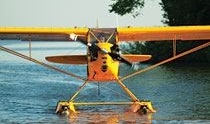
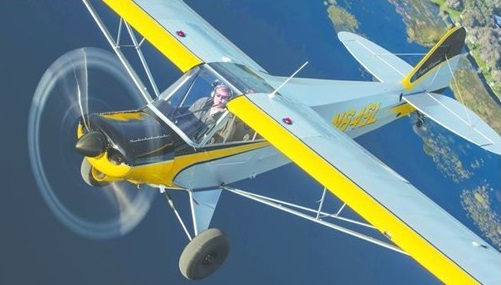
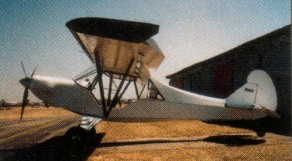
American Legend had 11 new registrations in the US during 2012. The Super Legend and new Legend Smart Cub (with a Garmin G3X system) were the most popular. Texas Star kit versions were also offered.
The Super Legend sports flaps, many carbon-fiber components and a 115 hp Lycoming IO-233-LSA multi-fuel engine. Continental O-200 (100 hp) and Jabiru 3300A (120 hp) versions were also offered. Price 2012: US$124,900 (open-cowl Legend Cub); US$128,900 (closed-cowl Cub); US$146,900 (Super Legend).
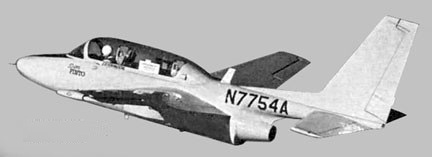
In June 1968 American Jet Industries Inc first flew the Super Pinto, a jet primary trainer or light strike aircraft developed from TT-1 Pinto built by Temco. Towards the end of the 1960s Aeronca undertook, in conjunction with American Jet Industries Inc., development of a light strike version of the Super Pinto, built originally as a jet primary trainer. Work was also done on five-seat executive version.
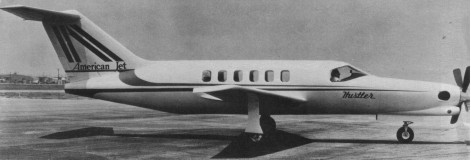
Unveiled at American Jet Industries plant in Van Nuys, California, in October, 1975, the seven place Hustler 400 turboprop/ turbojet has been modified since announcement was made. A major change was the redesign of the tail to a “T” tail configuration, and other changes include an increase of 52 inches in the wing span and installation of double slotted Fowler flaps on the supercritical wing. Sixteen inches have also been added to the fuselage. An 850 shp United Aircraft of Canada turboprop PT6A 41 in the nose provides power for the Hustler while the Teledyne turbojet engine will be used for standby’ power in the event of an engine failure. According to American Jet’s data the standby engine will enable the aircraft to maintain an airspeed of 170 mph at 13,500 feet with the nose turboprop engine feathered. A top speed of 380 mph for the Hustler is predicted with a maximum range of 2970 miles. Three prototypes were under construction at the American Jet California facility; two were to be used for flight testing and the third for ground structural testing. The Hustler faces some serious hurdles; for instance, no certificated jet engine of the size required by the design existed. Only various engines used for APUs, missiles or drones. If, on the other hand, a “single engine” classification were sought, the jet engine being viewed merely as a JATO unit, then the Hustler would face the challenge of making the FAA’s 70 mph landing speed requirement with a wing loading of at least 36 pounds per square foot. The Hustler was powered by a Pratt & Whitney PT6A-41 turboprop in the nose and a standby turbojet in the tail and made its first flight on January 12, 1978. Gulfstream American decided to replace the 850 shaft horsepower Pratt & Whitney PT6 turboprop engine in the nose of the Hustler with a 900 shp Garrett TPE331. The Pratt & Whitney JT15D remains Gulfstream’s choice for the Hustler’s rear mounted turbofan. Maximum takeoff weight was been increased to 10,000 from 9,500. Flight testing of the Gulfstream American Hustler 500 began late in January 1981 at Van Nuys, California, and continued at Mojave. This second Hustler prototype was powered by a 900 shp Garrett AiResearch TPE 331 10 501 turboprop in the nose and a 2,200 lb st (1000 kgp) Pratt & Whitney JT15D 1 turbofan in the tail.
Hustler 400 A Engine: Pratt&Whitney PT6A-41, 838 shp & Teledyne turbojet Length: 37.795 ft / 11.52 m Height: 10.761 ft / 3.28 m Wing span: 32.644 ft / 9.95 m Wing area: 185.141 sq.ft / 17.2 sq.m Max take off weight: 7497.0 lb / 3400.0 kg Weight empty: 3999.9 lb / 1814.0 kg Cruising speed: 343 kts / 636 kph Wing load: 40.59 lb/sq.ft / 198.0 kg/sq.m Range: 1303 nm / 2414 km Crew: 1 Payload: 6 Pax
Hustler 500 Engine: 1 x Garrett AiResearch TPE 331 10 501, 900 shp turboprop & 1 x Pratt & Whitney JT15D 1 turbofan 2,200 lb st (1000 kgp)
American Jet Industries Inc. was founded 1951, and became specialists in modification and repair of executive and transport aircraft, including large cargo types, and a successful program of Cessna turboprop conversions. In June 1968 first flew Super Pinto, a jet primary trainer or light strike aircraft developed from TT-1 Pinto built by Temco. Work was also done on five-seat executive version. Under a 1974 expansion program, production was concentrated in a facilities at Van Nuys Airport, California, building Hustler, a seven-seat business/utility monoplane with supercritical wing, conventional turboprop, and ‘standby’ turbofan in rear fuselage. First flight January 11,1978. Purchased Grumman American Aviation Corporation September 1978, being renamed Gulfstream American in 1979. Meantime, AJI renamed Gulfstream American Corporation of California, developing the Peregrine as a jet trainer and business aircraft. All programs stopped 1985.
A STOL utility aircraft (LSA) with interchangeable flaps and ailerons, as well as elevators and rudder, and an 18 cu.ft cargo area. First fown in 1994.
The man who designed this airplane was named Steve Nussbaum, he flew out of the airport I worked at, Galt airport 10C. I remember on a good day he could get one of these off the ground in 88 ft. He also designed the ribs to be replaceable in the field if they ever broke during a forced landing. Ted Domski
Engine: Continental IO-240, 125 hp Wing span: 30.6 ft Wing area: 130.6 sq.ft Fuel capacity: 26 USG Empty weight: 850 lb Gross weight: 1400 lb Height: 6.5 ft Length: 20.8 ft Top speed: 140 mph Cruise: 117 mph Stall: 30 mph Range: 500 sm Takeoff dist: 100 ft Landing dist: 125 ft Service ceiling: 12,500 ft Seats: 2 tandem Landing gear: tailwheel
Cruise: 100 mph Stall: 30 mph Range: 490 sm Rate of climb: 1000 fpm Takeoff dist: 120 ft Landing dist: 120 ft Engine: Continental O-200, 100 hp HP range: 100-125 Fuel capacity: 26 USG Empty weight: 771 lb Gross weight: 1320 lb Length: 21.9 ft Wing span: 30.6 ft Wing area: 130.5 sq.ft Seats: 2 tandem Cockpit width: 28 in Landing gear: tailwheel
Bought rights to Gulfstream Aerospace Corporation’s light aircraft (AA-1, AA-5 and GA-7 Cougar) 1989, with agreement in 1991 for GA-7 Cougar license manufacture by Tbilisi Aircraft Manufacturing Association in Georgia. No Cougar production was undertaken. A few AA-5s were built.
In 1942 revived American Eaglet light monoplane by building a new prototype. Tests postponed until after war. By end of February 1960 had built one Eaglet and was supplying plans for amateur builders. Company later sold to John Spach.
Established May 1931 in merger between American Eagle Aircraft Corp and Lincoln Aircraft Co. In early 1930s built American Eaglet two-seat light parasol monoplane, which had particular success. Eagle-Lincoln P.T. biplane was a trainer and Eagle-Lincoln A.P. a three-seat cabin monoplane.