A light parasol monoplane, first two-seat light airplane to be granted Approval Type Certificate by US Department of Commerce. Several hundred Eaglets built before company suspended operations in 1930 Depression.
Victor H. Roos Aircraft Co. succeeded American Eagle-Lincoln Aircraft Corporation in mid-1930s, and continued to produce American Eaglet light monoplane with 45hp Szekely engine.
In 1942 American Eaglecraft Co revived the American Eaglet light monoplane by building a new prototype. Tests postponed until after war. By end of February 1960 had built one Eaglet and was supplying plans for amateur builders. Company later sold to John Spach.
Aircraft
American Eagle Aircraft Corp
Established 1925 in Kansas City, with E. E. Porterfield as president.
1925: American Eagle Aircraft Co, 52 St and Prospect Ave, Kansas City MO (fdr: Edward E Porterfield Jr);
1925: 22 St and Harrison Ave
In 1926 built three-seat civil biplane with Curtiss OX-5 engine. Specially noted for American Eaglet light parasol monoplane, first two-seat light airplane to be granted Approval Type Certificate by US Department of Commerce. Several hundred Eaglets built before company suspended operations in 1930 Depression.
1928: American Eagle Aircraft Corp, with refinancing by A A Durant & Co (NYC), Fairfax Airport, Kansas City KS.
1929: Merged with Wallace Aircraft Co.
1930: Merged with Lincoln Aircraft as (Victor H) Roos Lincoln Aircraft Co, Lincoln NE.
1931: Acquired by Porterfield Aircraft Corp.
1931: Bought production rights to Wallace Touroplane.
1942: Company sold to Columbia Aircraft Corp; Porterfield to Ft Smith AR to manufacture gliders until retirement
c.1945. Company sold to Northwestern Aeronautical Corp, St Paul MN (neither Columbia nor Northwestern produced any Porterfield aircraft).
American Champion Aircraft Explorer
based on former Bellanca/Champion Scout.
American Champion Aircraft Adventure
based on former Bellanca/Champion Super Decathlon
American Champion Aircraft Aurora
based on former Bellanca/Champion Citabria
American Champion Aircraft Aerostar Super 700
Engine: Superior Vantage O-360-A3A2, 180hp
TBO: 2000 hrs
Propeller: Sensenich FP
Prop diameter: 76 in
Landing Gear type: Fixed/Conv.
Max ramp weight: 1800 lb
Max gross weight: 1800lb
Landing weight: 1800lb
Empty weight, std: 1250lb
Useful load, std: 550lb
Useable fuel, std: 35 USG
Payload, full std. fuel: 290 lb
Wingspan: 34.5 ft
Overall length: 22.1 ft
Height: 7.7 ft
Wing area:171.9 sq.ft
Wing loading: 10.5 lbs./sq. ft
Power loading: 10.0 lbs./hp
Wheel size: 8.00 x 6 in
Seating capacity: 2
Cabin doors: 1
Cabin width: 30 in
Cabin height: 47 in
Cruise speed, 80% power: 117 kt
Fuel burn , 80% power: 11 USgph
Best rate of climb, SL: 1350 fpm
Service ceiling: 17,000 ft
Vso: 46 kt
Takeoff ground roll: 370 ft
Takeoff over 50 ft. obstacle: 695 ft
Landing ground roll: 360 ft
Landing over 50 ft. obstacle: 740 ft
American Champion Aircraft Corp
Manufacturer of former Bellanca/Champion Aircraft two-seat lightplanes, in form of Aurora, Adventure, and Explorer based on former Citabria, plus Super Decathlon and Scout.
American Aviation Industries
Founded 1985 and offered Lockheed JetStar business jet re-engining program as FanStar.
American Aviation Corp
American Aviation Corporation; formed in 1964 to develop and manufacture the AA-1 Yankee side-by-side two-seat monoplane (formerly called Bede BD-1) using aluminum honeycomb fuselage construction and metal-to-metal bonding throughout. Also produced a trainer version (American Trainer) and a four-seater (American Traveler). Became part of Grumman American Aviation Corporation in January 1973.
Ameri-Can Ultralights Euraka
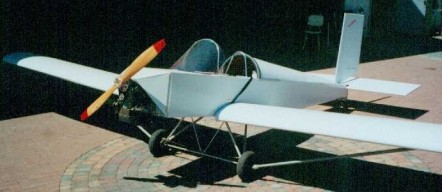
Of pre-manufactured sub-assemblies, with wings, tail empennage and fuselage all pre-built, ready for bolt-on, the kit arrives pre-fabricated and pre-painted white. The wings are built around a single deep spar. There are 26 foam ribs in each 12 foot long wing. When this assembly has been built, it is covered in full-span panels of pre-painted (white) aluminum skins, durable and UV-resistant. The resultant wing weighs less than 35 pounds. It is attached to the fuselage with just a few bolts, and in about 5 minutes. This airplane can be easily assembled in the field, and allows for trailer transport.
The purchaser assembles pre-built components with the supplied aircraft-grade bolts and nuts. This means that wrenches are the only tools required to assemble this aircraft kit.
It was designed to fly with a Hirth F-33 25hp engine, with electric start, or alternately, the Zenoah GB25 22hp engine with pull start can be used. Higher horsepower engines are not recommended.
First flown in August 1997, by July 2003 the Eureka had been withdrawn from the market due to lack of resources.
Engine: Hirth F33, 25hp
HP Range: 22-26
Wing Span: 26 ft
Wing Area: 104 sq.ft.
Height: 5.0 ft
Length: 14.5 ft
Empty Weight: 230 lb
Gross Weight: 460 lb
Fuel Capacity: 5 USG
Top Speed: 63 mph
Cruise: 55 mph
Endurance: 1.5 hours
Stall: 27 mph
Rate of Climb: 500 fpm
Takeoff Distance: 300 ft
Landing Distance: 250 ft
Service Ceiling: 10,000 ft
Seats: 1
Landing Gear: Tailwheel
Bldg. Materials: Aluminum, Foam
Airframe Cost: $5000 (2009)
Engine: Zenoah G25B, 22hp
HP Range: 22-26
Wing Span: 26 ft
Wing Area: 104 sq.ft.
Height: 5.0 ft
Length: 14.5 ft
Empty Weight: 238 lb
Gross Weight: 460 lb
Fuel Capacity: 5 USG
Top Speed: 63 mph
Cruise: 55 mph
Endurance: 1.6 hours
Stall: 27 mph
Rate of Climb: 450 fpm
Takeoff Distance: 350 ft
Landing Distance: 250 ft
Service Ceiling: 10,000 ft
Seats: 1
Landing Gear: Tailwheel
Bldg. Materials: Aluminum, Foam
Airframe Cost: $5000 (2009)
Engine: Cuyuna, 22 hp
HP range: 22-25
Wing span: 26 ft
Wing area: 104 sq.ft
Length: 14.5 ft
Height: 5 ft
MTOW: 460 lb
Empty wt: 250 lb
Fuel cap: 5 USG
Top speed: 63 mph
Cruise: 60 mph
Stall: 27 mph
Range: 150 sm
ROC: 350 fpm
TO dist: 400 ft
Ldg dist: 250 ft
Service ceiling: 7000 ft
Seats: 1
Undercarriage: tailwheel
Take-off distance (50ft obstacle): 300 ft / 91 m
Landing distance (50ft obstacle): 250 ft / 76 m

