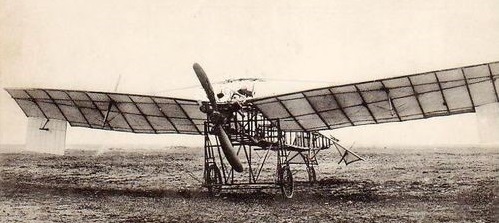
This monoplane was designed by Belgian engineer Albert Bracke, assisted by Monsieur Misson. The date is estimated as 1912-1913. Its engine was a 40 hp Anzani driving a 2.15 meter Chavière propeller
This monoplane was designed by Belgian engineer Albert Bracke, assisted by Monsieur Misson. The date is estimated as 1912-1913. Its engine was a 40 hp Anzani driving a 2.15 meter Chavière propeller
A single seat ultralight was designed and built by R.G.Bracewell at Gorleston, UK, in 1945, Registered G-AGOO, it used some or all of the Gunton Special G-AFRW.
It was not completed and broken up in December 1946.

Built by Beech Engineer Jack W Bowyer who drew the plans and along with his wife who bucked a vast majority of the rivets. They built it in their shop on weekends and evening while he worked at Beech. He also designed and constructed the prop.
A pure flying wing design construction was completed in late 1963 or early 64.

It first flew during 1964 with the registration N5401E. It flew several times out of an airport in Newton, Kansas. The aircraft was damaged in a landing accident and not rebuilt.

It is now in a hanger in southwest Missouri where the original builder is working once again on restoring it to the original condition, although he has no plans to fly it.

Engine: Franklin 4AC-176B, 65 hp
Wingspan: 26’0″ (or 36 ft)
Length: 21’0″
Seats: 1
Michael Bowlus used the tail of an HP-18 and the wings of an HP-11, reduced to 15 m., to develop his BZ-1, which first flew in 1984. This has an adapted North American F-86 Sabre drop tank for the front end of the fuselage, interconnected flaps and ailerons (the former extending to 90 degrees for approach control) and increased empty and gross weight of 249 kg/ 550 lb and 364 kg/ 780 lb respectively.
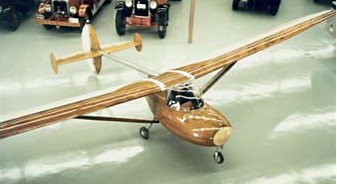
The Bumblebee was designed by William Hawley Bowlus and built in 1946. A powered sailplane with vertical tail and two small stabilizers mounted on a single boom, the Bumblebee was equipped with manually retracting undercarriage and 16 hp pusher engine.
The Dragonfly, NX1955, designed by Hawley Bowlus, was the first auxiliary-powered self-launching glider to be produced in the U.S.A. The designers nicknamed this design the Bumblebee but they sold the powered glider under the official moniker, Dragonfly. Rebuilt from Bumblebee and with tricycle gear, it featured 2-place, side-by-side seating, retractable tricycle landing gear and a Nelson engine. Some were powered by 48hp Nelson H-63CP engine. The marketing was sponsored by the Nelson Engine Company as a vehicle for their two- cycle four cylinder 25hp engine. The cockpit pod was molded plywood, aluminum boom, 2-spar wood wing with plywood D-tube, fabric cover aft of spar.
While the concept was good, the airplane never achieved real success, because it didn’t perform well, and because Nelson took his engine and left the partnership. The beautiful wooden fuselage pod made up of layers of mahogany was very labour intensive and thus very expensive. Some Dragonflys had the engine removed, converting them to pure sailplanes. The Dragonfly features a fully retractable tricycle landing gear with stearable nosewheel, dual control and a ratchet-wire pull starter in the cockpit for engine starts in flight or on the ground.
Of less than 10 built, 2 survived in 2008 at the National Soaring Museum. NX/NC34921 was restored in New York in 1964.
John Hess Auction Service Inc, Manheim, PA 17545, United States, consigned a Nelson-Bowlus BB-1 Dragonfly N33687 Glider and Culver Rigid Midge N215 jr. Racing Glider in May 2015.
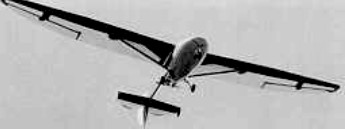
Bumblebee
Engine: 16hp pusher
Wingspan: 41’0″
Length: 23’5″
Useful load: 355 lb
Speed: 75 mph
Range: 110 mi
Seats: 1
Undercarriage: rg (manual)
Dragonfly
Engine: 25 hp Nelson 4 cylinder engine (retractable)
Wing span: 14.42m / 47.3ft
Wing area: 15.7sq.m / 169sq.ft
Empty Weight: 263kg / 580lb
Payload: 163kg / 360lb
Gross Weight: 426kg / 940lb
Wing Load: 27.13kg/sq.m / 5.56lb/sq.ft
Max speed: 50 mph (80 km/h) (originally 70 mph (113 km/h) with power)
Empty weight: 580 lb (263 kg)
Gross weight: 940 lb (426 kg)
Span: 47 ft 4 in (14.4 m)
Height: 6ft 10 in (2.1 m)
Length: 20 ft 4 in (6.2 m)
L/DMax: 18
Seats: 2
No. Built: 7
Aspect ratio: 13.25
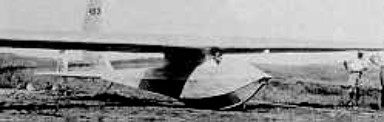
The wood and fabric Paper Wing, so called because it used paper webbed ribs, first flew in 1929. The wingspan was later increased to 14.33 m. / 47.0 ft principally by extending the ailerons. It was first U.S. built sailplane to fly for more than 1 hour. A replica of the Paper Wing belongs to the San Diego (CA) Museum of Flight.
Wing span: 13.4m / 44ft
Wing area: 16.63sq.m / 179sq.ft
Empty Weight: 73kg / 160lb
Payload: 66kg / 145lb
Gross Weight: 139kg / 305lb
Wing Load: 8.36kg/sq.m / 1.7lb/sq.ft
Aspect ratio: 11
Airfoil: 35-A
No. of Seats: 1
L/DMax: 20
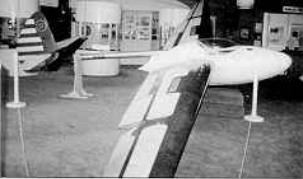
A development of the Baby Albatross, the Super Albatross used the BT-100 Baby Albatross pod and tail, with the boom moved down. The wing is the outer section of the BT-100, mounted in a shoulder position. One belongs to the National Soaring museum.
The BS-100 was constructed with wood and fabric wings and tail, a wood pod, and metal tail boom.
Wing span: 13.72m / 45ft
Wing area: 11.61sq.m / 125sq.ft
Empty Weight: 197kg / 435lb
Payload: 95kg / 210lb
Gross Weight: 292kg / 645lb
Wing Load: 25.15kg/sq.m / 5.25lb/sq.ft
No. of Seats: 1
No. Built: 2
L/DMax: 29 @ 76 kph / 41 kt / 47 mph
MinSink: 0.76 m/s / 2.5 fps / 1.96
Aspect ratio: 15.7
Airfoil: Go 549 tip symmetrical
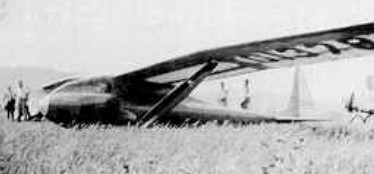
A development of the Bowlus Super Sailplane built by the Curtiss Wright Technical Institute in Glendale, CA in 1932, the senior Albatross had a slightly extended spar and gull wing. No two were completely alike, with flaps on at least one version. The design dominated the U.S. Nationals and held many U.S. records through the 1930’s. Senior Albatrosses were owned and/or flown by notables such as Warren Eaton, Richard du Pont and Chet Decker.
Examples belong to the Smithsonian Air & Space Museum and the National Soaring Museum.
The Senior Albatross has a wood monocoque fuselage, single strut braced wood D-tube wing, wood tail group, and is fabric covered
Wing span: 18.82m / 61.75ft
Wing area: 19sq.m / 204.75sq.ft
Empty Weight: 154kg / 340lb
Payload: 82kg / 180lb
Gross Weight: 236kg / 520lb
Wing Load: 12.42kg/sq.m / 2.54lb /sq.ft
Aspect ratio: 18.72
Airfoil: Go 549 root, symmetrical at tip
No. of Seats: 1
No. Built: 6
L/DMax: 22 @ 64 kph / 35 kt / 40 mph
MinSink: 0.59 m/s / 1.95 fps / 1.56 kt
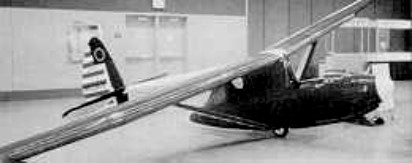
The two-place Baby-Albatross was created by lengthening the molded pod of the BA-100 Baby Albatross approximately two feet for a second seat beneath the monospar strutted wing, with porthole windows on each side. The Baby Albatross was built with an aluminum tube tail boom, wood wing, wood tail group, and fabric covered. The first built had the Bowlus control yokes while the second had conventional sticks. Those built up from BT-100 parts were known sometimes as the BTS-100. There were no approach control devices. One belongs to the National Soaring Museum and the Vintage Sailplane Association has plans.
Wing span: 13.56m / 44.5ft
Wing area: 13.94sq.m / 150sq.ft
Empty Weight: 216kg / 476lb
Payload: 192kg / 424lb
Gross Weight: 408kg / 900lb
Wing Load: 29.27kg/sq.m / 6lb /sq.ft
L/DMax: 20
MinSink: 0.69 m/s / 2.25 fps / 1.33 kt
Aspect ratio: 13.2
Airfoil: modified Go 535
No. of Seats: 2
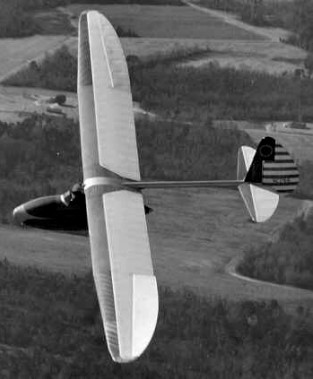
The Baby Albatross, first flown in 1937, was a production design by Hawley Bowlus for both kits and complete sailplanes. Bowlus produced kits until 1942, and in 1944 Laister-Kauffmann bought the rights but produced no aircraft before going out of business. The pod is a molded plywood unit, and no spoilers are provided, but some have been modified by owners. Many other modifications were carried out, including one Baby with a steel tube pod built by Schweizer. Many soaring notables had a Baby Bowlus as their first ship, including Dick Johnson, Dick Schreder and Joe Lincoln, and flights of more than 402 km / 250 miles have been made.
Bowlus Baby Albatross Article 1938
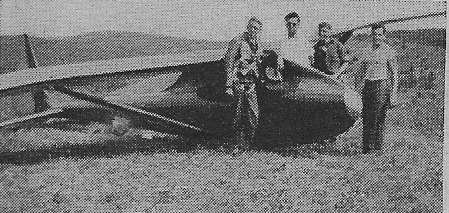
One example belongs to the National Soaring Museum.
The Vintage Sailplane Association has plans and the Baby Albatross is Air Transport Certifie
Wing span: 13.56 m / 44.5ft
Wing area: 13.93sq.m /150sq.ft
Empty Weight: 136kg /300lb
Payload: 93kg /205lb
Gross Weight: 229kg /505lb
Wing Load: 16.44kg/sq.m/ 3.3lb/sq.ft
MinSink: 0.69 m/s / 2.25 fps
L/DMax: 20
Aspect ratio: 13.2
Airfoil: Go 535 (mod)
No. of Seats: 1
No. Built: 156

