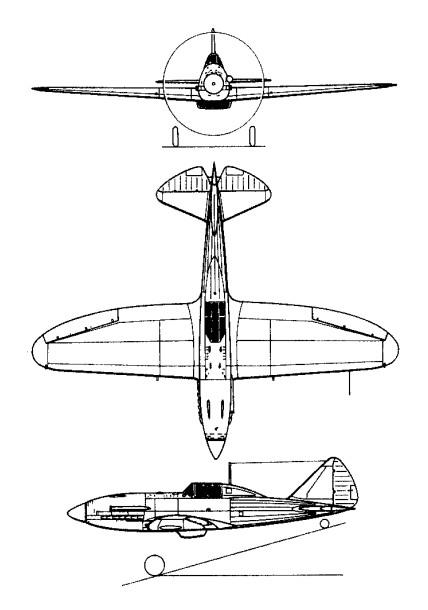
CARMAM JP-15 / Pettier PA 15-34 Kit-Club

CARMAN JP 15-36 Aiglon

The Aiglon (Eaglet) was a private venture design by CARMAM’s technical directors Robert Jacquet and Jean Pettier, and is a restricted Standard Class sailplane; design work began in September 1971, and the prototype made its first flight on 14 June 1974.

Series production began in 1976, the first production JP15-36A making its first flight on 16 October that year; a version with a retractable monowheel and provision for up to 121 lb of water ballast is designated JP 15-36AR.

The single-seater Aiglon is intended for intensive club use and so special attention has been paid to good flying qualities and safe landing characteristics for not-so-experienced pilots. Construction is of glassfibre, the cantilever mid wing having a single glassfibre spar and a glassfibre/Rohacell/epoxy sandwich skin and steel-tipped wing tip ‘salmon’ fairings. The ailerons are of plastic and can be operated either differentially or in unison, and there are Schempp-Hirth airbrakes on the upper and lower surfaces; for ease of wing rigging the aileron and air brake controls are designed to connect automatically. The semimonocoque glassfibre fuselage is moulded in two halves and joined at the centreline, a single bulkhead forming the cockpit backrest and a shock-absorbing structure for the monowheel. A large one-piece canopy gives excellent visibility, while both seat and rudder pedals are adjustable in flight: on the JP 15-36A the monowheel s fixed and has a cable brake, and there is also a tail bumper. The swept back fin is integral with the fuselage, and the wooden rudder is fabric-covered, the all-moving tailplane is of plastics construction.
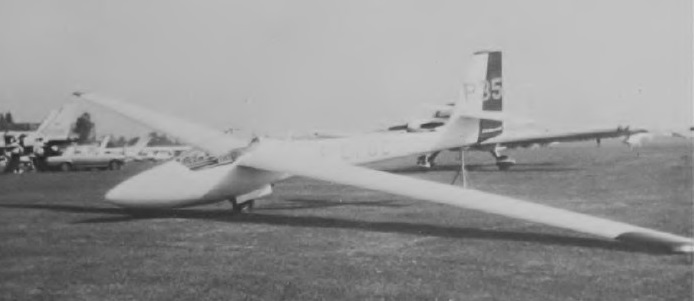
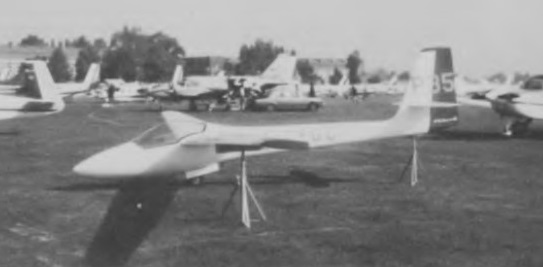
JP.15-36 Aiglon

The Pettier PA 15-34 Kit-Club homebuilt version is essentially the same as the JP 15-36A but with some structural simplification and redesign to make it more suitable for amateur builders; the glassfibre wings are factory-made. Plywood-covered spruce construction of the fuselage and tail unit replaces the Aiglon’s more sophisticated glassfibre structure, although the Kit-Club’s nose-cone is of glassfibre. The tail boom, rudder and rear part of the tailplane are fabric-covered, and there is a fixed unsprung monowheel, with a cable-operated drum brake on production aircraft. The change to wood construction results in only a slight weight penalty, the maximum weight going up to 926lb, and performance is very similar to the JP15-36A’s. The prototype Kit-Club made its first flight on 6 November 1976, and 12 had been built by December 1979. The Kit-Club is also available in factory-built form from CARMAM.

By January 1980 a total of 39 JP 15-36Aand JP 15-36AR Aiglons had been sold

The CARMAN JP 15-38 Standard Class single seater utilises the same wings as the JP 15-36A Aiglon with provision for 220lb of water ballast; these are married to a new fuselage of similar construction to the JP 15-36A, which has a mechanically retractable unsprung monowheel. Instead of the Aiglon’s low-set tailplane the 15-38 has a T-tail, with elevator and spring trim.
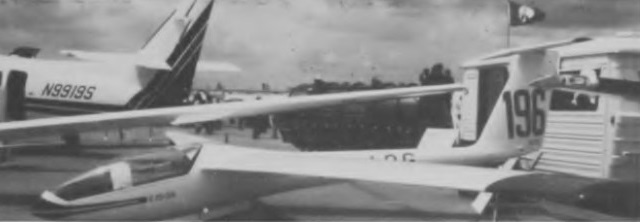
15-38

Construction of the 15-38 began in February 1977 and the prototype made its first flight on 17 June 1979.

JP. 15-36 Aiglon
Wing span: 15.0 m / 49 ft 2.5 in
Length: 6.4 m / 21 ft 0 in
Height: 1.4 m / 4 ft 7 in
Wing area: 11.0 sq.m / 118.4 sq.ft
Wing section: Wortmann FX-67-K-170/67-126
Aspect ratio: 20.4
Empty weight: 200 kg / 441 lb
Max weight: 390 kg / 860 lb
Water ballast: None
Max wing loading: 35.5 kg/sq.m / 7.27 lb/sq ft
Max speed: 130 kt / 240 km/h
Stalling speed: 33.5 kt / 62 km/h
Min sink: 0.6 m/sec / 2 ft/sec at 40.5 kt / 75 km/h
Max rough air speed: 108 kt / 200 km/h
Best glide ratio: 36 at 49.5 kt / 92 km/h

CARMAM JP15-36A
Span: 49ft 2.5 in
Length: 20ft 3 in
Height: 4ft 7 in
Wing area: 114.7 sqft
Aspect ratio: 20.4
Empty weight: 505 lb
Max weight: 860 lb
Max speed: 136mph (in smooth air)
Max aero-tow speed: 103 mph
Min sinking speed: 2.03ft/sec at 45 mph
Best glide ratio: 36.9:1 at 50 mph

CARMAM 15-38
Span: 49ft 2.5 in
Length: 21 ft 11.75 in
Height: 4ft 8 in
Wing area: 118.4 sqft
Aspect ratio: 20.6
Empty weight: 507 1b
Max weight: 970 lb
Max speed: 136 mph (in smooth air)
Max area-tow speed: 136 mph
Min sinking speed: 1.97ft/sec at 46.5 mph
Best glide ratio: 38:1 at 62 mph
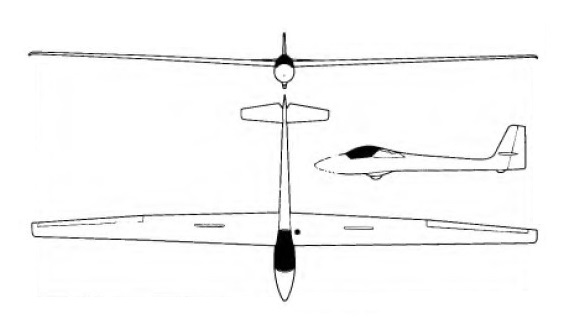
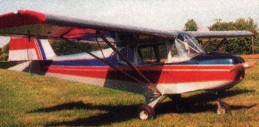
JP.15-36 Aiglon

Carlson Sparrow

Sparrow II

The Carlson Aircraft Sparrow Ultralight is a three axis aircraft conforming to FAA 103 regulations.
The Sparrow II is a two seat version of the Sparrow ultralight with optional folding wings.

Gallery

Sparrow II
Engine: Rotax 582, 66 hp.
Speed max: 130 mph.
Cruise: 110 mph.
Range: 300 sm.
Stall: 36 mph.
ROC: 1750 fpm.
Take-off dist: 75 ft.
Landing dist: 150 ft.
Fuel cap: 10 USG.
Weight empty: 510 lbs.
Gross: 1050 lbs.
Height: 7.75 ft.
Length: 18 ft.
Wing span: 31.5 ft.
Wing area: 140 sq.ft.
Seats: 2.
Landing gear: nose wheel.

Sparrow II XTC
Engine: Subaru, 82 hp.
HP range: 66-85.
Speed max: 130 mph.
Cruise: 110 mph.
Range: 400 sm.
ROC: 1100 fpm.
Take-off dist: 150 ft.
Landing dist: 250 ft.
Service ceiling: 13,000 ft.
Fuel cap: 22 USG.
Weight empty: 600 lbs.
Gross: 1250 lbs.
Height: 7.75 ft.
Length: 18 ft.
Wing span: 31.17 ft.
Wing area: 140 sq.ft.
Seats: 2.
Landing gear: nose wheel.
Optional Continental C-85 or Rotax 912 engine.

Sparrow Sport Special
Engine: Rotax 503, 52 hp.
Speed max: 120 mph.
Cruise: 85 mph.
Range: 300 sm.
Stall: 31 mph.
ROC: 1750 fpm.
Take-off dist: 85 ft.
Landing dist: 175 ft.
Service ceiling: 12,000 ft.
Fuel cap: 10 USG.
Weight empty: 360 lbs.
Gross: 710 lbs.
Height: 5.3 ft.
Length: 16.8 ft.
Wing span: 26.8 ft.
Wing area: 117 sq.ft.
Seats: 1.
Landing gear: tail wheel.

Sparrow Ultralight
Engine: Rotax 277, 28 hp.
Wing span: 30.2 ft.
Wing area: 120 sq.ft.
Length: 16.75 ft.
Height: 6.75 ft.
Weight empty: 115 kg / 254 lbs.
MTOW Weight: 229 kg / 504 lbs
Fuel cap: 5 USG.
Cruise: 50 kt / 58 mph / 93 kmh.
Range: 200 sm.
Stall: 26 mph / 23 kt / 42 kmh
VNE: 55 kt / 63 mph / 101 kmh
ROC: 750 fpm.
Take-off dist: 140 ft.
Landing dist: 195 ft.
Service ceiling: 10,000 ft.
Seats: 1.
Landing gear: nose wheel.

Carlingford Aërial Chariot / Aerhedon

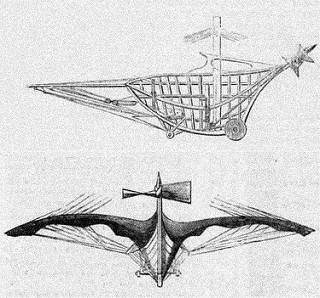
In 1856 Godwin Swift of Kilkenny, Ireland, aka Viscount Carlingford patented an aeroplane both in England and France, resembling in outline a falcon gliding downward with partially closed wings, described by the inventor as follows: “The aerial chariot in form is something in the shape of a boat, extremely light, with one wheel in front and two behind, having two wings, slightly concave, fixed to its sides”. “A tail can be raised and lowered at pleasure by means of a cord. The chariot is drawn forward by an ‘aerial screw’ in front thereof, which screws into the air at an elevation of 45°, turned by means of a winch acting on three multiplying wheels.” The machine was built and tested by swinging it from a rope. The propeller and a wheel are preserved at the Rothe House Museum of Kilkenny.

Carden-Baynes Bee

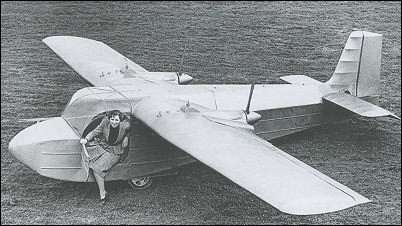
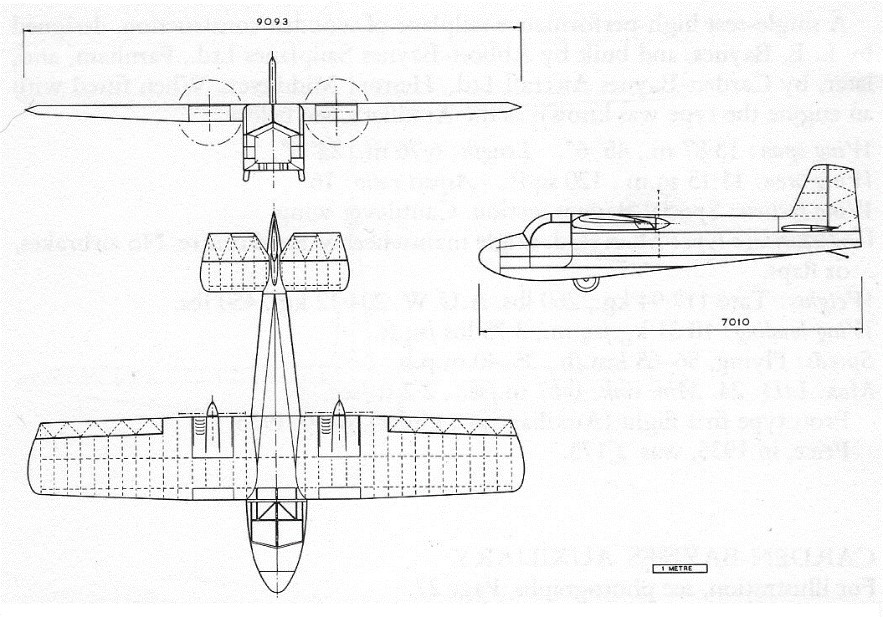
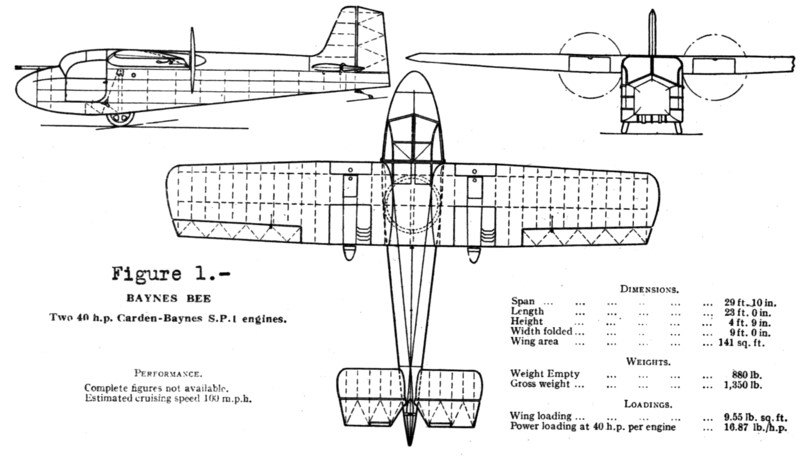
The Carden Baynes Air¬craft Company Ltd built the twin pusher, side by side two-seater, designed by L.E. Baynes, at Heston, Middlesex, UK. It was fitted with two totally-enclosed pusher Carden Ford S.P.1 modified car engines.

Of all wooden construction, the wings pivoted about the centre-line of the aircraft, the aft fuselage top decking folded down to enable the wings to pass over the top.

The undercarriage had twin mainwheels of fixed centre, mounted inside the fuselage, and a tail skid.

Only one Bee was built, c/n 1 G-AEWC. First flown on 3 April 1937, at Heston.

It was broken up and scrapped in 1939.

Engines: 2 x Carden Ford S.P.1, 10 hp
Wingspan: 9.09 m / 29 ft 10 in
Wing area: 13.10 sq.m / 141 sq.ft
Length: 7.01 m / 23 ft 0 in
Empty weight: 400 kg / 880 lb
AUW: 612.35 kg / 1350 lb
Wing loading: 46.62 kg/sq.m / 9.55 lb/sq.ft
Max speed: 177 kph / 110 mph
Cruise: 161 kph / 100 mph
Stall: 64 kph / 40 mph
ROC: 213 m/min / 700 fpm
Endurance: 3 hr

Carden-Baynes Aircraft Co Ltd

Sir John Carden was associated with British light aviation after designing the 750 cc ultralight engine for the Gloucestershire Gannet in the early 1920s. Went into partnership with L. E. Baynes in 1930 to produce a one-off single-seat powered glider.

Baynes and Carden then planned a two-seat twin-enged light aircraft and decided to set up a new company to produce this aircraft which was known as the Bee. In spite of the death of Carden in an air crash near Croyden, the new company Carden-Baynes Aircraft Ltd was formed in 1936 at Heston Airport, Middlesex. However, three successive partners, including the Duke of Grafton, also died one after the other but the Bee eventually flew at Heston on 3 April 1937 as a small two- seat high-wing monoplane with two Carden Ford S.P.1 modified car engines.

Development of three-seat B-3 halted by war.

Financial difficulties followed. An agreement was eventually reached with Major Shaw for a development of the Bee to be manufactured by Slingsby Sailplanes Ltd.

Caproni-Reggiane Re.2001 Srs Falco II / Re.2002 / Re.2005

Falco II

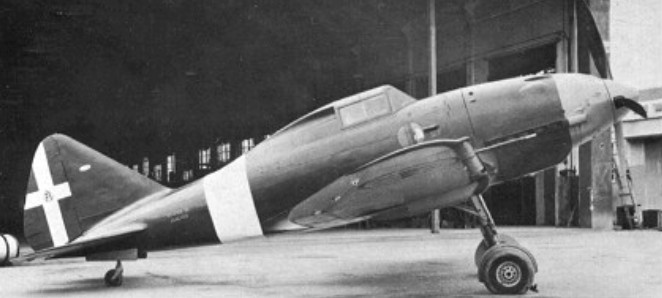
Following the Reggiane Re 2000, in 1941 there appeared the Re.2001 Falco II with a 783-kW (1,050-hp) Daimler-Benz DB 601A-1 inline, redesigned canopy and revised wing. After two prototypes had been completed in 1940 with German built DB 601A 1s, the fighter was ordered into production as the Re 2001 Falco II.

Caproni-Reggiane Re.2001 Article

Caprione-Reggiane Re.2001 Ariete I

A total of 236 were built (including prototypes and 10 pre¬production aircraft), in various sub series, major versions being the Serie I (100 built), with two 12.7 mm (0.5in) Breda SAFAT machine guns over the engine; the Re2001CN (Caccia Notturna: night fighter) Serie II and III with an additional 7.7 mm (0.303 in) gun in each wing or two German 20 mm (0.79 in) MG 151 cannon in underwing fairings; and the Re 2001CN Serie IV, which could carry an under fuselage 640 kg (1410 lb) bomb or a drop tank.

Various experimental models of the Re2001 included a torpedo carrying fighter conversion (Re 2001G); an antitank conversion (Re 2001M; a prototype conversion with flush mounted leading edge wing radiators (Re 2001bis); two Serie Is converted for catapult launching trials; and a testbed for the Isotta Fraschini Delta RC 16148 engine.

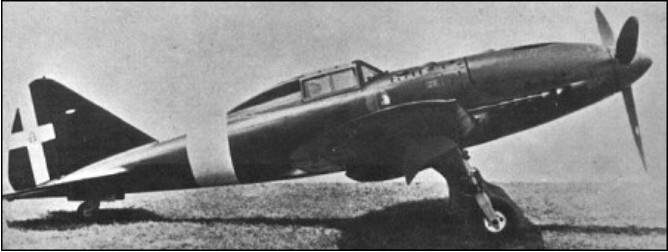
The one prototype with the 840 hp Isotta-Fraechini Delta IV engine was test flown at Guidonia and the maximum speed attained was 320 mph at 14,760 ft and 252 mph at SL. During one test flight the engine overheated at 28,250 ft and the test pilot was forced to leave the aircraft when it burst into flames.

Re.2001 with Isotta-Fraechini Delta IV engine

Production Serie I Re 2001s made their operational debut in attacks on Malta in the early summer of 1942, with subsequent production models following them into service later that year. Thirty nine Serie I aircraft were adapted as Re 2001CBs, able to carry a 640 kg (1410 lb) bomb or torpedo, and a further 12 as land based carrier trainers, fit¬ted with arrester gear. The most widely used version of all was the Re 2001CN (50 Serie II and 74 Serie III/IV), which from 1943 served with five Gruppi of the Regia Aeronautica as a defensive night fighter in central and northern Italy. But, by the armistice only 21 Falco IIs remained serviceable, of which eight were used subsequently by the Italian co belligerent air force.
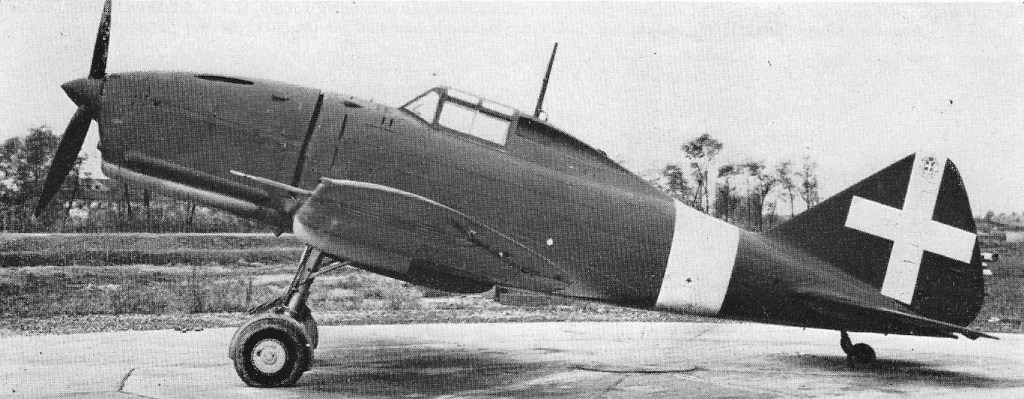
The type was used in a large development programme with other engines, and the total of 237 aircraft included 224 production aircraft in two fighter, one fighter-bomber and one night-fighter series. There followed 227 Re.2002 Ariete (ram) fighter-bombers with the 880-kW (1,180-hp) Piaggio P.XIX RC 45 radial, and finally 37 Re.2005 Sagittario (Archer) fighters.

Caprione-Reggiane Re.2002 Ariete II

The Re.2002 Ariete (Ram) fighter-bombers with the Regia Aeronautica, these being powered by the 876kW Piaggio P.XIX RC 45 radial engine mounted in a slightly lengthened and strengthened fuselage. The type first saw operational service in 1942, suffering heavy losses while contesting the Allied landings on Sicily.

Caprione-Reggiane Re.2002 Article

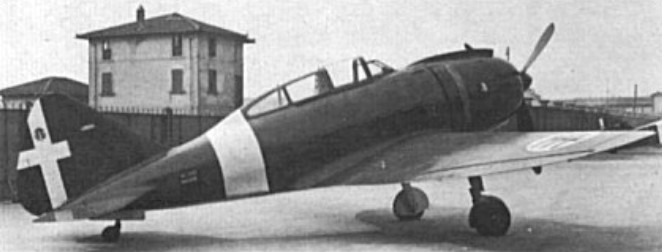
Re.2005 Sagittario

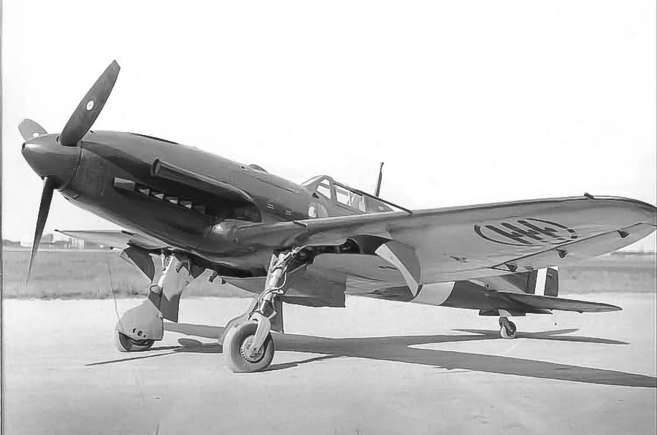
The Re.2005 Sagittario (Archer) had the same general configuration as its predecessors. However, its design incorporated considerable structural redesign, and refined landing gear, and the type reverted to the inline engine. First flown in September 1942 with a Daimler-Benz DB 605A-1, the Re.2005 led to a production model, of which deliveries began in 1943, with a licence-built version of this engine, the Fiat RA.1050 RC 58 Tifone. Only 48 had been delivered before finalisation of the armistice with the Allies, these aircraft fighting in the defence of Naples, Rome and Sicily, the survivors battling above Berlin.

Replica:
Tessore Regianne 2002

Gallery

Re.2001 Falco II Prototype
783-kW (1,050-hp) Daimler-Benz DB 601A-1 inline
two built

Re.2001
Engine: Isotta-Fraechini Delta IV, 840 hp
Max speed: 320 mph at 14,760 ft
Max speed: 252 mph at SL

Re.2001 Falco II
Engine 1 x Daimler-Benz DB 601A-1 / Alfa Romeo RA. 1000 RC.41-1a Monsonie, 783-kW (1,050-hp).
Crew: 1

Re 2001 Falco II Serie III
Span: 11 m (36ft 1.75in).
Length: 8.36 m (27 ft 5.25in).
Gross weight. 3280 kg (7230 lb).
Max speed: 542 kph (337 mph).

Re.2002 Ariete
Engine 1 x Piaggio P.XIX RC 45 radial, 880-kW (1,180-hp)
Crew: 1
227 built

Re.2005 Sagittario
Single-seat fighter and fighter-bomber.
Engine: l x Fiat RA.1050 RC 58 Tifone, 1100kW (1,475hp).
Span: 11m (36ft 1 in).
Wing area : 219.586 sq.ft / 20.4 sq.m
Length: 8.73m (28 ft 7.75 in).
Height: 10.335 ft / 3.15 m
Weight empty : 5733.0 lb / 2600.0 kg
Normal TO weight: 3610 kg (7,960 lb).
Max take off weight : 7849.8 lb / 3560.0 kg
Max speed: 421 mph at 6,560 ft.
Service ceiling: 39993 ft / 12190 m
Wing load: 35.88 lb/sq.ft / 175.0 kg/sq.m
Operational range: 777 miles.
Armament: 3 x 20-mm cannon and 2 x 12.7-mm (0.5-in) mg, 1000 kg (2,205 Ib) bombs
Crew: 1
37 built

Reggiane Re.2005 Sagittario