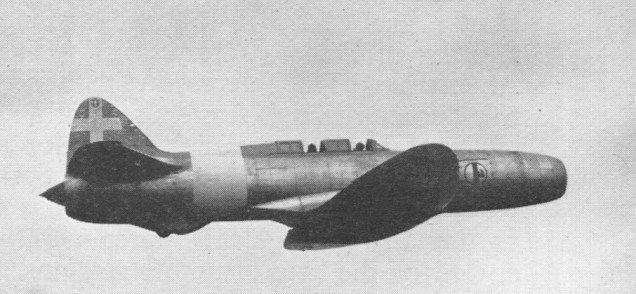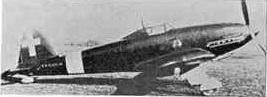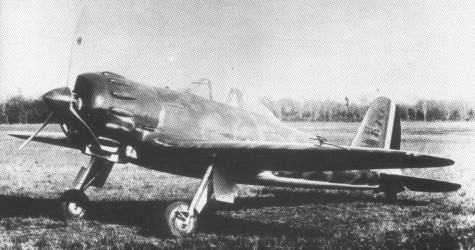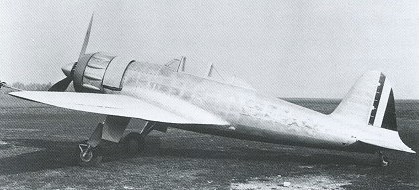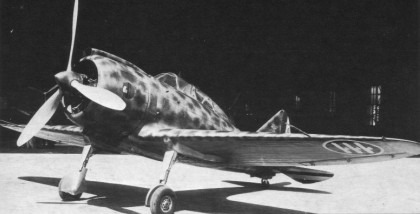
Designed by Roberto Longhi and Antonio Alessio in 1938, The Re 2000 Falco I (Falcon) was buily by Reggiane SA, a subsidiary of the Caproni group. The Re.2000 was the first aircraft designed by Reggiane that employed aluminum stressed skin rather than wooden or mixed wood and metal, with semi elliptical wings, with five spars and integral fuel tanks, and a tubby fuselage, the design was powered a 986 hp Piaggio P.XI RC 40 two row 14 cylinder radial in the Serie I production model. Reggiane Re.2000 had no fuselage tanks, but with the entire wing volume devoted to fuel, it had up to 460 kg (640 lt) gasoline, with a 900 1,100 km endurance. The armament was two 12.7 mm Breda’s (300 rounds each), plus the provision for bomblet-dispensers (spezzoniera).
Caproni-Reggiane Re.2000 Falco I Article
The Re.2000 prototype’s first flight was on 24 May 1939 at Reggio Emilia, flown by Mario De Bernardi,. The Re.2000, with 260 kg fuel (the maximum was 460 kg/640 lt) was quite light: 2,059 kg empty, 2,529 kg loaded. It reached 518 km/h at 5,250 m and 506 km/h/6,000 m, climbed to 6,000 m in 6,5 min, and had 11,500 m ceiling. During test flights the aircraft gave an excellent performance, and on several occasions, it performed better than other fighters then in production. In mock dogfights, it could successfully fight not only the slower Fiat CR.42 biplane, but even the more modern Macchi C.200 and the German Bf 109E.
In service, the Re.2000’s engine, a 986 hp (735 kW) Piaggio P.XI RC 40 radial, was not reliable. Moreover, it was not as rugged as the Macchi and its fuel tanks were vulnerable (they were not self-sealing). Consequently, the Regia Aeronautica rejected it.
The Falco was placed in production for export as the Re.2000 Serie 1 with minor modifications. Deliveries totalled 157 aircraft including 70 for Hungary and 60 for Sweden, beginning in in 1940.
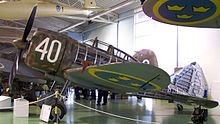
The Swedish purchases of various types of Italian warplanes in 1939–41 were an emergency measure resulting from the outbreak of war, as no other nations were willing to supply aircraft to this small neutral country whose domestic production did not become sufficient until 1943. The Swedish Air Force purchased 60 Re.2000 Serie Is, which received the Swedish designation J 20 and were delivered during 1941-43.
All of the J 20s were stationed at the F10 wing, Bulltofta airbase, Malmö, in the southern tip of Sweden in 1941-45. They were mainly used to intercept Axis and Allied bombers that violated Swedish airspace. One J 20 was lost in combat, shot down while intercepting a Luftwaffe Dornier Do 24 near Sölvesborg on 3 April 1945.
Its mechanical reliability did not meet Swedish Air Force requirements, with the aircraft having to spend a lot of time in maintenance. At the end of the war, the 37 J 20s that remained in service were so badly worn out that they were decommissioned in July 1945 and subsequently scrapped, while only one was kept for display purposes.
In December 1939 a British commission, led by Lord Hardwick and Air Ministry representatives, came to Italy to purchase (along with marine engines, armaments and light reconnaissance bombers) 300 Re 2000s. The Director of Aircraft Contracts confirmed the British order in January 1940. The German government approved the sale in March of the same year, but withdrew its approval the following month. The Italian and British governments then decided to complete the contract through the Italian Caproni’s Portuguese subsidiary, but the British order was cancelled when Italy entered World War II on 10 June 1940.
The Italian navy later accepted 10 Falco 1 Serie II aircraft which, strengthened for catapult launching and fitted with arrester hooks, underwent shipboard trials during 1942.
The Re.2000GA (Grande Autonomia) version, added extra 340 liters fuel tanks. This version was to have been used to reach Eastern Africa, but it wasn’t ready before the Italian defeat. Re.2000GAs were heavier and significantly slower than the standard production Re.2000s. At an empty weight was 2,190 kg compared to the Re.2000’s 2,080 kg, maximum speed was 520 km/h at 5,300 m. Armament was two 12.7 mm SAFAT with 600 rounds, and provisions for a Nardi dispenser with 88 2 kg bomblets (a typical ‘special armament’ for Re.2000s). The Re.2000GA was never really reliable (even for Re.2000 standards), especially its engine.
The Re.2000bis was equipped with the P XI bis engine built with only nine examples delivered when 377a Sq. was created, in August 1941.
In addition, 12 Serie III Falcos, with a modified cockpit hood, extra fuel, and internal improvements, were assigned to the Italian air force and deployed for overseas escort duties or as fighter bombers (with an under fuselage 200 kg [440 lb] bomb) from naval bases in Sicily. The Re.2000 Serie 3 long-range fighter had additional internal fuel and provision for an auxiliary tank or 2000-kg (4,405-lb) bomb load (12 Serie 1 conversions).
Only five Serie Is served in the Regia Aeronautica, including the prototype. They were organized into the Sezione Sperimentale Reggiane inside the 74a Squadriglia in Sicily. Later it was renamed 377a Squadriglia Autonoma Caccia Terrestre, and received nine further Serie III Re.2000bis; 12 of the 26 Reggianes were later converted to GA standard.
The few Re.2000 and 2000GA were used over Mediterranean Sea as escort and attack aircraft, sometimes with Macchi 200/202s and C.R.20 two-engine fighters. 377a was based in Sicily, and fought in Malta and Pantelleria, mainly in an escort role and protecting Axis ships almost until Tunisia (with a range up to 300–350 km), well beyond the other RA single seat-fighters; sometimes it was used to attack Malta with bomblets (spezzoni) and machine guns, typically at dawn. It reported a single ‘kill’ against a Bristol Blenheim. Overall, their service was not remarkable: there was at least one sudden fatal flat spin, while another Re.2000 had fatal engine damage (a piston was driven through the cylinder) and crash-landed, overturning, catching fire and almost killing its pilot (rescued by the ground crew). Although the Reggiane had a long range, it was disliked and even feared by ground crew and pilots, for its difficult maintenance and unpredictable engine reliability and handling. The last Re.2000 was sent back to the factory in September 1942.
The final fate of Re.2000 in Regia Aeronautica was to serve with 1° Nucleo Addestramento Intercettori (N.A.I.), based at Treviso, and serving for experimental purposes until the Armistice. The last two serviceable aircraft were demolished by the Germans, with another one destroyed after being captured at Furbara.
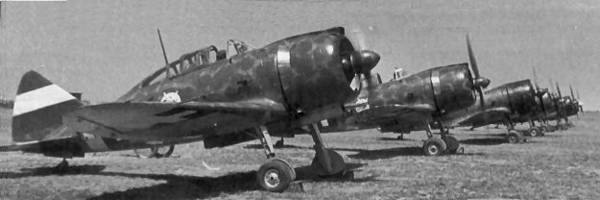
The Regia Marina (Italian Navy) experimented with a carrier version (Serie II) which was successfully launched by catapult. Lacking a carrier, Italy used a similar system to the British CAM ships equipped with Hurricanes. The first proposal was made in late December 1940, although the program officially began with an order issued in April 1943. The first modified Re.2000 Cat. (taken from the Swedish orders) flew on 27 June 1941, the last on 18 January 1942 (MM.8282-8288), but crashed on 10 September. There was another navalized Re.2000, the MM.471. It flew initially with a lower powered A.74 RC.38 engine, but it was lost too, during the travel from Reggio Emilia to Taranto (12 May 1941). The first launch was performed on 9 May 1942 with test pilot Giulio Reiner. The work to make suitable the Re.2000 Cat., nicknamed Ochetta (little goose) took considerable time and only at the beginning of 1943 were they used aboard the Littorio class, but not more than one for every ship (although capable of holding three aircraft). Initially the Re.2000 Cat. aircraft were issued to Littorio and Vittorio Veneto, while Roma followed only in the summer, after testing had taken place aboard the RN Miraglia.
The Re.2000 Cat. was slower than a standard Re.2000; instead of 515–530 kilometres per hour (320–329 mph; 278–286 kn), the maximum speed was only 505–520 kilometres per hour (314–323 mph; 273–281 kn) at 5,500 metres (18,040 ft) km/h at 5,500 m, and 390 kilometres per hour (240 mph; 210 kn) at sea level compared with 541 kilometres per hour (336 mph; 292 kn) for the Re.2000. The climb to 6,000 m was 7,75 min (vs 6,5-7 min), apparently there was not much difference in ceiling 10,000–11,100 m and endurance, range was 450 km, endurance 1,000 km (at 460 km/h), up to km 1,290 (at m 6,000, full loaded, km/h 430). Weights were 2,120–2,870 or, probably with the complete kit, 2,200–2,970 kg; the engine was the P.XIbis, that had 1,000 hp (750 kW) both at take-off and at 4,000 meters. Differing from the Serie I, both Serie II and III variants were equipped with radios. There was the usual Italian armament (two 0.50 caliber Breda machine-guns with 300 rounds each), and some provisions for external loads (tanks or bombs), apparently never utilized.
The Re.2000 were assigned to Squadriglia di Riserva Aerea delle FF.NN.BB. (air reserve squadron for naval battleships), led by Captain Donato Tondi. This was initially based at Grottaglie, then at Capodichino and finally at La Spezia, as air defence for naval bases. The squadron disbanded on April 1943 and was replaced by the 1° Gr. Riserva Aerea delle FF.NN.BB, led by now Maj. Tondi, with three flights. It had all the eight Re.2000s and several old fighters. Many of them were aboard the battleships: two for Vittorio Veneto and Roma, one for Littorio (summer 1943).
Six Re.2000 Cat.s were still available at the time of the Armistice and four were in service aboard the battleships Italia (Littorio before the fall of Mussolini), Roma and Vittorio Veneto (the normal load was only one, the battleship had up to three aircraft, but smaller than the Re.2000). The two left at La Spezia were demolished after September 1943 (they served with 1a Squadriglia). During the Roma ’s sinking (9 September 1943) only one was launched, as they were a single mission aircraft (forced to reach a land airfield); therefore, Do 217s attacked facing only anti-aircraft guns. The fate of the four Re.2000s was as follows: the one on Roma was lost with the battleship; the one of Italia was damaged and jettisoned from the ship, after the Fritz-X impact. One Re.2000 was launched from Vittorio Veneto to catch the intruders, but failed and finally crashed while landing near Ajaccio airfield. The last one survived and it is still existent, the only Re.2000 in Italy (another is in Sweden). This is the MM.8287.
The Serie II and III aircraft were converted from Serie Is and were powered by 1025 hp P.XIbis RC 40 engines. All three versions carried a fixed armament of two 12.7 mm (0.54in) Breda-SAFAT machine guns in the fuselage decking over the engine. These aircraft were known by the Hungarian air force as the Heja 1 (Hawk).
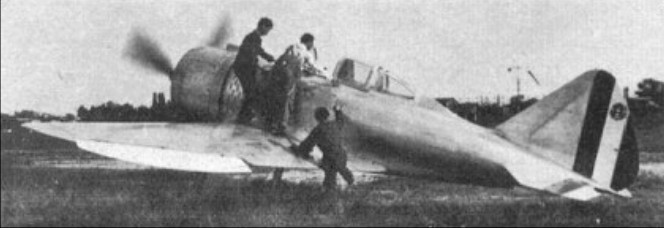
German leaders were reluctant to supply the Royal Hungarian Air Force (Magyar Királyi Honvéd Légierő), MKHL, which was seen to be focused on home defence and the possibility of conflict with Romania. Adolf Hitler expressed this in early 1942 when Hungary requested German-built fighters. “They would not use the single-seaters against the enemy but just for pleasure flights!… What the Hungarians have achieved in the aviation field to date is more than paltry. If I am going to give some aircraft, then rather to the Croats, who have proved they have an offensive spirit. To date, we have experienced only fiascos with the Hungarians.”
The MKHL consequently became a significant purchaser of Italian aircraft and was the main operator of the Re.2000. Hungary bought 70 Reggiane Re.2000 Falco Is and then also acquired the licence-production rights for this model to produce a total of 200 aircraft, known as MÁVAG Héja (“Hawk”) II built between 1940 and 1942.
The first aircraft were delivered Debrecen airport unassembled July 1940. In mid-April 1940, representatives of the Hungarian Ministry of Defense, visited the plant Reggiane, saw only a single fighter finished. (delivered 21 May 1940 and designated401 V. (V – Vadasz; Fighter)). The remaining aircraft were not even started because of production problems, including a lack of high-quality aluminum sheet “Alkled”. By December 1940 only seven had been delivered. Thirteen has been prepared for shipment, and the remaining 9 were expected. The total supply of 48 Re.2000 was completed by February 1941, and production of the remaining aircraft and spare parts continued until the end of the year.
August 5, 1941 the Hungarian Ministry of Defence to establish the Independent Fighter Group (Independent Fighter Group – IFG), which consisted of a half squadrons armed with seven new fighters. Formed in Szolnok (Szolnok), she was inducted into the “mobile body” (“Fast Corp”) of the Hungarian army. It included 12 Hejja squadron 1/1 Dongo (“Wasp”) formed in the same Szolnok. ‘Wasps’ commanded by Colonel Kalman Kshukash. The aircraft departed from Hungary July 1, 1942, and reached the front three days later contributing to the German offensive Fall Blau. The flight lost one aircraft which crashed while landing at stake. Another was slightly damaged in Kursk. The case was subject to the German Army Group “South”. The first seven Re.2000 were sent to the front on an experimental basis on 7 August 1941. Under the command of Captain Genesha Laszlo (Laszlo Gyenes) they arrived at Sutiski airfield, 20 km south of Vinnitsa. Squadron III had a proper name – “Ludas Matyi” (Lyudash Mati – the hero of Hungarian folk tales.) Flying alongside the Fiat CR.32s of 1/3 Fighter Company, the Reggiane pilots claimed eight kills, for one loss, during three months of combat, against Soviet Air Force.
Hejja flew escort bombers and assault jobs from August 11 until October 21, 1941, but due to the practical absence of the enemy had only a few dogfights. During this time they lost only one aircraft.
In the summer of 1942, Hungarian Air Force contributed with its 1st Repülőcsoport (aviation detachment) to the German offensive Fall Blau. 1/1 Fighter Group (1./I Vadász Osztály) equipped with 13 Re.2000s or Héjas, reached its first front base near Kursk on 2 July. By 3 August, 2/1 FS joined the other Hungarian fighter unit, that had moved to Ilvoskoje airfield. The Hungarians arrived to the location, but sent one plane, “the bride” to exclude mistaken identity with I-16 by the neighbouring Germans. This was ineffective and Hungarian planes often fired by their allies. Two 1/1 Hejja and were shot down, but the crew managed to jump with parachutes. The task of 2/1 was to escort short-range reconnaissance aircraft, while 1/1 would support bombing missions. Combat performance against the Soviet Air Force was satisfactory. On 4 August the Hungarians claimed their first kills, when Ens Vajda shot down two enemy aircraft. Caught in the dense anti-aircraft fire one aircraft (tail number V-420 pilot Gyula) was lost. The first Hungarian ace of the war, 2/Lt Imre Pànczél, claimed his first air victories while flying the Re.2000, three of them in one sortie, in 1942. However, the Re.2000’s flight characteristics were markedly different to the Fiat CR.32, from which Hungarian pilots frequently converted. The Re.2000 was much more prone to handling difficulties, especially stalls and spins, as well as reliability issues. All the 24 Re.2000s had suffered accidents (minor and major) within a month of combat deployment. Piaggio P.XI engine proved to be a mechanical nightmare for the mechanics. Landing and takeoff accidents were common on the rudimentary Russian airfields and due to the Re.2000 not having a rugged landing gear, compared to that of the CR.32. After a steel plate was added behind the cockpit to protect pilots, the shift in the aircraft’s center of gravity led to more frequent accidents.
In the summer of 1942, Hungarian Air Force. 1/1 Fighter Group (1./I Vadász Osztály) equipped with 13 Re.2000s or Héjas, reached its first front base near Kursk on 2 July. The day after the arrival the Hejja began to make trial flights and on July 5, 1942 1/1 squadron was declared combat-ready. The Germans initially entrusted the Hungarians for intelligence, though later added bomber escort. The fighters were transferred on July 13 to Stary Oskol, and four days later, were involved in a combat operation to provide air cover for an armoured regiment operating in the area. Over the next few days the Hungarians escorted aircraft spotters.
On July 30, 1942 at Kolozsvar came second squadron – 2/1 “Keresztes Pok” (Spider Araneus) consisting of eleven and two Re.2000 Vi-131, commanded by Captain Kerestesha Bela (Bela Keresztes). 2/1 and 1/1 squadron was deployed to Ilovskoe 3 and 5 August, respectively. 1/1 was assigned to escort bombers, while 2/1 – on cover of spotters. 1/1 squadrons had difficulties because of problems in the maintenance of aircraft and frequent equipment failures. The aircraft of lieutenant Peterffi Andorra was lost on August 7 in a dogfight over Korotoyak. On August 8, the division had only four combat-ready Hejja. During the last month of summer, Hungarian pilots declared victory over the five Soviet aircraft. They also had two and a “probable” victory in September.
In a much publicized mishap, 1/Lt István Horthy (the son of the Hungarian regent Miklós Horthy), serving as a fighter pilot with the Hungarian Second Army died flying a Re.2000 V-421 with 1/3 Fighter Squadron on 20 (on 18, according to other authors) August 1942, on his 25th operational sortie. After a pilot flying above asked Horthy to increase height, he pulled up rapidly, stalled and crashed. Nevertheless, the determined Hungarian pilots kept on flying combat missions and scoring a number of kills against the Soviet fighter, if they managed to force their Russian opponents into a dogfight, thanks to the maneuverability of the Italian built plane. The Hungarians Re.2000s had their most successful day on 9 August 1942. That day, near the village of Davidovka, 16 Ilyushin Il-2s and a similar number of LaGG-3S were intercepted by four Reggianes. The Hungarians downed four LaGGs, suffering the loss of the Re.2000 of Lt Takács, who crash-landed behind his own lines, wounded.
In October 1942, the 1/1 squadron was withdrawn for conversion and retraining on the Bf. 109F and later became part of the group III 52 fighter squadron of the Luftwaffe. At the same time they continued to fly at 2/1 with Hejja Ilovskogo. However, in early November of the squadron 2/1 four pilots were selected for transfer to Bf. 109. In December the squadron ubyla Hungary.
On October 20 Reggiane five went to home, however, over the Carpathian Mountains, they were in a thick fog. As a result, two cars crashed into a mountain, and one was badly damaged during a forced landing.
December 25, 1942 came 5 th Fighter Division in the squadron 5/2 (there were 13 Re.2000 and Ag.96). But after two weeks, only six of these fighters considered suitable to operate as three Hejja required new engines, three others had significant, though not fatal damage, and one embarked “on its belly”, in serious need of repair.
On January 12, 1943, Soviet troops launched an offensive in the area of the 2nd Hungarian Army northwest of Stalingrad. Re.2000, together with other aircraft tried in vain to stop the offensive. Two Re.2000 were sent to escort German bombers in the afternoon. The group left on purpose under the guise of cloud, but soon were linked fighters fight, but were able to avoid losses.
The Hungarian Reggianes flew their last sorties on the Soviet front on 14 and 15 January 1943, when they took off for uneventful patrols and reconnaissance missions. Between 16 and 19 January, with Red Army rapidly approaching Ilovskoje airfield, and with no time to heat the frozen Piaggio engine oil, mechanics blow up the last unserviceable Hejas.
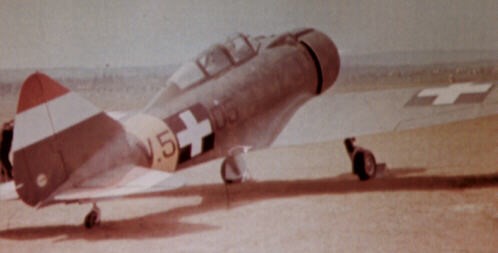
The surviving Reggianes were kept in Hungary for home defence. Production of licence-built Hejas continued: 98 were completed in 1943 and 72 in 1944 although the variant was regarded as no longer suitable for combat against the latest Soviet fighters. Hungary requested an additional 50–100 Re.2000 airframes made in Italy, as suitable engines and armament could be locally manufactured and other countries expressed interest, including Finland (100 examples), Portugal (50), Spain, Switzerland and Yugoslavia. However, no airframes were available.
Variants:
Re.2000
Initial prototype, one built.
Re.2000 Serie I / MÁVAG Héja I
Production model, 157 built. Serie I had modified windshield and slight equipment changes.
Re.2000 Serie II
Ship-borne version, 10 built. Serie II had a 1,025 hp Piaggio P.XIbis engine and arrester gear.
Re.2000 (GA) Serie III
Long-range fighter, 12 built. Serie III had redesigned cockpit, increased fuel capacity and option of a 170 l auxiliary fuel tank or a dispenser of 22 2 kg bomblets.
RE 2000 “Catapultabile”
Re 2000 aircraft modified for catapult launch from Regia Marina ships. On the day of the armistice, 8 September 1943, 6 Re 2000 “Catapultabile ” were in service, with two on the battleship Roma and one each on the Vittorio Veneto and Italia (formerly the Littorio).
Variation:
MÁVAG Héja II
Specifications:
Re 2000 Falco I (Falcon) / J 20 / Heja 1 (Hawk)
Engine: Piaggio P.XI RC 40, 986 hp (736 kW) (1000 CV) at 4,000 m (13,125 ft)
Propellers: Piaggion-D’Ascanio P.1001 three-bladed constant speed propeller
Propeller diameter: 3.10 m (10 ft 2 in)
Wing span: 11m (36 ft 1 in)
Wing area: 20.40 m² (219.6 sq ft)
Length: 7.99m (26 ft 2.5 in)
Height: 3.20 m (10 ft 5⅞ in)
Empty weight: 2,090 kg (4,585 lb)
Normal T/O weight: 2595 kg (5,722 lb)
Gross weight: 2850 kg (6285 lb)
Maximum speed: 530 km/h (268 knots, 329 mph) at 5,300 m (17,400 ft)
Cruise speed: 440 km/h (237 knots, 273 mph)
Range: 545 km (296 nmi, 340 mi)
Climb to 4,000 m (13,125 ft): 4 min
Service ceiling: 11,200 m (36,745 ft)
Endurance: 1.25 hours
Armament: 2 x 12.7 mm (0.54in) Breda-SAFAT machine gun
Crew: 1
Re 2000 Falco 1 Serie II
Engine: 1025 hp P.XIbis RC 40
Armament: 2 x 12.7 mm (0.54in) Breda-SAFAT machine gun
Crew: 1
Re.2000 Serie 3
long-range fighter
Engine: 1025 hp P.XIbis RC 40
Hard point load: 2000-kg (4,405-lb)
Armament: 2 x 12.7 mm (0.54in) Breda-SAFAT machine gun
Hard point load: 200 kg / 440 lb
Crew: 1
MAVAG Heja II
Engine: 986 hp WMK 14
Crew: 1