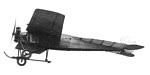
The 1910 Chassagny monoplane was designed by Chassagny and built by Labaudie et Puthet in France.
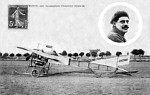
Span: 26’3″
The 1910 Chassagny monoplane was designed by Chassagny and built by Labaudie et Puthet in France.
Span: 26’3″
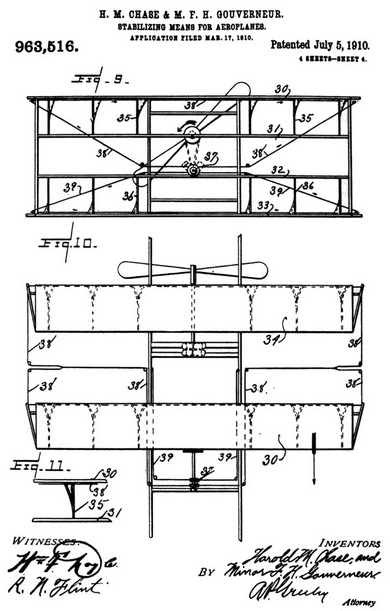
In July 1910 Harold M. Chase and Minor F.H. Gouverneur received a patent for a mechanism to stabilise and control aeroplanes. Their invention was a manually operated lever described as capable of being swung in any direction to transmit motion to other elements of the plane, apparently including on the wings. Three weeks later they won a second patent for rear wing panels (ailerons) that were controllable in flight by a cable or flexible cord, a device different enough from the 1906 Wright wing-warping patent.
On November 14, 1910, M. F. H. Gouverneur, vice-president of the Tide Water Power Company, and H. M. Chase, manager of the American Chemical and Textile Coloring Company, made the only public test flight of the airplane they built on Shell Island, sometimes called Moore’s Beach. More than 5,000 visitors crowded Wrightsville Beach four months earlier, when, on July 4, the pair had planned to attempt the first flight of their self-designed aircraft. Newspaper reports described the November flight, piloted by Mr. Chase, as having attained an altitude of about five feet, sustained for some distance, just long enough to demonstrate the plane’s ability to fly. The event carries the distinction of being the first airplane constructed in North Carolina and owned and flown by North Carolinians.
Designed and built by H. M. Chase and M. F. H. Gouverneur, Wilmington NC, USA, the 1911 Chase-Gouverneur “Wrightsville Beach” multiplane was similar to a Wright aircraft but built from aluminum.
It flew short hops at about five feet altitude on 10 November 1911, at Wrightsville Beach, Chase flew in a series of unannounced hops along the Shell Island beach at low tide.
In 1911 Gouverneur won a lawsuit for $380, with interest, against Boston’s Harriman Motor Works, apparently because its motor was unreliable.
In 1912 Gouverneur informed London’s Jane’s All the World’s Aircraft that he was now using the Gouverneur IV, a 25ft long monoplane with a 31 ft span, with pilot, it weighed 840 lb. According to Chase, his former patner hired an experienced pilot to fly one of his planes, apparently the Gouverneur IV, but the aviator crashed and “Gouverneur went no further”.
Engine: Harriman, 40hp
Wingspan: 16’0″
Length: 30’0″
Weight gross: 1200 lb
Seats: 1
Gouverneur IV
Wingspan: 31 ft
Length: 25ft long
Loaded weight: 840 lb

The Tourbillion (Whirlwind) is a single seat, amateur-built, light low-wing plane that comes from France.

Designed by Yves Chasle in 1964, the wooden prototype F-PMXQ first flew on 9 October 1965.
It is available in several models that differ only in their engine size. Most common is the 65-hp Continental. Airframe construction includes wood and fabric wings and a plywood-covered fuselage structure.
Plans no longer available.
Variants:
YC-12
prototype with Continental A65 engine
YC-121
similar to prototype with enlarged tailfin for limited certification
YC-122
similar to YC-121 but with Continental C90 engine
YC-123
similar to YC-121 but with Potez 4E-20b engine
YC-121
Powerplant: 1 × Continental A65, 48 kW (65 hp)
Propeller: 2-bladed EVRA fixed pitch wooden propeller, 1.75 m (5 ft 9 in) diameter
Wingspan: 6.7 m (22 ft 0 in)
Aspect ratio: 6
Airfoil: NACA Srs.7
Length: 5.95 m (19 ft 6 in)
Empty weight: 285 kg (628 lb)
Max takeoff weight: 432 kg (952 lb)
Fuel capacity: 60.5 l (16.0 US gal; 13.3 imp gal)
Maximum speed: 235 km/h (146 mph, 127 kn) at sea level
Cruise speed: 205 km/h (127 mph, 111 kn) at 70% power
Stall speed: 75 km/h (47 mph, 40 kn)
Range: 800 km (500 mi, 430 nmi)
Rate of climb: 4.6 m/s (910 ft/min)
Wing loading: 57.5 kg/sq.m (11.8 lb/sq ft)
Power/mass: 0.112 kW/kg (0.068 hp/lb
Takeoff run 855 ft
Landing roll 900 ft
Range 500 miles
Crew: 1
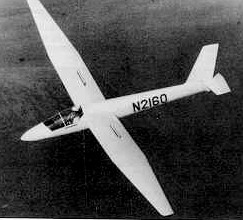
Designed by Robert Chase, the C100-S made its first flight in 1968. It uses a 3-piece wing with an airfoil 15% thick and no aerodynamic twist. Wood and Styrofoam are used in the construction of the wing (as well as the tail), but the entire surface and the stress- bearing material is fiberglass. The fuselage is of all-metal stress-skin construction, with a skid and fixed wheel.
Wing Span: 16.76 m / 55 ft
Wing Area: 12.82sq.m / 138sq.ft
Empty Weight: 240kg / 530lb
Payload: 91kg / 200lb
Gross Weight: 331kg / 730lb
Wing Load: 25.82kg/sq.m / 5.3 lb/sq.ft
L/DMax: 38 @ 88 kph/ 46 kt/ 55 mph
Aspect ratio: 22
MinSink: 0.61 m/s / 2.0 fps / 1.18 kt
Airfoil: NACA 4(3)-165
No. of Seats: 1
No. Built: 1
Structure: aluminum, fiberglass, wood
A powered version of the gliders, the 30-troop YC- 122 Avitruc was first flown on November 18,1948. Twelve built for USAF trials but no further production
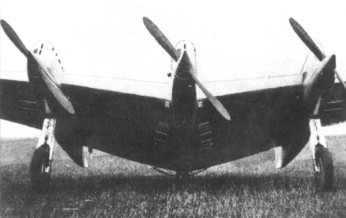
In April 1929, French engineer Jean Charpentier deposited a patent for a twin-engine craft he had named ” plane-aile”. This was followed by a second patent in June 1931, for a twin-engine of transport. These machines remained projects, unlike the following C-1, whose prototype was construct. Having obtained an order from the French government, Charpentier began building the C-1 at the Caudron establishments, in Issy-Les-Moulineaux. The craft was powered by three 6-cylinders Hispano-Suiza line of 100 hp, each with a fixed two-bladed propeller. The C-1 was two-seater, each pilot in a separated open cockpit. The C-1 was damaged during taxy tests at Stamps-Mondésir, in October 1933. Repaired, it took off for the first time in January 1935 with the hands of the Poivre staff sergeant, but crashed almost at once. Extensively damaged, it was not rebuilt.
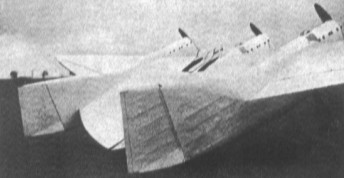
Wing span: 15.00 m
Length: 5.30 m
Wing area: 24.00 sq.m
Max. gross weight: 2000 kg

Built by Charles A Zornes in 1909, a single place open cockpit biplane described in Jane’s as having Voisin-type bowed wings with ailerons; horizontal tail forward, and a vertical one aft.
Engine: 25-35hp chain-driving two pusher props
Wingspan: 37’0″
Length: 41’0″
Seats: 1
Lind WA.
USA
Circa 1909 biplane builder
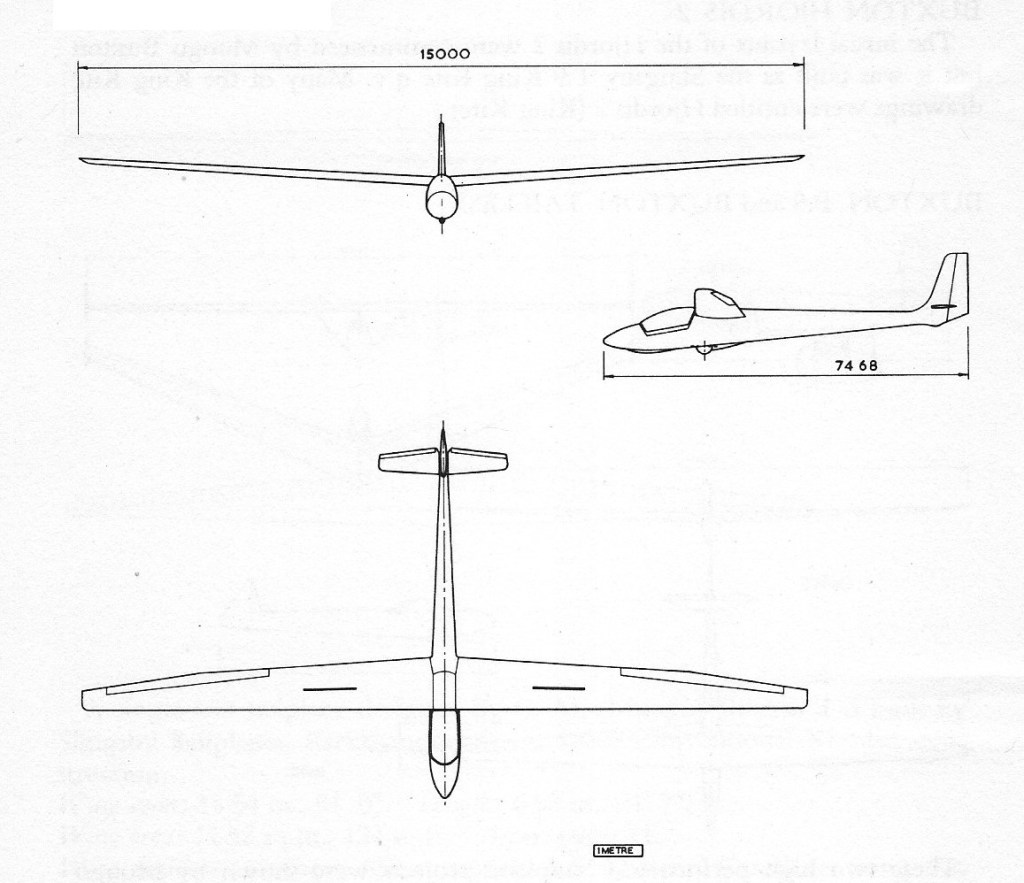
The Chard Osprey standard class glider was designed and built of conventional wooden construction by Keith Chard at Lasham, UK, using a Slingsby T.51 Dart 15 fuselage and tail, c/n 1457. The wings were designed and built by Chard. No flaps or airbrakes were fitted.
The wing sections were Chard KC-24 at root, Chard KC-29 at mid-point, and KC-30 at tip.
It was first flown on 15 May 1966.
Wingspan: 15.0 m / 49 ft 2.5 in
Length: 7.47 m / 25 ft 5 in
Wing area: 12.35 sq.m / 133 sq.ft
Aspect ratio: 18.3
Empty weight: 249.02 kg / 549 lb
AUW: 358.34 kg / 790 lb
Wing loading: 29.04 kg/sq.m / 5.95 lb/sq.ft
Max L/D: 34
Min sink: 0.64 m/sec at 85 kph / 2.1 ft/sec at 53 mph

The 1910 Chapiro biplane No. 2 was designed and built by Chapiro in France.

