Warner Aerocraft Inc made available plans and kits to build single-seat Revolution 1 and two-seat Revolution II low-wing monoplanes, based on former Country Air Space-Walker.
Aircraft
Coughlin SE-5A replica
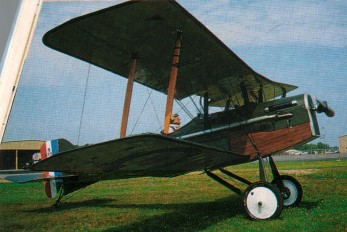
Dick Coughlin, a retired dentist, began building a full size SE-5A replica in the arly 1990s. Coughlin began with the original plans that he then revised for homebuilding.
Construction is of steel tube, wood and fabric. Power is supplied by a Dave Blanton conveted Ford V-6.
Cottle Ultra One

The aircaft was a Rans S4 Coyote Kit that was modified and registered N808KC with the FAA as a light sports Ultra One SN 101. Completed by Kenneth Cottle in 2005, the Ultra One has basic Instruments: airspeed, vertical speed, altimeter, rpm, cht, egt, external antenna, and electric start. The undercarriage has aluminium spring.
Engine: 1 x Rotax 503DC, 52 hp
Propeller: Warp Drive 2 blade ground adjusted
Wingspan: 29.5 ft
Length: 17 ft
Wing area: 127 Sq. ft
Empty Weight: 428 lbs
Gross Weight: 744 lbs
Fuel capacity: 12 USG
Cruise: 60-75 mph
VNE: 95 mph
VSO: 29 mph
VX: 50 mph
VY: 55 mph
Climb rate: 600-700 fpm
Take off and landing dist: <500 ft
Seats: 1
Cosvus Phantom

Stall: 35 kt / 40 mph / 65 kmh
Cruise: 97 kt / 112 mph / 180 kmh
VNE: 146 kt / 168 mph / 270 kmh
Empty Weight: 0 kg / 0 lbs
MTOW Weight: 214 kg / 472 lbs
Climb Ratio: 1600 ft/min / 8.1 m/s
Cosvus Corone Mk.I

The main aspect of contructing Corvus Corone aircraft was to create a spacious, economic. Two-seater light sport aircraft using high-tech composite technology. Primarily it is designed for long distance crooss-country flight and towing gliders.
The design of Corone is traditionai with the engine in the front and with nose-wheel. The fuselage is made with kevlar honeycomb sandwich structure containing carbon and glass fibre soaked with epoxy resin. All the elements of the fuselage are produced with vacuum technology using pre-preg textile and patterns.
The low position cantilever semimonocoque wings consist of two parts. The required torsion stiffness is provided by the wing skin panels. The Frise ailerons and the slotted trailing edge flaps provide outstanding performance. The removable fuel tanks are placed in the wings.
The horizontal and vertical fin, the ailerons, the flaps, the rudder and the elevator are of pure monocoque structure. The nose wheel can be controlled with the rudder pedals. The pedals can be adjusted to the size of the pilot. The two pilots are seated side by side in the cabin. Both seats are equipped with 4 attachpoint seat belts. Corone can be controlled from either seat. The throttle, the mechanical or electronic flap and elevator trim control are on the central console. The main gear differential breaks can be operated by tilting the pedals. The sport or deluxe canopy is actuated with electric motor or gas-telescope, opening forward.
In pieces the Corone can be stored even in a garage. It is easy to remove the wings and the horizontal stabilizator.
The computer which is located at the middle of the instrument panel collects all the engine and flight parameters and shows them on an LCD monitor. In case of emergency the computer gives light and audio alert signals. The Corone can be equipped with analog instruments.
Stall: 32 kt / 37 mph / 60 kmh
Cruise: 119 kt / 137 mph / 220 kmh
VNE: 143 kt / 165 mph / 265 kmh
Empty Weight: 320 kg / 705 lbs
MTOW Weight: 600 kg / 1323 lbs
Climb Ratio: 1600 ft/min / 8 m/s
Take-off distance (50ft obstacle): 950 ft / 290 m
Landing distance (50ft obstacle): 1050 ft / 320 m
Costello Flapper
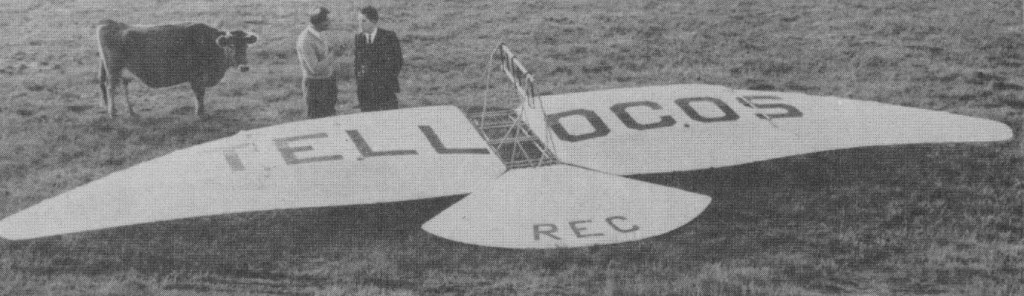
Australian Ron Costello, 46, of Victoria, designed and built this pedal-powered flapper in 1964. The tail is controlled ‘string’, with the pilot standing on a narrow platform.
Costello worked for the Civil Aviation Department and government buddies notified him officially by letter that man-powered craft don’t always work.
Cosmos Helios
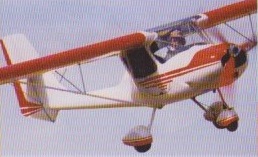
Built almost entirely of composited, it was planned, circa 198, to build the Helios from the new Cosmos factory at Darois Aerodrome.
Engine: Rotax 582, 64 hp
Wing span: 10.9 m
Wing area: 15.7 sq.m
MAUW: 450 kg
Empty weight: 154 kg
Fuel capacity: 60 lt
Max speed: 165 kph
Cruise speed: 130 kph
Minimum speed: 60 kph
Climb rate: 4 m/s
Fuel consumption: 10 lt/hr
Seats: 2
Price (1998): 142,500 Fttc
Kit price (1998): 122,280 Fttc
Cosmic Aircraft Corp
USA
In May 1970 Cosmic Aircraft Corp acquired all rights in manufacture of F-23 single-seat agricultural monoplane, produced previously by D. D. Funk Aviation Company Inc. Two models: F-23A (Continental radial) and F-23B (Jabobs radial). Production ceased 1975.
Correa 1911 aeroplane
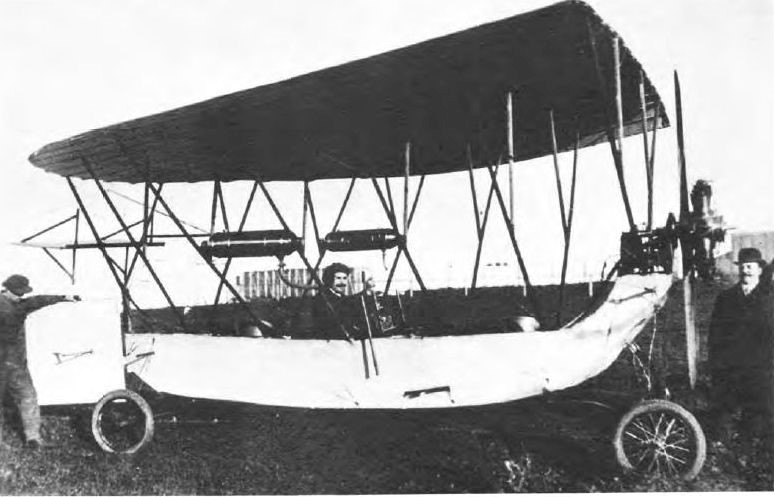
Argentine engineer Federico Correa built this half parasol, half flying-wing machine which was described in 1911. It was powered by a Gnôme engine.
Cornelius XFG-1
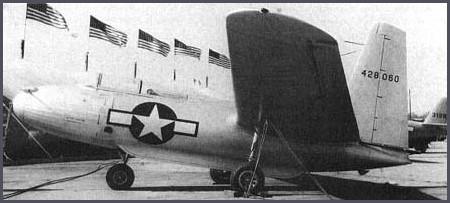
The 677 gal (2,563 l) experimental fuelling glider XFG-1 incorporated Cornelius’ experience with swept-forward wings and was intended to be towed (by a Douglas C 47) pilotless with the controls locked. After the fuel was transferred to the towplane, it was to be cast off and abandoned. An alternative use was as a piloted fuel carrier, jettisoning its undercarriage after take-off, and landing at its destination on two skids at the bottom of the fuselage.
Basically a flying fuel tank, the forward swept wings were mounted behind the cylindrical fuel tank forming the fuselage centre section. The incidence of the XFG-1 wing was adjustable on the ground at 3°, 5° and 7°. With a swept-forward wing, an increase in incidence raises the wingtips and produces dihedral, which may explain why some accounts describe the adjustment as variable-dihedral.
Two were produced for the USAAF in 1945 by the Spartan Aircraft Corporation at Tulsa, Oklahoma, under the serials 44-28059, 44-28060. Thirteen flights were made in prototype 44-28059 by Reitherman, on the last of which he was killed after failing to recover from a spin. The second machine, 44-28060, made 19 flights, but work was discontinued with the end of WW II.

