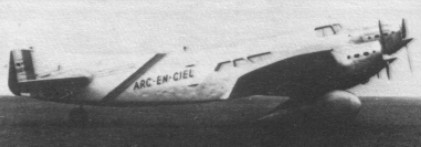
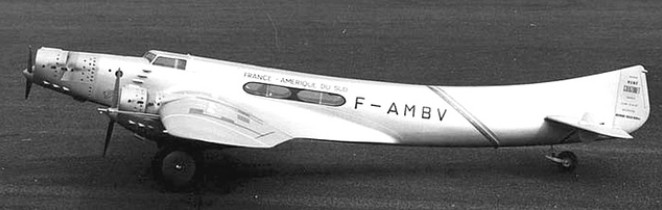
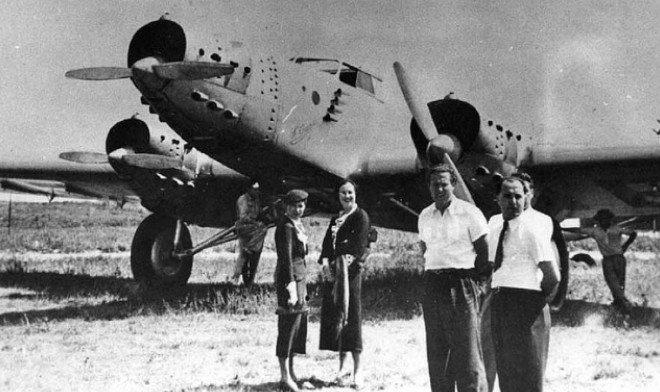
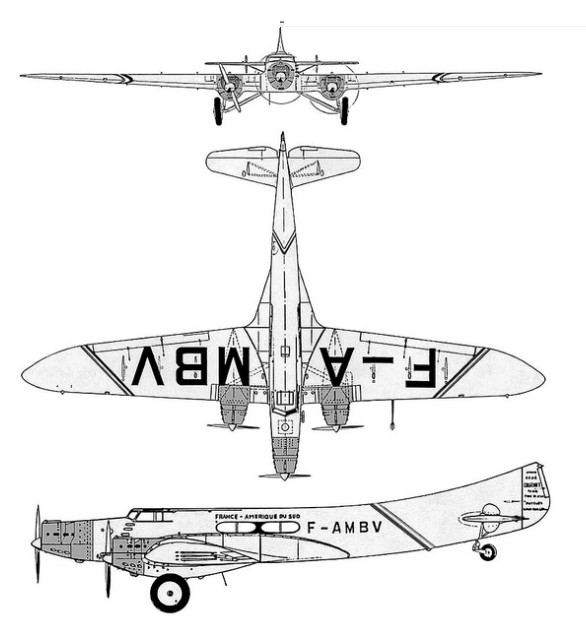
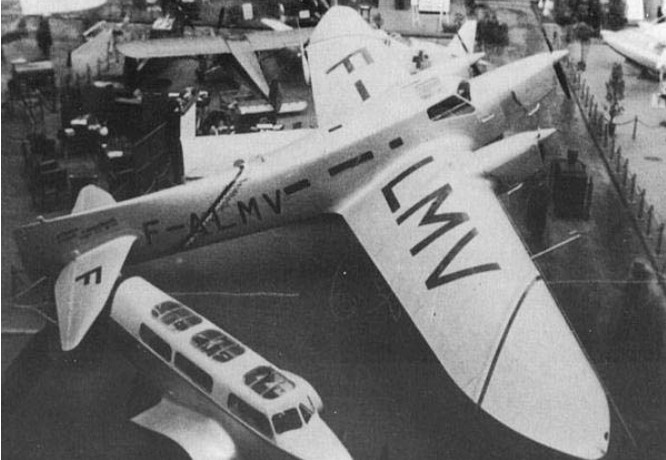
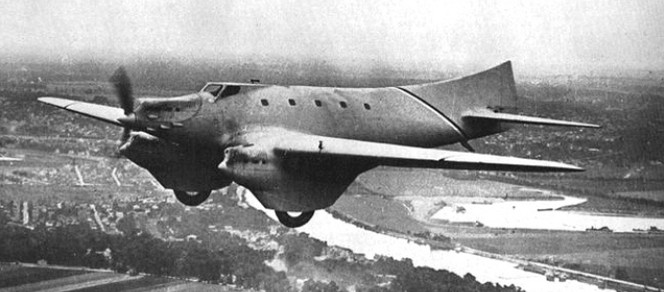
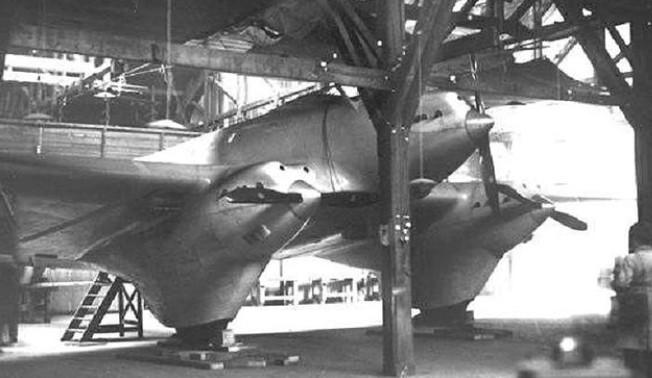
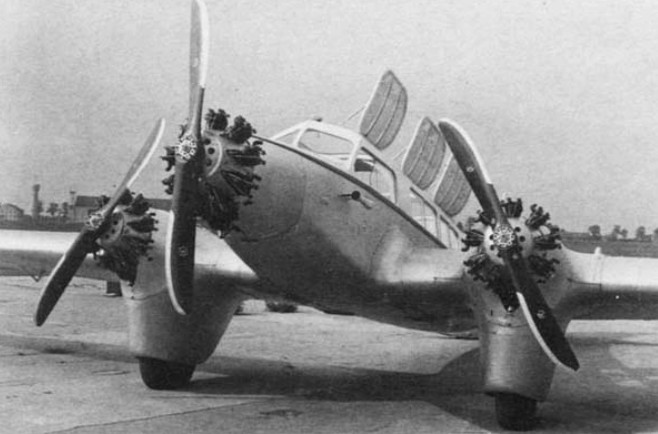
Developed from the Couzinet 30, the Couzinet 70 was also called Arc-en-Ciel and intended for Aeropostale’s transatlantic mail service to South America. The number 3 model designated the Couzinet 70 by the company was completed at the beginning of 1932.
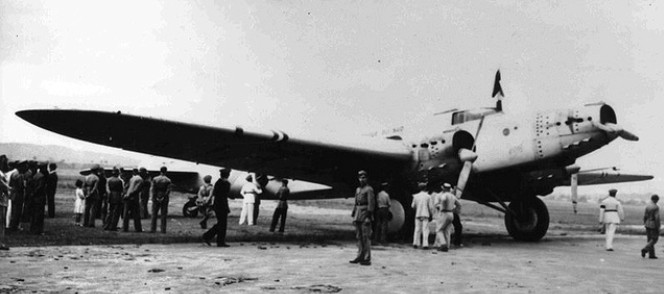
First flown on 11 February 1932, the aircraft was a low-wing monoplane with a fixed tailwheel landing gear. The aircraft was powered by three Hispano-Suiza 12Nb inline piston engines. The two wing mounted engines could be accessed in flight through tunnels in the wing.
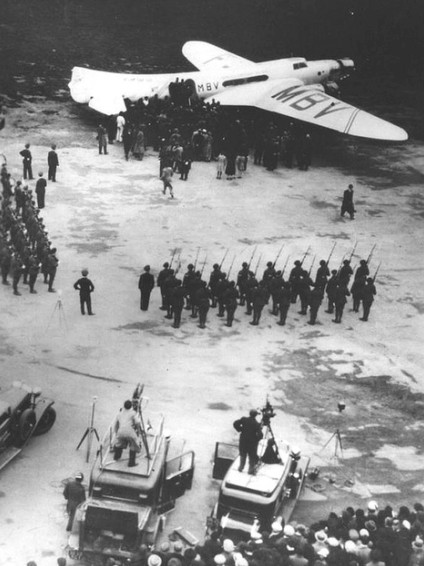
Jean Mermoz the famed French pilot would fly it to Buenos Aires a year later with its inventor at his side. Upon their return in France, they would be welcomed and greeted as heroes. At the age of 29, René Couzinet was at the apogee of his glory.
Number 3 model / Couzinet 70
After route-proving flight from Paris to Argentina by Jean Mermoz in January 1933 it was extensively modified as Couzinet 71 and entered regular service in May 1934.
C.70
Sold to Air France before being retired in 1937, the Couzinet 70 became model 71 after miscellaneous modifications, and it is the best known of all the airplanes built by Couzinet.
At the age of 23 René Couzinet built his first airplane, the Couzinet 10, the first of the three Arc-en-Ciel built before the Second World War. The Couzinet 10, which René completed while serving as an Officer for the 34th Aviation Regiment based at Le Bourget possessed some revolutionary technical innovations for its time, such as excess reserve power, or the accessibility of the engines in flight. Those innovations however were not sufficient to convince the official service of the Air Ministry, and the certification of the airplane would be denied for a long time.
When the Arc-en-Ciel number 1 came out of the factory in 1928, the news media issued the most complimentary, and perhaps even “over done” reports. The journalists constantly bragged about the merits of this three engines, cantilever low wing monoplane, weighing 16 tons, and with a wingspan over 27 meters. The Couzinet 10 was equipped with several fuel tanks having a total capacity of over 6,000 liters and providing a range of 10,000 kilometers. Finally, this revolutionary airplane not only made the biplanes and other types antic machines, but it had a wing loading of 100 kilos per square meter whereas the official norm for the period never exceeded 50 kilos!
C.10a
The Arc-en-Ciel number 1 crashed at the Orly airdrome on the 8th of August 1927. The crash resulted in the death of the pilot Maurice Drouhin and his mechanic. When about ready to leave the assembly line, the number 2 model ended up in ashes on the evening of February 17 1930 after a fire consumed the Meudon factory that industrialist Emile-Louis Letord had put at the disposition of Couzinet.
Couzinet 10
The number 3 model designated the Couzinet 70 by the company was completed at the beginning of 1932.
France Born in 1904 in the Vendée region of France, engineer Rene Couzinet graduated from the famed “Arts et métiers” school in Angers and began manufacturing aeroplanes in 1928 with the tri-motor monoplane Couzinet 10 Arc-en-Ciel prototype, designed for transatlantic flight.
The Couzinet 70, developed from the Couzinet 30, was also called Arc-en-Ciel and intended for Aeropostale’s transatlantic mail service to South America. After route-proving flight by Jean Mermoz in January 1933 it was extensively modified as Couzinet 71 and entered regular service in May 1934. Air Couzinet 10 of 1937 was totally unrelated twin-engined monoplane. Couzinet himself went to Brazil in the late 1930s, assisting with the development of that country’s aviation industry.
Designed by Jaques Coupé, the Coupé-Aviation JC-01 is the first of a series of very similar designs of two seat, single engine sports aircraft, amateur built from plans in France from 1976. These provided a range of engine sizes and undercarriage layouts, but total production was small. Design emphasis was placed on ensuring that homebuilders would find it easy to construct, and plans became available through Coupé-Aviation.
The first was designated JC-01, a side-by-side two-seat light-plane. It had a non-retractable tail wheel type landing gear and was powered by a 65 hp Continental A65-8F flat-four engine. It was flown for the first time on March 16, 1976, registered as F-PXKV (c/n 01).
The JC-01 and its variants were designed as conventional two-seat side by side light aircraft that could be built from plans by amateurs. The different models are chiefly distinguished by engine choice, though undercarriage configurations vary and there are slight alterations to the vertical surfaces. Coupé subsequently began construction of a derivative of the JC-01 in September 1976. Designated JC-2, it was generally similar to the JC-01 but had a 90 hp Continental A65-8F flat-four engine. It flew for the first time on May 7, 1981, registered F-WYJI (c/n 01), after gaining its CofA it was reregistered F-PYJI.
Of wooden construction, covered with plywood and fabric, the J-01 and the J-2 have identical spans, wing areas and lengths, though the J-2, with a 90 hp rather than 65 hp engine and a tricycle rather than conventional undercarriage weighs more: empty, the J-01 weighs 330 kg (728 lb), the J-2 500 kg (1,103 lb).
The J-2 has a constant chord, one piece low wing. Its inner panels have no dihedral but the outer ones are set at 4°. Both the main box spar and the rear spar have spruce booms and plywood webs. The leading edge is ply covered and fitted with fixed slots. The wing, including ailerons and flaps is Dacron covered overall. The empennage of the J-2 is conventional and cantilever, with the horizontal tail mounted on top of the fuselage; both fin and rudder are swept, the latter only slightly. The fixed surfaces are ply covered but control surfaces are fabric covered. The elevator has a trim tab.
The fuselage of the J-2 is a three frame truss structure with a ply covered forward section and fabric covering aft. A 67 kW (90 hp) Continental C90 flat four engine in the nose drives a two-blade, fixed pitch propeller. Its fuel is stored in a tank immediately aft of the engine firewall. The cockpit, placed over the wing, seats two side by side under a large, rearward sliding canopy, with a space behind the seats which can take up to 20 kg (44 lbs) of baggage. The J-2 lands on fixed tricycle gear. The mainwheels have oleo-pneumatic damping and mechanical brakes; the nosewheel swivels.
Plans were available to amateur builders for the construction of the JC-01 and its variants and about a dozen JC-01s were built. Two remained on the French civil aircraft register in 2010, together one example of each of the other variants making the total number of all variants built at least fifteen. Some builders included their own name and initials in the aircraft description, for example the Dessevres-Coupé JCD 01 and the Coupé-Brault JCFB 01.
The JC-200 was a refined version of the JC-2, the first example was flown on August 18, 1989.
Coupe JC-200 constructed by Gérard Gouin of Moulins-la-Marche, registered as F-PGGO November 11, 1989.
Variants: JC-01 Original version with 48 kW (65 hp) Continental A65 engine and unswept rudder. Later the prototype was modified with a swept rudder. At least one was built with a Limbach 1700 engine. Tailwheel undercarriage. First flown 16 March 1976.
JC-2 Similar to JC-01 but with a 67 kW (90 hp) Continental C90, 50% heavier, swept vertical tail and tricycle undercarriage. First flown May 1981.
JC-3 Lightened JC-01 with swept vertical tail and 51 kW (68 hp) Limbach L 1700 or 60 kW (80 hp) L 2000 engine.
JC-200 “Refined” version of JC-2 with a 75 kW (100 hp) Rolls-Royce Continental O-200 engine, first flown 18 August 1989.