Antonov An-124 Ruslan

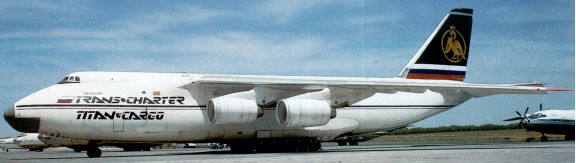
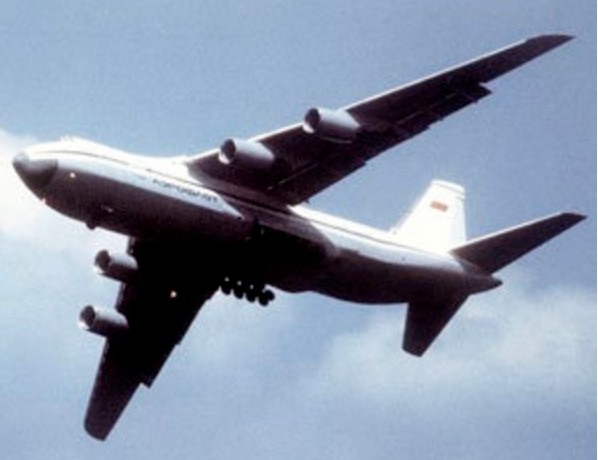
The An-124 strategic airlifter, Nato code name Condor, first flew on December 26, 1982 with Vladimir Terski at the controls, and at least nine had been built by June 1987. At the time of its first flight, the An-124 was the largest aircraft in the world.
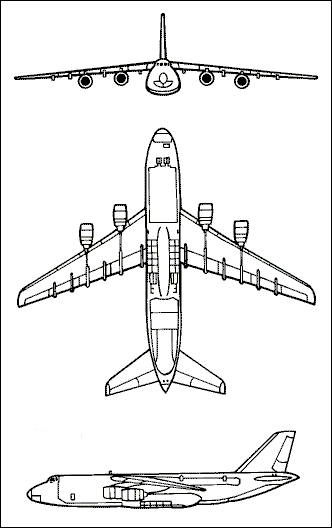
The An-124 is powered by four 230kN-thrust Lotarev D-18T high-bypass turbofans, and is claimed to carry its 150-tonne maximum payload over 4,500km. Designed for simultaneous nose and tail loading, with a visor-type lifting nose and integral forward-folding ramp, the pressurised cargo hold is 36m long, 6.4m wide, and 4.4m high. A pressurised upper deck can accommodate 88 passengers.
The An-124 has a six-man crew (two pilots, two engineers, a navigator and a radio operator), dual weather and ground mapping raders, quadruplex inertial navigation, and anologue fly-by-wire controls with mechanical backup operating hydraulic control servos.
Two overhead travelling cranes, which have a lifting capacity of 30 tonnes, and two winches allow heavy cargo to be self-loaded without the use of special airport loading equipment.
To enable the carriage of extremely heavy cargo, HeavyLift-Volga-Dnepr have developed special loading systems allowing individual items of up to 100 tonnes to be loaded. In addition, two double-deck car-racking systems have been built allowing up to 50 cars to be carried in one flight.
Approximately 5,500kg of composite materials are used in doors, fairings, and panels, including 3,000kg of carbonfibre, giving a 1,800kg overall weight saving.
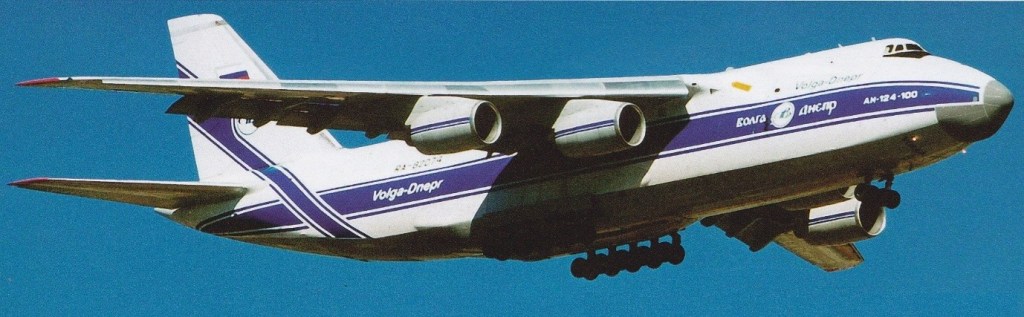
The second aircraft, named Ruslan, appeared at the 1985 Paris Air Salon. The aircraft entered service with Aeroflot in early 1986, and now serves principally on the Siberian run, carrying outsize items to the oil and mineral exploitation industries. In 1987 the An-124 began service with the air force. Production is reportedly eight to ten aircraft per year, and by 1989 over 25 had been completed. The An-124 was assigned the NATO reporting name ‘Condor’.
The An-124-100 is a civil varient, certified in Russia. They are built one at a time and take about three and a half years to construct. Its 24-wheel undercarriage allow it to go into semi-prepared strips and the two nose-wheel units can be retracted on the ground allowing the aircraft to ‘kneel’ to assist loading. The large undercarriage system, the full-span, leading-edge slats and flaps give the An-124 very good short field performance.
Full-span leading-edge slats and large flaps give the An-124 short field capability, while its 20 main wheels allow the type to use rough fields..
Civil examples were with Antonov Air Foyle, HeavyLift Volga Dnepr and the Russian-Australian joint venture, Antonov Airlines.
Antonov An-124 Article

Gallery

An-124
Engine: 4 x Lotarev D-18T Turbofan, 229.9 kN. / 51,590 lb
Installed thrust: 920 kW.
Wingspan: 73.0 m / 239 ft 6 in
Length: 69.1 m / 226 ft 5 in
Height: 68.18ft / 20.78m
Wing area: 6759.792 sq.ft. / 628.0 sq.m
Wing load : 132.23 lb/sq.ft / 645.00 kg/sq.m
Height: 22.0 m / 72 ft 2 in
Max take off weight : 893025.0 lb / 405000.0 kg
Weight empty : 429975.0 lb / 195000.0 kg
Max. weight carried : 463050.0 lb / 210000.0 kg
Max. speed : 466 kt / 863 km/h / 537mph
Landing speed : 132 kt / 245 km/h
Cruising speed : 445 kt / 825 km/h
Service ceiling : 39370 ft / 12000 m
Range w/max.fuel: 16500 km / 10253 miles
Range w/max.payload: 4500 km / 2796 miles
T/O run: 1200 m.
Ldg run: 800 m.
Crew: 6
Capacity: 88 pax.
Air refuel: No.
Antonov An-74 / An-88

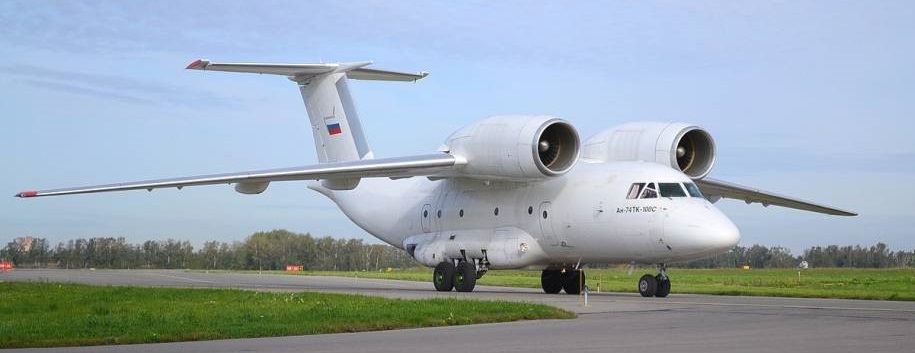
An-74TK

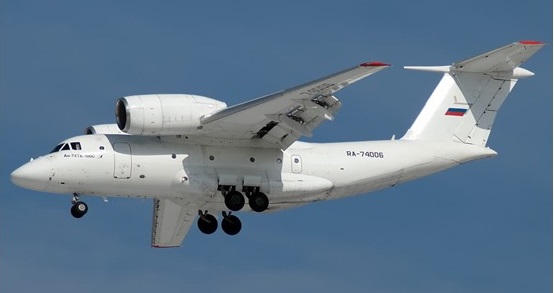
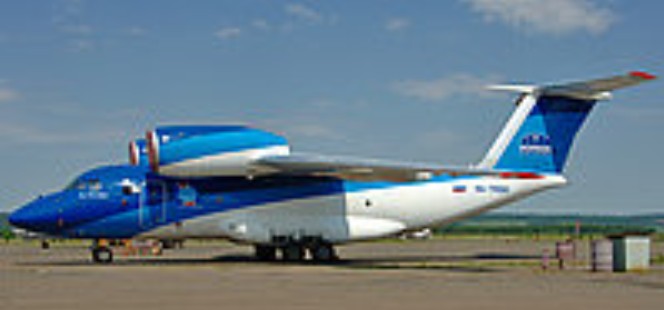
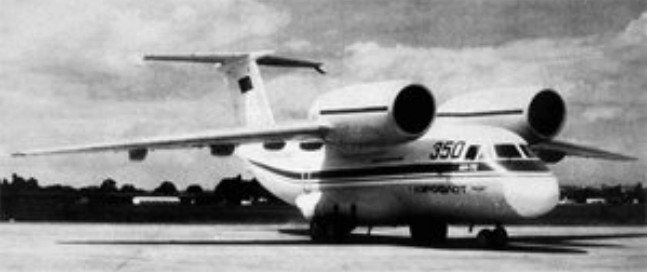
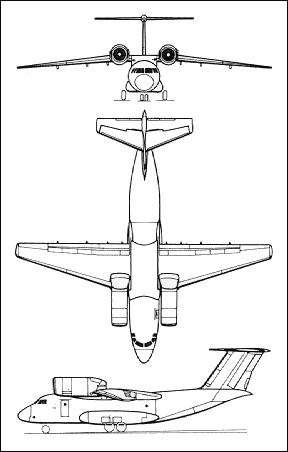
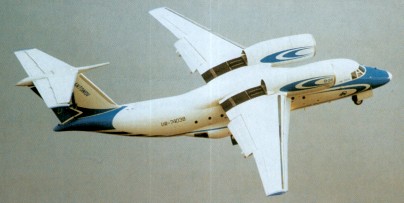
Flight testing of an An-74 develop¬ment of the An-72 Coaler twin-turbofan Stol transport was announced early in February 1984. The An-74 has been developed specifically for use in the Arctic and Antarctic, and may be equipped with an interchangeable landing gear, with skis available for operations from ice and snow. Principal differences apparent in the An-74 are a longer fuselage with a nose-mounted radar, and a redesigned wing.
First flown in 1977, the An-72, and the related An-74, only received its airworthiness certificate when the An-74TK was certified by Aeronautical Register on 2 August 1991. The An-74 was also produced at Kharkov from December 1989.

Antonov An-74TK-100C RA-74006

Production of An-74 also started by Polyot Industrial Association at Omsk, Russia, in 1993 (assisted by Progress at Arsenyev); first Polyot aircraft (RA-74050) was flown 25 December 1993.

An An-72P maritime patrol version was demonstrated 1992 and development of the An-74-200 and An-74TK-200 by Antonov started 1995. The An-74TK-300 is basically an An-74TK-200 with underslung engines.
The An-88 is a tactical battlefield surveillance aircraft based on An-72 (also known as An-72R).

Gallery

An-74 Coaler
Engine: 2 x Lotarev D-36 turbofan.
Installed thrust: 127.4 kN.
Span: 31.9 m.
Length: 28.7 m.
MTOW: 34,500 kg.
Payload: 10,000 kg.
Cruise speed: 550 kph.
Ceiling: 10,500 m.
T/O run: 470 m.
Range/payload: 3300 km with 5000 kg.

An-74TK-300
Engines: 2 x Lotarev D-436.

Antonov An-72

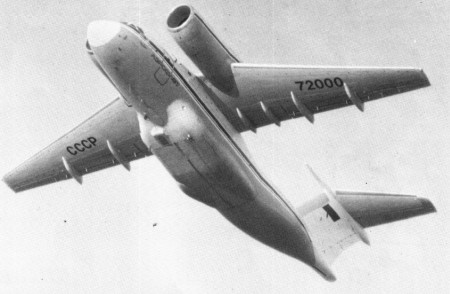
Originating as private venture military transport based on stillborn An-60 64-73 seat civil airliner designed to meet 1967 specification, the revised design, following issue of military requirement in 1968, included relocation of engines above wings.

Antonov An-72 Article

Two static test airframes, and two prototype An-72 were built at Kiev. The first (SSSR-197744) flew on 31 August 1977.
Intended to replace the turboprop powered An 26 in Aeroflot service, its high lift devices and multi wheel landing gear make it suitable for operation from unprepared airfields with snow or ice covering and accommodate about 52 passengers. Overwing engines exhaust over the wing and trailing edge devices, to increase lift at low airspeeds. The NATO named Coaler is designed for rough-field operations and has a rear cargo door/ramp.
A production order was placed in December 1980 for an improved An-72A version, when manufacture was transferred to Kharkov, Ukraine, where first production An-72 flew 22 December 1985.
The An-72, and the related An-74, only received its airworthiness certificate in 1991. By mid-1992, about 50 were in industrial service, although none with Aeroflot.
The An-72 platform went on to spawn other variants that included maritime surveillance An-72P model, the An-71 “Madcap” AEW model and the An-74 “improved Coaler” upgraded engines and a conventional engine mounting. The An-72P armed surveillance and maritime patrol aircraft was developed in conjunction with Israeli Aircraft Industries and featured revised cockpit glass design, specialized Elta radar, electronic warfare systems and long range day/night observation equipment and systems.

The An-74 is a civil development of the An-72.

Engine: 2 x turbo-jet Lotarev D-30, 62.8kN
Length: 26.6 m / 87 ft 3 in
Height: 8.2 m / 26 ft 11 in
Take-off weight: 26500-30500 kg / 58423 – 67241 lb
MTOW increased: 72,751 lb (33 000 kg)
Max useful load: 22,046 lb (10 000 kg) Wingspan: 25.8 m / 84 ft 8 in
Cruise speed: 720 km/h / 447 mph
Ceiling: 11000 m / 36100 ft
Range w/max.fuel: 3200 km / 1988 miles
Range w/max.payload: 1000 km / 621 miles
Range 16,534 lb (7500 kg) useful load: 1,243 mls (2000 km)
Crew: 2-3
Passengers: 32

An-72 (Coaler-C)
Engines: 2 x Lotarev D-36 turbofan, 14,330lbs thrust
Length: 94.16ft (28.7m)
Wingspan: 104.66ft (31.90m)
Height: 28.38ft (8.65m)
Empty Weight:41,998lbs (19,050kg)
Maximum Take-Off Weight:76,059lbs (34,500kg)
Maximum Speed: 438mph (705kmh; 381kts)
Maximum Range: 497miles (800km)
Service Ceiling: 125,246ft (38,175m)

An-72P
Armament: 1 x 23mm gun pod,
2 x UB-23M rocket launcher system
4 x 220lb internally-held bombs
Accommodation: 3

Antonov An-71

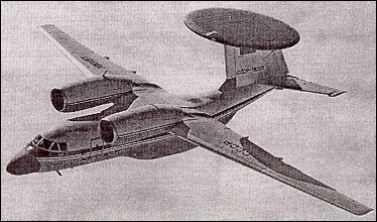
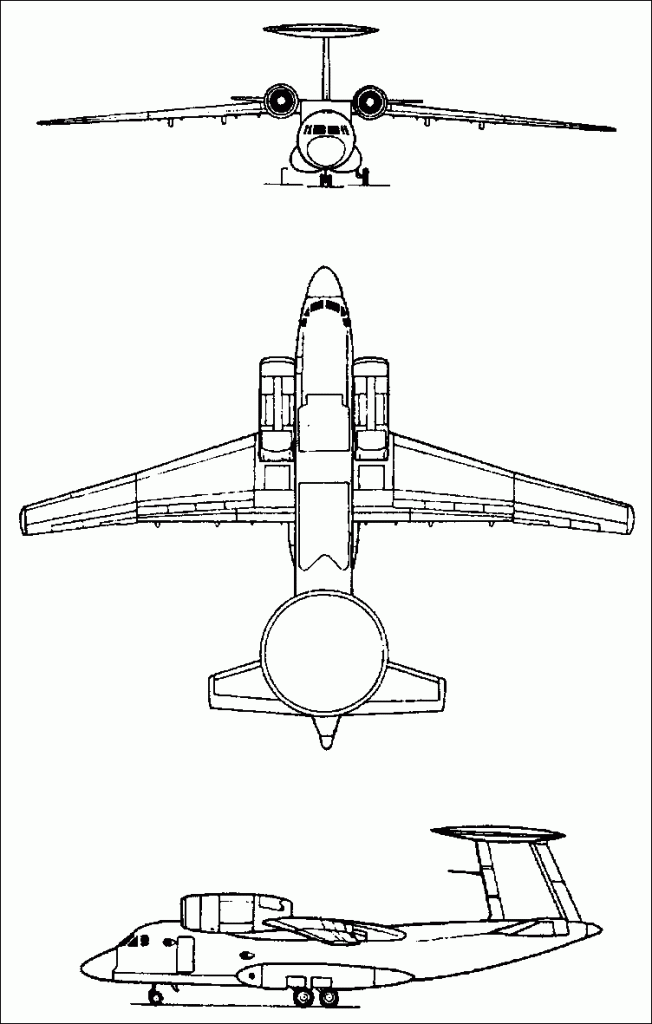
An AEW plane based on An-72 transport plane, the first prototype flew on July 12, 1985. A small tactical airborne early warning and control aircraft with rotating radome above tailfin, the program was canceled with no production orders. NATO reporting name ‘Madcap’.

An-71
Engine: 2 x D-436K turbofans, 7500kg + 1 x RD-38A, 2900kg
Wingspan: 31.89 m / 104 ft 8 in
Length: 23.50 m / 77 ft 1 in
Height: 9.20 m / 30 ft 2 in
Max. Speed: 650 km/h / 404 mph
Cruise Speed: 530 km/h / 329 mph
Ceiling: 10800 m / 35450 ft
Crew: 6

Antonov An-70

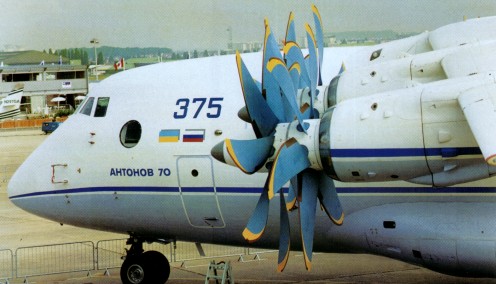
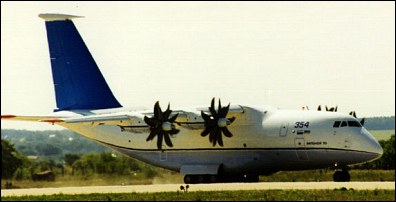
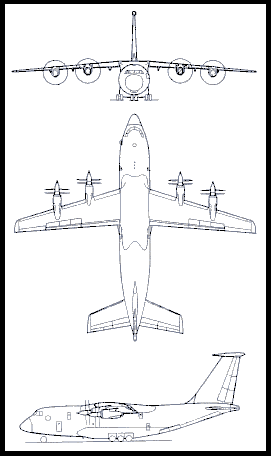
The development of the An-70 program began in 1975 but the collapse of the Soviet Union effectively stopped the funding of most major new programs. The An-70 has the high wing and tail loading ramp for a tactical freight aircraft and uses contra-rotating propfans. Each propfan has contra-rotating propellers; the front has eight composite blades, the rear just six.

A new propfan medium-size wide-body short take-off and landing transport aircraft intended to replace An-12, the first flight was achieved on December 16, 1994 but the first prototype crashed on 10 February 1995 after colliding with its An-72 chase plane.
Construction of a second prototype was completed, which began flight testing at Gostomel airport in Ukraine on April 24, 1997.

Engine: 4 x D-27 propfans, 10300kW
Take-off weight: 130000 kg / 286602 lb
Wingspan: 44.06 m / 144 ft 7 in
Length: 40.25 m / 132 ft 1 in
Height: 16.1 m / 52 ft 10 in
Cruise speed: 750-800 km/h / 466 – 497 mph
Ceiling: 12000 m / 39350 ft
Range: 7250 km / 4505 miles
Range w/max.payload: 1350 km / 839 miles
Maximum payload: 47 tons.
Crew: 3-5

Antonov An-32

AN-32 Firebomber

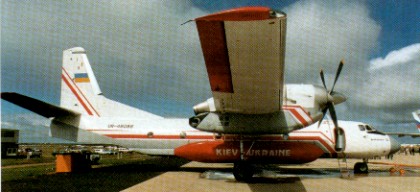
The An-24 was developed into the An-26 (freighter), the An-30 (survey/photo) and the An-32 (hot and high version). A short/medium-range twin-turboprop transport first flown July 1976, the An-32 has almost twice the installed power of the An-24.

Antonov An-32 Article

Delivery of 95 An-32s to India, where it is known as the Sutlej, began in July 1984, to replace C-47 Dakotas and C-119 Packets. Peru became the third customer for the An-32, placing an order for 22 to replace its fleet of An-26s. Deliveries began with the first five aircraft in May 1987.

An-32

Gallery

Engine: 2 x Ivchenko AI-20DM turboprop.
Installed pwr: 7720 kW.
Span: 29.2 m.
Length: 23.7 m.
Wing area: 75 sq.m.
MTOW: 27,000 kg.
Payload: 6700 kg.
Cruise speed: 530 kph.
Ceiling: 9000 m.
T/O run: 760 m.
Ldg run: 470 m.
Fuel internal: 5500 lt.
Range/payload: 800 km with 6700 kg.
Capacity: 39 pax.

Engine: 2 x Iwtshenko AI-20M, 4133 shp
Length: 78.084 ft / 23.8 m
Height: 28.15 ft / 8.58 m
Wingspan: 95.801 ft / 29.2 m
Wing area: 807.3 sqft / 75.0 sq.m
Max take off weight: 57330.0 lb / 26000.0 kg
Cruising speed: 275 kts / 510 km/h
Service ceiling: 31168 ft / 9500 m
Wing load: 71.14 lb/sq.ft / 347.00 kg/sq.m
Range: 1188 nm / 2200 km
Range (max. weight): 432 nm / 800 km
Crew: 5
Payload: 39 Pax

Antonov An-30

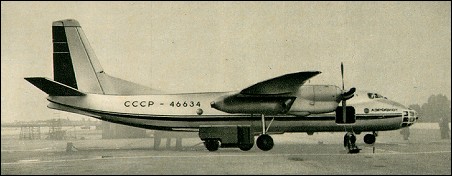
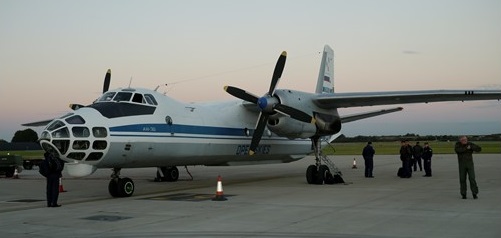
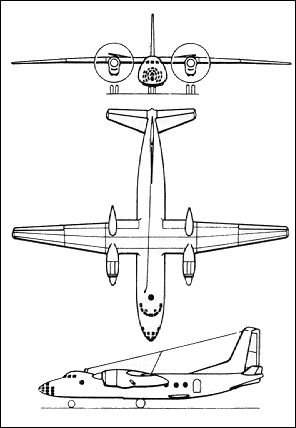
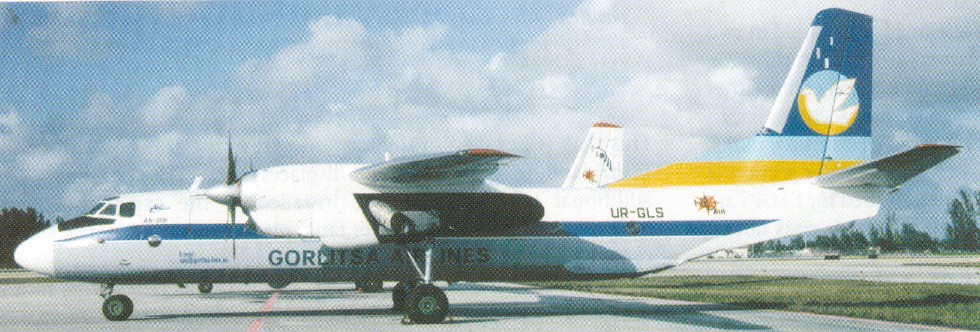
The Antonov An-24 was developed into the An-26 (freighter), the An-30 (survey/photo) and the An-32 (hot and high version). First flown 1974 with distinctive glazing around the nose, the An-30 Clank was built specifically for aerial survey work. The An-30 is essentially an Ant-24RT or an An-26 with mission related equipment fitted.

Aside from the dozen or so in service with Aeroflot, examples of the An-30 have been bought by Balkan Bulgarian Airlines, CAAC of China and the Romanian Air Force.

Engine: 2 x turbo prop AI-24VT, 2075 kW and turbo-jet RU-19A, 7.8kN
Take-Off Weight: 23000 kg / 50707 lb
Empty Weight: 15950 kg / 35164 lb
Wingspan: 29.2 m / 95 ft 10 in
Length: 24.3 m / 79 ft 9 in
Height: 8.3 m / 27 ft 3 in
Wing Area: 75.0 sq.m / 807.29 sq ft
Max. Speed: 540 km/h / 336 mph
Cruise Speed: 430 km/h / 267 mph
Range: 2600 km / 1616 miles
Crew: 6-7

Antonov An-28 / PZL M-28 Bryza / Skytruck

Bryza 1R

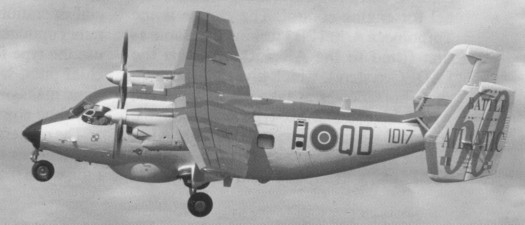
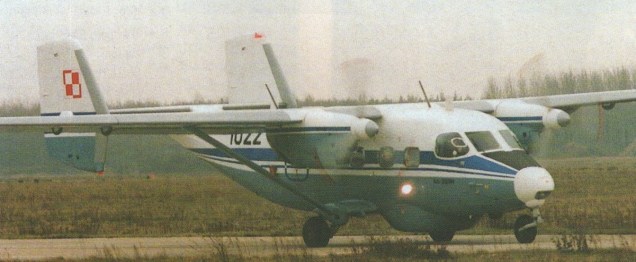
With the NATO reporting name Cash, the An-28 Was designed for STOL performance with up to 19 passengers. A development of the piston-engined An-14, the first prototype flew in September 1969 and had a retractable landing gear and Isotov TVD-850 engines. Production An-28 have a non-retractable tricycle type landing gear and two 723kW Glushenkov TVD-10B turboprops.
Operational in 1969, the An-28 went into production in Poland (still in production in 1999) by WSK “PZL-Mielec” as the M-28 Bryza / Skytruck.

An-28RM

Engine: 2 x turbo prop TVD-10B, 705kW
Wingspan: 22.1 m / 72 ft 6 in
Length: 13.0 m / 42 ft 8 in
Height: 4.5 m / 14 ft 9 in
Take-off weight: 5100 kg / 11244 lb
Empty weight: 3000 kg / 6614 lb
Max. speed: 350 km/h / 217 mph
Cruise speed: 300 km/h / 186 mph
Ceiling: 6000 m / 19700 ft
Range w/max.fuel: 1300 km / 808 miles
Range w/max.payload: 1000 km / 621 miles
Crew: 1-2
Passengers: 15-26

Antonov An-26

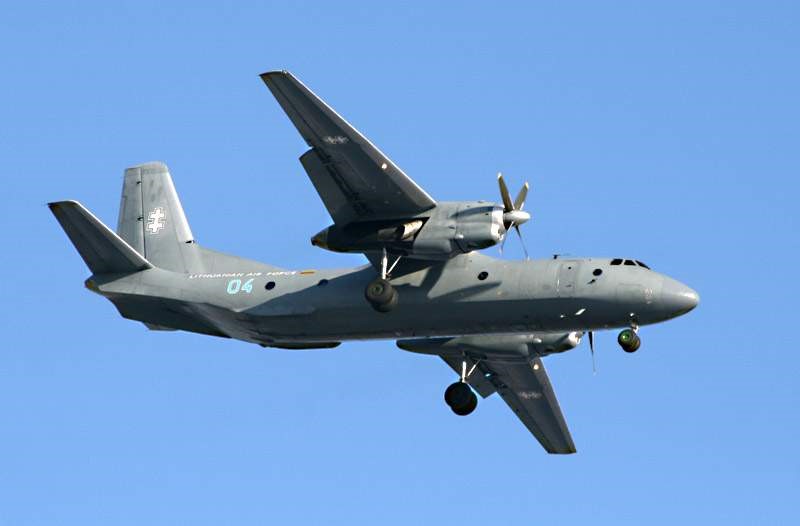
NATO code name ‘Curl’, the Antonov An-26 is a twin-engine transport aircraft first flown in May 1969 and exhibited at the 1969 Paris Air Show. A militarised development of the An-24 airliner, the pressurised An-26 flew first in 1968 and differs from the An-24 in featuring a rear loading ramp, more powerful lvchenko turbine-engines and an auxiliary turbojet in the right engine nacelle.
An improved An-26B version was announced in 1981 with an improved freight handling system.

An-26B

Approximately 1,410 An-26s and An-26Bs were built by GAZ 473 at Kiev, 1968-85, before being superseded in production by An-32. Production of the An-26 Curl twin-turboprop transport and its hot-and-high derivative, the An-32 Cline, continued in 1987. They were widely exported, serving in more than 20 countries. It was developed into the An-26 (freighter), the An-30 (survey/photo) and the An-32 (hot and high version).
A derivative Y7H-500 was built by Xian Aircraft Company, in China.

The Antonov An-26 arrived in Cuba in late 1978 and early 1979. The fleet consisted of two squadrons numbered from FAR 12-20 to FAR 12-39. In the first half of the 80s, more aircraft of this type were incorporated, reaching more than 30, of which 4 became Aerocaribbean.

The remaining AN-26s begin to change their military paint scheme, known as “chipojos” to the Cubana de Aviación paint scheme but without belonging to the airline. In 1994 with the emergence of Aerogaviota, most of these aircraft were painted with the new scheme. At present (2014) only around 5 Antonov An-26 aircraft remain active.

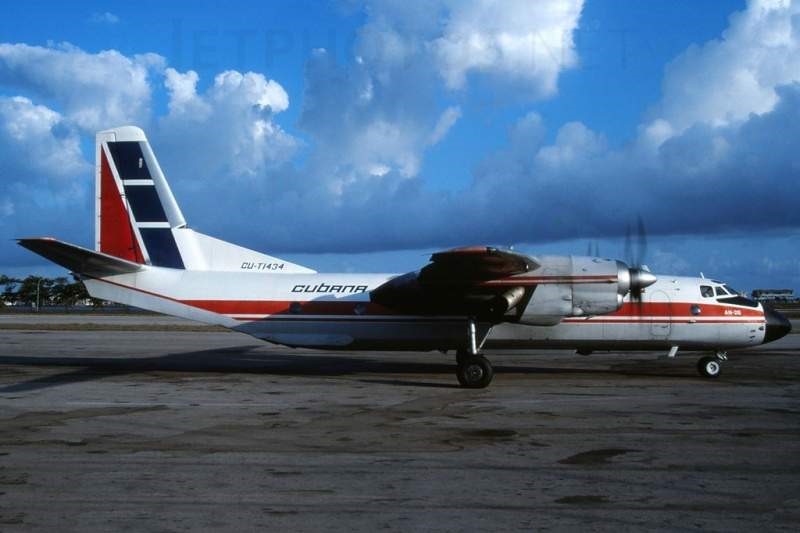
Antonov An-26 of Cubana de Aviación

Gallery

Variants:
An-26: standard version of tactical transport.
An-26B: Equipped with two Ivchenko Al-24VT turboprops, of greater power.
An-26BRL: Research version for frozen areas.
An-26L: Track calibration version.
An-26M: Air ambulance.
An-26P: Fire control plane.
An-26RTR: Electronic warfare and signals intelligence version.
An-26ST: Special missions version manufactured for the Air Force of the German Democratic Republic.
An-26Z-1: Signal intelligence aircraft (SIGINT).
Y-7H: Chinese version of military transport (No license).
Y-7-500: Chinese civil cargo version (Unlicensed).

Engine: 2 x turbo prop AI-24T, 2075kW and 1 x turbo-jet RU-19-300, 8.8kW
Wingspan: 29.2 m / 95 ft 10 in
Length: 23.8 m / 78 ft 1 in
Height: 8.6 m / 28 ft 3 in
Wing area: 75.0 sq.m / 807.29 sq ft
Take-off weight: 24000 kg / 52911 lb
Max payload: 5.500kg / 40 passengers.
Max. speed: 540 km/h / 336 mph
Cruise speed: 430 km/h / 267 mph
Ceiling: 7500 m / 24600 ft
Range w/max.fuel: 2550 km / 1585 miles
Range w/max.payload: 980 km / 609 miles
Crew: 5
Passengers: 38-40
Hold cap: 1765 cu.ft.

Engines: 2 × Progress AI-24VT turboprop, 2,103 kW / 2,820 hp
Wingspan: 29.20 m
Wing area: 74.98 m²
Length: 23.80 m
Height: 8.58 m
Empty weight: 15,020 kg
Maximum takeoff weight: 24,000 kg
Load: 5,500 kg
Cruise speed: 440 km / h (237 knots, 273 mph)
Range: 2,550 km; 1,100 km at full load
Service ceiling: 7,500 m (24,600 ft)
Rate of climb: 8 m / s (1,575 ft / min)
Crew: 5 (2 pilots, 1 radio operator, 1 flight engineer, 1 navigator)
Capacity: 40 passengers

Antonov An-24

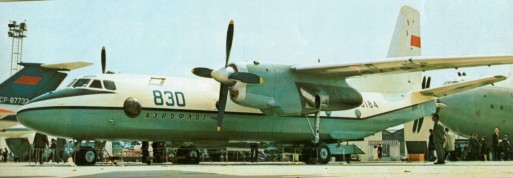
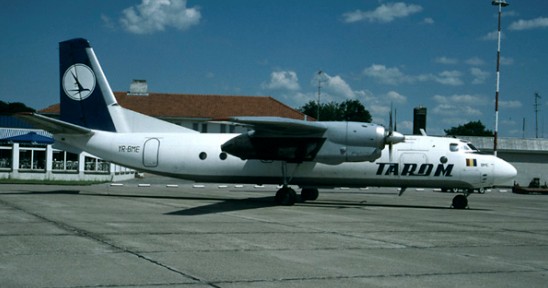
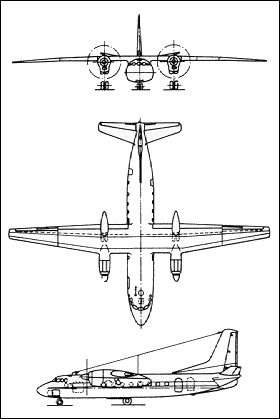
Development of this twin-turboprop transport was started in 1957, to replace piston-engined Li-2 and Il-14’s types on Aeroflot’s internal feederline routes. The An-24 was intended originally to carry 32 to 40 passengers, but when the first of two prototypes flew on 20 October 1959, it had been developed into a 44-seater. It was followed by a second prototype and five preproduction An-24. On the prototype, the engine nacelles extended only a little past the wing trailing-edges: production An-24 have lengthened nacelles with conical rear fairings. A ventral tail fin was also added on production models of the passenger-carrying version, which are supplemented by the An-24T and An-26 specialised freight-carrying versions of the same basic design.
Flight testing was completed in September 1962 and the An-24 entered service on Aeroflot’s routes from Moscow to Voronezh and Saratov in September 1963.

Antonov An-24 Article

Normal accommodation is for two pilots, a navigator, a steward and up to 44 passengers in four-abreast seats, mounted in pairs. The front cabin is movable to make possible alternative mixed passenger-freight payloads, all passenger seats can be removed. The cabin is 48 ft 1.5 in long, 9 ft 5 in wide and 6 ft 5 in high, with a volume of 2750 cu.ft and floor area of 439 sq.ft. In the standard version, there is a luggage compartment forward of the passenger cabin on the port side, with a freight hold on the starboard side. Entry to the cabin is via a door at the rear, on the port side, with built-in airstairs.

The An-24 is designed to operate from airfields of limited size, with paved or natural runways and can be fitted with rocket-assisted take-off units to permit operation with a full load of cargo at ambient temperatures above 30°C. Two were taken to the Antarctic in late 1969, to replace piston-engined Il-14 used previously for flights between Antarctic stations.

Deliveries of the An-24V started in 1962. The An-24RV features a small turbojet in the right engine nacelle to boost takeoff performance and up to 5 crew and 50 passengers.

Production ended in 1979 with over 1460 An-24 variants were built in Kiev, Irkutsk and Ulan Ude in the former USSR/Ukraine. An An-24 variant entered production in China as the Xian Y-7.

It was widely exported, serving in more than 20 countries. It was developed into the An-26 (freighter), the An-30 (survey/photo) and the An-32 (hot and high version).

The An-24RT variant became the basis for a developmentally improved design in the An-26 “Curl”.

Gallery

An-24T
Length: 77.20ft (23.53m)
Wingspan: 95.80ft (29.20m)
Height: 27.30ft (8.32m)
Maximum Speed: 280mph (450kmh; 243kts)
Maximum Range: 398miles (640km)
Service Ceiling: 27,559ft (8,400m)
Accommodation: 2 + 44
Engines: 2 x ZMBD Progress (Ivchenko) AI-24A turboprop engines generating 2,250eshp each.

Engine: 2 x turbo prop AI-24, 1875 kW
Wingspan: 29.2 m / 95 ft 10 in
Length: 23.5 m / 77 ft 1 in
Height: 8.3 m / 27 ft 3 in
Wing area: 72.5 sq.m / 780.38 sq ft
Take-off weight: 21000 kg / 46297 lb
Empty weight: 14248 kg / 31412 lb
Cruise speed: 500 km/h / 311 mph
Ceiling: 8400 m / 27550 ft
Range w/max.fuel: 2280 km / 1417 miles
Range w/max.payload: 750 km / 466 miles
Crew: 2
Passengers: 44-50