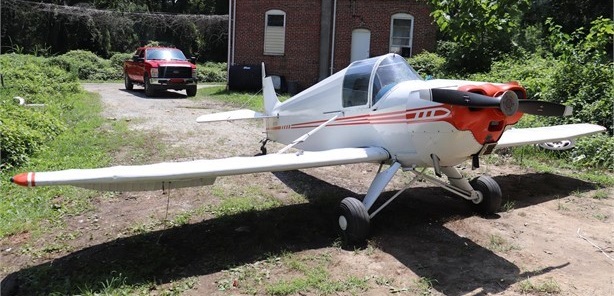
The 1964 Apple Trail Air single seater is an experimental aircraft powered by a Continental A65-8 engine and McCauley prop.
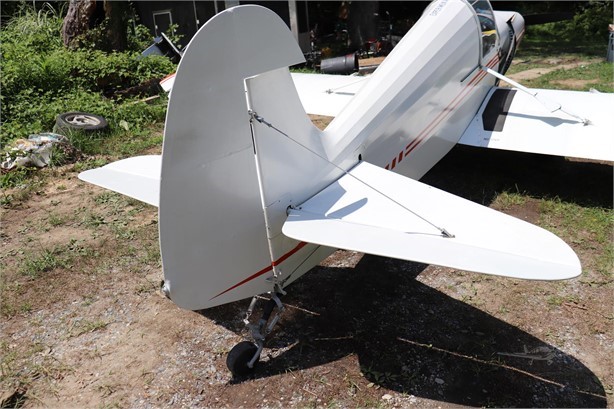
The wings fold up and in for compact storage. There are 4 total front wing struts, 2 on each wing, only 1 each in pictures.
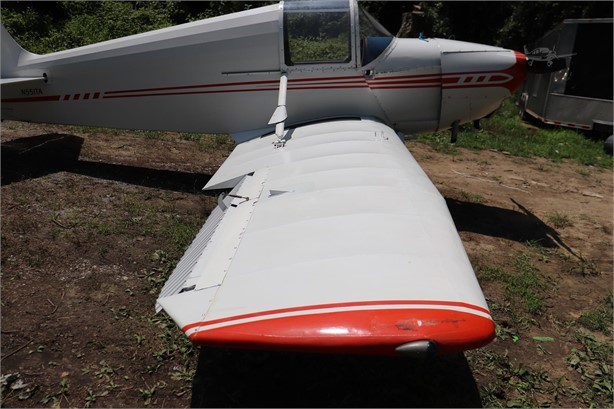
The 1964 Apple Trail Air single seater is an experimental aircraft powered by a Continental A65-8 engine and McCauley prop.
The wings fold up and in for compact storage. There are 4 total front wing struts, 2 on each wing, only 1 each in pictures.
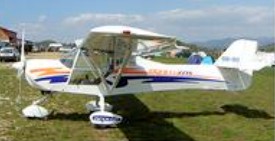
The Apollo Fox is built according to the BCAR Section S constuction norm.
The aircraft has welded steel alloy tube fuselage covered with ceconite fabric. The wings are made of aluminium alloy both spars and ribs and then covered with ceconite.
Wing can be folded backwards. One pilot can do it within 10 minutes. The landing gears are aluminium plate sheet as year suspension. Wheels are equipped with hidraulic disc or mechanical drum brakes.
Available tail or nose wheel configurations.
Engine opts:
Rotax 582 UL Mod 99 (65Hp)
Rotax 912UL (80 Hp)
Rotax 912 ULS (100 Hp)
Jabiru 2200 (80Hp)
Subaru EA 81 (100 Hp).
Stall: 35 kt / 40 mph / 64 kmh
Cruise: 81 kt / 93 mph / 150 kmh
VNE: 97 kt / 112 mph / 180 kmh
Empty Weight: 274 kg / 604 lbs
MTOW Weight: 450 kg / 992 lbs
Take-off distance (50ft obstacle): 460 ft / 140 m
Landing distance (50ft obstacle): 660 ft / 200 m
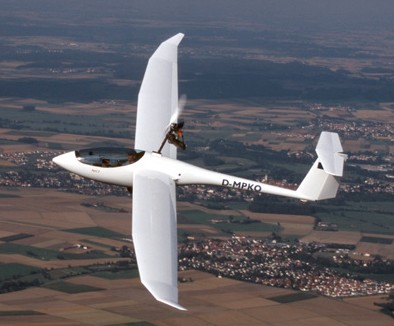
The Apis series includes both a 13- and 15-meter sailplane, is a combination of composite construction and old world craftsmanship. The Apis is intended for the sport flyer, but still holds several world records. They offer a forward-hinged canopy, automatic control hookups, in-flight adjustable rudder pedals, full-span flaperons, blended winglets, and Schempp-Hirth type airbrakes. They also make the Apis M, a 15-meter motorglider.
The Apis 2 is built with CFRP technology with 15 m span and T-tail. The wings are a multi trapezoid with raising tips. Aileron and flaps are interconnected (flaperons) and standard SH airbrakes give short landing approaches.
The spars are connected with two bolts in tongue/tongue technique. Rigging is straight forward and can be easily accomplished by one person. The glider fits in a standard sailplane trailer. The large canopy opens to the side and allows easy access to the ergonomic and roomy cockpit.
The Apis 2 includes a parachute rescue system. Wearing a pilots parachute is therefore not necessary and allows tall pilots to fit in the Apis 2.
The Apis 2 has a large canopy that opens to the side. The back-board can be adjusted continuously, the rudder pedals have some detents, and both can be readjusted during flight. The electric starter button and the throttle are located in the arm rest on the left side. The panel offers space for six instruments with 57 mm diameter in addition to the ECU indicator. One of these six can be replaced by a 80-mm-instrument alternatively. The battery fits into the quick-release rack in the fuselages nose. It energises both the ECU and the instruments.
The Apis 2 cockpit is made up of a double hull. The lightweight hollow section frame of the canopy offers a maximum stiffness in this area.
The Apis 2 takes off under its own power as a self launch glider. Despite the fixed tailwheel it is easy to control on the ground. Two aerodynamic tip wheels help eliminate the need for a wing runner.
The Apis 2 has a fixed gear with a wheel brake on the 4″ wheel.
After a short roll only climb rate is about 2.5 m/s (4.8 kt) at a speed of 80 to 85 km/h (45 kt). After about 150 m (500 ft) it will be airborne and it takes about 290 m (950 ft) over the 50 ft obstacle.
There is almost no trim change flying under engine or in gliding mode or while extending or retracting the engine. The camber changing flaps with a neutral trim will give you a speed range of 80 km/h (43 kt) at +9° to 160 km/h (86 kt) at -6°.
Thermal speed is about 80 km/h (43 kt) and minimum sink is 0.6 m/s (115 fpm). Best glide speed is 95 km/h (52 kt) which will give you a L/D of 39. Landing approach is at 90 km/h (48 kt) with positive flaps. The highly efficient airbrakes allow safe and steep approaches into short airfields. The Apis 2 can be landed with retracted or with extended engine.
The Apis 2 powerplant is an aircooled single cylinder Hirth F33 with intake and exhaust silencer. It generates 27 hp from 303 cc. The 148 cm ground adjustable carbon fibre propeller has been developed by Martin Wezel specially for the Apis 2. The noise level of the Apis 2 is at 57.7 db(A).
The powerplant is retractable. The process is controlled by ECU (Engine Control Unit) an instrument by TL elektronic. The extension of the powerplant is started by switching on the main switch, then the ignition. The ECU then takes over the process and the pilot can start the engine with the starter button. It is not necessary to manually control fuel valve or a choke lever. The ECU is optimizing the engine according to the temperature. During the retraction procedure for the powerplant the ECU is activating the propeller stop as soon as the RPM allows. Then the ECU is controlling the full procedure until the engine is completely stowed away.
The whole process takes about 20 seconds.
German certification in the Ultralight category was issued on 4 September 2003.
Apis 2
Span: 15 m
Wing area: 12.4 sq.m
Aspect ratio: 18.2
Length overall: 6.5 m
Empty weight: from 210 kg
Max. gross weight: 320 kg
Max. load factor: +5.3 / -3.3 g
L/D: 39 at 95 km/h (52 kt)
Min. sink rate: 0.6 m/s at 80 km/h (43 kt)
Flap settings: +9°, +5°, 0°, -3°, -6°
Stall: 35 kt / 40 mph / 65 kmh
Cruise: 81 kt / 93 mph / 150 kmh
VNE: 200 km/h (108 kt)
Engine: Hirth F 33 B, 27 PS / 19.3 kW
Carburetor: Mikuni membrane carburetor
Drive: Poly-V-belt 1:2.5
Propeller: Wezel 2-blade CFRPØ 1.48 m
Fueltank: 14 liter
Fuel consumption while climbing: 9 l/h
Noise level: 57.7 dB(A)
Apis 15M
Cruise: 51 mph
Stall: 36 mph
Aspect Ratio: 17-1
L/D: 40:1
Min sink: 115 fpm
Empty weight: 327 lb
Gross weight: 661 lb
Length: 20.6 ft
Wing span: 49.2 ft
Wing area: 132 sq.ft
Cockpit width: 32 in
Landing gear: tailwheel
Seats: 1
Apis M
Cruise: 56 mph
Stall: 36 mph
Aspect Ratio: 17-1
L/D: 40:1
Min sink: 115 fpm
Engine: Rotax 447, 40 hp
Fuel cap: 3.5 USG
Empty weight: 445 lb
Gross weight: 710 lb
Length: 20.6 ft
Wing span: 49.2 ft
Wing area: 132 sq.ft
Cockpit width: 32 in
Landing gear: tailwheel
Seats: 1
Apis Electric Self-Launch
Cruise: 51 mph
Stall: 36 mph
Aspect Ratio: 18.35-1
L/D: 40:1
Min sink: 108 fpm
Engine: Brushless DC, 13 kW
Empty weight: 452 lb
Gross weight: 710 lb
Length: 20.6 ft
Wing span: 49.2 ft
Wing area: 132 sq.ft
Cockpit width: 32 in
Landing gear: tailwheel
Seats: 1
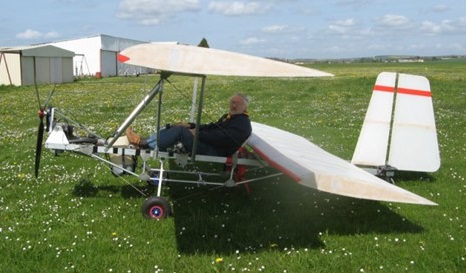
The original design, the Pouchel, was based upon the 1930s Henri Mignet-designed Mignet Pou-du-Ciel (Flying Flea), but constructed using three commercial household aluminium ladders to save construction time, cost and weight. The aircraft first flew on 14 March 1999 and 120 sets of plans were quickly sold.
When the ladder manufacturer no longer wanted to sell ladders for aircraft construction, due to liability concerns, Dalby redesigned the aircraft to use aeronautical rectangular aluminium tubing instead, which resulted in a lighter and cheaper aircraft, the Pouchel II.
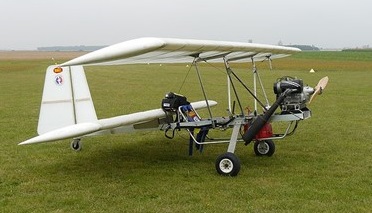
The Pouchel II replaced the original APEV Pouchel in production. The original Pouchel was constructed using three commercially available aluminium ladders, hence APEV is the Association pour la Promotion des Echelles Volantes, or in English, Association for the Promotion of Flying Ladders. Later the ladder manufacturer grew concerned about liability and refused to supply any more ladders. The Pouchel was then re-designed to use aeronautical rectangular aluminium tubing in place of the original ladders and the new aircraft was designated the Pouchel II. The Pouchel series are all derivatives of the classic 1930s Henri Mignet-designed Mignet Pou-du-Ciel (Flying Flea).
The Pouchel II features a cantilever rear wing with a strut-braced parasol front wing, a single-seat open cockpit without a windshield, fixed conventional landing gear and a single engine in tractor configuration. The aircraft is made from bolted-together aluminium tubing, with its flying surfaces covered in Dacron sailcloth. Its 6 m (19.7 ft) span front wing and 4 m (13.1 ft) span rear have a combined area of 12 m2 (130 sq ft) and both employ NACA 23112 airfoils. The prototype used a 40 hp (30 kW) Rotax 447 two-stroke powerplant, but the 35 hp (26 kW) Rotax 377 is also recommended. The 28 hp (21 kW) Hirth F-33 has also been fitted.
The Pouchel II sold for €4,000 in 2003. The APEV Pouchel II was supplied as plans or as a kit for amateur construction, but is no longer available. It has been replaced in production by the APEV Pouchel Light.
The Pouchel II was further refined into the Pouchel Light and an electric powered version, the Pouchelec.
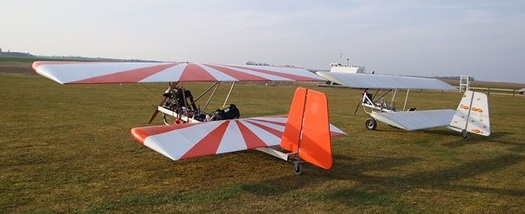
Supplied as plans or as a kit for amateur construction, the Pouchel Classic is derived from the APEV Pouchel and features a cantilever rear wing and a strut-braced front parasol wing, a single-seat open cockpit, fixed conventional landing gear and a single engine in tractor configuration.
The Pouchel Classic differs from the earlier Pouchel in that it has a newly designed wooden fuselage to replace the aluminum ladder and rectangular tube design of the Pouchel and the Pouchel II. The Pouchel Classic’s fuselage is also longer. Its 6 m (19.7 ft) span front wing and 4 m (13.1 ft) span rear wing have a combined area of 12 m2 (130 sq ft) and employ NACA 23112 airfoils. Flying surfaces are covered in Dacron sailcloth. Standard engines recommended are the 35 hp (26 kW) Rotax 377 or the 40 hp (30 kW) Rotax 447 two-stroke powerplants. The Pouchel Classic kit sold for €5,000 in 2011.
Pouchel
Seats: one
Pouchel II
Engine: 1 × Hirth F-33, 21 kW (28 hp)
Propeller: 2-bladed wooden
Upper wingspan: 6 m (19 ft 8 in)
Lower wingspan: 4 m (13 ft 1 in)
Wing area: 12 sq.m (130 sq ft)
Airfoil: NACA 23112
Empty weight: 150 kg (331 lb)
Gross weight: 275 kg (606 lb)
Fuel capacity: 12 litres (2.6 imp gal; 3.2 US gal)
Cruise speed: 90 km/h (56 mph; 49 kn)
Stall speed: 40 km/h (25 mph; 22 kn)
Never exceed speed: 120 km/h (75 mph; 65 kn)
g limits: +4/-2
Rate of climb: 2.5 m/s (490 ft/min)
Wing loading: 18.75 kg/m2 (3.84 lb/sq ft)
Crew: one
Pouchel Classic
Engine: 1 × Rotax 447, 30 kW (40 hp)
Upper wingspan: 6 m (19 ft 8 in)
Lower wingspan: 4 m (13 ft 1 in)
Wing area: 12 sq.m (130 sq ft) total
Airfoil: NACA 23112
Empty weight: 150 kg (331 lb)
Gross weight: 250 kg (551 lb)
Fuel capacity: 30 litres (6.6 imp gal; 7.9 US gal)
Cruise speed: 90 km/h (56 mph; 49 kn)
Stall speed: 40 km/h (25 mph; 22 kn)
Never exceed speed: 120 km/h (75 mph; 65 kn)
g limits: +4/-2
Rate of climb: 3 m/s (590 ft/min)
Wing loading: 20.8 kg/m2 (4.3 lb/sq ft)
Crew: one
Pouchel Light
Crew: one
Pouchelec
Engine: electric
Crew: one
Scoutchel
Crew: one
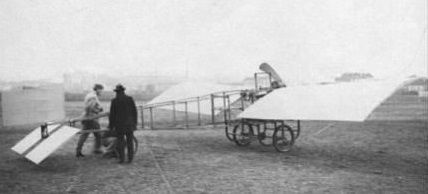
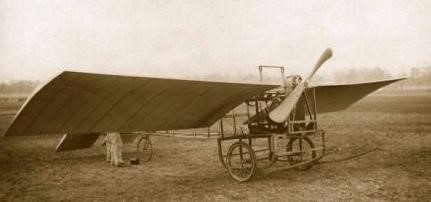
Anzani built his plane in 1909, the same year he took up flying a Voisin type machine. The Anzani had a span of 8 meters and was powered by a 3 cylinder Anzani engine with a belt drive to the propeller. The project had limited success and was financed by de Mas.

The Antonov An-181 (or product 181, Ukrainian: Виріб 181, Russian: изделие 181) project was terminated because of the lack of funds due to the collapse of the Soviet Union. An interesting feature of the plane is its unusual arc-shaped wing, a so-called Channel wing. The aircraft has two seats next to each other, a conventional fixed landing gear, a V-tailplane, and high-wing equipped with a channel wing in the area of the propellers. Power from the engine is delivered by means of drive shafts and deflection gearboxes to the two-blade propellers. The aircraft received the registration СССР-190101 and is exhibited in the State Museum of Aviation of Ukraine. Willard Ray Custer had previously built aeroplanes with the same wing concept in the USA.
Crew: 2 people
Length: 7,31 m
Wingspan: 7,3 m
Height: 2,5 m
Wing area: 7 m²
Normal take-off weight: 820 kg
Maximum take-off weight: 900 kg
Engine: AP LOM M-337A, 6 cylinders, 103 kW
Propeller diameter: 1.5 m
Maximum speed: 225 km / h
Practical range: 530 km
Service height: 4200 m
Starting distance: 70 m
Landing distance: 80 m
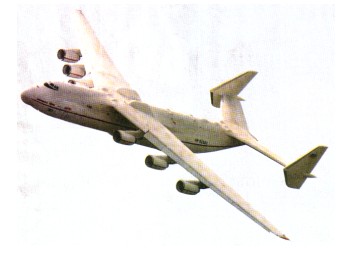
The An-225 Mriya (dream) stemmed from the need to transport large items for the Soviet space programme. In mid-1985 Antonov began the design and the An-124 provided the basis for the new aircraft, Antonov using many of the same components to keep cost and development effort down. Standard An-124, wings are grafted on to a new centre section, thereby increasing the span while keeping the engine installations the same. An additional pair of D-36T turbofans is fitted to the new centre section.
The cabin retains the same cross-sectional dimensions but with increased length, and to save weight the rear loading ramp is removed, but the An-225 retains the nose visor.
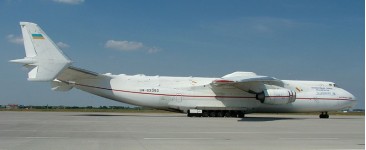
To support the increased weight, seven pairs of wheels are fitted to each side as opposed to five in the An-124.
Outsize loads are carried ‘piggy-back’, the load supported on two main attachments above the centre section. These supports and other smaller ones along the fuselage top are faired over when not in use. To avoid buffeting from the ‘piggyback’ load, the An-225 has twin vertical fins mounted on the end of a large tailplane.
The prototype made its first flight on 21 December 1988 from Hostomel Airport outside Kiev, Ukraine, and the first flew with Buran on 13 May 1989 from Baikonur cosmodrome. This combination appeared at the Paris air show in 1989, car¬rying the 62.1 tonne (136,684 lb) Buran on its back.
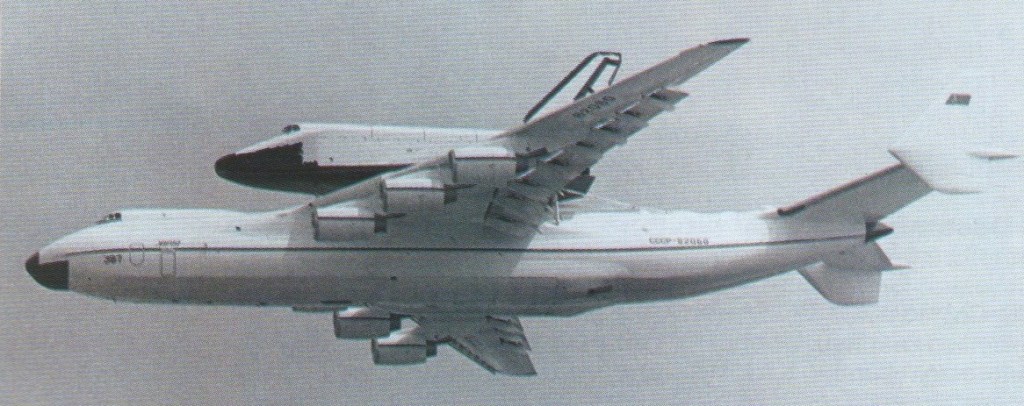
On 22 March 1989, in the course of a single 3 hr 30 minute flight from Kiev, the An-225 set 105 world and class records. With a payload of 344,576 lb / 156,300 kg, the machine took off at a weight of 1,120,370 lb / 508,200 kg. It proceeded to fly a 1243 mile / 2000 km closed circuit at an average speed of 505.24 mph / 813.09 kph and to reach a maximum altitude of 40,485 ft / 12,340 m.
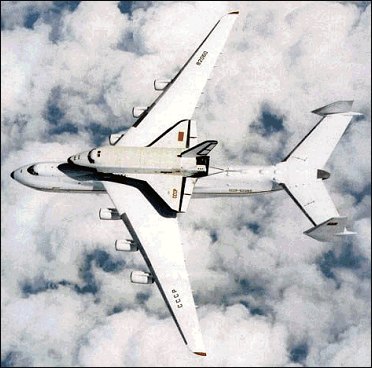
Typically, the An-225 carries two pilots, two flight engineers and two navigators, the flight system incorporating fly-by-wire controls. NATO name Cossack.
The Antonov An-225 has been extensively modified since 1988 with its six engines being updated and a strengthened fuselage being among the many changes.
The first commercial flight was performed by the An-225 in May, 1990. A T-800 tractor weighing more than 100 tons was delivered from Chelyabinsk to Yakutia.
After the collapse of the USSR the only plane stopped flying in 1994 and some parts were disassembled to be used on other planes. However by the 2000s it was restored by efforts of some Ukrainian companies. The airliner was amended a bit to meet the standards of civil aviation first flying aain on the 7th of May, 2001.
Antonov planned to finish building a second An-225 if they have financial support. 70% was ready; the centre wing-section, fuselage and a wing remained since the Soviet times. If they had a customer they would finish it, requiring $150 million.
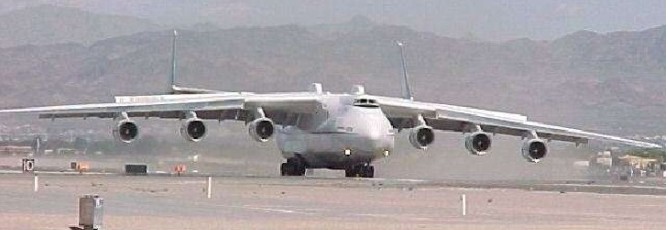
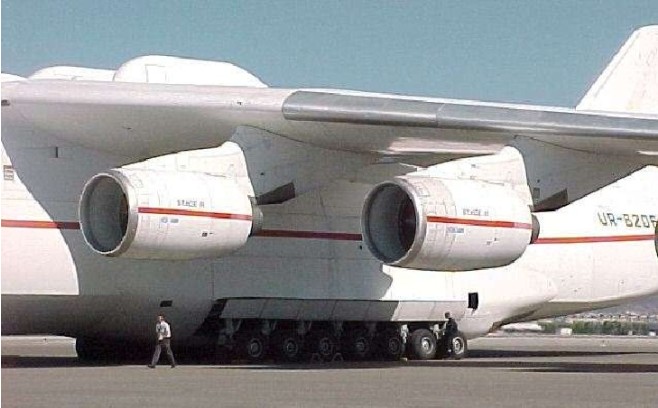
Antonov An-225 / Molniya Buran Gallery
An-225 Mriya (Cossack)
Engines: 6 x ZMKB Progress (Lotarev) D-18T turbofan, 225140 N / 22950 kp / 51,587lbs thrust
Length: 84.0 m / 275 ft 7 in
Height: 18.2 m / 59 ft 9 in
Wingspan: 290 ft / 88.4 m
Wing area: 905.0 sq.m / 9741.33 sq ft
Empty Weight: 385,809lbs (175,000kg)
Maximum Take-Off Weight: 1,322,774lbs (600,000kg)
Max. weight carried: 661500.0 lb / 300000.0 kg
Wing load: 128.74 lb/sq.ft / 628.0 kg/sq.m
Maximum Speed: 528mph (850kmh; 459kts)
Landing speed: 135 kts / 250 km/h
Cruising speed: 432 kts / 800 km/h
Range w/max.fuel: 15400 km / 9569 miles
Range w/max.payload: 4500 km / 2796 miles
Service Ceiling: 36,089ft (11,000m)
Internal cargo hold: 43m x 6.4m x 4.4m.
Crew: 4-6 +23
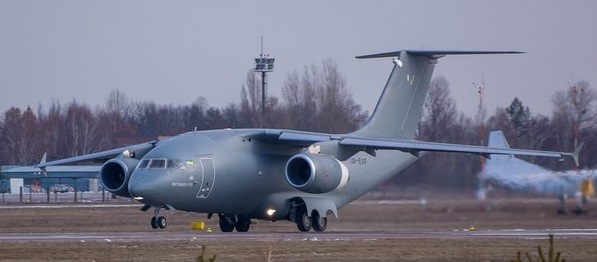
The Antonov An-178 (Ukrainian: Антонов Ан-178) is a short-range medium-airlift military transport aircraft designed by the Ukrainian Antonov company and based on the Antonov An-158 (An-148-200).
An-178 is a high-wing transport aircraft with moderately swept wing, winglets and a T-tail. The wing outer panels (including winglets), front fuselage with cockpit and nosewheel leg come from the An-158. The cargo hold is slightly enlarged, and there is an extra pair of main-wheels on each side. The airframe is made of aluminium alloys and composite materials. The fuselage is semi-monocoque with a circular cross-section. The retractable landing gear consists of two main wheel bogies and a dual nose wheel. The flight control system is dual duplex fly-by-wire system, consisting of two parts: FCS-A and FCS-B, each of which is responsible for two control channels. The flight control surfaces include ailerons near the wing tips, four control spoilers, six lift-dump/speed-brake spoilers, rudder and elevators, with an emergency mechanical cable back-up system. The powerplant consists of two Progress D-436-148FM turbofan engines, mounted on pylons under the wings and an auxiliary power unit. It can shift 18 tonnes over 1,000 km, or 10 tonnes over 4,000 km.
The aircraft was derived from the 99-seat An-158 regional airliner and was fitted with the commonized F1 fuselage nose section with the identical flight deck, wing panels, empennage and most of the onboard systems. The fuselage however was newly created with an enlarged diameter that had grown from 3.35 m to 3.9 m, which has resulted in an enlarged cargo hold – the cargo cabin cross section increased to 2.75 m by 2.75 m. Aside from the wing structure, outer panels (including winglets), front fuselage nose, cockpit and nose landing gear which come from the An-158, there is an extra pair of tandem main-wheels on each side.
The An-178 was previously known as the An-148T. The aircraft made its Western debut at the 2015 Paris Air Show.
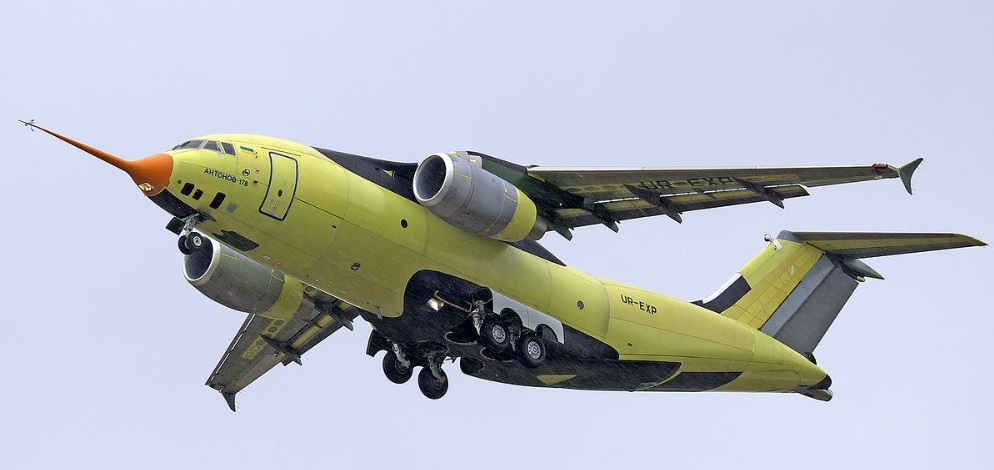
It was announced on 5 February 2010, rolled out on 16 April 2015 and the maiden flight was on 7 May 2015.
There are reports that future production-standard aircraft will have a longer wingspan while retaining the organic wing panels of the An-158. Its maximal take-off weight would increase to an estimated 56 tons. Later production variants would need turbofan engines with a thrust of about 9,500 kgf to have the characteristics required. The planned engine may be the new-generation in-development Ivchenko-Progress AI-28 turbofan. The decision was made to fit the An-178 prototype with less powerful D-436-148FM engines in the interim. The D-436-148FM is a derivative of the production-standard D-436-148 with an upgraded fan, which boosted the takeoff thrust to 7,800 kgf and at emergency power rating to 8,580 kgf.
Powerplant: 2 × Progress D-436-148FM Turbofan, 73.55 kN (16,534 lbf)
Wingspan: 30.57 m (100 ft 4 in)
Length: 32.23 m (105 ft 9 in)
Height: 9.57 m (31 ft 5 in)
Max takeoff weight: 51,000 kg (112,436 lb)
Fuel capacity: 14,650 kg (32,298 lb)
Max landing weight: 47,000 kg (103,617 lb)
Maximum speed: 990 km/h (620 mph, 530 kn)
Cruise speed: 825 km/h (513 mph, 445 kn)
Range: 4,700 km (2,900 mi, 2,500 nmi)
Ferry range: 5,300 km (3,300 mi, 2,900 nmi)
Service ceiling: 12,000 m (39,000 ft)
Landing distance: 2,500 m (8,200 ft)
Crew: 2
Capacity: 90 soldiers, 70 paratroopers, 48 on stretchers +15 seated, 8 medical modules and 12, or 16 tons of cargo, overload variant 18 tons.
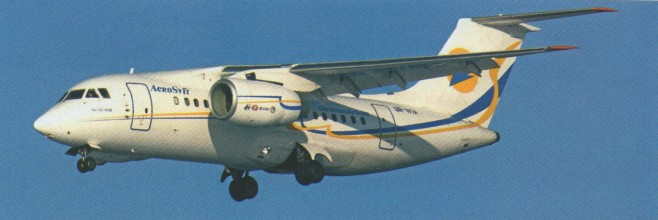
The Antonov An-148 (Ukrainian: Антонов Ан-148) is a regional jet designed and built by Antonov of Ukraine.
The beginning of the An-148 project dates to the early 1990s, when work on the Antonov An-74 passenger modification started, headed by Petro Balabuev. In 2001, the project was renamed An-148. The An-74 fuselage was extended and the new aircraft’s wing design was created from scratch. The developers initially used Motor Sich D-436-148 engines.
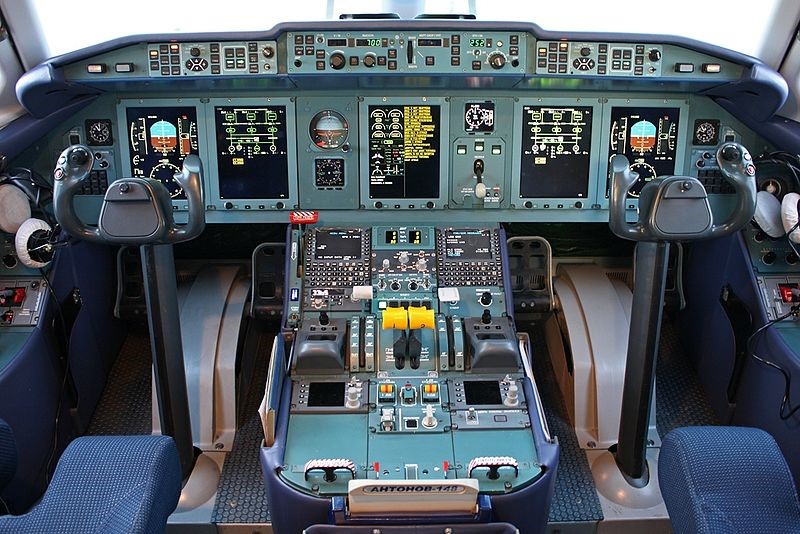
The An-148 aircraft is a high-wing monoplane with two turbofan jet engines mounted in pods under the wing. This arrangement protects the engines and wing structure against foreign object damage. A built-in autodiagnosis system, auxiliary power unit, and the wing configuration allow the An-148 to be used at poorly equipped airfields. Flight and navigation equipment features five 15 by 20 cm (5.9 by 7.9 in) liquid crystal display panels built by Russia’s Aviapribor and a fly-by-wire system.
The main landing gear rotates into the belly of the aircraft when in flight, with partial doors covering the legs, and the sides of the tires remaining exposed. Built-in entrance stairs enable boarding and disembarking the aircraft without extra ground equipment.
The An-148-100 regional aircraft is the main model of the An-148. It seats 70 passengers at 864 mm (34.0 in) or up to 80 passengers at 762 mm (30.0 in) pitch in a one-class 2+3 seating layout. The aircraft is also configurable in a multiple-class layout which can carry fewer passengers, typically with four abreast business class.

In 2002, production of the first three prototypes was begun at AVIANT. On 17 December 2004, the first prototype completed its maiden flight. The second prototype joined the testing programme in April 2005. During the certification programme, the two prototypes performed about 600 flights in total. On 26 February 2007, the aircraft, its D-436-148 engine and the AI-450-МS auxiliary power unit were certified by the Interstate Aviation Committee of Russia and the State Aviation Administration of Ukraine.
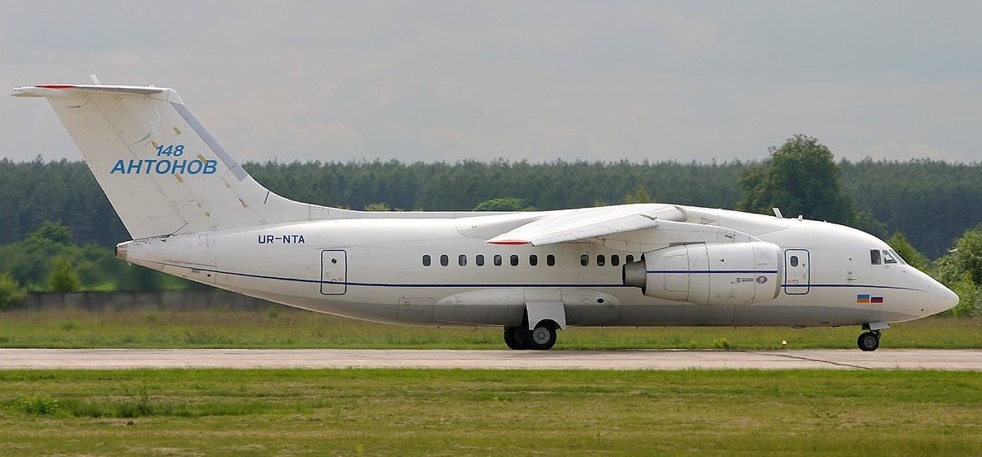
The aircraft completed its certification programme on 26 February 2007. The An-148 has a maximum range of 2,100–4,400 km (1,100–2,400 nmi; 1,300–2,700 mi) and is able to carry 68–85 passengers, depending on the configuration.
The An-148 was manufactured by the Ukrainian Kyiv AVIANT plant (now Antonov Serial Production Plant) and Russia’s Voronezh Aircraft Production Association (VASO). On 28 June 2009, the first serially produced An-148, manufactured at VASO in Voronezh, took to the skies. Although numerous companies are involved in the project, at least 70% of the aircraft’s hardware is made by Russian manufacturers. The An-148’s list price is about $24–30 million. The main problem with the project has been increasing the aircraft’s sluggish production rate. The then-independent AVIANT plant initially failed to satisfy to growing orders, leading to VASO’s growing involvement in the aircraft’s assembly. VASO announced in June 2017 that the two final Russian-assembled An-148s would be delivered, and the project would not see further development.
In April 2005, the Ilyushin Finance Leasing Company ordered the first series of An-148 for the Krasair airline. Lease agreement calls for ten aircraft with an option for five units valued at $270 million.
The Antonov An-158 is a stretched fuselage version of the aircraft, accommodating up to 100 passengers.
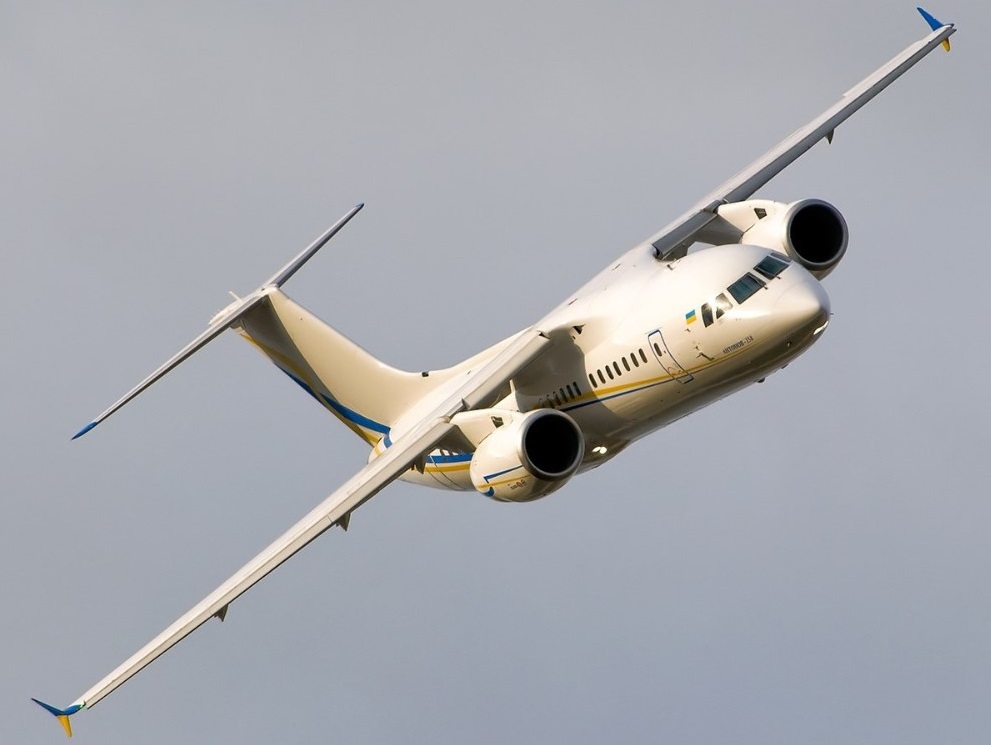
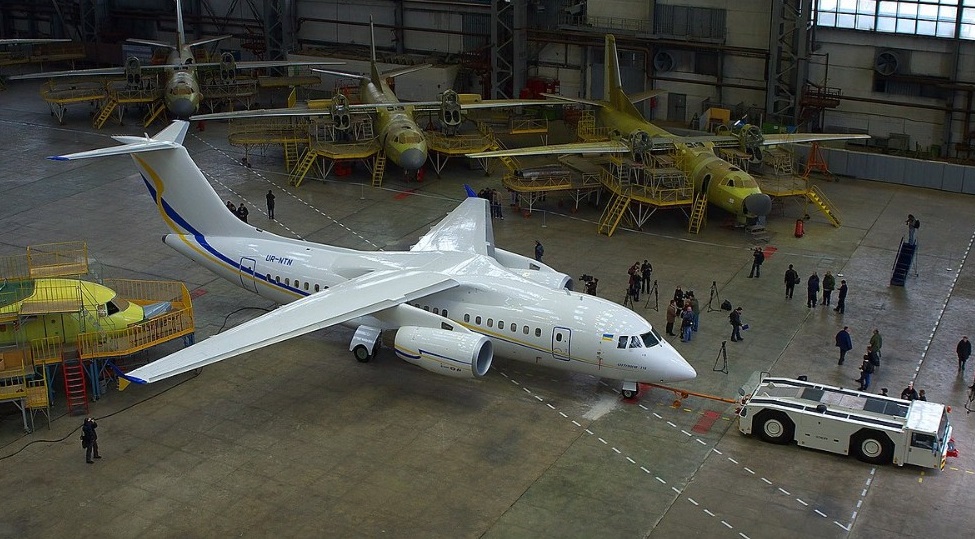
The An-158 is a 1.7m stretched fuselage version for 99 passengers in a one-class standard configuration. Other changes include the installation of wingtip fences. The airplane successfully completed its first flight on 28 April 2010, with flight certification tests were planned to be completed before the end of 2010; on 3 March 2011, it was given Russian certification.
After flight and land test in night lands airports of Ecuador (Latacunga / Cotopaxi International Airport, 2806 m AMSL) and Bolivia (La Paz / El Alto International Airport, 4061 m AMSL) in November 2013 prepare documentation for obtaining correspondent supplements to the type certificate of this airplane.
On 2 June 2009, the first An-148 entered commercial service with the Ukrainian carrier Aerosvit. The first passenger flight was from Kharkiv to Kyiv; the aircraft had the civilian registration UR-NTA. By November 2009, Aerosvit was operating the An-148 on the Kyiv–Odessa and Simferopol–Lviv routes, performing two flights a day with the average flight time of 4–5 hours.
On 21 December 2009, the An-148 was put into service in Russia with Rossiya airline. The first passenger flight was FV135 from Pulkovo Airport in Saint Petersburg to Sheremetyevo International Airport in Moscow. By 20 May 2010, Rossiya’s An-148 fleet had accumulated a total of 915 flight hours and performed 710 landings. Rossiya complained that the aircraft experienced some reliability problems. There were some technical problems with the aircraft, and pilot training could not be ramped up fast enough, leading to pilot shortages. However, by 2011 the situation had improved.
On 15 February 2010, the An-148 started international flights to the European Union (Poland) with the Aerosvit airline.
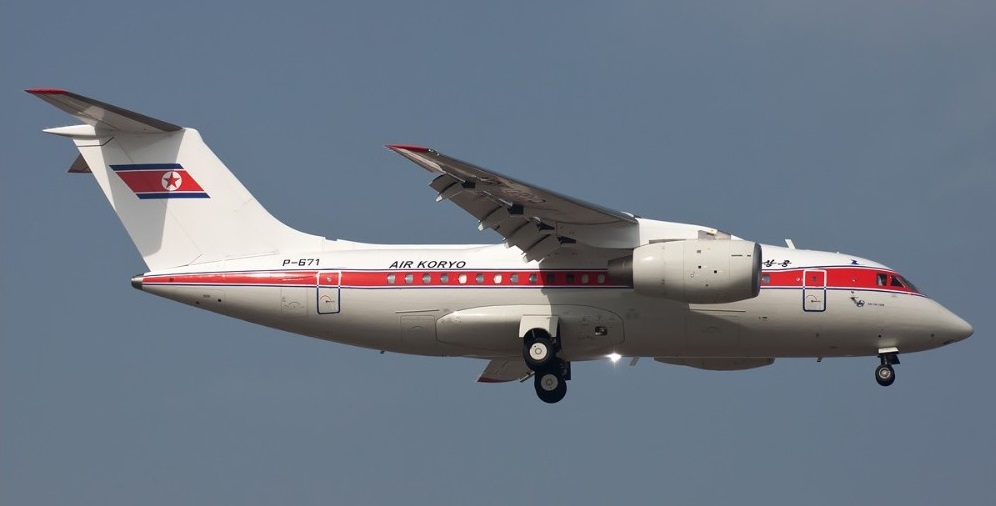
On 18 April 2013, the first serial An-158 version was delivered to the Cuban flagship airline Cubana de Aviación. According to Antonov, Cubana additionally ordered two more aircraft, while other sources report this order to be for ten aircraft. On 28 April 2013, Ukraine’s Antonov aircraft maker handed over a third An-158 passenger airliner to Cuba and signed a contract for the delivery of three more.
Following a crash in February 2018, all An-148 and An-158 in Russia were grounded by the Russian Ministry of Transport. In addition, Cubana grounded its An-158 fleet as of May 2018 due to several technical issues with the aircraft. Until late 2018, the Antonov An-148 aircraft was also being produced in Russia by Voronezh Aircraft Production Association; however, due to the souring political relationship between Ukraine and Russia, production in Russia was discontinued. The last Russian-built An-148 was completed in October 2018.
In April 2016, Indian company Reliance defense limited and Antonov entered into an agreement to construct an aircraft based on An 148/ An 158 for defense and commercial purposes.
In April 2017, Cubana de Aviación suspended its flights between Havana and Guantánamo due to “technical problems” with its An-158 fleet. The route from Havana to Holguín also had problems: of 116 planned flights in the first months of 2017, 38 were cancelled and 36 suffered significant delays. Yoanka Acosta, head of Cubana’s commercial division, explained that the planes were leased from Ukraine but spare parts were sourced from Russia, so the state of conflict between the two countries had affected the supply of parts, making maintenance difficult. In late April, however, representatives from Antonov and Cubana met and signed a service agreement that extended the aircraft’s navigation directives to 3,600 flights and guaranteed the supply of spare parts, although it did not specify a date for normalization.
In March 2018 Rostransnadzor suspended all flights of An-148 in Russia after crash on 11 February 2018.
In May 2018, Cubana de Aviación grounded its An-158 fleet after it received an order from the Cuban National Aviation Authority. The official reason given by the Cuban National Aviation Authority was “multiple and repeating failures have been found in complex systems, built by mechanical, hydraulic and electrical components, as well as computer performance algorithms”, in addition to “evidence of design and manufacturing flaws, serious issues in flight control system, cracks in the structure and engine temperature increase above normal parameters”.
On 5 March 2011, an Antonov An-148 (assembled by VASO) carrying test registration 61708 crashed during a test flight in Russia’s Belgorod Oblast after an inflight breakup, killing all six crew members on board. An investigation commission found that the crew permitted the aircraft to accelerate more than 60 knots above its “Never Exceed” speed in an emergency descent, which led to the inflight breakup. Witnesses on the ground reported a wing had separated from the aircraft in flight. The aircraft was due to be delivered to Myanmar.
On 11 February 2018, an Antonov An-148 operating as Saratov Airlines Flight 703, crashed shortly after takeoff near Ramenskoye, outside of Moscow. The aircraft was carrying 65 passengers and six crew members. There were no survivors. This is the first fatal commercial accident for this aircraft type.
At least 47 were built.
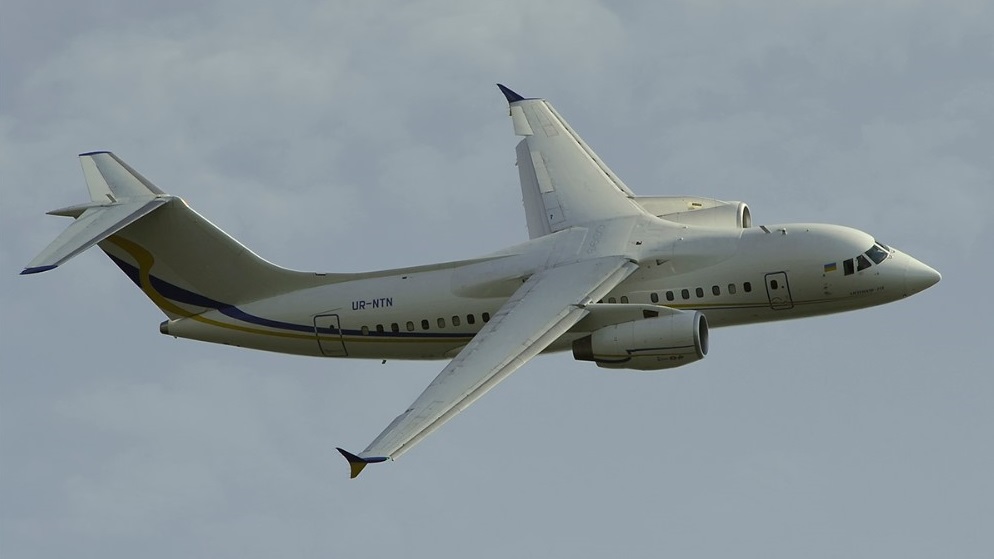
Versions
An-148-100A
main version of the An-148. It has a passenger capacity of 85 in a one-class dense configuration or 68 in a two-class configuration, and a range of 2,100 km (1,100 nmi; 1,300 mi)
An-148-100B
extended-range version, up to 3,500 km (1,900 nmi; 2,200 mi)
An-148-100E
extended-range version, up to 4,400 km (2,400 nmi; 2,700 mi) and a maximum takeoff weight (MTOW) of 43.7 t (43,700 kg; 96,000 lb)
An-148-200
unified with An-158 by the rear part of the fuselage. Hence maximum seating capacity is increased to 89 passengers in dense configuration, comparing to 85 for An-148-100. Planned for production in Kyiv with An-158.
An-148-300
previously called An-168, business variant, seating 8-40 passengers, with a range up to 7,000 km (3,800 nmi; 4,300 mi)
Specifications:
148-100E
Engines: 2 x Progress D-436-148, 14,000 lbf; 63 kN
Wingspan: 28.91 m (94 ft 10 in)
Wing area: 87.32 m2 (939.9 sq ft)
Length: 29.13 m (95 ft 7 in)
Height: 8.19 m (26 ft 10 in)
MTOW: 43,700 kg (96,300 lb)
Max. payload: 9,000 kg (20,000 lb)
OEW: 22,000 kg (49,000 lb)
Max. fuel: 12,050 kg (26,570 lb)
Ceiling: 12,200 m (40,000 ft)
Cruise: 800 to 870 km/h (430 to 470 kn)
Range (75 pax/max): 4,400 km (2,400 nmi)
Fuel burn: 1,650 kg/h (3,600 lb/h)
Take off run (MTOW): 1,885 m (6,184 ft)
Seats: 68–85
Seat pitch: 30–35 in
Cargo: 14.60 m3 (516 cu ft)
Cabin: 3.15 m (10 ft 4 in) width × 2.00 m (6 ft 7 in) height
Cockpit crew: 2
An-158
Engines: 2 x Progress D-436, 15,100 lbf; 67.0 kN
Wingspan: 28.91 m (94 ft 10 in)
Wing area: 87.32 m2 (939.9 sq ft)
Length: 30.83 m (101 ft 2 in)
Height: 8.19 m (26 ft 10 in)
MTOW: 43,700 kg (96,300 lb)
Max. payload: 5,000 kg (11,000 lb)
OEW: 22,000 kg (49,000 lb)
Max. fuel: 12,050 kg (26,570 lb)
Ceiling: 12,200 m (40,000 ft)
Cruise: 800 to 870 km/h (430 to 470 kn)
Range (75 pax/max): 2,500 km (1,300 nmi)
Fuel burn: 1,800 kg/h (4,000 lb/h)
Take off run (MTOW): 1,900 m (6,200 ft)
Cockpit crew: 2
Seats: 86–99
Seat pitch: 30–34 in
Cabin: 3.15 m (10 ft 4 in) width × 2.00 m (6 ft 7 in) height
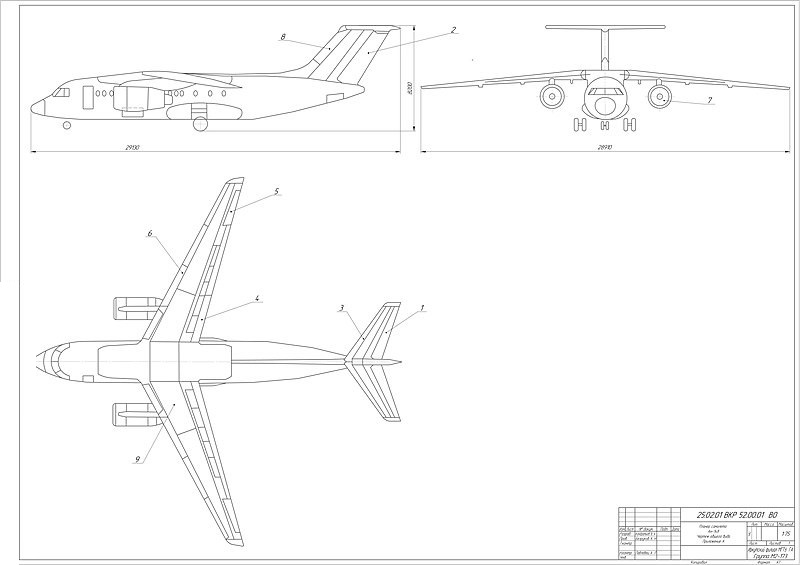
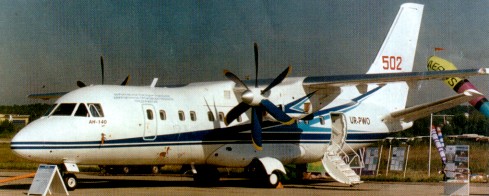
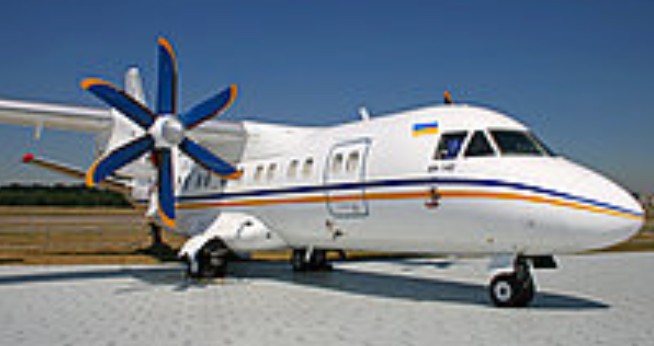
The An-140 (first flown September 1997) short-haul regional airliner was planned to supersede the An-24.
An agreement for licence production by Iranian Aviation called ‘Iran-140’ was signed in 1993. The first aircraft, supplied as a kit, flew on 7 February 2001.
Seats: 46-52.