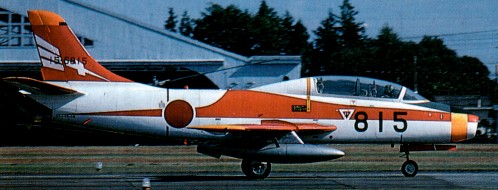
First post-war jet aircraft of Japanese design, the prototype T1F2 flew for the first time on January 19, 1958, powered by a 4,000 lb thrust Bristol Siddeley Orpheus 805 turbo-jet. Two production batches of 20 of this version were built as standard two-seat intermediate jet trainers for the Japanese Air Self-Defence Force, under the designation T1A.
They were followed by the all-Japanese T1F1 (JASDF designation TIB) with a 2,645 lb thrust J3 IHI 3 turbojet produced by Ishikawajima-Harima. The prototype of this version flew on May 17, 1960, and 20 production models were ordered by the JASDF for delivery between August 1962 and March 1963.
Fuji T1F2 (T1A)
T1A / T1F2 Engine: 1 x 4,000 lbs.t. (1814 kgp) Bristol Siddeley Orpheus 80506. Span: 34 ft 5.5 in (10.5 m) Length: 39 ft 9.25 in (12.12 m) Wing area: 239 sq.ft (22.22 sq.m) Height: 13ft 3in Empty weight: 5,335 lb (2 420 kg) Loaded weight: 9,150 lb (4 238 kg) Gross weight: 10,6701b Max speed: 576 mph (921 kph) at 20,000ft (6100 m) Cruise: 397 mph (640 kph) Initial climb: 3,460 fpm (17.3 m/sec) Ceiling: 52,490 ft (16000 m) Range: 806 mls (1297 km). Max rate of climb at SL: 6,100 ft/min
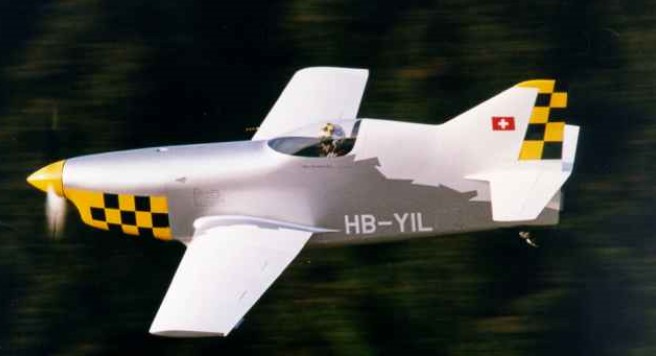
The Valentino Fry Esprit VFII has flaps on rear fuselage, both sides, mechanically actuated. The Al 6061 landing gear has hydraulically actuated brakes, with 500×5 Celeveland units.
The VF-II SC is the supercharged version of the VF-II. It is equipped with a LOM Praha M-332 AK Engine and a MTV 175-7 3 blade propeller.
Esprit VFII Engine: Rolls-Royce O-200A Wing Span: 6.090 m Length: 5.600 m Height @ Cockpit: 1.200 m Height @ Tail: 1.750 m Wing Area: 6.056 sq.m Elevator Area: 0.79 sq.m Empty Weight: 358 kg MTOW: 490 kg Wing Load: 81 kg/sq.m Fuel capacity: 65 lt AVAGAS 100 LL Propeller: MTV-1F / 170-08 VF II (Mühlbauer) Electrical Constant Speed Propeller Prop Diameter: 1700mm Top level speed @ 500ft MSL: 185 kt Design speed vd: 230 kt Never exceed speed vne: 206 kt Manouver speed va: 133 kt Stall speed, power off vso: 54 kt Best rate of climb speed vy: 74 kt Practical climb speed: 100 kt Best rate of climb: 1800 ft/min max. positive load: 6g max negative load: 3g
Esprit VFII SC Engine: LOM Praha M-332 AK Propeller: MTV 175-7 (Mühlbauer) Constant Speed Propeller (electrical) 3 blade Prop Diameter: 1750mm Wing Span: 6.090 m Length: 6.000 m Height @ Cockpit: 1.200 m Height @ Tail: 1.750 m Wing Area: 6.056 sq.m Elevator Area: 0.79 sq.m Empty Weight: 365 kg MTOW: 490 kg Wing Load: 81 kg/sq.m Fuel 65 lt, 78-98 oct Automotive Max speed: 205 kt (IAS) Max speed @ 7000 ft: 195 kts (TAS) Max speed @ 12000 ft: 210 kts (TAS) Design speed vd: 230 kt Manouver speed va: 133 kt Stall speed, power off vso: 54 kt Best rate of climb speed vy: 74 kt Practical climb speed: 100 kt Best rate of climb: 2700 ft/min max. positive load: 6g max negative load: 3g
A metal monocoque aircraft kit with 2 seats side by side. The MD-11 can accommodate engines up to 200hp. Built with 2024 T-3 aluminium. First flown in 1993. The standard kit price in 1996 was US$19,500.
Engine: Franklin, 120 hp. HP range: 100-180. Height: 6 ft. Length: 24.5 ft. Wing span: 29.5 ft. Wing area: 155.9 sq.ft. Weight empty: 925 lbs. Gross: 1800 lbs. Speed max: 180 mph. Cruise: 125 mph. Range: 875 sm. Stall: 40 mph. ROC: 1000 fpm. Take-off dist: 500 ft. Landing dist: 400 ft. Service ceiling: 16,000 ft. Seats: 2. Landing gear: tail wheel. Cabin width: 43 in
Engine: Walter Lom, 140 hp HP range: 100-200 Fuel capacity: 43 USG Height: 6.5 ft Length: 27.5 ft Wing span: 29.5 ft Wing area: 177 sq.ft Empty weight: 1150 lb Gross weight: 2000 lb Top speed: 200 mph Cruise: 150 mph Stall: 35 mph Range: 700 sm Rate of climb: 1000 fpm Takeoff dist: 500 ft Landing dist: 400 ft Service ceiling: 16,000 ft Seats: 2 Landing gear: tail Cabin width: 43 in
Engine: Lycoming HP range: 150-180 Height: 6.5 ft Length: 27.5 ft Wing span: 29.5 ft Wing area: 177 sq.ft Fuel capacity: 43 USG Empty weight: 1150 lb Gross weight: 2000 lb Top speed: 200 mph Cruise: 150 mph Stall: 35 mph Range: 700 sm Rate of climb: 1000 fpm Takeoff dist: 500 ft Landing dist: 400 ft Service ceiling: 16,000 ft Seats: 2 Landing gear: tail Cabin width: 43 in
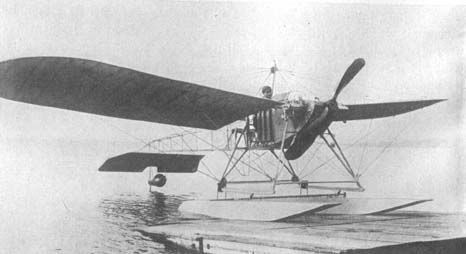
A 1913 development of the floatplane of the Swiss engineer Grandjean, who had patented floats with coils (in German: “Schwimmerabfedering”). Characteristic of this wing warping monoplane is its Orlikon engine of 50 hp, radiators at the fuselage sides and completely open fuselage behind the pilot seat.
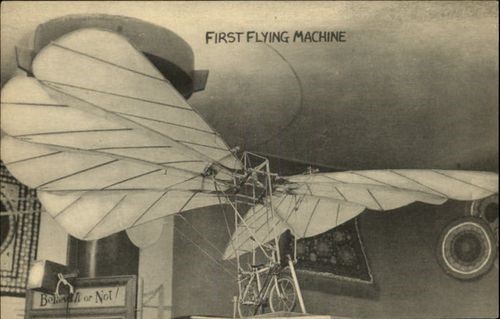
As a youth living in Russia, Oskar Freymann had observed eagles in flight and determined to build a flying machine based on the actions he saw. After emigrating to America in 1895 he worked in a bicycle shop in Brooklyn. Freymann soon built his flying machine, with four wings operated by the pedaling action of a bicycle, and handle bars that moved a rudder at the rear. In November 1896, Freymann and three other men trucked the machine to an open field in Flatbush. He claimed to have pedaled furiously and flown the ornithopter to an altitude of 14 feet – but this is quite doubtful. In any event the machine was damaged during the trial and never rebuilt. Freymann ultimately planned on building a larger, gasoline-powered ornithopter on a tricycle, but ran out of money and abandoned the project. The model – seen here in 1939 on display at the Ripley’s “Believe It or Not!” Odditorium in New York – was built by Freymann in 1895, to help him work out the wing-flapping system. It currently resides at the Cradle of Aviation Museum in East Garden City, New York.
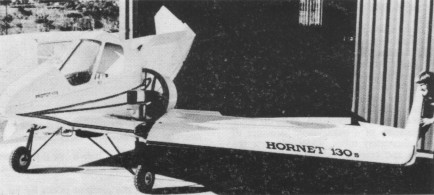
Single-seat single-engined low-wing monoplane with conventional three-axis control. Wing has swept back leading and trailing edges, and tapering chord; no tail. Pitch/roll control by stabilator; yaw control by tip rudders; control inputs through stick for pitch/roll and pedals for yaw. Cantilever wing; 100% double-surface. Undercarriage has three wheels in tall-dragger formation; rubber suspension on main wheels. Composite construction fuselage, totally enclosed. Engine mounted above wing driving pusher propeller. The David Betteridge designed Hornet (which should not be confused with the British manufacturer of the same name) is one of the most innovative designs to come from Australia, especially considering that the aircraft was originally conceived in 1977. At that time Free Flight was a hang-glider producer, and it was David’s involvement which got the Hornet project started. Construction of what was originally intended to be a rigid-wing powered hang-glider began in early 1978 and the first non-flying prototype was exhibited at the Schofields Airshow in Sydney that year, finally taking to the air on 8 March 1979 in the hands of Colin Scott. From that prototype the Hornet 130S evolved – a tail-less composite-construction machine with a tapered swept-back wing and ailerons which can be used together to act as elevators, in a similar fashion to the stabilators of a Mitchell Wing B10. Like the latter, yaw control is by tip rudders. As an aid to portability, the wings fold upward and rearward, giving a package for transport which is only 15.1 ft long x 7.5 ft wide (4.6 x 2.3 m). Wing structure consists of a 4.5 inch (114mm) diameter aluminium alloy spar tube reinforced with riveted flanges over the inboard section. Bonded and riveted to this tube are moulded glass-fibre ribs, supporting a C-section alclad rear spar. The leading edge is a U-section glass-fibre moulding with a spruce stiffener. Wing covering is glass-fibre sheet. The fuselage is predominantly glass-fibre too, moulded around paper-honeycomb bulkheads. Early versions of the 130S used a Lock Laird 0-500-2 four-stroke opposed twin giving 36 hp, but later the company switched to a fuel-injected version of the Koenig three cylinder radial, coupled to a direct-drive three-blade ducted fan.
Engine: Konig SC430 engine. Max power 30hp at 4500rpm. Propeller: three blade. No reduction. Power per unit area 0.23hp/sq.ft, 2.5 hp/sq.m. Empty weight 2291b, 104kg. Max take-off weight 397 1b, 180kg. Payload 168 1b, 76 kg. Max wing loading 3.08 1b/sq.ft, 15.0 kg/sq.m. Max power loading 13.2 1b/hp, 6.0 kg/hp. Load factors +6.6, -3.3 design; +8.0, ultimate. Length overall 9.8ft, 3.0m. Height overall 5.6ft, 1.70m. Wing span 25.9ft, 7.90m. Mean chord 5.0ft, 1.52m. Dihedral 2 deg. Sweepback 18 deg. Total wing area 129 sq.ft, 12.0sq.m. Wing aspect ratio 5.2/1. Max level speed 127mph, 204kph. Cruising speed 98mph, 158 kph. Stalling speed 35 mph, 56 kph. Max climb rate at sea level 790 ft/min, 4.0 m/s. Best glide ratio with power off 16/1. Take-off distance 200ft, 60m. Landing distance 350 ft, 105 m.
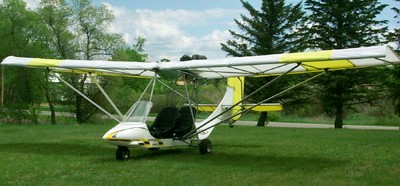
The LiteSport Classic is a side by side, Experimental/UltraLight comes standard with the high lift wing. Like all FBI Aircraft, the Classic has detachable wings for simple trailering. These LSA aircraft come standard with all anodized aluminum, side by side two seater controllable from either seat, with a fiberglass nose cone, hydraulic brakes, and polished aluminum wheels.
LiteSport Classic Cruise: 75 mph Stall: 36 mph Rate of climb: 800 fpm Takeoff dist: 300 ft Landing dist: 300 ft Engine: Rotax 503, 52 hp HP range: 52-85 Fuel capacity: 10 USG Empty weight: 440 lb Gross weight: 870 lb Length: 16.8 ft Wing span: 28 ft Wing area: 142 sq.ft Seats: 2 Cockpit width: 42 in Landing gear: nose LSA: yes
LiteSport Ultra Cruise: 55 mph Stall: 22 mph Range: 90 sm Rate of climb: 850 fpm Takeoff dist: 75 ft Landing dist: 150 ft Engine: Rotax 447 Fuel capacity: 5 USG Empty weight: 330 lb Gross weight: 530 lb Length: 15.6 ft Wing span: 26 ft Wing area: 142 sq.ft Seats: 1 Cockpit width: 22 in Landing gear: nose LSA: yes
LiteSport II Cruise: 75 mph Stall: 32 mph Range: 160 sm Rate of climb: 800 fpm Takeoff dist: 250 ft Landing dist: 150 ft Engine: Rotax 503, 48 hp HP range: 48-80 Fuel capacity: 8.5 USG Empty weight: 375 lb Gross weight: 900 lb Length: 15.2 ft Wing span: 26 ft Wing area: 142 sq.ft Cockpit width: 22 in Seats: 2 Landing gear: nose LSA: yes


 All Aero