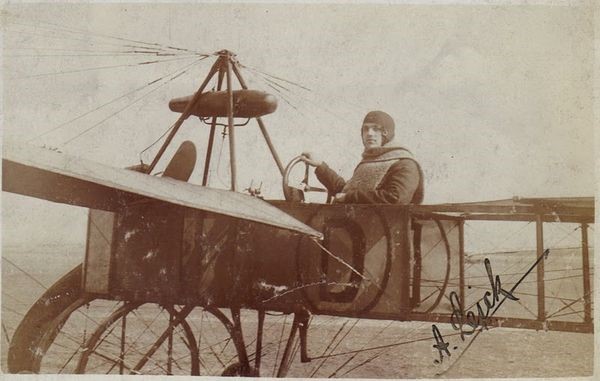
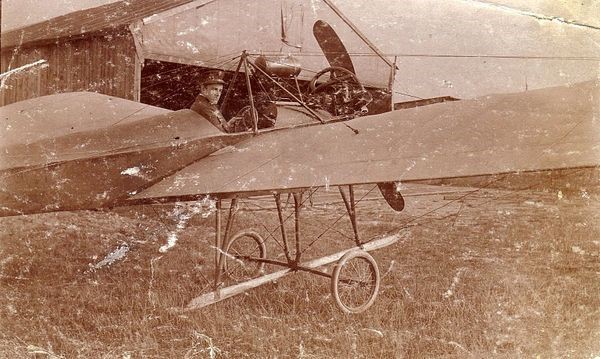
A construction of “Gesellschaft für Flugmaschinen- und Apparatenbau” at Bonn-Hangelar; designed and built by Dr. Josef Hoos – a “Kölner” – and a flyer since 1911. Similar monoplanes were built in “some” numbers during 1910-13, with various engines and used by the Hoos flying school up until 1914 – at first in Cologne and from December 1913 in Bonn-Hangelar.
The earlier G.E.F.A. eindeckers (of 1911/12) had a small rudder, the later rudders were larger. This example, probably a later model with a partially covered fuselage, is shown at Hangelar Flugplatz in early 1914 with flight-student Albert Leick seated.
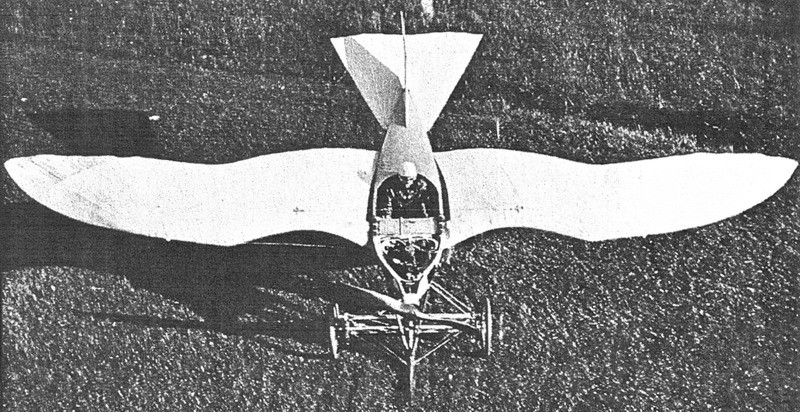
Development of the machine started in December 1909. It was powered by a 12 hp engine driving a two-bladed tractor propeller. The undercarriage was a tricycle construction with a strong skid in the middle of the front wheels. The characteristic wing – later the trademark of the Geest Möwe Eindecker types – was based on earlier work of Alois Wolfmüller. The machine was not tested as Wolfmüller realized that the machine would not reach the required speed to get into the air.
The Geest Flugzeugbau GmbH Möwe 2 was built at L.V.G. in Johannisthal during the second part of 1911. The idea was to build a Morane E.D fuselage with a Geest’s wing, but the result looks quite different. The engine was a 70 hp Gnome. It was successfully flown before winter by the L.V.G. pilot Alois Stiploschek. Some time later, it crashed.
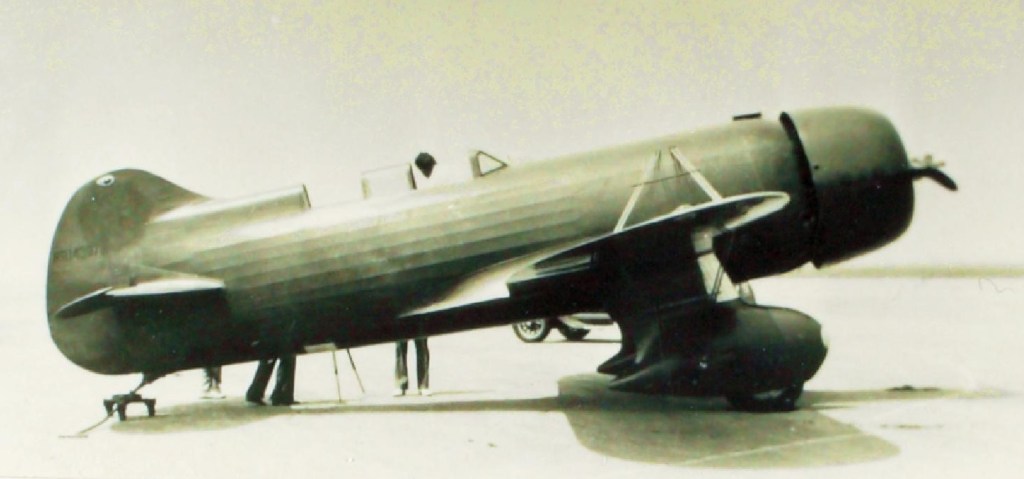
After liquidation the workforce built the QED, and the ‘Time Flies’ a racer for Frank Hawks. The Gee Bee R6 (later designated Q.E.D.) was designed and built as a two place transcontinental air racer specifically to complete in the MacRobertson Trophy Race – a transcontinental air race from London to Melbourne, Australia. The QED was powered by a 650 hp P&W R-1690 Hornet engine.
The QED did not finish the MacRobertson Trophy Race only reaching Bucharest and in 1939 was sold to Mexican competition pilot Francisco Sarabia.
After setting a new speed record from Mexico City to New York City in 10 hrs 48 minutes, tragedy struck and Sarabia was killed when the engine quit on take off from Washington D.C. and the aircraft plunged into the Potomac River.
The Q.E.D. was not badly damaged, and was restored and is now on display in Mexico as a tribute to Francisco Sarabia.
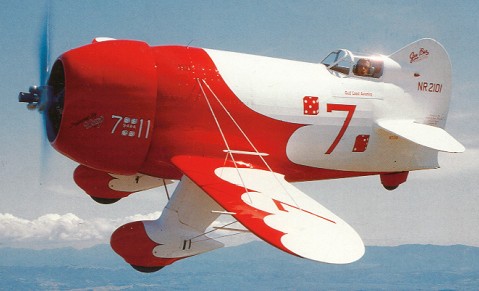
The Granvilles and their new chief engineer, Howell “Pete” Miller, came up with two of the most powerful models yet—the R Series Super Sportsters, race numbers 7 and 11—tailor-made to win the 1932 Nationals. For the Bendix there was No. 7, the Wasp Jr.-powered R 2; for the Thompson Trophy event there was No. 11, the Gee Bee R 1.
Gee Bee R 2 Super Sportster
P&W R-985, 535 hp Built for the Bendix trophy. 302 USG fuel cap. Fixed tailwheel.
The Granvilles and their new chief engineer, Howell “Pete” Miller, came up with two of the most powerful models yet—the R Series Super Sportsters, race numbers 7 and 11—tailor-made to win the 1932 Nationals. For the Bendix there was No. 7, the Wasp Jr.-powered R 2; for the 1932 Thompson Trophy event there was No. 11, the Gee Bee R 1.
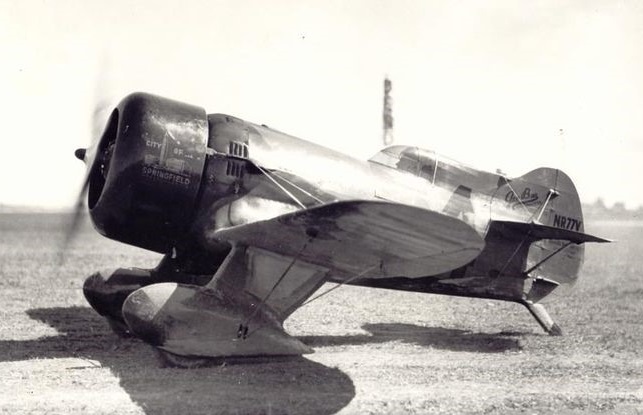
The Granvilles needed a pilot, and Jimmy Doolittle needed a plane. Doolittle flew to Springfield for a look. The Granvilles rolled out their creation, in a scalloped, black-piped, red-and-white paint scheme, set off by red 11s and dice showing 5 and 6. The R 1, essentially a scaled-up version of the Model Z, struck Doolittle as “all engine with minuscule wings and a bomblike fuselage.” The Granvilles had simply streamlined a Wasp Sr. engine with a modicum of bodywork, adding just enough wing and control surface area to keep it airborne, barely under control, and moving at nearly 300 mph.
Doolittle knew the airplane would be “extremely hot to handle.” After his one brief test flight, Boardman had reported severe directional instability, and the Granvilles had added two square feet of fin to the rudder. Doolittle clambered into the cockpit and asked that the engine be fired up. As the Wasp Sr. roared to life, one of the Granvilles, no doubt thinking ahead to locating the wreckage, asked where he was headed.
“I’m going to Cleveland, of course!” answered Doolittle. He took off and, without even a turn around the field, headed west. In less than two hours the Granvilles received a telegram: “Landed in Cleveland O.K., Jim.”
Super Sportster R-1 Engine: Pratt & Whitney R-1340, 800 hp Length: 17.749 ft / 5.41 m Height: 8.104 ft / 2.47 m Wingspan: 25.0 ft / 7.62 m Wing area: 79.654 sq.ft / 7.4 sq.m Max take off weight: 3065.0 lb / 1390.0 kg Weight empty: 1841.2 lb / 835.0 kg Max. speed: 254 kt / 470 km/h Landing speed: 103 kt / 190 km/h Service ceiling: 4921 ft / 1500 m Wing loading: 38.54 lb/sq.ft / 188.0 kg/sq.m Endurance: 1 h Crew: 1 Fuel capacity 160 USG. Steerable tailwheel.
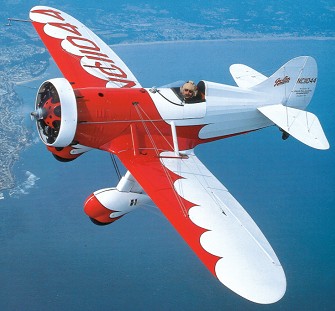
The Granville brothers first Gee Bee Sportster were fairly orthodox: but in 1931 they produced the Super Sportster Model Z which was pure racer, with a huge radial engine in a barrel like fuselage, stubby braced wings and enormous wheel spats. With an engine borrowed from Pratt & Whitney and propeller borrowed from Curtiss, the Gee Bee Model Z Sportser entered competition. In one race, the Gee Bee averaged 267.342 miles per hour, the fastest speed ever recorded for a land plane. Later in the year with a upgraded 800-hp Pratt & Whitney R-1340, the model Z was clock in at 281.75 mph. Piloted by Lowell Bayles it won the 1931 Thompson Trophy Race at 236 mph. In December 1931, while trying to set a new air speed record, Lowell Bayles had crashed in the Gee Bee and died. Movie footage and analysis of the wreckage revealed that a loose fuel cap had come off and smashed the Model Z’s canopy, causing Bayles to lose control
Engine 535-hp, supercharged Pratt & Whitney R-985 Wasp Jr. Span 25 ft Length 17 ft. 9 in Height 8 ft. 2 in Wing area 75 sq. ft Gross wt. 2,280 lb Empty wt. 1,400 lb Fuel capacity 103 USG Top speed 270 mph. Cruise speed 230 mph. Seats 1



 All Aero