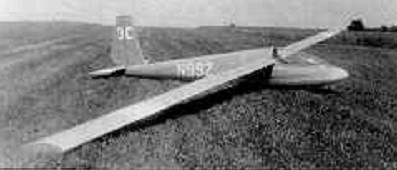
The fourth glider in the GAL.56 research series was built as the GAL.61. The GAL.61 placed the pilot in a blister on the pot side whilst the observer was in a prone position on the starboard side with a window in the wing leading edge.
The glider was of all wooden construction. No fins or rudders were fitted, directional control being by drag rudders in the wingtips. The wing was symmetrical with cusped trailing edge. Split trailing edge flaps of 20% chord were hydraulically operated.
The undercarriage was hydraulically operated retractable tricycle.
Wingspan: 15.84 m / 51 ft 11.5 in Overall length: 7.53 m / 24 ft 8.3 in Aspect ratio: 5.94 Wing area: 41.8 sq.m / 450 sq.ft Empty weight: 1972 kg / 4348 lb AUW: 2350 kg / 5174 lb Mean sweepback: 35 degrees Max speed: 322 kph / 200 mph Towing speed: 242 kph / 150 mph
The General Aircraft GAL.58 Hamilcar 10 was a powered version of the Hamilcar 1 to AM Spec X.4/44, for Far-Easton Sector operations. The glider was fitted with two Bristol Mercury engines of 965 hp each, to enable the glider to maintain level flight when lightly loaded.
Wing span: 110.007 ft / 33.53 m Wing area: 1657.441 sq.ft / 153.980 sq.m Length: 68.012 ft / 20.73 m Height: 20.243 ft / 6.17 m Max take off weight: 45,500 lb / 20,412 kg Weight empty: 25,510 lb / 11,571 kg Aspect ratio: 7.3 Wing section: RAF 34 modified Max speed: 145 mph / 233 kg Max speed: 112 mph at 32,500 lb Cruise: 180 kph at 14,742 kg
The General Aircraft GAL.55 was a two-seat training glider designed and built by General Aircraft Ltd to AM Spec TX.3/43 to train transport glider pilots.
Wings were built from spruce and plywood, the fuselage being made out of steel tubes faired with wooden formers and fabric covered.
Side-by-side seating with amber panels for daytime night flying.
The undercarriage was tricycle, of fixed centres, plus tail bumper. Dive brakes were fitted, plus bellows-operated split tailing edge flaps.
The first flights wee around the end of 1943, a Westland Lysander being used for towing.
Wingspan: 10.71 m / 35 ft 1.5 in Length: 7.79 m / 25 ft 6.5 in Wing area: 16.74 sq.m / 182 sq.ft Aspect ratio: 6.8 Empty weight: 747.4 kg / 1650 lb AUW: 1066 kg / 2350 lb Max speed: 362 kph / 225 mph Max tow speed: 282 kph / 175 mph Stall: 100 kph / 62 mph flaps up / 87 kph / 54 mph flaps down
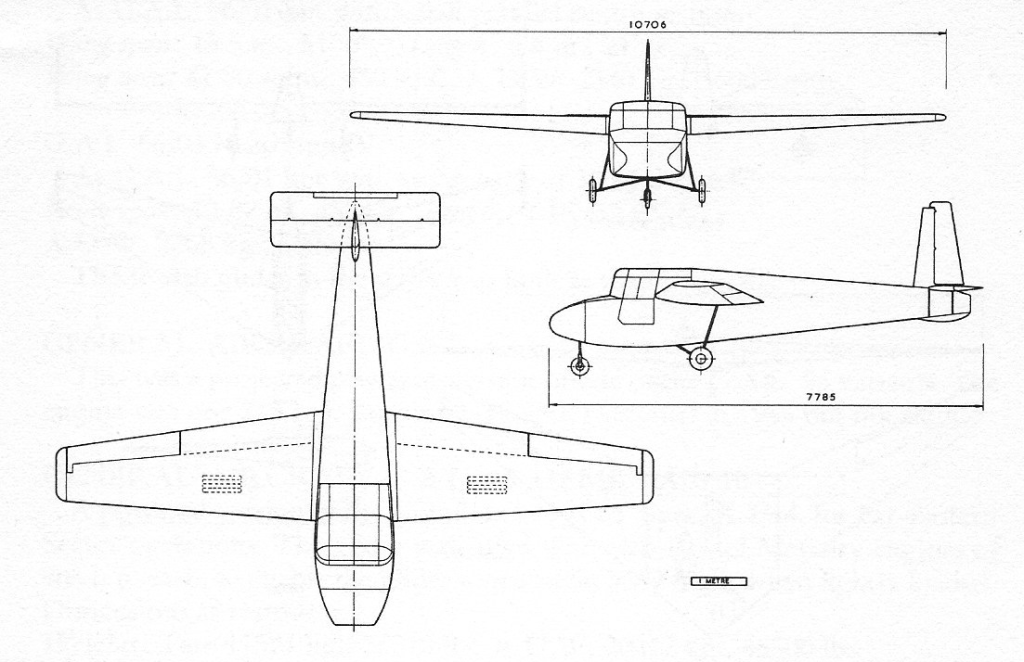
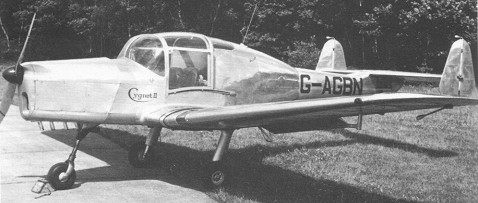
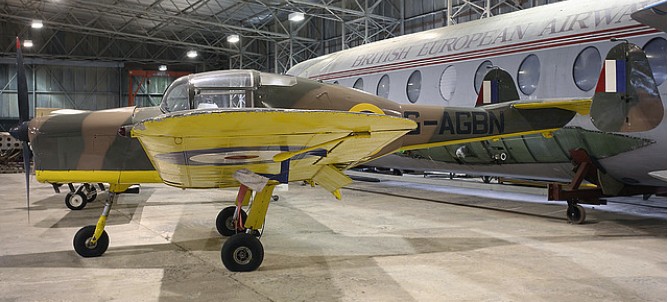
CW Aircraft was established in 1936 by C R. Chronander and J. I. Waddington to design and develop Cygnet two-seat all-metal cabin monoplane, which first flew in 1937. Rights in Cygnet acquired by General Aircraft Ltd. in 1938.
This 1936 side by side two seat training and club aircraft was an attempt at a more robust and easily made machine than those of longeron, plywood and fabric construction. It was the first British light aeroplane to have both metal skinned wings and fuselage. The first version had a single fin and rudder and a tailwheel landing gear. The later Cygnets had twin fins and a tricycle landing gear making it easier to fly. There was also an experimental open-cockpit version, the Owlet.
General Aircraft GAL-42 Cygnet 2 a
Cygnet Engine: One 150 h.p. Blackburn Major II. Length: 23.25 ft. (7.08 m.). Wing span: 34.5 ft. (10.5 m). Weight empty: 1,475 lb. (670 kg.). Seats: 2. Max cruise: 115 m.p.h. (185 km.p.h.). Ceiling: 14,000 ft. (4,300 m.) fully loaded. Range: 445 miles (720 km.).
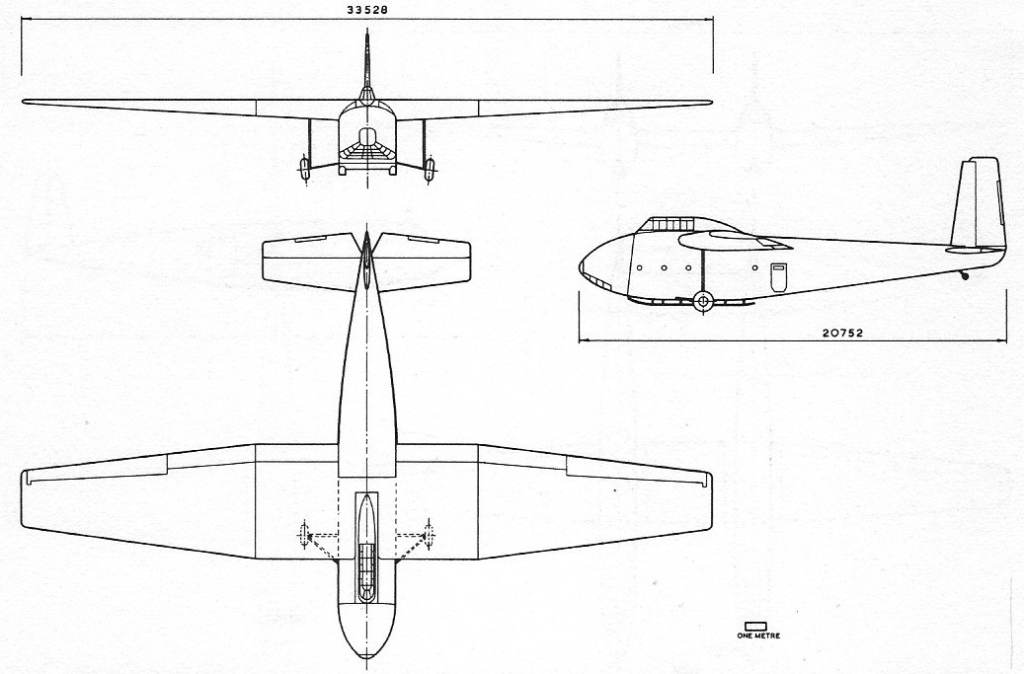
The General Aircraft GAL 49 Hamilcar 1 was a large transport glider of wooden construction, designed to A.M. Spec. X.27/40 to carry a crew of two and either 60 troops or a flight 7-ton tank.
A hinged nose section was fitted for loading. The undercarriage was jettisonable mainwheels and two steel sprung main skids. Trailing edge flaps were fitted.
They were built by General Aircraft Ltd and various sub-contractors. The first flight of the prototype was on 27 Mach 1942.
Variation General Aircraft GAL.58 Hamilcar
Wing span: 110.007 ft / 33.53 m Wing area: 1657.441 sq.ft / 153.980 sq.m Length: 68.012 ft / 20.73 m Height: 20.243 ft / 6.17 m Max take off weight: 36005.4 lb / 16329.0 kg Weight empty: 18402.9 lb / 8346.0 kg Aspect ratio: 7.3 Wing section: RAF 34 modified Max. speed: 130 kts / 241 kph Max tow speed: 241 kph / 150 mph Stall: 104 kph / 65 mph Landing speed: 57 kts / 105 kph Wing load: 21.73 lb/sq.ft / 106.0 kg/sq.m Crew: 1
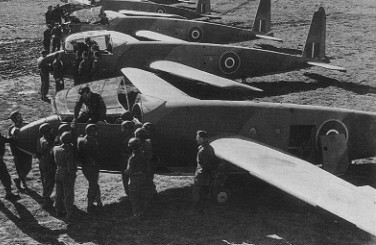
The General Aircraft GAL 48 Hotspur I was an eight-seat troop carrying glider of all wood construction designed to Air Ministry Specification X.10/40 and built by General Aircraft and Slingsby Sailplanes in 1941.
The prototype first flew in 1941.
The General Aircraft Hotspur 8 seat assault training glider was first intended to be released at 20,000ft for long gliding missions, but 16ft was lopped off the span and it was used for training as the Hotspur 2.
The GAL.48 Hotspur 2 were built by Harris Lebus and other sub-contractors, in 1941.
The GAL.48 Hotspur 3 were Hotspur 2 fitted with dual controls.
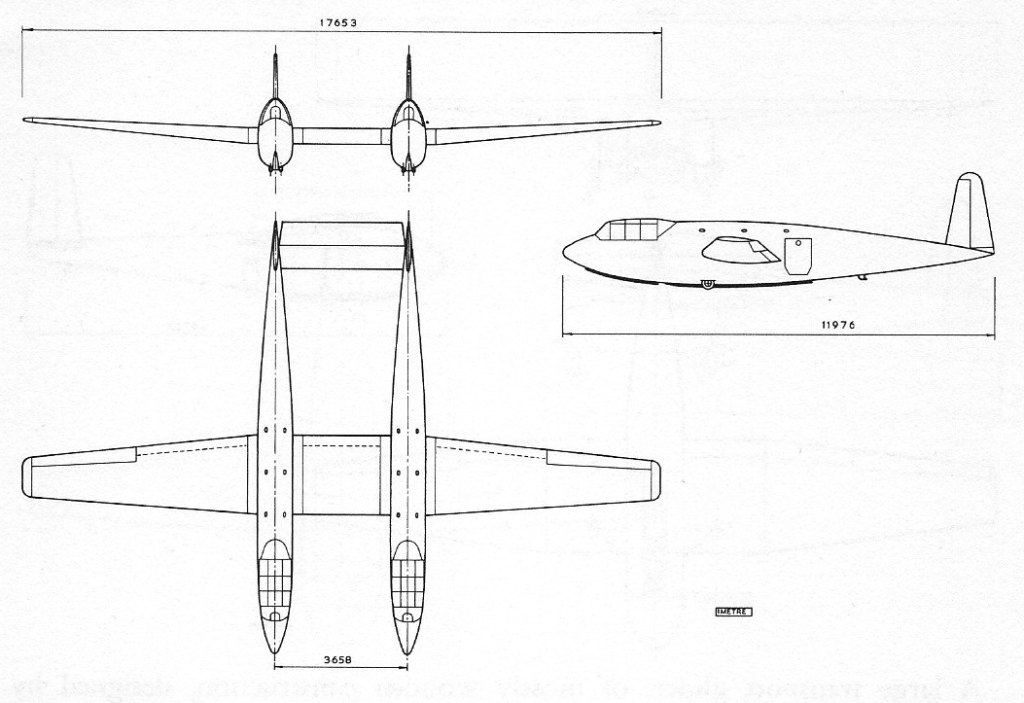
The GAL.48B Twin Hotspur was a sixteen-seat troop transport glider built by General Aircraft Ltd in 1942. It was two Hotspur 2 fuselages joined together with a short centre wing. The first flight of the prototype was in August 1942. It was flown from the port fuselage, there being no controls in the starboard cockpit.
General Aircraft GAL 48 Hotspur Training glider, United Kingdom, 1940 Length: 39.304 ft / 11.98 m Height: 10.827 ft / 3.3 m Wing span: 61.909 ft / 18.87 m Wing area: 272.006 sq.ft / 25.27 sq.m Max take off weight: 3598.6 lb / 1632.0 kg Weight empty: 1660.4 lb / 753.0 kg Max. speed: 113 kts / 209 kph Landing speed: 49 kts / 90 kph Cruising speed: 78 kts / 145 kph Cruising altitude: 20013 ft / 6100 m Wing loading: 13.33 lb/sq.ft / 65.0 kg/sq.m Range: 72 nm / 134 km Crew: 8
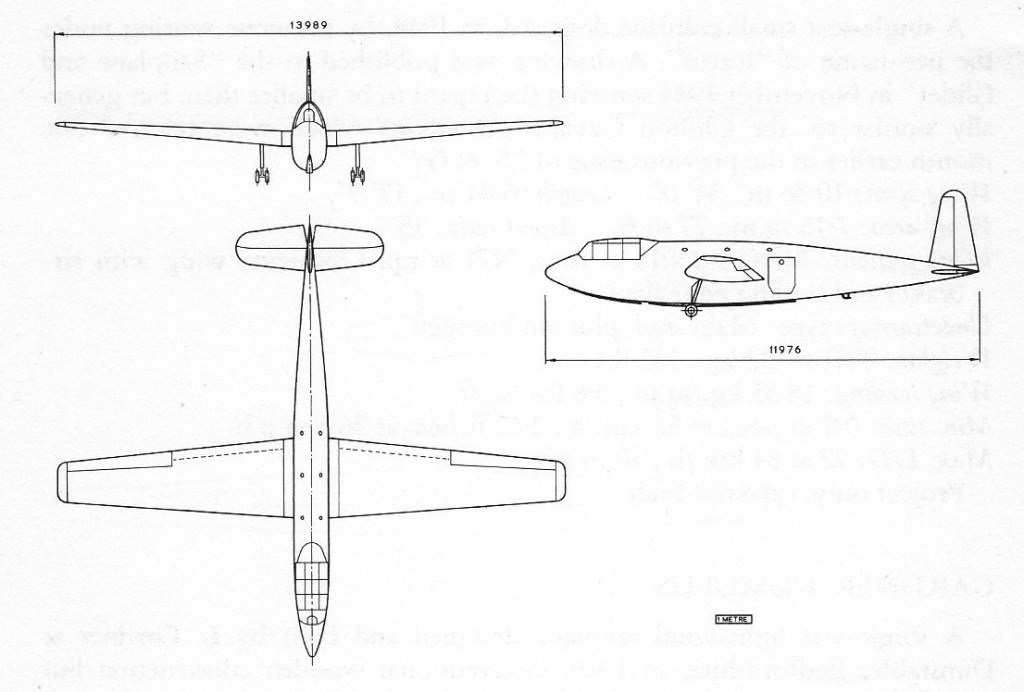
GAL 48 Hotspur 2 Wing span: 13.99 m / 45 ft 10.75 in Length: 11.98 m / 39 ft 3.5 in Wing area: 25.04 sq.m / 272 sq.ft Aspect ratio: 7.7 Empty weight: 753.4 kg / 1661 lb AUW: 1632 kg / 3598 lb Wing loading: 71.77 kg/sq.m / 14.7 lb/sq.ft Max speed: 273 kph / 170 mph Normal glide: 129 kph / 80 mph
GAL.48B Twin Hotspur Wingspan: 17.65 m / 57 ft 11 in Length: 11.98 m / 39 ft 3.5 in Wing area: 33.9 sq.m / 365 sq.ft Aspect ratio: 9.25 Empty weight: 1456 kg / 3210 lb AUW: 2925.7 kg / 6450 lb Max speed: 249 kph / 155 mph Stall: 105 kph / 65 mph
In 1937 the British Admiralty issued a requirement for a novel type of aircraft to shadow enemy fleets, especially by night. The Air Ministry issued Specification S.22/37 calling for an aircraft compatible with aircraft carriers which would provide comfortable accommodation for a pilot, observer and radio operator, outstanding all round view and the ability to cruise at 40 knots for 11 hours. Two prototypes were built, the Airspeed A.S.39 (serial N1323) and the General Aircraft G.A.L.38 (P1758). These flew after the out break of the Second World War. Both were high wing aircraft with extensive slats, flaps and drooping ailerons all in the slipstream of four 130 hp Pobjoy Niagara V radials driving fixed pitch propellers. The G.A. aircraft was all wood, but the Airspeed Fleet Shadower, had a metal fuselage; the former had a nose¬ wheel and tall single fin, while the Airspeed had a tail wheel and three small fins. Each seated the observer in a panoramic nose, the pilot high and behind and the radio operator further aft. Both aircraft met the requirement but the Admiralty changed their minds about the desirability of such an air¬ craft and scrapped this programme in 1940.
Span: 17.02m (55ft 10in) Length: 11 m (36 ft 1 in) Gross weight: 3897 kg (8590 lb) Maximum speed: 185 km/h (115 mph).
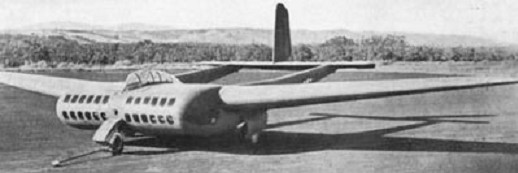
William Hawley Bowlus, a sailplane and glider manufacturer, designed a flying wing glider, the MC-1 in February 1942. Its design was a departure from single fuselage designs and incorporated a twin boom design. The MC-1 was an all-wood twin boom military transport glider of 91ft 10in span, featuring an aerofoil-sectioned lifting fuselage between the booms in which either cargo or troops could be carried in two 16ft x 7ft compartments. The load could be four tons of cargo or 48 armed troops. The front of the wing opened upwards and downwards like a pair of jaws, the bottom doors doubling as a loading ramp. A mock-up of the troop accommodation shows that the compartment tapered towards the trailing edge, allowing little headroom for those unfortunates at the back. The crew of two sat in tandem beneath a continuous canopy atop the centre section.
A single fin and rudder was mounted on the tailplane between the booms. The tricycle landing gear was retractable, and flaps were fitted to the outer wing panels and the fuselage centre section. The MC-1 was constructed mainly of plywood, although all flying surfaces and flaps were fabric-covered. Early test flights of a full scale model proved disastrous when unsecured weighted bags shifted causing it to become unbalanced and killing the pilot and several passengers. Hawley’s General Airbourne Transport Company received a contract in November 1943 to build the glider. The first glider was delivered six months late at three times the cost in the summer of 1943. The MC-1 was test flown by the company and Richard duPont was the instigator of a demonstration for the military on September 11, 1943 from March Field. The pilot of the glider was Col P. E. Gable, deputy director of the Army Air Corps assault glider program. The copilot was Howard Morrison, a long time associate of Bowlus and a test pilot. Several VIPs set off on the flight. They included Richard Dupont, special assistant to Gen Arnold; Col Ernest Gabel, another glider specialist on the staff of the Chief of Staff of the Air Force, and C. C. Chandler, thrice soaring champion. In order to bring the glider up to more-or-less full load, bags of sand and lead shot were loaded aboard but apparently were in securely lashed some reports say they were not lashed to the glider at all. The glider was towed off from March Field by a Lockheed C-60. During turbulence the bags shifted aft and set up a porpoising moment. The tow release did not release at first pull but released on the third porpoise of the MC-1. It released from the glider. The glider entered a flat spin from which it failed to recover. Three managed to take to their parachutes but the other occupants, including Dupont, perished. Only one survived the jump. One report says that Gable had less than 6 hours total time on gliders and allowed the XCG-16 to fly into the wake of the C-60, causing the glidcr to pitch violently and breaking the cable. The ballast shifted aft, and the glider entered the flat spin.
Despite this tragic occurrence the company persevered with a further XCG-16, albeit six months late and costing three times the estimate. It was tested at Clinton Army Air Field and at Orlando, Florida. This is probably the aircraft tested by GAT test pilot Paul E. Tuntland and Northrop test pilot J. Meyers together with army officers from the glider branch at Dayton Ohio. Total flying time for the tests was 34 hours, including 50 landings made under Service operating conditions. Once the factory flight tests on the XCG-16 were completed, glider pilots at CCAAF flew the XCG-16 on over 70 flights in October of 1944 before the glider was rejected. In his pilot’s test report summary, Tuntland had this to say about the handling of the XCG-16: “In my opinion the XCG-16 has excellent handling qualities. During the flight tests I had the impression of flying a large sail plane. It is laterally stable in that it has a tendency to over-bank in steep spirals. I always had good lateral control at the slower airspeeds and higher angles of attack. Longitudinal control was normal with high elevator forces noted at increased airspeeds. “Directional control was good throughout the normal speed range. There was sufficient vertical area in the tail group to maintain good directional control throughout the approach and landing roll, even in moderate crosswinds. There was no tendency to yaw before or during the landing roll except in a crosswind, where normal correction was satisfactory. The subject aircraft is very maneuverable, being capable of rolling from one vertical turn to another in a minimum of time. On one occasion I was able to soar the aircraft in moderate lift conditions. Stalling characteristics are excellent. The first stall warning is indicated about 15 m.p.h. above actual stalling speed. This aircraft made normal landings at between 40 and 75 m.p.h. with the average about 48 m.p.h. A minimum of longitudinal trimming control was necessary in a c.g. shift from 24 per cent MAC to 36 per cent MAC. Normal landings were made with the flaps retracted at approximately 70 m.p.h. “The copilot’s lateral vision is rather poor from the rear cockpit. The pilot’s front cockpit vision is excellent forward, and good towards the sides. “The ground cushioning effect is very noticeable and is a desirable feature of the type, assisting soft ground contact from a rough approach. “Any glider of either tricycle or conventional landing gear that has sufficient vertical tail surfaces for directional stability will tend to turn into the wind during crosswind landings at high or low angles of attack. In this respect the XCG-16 glider has absolutely no objectionable qualities compared to any other aircraft with which I have had experience. The tendency to turn could be readily corrected by the action of the rudder and of the brakes at slow speeds.” The report is dated October 31, 1944. Despite the favorable flying qualities of the XCG-16 there were a number of operational snags; rather too many, as it turned out. These included: inadequate protection in the event of a crash; insufficient exits for crew in the event of an emergency; unsatisfactory loading ramps; poor location of flight equipment, and critical lateral loading. After tests by the AAF Board at Clinton Army Air Field and at Orlando, the contract for the XCG-16 was cancelled on November 30, 1944.
Span: 91 ft 10 in. Length: 48 ft 4 in Height: 18 ft 4 in. Aspect ratio:7.4:1 All up weight: 19,580 lb. Empty weight: 9,500 lb Cargo: 10,080 lb. Max speed: 220 mph Stall speed flaps down: 58 mph Stall speed flaps up: 62 mph
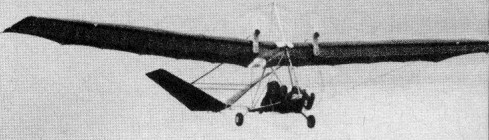
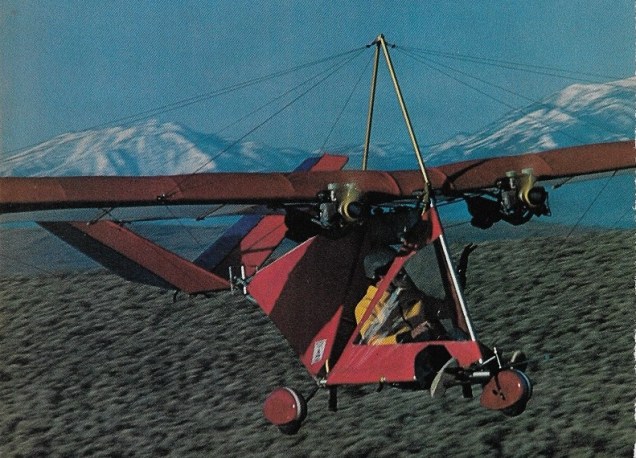
The Gemini Hummingbird 103 and Hummingbird Super 103 are single seat twin engined high wing mono¬plane with conventional three axis control. Wing has unswept leading edge, swept forward trailing edge and tapering chord; V tail. Pitch/yaw control by elevon; roll control by ailerons; control inputs through stick for pitch/roll and pedals for yaw. Wing braced from below by struts; wing profile; double surface. Undercarriage has three wheels in tricycle formation; no suspension on nosewheel and steel spring suspension on main wheels. Push right go right nosewheel steering connected to yaw control. Optional brake on nosewheel; optional brakes on main wheels. Aluminium tube framework, without pod (Hummingbird 103), totally enclosed (Hummingbird Super 103). Engines mounted at wing height driving tractor propellers. Two tractor Solo 210 engines, direct drive (two 20-hp Solos, 3:1 reduction unit, tuned exhaust optional). The Super 103 is the same basic configuration as the Standard 103 but POWERPLANT: Two Solo 210s, 3:1 reduction unit, tuned exhaust.
First year built: 1979. The 103 marks a change in marketing policy for the company, as it is the first kit built machine offered by the firm, taking two days to build. A wide range of options is available on the 103, including wheel spats and a fabric covering for the fuselage, with Lexan windows to make a fully enclosed cockpit. Thus modified, the aircraft is known as the Hummingbird Super 103 and costs $6185, as against $5495 for the Hummingbird 103, in 1982. Other notable options are floats, amphibious floats into which the wheels retract, disc or drum brakes on the main wheels, a nosewheel brake, heavy duty 16 inch (41 cm) wheels and a ‘Super Wing’ high performance wing. Reduction drive is optional. Units delivered by June 1981 48. The Hummingbird Prospector had the wing braced from above by kingpost and cables, from below by cables. Aluminium tube framework, without pod (total enclosure optional). The Hummingbird Prospector was the flagship of the Gemini range in that it came complete and test flown from the factory, unlike the Hummingbird 103 and Hummingbird Super 103. It was an older design, easily distinguished from the 103s by its retention of kingpost and cable bracing. The Prospector was sold with two Solo 335 engines. However, there were plenty of Prospectors around with Limbach 275 cc engines. Latest power units for the Hummingbird Prospector were reduction drive Solos.
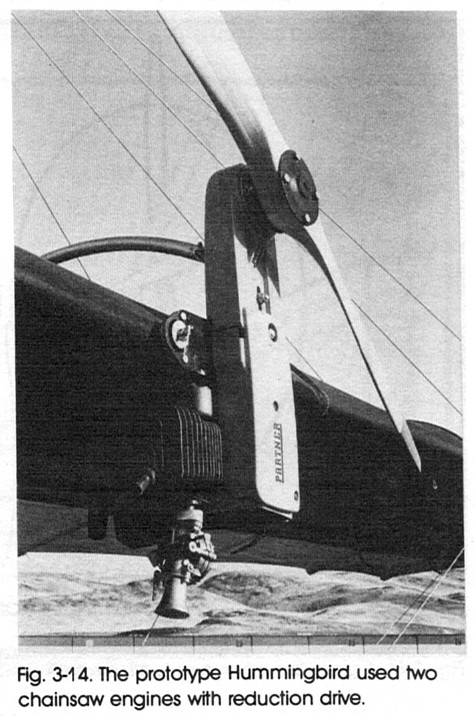
The Tractorplane is a utility ultralight version of Prospector. The Sport Hummingbird is a mono-wing with upright V-tail. Mixed three-axis controls make use of true ailerons for roll control and a separate elevator on the V-tail for pitch control. Construction is aluminum-tubing frame with the wings and tail surfaces covered with presewn 3.8-ounce Dacron. The engines are mounted in tractor position on the leading edge of each wing, and operated separately. Reduction drive turns each two-blade wooden Gemini propeller. Fuel tank is polypropylene. LANDING GEAR: Solid tricycle with steerable nosewheel. Wheels measure 16 inches.
Hummingbird 3-axis conventional (rudder, aileron, elevator). Gross weight 415 lb. Empty weight 163 lb (can be modified to 155). Max pilot weight 230 lbs. First year built 1979.
Hummingbird Standard 103 Engines: 2 x Solo 335, 20 hp at 7200 rpm. Propeller diameter and pitch 52 x 27 inch, 1.32 x 0.69 m. V belt reduction, ratio 3.0/1. Max static thrust 340 lb, 154 kg. Power per unit area 0.24 hp/sq.ft, 2.6 hp/sq.m. Fuel capacity 4.4 US gal, 3.7 Imp gal, 16.6 litre. Length overall 21.0 ft, 6.40 m. Height overall 5.0ft, 1.52m. Wing span 36.0ft, 10.97m. Chord at root 5.0ft, 1.52m. Chord at tip 3.9ft, 1.16m. Dihedral 4 deg. Sweepback 0 deg Tailplane span 5.0ft, 1.52m. Height of in¬clined fixed surface 5.0 ft, 1.52 m. Total wing area 163 sq.ft, 15.1sq.m. Total aileron area 18.0sq.ft, 1.67sq.m. Inclined fixed area 18.0sq.ft, 1.67 sq.m. Total elevon area 14.0 sq.ft, 1.30 sq.m. Wing aspect ratio 7.9/1. Wheel track 6.0ft, 1.82m. Wheelbase 5.0ft, 1.52m. Nosewheel diameter overall 6 inch, 15cm. Main wheels diameter overall 6 inch, 15cm. Optional floats: length 8.0ft, 2.43m. Optional skis: length x width 6.0 ft x 3.5 inch, 1.82 x 0.08 m. Empty weight 240 lb, 109 kg. Max take off weight 560 lb, 254 kg. Payload 320 lb, 145 Max wing loading 3.43 lb/sq.ft, 16.7 kg/sq.m. Max power loading 14.0 lb/hp, 6.3kg/hp. Load factors +4.5, 3.5 design; +5.0, 4.0 ulti¬mate. Max level speed 62 mph, 100 kph. Never exceed speed 70 mph, 113 kph. Max cruising speed 57 mph, 92 kph. Economic cruising speed 45 mph, 72 kph. Stalling speed 22 mph, 35 kph. Max climb rate at sea level 941 ft/min, 4.8 m/s. Min sink rate 207 ft/min at 30 mph, 1.0 m/s at 48 kph. Best glide ratio with power off 11/1 at 42mph, 67 kph. Take off distance 100 ft, 30 m. Land¬ing distance 120ft, 38m. Service ceiling 27,000ft, 8235m. Range at average cruising speed 100 mile, 160km.
Hummingbird Super 103 Engines: 2 x Solo 335, 20 hp at 7200 rpm. Propeller diameter and pitch 52 x 27 inch, 1.32 x 0.69 m. V belt reduction, ratio 3.0/1. Max static thrust 340 lb, 154 kg. Power per unit area 0.24 hp/sq.ft, 2.6 hp/sq.m. Fuel capacity 4.4 US gal, 3.7 Imp gal, 16.6 litre. Length overall 21.0 ft, 6.40 m. Height overall 5.0ft, 1.52m. Wing span 36.0ft, 10.97m. Chord at root 5.0ft, 1.52m. Chord at tip 3.9ft, 1.16m. Dihedral 4 degs. Sweepback 0 deg. Tailplane span 5.0ft, 1.52m. Height of in¬clined fixed surface 5.0 ft, 1.52 m. Total wing area 163 sq.ft, 15.1sq.m. Total aileron area 18.0sq.ft, 1.67sq.m. Inclined fixed area 18.0sq.ft, 1.67 sq.m. Total elevon area 14.0 sq.ft, 1.30 sq.m. Wing aspect ratio 7.9/1. Wheel track 6.0ft, 1.82m. Wheelbase 5.0ft, 1.52m. Nosewheel diameter overall 6 inch, 15cm. Main wheels diameter overall 6 inch, 15cm. Optional floats: length 8.0ft, 2.43m. Optional skis: length x width 6.0 ft x 3.5 inch, 1.82 x 0.08 m. Empty weight 240 lb, 109 kg. Max take off weight 560 lb, 254 kg. Payload 320 lb, 145 Max wing loading 3.43 lb/sq.ft, 16.7 kg/sq.m. Max power loading 14.0 lb/hp, 6.3kg/hp. Load factors +4.5, 3.5 design; +5.0, 4.0 ulti¬mate. Max level speed 62 mph, 100 kph. Never exceed speed 70 mph, 113 kph. Max cruising speed 57 mph, 92 kph. Economic cruising speed 45 mph, 72 kph. Stalling speed 22 mph, 35 kph. Max climb rate at sea level 941 ft/min, 4.8 m/s. Min sink rate 207 ft/min at 30 mph, 1.0 m/s at 48 kph. Best glide ratio with power off 11/1 at 42mph, 67 kph. Take off distance 100 ft, 30 m. Land¬ing distance 120ft, 38m. Service ceiling 27,000ft, 8235m. Range at average cruising speed 100 mile, 160km.
Hummingbird Prospector Engines: Twin Solo 210 cc , 12.5 hp, 3:1 reduction unit, tuned exhaust. Undercarriage: Standard tricycle, steerable nosewheel. Wingspan 34 ft. Wing area 153 sq.ft. Aspect ratio 7.5:1. Length 22 ft. Empty weight: 240 lbs. Payload 400 lbs. Gross weight 640 lbs. Wing loading 4.18 lbs/sq.ft. L/D 10:1. Cruise speed 33 mph. Stall speed 21 mph. Vmax 63 mph. Takeoff/landing roll 75 ft. Climb rate 600 fpm. Fuel capacity 4.5 USG.
Hummingbird Tractorplane Engines: Two Solo 210s, 3:1 reduction unit, tuned exhaust. Undercarriage: Standard tricycle, steerable nose-wheel Wingspan 34 ft. Wing area 153 sq.ft. Aspect ratio 7.5:1. Length 22 ft. Empty weight: 163 lbs. (can be modified to 155). Max pilot wt: 230 lbs. Payload 420 lbs. Wing loading 4.18 lbs/sq.ft. L/D 10:1.
Sport Hummingbird Engine: Twin Gemini/Partner K-1200 100cc, 7 hp Static thrust, 51 lbs each. Wingspan, 34 ft. Wing area: 186 sq.ft. Aspect ratio, 7.5:1. Empty weight, 138 lbs. Usable payload (include fuel), 200 lbs. Wing loading, 1.07 lbs/sq.ft. L/D power-off glide ratio, 11:1. Cruise speed (85% power), 30 mph. Stall speed, 15 mph. Approach speed, 25 mph. Flair speed, 20 mph. Liftoff speed, 17 mph. Takeoff roll distance, 150 ft. Rate of climb, 250 fpm. Fuel capacity, 1.75 USG. Range at cruise, 50 sm.
The GP-1, which first flew in 1968, was designed by Jay and Rod Gehrlein as a simple kit-built sailplane. The all metal ship features a constant-chord (76 cm/ 30 in) wing with scissors-type airbrakes.

 All Aero