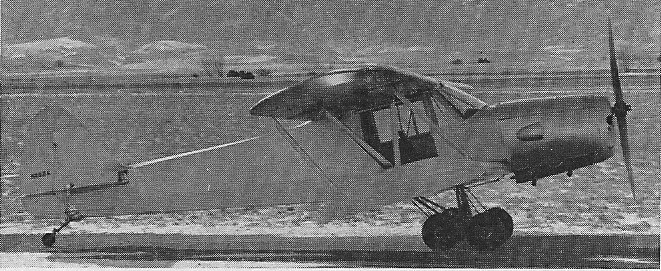
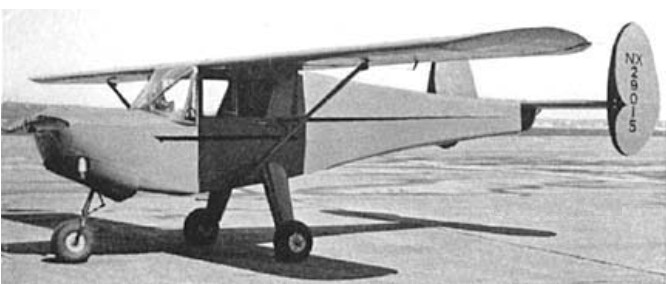
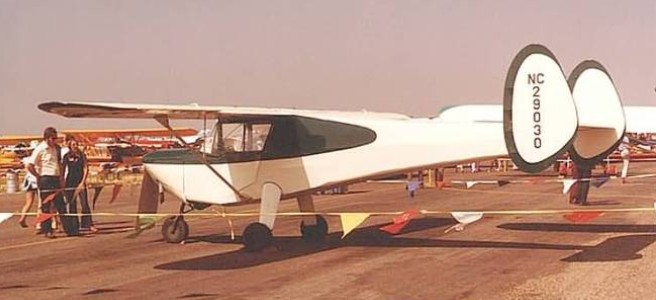
The General Aircraft Corporation was established to build an aircraft designed by Doctor Otto C. Koppen from the Massachusetts Institute of Technology. The aircraft was the G1-80 Skyfarer, a two-seat cabin high-wing braced monoplane with a light alloy basic structure and a mixed steel tube and fabric covering. It had an unusual tail unit, a cantilever tailplane with the elevator mounted on the upper surface of the tail with aluminum endplate fins and no movable rudders. It was powered by a 75 hp (56 kW) Avco Lycoming GO-145-C2 geared air-cooled four-cylinder engine.
The aircraft incorporated aerodynamic control principles covered by patents issued to Fred Weick, an early aeronautical engineer who went on to design and market the Ercoupe. Since it had no rudders (or rudder pedals), it was simpler to fly (it had a single control wheel, which controlled the ailerons and elevator), and was considered spin-proof. The aircraft was certified in 1941 with a placard that stated the aircraft was characteristically incapable of spinning. The company also made a comment to Popular Science in a September 1941 article, with first public photos that an “average” person could learn to fly the Skyfarer …in an hour or so…
It was anticipated that many aircraft would be ordered and built, but the United States became involved in the Second World War and the Skyfarer programme was abandoned after 17 examples had been built. The rights and tooling passed to Grand Rapids Industries in 1943, who built 2 aircraft before stopping production. The company became a manufacturer of the Waco CG-4A troop glider.
L.W. DuVon and Dr. David O. Kime of Western Union College convinced the type holder Grand Rapids Industries, to give the equipment, tools and one of the finished planes to the college in 1944. They then found local investors who formed Mars Corporation in 1945. The aircraft was later licenced as the Mars M1-80 Skycoupe with a 100 hp engine. One example was built and production plans were estimated to be as high as 75 planes in its first year. The glut of aircraft produced after the war left little market for the aircraft. The facility to manufacture the aircraft was sold by 1946.
The aircraft NC29030 resides in the Plymouth County, Iowa Historical Museum.
Gallery
G1-80 Skyfarer
Engine: 1 × Lycoming GO-145-C2, 75 hp (56 kW)
Wingspan: 31 ft 5 in (9.58 m)
Wing area: 121.3 sq.ft (11.27 sq.m)
Length: 22 ft 0 in (6.71 m)
Height: 8 ft 8 in (2.64 m)
Empty weight: 890 lb (404 kg)
Gross weight: 1350 lb (612 kg)
Maximum speed: 144 mph ( km/h)
Cruise speed: 100 mph (161 km/h)
Range: 350 miles (563 km)
Service ceiling: 10,000 ft (3050 m)
Seats: 1 pilot, 1 passenger, side-by-side


 All Aero