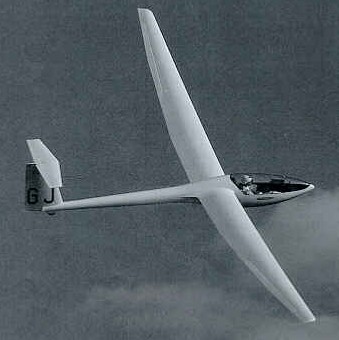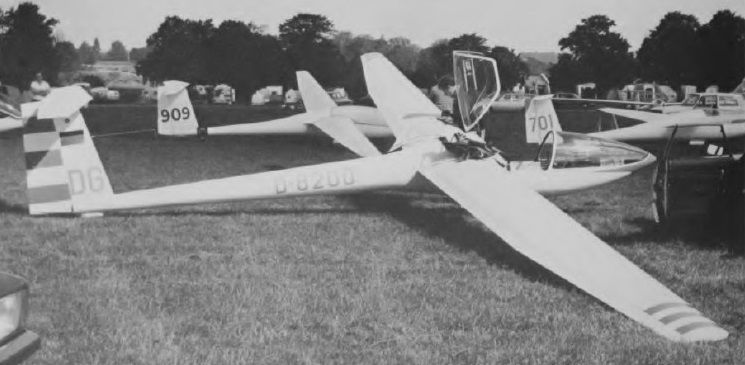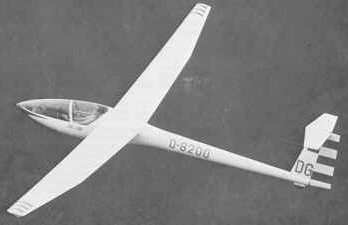
Glaser-Dirks DG-800

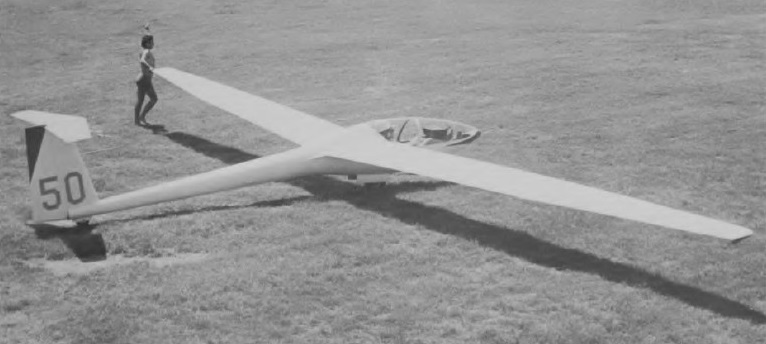
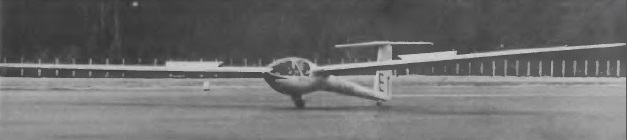
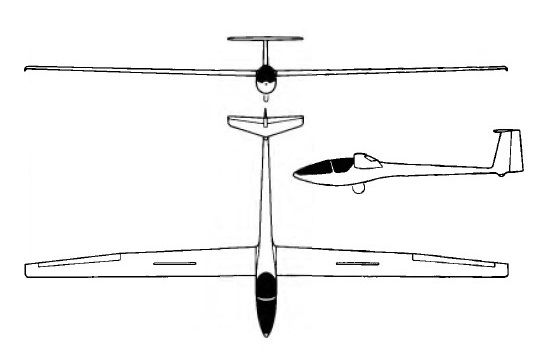
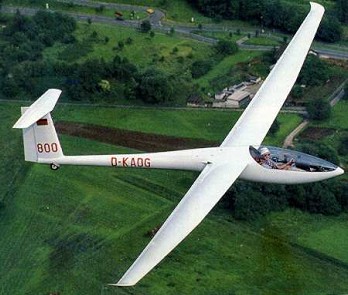
Models of the DG-800, which first flew in 1991, have been developed including the unpowered DG- 800S, the Rotax powered DG-800A and the liquid cooled buried engine configuration of the 800B substantially reduces noise emissions. Each model comes either with a one piece 18 m. wing or a 15 m wing with tip extensions increasing the span to 18 m. The engine in the DG-800 A is a 32 kW/ 43 bhp. Rotax 505A.
Later 800Bs are fitted with an Oehler Solo liquid cooled two-cycle engine with automatic fuel- injection.

DG-800 18m
Wing span: 18m / 59ft
Wing area: 11.81 sq.m / 127sq.ft
Empty Weight: 338kg / 745lb
Payload: 187kg / 412lb
Gross Weight: 525kg / 1157lb
Wing Load: 44.45 kg/sq.m / 9.11lb/sq.ft
Water Ballast: 100kg / 220lb
L/DMax: 50 110 kph / 59 kt / 68 mph
MinSink: 0.50 m/s / 1.63 fps / 0.99 kt
Seats: 1
Aspect ratio: 27.42
Airfoil: Boermans DU-89-138/14, root; DU-92-137/14 tip
Structure: CFRP/AFRP/GFRP
Engine: 37 kW/51 bhp MidWest AE 50 or 40 kW/55 bhp Oehler Solo 2625

DG-800 15m
Wing span: 15m / 49.2ft
Wing area: 10.7sq.m / 115sq.ft
Empty Weight: 224kg / 736lb.
Payload: 191kg / 421lb.
Gross Weight: 525kg / 1157lb
Wing Load: 44.45kg/sq.m / 9.11 lb/sq.ft
Water Ballast: 100kg / 220lb
L/DMax: 45 116 kph/ 63 kt/ 72 mph
MinSink: 0.59 m/s / 1.92 fps. / 1.14 kt
Seats: 1
Aspect ratio: 21.07
Airfoil: Boermans DU-89-138/14, root; DU-92-137/14 tip
Structure: CFRP/AFRP/GFRP
Engine: 37 kW/51 bhp MidWest AE 50 or 40 kW/55 bhp Oehler Solo 2625

DG-808C 15m
Wingspan: 15 m (49.2 ft)
Wing area: 10,68 sq.m (115.0 sq.ft)
Aspect ratio: 21,07
Fuselage length: 7,055 m (23.1 ft)
Fuselage height: 1,434 m (4.7 ft)
Empty weight with parting (full instruments): 334 kg (736lb)
Wing loading with 80 kg payload: 38,8 kg/sq.m (7,95 lbs/sq.ft)
Water ballast wings (option): 100 lt(26.4 US gal)
Max. Weight of the normal version: 525 kg (1156lb)
Max. Wing loading: 49,2 kg/sq.m (10.1 lbs/sq.ft)
Max. Speed vne: 270 kph (146 kt)
Stall speed with 80 kg (176 lbs) payload: 72 kph (39 kt)
Best glide ratio at max. weight: 1:45 at 116 kph (63 kt)
Min. Sink at 400 kg (881 lbs): 0,59 m/s (116 ft/min) at 80 kph (43 kt)
Engine: SOLO 2625, 39kW/53hp
Reduction gearing: 3:1
Fuel tank fuselage: 22 lt(5.8 US gal)
Fuel tank wing (Option) : 2 x 10 lt(2×2,5 US gal)
Take-off distance 15m (50 ft) obst. weight 450 kg / 992 lbs): 200m (656ft)
Climb rate (weight 450 kg / 992 lbs): 4,5 m/s (885 ft/min)

DG-808C 18m
Wingspan: 18 m (59.0 ft)
Wing area: 11,81 sq.m (127.0 sq.ft)
Aspect ratio: 27,43
Fuselage length: 7,055 m (23.1 ft)
Fuselage height: 1,434 m (4.7 ft)
Empty weight with parting (full instruments): 338 kg (745lb)
Empty weight no parting (full instruments): 335 kg (738lb)
Wing loading with 80 kg payload: 35,1 kg/sq.m (7,19 lbs/sq.ft)
Water ballast wings (option): 100 lt(26.4 US gal)
Max. Weight of the normal version: 525 kg (1156lb)
Max. Wing loading: 44,5 kg/sq.m (9,1 lbs/sq.ft)
Max. Speed vne: 270 kph (146 kt)
Stall speed with 80 kg (176 lbs) payload: 68 kph (37 kt)
Best glide ratio at max. Weight about: 1:50 at 110 kph (59 kt)
Min. Sink at 400 kg (881 lbs): 0,50 m/s (98 ft/min) at 76 kph (41 kt)

DG-808S
Wingspan: 15 m (49.2 ft)
Wing area: 10,68 sq.m (115.0 sq.ft)
Aspect ratio: 21,07
Fuselage length: 6.86 m (22.5 ft)
Fuselage height: 1.39 m (4.56 ft)
Empty weight (full instruments): 256 kg (564lb)
Wing loading with 80 kg payload: 32.4 kg/sq.m (6.62 lbs/sq.ft)
Waterballast wings: 120 lt/174 lt/239 lt (31.7 USG /46.0 USG /63.2 USG)
Waterballast in fin tank: 6 lt(1.6 USG)
Max. weight: 570 kg (1255lb)
Max. wing loading: 53.4 kg/sq.m (11 lb/sqft)
Max. speed VNE: 270 kph (146 kt)
Stall speed with 80 kg (176 lbs) payload: 66 kph (35.5 kt)
Best glide ratio at max weight: 1:45 at 116 kph (63 kt)
Min. sink at 400 kg (881 lbs): 0,55 m/s (108 fpm) at 75 kph (40 kt)

DG-808S (without winglets)
Wingspan: 18 m (59.0 ft)
Wing area: 11,81 sq.m (127.0 sq.ft)
Aspect ratio: 27,43
Fuselage length: 6.86 m (22.5 ft)
Fuselage height: 1.39 m (4.56 ft)
Empty weight (full instruments): 262 kg (578lb)
Wing loading with 80 kg payload: 29.4 kg/sq.m (6.02 lbs/sq.ft)
Waterballast wings: 120 lt/174 lt/239 lt(31.7 USG /46.0 USG /63.2 USG)
Waterballast in fin tank: 6 lt(1.6 USG)
Max. weight: 600 kg (1321lb)
Max. wing loading: 50.8 kg/sq.m (10.4 lb/sqft)
Max. speed VNE: 270 kph (146 kt)
Stall speed with 80 kg (176 lbs) payload: 63 kph (34 kt)
Best glide ratio at max weight: 1:50 at 110 kph (59 kt)
Min. sink at 400 kg (881 lbs): 0,47 m/s (92 fpm) at 72 kph (39 kt)
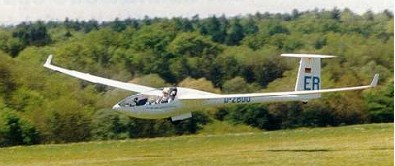
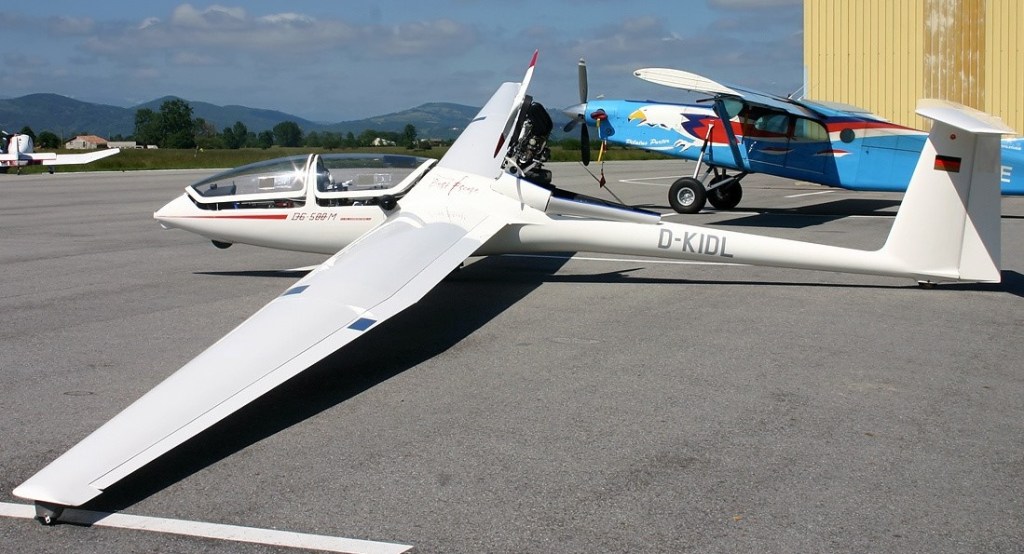
Glaser-Dirks DG-600

The successor to the DG-202/DG-400, the unpowered 15 m. racing class DG-600 first flew in 1987, followed by the mast mounted self- launching DG-600M in 1989.
The fuselage is based on that of the DG-400, but with a more slender tailboom. The wing has a thin section with fully span flaperons. Approach control is by the top surface double panel Schemmpp-Hirth type airbrakes. There is also a fin ballast tank which carries 7 kg / 15.4 lb of water.
The 600 came with four different wingtip configurations- conventional 15 m, 15 m with winglets, conventional 17 m. and swept back 18 m.
The DG-600/18 and DG-600/18M named Evolution have gross weight of 480 kg/ 1,058 lb and 440 kg/ 970 lb respectively. In the 600M, main ballast is reduced to 120 kg/ 265 lb.

DG-600 17M
Wing span: 17m / 55.7ft
Wing area: 11.59sq.m / 124.75sq.ft
Empty Weight: 255kg / 562lb
Payload: 270kg /595lb.
Gross Weight: 525kg / 1157lb
Wing Load: 45.3kg/sq.m / 9.27lb/sq.ft
Water Ballast: 180kg / 397lb
MinSink: 0.50 m/s / 1.64 fps / 0.97 kt
L/DMax: 46 83 kph/ 45 kt/ 52 mph
Aspect ratio: 24.9
Airfoil: HQ-37 on tips
Seats: 1
Structure: CFRP/ aramid

Glaser-Dirks DG505

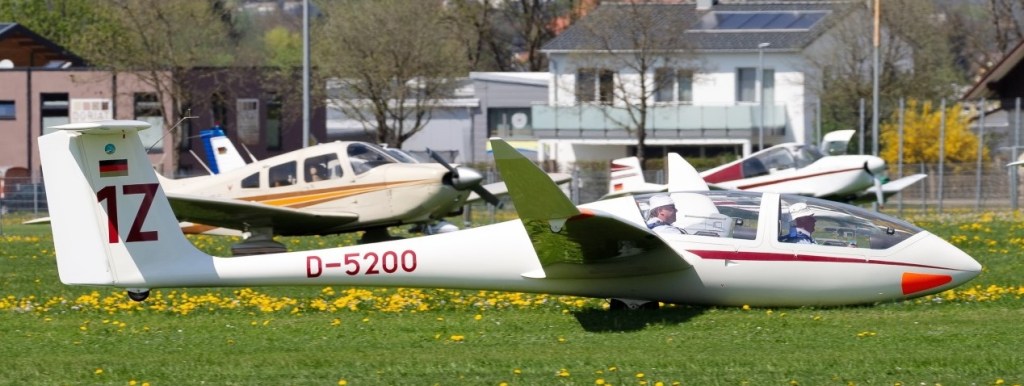
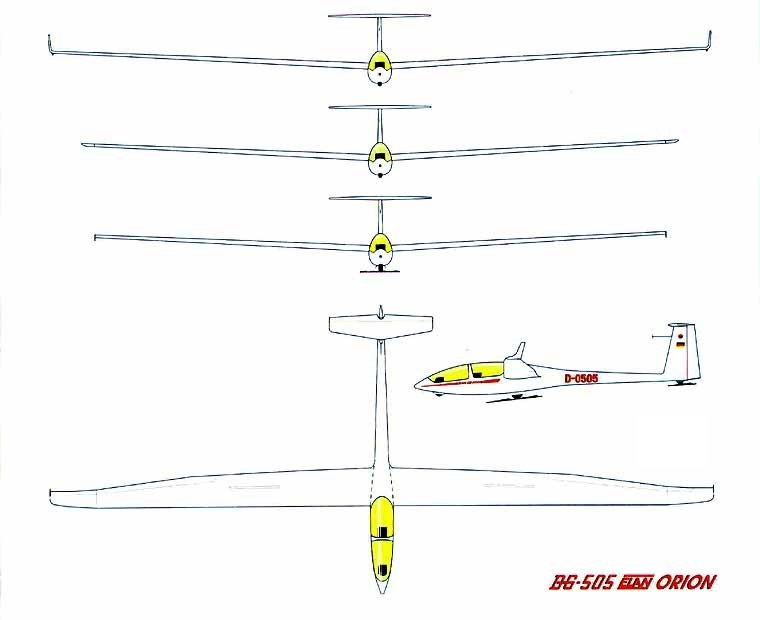
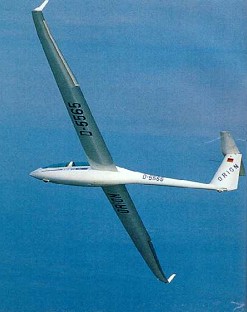
The DG-505 Elan Orion is a two seat glider for training, high performance flying and aerobatics. It can perform basic training, fly a speed triangle with 20 m span, 160 liters of water ballast and a glide ratio of 44 and train aerobatics with 17.2 m span. The designation DG-505 marks the development of the DG-500 and features various major improvements, in particular the cockpit space was increased to enable pilots up to 2 m to fly from either seat.

18 m wing tips for flying characteristics equal to the DG-505 Elan Trainer are available as an option. Operators who own already a DG-505 Elan Trainer can use the Orion with 18 m span without different flying characteristics.

With the standard wing tip extensions the wingspan can be increased to 20 m for high performance and competition flying.

The winglets at the 20 m tips make possible almost as good a performance as with 22 m wingspan (comparison flights with a 22 m DG-505 showed that at same wing loading there is only a performance decrease of 3 % although the wingspan is reduced by 10%). In addition the winglets which are permanently installed to the wing tip extensions improve the excellent handling qualities. The sweep back of the wing tip extensions provides further improvement of low speed performance and handling, both important benefits for thermalling.

Variation:
Windward Performance Perlan I

Wingspan: 18.0 m./ 59.1 ft
Wing area: 16.6 sq. m. / 178.6 sq.ft
Aspect ratio 19.52
Airfoil Wortmann FX-73-K-170/20 root; -170/22 tip.
Water ballast 160 kg / 353 lb
Structure CFRP/GFRP.
Crew: ½

DG Flugzeugbau DG505 Elan Orion
Wingspan: 20 m
Max T/O weight: 750 kg
Glide ratio: 44
Cruise speed: 110 km/h
Max speed: 270 km/h
Crew: 2

Wingspan: 22.00 m./ 72.2 ft
Wing area: 8.29 sq.m./ 196.8 sq.ft
Aspect ratio 19.52
Airfoil Wortmann FX-73-K-170/20 root; -170/22 tip.
Aspect Ratio: 26.5
Length: 8.66m
Height: 1.66m
Empty Weight: 550Kg
Gross Weight: 825Kg
Water ballast 160 kg / 353 lb
Min Sink: 0.58m/s
Glide Ratio: 44
Stall speed: 80Km/h
VNE: 270Km/h
G: 5.3/-2.65
Structure CFRP/GFRP.
Crew: ½

DG-505 Orion

Glaser-Dirks DG-500

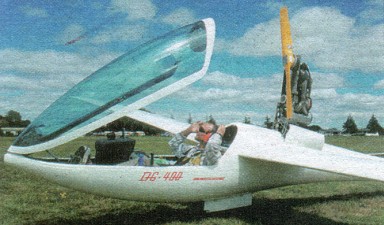
The DG-500 comes in a number of sizes which all share the same basic fuselage. The 500T Elan Trainer, which first flew in 1989 has an unflapped 18 m. wing without provision for water ballast; retractable gear is an option. The front cockpit design has been purposely made similar to that of the DG-300 Club. The higher performance versions (DG-500-22 Elan and DG-500 M) have a 22 m flapped wing and are, respectively, unpowered and self-launch models. The powered model (DG- 500M) has been liquid cooled Rotax powerplant on an electrically retracting pylon, digital engine instrumentation (DEI) and water ballast reduced to 100 kg 220 lb, and comes with an optional steerable nosewheel. The DEI, which has instrumentation in both cockpits, shows rpm, temperatures, pressures and fuel quantity as well as controlling the amount of fuel injected by the electronic fuel system. Engine retraction is automatic once the propeller has been stopped and centred. All 22m ships, which have a four piece wing, have retractable gear as standard. Performance of the 500M is similar to the 500/22 Elan, but empty and gross weights are 565 kg/ 1,246 lb and 825/1,819 lb respectively. All developed with 3 different sets of wingtips; 17.2 m for aerobatics, 18 m and (with winglets) 20 m. A flapped unpowered development of the DG-500/22 Elan. Known as the DG-500/20 Elan Winglets, has been designed for the German 20 m two-place contest class. This has the 750 kg/ 1,653 lb gross weight of the DG-500/22, and a wing loading of 45.0 kg/sq.m./ 9.22 lb/sq. ft. Manufacture of the DG-500 is partly by Elan in Slovenia.

Wing span: 18m / 59.1ft
Wing area: 16.6sq.m / 178.6sq.ft
Empty Weight: 390kg/ 860lb
Payload: 225kg / 496lb
Gross Weight: 615kg / 1356lb
Wing Load: 37.05kg/sq.m / 7.59lb/sq.ft
Water Ballast: 160kg / 353lb
Aspect ratio: 19.52
No. of Seats: 2
Structure: CFRP/GFRP
Airfoil: Wortmann FX-73-K-170/20 root; -170/22 tip

DG-500/22
Wing span: 15m / 49.2ft
Wing area: 10.95sq.m / 117.9sq.ft
Empty Weight: 255kg / 562lb
Payload: 270kg / 595lb
Gross Weight: 525kg / 1157lb
Wing Load: 47.94kg/sq.m / 9.82lb/sq.ft
Water Ballast: 180kg / 397lb
L/DMax: 40 @ 109 kph / 59 kt / 68 mph
No. of Seats: 2
MinSink: 80 kph / 43 kt /49 mph
Aspect ratio: 20.5
Airfoil: HQ-35; HQ 37 on tips extensions
Structure: CFRP/ aramid

Glaser-Dirks DG-400

The DG400 is a single-seater motor glider version of the DG202, with a dorsally-mounted 43hp Rotax engine driving a tractor airscrew and electrically retractable backwards into the fuselage.

Fuel capacity is 4.5 Imp gallons, with optional extra fuel tanks in each wing. Detachable wing tips can be fitted to the DG400/15 to increase the span to 17m for Open Class competition, in which form it becomes the DG400/17. Without the tip extensions, the 15 m version carries 20 kg / 43 lb more payload, but with higher sink rate (0.60 m/s / 1.97 fps / 1.17 kt ) and lower L/D (41).

The DG400 prototype first flew in May 1981 in the hands of Walter Binder, and first production deliveries were planned for December 1981.

B. Brunzil of Switzerland raised the world 500 km speed triangle record to 170.06 kph/ 91.8 kt/ 105,7 mph flying a DG-400.

DG-400/15
Span: 49 ft 2.5 in
Length: 23 ft 0 in
Empty weight: 595 lb
Max take-off weight: 1,058 lb
Sink rate: 0.60 m/s / 1.97 fps / 1.17 kt
L/D: 41

DG-400/17
Span: 55 ft 9 in
Length: 23 ft 0 in
Empty weight: 610 lb
Max take-off weight: 992 lb

DG-400/17 M
Wing span: 17m / 55.8ft
Wing area: 10.57sq.m / 113.8sq.ft
Empty Weight: 310kg / 683lb
Payload: 155kg / 342lb
Gross Weight: 460kg / 1014lb
Wing Load: 43.52kg/sq.m / 8.91lb/sq.ft
Aspect ratio: 27.3
MinSink: 0.50 m/s / 1.64 fps / 0.97 kt
No. of Seats: 1
L/DMax: 45 @109 kph / 59 kt / 69 mph
Airfoil: Wortmann FX67-K-170-17 root, FX-60-K-126 tip
Structure: carbon wing, fiberglass fuselage/tail
Engine: Rotax 503, 32 kW/ 43 bhp

Glaser-Dirks DG-300

The Standard Class successor to the DG-101 features an HQ airfoil with blow-holes to inject high-energy air into the boundary layer to delay laminar separation. It has fin ballast for centre of gravity control. Approach control is by top surface Schemmpp-Hirth type airbrakes. Like other DG ships, the DG-300 features a parallelogram stick to avoid turbulence-included control inputs. Some were manufactured by Elan in Slovenia. The DG-300 Club is a simplified version with a fixed main wheel suitable for club use. Both the DG-300 and the DG-300 Club are produced in Acro models stressed for +7/-5 g. The improved DG-303 Elan model (which also comes in standard, standard Acro, Club and Club Acro variants) has a modified wing section and winglets, and a claimed L/D max of 44 and a minimum sink rate of 0.53 m/s / 1,73 fps/ 1,93 kt. Water ballast is an option for the DG-303 Club Elan.

Wing span: 15m / 49.2ft
Wing area: 10.27sq.m / 110.5sq.ft
Empty Weight: 240kg / 529lb
Payload: 285kg / 628lb
Gross Weight: 525kg / 1157lb
Wing Load: 51.1kg/sq.m / 10.47lb/sq.ft
Water Ballast: 216kg / 477lb
Airfoil: Horstmann Quast
Aspect ratio: 21.9
L/DMax: 42 @89 kph / 48 kt / 55 mph
No. of Seats: 1
MinSink: 0.59 m/s / 1.97 fps / 1.15 kt
Structure: fibreglass

Glaser-Dirks DG-200 / DG-202

To meet the demand for a sailplane with flaps for the Unrestricted Class 15m International competitions the DG-200 was developed from the Standard Class DG-100 series using the same fuselage and tail, but with flaps and a reduced wing area.

The tailplane on the prototype DG-100 was all-moving, incorporating a large anti-servo tab, but this was altered to a conventional fixed tailplane and elevator on both the DG-100 and DG-200. The trimmer is fitted on the control column, which is of the parallelogram linkage type, enabling high speed flight with reduced risk of pilot-induced oscillation. The prototype made its first flight on 22 April 1977. This has the same 15m span wing with glassfibre flaps added, the Schempp-Hirth air brakes being retained; and the water ballast capacity was increased to 120 kg / 265 lb. The tailplane is a glassfibre/foam sandwich, with an all-glassfibre elevator, and the ailerons are also of glassfibre; construction is otherwise the same as the DG-100.

The pilot is accommodated in semi-reclining position in the slim cockpit, covered by a two-piece canopy, the rear section of which is hinged to open upwards and back. The adjustable head rest is attached to the canopy hinge. The landing gear includes a retractable main wheel and a fixed tail wheel.

In 1978 two other versions were developed: the 17m DG-200-17 and the 13.1 m Acroracer.

The DG-200/17 is a 17m span version of the DG-200 created by adding special insertable wing tips to the DG-200. The DG-200 Acroracer is an aerobatic version of the DG-200 with detachable wing tips that reduce the span to 13.1m (42 ft 11.25 in); these can be replaced to bring the span up to 15m.

The prototype Acroracer first flew on 28 November 1978, but was the only one of this variant built. The DG200 Acroracer’s wingtips are removable to convert the aircraft from a 15m sailplane to a 13.3m, fully aerobatic glider.

The DG-200C is similar to the DG-200 but has carbon-fibre spar booms, wing skin and flaps. The DG-200/17C is the same as the DG-200/17 but has the DG-200C’s carbon-fibre wing structure.

DG200

A total of 20 DG-200s had been delivered by early 1978. Altogether 89 DG-200s had been built by April 1980.

DG subsequently produced add- on wing tips for the DG-202 (known as the DG-202/17) increasing the span to 17m.

After more than 100 DG-200’s had been produced the improved DG-202 was introduced. The 15m span DG-202, which first flew in prototype form on 30 April 1980, is very similar to the DG-200 but has an improved cockpit and controls, modified airfoil, a large one-piece forward-opening canopy, automatic tailplane connection and an improved water ballast system.

DG subsequently produced add-on wing tips for the DG-202 (known as the DG-202/17) increasing the span to 17m.

The DG-202/17 has detachable wing tips to bring the span up to 17m and the DG-202/17C has carbon-fibre in the wing structure and a carbon-fibre spar.

DG200
Wing span: 15 m / 49 ft 2.5 in
Wing area: 10 sq.m / 107.6 sq.ft
Aspect ratio: 22.5
Max speed: 168 mph (smooth air)
Length: 22 ft 11.25 in / 7.0 m
Height: 4 ft 7 in / 1.4 m
Empty Weight: 248 kg / 546 lb
Payload: 232kg / 512lb
Gross Weight: 480 kg / 1058 lb
Water ballast: 120 kg / 265 lb
Wing Load: 48 kg/sq.m / 9.8 lb/sq.ft
Stalling speed: 33.5 kt / 62 km/h
Max rough air speed: 146 kt / 270 km/h
Max aero-tow speed: 118 mph
L/DMax: 42 @106 kph / 57 kt / 66 mph
No. of Seats: 1
MinSink: 0.59 m/s / 1.70 fps / 1.01 kt at 45 mph
Airfoil: Wortmann FX-61-184/60-126
Structure: fibreglass

Acroracer
Seats: 1
Length: 22.9ft
Height: 2.7ft
Wing aspect ratio: 20.3.
Max wt: 794 lbs
Standard empty wt: 522 lbs.
Max useful load: 272 lbs.
Water ballast: 350 lbs.
Wing loading: 7 lbs/sq.ft.
Min sink: 138 fpm @ 46 kts.
Max speed: 157 kts.
Stall speed: 35 kts.
Glide ratio: 37-1 @ 57 kts.

DG-202
Wing span: 17m / 55.8ft
Wing area: 10.57sq.m / 113.7sq.ft
Empty Weight: 251kg / 553lb
Payload: 199kg / 439lb
Gross Weight: 450kg / 992lb
Wing Load: 48kg/sq.m / 9.8lb/sq.ft
No. of Seats: 1
L/DMax: 45 @ 126 kph/ 68 kt/ 78 mph
Aspect ratio: 27.3
MinSink: 0.59 m/s / 1.70 fps/ 1.01 kt
Airfoil: Wortmann
Structure: fibreglass

Glaser-Dirks DG-100 / DG 101 / Elan DG 100 / DG 101

The DG-100 Standard Class single-seater is a modified and lighter weight development of the Akaflieg Darmstadt D-38 glass-reinforced plastic sailplane, which first flew in February 1973. The Akaflieg Darmstadt D-38 was designed by Wilhelm Dirks before forming Glaser-Dirks Flugzeugbau GmbH.

The DG-100 has Schemmpp-Hirth type top-surface airbrakes, an all-flying T-tail and water ballast. Options offered included both retractable and fixed landing gear, and a fixed stabilizer. It displayed better performance and handling qualities than expected and so its designer, Dipl-lng Wilhelm Dirks, sought the necessary backing to develop a production version. With Gerhard Glaser he founded the Glaser-Dirks Flugzeugbau GmbH and the DG-100, design of which had begun in August 1973, first flew in prototype form on 10 May 1974.

The DG-100 itself is basically very similar to the D-38 but with a lighter plastic foam supporting the glassfibre skin instead of the balsa wood used in the D-38, and the letter’s rounded nose has been replaced by a more pointed nose of better aerodynamic shape. The DG-100 Club version for club flying is available with either an all-moving tailplane or conventional tailplane like the DG-100G’s and a fixed monowheel. The DG-100G, first flown on 11 June 1976, is generally similar to the DG-100 except that its tailplane and elevators are similar to those of the later DG-200. The cantilever shoulder wings each have a glassfibre roving main spar and are of glassfibre/Conticell/foam sandwich construction, as are the ailerons and the tailplane. Instead of flaps, there are Schempp-Hirth duralumin air brakes on the upper wing surfaces; these are considered to be cheaper to make and lighter than flaps, as well as being simpler to operate for landing. Up to 220lb of water ballast can be carried in two wing tanks, and this can be jettisoned in flight. The semi-monocoque fuselage is an all glassfibre structure, as are the fin and rudder.

The prototype DG-100 had an all moving tailplane with a large anti-servo tab, and production aircraft have a similar tailplane with a full-span trimmable anti-Flettner tab. The manually-retractable monowheel has a drum brake, and there is a tailwheel. The pilot sits in a semi-reclining position under a two-piece cockpit canopy, the rear section of which is hinged to open upwards and backwards, the adjustable headrest being attached to the canopy hinge.

Production of the DG-100 series was transferred to the Yugoslav firm Elan, who have been building the DG-100 under licence since the autumn of 1978. A total of 102 DG-100s had been delivered by the beginning of 1978, plus a further 15 examples of the DG-100G.

After more than 100 were built it was succeeded by the DG-101, offering a front-hinged canopy, automatic trim and a cockpit of improved impact-resistant design. The DG-100 Club is an unballasted, fixed gear version with a gross weight of 385 kg / 849 lb.

Production versions were the DG-101, DG-101G and DG-101G Club, which have the forward opening
one-piece canopy of the DG-202.

DG-100
Wing span: 15m / 49 ft 2.5 in
Wing area: 11 sq.m / 118.4 sq.ft
Length: 7.0 m / 22 ft 11.25 in
Height: 1.4m / 4 ft 7 in
Empty Weight: 230 kg / 507 lb
Payload: 188 kg / 415 lb
Gross Weight: 418 kg / 922 lb
Wing Load: 38.0 kg/sq.m / 8.78 lb/sq ft
Water Ballast: 100kg / 220lb
Airfoil: Wortmann FX-61-184/60-126
Aspect ratio: 20.5
MinSink: 0.58 m/s / 1.94 fps / 1.13 kt @ 40kt / 46 mph / 74 km/h
No. of Seats: 1
L/DMax: 36 @ 91 kph / 49 kt / 56 mph
Max speed: 140 kts / 161 mph / 260 km/h (smooth air)
Max speed: 140 kt / 260 km/h (rough air)
Stall speed: 32 kts / 60 km/h
Max aero-tow speed: 102.5 mph
Glide ratio: 39-1 @ 57 kts / 65 mph / 105 km/h
Structure: fibreglass

Glasair Merlin

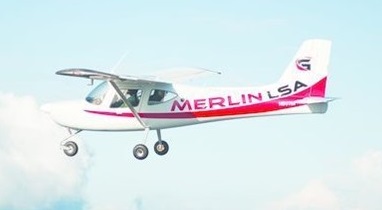
The first flight of Glasair Aviation’s Merlin light sport aircraft (LSA) took place on April 7, 2015. For nearly a year afterward, refinements and testing took place.

Almost a year later to the day, Glasair received the certification it sought on its prototype model, allowing it to reclassify the Merlin as an SLSA (that first S stands for Special). The Merlin will sell as fully factory-built, ready-to-buy-and-fly aircraft.

Pilot and passenger have a 47 inch wide cockpit and sweeping views outside. Skylights make it that much easier to track traffic.

Engine: Rotax 912 iS, 100 hp
Max Speed at Sea Level: 120 kts / 138 mph
Wing Span: 31 ft 9 in
Wing Area: 132 sq.ft
Length: 21 ft 8 in
Height: 8 ft 8 in
Empty weight (Prototype) 850 lb
Max takeoff weight: 1320 lb
Useful Load (Prototype): 470 lb
Limit Load: +4g / -2g
Fuel capacity: 24 USgal
Cruise: 105 kts / 121 mph
Stall, no flaps: 45 kts / 52 mph
Stall, full flaps: 39 kts, 45 mph
Cabin width: 46.5 in
Baggage: 50 lb
Base price: 2016: $149,000

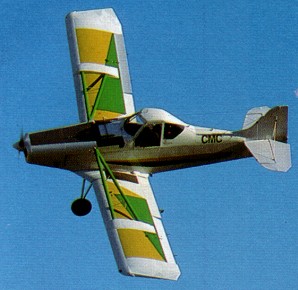
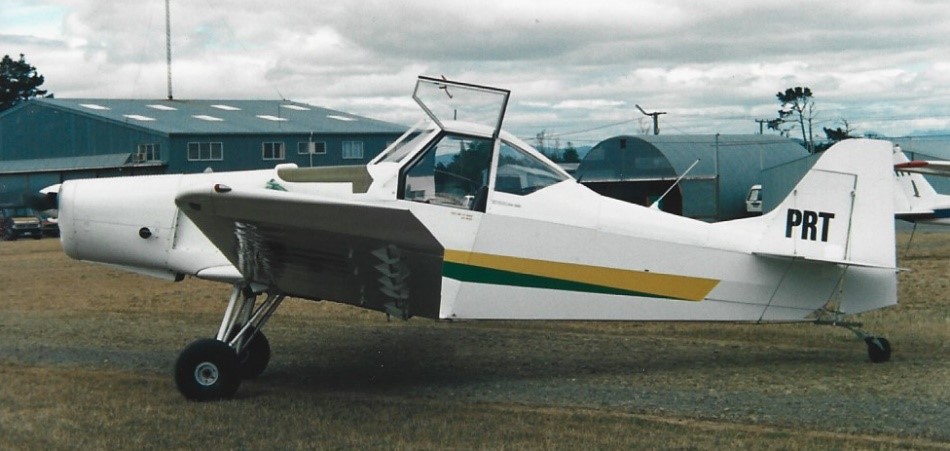
Gippsland GA-200 Fatman

The Fatman was developed to improve on the PA-25 Pawnee by Peter Furlong and George Morgan. Gippsland Aeronautics began to rework the original Piper concept in 1983 and today only three components have commonality with the old familiar design interchangeable lift struts, undercar¬riage legs and engine mounts. Originally flying on a Pawnee Supplementary Type Certificate, after some fifteen interim prototypes the GA-200 achieved a type certificate of its own.
Built and tested to FAR 23 specs, the 260 hp Lycoming 0 540 powered GA¬200 can haul a genuine 1500 cwt off and onto some confined spaces.

The GA¬200 featured a kevlar 180 litre fuselage fuel tank, however the company was offering an inboard (223 litre) wing fuel system as well as a further option with both fuselage and wing tanks, providing a six and a half hour endurance. No parts of the fuel system are installed forward of the firewall with the exception of the carburetor.

GA-200

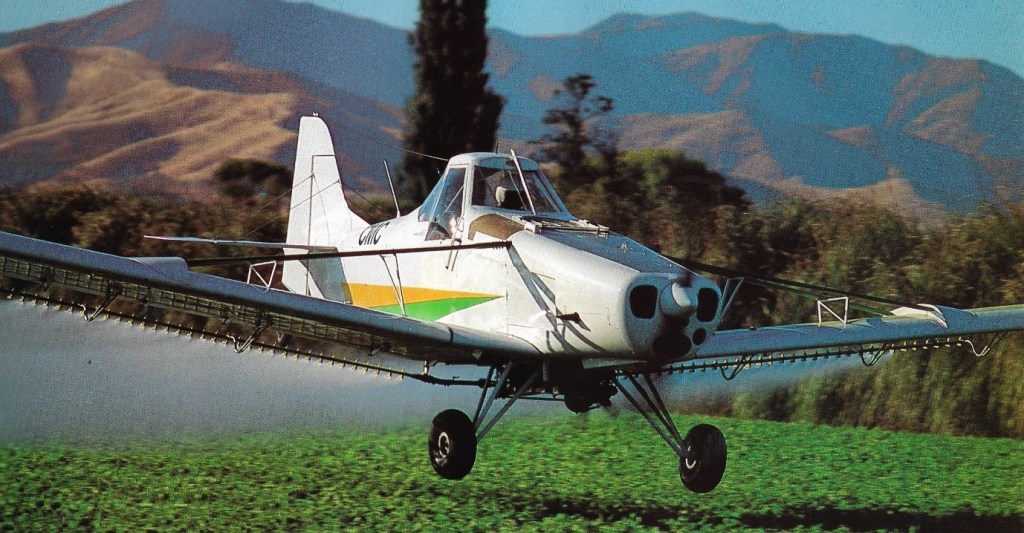
All metal wings house fuel tanks with fuel gauges mounted in the wings. Normal tank venting is outboard on the wings. The leading edge of each wing is made of five nonstructural sections. Both wings have airscoops that pressurise both wings and fuselage to keep fertiliser dust out and eliminate the possibility of spray contamination. The bottom rudder slants up so – in the event that a tailspring breaks – the rudder will not sustain damage. The undercarriage is not the same as a Pawnee, having been beefed up using Fletcher mainwheels and the safety straps are now top mounted. The top leg attachment bolts are easily accessible from the outside of the airframe. The fuselage is of welded 4130 chrome moly steel tube – the high wear and tear area where the hopper outlet is fitted being of stainless steel. The hopper outlet is unique – the same base is used for both spray or solids, and doesn’t detract from aircraft performance or dump capability. The header tank features its own sight glass right in front of the pilot and holds enough fuel for about 15 minutes.

Fitted with two seats, the GA 200 has a superficial resemblance to its older brother but is in fact both shorter and wider. Engineered out of the design are the cooling problems common to the Pawnee and the 1930s vintage rag wing aerofoil. The fabric covered steel tube fuselage and all metal winged aircraft is fitted with an 800 litre hopper and has been designed and built to be extremely “fieldworthy”.

Federal Aviation Administration Type Acceptance Certificate No.98/14 was granted to the GA200C in the Restricted Category on 9 September 1998 at the original maximum take-off weight of 1315 kg. Type acceptance at the increased MCTOW of 1524 kg was granted on 17 February 1999, based on validation of CASA Certificate of Type Approval number 83-6.

GA-200 ZK-CMC pilot Ray Patchett

The GA200C is a development of the original GA200 at the instigation of the NZ agent. It has a larger volumetric capacity hopper (1050 litres), and associated with that a revised fuselage structure and a fuel injected 300 hp engine with constant speed propeller. The GA200C incorporates the Option 1 extended wing tips as standard and has a modified fuel system with gravity fed sump tank. Initially certification was achieved at the same weights as for the GA200 and at the same 250 hp in the standard category. Gippsland subsequently certificated the GA200C at a higher weight and with a slight increase in structural speeds. (To provide for the possible installation of an IO-580 engine.) The changed airworthiness limitations were originally going to be applied to a proposed GA200C-1 model, but that designation has now been dropped.

The GA200C Type Certificate Holder since Revision 9 dated 08.08.2006: GA200 Pty Ltd.

The last production example of the GA200 Series was serial number 200C-0345.

GA-200
Engine: Lycoming O-540-A1D5, 250 hp.
Prop: McAulay fixed pitch.
Hopper cap: 800 lt.
Seats: 2.

GA-200B
Engine: 250 hp.

GA-200C
Engine: Lycoming IO-540-K1A5, 300 hp or
Lycoming IO-540-K1C5 modified in accordance with Edge Aviation EO No. EA001001 Issue 3
Propeller: Hartzell HC-C2YR-1BF/F8475R
MCTOW 1524 kg (3360 lb.)
Max. No. of Seats: 2
Hopper cap: 1000 lt.