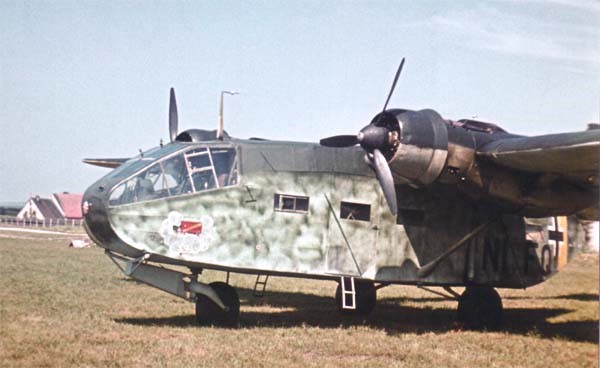
Gotha Go 244

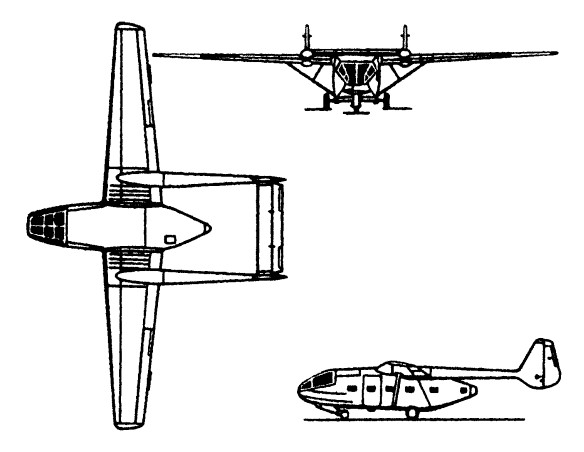
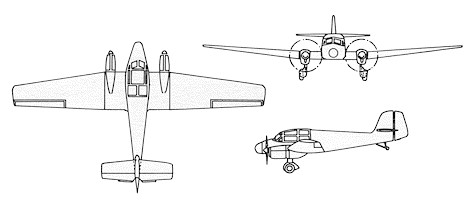
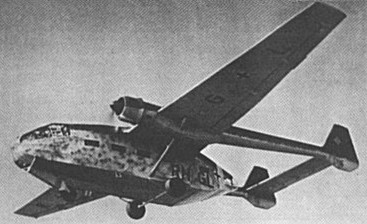
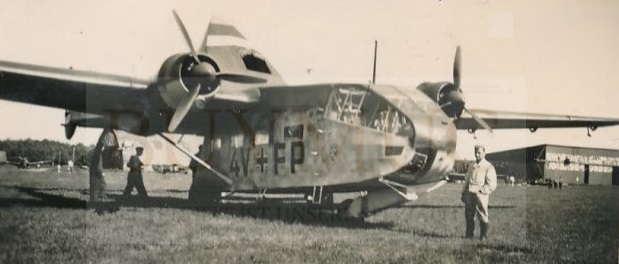
After the fall of France the French Gnome-Rhone 14M radial engine became available to the Germans in large numbers, and the Go 242 was modified to serve as the Go 244 twin-engined transport, each of the twin booms being extended forward of the leading edge of the wing to mount one of these engines. At the same time fixed tricycle landing gear was installed.

A total of 133 conversions was made from the five Go 242B variants and these were designated correspondingly Go 244B-1 to B-5. First deliveries were made in March 1942 to the Greek-based KGrzbV 104 and to KGrzbV 106 in Crete, but they proved to be relatively easy targets for Allied fighter aircraft and had been withdrawn by November 1942. Some Go 244s had 492kW BMW 132Z or captured Russian Shvetsov M-25As each of 559kW.

Go-244B-2
Engine: 2 x Gnome-Rhone 14M, 522kW
Max take-off weight: 7800 kg / 17196 lb
Empty weight: 5100 kg / 11244 lb
Wingspan: 24.5 m / 80 ft 5 in
Length: 15.80 m / 51 ft 10 in
Height: 4.70 m / 15 ft 5 in
Wing area: 64.4 sq.m / 693.20 sq ft
Max. speed: 290 km/h / 180 mph
Ceiling: 7500 m / 24600 ft
Range: 600 km / 373 miles
Armament: 4 x 7.9mm machine-guns

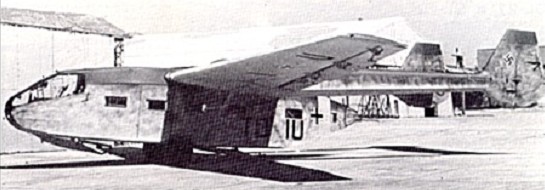
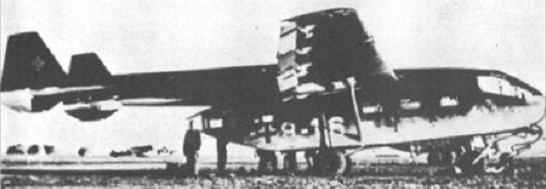
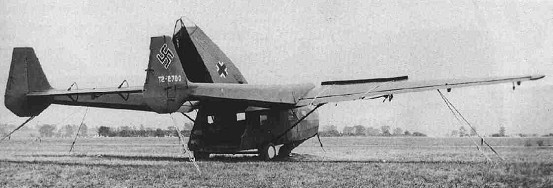
Gotha Go 242

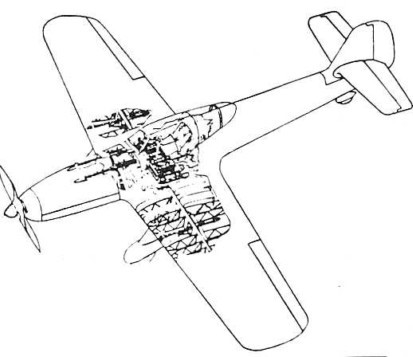
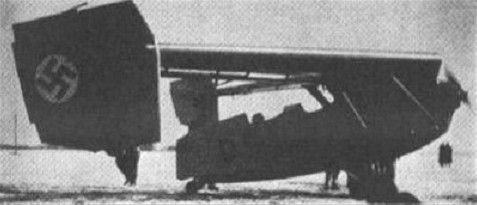
The work of Dipl. Ing Albert Kalkert, the Gotha Go 242 assault glider was developed with the approval of the Reichs-luftfahrtministerium since it offered almost three times the troop-carrying capacity of the DFS 230 then in use.
The fuselage pod was of steel tubular construction with fabric covering, and carried jettisonable landing gear and two retractable skids. The wings were made of wood with fabric and plywood covering.

The aircraft could carry 21 fully-equipped troops, or equivalent weight in military loads, such as a Kubelwagen utility vehicle, loaded through the hinged rear fuselage.
Two prototypes were flown in 1941 and production followed permitting entry into service in 1942.
The type’s operational debut was made in the Mediterranean and Aegean theatres, Go 242 units being based in Greece, Sicily and North Africa. Heinkel He 111 tugs were usually employed and rocket-assisted take-off equipment could be fitted, the variety of propulsion units including four 500kg Rheinmetall-Borsig RI-502 solid fuel rockets. Production totalled 1,528 aircraft.
133 were modified into Go-244.

Go 242B

Gallery

Go-242
Max take-off weight: 6800-7300 kg / 14992 – 16094 lb
Empty weight: 3200 kg / 7055 lb
Wingspan: 24.5 m / 80 ft 5 in
Length: 15.8 m / 51 ft 10 in
Height: 4.25 m / 13 ft 11 in
Wing area: 62.4 sq.m / 671.67 sq ft
Armament: 4 x 7.9mm machine-guns

Gotha Go 150

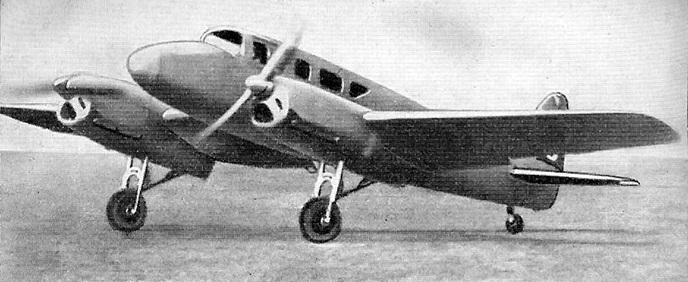
In January 1937 Major Werner Junck, chief of the LC II, the technical wing of the Reichsluftfahrtministerium responsible for the development of new aircraft, informed various minor aircraft manufacturers such as Gothaer Waggonfabrik, Bücker, Fieseler, Flugzeugwerke Halle and Klemm that they would not get any contracts for the development of military aircraft. He therefore advised them to concentrate in the development of a Volksflugzeug or a small twin-engined plane. As a result, Gothaer Waggonfabrik developed the Go 150.

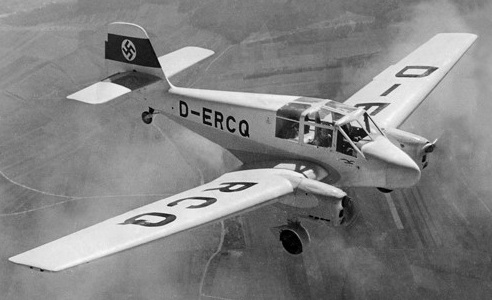
The aircraft was a twin-engined monoplane with an enclosed cockpit, designed by Albert Kalkert.

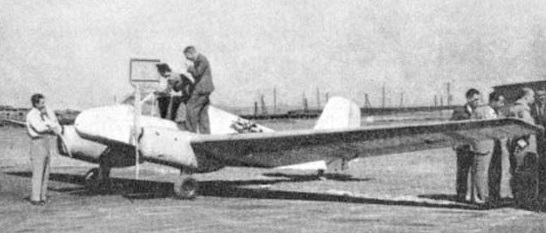
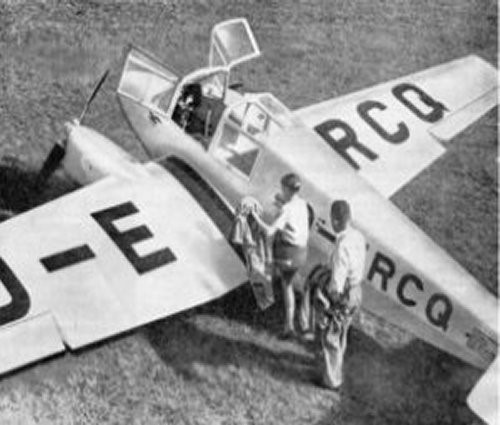
The first, D-ERCQ, first flew in 1937. The results of this flight were good, and production began. The aircraft was used to train both civilian and Luftwaffe pilots. The Go 150 was later also used in tests, where it was towed by a Heinkel He 46.

Two prototypes were built, followed by a series of 10. All of them received civil registration. Another series with 10 aircraft was planned but not fulfilled.

The Go.150 established flight altitude records in its class. Firstly, three test attempts in which the aircraft reached heights of 7100 m, 7500 and 7800 m were made. Only when there was full confidence in achieving the record, the Go.150 made the attempt.

On July 5, 1938, piloted by Fritz Platz, after 45 minutes he had reached 7,000 meters, but fell sharply in this rate of climb. At an altitude of 7100 meters, it was only 1m\sec, and in another 700 meters, it decreased to 0.5 m\sec. After 1.5 hours he reached an estimated height of 8,000 meters. After ascertaining the correct indication of the instrument pilot, and after 30 minutes, made a successful landing at its airport. This record was officially recorded FAI.

Gallery

Engines: 2 × Zündapp Z 9-092, 37 kW (50 hp) each
Wingspan: 11.80 m (38 ft 9 in)
Wing area: 17.50 m2 (188 sq ft)
Aspect ratio: 8.1
Length: 7.15 m (23 ft 5 in)
Height: 2.03 m (6 ft 8 in)
Empty weight: 535 kg (1,179 lb)
Gross weight: 850 kg (1,874 lb)
Max takeoff weight: 1,036 kg (2,284 lb)
Fuel capacity: 80 kg
Oil capacity: 6 kg
Load: 315 kg
Fuel consumption: 12.7 l/100 km
Flying weight 48.5 kg/sq.m
Maximum speed: 200 km/h (124 mph; 108 kn)
Cruising speed: 185 km/h (115 mph; 100 kn)
Landing speed: 85 km/h
Range: 900 km (559 mi; 486 nmi)
Service ceiling: 4,200 m (13,780 ft)
Rate of climb: 2.74 m/s (539 ft/min)
Time to 1000m: 6min. 5sec.
TO dist to 20m: 400 m
Landing dist from 20m: 500 m
Crew: 1
Gotha Go 149

The Gotha Go 149 was a military aircraft developed in Germany in the mid-1930s for training fighter pilots. It was a conventional low-wing cantilever monoplane with tailwheel undercarriage, the main units of which retracted inwards. The wing was wooden, while the monocoque fuselage was metal. Two prototypes were constructed, and an armed version was also proposed as a light home-defence fighter (Heimatschutzjäger) armed with two 7.92 mm (.312 in) MG 17 machine guns, but the Luftwaffe did not purchase either version of the design, and no further examples were built.

Gotha Go 147

The Gotha Go 147 was a German experimental prototype reconnaissance aircraft designed in 1936. Designed by Gothaer Waggonfabrik and Albert Kalkert, construction of the two-seater aircraft was abandoned before the end of World War II.
Featuring an unconventional design, it was built to test how an aircraft without a tail would fly, with the hope of using the experience to produce a future version for military use. Construction was suspended after the prototype proved to have poor flight characteristics.

Gotha Go 146

The Gotha Go 146 was a twin-engine utility aircraft developed in Germany in the mid-1930s. It was a conventional low-wing cantilever monoplane with tailwheel undercarriage, the main units of which retracted into the engine nacelles on the wings. It was offered to the Luftwaffe as a high-speed courier aircraft, but the Siebel Fh 104 was selected instead. With Gotha unable to attract other customers, no serious production was undertaken and a small number of prototypes were the only examples built.

Gossamer Albatross

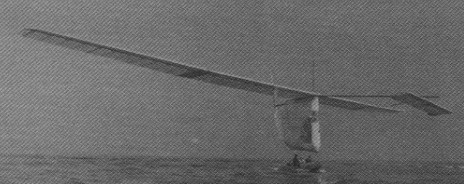
The Albatross had grown out of the Condor’s success but it is in a number of ways a very different craft — utilising carbon fibre reinforced plastic tubing for wing spars, bowsprit and gondola to produce a light, strong structure. The fuselage gondola and flying surfaces are covered by a Mylar plastic film, attached by double-sided adhesive tape with wing ribs cut from expanded polystyrene foam. Its 28.3¬m (93 ft) wing could be broken down into four sections for ease of transport, and had instruments an airspeed sensor driven by a tiny propeller mounted on the foreplane bowsprit, and an ‘altimeter’ developed from the automatic focusing device of a Polaroid camera.
Control of-the aircraft is effected by an all-moving canard and by wing-warping.
This 75 lb aircraft, flown and powered by 140 lb Bryan Allen, conquered the English Channel in 2 hours 49 minutes at a speed of some 11 knots in June 1979. Instrumentation is down to the basics of an airspeed indicator and an altimeter — neither of which proved essential when, in the latter half of the Channel-crossing, flat batteries mean a loss of readings.

Wing span: 93 ft 10 in.

Gossamer Condor II

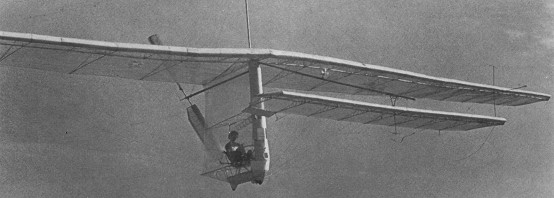
After the Condor, a new design went together at Shafter, a new base in Central Valley. It was called number two because it represented a major change in some ways. Paul MacCready kept the basic wire-braced tube-structure concept, but aspect ratio was increased from 8.3 to 12.8 and the wing loading raised from 0.22 to 0.26 lbs/sq.ft. A thick, double-surface airfoil was computer-designed and only a single tube along the centre of pressure was used for the spar. By eliminating the rear spar, enough weight was saved to permit use of more closely-spaced ribs and a cardboard leading edge. The pilot’s seat and chain-wheels were enclosed by a streamlined plastic envelope.
The result was that Greg Miller and Tyler MacCready almost immediately doubled their duration times. But making a turn and control of the new machine in bank had yet to be accomplished. Beyond a quarter turn the drag was too high creating reversal at low speeds.
Opposite-action wing warp was one of the final keys to success. The drag of the inner wing (due to its increased angle of attack) swings that wing back, but also adds just enough lift to keep it from dropping. The result – a perfect turn. The pilot just clicks a lever into the notch and the wings are held in a twist for a turn with no other action necessary until the ship is straightened. Then he lifts the lever into neutral and goes his way. The Condor can turn about in only 180 feet. The wings were slightly swept back to aid stability, and the foreplane could be banked and its angle of incidence in¬creased to start a turn, with the innermost wing warped to provide additional lift and thus balance the turn and prevent that damaging slip into the ground which had wrecked previous man powered aircraft.
By the summer of 1977 the Gossamer Condor had made more than 430 flights and had accumulated more time in the air than all previous man powered aircraft com¬bined.
On 23rd August 1977, for the 223rd flight, in ideal conditions with a windspeed of less than 2 knots, Bryan Allen made a 30ft take-off run toward the north pylon on Shafter Airport runway. After a 500ft cruise Bryan cleared the Tee bar on the start line and observer Bill Richardson clicked his stopwatch. Bryan was soon into the first, right turn after 250 more feet and he made a 425ft diameter 180 degree sweep around the marker to head for the south pylon, 2,640ft away. It was a smooth cruise of almost three minutes, then another sweeping left turn to re-trace his course back northwards. As he neared the original take-off point, eager followers yelled encouragement and with one last effort Bryan took the Condor over the Tee bar to finish at precisely 6:22.5. He had traced an almost perfect figure eight, the flightpaths 9ft 7in. apart on the start/finish line and met all the conditions of the famous contest.
On 31st December 1977, Gossamer Condor was aired for the last time before moving across the USA to be hung in the Smithsonian Institute at Washington DC. Rough weather over Christmas almost prevented this ‘last fling’ but fate decreed a dead calm end to the momentous year.
Less than a month after the Gossamer Condor’s record-setting flight, the manpowered airplane was flown by Maude Oldershaw whose husband was the Condor’s mechanic.
The Gossamer Condor, winner of the Kremer Prize for man-powered flight, in 1978 was being moved to the National Air and Space Museum, in Washington, D.C.

Aspect ratio 12.8.
Height 18 ft.
Length 30 ft.
Span: 96 ft.
Wing area: 760 sq.ft.
Canard area: 93 sq.ft.

Gossamer Condor I

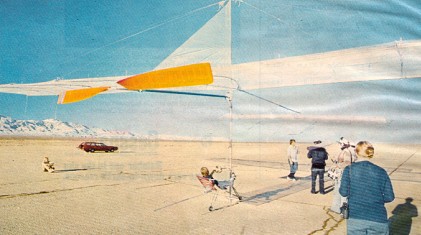
In 1976 Paul MacCready was thinking about trying for the £50,000 Kremer Prize for manpowered flight. The wing loading would be very light and that it would operate a lift coefficient of only .9 (compared to 1.4, or better, for previous MPAs). This meant a single-surface airfoil would have low drag.
Construction began in the Rose Parade float shed down in the Arroyo Seco not far from Pasadena. Two inch diameter .035in. thick alloy tubes in 12ft sections that were joined to make an 88ft span wing.
On 9th October 1976, though the lightly misting rain added a lot of weight, the craft acted more like a balloon than an airplane. They walked with it at 5 mph; it lifted easily and strained at the ropes attached to all corners. Nothing broke. The structural idea was reasonable.
The 96ft span craft was moved to Mojave Airport soon after the tubing was chemically milled down from 22 thousandths at the centre to 14 thousandths of an inch at the outer sections of the wing.
First flights with Paul’s son Tyler (a hang glider pilot) on board were promising. Tyler pedalled rather easily making 45-second flights with a push start. Greg Miller, a new rider of racing cyclist championship quality could take off on his own and, after a good deal of flying practice, made a tremendously encouraging flight of two-and-a-half minutes while covering over a thousand foot distance.

The next time, MacCready measured and marked the one-mile figure-eight course, practised taking off and flying over the 10 ft barrier, and called out the officials. After several trials, Greg’s best flight was 2 minutes and 30 seconds. It had to stay up three times longer, and the matter of control was even more critical – a full turn had yet to be made. Winds of 2 to 4 mph and the slightest gustiness would limit flights to only 30 or 40 seconds. Thin, single-surface airfbils have low drag at only one angle of attack. For the Condor, a low-drag spike occurred at about 8.2 mph. Above or below that speed, the drag rose impossibly high.
The Condor I conducted 332 flights.

With budgetary problems NASA was having trying to keep its space program alive and well, NASA/ Dryden Flight Research Center established a NASA test program is to study the unusual aerodynamic performance, stability and control characteristics of large but very lightly-loaded and slow-flying aircraft. Data acquired will be used in the design of future aircraft for extremely low-speed flight at any altitude, and particularly for low-power flight in very low densities at high altitudes up to 100,000 feet. Not that they expect Bryan to crank his way into the stratosphere – they just wonder what it would be like to f ly a homebuilt aircraft like the G.A. in the thin air of Mars.
Under Project Manager Dale Reed, in mid February 1980 the 55-pound man-powered aircraft finally got off the ground, between midwinter rains, with Bryan Atlen doing the legwork.
When the rains let up, they hooked up an electric motor and to make it an EPA (electric powered aircraft), preparatory to installing solar cells on the wings.

Aspect ratio: 8.3.
Span: 96 ft.
Chord: 115 in.
Wing area: 1056 sq.ft.
Prop dia: 12 ft.
Weight: 84 lb