At the 1912 Allgemeine Luftfahrzeug-Ausstellung in Berlin, Hans Grade displayed two new monoplanes, with a “normal” fuselage, egg-shaped and tapering into a flat tail, instead the usual gondolas of his previous airplanes. One was a “Renneindecker”, identified as the D type, with a 30/45 hp Grade engine.
Monoplane
Gowland Jenny Wren
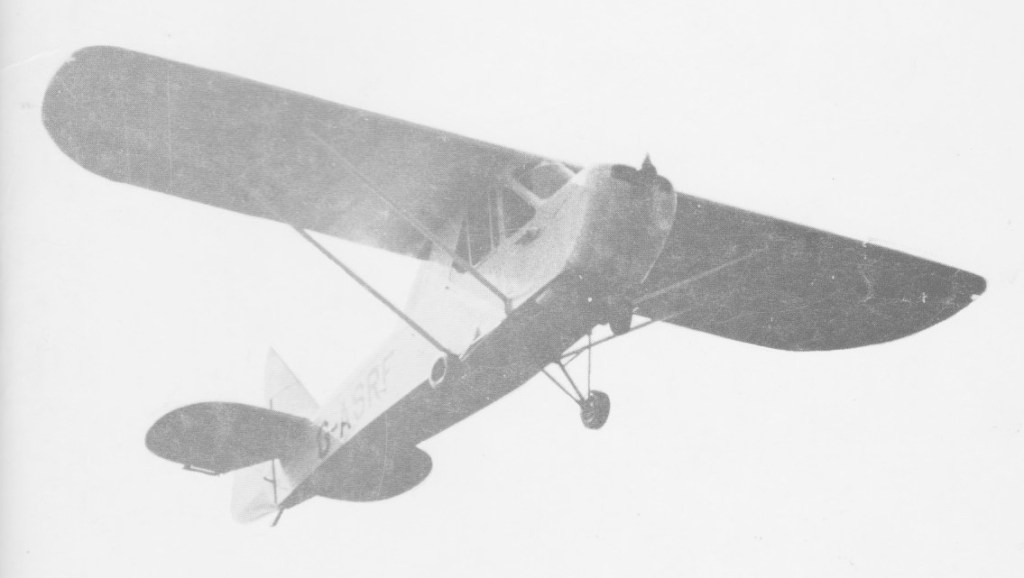
Built by G.W.Gowland in the mid-1960s, the Gowland Jenny Wren G-ASRF c/n GWG.2, PFA.1300, was basically a Luton Minor with an enclosed cockpit with pilot and a child’s seat in tandem, tricycle undercarriage, and a Lycoming O-145-A2 engine.
It was built by the designer at Brookmans Park with final assembly taking place at Panshanger in 1966. It used the wings of Luton Minor G-ACEP (PFA.538b).
The first flight took place on 13 October 1966.
Withdrawn from use prior to 1971, it was thought to be stored at Gowlands home. Only one conversion was made.
Government Aircraft Factories / GAF N24 Nomad
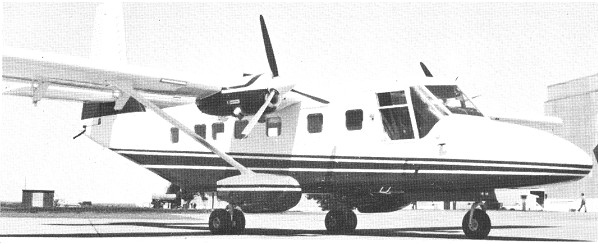
Originally designed in the 1960s as a STOL utility aircraft for both civil and military use. The first prototype flew in 1971.
One hundred and seventy were sold by GAF / ASTA.
Certification in accordance with the Australian Department of Transport air regulation 27 approves the use of N24A as an 18-place airliner in regular public transport as well as in normal operation. N24A is an improved version of the previous ‘stretched’ Nomad N24. It has increased passenger and load carrying capacity with an all-up-weight of 9400 pounds from the original 8500 pounds.
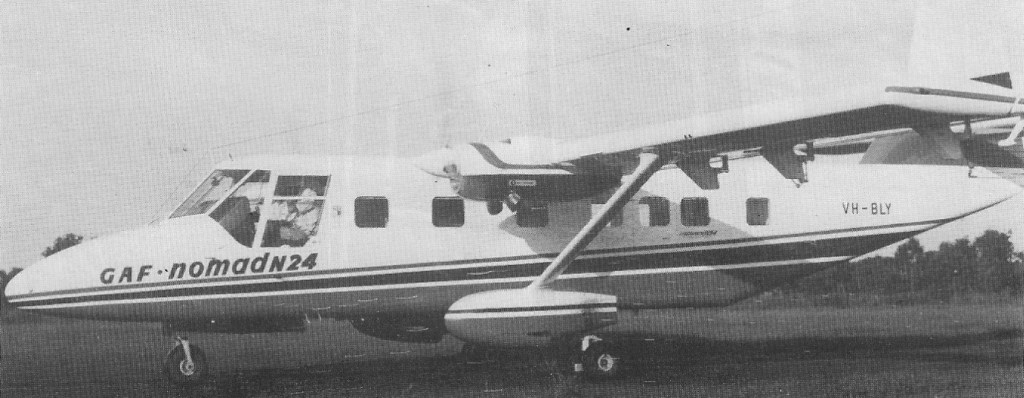
Production ceased in 1984 after safety concerns following a number of accidents and the loss of 54 lives.
Boeing obtained the type certificate via its 1999 acquisition of Rockwell, which had previously acquired ASTA.
Gippsland Aeronautics purchased the GAF N24 Nomad type certificate from Boeing Australia and planned to restart production.
N-24
Engine: 2 x Allison 250-B17B, 400 hp.
Seats: 18.
Wing loading: 27 lb/sq.ft.
Pwr loading: 10.5 lb/hp.
Gross wt: 8750 lb.
Empty wt: 4844 lb.
Equipped useful load: 3811 lb.
Payload max fuel: 1451 lb.
Range max fuel/75%: 964nm/5.7hr.
Range max fuel /55%: 1071nm/7.7hr.
Ceiling: 22,500 ft.
Max cruise: 167 kt.
Max range cruise: 140 kt.
Vmc: 62 kt.
Stall: 52-70 kt.
1.3 Vso: 68 kt.
ROC: 1430 fpm.
SE ROC: 280 fpm @ 87 kt.
SE ceiling: 9000 ft.
Min field length: 1100 ft.
Fuel cap: 1770/2360 lb.
N24A
Engines: 2 x Allison 250-B17C, 400 shp.
Props: Hartzell 3-blade, 90-in.
Seats: 17.
Length: 47 ft.
Height: 18.2 ft.
Wingspan: 54.2 ft.
Wing area: 320 sq.ft.
Wing aspect ratio: 9.1.
Maximum ramp weight: 9450 lbs.
Maximum takeoff weight: 9400 lbs.
Standard empty weight: 5480 lbs.
Maximum useful load: 3970 lbs.
Maximum landing weight: 9200 lbs.
Wing loading: 20.9 lbs/sq.ft.
Power loading: 12.2 lbs/hp.
Maximum usable fuel: 1770 lbs.
Best rate of climb: 1313 fpm.
Service ceiling: 23,300 ft.
Maximum single-engine rate of climb: 240 fpm @ 96 kts.
Single-engine climb gradient: 113 ft/nm.
Single-engine ceiling: 11,390 ft.
Maximum speed: 173 kts.
Normal cruise @ 8,000 ft: 169 kts.
Fuel flow @ normal cruise: 335 pph.
Endurance at normal cruise: 5.3 hrs:
Stalling speed clean: 72 kts.
Stalling speed gear/flaps down: 57 kts.
Turbulent-air penetration speed: 134 kts.
Takeoff distance (50ft) 1,710 ft
Landing distance (50 ft) 1,380 ft
Government Aircraft Factories / GAF N22 Nomad
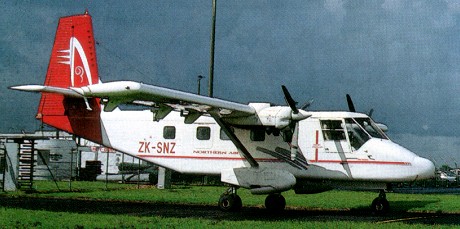
In 1965 design studies were started by GAF to find a follow-on production commitment. Interest expressed from commercial operators lead to a twin engined utility transport. Production commenced on the prototypes in January 1970 with flight testing beginning in 1971.
Conversion to N.22A allowed an increase in AUW.
The final version, launched in May 1985, was the N22C, aimed at the commuter airline market and offering an increased all-up weight of 4,060kg. The N22C was a post-production variant with increased weights, strengthened undercarriage, improved tail structural design and other modifications. Most Nomads delivered from storage after production ended were to this standard and some earlier aircraft were modified.
Three military variants of the N22/N24 Nomad, the utility Missionmaster, the coastal surveillance Searchmaster B with 1200 scan Bendix radar, and the Searchmaster L with 3600 scan Litton radar, were built for five customers.
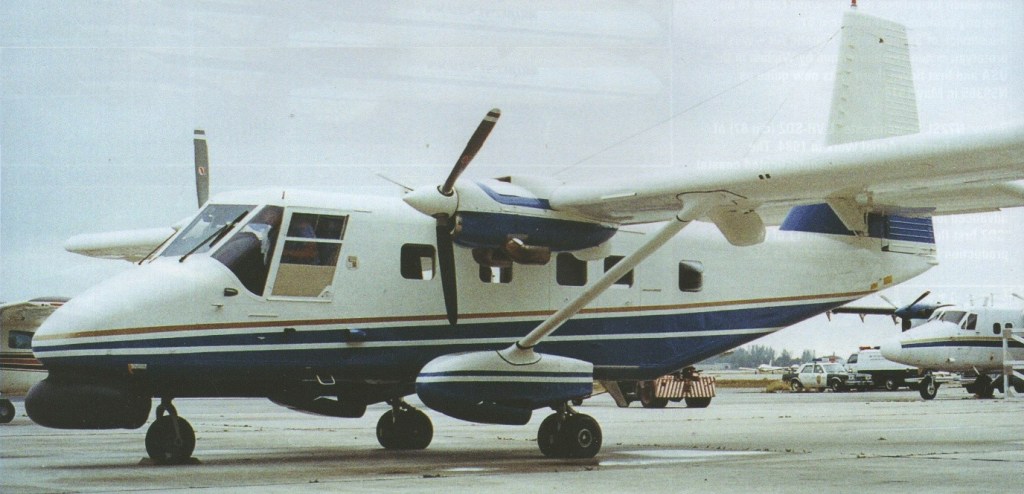
The Nomad is designed and built by the Government Aircraft Factories in Australia in two models. These are the short-takeoff-and-landing (STOL) Nomad N22B and the Nomad N24A commuter aircraft. Variations on the basic aircraft include the Mission Master, the Search Master for maritime surveillance work, and a photographic and mapping model. The aircraft have proven successful in many countries, often flying over rugged terrain in climates ranging from tropical to subarctic. Its STOL capability, originally developed for Australian military use, has made it ideal for operations in rugged areas such as the highlands of Papua, New Guinea. The N22B, capable of carrying up to 12 passengers, can take off in only 800 feet. The larger N24A is a later development of the basic aircraft capable of carrying more passengers and cargo.
The Nomad is characterized by simplicity of construction and systems, which contribute to its economy of operation. Its two Allison 250-B17C turboprops are rated at 420 shp, producing more than two horsepower per pound of engine weight. The B17C offers an improved single-engine high-altitude performance capability and a more rugged gearbox.
The Royal Thai Air Force received 20 N22B Missionmasters.
N22B
Engines: 2 x Allison 250-B17, 416 shp.
Props: Hartzell 3 blade reversible 7 ft 6 in.
Fuel cap: 1030 lt.
Wing span: 54.0 ft (16.46 m).
Length: 41.2 ft (12.57 m).
Height (tail section): 18.12 ft (5.52m).
Main wheel track: 10.6 ft (3.23m).
Wheel base: 12 ft (3.66 m).
Propeller ground clearance: 4 ft (1.22m).
Wing area: 324 sq.ft (30.2 sq.m).
Wing loading at max. gross weight: 26.2 lbsft) 127.9 kg/ sq.m).
Power loading at max. gross weight: 10.2 lbs eshp (4.64 kg eshp).
(Excluding flight deck) – Cabin length: 17.5ft (5.34m).
Cabin height: 5.13ft (1.57m).
Cabin volume: 360 cu.ft (10.2 cu.m).
Cabin door size: 4.06 ft x 4.33 ft (1.24 m x 1.32m).
Baggage compartment volume (nose): 28 cu.ft ( 0.79 cu.m).
Baggage compartment volume (rear): 30 cu.ft (0.85 cu.m).
Take of pwr: 416 eshp (400shp).
Maximum continuous: 400 eshp (385 shp).
Maximum cruise: 380 eshp (366 shp).
Normal internal fuel tanks (usable): 227 Imp gals (1030 lt, 268 U S gals).
Maximum take-off: 8500 lbs (3856 kg).
Maximum landing: 8500 lbs (3856 kg).
Typical operating empty (including commercial interior and avionics): 4730 lbs (2146 kg).
Max fuel capacity (usable): 1793 lbs (813.5 kg).
Tyre size – Nosewheel: 35 p.s i. (241.1 KPa).
Mainwheels (dual): 29 p s i. (199.8 KPa).
All performance quoted at 8500 lbs (3856 kg) TO weight – STOL
Ground roll: 600 ft (183 m).
Distance over 50 ft: 1050 ft (320 m).
FAR 23 Ground roll: 800 ft (244 m).
Distance over 50 ft: 1360 ft (415 m).
STOL Ground roll: 250 ft (76 m).
Distance over 50 ft: 635 ft (194 m).
FAR 23 (no reverse thrust) Ground roll: 655 ft (200 m).
Distance over 50 ft: 1150 ft (351 m).
Stalling Flaps retracted: 68 knots EAS.
Flaps extended: 49 knots EAS.
ROC take-off rating: 1440 fpm (439 m/min).
ROC max. cruise rating: 1260 fpm (384 m/min).
ROC Single engine wax. continuous: 220 fpm (67 m/min).
Service ceiling: 22,500 ft (6858m).
Single engine max continuous rating service ceiling: 10,000 ft (3050 m).
Max. cruise speed — ISA, 5000 ft (1 525 m): 169 kt.
Cruise speed 90% power ISA 5000 ft: 165 kt.
Long range cruise speed 145 kts
TAS: 50 NM wth 3300 lbs (1496kg) payload; 860nm wth 1617lb (733kg).
Max cruise speed (168 knots TAS) range: 50nm wth 3280 lbs (1470 kg) payload; 730nm wth 1617 lbs (733 kg) payload.
N22C Nomad
Engine: 2 x Allison 250.
Installed pwr: 630 kW.
Span: 16.5 m.
Length: 12.6 m.
Wing area: 30 sq.m.
Empty wt: 2092 kg.
MTOW: 4060 kg.
Payload: 1630 kg.
Vne: 200 kts.
Cruise speed: 304 kph.
Initial ROC: 445 m / min.
Ceiling: 7620 m.
T/O run (to 15m): 400 m.
Ldg run (from 15m): 385 m.
Fuel internal: 1018 (+335) lt.
Range (std fuel): 1460 km.
Capacity: 13 pax.
Gouveia Monoplane
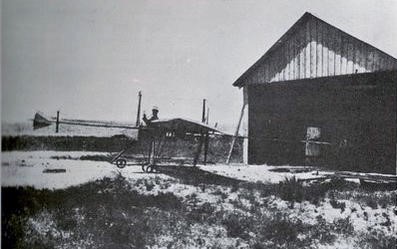
On December 11, 1909, Portuguese inventor João Gouveia, known for his model aeroplanes and who had already designed and constructed kites since 1907, presented a plan to the Academy of Sciences for the “Gouveia”, a 9 metre span monoplane powered by a 26 hp Anzani engine. He built a hangar in Seixal in 1911, constructed the machine and conducted experiments, but eventually abandoned the project due to breakdowns and a lack of funds.
Gourdou-Leseurre GL.30 / GL.31 / GL.32 / GL.40 / GL.529 / GL.60
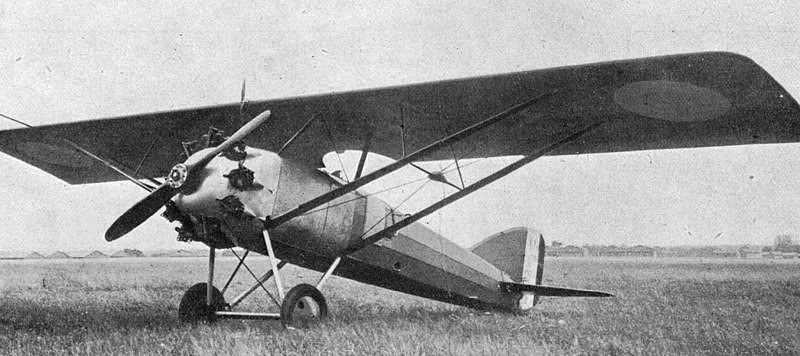
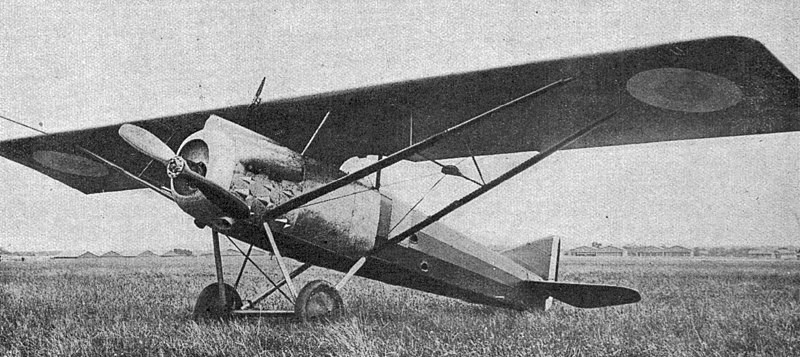
The GL-30 was a parasol-wing monoplane with retractable undercarriage and a Bristol Jupiter engine. Like most of Gordou-Lesserre’s earlier aircraft, it was a parasol wing design but its planform was trapezoidal rather than rectangular. In 1923 it flew the Coupe Beaumont course at an impressive 360 km/h (220 mph; 190 kn).
The GL.30 was the basis of a new fighter, the GL.31, which had a greater span, almost double the wing area, a fixed undercarriage, and a Gnome-Rhône 9A engine. It was armed with four machine guns, two in the forward fuselage and two in the wings. The GL. 31 was not flown until 1926 and then abandoned, overtaken by the GL.32, the company’s entry in a 1923 Aéronautique Militaire competition to select a new fighter. It returned to a rectangular plan wing.
By the time this prototype flew, the Gourdou-Leseurre had been acquired by Loire, and therefore the new aircraft was entered as the LGL.32. Placed second in the trials, the type’s performance was impressive enough to still result in an order in January 1927 for a small batch of aircraft – five evaluation aircraft and 20 preproduction machines. Eventually, 475 of this basic version, dubbed LGL.32C.1 in service, would be ordered by the Aéronautique Militaire and 15 more by the Aéronautique Maritime. Romania ordered a further 50 aircraft of the same design as the examples in French service, Turkey ordered 12 (these designated LGL.32-T) and another one may have been purchased by Japan.
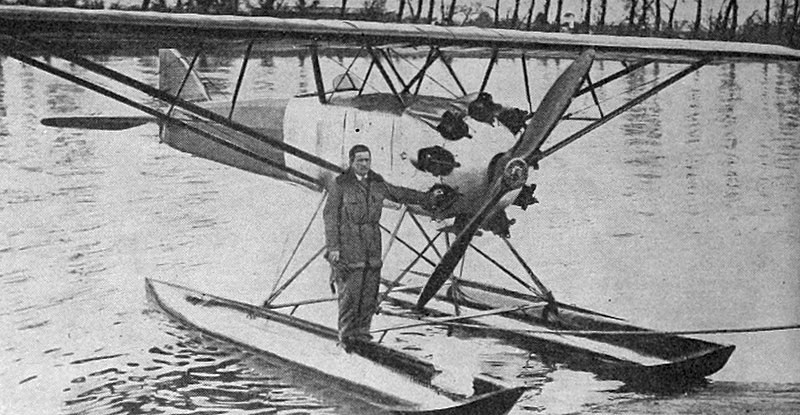
The LGL.32 Hy was a twin-pontoon floatplane version converted from the LGL.32 prototype. It set a world seaplane altitude record on 28 March 1927.
In French service, development turned from fighters to adapting the aircraft as a carrier-borne dive bomber. These featured general strengthening of the airframe, divided main undercarriage units, and a “fork” under the fuselage able to release a 50 kg (110 lb) bomb from under the fuselage while avoiding hitting the propeller.
While prolific, the GL.32 was not long-lasting, and attrition took a heavy toll on them. By 1934, all remaining examples were relegated to training and as instructional airframes; at the start of 1936, only 135 remained of the original 380 purchased. A number of these were sold to the government of the Second Spanish Republic and to the autonomous Basque Government. Another aircraft was supplied to the Basques in 1937, modified as a dive bomber along the lines of the previous French experiments. Designated the GL.633, this aircraft was used by Miguel Zambudio to attack the Nationalist battleship España, scoring decisive hits that contributed substantially to her subsequent sinking.
Variants:
GL.30
Racer with retractable undercarriage and
Engine: Bristol Jupiter
one built
GL.31 / GL.31C.1 / CL-I-3
Four-gun fighter prototype with fixed undercarriage
longer-span wings
engine: Gnome-Rhône 9A
one built
LGL.32 / GL.32C.1
Definitive two-gun fighter version
Powerplant: 1 × Gnome et Rhône 9A Jupiter VIII, 450 kW (600 hp)
Propeller: 2-bladed wooden fixed pitch
Wingspan: 12.2 m (40 ft 0 in)
Wing area: 24.9 m2 (268 sq ft)
Length: 7.55 m (24 ft 9 in)
Height: 2.95 m (9 ft 8 in)
Empty weight: 963 kg (2,123 lb)
Gross weight: 1,376 kg (3,034 lb)
Fuel capacity: 285 kg (628 lb) – (ca. 200 L (53 US gal; 44 imp gal))
Maximum speed: 270 km/h (170 mph, 150 kn) at sea level
Maximum speed: 260 km/h (160 mph; 140 kn) at 3,000 m (9,800 ft)
Maximum speed: 251 km/h (156 mph; 136 kn) at 5,000 m (16,000 ft)
Maximum speed: 215 km/h (134 mph; 116 kn) at 8,000 m (26,000 ft)
Landing speed: 90 km/h (56 mph; 49 kn)
Range: 500 km (310 mi, 270 nmi)
Service ceiling: 9,700 m (31,800 ft)
Time to 2,000 m (6,600 ft): 3 minutes 5 seconds
Time to 5,000 m (16,000 ft): 11 minutes
Time to 8,000 m (26,000 ft): 31 minutes
Wing loading: 54.8 kg/m2 (11.2 lb/sq ft)
Power/mass: 0.33 kW/kg (0.2 hp/lb)
Armament: 2x 7.7 mm (0.303 in) Vickers or Darne machine-guns – fuselage / 2x 7.7 mm (0.303 in) Darne machine-guns in wings
Crew: 1
ca. 490 built
LGL.32.01
The first prototype.
LGL.32T
Export version for Turkey
12 built
LGL.32 Hy
Twin-pontoon floatplane version converted from LGL.32 prototype.
one converted
LGL.321
LGL.32 converted to use 450 kW (600 hp) version of the Gnome & Rhône 9Ac
one converted
LGL.323
LGL.32 converted to use supercharged 373 kW (600 hp) Bristol Jupiter for unsuccessful altitude record attempts.
one converted
LGL.324
LGL.323 further modified and used by Pierre Lemoigne to set world landplane altitude record
500 kg payload of 9,600 m (31,500 ft) on 23 May 1929
Albert Lécrivain set world landplane altitude record
11,000 m (39,090 ft) on 24 October
one converted
LGL.33 / LGL.33C.1
Similar to LGL.32
revised wing struts, landing gear, and tail
Engine: Lorraine 12Eb
one built
LGL.34 / LGL.34C.1
Similar to LGL.32
Engine: Hispano-Suiza 12Gb
one built
LGL.341
similar to LGL.32
Engine: Hispano-Suiza 12Hb
two built, second with revised radiator arrangement
LGL.351
Engine: Renault 12J
one built
LGL.390
night fighter prototype
Engine: Hispano-Suiza 9Va
one converted from LGL.32
GL.410
modernised fighter with divided main undercarriage
one built
GL.430
strengthened carrier-borne dive-bomber prototype
one built
GL.432
dive-bomber variant similar to GL.430 used for operational testing
four built
GL.450
fighter version
GL-482
fighter version
Engine: Hispano-Suiza 12Xbrs
one built
GL.521
dive-bomber version
taller tail fin
Engine: Gnome-Rhône 9Kfr
two built
GL.633
dive-bomber similar to GL.432
one built
Gourdou-Leseurre B-3

Gourdou G-120

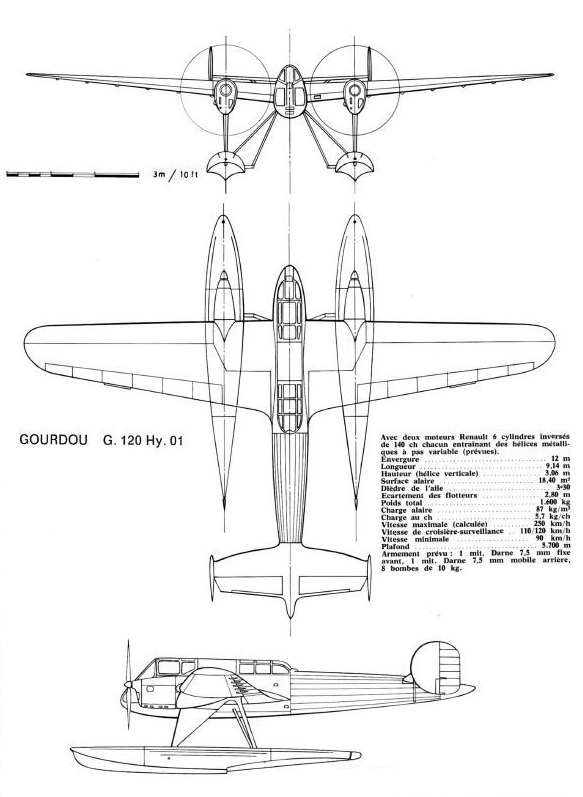
In 1937, the French Navy launched a program for a twin-engine, catapultable twin-engine seaplane for anti-submarine warfare. The aircraft should not exceed a weight of 1,600 kg, and carry 10 bombs of 10 kg. It needed a top speed of 250 km / h, a minimum speed of 90 km / h, and a cruising speed of 110 to 120 km / h. Gourdou proposed a plane equipped with high-lift devices.
In early 1938, the Technical Service of Aeronautics commissioned a life-size, rectangular wing with a constant profile, which passed the tests in the large Chalais-Meudon wind tunnel in June. This wing of 12 m wingspan and 18 sq.m wing surface, resulted in the order of a prototype.
The structure of the wing was two longitudinal members braced by oblique ribs lattice. The wing was fabric covered. The aircraft had a Fowler-type double-flap system, fitting one into the other. In the “out” position, the ensemble retreated by increasing its initial surface area by 50% and opening two slots. The slits obtained by this system were “convergent-divergent”. They differed from the converging slits of Handley-Page beaks and flaps of Bernard aircraft. Once the shutters returned, there were only small dents on the underside.
The fuselage was of welded steel-molybdenum tube structure. It had an advanced cockpit, and a firing point for the gunner behind a common fairing. This defensive post was equipped with a 7.5 mm Darne machine gun. A second machine gun of the same type, fixed, was installed in the nose. The cockpit roofs were glazed, and the front part of the fuselage was Plexiglas.
Both floats each had a volume of 1500 litres. Each float was located under the engine nacelles. They were held in the vertical plane by a triangular panel and a rear strut. Two slashes connected him to the fuselage. The floats were built in three elements, like those of the seaplanes Bernard H.52 C1 and H.110 C1.
The empennages were also made of welded steel tubes. To clear the shot in the rear weapon, the tail was twin fin.
The aircraft was subjected to static tests on a specially designed bench in the Parc Saint-Maur plant. At the beginning of the winter of 1939-1940, the seaplane was transferred to Chalais-Meudon where a special three-column support had been built on the balance plate of the large wind tunnel. In December 1939, the glider tests were carried out, flaps out. The results were disappointing. The lift was 30% lower than expected, the drag higher, the stability at depth mediocre. The director of the wind tunnel tests, Mr. Rebuffel, decided to visualize the flow on the wing with a thin stream of hot oil. The defect was a small oil cooler placed in the leading edge of the wing between the fuselage and the engine. The air intake was on the underside and the exit located on the rear. The smoke clearly indicated that this exit was prominent and caused air separation throughout the area between the fuselage and the engine. Once this radiator output changed, everything returned to normal. The exit and the return of the shutters, in 11 seconds, created a normal flow.
The powered tests began in February 1940, with test pilot Jean-Marie Le Borgne. The metal propellers that were not delivered on time were replaced by wooden pitch propellers. The results confirmed the calculations: the stability was good.
The G.120 was transported to Athis-Mons, in a rented shed on the banks of the Seine. It was launched on June 1, 1940. The test pilot Le Borgne made several hydroplanings, shutters closed, with a test engineer in the rear seat. Passing on his own wake, the pilot noticed a certain lack of rigidity in the behaviour of the floats. During another test, the flaps released, and at 70 km / h the G.120 took off by surprise, after 100 m and rose to 20 m of altitude. After a small flight of 200 m, the pilot landed without difficulty. The next day, the aircraft flew again in front of the STAé officials and flew 50 m above the water for more than 3 km. After this flight, the pilot pointed out the lack of effectiveness of the ailerons. He had been obliged to counter the lateral wind with the rudder. The flotation behaviour of the floats was remedied. This work could not be completed because of the German invasion. To prevent the prototype from falling into the hands of the enemy, Le Borgne destroyed it and sank the wreck in the Seine.
Gourdou G.120 Hy
Engines: 2 x Renault, 140 hp
Wingspan: 12 m
Length: 9.14 m
Height: 3.06 m
Wing area: 18,40 sq.m
Cruising speed: 110-120 km / h
Maximum speed: 250 km / h
Ceiling: 5,700 m
Wing load: 87 kg / sq.m
Load factor 5.7
Armament: 2 x Darne 7.5 mm machine guns
Bombload: 8 x 10 kg bombs
Gotha Ka 430
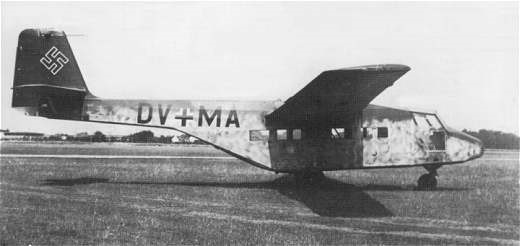
The Gotha Ka 430 was a military transport glider, first built in 1944. The glider was designed by Albert Kalkert. Twelve had been produced by the end of World War II, but none of them was used operationally.
The glider could carry twelve men, and tests were being conducted towards the end of the war to see if it could carry a cargo of 1,400 kg (3,100 lb). A single 13 mm (.51 in) MG 131 machine gun was fitted for self defence.
Gotha Go 345
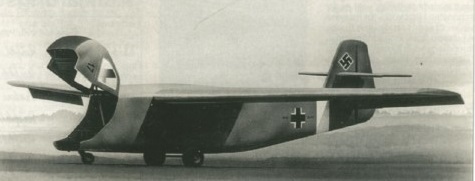
The Gotha Go 345 was a prototype German Military transport glider of the Second World War. A single example was tested in 1944.
 All Aero