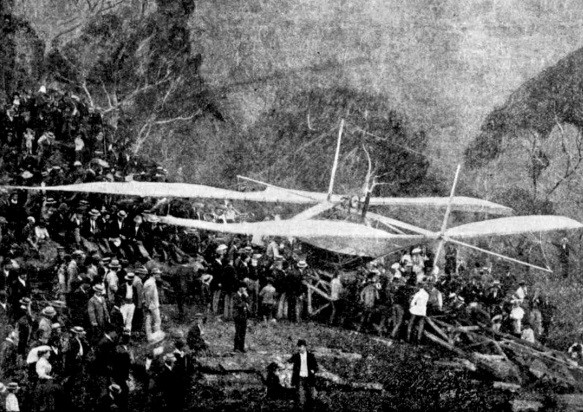
The creation of Australian inventor Newton Roberts Gordon, the “Air Ship” was the subject to a public test at Chowder Bay, Sydney, on December 26, 1894. The machine was a tandem-wing monoplane with steam-powered flappers between the sail-like wings. It slid down its starting ramp and crashed down onto the beach in front of thousands of spectators.
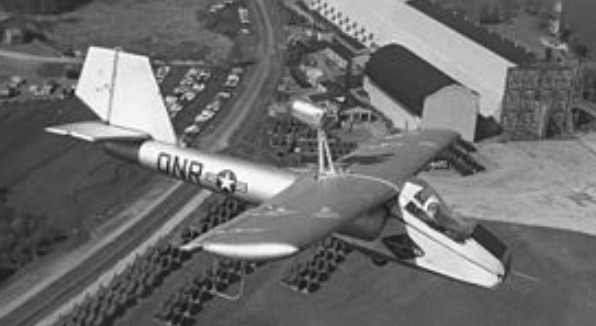
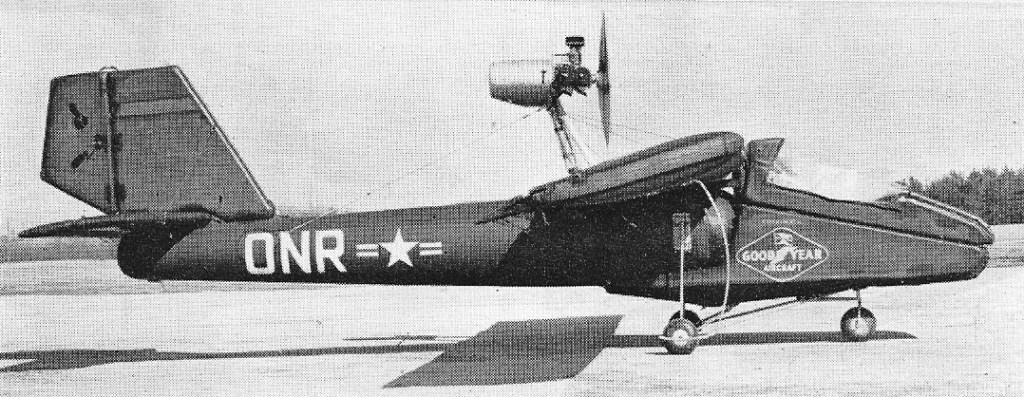
The original concept of an all-fabric inflatable aircraft was based on Taylor McDaniel inflatable rubber glider experiments in 1931. Designed and built in only 12 weeks, the Goodyear Inflatoplane was built in 1956, with the idea that it could be used by the military as a rescue plane to be dropped in a hardened container behind enemy lines. The 44 cubic ft (1.25 cubic meter) container could also be transported by truck, jeep trailer or aircraft.
The inflatable surface of this aircraft was actually a sandwich of two rubber-type materials connected by a mesh of nylon threads, forming an I-beam. When the nylon was exposed to air, it absorbed and repelled water as it stiffened, giving the aircraft its shape and rigidity. Structural integrity was retained in flight with forced air being continually circulated by the aircraft’s motor and guy wires.
There were at least two versions: The GA-468 was a single-seater. It took about five minutes to inflate to about 25 psi (170 kPa); at full size, it was 19 ft 7 in (5.97 m) long, with a 22 ft (6.7 m) wingspan. A pilot would then hand-start the two-stroke cycle, 40 horsepower (30 kW) Nelson engine, and takeoff with a maximum load of 240 pounds (110 kg). On 20 US gallons (76 L) of fuel, the aircraft could fly 390 miles (630 km), with an endurance of 6.5 hours. Maximum speed was 72 miles per hour (116 km/h), with a cruise speed of 60 mph. Later, a 42 horsepower (31 kW) engine was used in the aircraft.
Takeoff from turf was in 250 feet with 575 feet needed to clear a 50 foot obstacle. It landed in 350 feet. Rate of climb was 550 feet per minute. Its service ceiling was estimated at 10,000 ft.
The GA-466 was the two-seater version, 2 in (51 mm) shorter, but with a 6 ft (1.8 m) longer wingspan than the GA-468. A more powerful 60 horsepower (45 kW) McCulloch 4318 engine could power the 740 pounds (340 kg) of plane and passenger to 70 miles per hour (110 km/h), although the range of the plane was limited to 275 miles (443 km).
The test program at Goodyear’s facilities near Wingfoot Lake, Akron, Ohio showed that the inflation could be accomplished with as little as 8 psi (544 mbar), less than a car tire. The flight test program had a fatal crash when Army aviator Lt. “Pug” Wallace was killed. The aircraft was in a descending turn when one of the control cables under the wing came off the pulley and was wedged in the pulley bracket, locking the stick. The turn tightened until one of the wings folded up over the prop and was chopped up. With the wings flapping because of loss of air, one of the aluminum wing tip skids hit the pilot alongside the head, as was clear from marks on his helmet. Wallace was pitched out over the nose of the aircraft and fell into the shallow lake. His chute never opened. He may have been knocked unconscious and rendered unable to open it.
Only 12 Goodyear Inflatoplanes were built, but development continued until the project was cancelled in 1973. The US Army was not ready for blow up aircraft, however, and civilian certification standards prevented Goodyear from offering their Inflatobird to the public.
Mk.II with enclosed cockpit and smaller undercarriage
Goodyear donated two Inflatoplanes for museum display at the end of the project, one to the Franklin Institute in Philadelphia and one to the Smithsonian Institution in Washington, D.C.
Variants:
GA-33 Inflatoplane The initial single-seat version, with open cockpit, based on the Taylor McDaniel inflatable rubber glider experiments from the early 1930’s. One built.
GA-447 Inflatoplane An enclosed cockpit and new wing, used for undercarriage experiments (tricycle, uniwheel, and hydroskid). One built.
GA-466 Inflatoplane Company designation for the AO-2 Inflatoplane
GA-468 Inflatoplane Company designation for the AO-2 Inflatoplane
XAO-2-GI Inflatoplane Military designation for the GA-466. One built.
XAO-3-GI Inflatoplane Military designation for the GA-468. Five built.
General characteristics Engine: 1 × McCulloch 4318 air-cooled, 60 hp (45 kW) Length: 19 ft 2 in (m) Wingspan: 28 ft (8.53 m) Height: 4 ft (1.22 m) Loaded weight: 740 lb (336 kg) Maximum speed: 70 mph (113 km/h) Range: 275 mi (440 km) Service ceiling: 6,500 ft (1,981 m) Rate of climb: 500 ft/min (152 m/min) Crew: 1 Capacity: 1 passenger
In 1950, a revised four-seat variant of the Goodyear GA-2, the GA-22 Drake was flown, followed in 1953 by the GA-22A Drake (with a revised hull); only one of each was built.
The GA-22A Drake was powered by a 225 hp (167 kW) Continental E-225-8 and converted into a flying boat with a revised hull; first flight in 1953.
The last aircraft built, the GA-22A Drake registered N5516M, is stored by the EAA Air Venture Museum
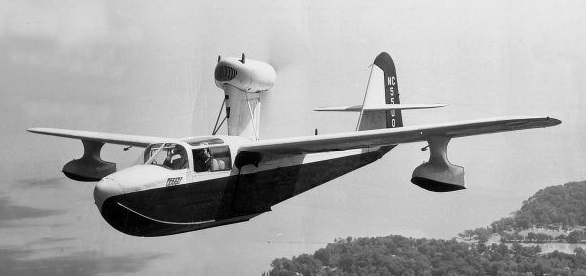
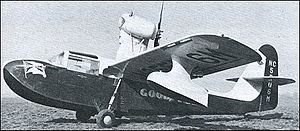
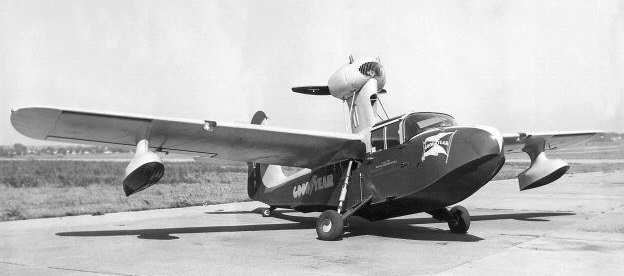
The Goodyear Aircraft Corporation began to design a small light amphibian before the end of the Second World War. The prototype designated GA-1 first flew in September 1944. It was a cantilever high-wing monoplane with underwing stabilizing floats. The GA-1 had an all-metal fabric-covered wing, an all-metal single-step hull, and a cruciform tail unit. It had a retractable tail-wheel, accommodation for two, and a pylon-mounted piston engine with a pusher propeller.
Goodyear GA-2 Duck
After successful testing of the prototype, 18 demonstration aircraft were built. These differed from the prototype in that they had room for the pilot and two passengers. Two versions were built, the GA-2 with a 145 hp (108 kW) Franklin 6A4-145-A3 piston engine, and the GA-2B with a 165 hp (123 kW) Franklin 6A4-165-B3 flat-six piston engine.
Sixteen GA-2 Duck were built, some later modified as GA-2Bs. Six GA-2B Duck were modified from GA-2s in 1949. The GA-2B had improvements over the GA-2, not the least insignificant of which was the fitting of the patented Goodyear Cross-Wind Landing Gear.
Goodyear GA-2B Duck NC5504M
GA-2B Engine: 1 × Franklin 6A4-163-B3, 165 hp (123 kW) Length: 26 ft 0 in (7.92 m) Wingspan: 36 ft 0 in (10.97 m) Height: 9 ft 6 (on wheels) in (2.90 (on wheels) m) Wing area: 178.20 ft2 (16.55 m2) Empty weight: 1600 lb (726 kg) Gross weight: 2300 lb (1043 kg) Maximum speed: 125 mph (201 km/h) Range: 300 miles (483 km) Service ceiling: 15,000 ft (4570 m) Crew: One Capacity: Two passengers
The Goodyear Aircraft Corporation began to design a small light amphibian before the end of the Second World War. The prototype designated GA-1 first flew in September 1944. It was a cantilever high-wing monoplane with underwing stabilizing floats. The GA-1 had an all-metal fabric-covered wing, an all-metal single-step hull, and a cruciform tail unit. It had a retractable tail-wheel, accommodation for two, and a pylon-mounted piston engine with a pusher propeller. Originally powered by a 107 hp (80 kW) Franklin 4ACG-100-H3 piston engine, later fitted with a 125 hp (93 kW) Franklin 6A engine.
After successful testing of the prototype, 18 demonstration aircraft were built. These differed from the prototype in that they had room for the pilot and two passengers. Two versions were built, the GA-2 with a 145 hp (108 kW) Franklin 6A4-145-A3 piston engine, and the GA-2B with a 165 hp (123 kW) Franklin 6A4-165-B3 flat-six piston engine.
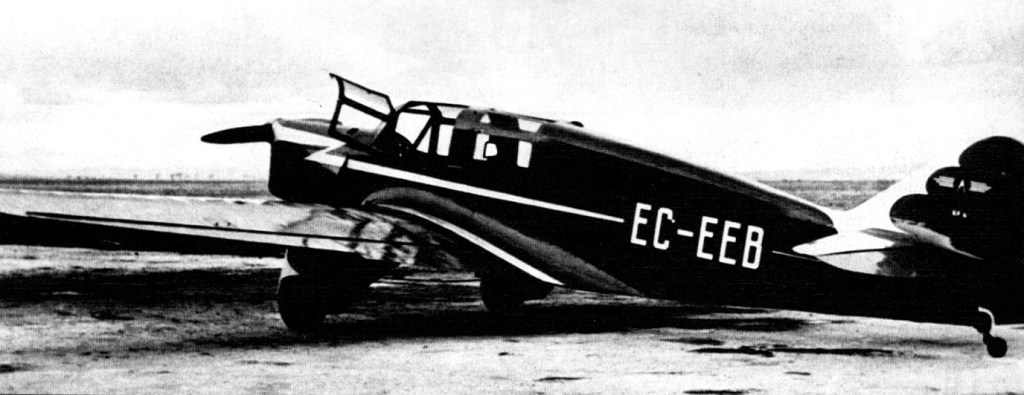
Gonzales Gil-Pazo GP II was built in Spain by Arturo Gil y Santibanez and Jose Pazo Montes. This special version was fitted with a single 130 hp engine. It took part in a record attempt from Barcelona to Senegal, piloted by Ramon Torres and Carlos Coll of the Aero Club Aero Popular de Barcelone, but landed in Morocco after cross winds affected its flight. It is photographed here at Madrid airport during test flights, where it proved it could average a speed of 250 kph with a range of 2000 km.
It was destroyed in an accident at Los Alcazares in January 1937.
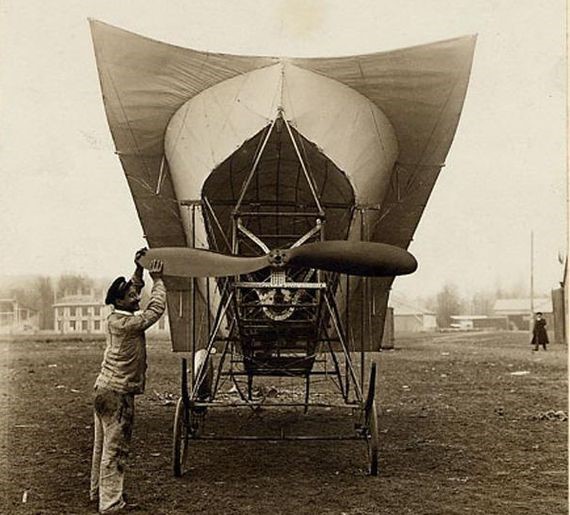
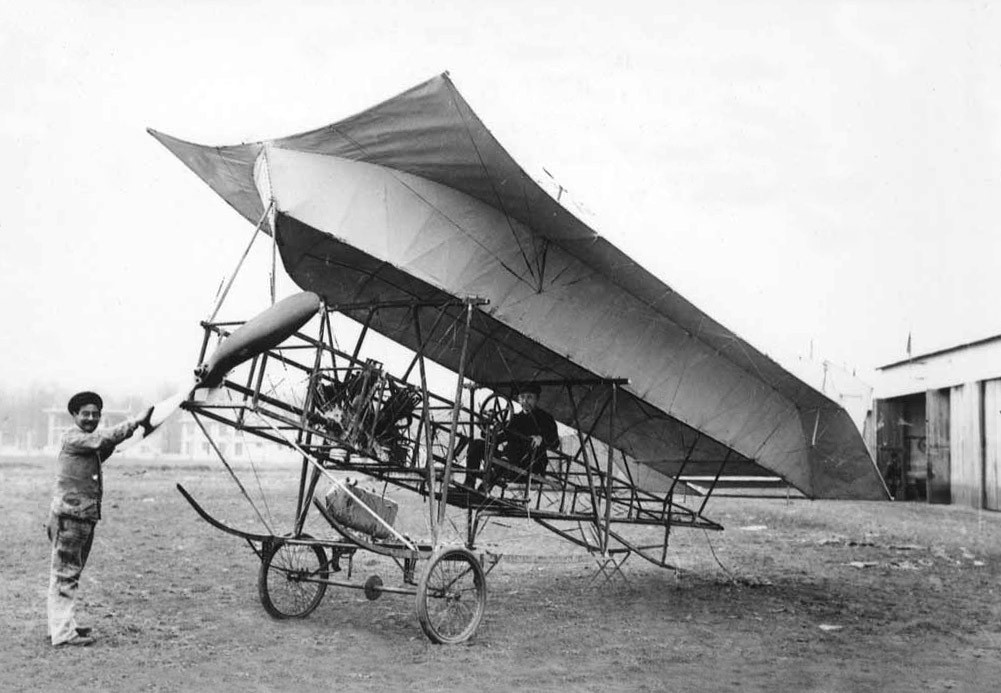
The second patented Uniplan of the Gonnel brothers – Raoul-Georges and Arthur-Édouard – built at Juvisy, France during March 1911.
This rebuilt, 2nd version of the machine, which is actually a complete rebuilt of the fuselage and undercarriage, was also fitted with a more powerful engine, a 45-50 hp 4-cylinder Velox-Suère.
The Aero¬star is a totally newly de¬signed airplane with increased wing, canard and winglet area; a totally redesigned fuselage that is 3½ inches wider than the Goldwing ST and sports a center-mounted control stick; wide-track landing gear; and a vacuum-molded manufacturing process utilizing carbon graphite spar caps, high-density foam cores and Du Pont Kevlar in a variety of sandwich struc¬tures. The wings, canard, elevators and fuselage are built in large, specially designed molds. All major com¬ponents are completed in two halves, which are mated together while still in their molds.



 All Aero