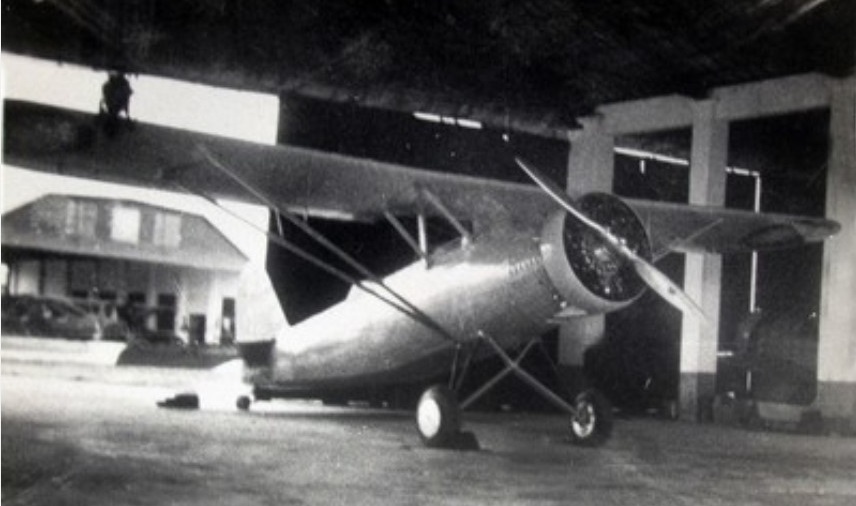
The Guangzhou/Kunming 1st Aircraft Manufacturer built one example of the Yang Ch’eng 78.
The Guangzhou/Kunming 1st Aircraft Manufacturer built one example of the Yang Ch’eng 78.
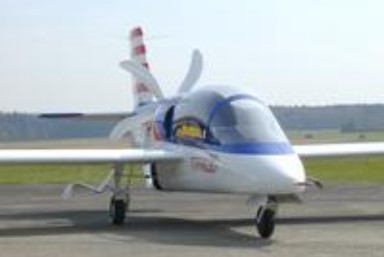
Austrian Ultralight Project looking for a producer.
Cruise: 189 kt / 217 mph / 350 kmh
Empty Weight: 520 kg / 1146 lbs
MTOW Weight: 750 kg / 1653 lbs
Climb Ratio: 1600 ft/min / 8,50 m/s
Take-off distance (50ft obstacle): 770 ft / 235 m
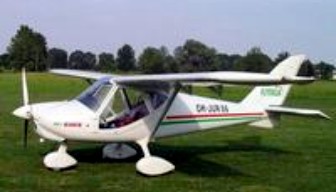
Classical all-metal high-wing with side-by-side seats designed to be ideal for training, cross-country flying and flying for fun.
Stall: 34 kt / 39 mph / 63 kmh
Cruise: 119 kt / 137 mph / 220 kmh
VNE: 148 kt / 171 mph / 275 kmh
Empty Weight: 275 kg / 606 lbs
MTOW Weight: 480 kg / 1058 lbs
Climb Ratio: 1000 ft/min / 5 m/s
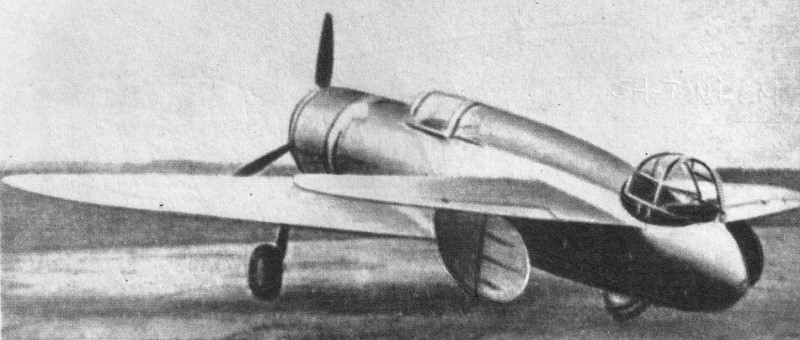
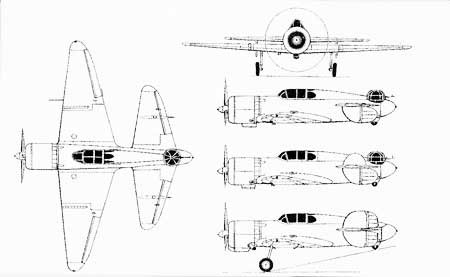
A development of the KB MAI under the direction of PD Grushin, known as Sh-MAI, MAI-3, Sh-Tandem or Tandem-MAI (Russian МАИ/Грушин Ш-Тандем), designed as a two-seater with an unconventional structure of tandem wings. This configuration was selected taking into account that the distribution of mass along the entire length of the cantral axis of the aircraft would allow excellent longitudinal stability. Another success of this configuration was the possibility of locating the gunner’s turret directly in the tail section, which together with the use of a double empennage structure, allowed excellent defensive coverage. The tandem scheme also facilitated armor plating and the location of the weapons bay.
Originally the Sh-Tandem was designed to use an M-88 air-cooled radial engine, but when it was not available an M-87 and later an M-87A were used.
The main wing was set low and housed the main landing gear lugs. The tail wheel was not retracted in flight.
The rear wing was located high on the fuselage and its area represented 45% of the main one, also working as a tailplane. Ailerons were arranged on both wings, behaving at the rear also as elevators.
The vertical empennages were located on the rear wing, roughly in the center of the console’s wingspan.Five different configurations of these vertical fins were tested, ending up with large area washer-like structures, located above and below the wing. Each fin was integrated into the wing structure and contained the rudders. This configuration affected the gunner’s firing coverage area, which led to the need to move him towards the wing.
The Sh-Tandem was built entirely in wood, mainly bakelite plywood. The wing featured a double spar with crafted covering panels.
The Sh-Tandem’s armament was standard for a light attack aircraft and consisted of 4 x 7.62mm ShKAS machine guns in the wings with 2,400 rounds total, one ShKAS machine gun in the turret with 700 rounds and capacity for 200kg bombs externally.
The Sh-Tandem prototype was built in the MAI workshops and the fuselage, the centerplane and the main consoles were built by a group of 18 workers from the institute’s workshops in just 45 days.
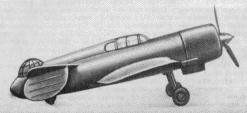
On January 8, 1939, the plane in a single-seat configuration and without weapons carried out the first flight tests with the M-87 engine. In these flights, a high speed was achieved, the performance corresponding to the calculated data. The speed at sea level reached 406 km/h and at an altitude of 4,250 meters it was 488 km/h.
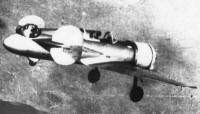
Based on the results obtained in the tests, Grushin was recommended to move the gunner’s cabin a little more to the stern and equip it with an MV-5 turret.
Between September and October 1939, the two-seater version of the Sh-Tandem with a new M-87A power plant with a nominal power of 950 hp and a BISh-3 variable pitch propeller carried out joint factory and state tests. This example featured a rearward gunner’s cabin and MV-3 turret. During the tests, 51 flights were carried out with a total time of 18 hours and 38 minutes. With a flying weight of 2,800 kg, the speed at sea level reached 361 km/h and at 5,600 meters it was 444 km/h. Landing speed without air brakes was 140 – 145 km/h. The takeoff run was 400 meters and the landing run was 480 meters.
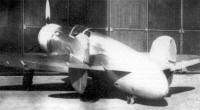
The test report was signed on October 10, reflecting the aircraft’s ease of handling, but in general it was considered that the Sh-Tandem failed the tests because it failed to achieve the results requested by the military, in addition of presenting a tendency to destabilize with increasing speed and other problems such as discomfort in the gunner’s cabin, ineffective design of the landing gear and lack of rigidity in the front wing.
The takeoff was rated as difficult and the upper position of the rear wing was considered not the most appropriate. The armament was also not considered finished. The MV-3 turret “swallowed” 34 km/h speed, so it was decided to redesign the gunner’s position to a version similar to the one used by the Fokker G.1. However, it was considered that the Sh-Tandem scheme represented military interest, so it was recommended to deliver the prototype to the TsAGI, make the improvements and present it again for testing.
The construction of a second prototype characterized by the negative dihedral in the rear wing began. This example included a retractable tricycle landing gear and an M-63 engine capable of developing 800 hp at 4,500 meters. The little formality of the design and the low power of the weapon conditioned the decision of the NKAP to abandon development in May 1939. The second prototype was 70% complete when work was definitively suspended.
The results obtained during the tests were used in the projection of the next model of the KB MAI, a light bomber that was called BB-MAI.
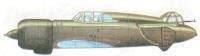
Sh-Tandem
Engine: 1 x 930 hp М-87
Wingspan: 11.00 m
Length: 8.50m
Wing area: 30.40 m²
Normal takeoff weight: 2560 kg
Wing loading: 84kg/m²
Power load: 3.3kg/hp
Maximum speed at sea level: 406 km/h
Maximum speed at altitude: 488 km/h
Landing speed: 145 km/h
Accommodation: 2
Armament: Five 7.62mm ShKAS machine guns
Bombload: 200kg
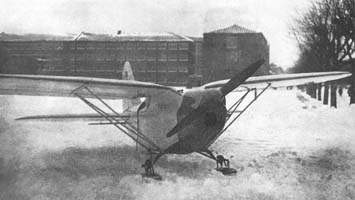
In the mid-30s at the OKB-1 of the Moscow Aviation Institute (MAI), led by PD Grushin, developed a small light aircraft with a monoplane tandem wing named Ortyabrionok (Russian: МАИ/Грушин Октябренок). This project was developed in 1935 to participate in the contest for light aircraft with low engine power, called by the management of Osoaviajim and Aviavnito. The main requirements of this contest were: totally safe flight, wide tolerance in piloting, ability to be used for the preparation of novice pilots and, above all, low manufacturing and operating cost.
The work on the Oktyabrionok included the development of a scale model for wind tunnel tests, and the development of various configurations. As a result, an airplane with tandem monoplane wings was designed.
On the Oktyabrionok the front and rear wings were fixed. Elevons were located on the forward wing along the entire wingspan of the trailing edge. These elevons that performed functions of elevators, flaps for takeoff and landing operations, and ailerons for turns. The rear wing was embedded in the airframe and lacked control surfaces. The presence of the elevators in the forward wing allowed to obtain a great efficiency in the takeoff and landing operations.
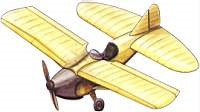
Unlike the French ” Pou du Ciel “, in the Oktyabrionok the front wing was fixed to the fuselage by means of horizontal joints linked to the control stick, which allowed a variation of the incidence of the wing in relation to the longitudinal axis. With this modification, the elevators managed to maintain their effectiveness in all flight regimes, including diving, which managed to solve one of the main deficiencies of the French model, which also caused a few accidents. This configuration was the result of wind tunnel tests and was later confirmed during flight tests. It was flown by pilots with very little experience.
The control of the flight in the basic piloting configuration was executed only by means of the flight stick. In this case the pedals only served to direct the tail wheel on the ground. Modifying the center of gravity of the airplane towards 50 – 60% of the longitudinal axis, it was possible to reduce the stability of the airplane in flight to an acceptable level for pilots with medium qualifications. In this case the pedals were connected to the rudder.
Originally in order folding wings were designed. The front ones were collected upwards and the rear ones back to the sides of the fuselage. In the model development process this option was eliminated.
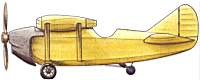
In the initial conception, a power plant that was developed as a project by the OKB-2 of MAI. This model was not yet ready at the time of the competition, so the initial power plant was a 27 hp Obré-Dunné, which was later changed to a 30 hp Bristol Cherub. The plane turned out to be somewhat heavier than the calculations, instead of 230 kg its weight was close to 400 kg. For this reason, after several modifications, a more powerful 45 hp Salmsom engine was installed.
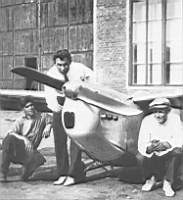
AI Grinchik, PI Blandov, PV Semionov and AA Lebiedinski took a very active part in the construction of the Oktyabrionok. In the process of developing the model, the wing spars were reinforced, shock absorbers were added to the wheels, and the rudder area was increased.
The first flight of the Oktyabrionok took place on October 23, 1936. Test pilot AI Zhukov, chief pilot of the Aviajim Factory, reached 1000 meters. After several turns over the airfield, Zhukov executed an eight, demonstrating the excellent stability of the plane. For takeoff only 50 – 60 meters were enough. For the landing only 15 meters.
On October 30, taking off from the airfield of the MAI aeroclub in Khimki, AI Zhukov flew over the institute and made several figures over the Tushino airfield.
The instructors of the MAI Flying Club, AA Lebiedinski and S. Jolobtsov, flew at Oktyabrionok and PD Grushin himself received his training as a pilot on this plane.
The Oktyabrionok flew well, but the tandem wing configuration did not allow for great aerodynamic advantages relative to the conventional monoplane layout.
After tests at the NII VVS, developed by PM Stefanovski , the Oktyabrionok was delivered to the VVS , being registered as a staff liaison aircraft. It flew successfully for a few years.
In 1938 the Oktyabrionok participated in the air show held in Tushino.
Engine: 1 x 45 hp Salmson
Forward wing span: 6.00 m
Rear wing span: 4.4 m
Total wing area: 12.80 m²
Front wing area: 7 m²
Length: 4.12 m
Empty weight: 295 kg
Maximum takeoff weight: 400 kg
Fuel capacity: 25 kg
Payload capacity: 105 kg
Wing loading: 23 kg/m²
Power load: 8.9 kg/hp
Maximum speed: 115 km/h
Cruising speed: 95 km/h
Landing speed: 55 km/h
Accommodation: 1
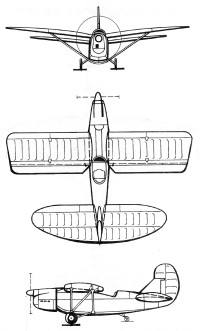
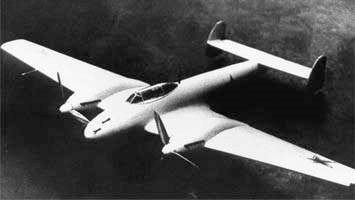
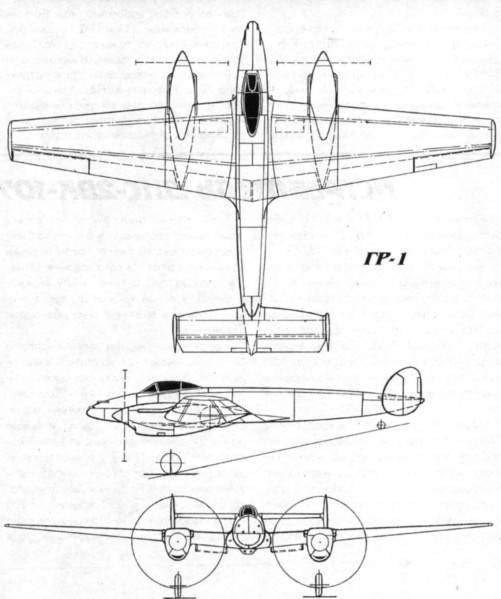
In 1940 PD Grushin was given the task of creating a long-range escort fighter within the experimental aviation development program. Developed by Grushin during his period as the OKB ‘s chief builder at Kharkiv Aviation Plant No.135, the IDS heavy escort fighter name corresponds to the initials Long-Range Fighter (in Russian: Истребитель Дальнего Сопровождения), but it was also known as Gr-1 (Grushin No.1).
The Gr-1 was designed as a twin-engine monoplane of conventional structure with a twin-empennage tail and was powered by two water-cooled Mikulin AM-37s rated at 1,200 hp. The structure of the Gr-1 was metal. The wings featured spars of square section and the rib of shaped and welded pieces of steel forming a closed contour.
The Gr-1 cockpit featured armor plating using a steel slatted trunk and this was the primary cause for the single-seat configuration selection. During development Grushin asked his specialists to assess between a two-seater configuration with pilot and gunner and an armored single-seater configuration capable of fully defending the pilot. The results showed that the second configuration was 18 kg lighter than the first and from this analysis the Gr-1 emerged as a single-seater.
AM-37 engines featured exhaust manifolds located above the wing and the radiators were located in the lower part of the wing center and had a retractable configuration to reduce the probability of impacts during dogfights.
The IDS had in the nose two 7.62 mm ShKAS machine guns and two 20 mm ShBAK cannons. Two other ShKAS machine guns were located in the wings. All the machine guns had 1,250 rounds, while the cannons had 300 rounds per unit. It was also planned to install a station with a pair of 37 mm guns in the lower part of the fuselage with 200 rounds each.
In the wing, 4 supports capable of carrying eight 100 kg aviation bombs or four RS-82 or RS-132 unguided rockets could be located. Instead of installing guns, up to 500 kg of bombs could be hung under the fuselage.
The Gr-1 was designed and built in just 9 months. The static resistance tests took several days and in the spring of 1941 the plane was ready to fly. After a period of fine-tuning and fixing details, someone objected that the plane had not been tested in the TsAGI wind tunnel. Without this proof, flying was too risky, so the plane was disassembled and sent to Moscow.
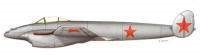
After the tests, the plane was again disassembled and sent to Factory No.135 to correct the indications, but the war began.
The Factory was evacuated to the west and the plane was repacked. During the transfer the convoy was bombed. The Gr-1 suffered extensive damage and all the documentation was burned. Work on the fighter was never continued. Grushin was sent to Factory No.21, where he held the post of chief engineer and later replacement for builder Semyon Lavochkin.
Gr-1
Powerplant: 2 x 1,250 hp Mikulin АМ-37
Wingspan: 16.80 m
Wing area: 42.00 m²
Length: 11.60m
Height: 3.88m
Empty weight: 5420 kg
Normal takeoff weight: 7650 kg
Fuel capacity: 1860/2550 kg
Wing loading: 182kg/m²
Power load: 2.73 kg/hp
Calculated
Maximum speed at sea level: 448 km/h
Maximum speed at 7200 m: 595 km/h
Landing speed: 120 km/h
Ascent time to 5000 m: 9.8 min.
Range: 1890 km
Practical range: 1380 km
Practical ceiling: 11700 m
Accommodation: 1
Armament: Four 7.62 mm ShKAS machine guns and two 20 mm ShKAS cannon
Bombload: 500 kg or eight RS-82 and RS-132 rockets
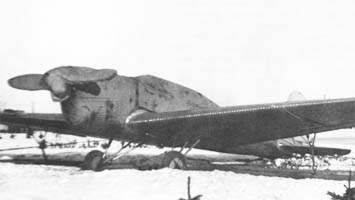
The idea for the creation of the MAI/Grushin Stal-MAI (Russian МАИ/Грушин Сталь-МАИ) arose in 1931, when the TsAGI decided to develop record-setting aircraft to achieve long-range flights. In August 1931, the Military Revolutionary Committee (Revboyensoviet) organized a commission for the development of a long-range aircraft and in December 1931 the decision was made to finance the development of the RD (ANT-25) designed by Sukhoi in the OKB of AN Tupolev and designed to reach 13,000 km. In parallel, it was requested to create an aircraft with a range of about 5000 km.
At the end of 1931, the head of the chair of construction and aeronautical projection of the MAI, DP Grigorovich organized a group of students for the design of the airplane. Such students as P. Grushin, M. Pasinnin, L. Kurbala, V. Fiedulov and A. Shelkin were included in this group.
The strength calculation was developed by VP Yarovitski and the construction was directed by the deputy director of UPM SM Belyaikin. The head of the production workshop was AS Orlov, the engineer-technologist for welding processes L. Pasiechnik. The new aircraft, named Stal-MAI (Steel-MAI) was built by A. Bajariev, V. Novikov, A. Ivanov and others in the MAI.
During the course of the construction process, the technical direction passed to PD Grushin, who in 1933 went on to lead the recently created OKB-1, built on the basis of the KB of the aeronautical construction faculty of the MAI.
The Stal-MAI was a low-wing monoplane with a straight trapezoidal wing. The relatively short fuselage with monoplane tail of conventional type. The engine was a water-cooled M-34R with 830 horsepower. The engine used in the Stal-MAI was the one used in exhibitions and for this reason it was characterized by a special finish, reflected in the polishing of the outer surface, the chrome finish of the nuts and piston heads, and the painting of the block. The M-34R used a gearbox to drive a variable-pitch metal propeller.
The Stal-MAI was one of the first aircraft in the world made entirely of steel (hence its name). The construction was entirely in Enerzh-6 stainless steel, with fabric covering on the control surfaces. The fuselage was a welded semi-monocoque structure covered with light plates.
The wing featured a double spar. The front spar was located at the thickest point of the profile (28% of the chord) and was built on the basis of shaped strips. The rear spar was made of chrome molybdenum steel tubes. The wings had a wingspan of 18 meters and an area of 40 m², allowing a calculated speed of 320 km/h, with a landing speed close to 100 km/h.
Virtually all construction of the fuselage, wing and tail was made using electric spot welding. The wing and fuselage skin was made with thin 0.3 – 0.5 mm steel sheets. At some key points the shell was reinforced with internally welded corrugated steel. All the ribbing was also made with shaped steel parts.
The landing gear was of the conventional type with retractable main landing gear with air shocks and a tailwheel. The main units retracted into the wing with the help of a hand crank mechanism.
The cabin was two-seater, closed by a single cover.
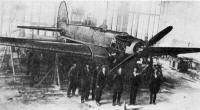
The Stal-MAI was built at the UPM MAI and was delivered for testing in the summer of 1934. The tests took place at the Jodinka airfield and the test pilots were IF Kozlov and Yu. I. Pyontkovsky.
On September 19, 1934, Yu . I. Piontkovski made the first flight of the model. During the fifth flight an accident occurred due to an overheating of the engine. Yu. I. Piontkovski and PD Grushin were able to land successfully, but during touchdown the power bank and the wing fixing base deformed. The repair process was extremely long, extending practically throughout 1935, without actually finishing it, so the plane never took flight again.
Powerplant: 1 x 830 hp M-34R
Wingspan: 18.00 m
Wing area: 40.00 m²
Length: 11.30m
(Calculated)
Maximum speed: 320 km/h
Cruise speed: 280 km/h
Landing speed: 100 km/h
Range: 5000km
Accommodation: 2
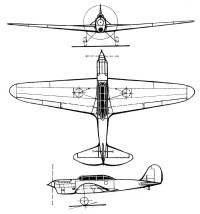
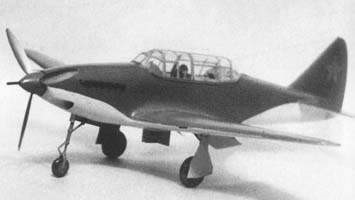
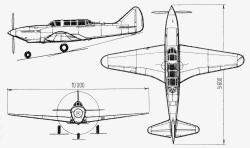
Developed in the late 1930s by the Moscow Aviation Institute in the OKB-1 led by PD Grushin, was a ground attack aircraft and light bomber that received the designation MAI/Grushin BB-MAI (Russian: МАИ/Грушин ББ-МАИ).
The BB-MAI was designed as a classic monoplane layout airplane with a 1050 hp M-105 powerplant and was designed during 1938 and 1939.
The BB-MAI introduced the use of bakelite plywood construction, introduced with the help of a group of specialists from VIAM, the engine used a compressor that worked with exhaust gases, developed by TsIAM, for the first time in the USSR, a nose Wheel undercarriage, and a movable turret.
The double-spar wing was made up of three C-sections made of Bakelite plywood. When these sections were joined together, the “back” formed the spar wall and its base became the wing covering. The sections were glued with VIAM B-3 glue during assembly, producing a structure of considerable rigidity. The wing area was small at 15.2 m², therefore, with a takeoff weight close to 3,500 kg, the wing loading reached 210 kg/m². The wing also had automatic slats.
The coating on the base of the wing reached 5 mm and on the tail section 3 mm. The walls of the stringers were 25 mm. The fuselage was of the monocoque type made of bakelite plywood glued with the same glue. This construction achieved such strength that the internal structure could be lightened. As in the case of the Grushin Sh-Tandem, the surface was highly polished.
The main wheels were retracted towards the wing, to the sides of the fuselage, with a 90º turn of the wheels. Behind the front wheel was the radiator.
Construction of the prototype began in 1939 and it was completed in 1940 at KBMAI. The main builder of the prototype was AA Lebiedinski and AA Manucharov was appointed as the main test engineer. The BB-MAI was tested by MAI graduate AN Grinchik, a Soviet test pilot who would die in a crash in the USSR’s first turbojet aircraft.
Construction delays led to the first flight taking place in December 1941. By that time the interest of the VVS for an aircraft with these characteristics had already disappeared. Grushin himself had been appointed KB ‘s main builder at Kharkiv Aviation Factory (JAZ) No.135 and KB MAI was soon shut down for a few years.
Only one prototype was built and flown in the December 1941. The proximity of the war led to the end of the project. The BB-MAI was never armed.
Powerplant: 1 x 1050 hp М-105
Wing span: 10.00 m
Wing area: 16.80 m²
Length: 9.60m
Empty weight: 2965 kg
Normal takeoff weight: 3490 kg
Wing loading: 208 kg/m²
Power load: 3.3 kg/hp
Maximum speed at sea level: 508 km/h
Maximum speed at altitude: 550 km/h
Ascent time to 5000 m: 9.2 min.
Practical range: 500 km
Practical ceiling: 9000 m
Accommodation: 2
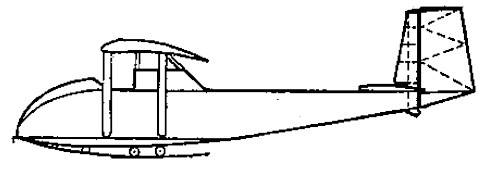
Training glider, Germany, 1931
Length: 18.373 ft / 5.6 m
Wingspan: 32.808 ft / 10.0 m
Crew: 1
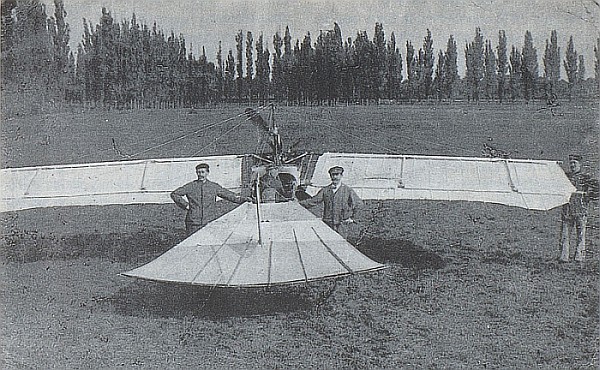
The first aeroplane built in Speyer (Pfalz), by a Leutnant Grundner with assistance of the officers of the Kgl. II Bayerische II. Pionierbataillon, which was stationed at Speyer. Details of its flying capabilities (if there were any) and other facts are missing. Flat wings without airfoil and exposed structure on the upper wing surface were for 1912 unusual features and not helpful to get the monoplane in the air.
 All Aero