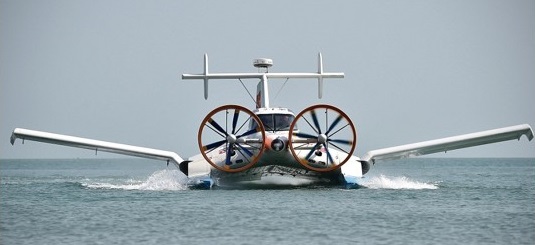
A development of TsKB Rostislav Alekseev went to China under a contract, to Hainan Yingge Wing who developed the modernized version of the Volga-2 ekranoplan. Hainan Yingge Wing conducted flight tests of CYG-11 (Oriole) vehicles on the coast of Hainan Island, near the city of Haikou.
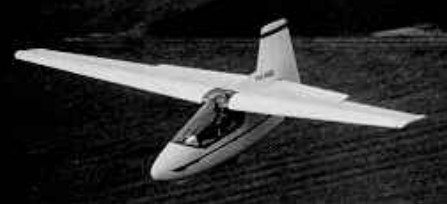
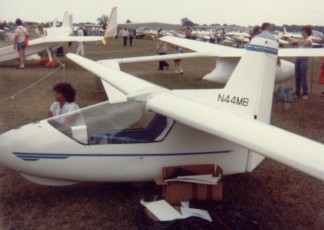
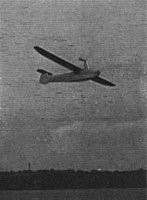
The “Minibat” ultralight single-seater glider was designed by Larry Haig of Muskegan, Michigan, over a three-month period at a cost of $3,500, and made its first flight on March 11, 1979. The Minibat had a cantilever, swept forward wing and used a reflex airfoil. It was constructed of Kevlar, carbon fibres and foam sandwich with glass fibre covering. The fuselage was made up of two halves joined by the metallic structure which formed the pilot’s seat. Wings were demountable in the same way as a conventional glider, and a peculiarity of this machine was that the two ailerons could be raised together to act as spoilers. Extended wing tips were also available, increasing span to 10 meters.
The Minibat was available as fast-build kits for the homebuilder, assembly was said to require only 5 – 10 days using moulded parts. A powered version was planned, using a 3 hp chain saw sustainer engine mounted behind the cockpit and driving a pusher propeller mounted in a slot between the fin and rudder. The Minibat was not a self-launching design but the engine was intended, after launch by auto-tow, winch or bungee, to provide a positive rate of climb.
By January 1982, four Minibats had already had accidents during take-off. It was concluded that this machine should not be made available to just anybody, as it was initially expected. It seems that the airfoil was the major cause for the bad handling characteristics. But yet the Minibat was a very interesting concept of a very light and efficient “minimum” glider.
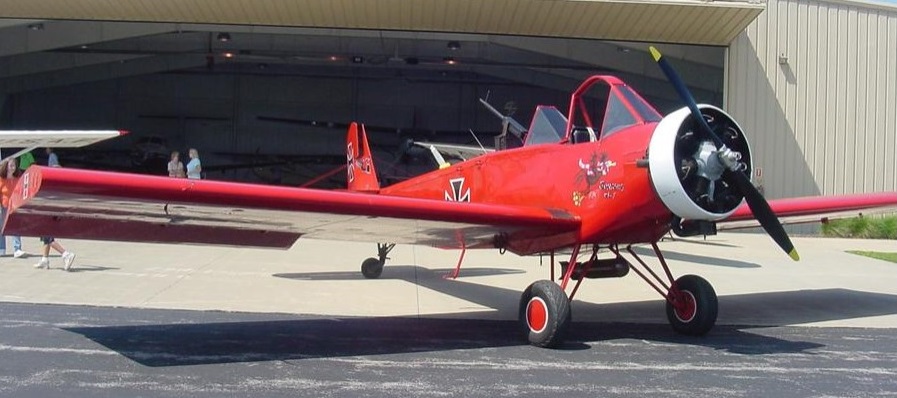
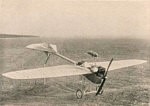
In 1986 Joseph Haig built a Junkers J8 replica in the U.S. This replica was based on a Snow S2A (s/n 1019, built in 1959). The replica was registered as N4976C in 1993 and was used on U.S. Airshows until 2005.
The replica was sold to T.Fissell Flying Service in Clarksville Texas.
The prototype of this tandem two-seat training sailplane flew on September 10, 1956 and at least eight more were flying by 1961. Construction is similar to that of the H-22B-3.
Span: 43 ft 2 in Length: 23 ft 4 in Wing area: 185 sq.ft Gross weight: 838 lb Empty weight: 463 lb Max L/D: 18 at 42.5 mph Min sink: 3.6 ft/min at 38.5 mph
Thirty of these tandem two-seat primary training gliders have been built by 1961, since August 1953, when the prototype made its first flight. Construction is conventional, with a fabric-covered steel-tube fuselage nacelle and fabric-covered two-spar braced wooden wing.
Horikaw A H-22B-3 Span: 40 ft l in Length: 23 ft Wing area: 181 sq.ft Gross weight: 661 lb Empty weight: 375 lb Max L/D: 14.2 at 41,5 mph Min sink: 3.8 ft/sec at 34 mph
Helmut Haessler and Franz Villinger, engineers from the Junkers company, built a sailplane like aircraft called the Muffi which had a footcranked pusher propeller. It flew 722 m (790 yards) after an elastic aided launch and was awarded a consolation prize by Flugsport magazine for the first man powered flight of 1 km (0.6 mile) around two pylons set 400 m (437 yards) apart.
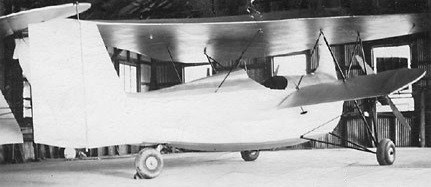
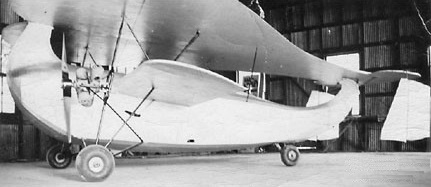
The Hackenberger 1A is an evolution of the model H. Similar in its design, but larger and more streamlined.
Built in 1935, the single place 1A extremites of the elevator had twin stabilizer/rudders.
Those rudders were actually braced onto the rear of the fuselage and only a single strut balanced the elevator above the stabilizers. The fuselage curved upwards at both ends, connecting to the leading and trailing edges of the parasol. Somehow the angle of the elevator was varied at its joining with the parasol/fuselage.
Registered N13974 c/n 2, power was two 20hp Irwin Meteormotors, changed to 40hp Continentals in 1938.
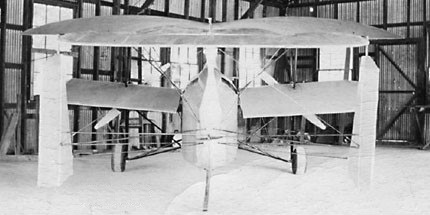
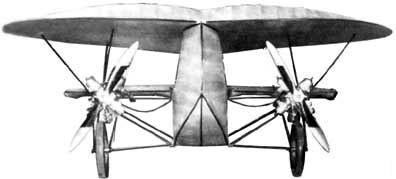
A 1930 twin-engine flying pancake-type with heart-shaped parasol wing built by A L. Hackenberger. The Hackenberger H, or Helioplane, was powered by two 4-cyl “Scroggies”.
The aircraft was registered NX18966 c/n 5H-1 (as H) as a single seater.
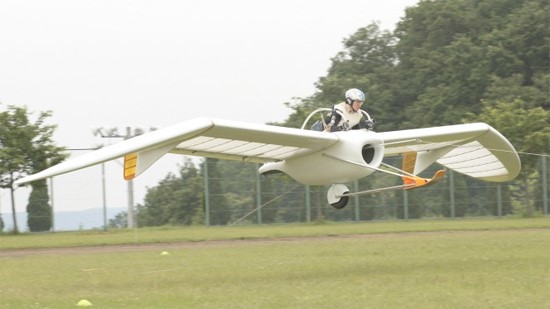
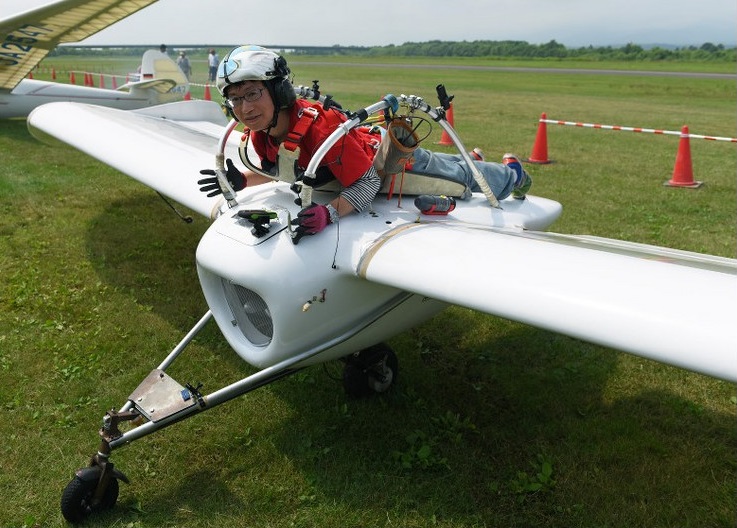
Designed by Satoru Shinohe, the OpenSky M-02 glider/jet-powered motor glider is based on the ‘Mehve’ glider seen in the 1984 anime film, directed by Hayao Miyazaki, Nausicaä of the Valley of the Wind. In the film, Nausicaa takes flight uses the Mehve – the name taken from the German “Möwe”, meaning ‘gull’ – to survey a toxic wasteland.
The M-02J is the work of Kazuhiko Hachiya, who has been working to produce a pilotable version of the aircraft since 2014. Like the animated version, Hachiya’s craft is built around a small jet engine, which is used to achieve take off, climb for a duration of 10 minutes, and attain gliding altitude.
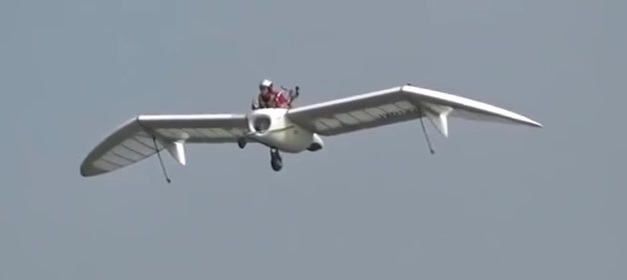
Hachiya’s Mehve, called the OpenSky, has been through several versions since 2003. The original version was radio-controlled, but Hachiya himself took to the sky on OpenSky 3.0. It was this model he planned to show to the public.
The craft boasts a 963cm wingspan and a 267cm fuselage. Like in the film, the pilot lies flat against the top pf the vehicle, and steers by shifting their weight around.
As of June 2006, two aircraft prototypes had been constructed, and one has successfully completed a series of 10 unpowered test flights where it flew 98 meters and achieved an altitude of 4 meters after being tow-launched by a tensed elastic cable. The project is led by artist Kazuhiko Hachiya and design by Satoru Shinohe and manufactured by Aircraft Olympos.
The Jet engine installed version, M-02J, had public demonstration flight in June 2016 at Takikawa, Hokkaido. Hachiya – a pilot and artist, who conducted the flight in a helmet decorated with wings – hoped to improve stabilisation for future efforts.
Variants:
Möwe 1/2 (メーヴェ1/2) — sub-scale, radio-controlled development aircraft
M-01 — unpowered development aircraft
M-02 a total of 2 airframes of M-02 were built, 1 for preliminary gliding practice and 1 for installing Jet engine with no intention to mass-production.
M-02J (14 June 2007) Modified M-02 airframe has had a Jet engine installed. (14 April 2010) Vehicle M-02 has undergone high speed taxi tests at Fukusima Sky Park runway, in order to evaluate stability and acceleration. More details of the jet engine assembly are available, and the engine has a considerable separation from the walls of the engine pod, in order to permit better cooling and prevent the wood and composite airframe from encountering an excessive fire risk.
M-02 Engine: 1 × (undisclosed engine), 40 kg (88 lbf) Wingspan: 9.636 m (31.61 ft) Wing area: 12.2 m² (131.3 sq ft) Aspect ratio: 3.74 Airfoil: high forward camber, reflexed Mean aerodynamic chord: 1.287 m (4.22 ft) Length: 2.083 m (6.83 ft) Height: 1.057 m (3.47 ft) Empty weight: 50 kg (110 lb) Useful load: 50 kg (110 lb) Loaded weight: 105 kg (231 lb) Max. takeoff weight: 115 kg (253 lb) Fuel capacity: 10 L (planned) Never exceed speed: 200 km/h (124 mph) Maximum speed: 120 km/h (75 mph) Cruise speed: (projected) 50–90 km/h (31–56 mph) Stall speed: 36 km/h (23 mph) Wing loading: 8.6 kg/sq.m (0.0122 lb/sq.in) Thrust/weight: 0.36 Seats: 1

 All Aero