Kellner-Bechereau 23

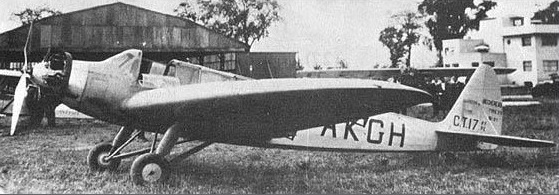
The Kellner-Béchereau 23 was the first aircraft known as a Kellner-Béchereau (the company was founded in 1931), though the only example built (F-AKGH) was originally marked as the Béchereau 23. Only one was completed, built in 1932.

It was a single engine cabin aircraft with an all-metal, three part cantilever wing constructed in a novel way. In place of spars, an approximately oval section, light metal tube, shaped around a wooden form which was then removed, provided both structural strength and formed the outer skin of the forward half of the wing. A more conventional lattice structure was attached to the rear of the tube and supported ailerons. The whole wing was then fabric covered.

In plan, the wing was approximately elliptical. The centre section, occupying about 20% of the span, was built into the fuselage and the outer panels tapered rapidly to pointed tips. The wings also tapered in section; the upper surface was horizontal but the lower sloped upwards, providing about 5° dihedral at the centreline. Their trailing edges were entirely filled with two-part, high aspect ratio ailerons.

Its flat-sided cross-section fuselage was built around four spruce longerons, transversely braced with steel tubes. They supported a light, fabric covered body formed with plywood frames and stringers. The 71 kW (95 hp) Salmson 7AC, a seven-cylinder radial engine, was in a pointed nose with its cylinders exposed for cooling. Its fuel tanks were in the wing centre-section. The tourer’s cabin seated two in tandem under a long, multi-part, fully glazed canopy which ran from the leading edge to mid-chord, then blended without change in height into the upper fuselage. The cabin had two small baggage holds in the centre wing section, each providing 0.1125 m3 (3.97 cu ft) of space.

The empennage of the Kellner-Béchereau 23 was conventional, with a triangular tailplane mounted on the upper fuselage and carrying narrow, rounded elevators was wire braced to the blunted triangular fin which carried a curved and narrow unbalanced rudder. The tourer had a fixed tailwheel undercarriage with independent mainwheels on hinged V-struts from the fuselage underside and near-vertical sprung legs, with Béchereau shock absorbers, from the wings. The mainwheels, with a track of 2.80 m (9 ft 2 in), were equipped with independent brakes. At the rear the sprung tailwheel was free to castor.

The date of the Kellner-Béchereau 23’s first flight is not known but by early September 1932 it was sufficiently developed to begin its official tests with the S.T. Aé at Villacoublay, flown by Seitz. These were resumed in December. In September 1933 it was one of the eleven aircraft in the third annual, eight day Tour de France des avions prototypes.

Engine: 1 × Salmson 7AC, 71 kW (95 hp)
Propeller: 2-blade Levasseur, 2.16 m (7 ft 1 in) diameter metal
Wingspan: 14.0 m (45 ft 11 in)
Wing area: 23.10 m2 (248.6 sq ft)
Length: 8.74 m (28 ft 8 in)
Height: 2.164 m (7 ft 1 in)
Empty weight: 565 kg (1,246 lb)
Gross weight: 860 kg (1,896 lb)
Fuel capacity: 80 kg (180 lb)
Maximum speed: 164 km/h (102 mph, 89 kn)
Cruise speed: 123 km/h (76 mph, 66 kn)
Range: 300 km (190 mi, 160 nmi)
Service ceiling: 7,950 m (26,080 ft)
Time to altitude: 45 min to 6,555 m (21,506 ft)
Take-off distance: 145 m (476 ft)
Landing distance: 140 m (460 ft)
Crew: One
Capacity: One passenger
Kellner-Bechereau E.1

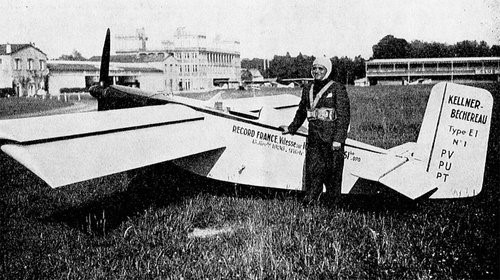
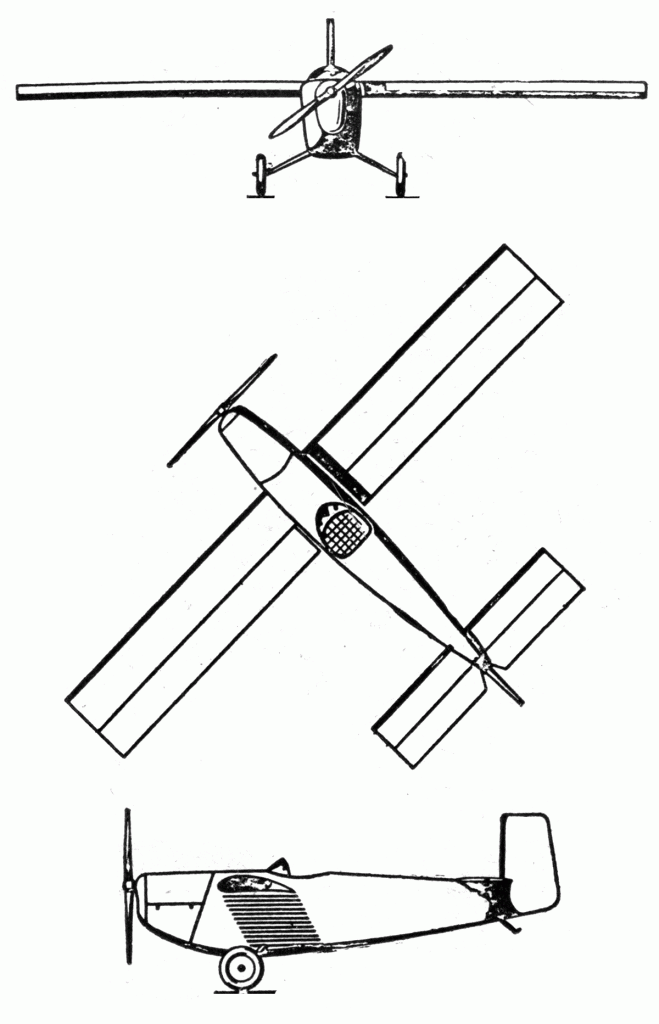
In the 1930s, Louis Béchereau set up Avions Kellner-Béchereau, a collaboration with the well known automobile coach builders Kellner. In 1936-7 they built a short series of small monoplanes exploiting one of Béchereau’s patents, a full span lateral division of the wing into two sections forming a “double wing” a little like that used by Junkers but with a more equal division of area. The Kellner-Béchereau E.1 was the first of these.

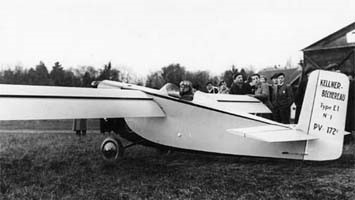
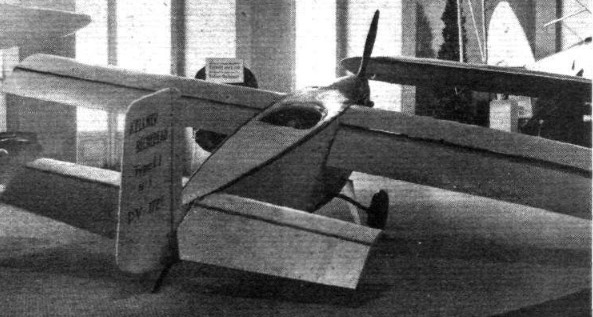
The Kellner-Béchereau E.1 was an experimental single engine, single seat light aircraft. It was a monoplane with a novel “double” wing, the rear part providing lift and lateral control as well as acting as slotted flaps.

The E.1 was a wooden aircraft with spruce frames and plywood covering. It was a mid-wing cantilever monoplane with straight, thick section, constant chord wings of quite high aspect ratio (8.45). The lateral division was at about 65% chord, with the rear part joined to the front with conspicuous V-shaped faired underwing hinges. In normal flight the two parts were close together and the rear sections acted both as lifting surface and, differentially, ailerons but they could also be lowered together as slotted flaps, moving rearwards as well as down to produce a slot between fore and aft parts. The fuselage was rectangular in cross section, with a single place open cockpit at the wing trailing edge, baggage space behind and an inverted in-line 30 kW (40 hp) Train 4T in the nose. A straight edged tailplane was mounted on the upper fuselage longerons and carried elevators with a small cut-out for rudder movement. The latter, mounted on a very narrow fin, was rectangular and extended to the bottom of the fuselage. The rear control surfaces were fabric covered. The E.1 had a conventional undercarriage with cantilever main legs hinged on the lower longerons, rubber sprung inside the fuselage.

The aircraft first flew in November 1934 and after flight tests in 1936, the E.1 was developed into a pair of larger and more powerful side by side seat basic trainers, the wooden Kellner-Béchereau EC.4 and the metal Kellner-Béchereau ED.5, flown in 1937.

Engine: 1 × Train 4T, 30 kW (40 hp)
Propeller: 2-bladed
Wingspan: 6.50 m (21 ft 4 in)
Wing area: 5.0 sq.m (54 sq ft)
Length: 4.42 m (14 ft 6 in)
Height: 1.98 m (6 ft 6 in)
Empty weight: 172 kg (379 lb)
Gross weight: 276 kg (608 lb)
Maximum speed: 160 km/h (99 mph, 86 kn)
Cruising speed: 145 km / h
Stall speed: 58 km/h (36 mph, 31 kn)
Endurance: 3 hr
Practical range: 500 km
Rate of climb: 2.0 m/s (390 ft/min)
Service ceiling: 6,000 m (20,000 ft)
Seats: 1

Kelly F1D

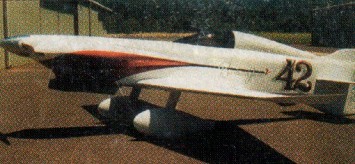
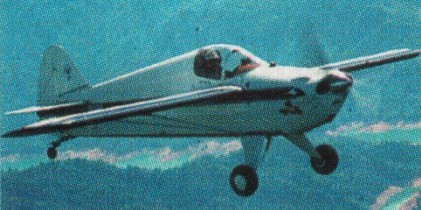
Designed and built as a formula 1 racer, the debut was at the 1995 Reno Races.

Top speed: 300 mph
Cruise: 205 mph
Stall: 60 mph
Range: 400 sm
Rate of climb: 2000 fpm
Takeoff dist: 600 ft
Landing dist: 1200 ft
Engine: Continental O-200A, 100 hp
HP range: 85-125
Fuel capacity: 13 USG
Empty weight: 500 lb
Gross weight: 800 lb
Height: 4 ft
Length: 17 ft
Wing span: 19.3 ft
Wing area: 67.5 sq.ft
Seats: 1
Landing gear: tailwheel

Kellett KH-17A

Experimental conversion of a standard Kellett KD-IB Autgiro into a convertiplane, for the U.S. Navy. Chief external changes are addition of wings and two wing-mounied engines. Was due to fly in 1955.

Engine: 1 x 275 hp Jacobs and 2 x 140 hp Lycoming
Rotor diameter: 40 ft
Rotors: 3-blade main; 3 propellers
Length (blades folded): 25 ft 11 in
Loaded weight: 3,400 lb
Seats: 1.

Keli SkySpark

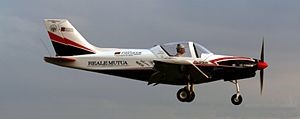
This aircraft was designed and built by the Italian astronaut Maurizio Keli (Italian: Maurizio Cheli), with the assistance of the Turin Polytechnic Institute, DigiSky and several other companies (Sparco, Sicme Motori). As a prototype, an Alpi Pioneer 300 aircraft was used. June 10, 2009 made the first flight. The main design feature is electric traction. A battery pack weighing more than 70 kg is installed on the machine. The power of this electric motor is 75 kW.

SkySpark June 12, 2009 set a world speed record for this type – 250 kilometers per hour.

Keleher Lark-IK-1

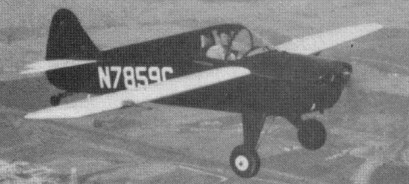
The Lark is an enclosed cabin cockpit midwing monoplane. This single-seat taildragger is relatively unusual with its strut-braced mid-wing configuration. The fuselage is of steel-tube construction, and the wing uses wood spars and ribs. The whole aircraft is fabric covered. Engines vary from 65 to 100 hp.

Gross Wt. 855 lb
Empty Wt. 555 lb
Fuel capacity 12 USG
Wingspan 23 ft
Length 17 ft
Top 135 mph.
Cruise 122 mph
Stall 55 mph
Climb rate 1000 fpm
Takeoff run 550 ft
Landing roll 700 ft
Range 300 miles

Kébouroff-Vasiliev 1912 Monoplane

Vissarion Kébouroff

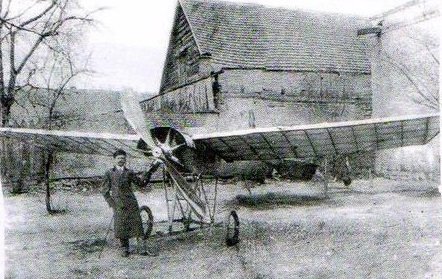
The second monoplane design of Kébouroff and Vasiliev, built in 1912 in Georgia (part of Russia). In 1910 Vissarion Kébouroff took flying lessons from Blériot at his flying school in Pau, France where he obtained a brevet from the Aero Club de France. On his return to Russia he brought back two Blériot monoplanes which he flew there frequently. As these machines were rapidly worn out and in need of repair, Kébouroff worked together with Alexander Vasiliev to design and built a new monoplane to replace the aging Blériots. Kébouroff and Vasiliev actually built a pair, where the second (1912) is given as the same construction as the first but fitted with a 50 hp Gnôme rotary engine. Later a third monoplane was built by the two which was designed somewhat along the lines of the Nieuport IV monoplane.

Keane HKL-27

Designed by Horace Keane, the HKL-27 was a short-lived redesign of the Aeromarine Klemm AKL-26. A two place, open cockpit, low wing monoplane, the wood frame work was fabric covered.

Five were produced at $1800 around 1929.

Engine: Ford V-8, 82hp
Wing span: 36’8″
Length: 23’4″
Useful load: 650 lb
Max speed: 112 ph
Cruise: 94 mph
Stall: 47 mph
Range: 450 mi
Ceiling: 12,000′