1985: Robert Labahn, 6 Victoria St, Seville, Vic 3139. Australia.
UL builder
1985: Robert Labahn, 6 Victoria St, Seville, Vic 3139. Australia.
UL builder
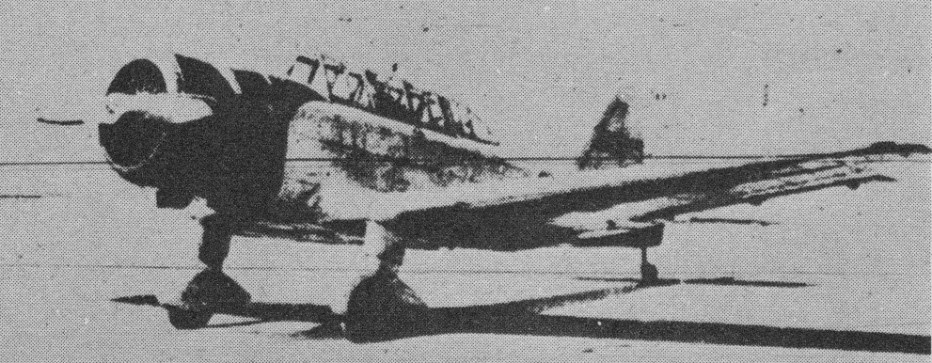
The Kyushu K10W1 Type 2 basic trainer was the Watanabe version of the North American NA.16 which was in standard JNAF use at the time.
Never illustrated or identified in recognition manuals, the code name ‘Oak’ was allocated.
The K11W served as the basis for the Q3W1 Nankai (南海, “South Sea”) anti-submarine patrol aircraft.
The Q3W1 retained the basic layout of the K11W2, with a circular fuselage and large wing with a straight trailing edge and tapered leading edge. It carried a crew of two with the remaining space allocated for anti-submarine warfare equipment. A single prototype was produced, and made its maiden flight in January 1945. This first flight ended with a wheels-up landing, and after that work on the project was suspended and didn’t resume before the end of the war.
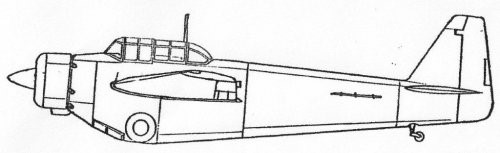
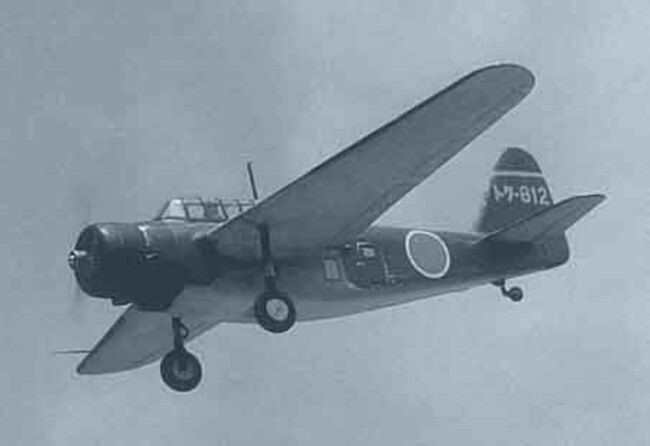
The Kyūshū K11W Shiragiku (白菊, “White Chrysanthemum”) made by the Kyūshū Aircraft Company, was a land-based bombing trainer aircraft which served in the Imperial Japanese Navy Air Service in the latter years of World War II. As indicated by its Japanese designation, “training aircraft for on-board work” (機上作業練習機, kijō sagyō renshū-ki), it was designed to train crews in operating equipment for bombing, navigation, and communication, as well as navigation techniques.
The Kyūshū K11W had a mid-wing layout, the crew consisting of a pilot and gunner/radio operator sitting in line under the canopy and the trainee bombardier, trainee navigator, and instructor in the lower fuselage beneath the wing.
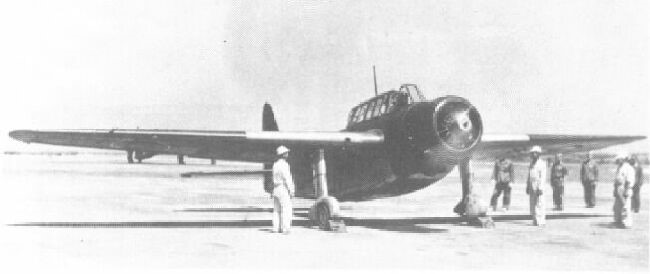
The K11W1 was a basic bomber crew trainer, of all-metal construction with fabric-covered control surfaces.
The K11W2 was a anti-submarine warfare and transport version of all-wood construction.
A total of 798 K11Ws were manufactured, including a small number of K11W2 ASW and transport aircraft alongside the K11W1 trainer variant. These aircraft were also used in kamikaze mission during the last stages of the Pacific War.
The K11W served as the basis for the Q3W1 Nankai (南海, “South Sea”) anti-submarine patrol aircraft.
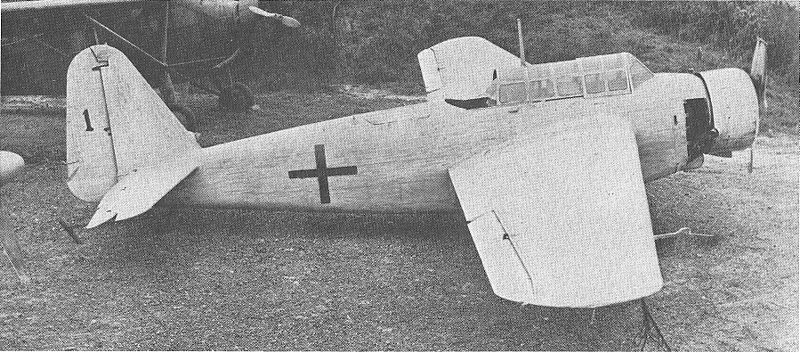
K11W1
Powerplant: 1 × Hitachi GK2B Amakaze 21, 384 kW (515 hp)
Wingspan: 14.98 m (49 ft 2 in)
Wing area: 30.5 sq m (328 sq ft)
Length: 10.24 m (33 ft 7 in)
Height: 3.93 m (12 ft 11 in)
Empty weight: 1,677 kg (3,697 lb)
Gross weight: 2,640 kg (5,820 lb)
Maximum speed: 230 km/h (140 mph, 120 kn) at 1,700 m (5,577 ft)
Cruise speed: 175 km/h (109 mph, 94 kn) at 1,000 m (3,281 ft)
Range: 1,760 km (1,090 mi, 950 nmi)
Service ceiling: 5,620 m (18,440 ft)
Time to altitude: 3,000 m (9,843 ft) in 19 min 35 sec
Crew: 5
Armament: 1 × 7.7 mm rear-firing machine gun
Bombload 2 × 30 kg (66 lb) bombs, or 1 × 250 kg (550 lb) bomb on kamikaze missions
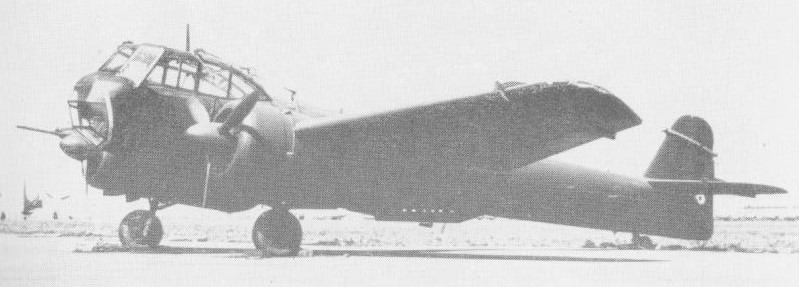
Built as an anti-submarine patrol aircraft for home defense, the Q1W1 was mentioned in a Japanese Navy delivery schedule directed to the manufacturer that was captured in 1944 and received the allied code name ‘Lorna’. It wasn’t spotted in action until 1945.
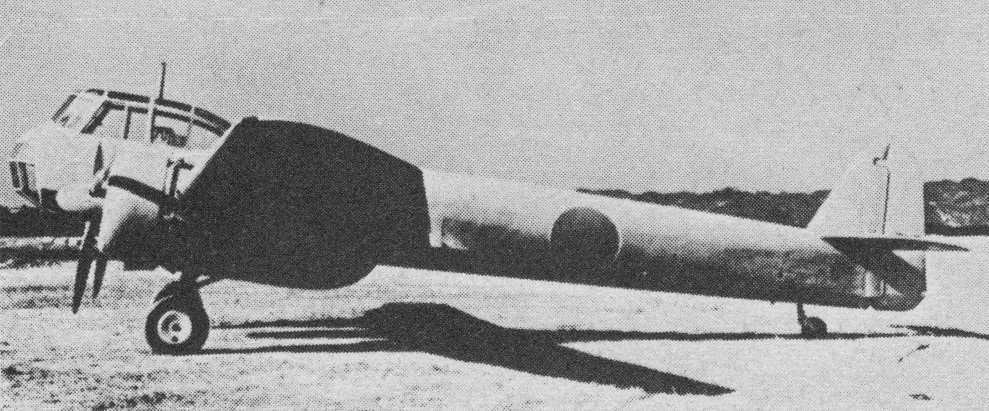
Kyushi built 153 of the Q1W1 Tokai during the war (allied codename Lorna).
Some Tokais were equipped with crude forms of radar and submarine detection gear.
Engines: 2 x Hitachi Tempu 31, 610 hp
Wingspan: 52 ft 6 in
AUW: 10,582 lb
Max speed: 200 mph at 4396 ft
Ceiling: 14,730 ft
Range: 914 miles
Armament: 1 x 20mm cannon, 1 x 7,7mm mg
Bombload: 1100 lb
Crew: 3
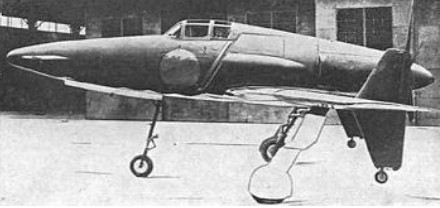
Towards the end of World War II the Japanese developed a canard fighter design which was the only such aircraft ever ordered into mass production. The machine was conceived in 1943 by Captain Masaoki Tsuruno, an Imperial Japanese Navy technical officer, who planned a jet powered high performance interceptor to counter the growing effectiveness of American air power in the Pacific. Three glider prototypes were built by the Dai lchi Kaigun Koku Gijitsusho (First Naval Air Technical Arsenal). They performed well, so in 1944 the Kyushu Hikoki company was commissioned to finalize the interceptor design. The Kyushu J7W Shinden (Magnificent Lightning) was powered by the 2130 hp Mitsubishi MK9D radial engine mounted amidships driving a six bladed pusher propeller through a long transmission shaft. It was armed with four 30 mm cannon and a projected maximum speed 0f 750 kph (466 mph) and a maximum operating altitude 0f 12,000 m (39,370 ft). The Japanese Navy ordered the Shinden into mass production long before the first prototype was ready. Nakajinia and Kyushu tooled up for but the first prototype did not fly until 3 August 1945, 12 days before the Japanese surrender.
Speed: 466 mph
Range: 528 miles
Crew: 1
Armament: 4 x 30mm cannon
Bombload: 4 x 66 lb or 132 lb bombs
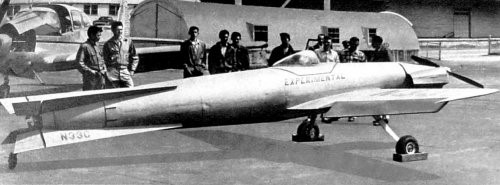
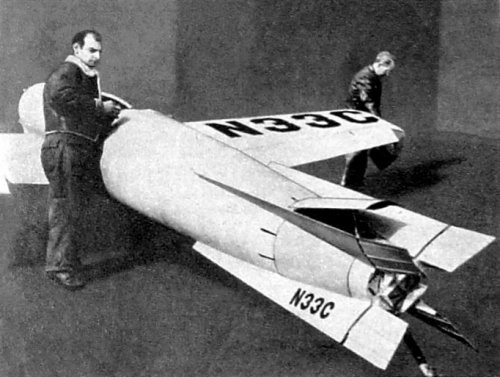
Cliff Kysor’s torpedo-shaped plane of 1950 had tail controls built flush with fuselage. The conventional elevators and rudder were eliminated to minimize air drag and permit greater speed. The four control surfaces at the top, bottom and sides of the tail section, were operated by a stick and by rudder pedals. Small tabs at the trailing edge of the fins were used only to trim the aircraft.
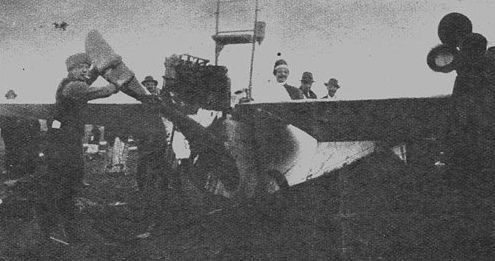
The second monoplane designed and built by Slovakian András (Andrej) Kvasz at a Budapest workshop.
First flown in August 1911 by Kvasz, powered by an Anzani 3W, 25 hp, later Anzani 3Y, 35 hp and Austro Daimler, 40 hp, 4-cyl.
On August 30, 1911, with this monoplane, Kvasz won the Sacellár prize. In November 1911 he organized public flights at Szarvas drawing 40,000 spectators. Kvasz, who worked as an engineer for Aladár Zsélyi in Wiener-Neustadt from 1909 on, started to build his own machines in 1911.
Span: 39’4″
Length: 24’7″
Weight: 750 lb
The 1910 Kvasz I monoplane was designed and built by Kvasz in Hungary.
Span: 32’2″
Length: 24’7″
Speed: 31 mph
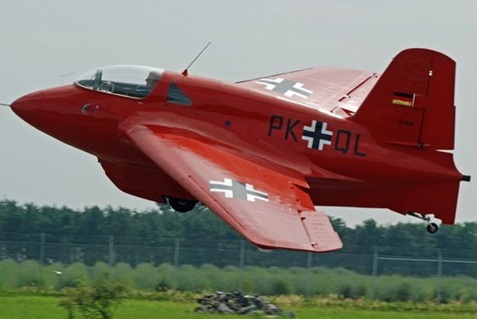
A flying replica Me 163B was constructed between 1994 and 1996 by Joseph Kurtz, a former Luftwaffe pilot who trained to fly Me 163s, but who never flew in combat. In 1944-1945 Josef Kurz was in training for Me 163B service, but the end of the war prevented him from flying the real thing.
Construction was started in 1994 in Germany. The replica is an unpowered glider whose shape matches that of an Me 163, although its construction completely differs – the glider is built of wood with an empty weight of 285 kilograms (628 lb), a fraction of the weight of a wartime aircraft. Maximum weight is around 400 kg.
Kurz used a microfilm set of 2500 drawings, which he printed on A3 size. From this set of drawings Kurz developped his own drawings. These are not really suitable for other builders, since they lacked many notes and details. Especially the fuselage was constructed completely different than the original (wood replaced metal). The external shape is similar however. One example were the fuselage frames. The real one has circular frames, covered with skins, to which fairings are added on the top and bottom and sides (wing root fairings). Kurz built frames incorporating these fairings. The new structure was designed and stressed by people of the Oskar Ursinus group. The wing section was Göttingen 765, just like the original. The trouble-prone skid was replaced by a single wheel, with a white skid painted on. The tail wheel is completely faired in, which is different from the original. The rear-view windows are omitted. The flight control system is an exact copy.
Kurz painted his replica Komet in the markings of the most famous Me 163- the Me 163B flown by Erprobungskommando 16 (EK16- an operational test unit) commander Wolfgang Späte on the Komet’s first operational combat mission in 1944. His crew chief had painted the aircraft red in honor of the Baron von Richtofen (the Red Baron). The paint added 40 pounds to the aircraft weight. Späte did not share his crew’s confidence in the aircraft’s performance and ordered it repainted in standard camouflage. No known photos exist of the red Me-163 but was described in detail in Späte’s memoirs. Kurz used the descriptions to replicate the paint job and markings.
Kurz first flew his Komet replica on 18 June 1996 from the airfield at Ziegenhain with the registration D-ESJK. Designating his glider the Me 163BS, Kurz made numerous short test flights before unveiling it at a vintage aircraft fly-in in September 1997. Its last flight in Kurz’s hands was at the Berlin ILA 2000 air show.
Kurz reported that the flying characteristics are excellent. This was also confirmed by another pilot present who had recently flown the aircraft. Stall is extremely gentle, without any rolling. Controls are very well harmonised. Kurz guessed the L/D was around 25 (compared to 17 of the original). Flaps are not installed.
With only five flight hours logged, Kurz sold the replica to EADS (European Aeronautic Defence and Space Company, which then had just been formed as the parent to Airbus Industrie and Eurocopter) in 2000 in a non-airworthy condition for display in the Flugmuseum Messerschmitt at Manching, Bavaria. The aircraft was registered as D-1634 instead of D-ESJK previously. The Komet replica is located at the EADS museum hangar at Ingolstadt-Manching in South Germany.
The Kurz Komet was exhibited at the Musée de l’air et de l’espace at Paris-Le Bourget in 2001. The museum’s agenda, which reports that the exposition opened on 26 October 2001, and is called ‘Exposition Willy Messerschmitt, Ingénieur et pionnier 1898-1977’. The agenda reports that the Museum organises the display with support of EADS. The display consists of two aircraft “that particularly illustrate the carreer of this great engineer, namely a Me 109G and a Me 163”.
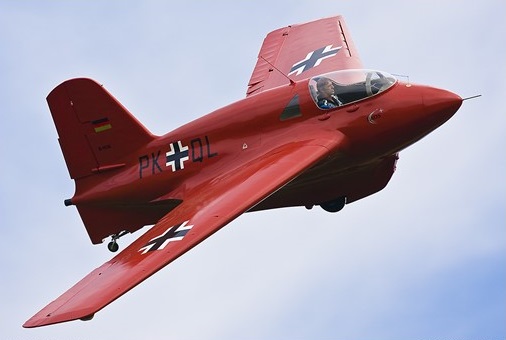
From the flight manual, the performance is not really exciting, and this is more or less confirmed by EADS. There were ideas to strenghten the structure, and re-certify it for at least basic aerobatics. A budget was not yet found at that point. EADS took steps to add the Me-163 to the museum’s heritage flight. Additional modifications were made to strengthen the internal structure. The landing skid was modified to allow for better ground handling. The original paint scheme was restored minus the Nazi Swastika that is banned from display in Germany. The aircraft was re-registered as a one-off glider with the civilian registration of D-1636. EADS performed an extensive overhaul and a lot of modifications from 2004 to 2006. The aircraft became quite a different one. Two visible differences are that the triangular rear view windows and Morane antenna have been added.
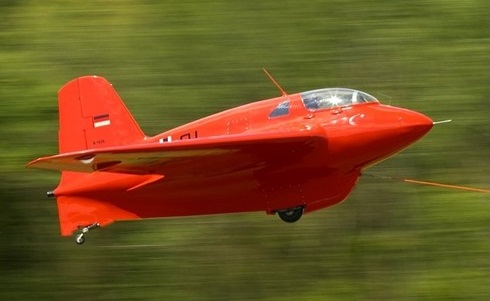
It made its second maiden flight on 20 June 2006 after which it joined the EADS Heritage Flight fleet at the Flugmuseum Messerschmitt. It appears the permit was obtained as at the 8 July 2006 EADS family day at Ingolstadt-Manching, it was towed into the air by a Do 27 and then made a free flight. Pilot was reported to be Captain Philipp. It was painted as PK+QL with D-1634 is small lettering on the vertical tail and in large lettering under the wing.
By the end of 2010 the replica Komet had flown forty hours. Two pilots with the EADS Heritage Flight were rated in the glider, using a Dornier Do 27 tow plane to get to altitude. Taking 10 minutes to reach 4,000 feet, the Komet is said to be most demanding on the tow line and is much easier to handle in free flight. As the aircraft was optimized for high speed flight, its gliding performance wasn’t on par of purpose-built sport gliders but has nonetheless been a hit at air shows in Europe.
As of 2011, it was still flying with the civil registration D-1636.
 All Aero