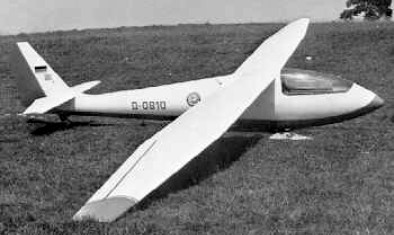
Designed by Wilhelm Kurten, 27 were built.
No. of Seats: 1
L/DMax: 34 85 kph
MinSink: 0.64 m/s 78 kph
Wing span: 15m
Wing area: 11.84sq.m
Empty Weight: 215kg
Gross Weight: 340kg
Wing Load: 28.7kg/sq.m
Aspect ratio: 19
Airfoil: FX 61-184
Designed by Wilhelm Kurten, 27 were built.
No. of Seats: 1
L/DMax: 34 85 kph
MinSink: 0.64 m/s 78 kph
Wing span: 15m
Wing area: 11.84sq.m
Empty Weight: 215kg
Gross Weight: 340kg
Wing Load: 28.7kg/sq.m
Aspect ratio: 19
Airfoil: FX 61-184
The Strekoza (Three axis) was a single seat single engined high wing mono¬plane with three axis control circa 1983. Constant chord wing; conventional tail. Pitch control by elevator on tail; yaw control by fin mounted rudder; roll control by full span ailerons. Engine mounted at wing height driving tractor propeller.
The Strekoza is a com¬pletely original design from the students at the polytechnic of Kuibychev and in concept of a mini aeroplane. Using a conventional tail supported by a metal framework, the Strekoza carries slotted ailerons along the entire trailing edge of its constant chord high wing. The engine, an air cooled Wichr 25 developing 25 hp, is placed in a nacelle on the leading edge of the wing, connected to a two blade 43 inch (1.10 m) propeller.
Length overall 19.9 ft, 6.07 m.
Wing span 23.6 ft, 7.20 m.
Constant chord 3.6 ft, 1.10 m.
Total wing area 105 sq.ft, 9.80 sq.m.
Engine: Wichr 25, 25 hp.
Propeller diameter: 43 in, 1.10m.
Power per unit area 0.24hp/ sq.ft, 2.6hp/sq.m
Empty weight 331 lb, 150 kg.
Max take off weight 507 lb, 230kg.
Payload 176 lb, 804.
Max wing loading 4.831b/sq.ft, 23.5kg/sq.m
Max power loading: 20.31b/hp, 9.2kg/hp.
Max level speed: 62mph, 100kph.
Landing speed 28mph, 45 kph.
Stalling speed 31 mph, 50 kph.
Take¬off distance 660 ft, 200 m.
Landing distance 590 ft, 180 m.
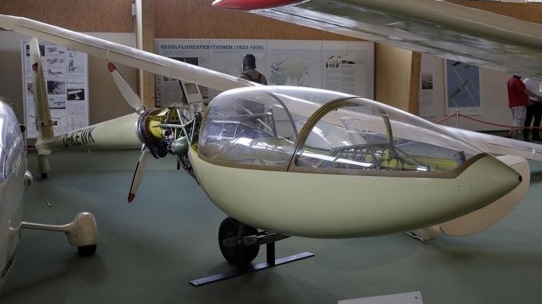
Built by Werner Kuffner (WK) as a one off in 1975, the WK-1 is a two seater motor glider with a BMW R90/S, 600cc 58 HP motor driving a foldable 3 blade prop that spins around the fuselage behind the cabin. The engine runs a toothed belt that spins a metal ring on which folding propeller blades are mounted.
It is in the Glider Museum Wasserkuppe.
Wing span: 18.80m
Empty weight: 430kg
Best glide ratio: 33.2
Seats: 2
The 1911 Kudashev 4 monoplane was designed and built by A. S. Kudashev in Russia.
Span: 31’10”
Length: 28’6″
Weight loaded: 750 lb
Speed: 50 mph
The 1910 Kudashev 3 monoplane was designed and built by AS.Kudashev in Russia.
Span: 30’2″
Length: 23’8″
Weight loaded: 705 lb
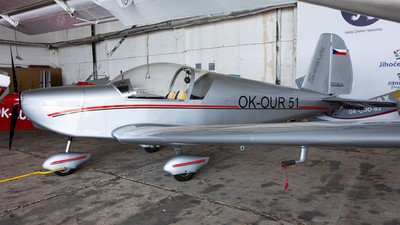
In 2005 Petr Kubiček, encouraged by aerospace engineering students at Brno University, began to design a modernised Mráz M-2 Skaut with the hope of production. The first Kubicek M-2 Scout (the name was Anglicised) of the 21st century appeared, unflown, at Aero ’09 held in Friedrichshafen in the spring of 2009 and flew for the first time on 7 May 2009. The Scout design began with the original plans reassessed with modern methods and using a metal rather than wood structure, supplemented with some composite materials for the engines cowling and flying surface tips.
Externally the old and new aircraft are similar, wings and tail having the same features and the side-by-side seating retained. The aircraft is made from riveted and bonded aluminum sheet and is completely corrosion-treated after assembly. Electrically operated flaps are fitted to the Scout and there is a central trim tab on the elevator. Its fixed tricycle undercarriage is mounted on the fuselage with cantilever composite mainlegs. The mainwheels have brakes operated with a central lever and the nosewheel has helical springing. All wheels are spatted.
The new M-2 was designed to comply with the Fédération Aéronautique Internationale microlight rules and US light-sport aircraft rules.
After its first flight in May 2009, the Scout prototype appeared at several Czech airshows and fly-ins.
Two versions are being developed, one to meet the US Light Sport requirement with a maximum take-off weight (MTOW) of 598 kg (1,320 lb) and a second for the European Ultralight MTOW limit of 450 kg (992 lb). Both these MTOWs are less than that of the original Skaut and empty weight are also less. Certification was proceeding in 2010, with the aim of first deliveries during 2011.
M-2 Scout LSA
US light-sport category
Engine: Rotax 912ULS, 73.5 kW (98.6 hp)
Propeller: 3 blade ground adjustable
Wingspan: 9.6 m (31.5 ft)
Wing area: 12.4 m2 (133 sq ft)
Length: 6.87 m (22 ft 6 in)
Height: 2.35 m (7 ft 9 in)
Empty weight: 320 kg (705 lb)
Gross weight: 600 kg (1,323 lb)
Fuel capacity: 90 L (23.5 US gal; 19.8 Imp gal).
Maximum speed: 220 km/h (140 mph, 120 kn)
Cruise speed: 180 km/h (110 mph, 97 kn)
Stall speed: 72 km/h (45 mph, 39 kn) in the landing configuration
Never exceed speed: 260 km/h (160 mph, 140 kn)
ROC: 6.0 m/s / 1.181 ft/min
Endurance: 6 hours
g limits: +4/-2
Crew: one
Capacity: one passenger
Cockpit width: 120 cm (47 in)
M-2 Scout UL
European ultralight category
Engine: Rotax 912ULS, 73.5 kW (98.6 hp)
Propeller: 3 blade ground adjustable
Wingspan: 9.6 m (31.5 ft)
Wing area: 12.4 m2 (133 sq ft)
Length: 6.87 m (22 ft 6 in)
Height: 2.35 m (7 ft 9 in)
Empty weight: 320 kg (705 lb)
Gross weight: 472.5 kg (1,042 lb)
Fuel capacity: 90 L (23.5 US gal; 19.8 Imp gal).
ROC: 5.0 m/s (984 ft/min)
Cockpit width: 120 cm (47 in)
Crew: one
Capacity: one passenger
As with many homebuilts, a number of builders have made design changes to their HP Aircraft HP-14. In some cases these have been substantial. Andre Krutchkoff built his SHP-1 with his own design of fuselage with T-tail.
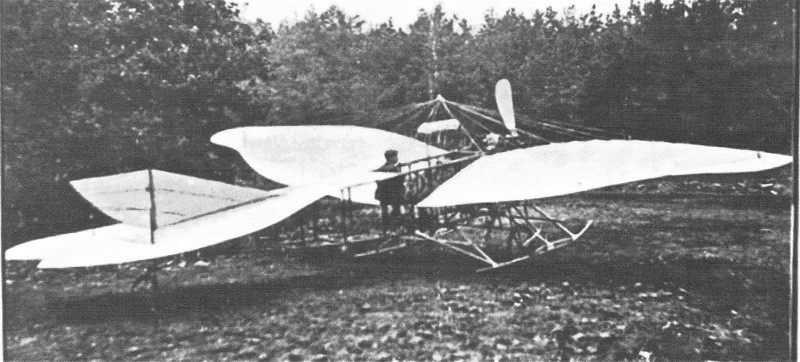
Wilhelm Krumsiek’s machine flew in 1909, and crashed sometimes later…
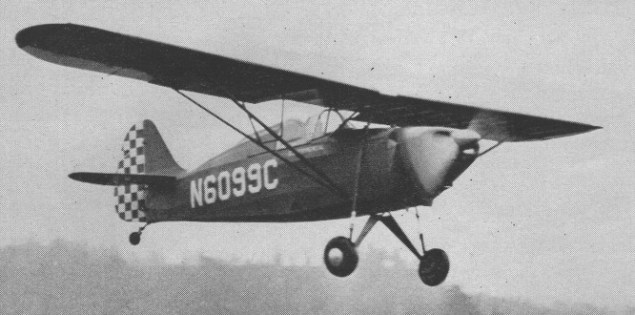
Aircraft mechanic Cliff Krum, Portland, OR, who maintained aircraft for the US Forest Service, built this high wing monoplane in 1957.
Engine: Cont Motor A&C65 Series
Number of Seats: 2
Construction Number (C/N): 1
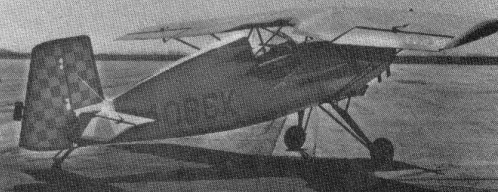
The Jungster II is a follow-up design that grew out of experience with the Jungster I. The intent was to create a plane with the same open cockpit concept but to increase speed and capacity so that it would be an acceptable cross-country airplane. The Jungster II uses the same design and construction concepts except that it is just a little bit bigger, has left the lower wing, behind in favor of a single extended parasol-type wing, and uses a welded steel-tube center section. Engines rated from 85 to 180 hp are used.
Gross Wt. 1375 lb
Empty Wt. 739 lb
Fuel capacity 16 lb
Wingspan 22’4”
Length 16’11”
Top 170 mph
Cruise 148 mph
Stall 55 mph
Climb rate 3500 fpm
Takeoff run 200 ft
Landing roll 800 ft
 All Aero