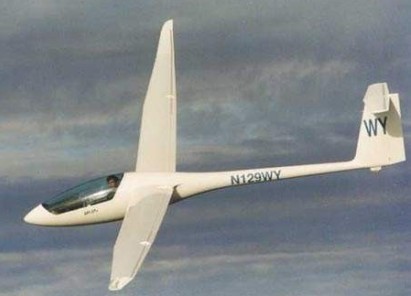
Wing span: 18m
Wing area: 9.8sq.m
Aspect ratio: 33
Empty Weight: 226kg
Gross Weight: 453kg
Wing Load: 46.2kg/sq.m
MinSink: 0.48 m/s
L/DMax: 50
Seats: 1
Wing span: 18m
Wing area: 9.8sq.m
Aspect ratio: 33
Empty Weight: 226kg
Gross Weight: 453kg
Wing Load: 46.2kg/sq.m
MinSink: 0.48 m/s
L/DMax: 50
Seats: 1
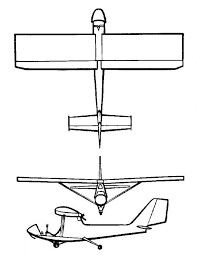
A very basic primary glider, although fitted with wheels. Capable of operating in up to 18 km/h wind.
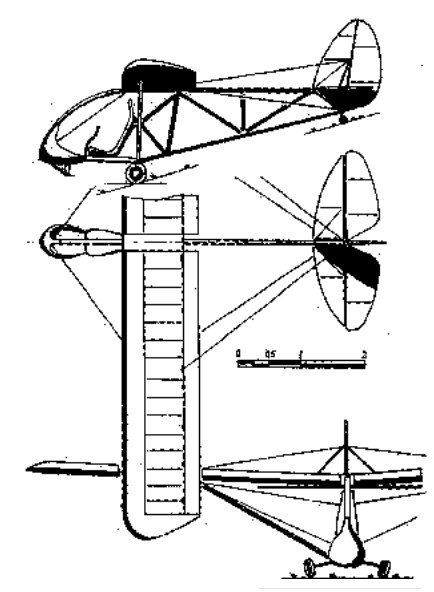
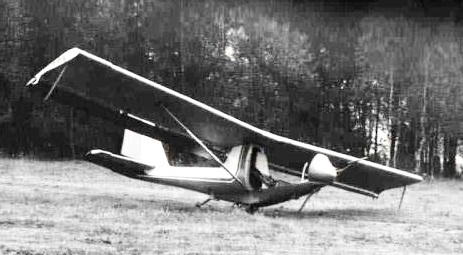
The LAK-14 Strazdas (Thrush) was designed at LAK by Antanas Paknis, one of the organization’s original design team. Like other LAK designs it developed the aeronautical use of glass fibre, foams and other novel materials. It was intended to succeed the Oskinis BRO-11M, also known as the LAK-2. It was therefore in competition with the Oškinis BRO-23KR Garnys.
The Strazdas had an externally more conventional fuselage, though its construction was more advanced. One of LAK’s founding goals was to develop the aeronautical use of plastics and composites, so the forward fuselage of the Strazdas, apart from a wooden nose fairing which held the launch towing hook, was built from three-ply glass fibre with foam filling. The pilot sat in a long, open cockpit with the seat back against a pedestal that supported the wing. This pedestal was part of the enclosed, round-sectioned rear fuselage structure which also included an integral fin. The tailplane, mounted high on the fuselage, had foam ribs and two-ply glass cloth skin.
The two-part, rectangular plan wing of the Strazdas was mounted high on its pedestal with 5° of dihedral. It was built around single spars, each braced to the lower fuselage with a single strut. Early development aircraft had wooden spars and ribs with glass cloth covering. Slotted, broad chord ailerons filled the whole trailing edge.
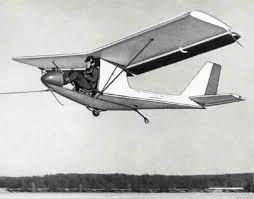
First flown in 1981, production began early in 1981. The first production aircraft had wooden spars but this was later replaced by integrated glass fibre reinforced polyester resin structures. Production continued until 1985.
Wingspan: 7.34 m (24 ft 1 in)
Wing area: 10.60 m2 (114.1 sq ft)
Aspect ratio: 5.1
Airfoil: TsAGI R-P
Length: 5.25 m (17 ft 3 in)
Height: 2.30 m (7 ft 7 in)
Empty weight: 100 kg (220 lb)
Max takeoff weight: 185 kg (408 lb)
Maximum speed: 100 km/h (62 mph, 54 kn) in rough or smooth air
Stall speed: 45 km/h (28 mph, 24 kn)
g limits: +4.0/-2.0
Maximum glide ratio: 13 at 52 km/h (32 mph; 28 kn)
Rate of sink: 1.10 m/s (217 ft/min) minimum, at 50 km/h (31 mph; 27 kn)
Crew: One
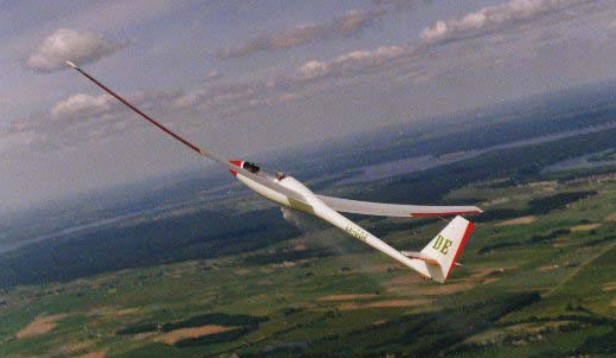
The LAK-12 is a Lithuanian built single-seat FAI Open-class mid-wing sailplane with a one-piece forward-hinged canopy. The retractable main wheel rides on an oil/nitrogen shock absorber and uses a mechanical brake. A skid is used at the tail. The wings are glass-foam-glass construction and taper from a Wortmann FX67-K-170 airfoil inboard to an FX67- K-150 at the tips. Glidepath control is provided by double-panel upper surface airbrakes and by the flaps (-7, -4, 0, +5, +11, +15 deg). The wings are capable of holding a total of 190 liters of water in their leading edges and are filled and emptied through a hole in bottom of the fuselage.
Wing span: 20.42m / 67ft
Wing area: 14.63sq.m / 157.5sq.ft
Empty Weight: 360kg / 793.7lb
Payload: 290kg / 639.3lb
Gross Weight: 650kg / 1433lb
Wing Load: 29.5kg/sq.m / 6.05lb/sq.ft
Water Ballast: 190kg / 418.9lb
L/DMax: 47 at 51.3 kts / 95 km/h
MinSink: 0.48 m/s / 1.7 fps at 40.5 kts / 75 km/h
Aspect ratio: 28.5
Airfoil: Wortmann FX67-K-170 w/ FX67-K-150 tips
Seats: 1
Structure: Fiberglass / carbon fiber

Built by the fitter Eugen Lamprecht and engine mechanic Heinrich Gerstel in Pforzheim in 1909. Lamprecht was the initiator of the project with Gerstel to install the engine. When funds ran out, the machine was exhibited at the guest house “Schwarzer Adler”, where it is told that the engine was occasionally started inside the ball room. Afterwards the monoplane was tested at the Exerzierplatz Forchheim, with only minor success.
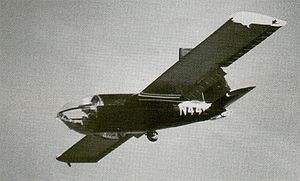
Philip Lamson designed and built the single-seat PL-1 Quark in 1964 as a lighthearted experimental aircraft project to create a prone position-pilot glider. To this end the pilot was accommodated lying down with his head in the nose bubble.
The PL-1 is constructed from fiberglass, with the wings made from a balsa-fiberglass sandwich that was laid up in a female mold. The wing was originally of 20 ft (6.1 m) span, but this was quickly increased to 30 ft (9.1 m) with tip extensions and finally the aircraft received a new 40 ft (12.2 m) three-piece wing. The airfoil was an Irv Culver modification to the NACA 0012. The landing gear was a monowheel, with small wing tip skids.
Soaring Magazine described the aircraft as “purely a lark and a quirky lark at that”. The designer described the performance as “somewhere between a Nimbus and a Rogallo”.
Only one Quark was built and it was registered with the US Federal Aviation Administration in the Experimental – amateur-built category.
The aircraft logged about 300 hours in its 30 ft (9.1 m) wingspan version. The Quark was removed from the FAA registry on 13 August 2002 and the aircraft likely no longer exists.
Length: 10 ft (3.0 m)
Wingspan: 40 ft (12 m)
Wing area: 88.89 sq ft (8.258 sq.m)
Aspect ratio: 18:1
Airfoil: Irv Culver modification to the NACA 0012
Empty weight: 340 lb (154 kg)
Gross weight: 504 lb (229 kg)
Crew: one
Wing loading: 5.67 lb/sq ft (27.7 kg/sq.m)
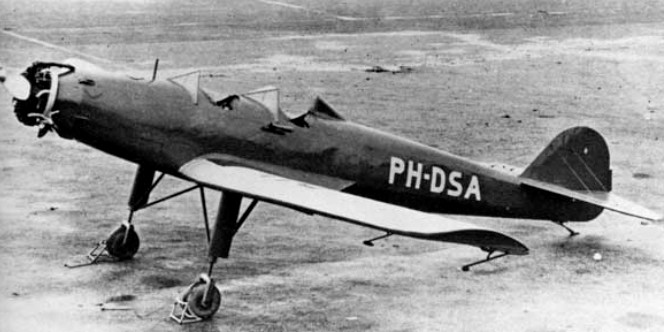
When in the early 1930s members of the Delft Student Aeroclub were trying to bring down the costs of tuition they decided that in the absence of public finance they would build their own aircraft. J.W.H. (Hugo) Lambach, a former DSA member, was asked to design a machine which would be cheap to produce and operate. A group of about twenty-five students set about its construction; some members of Pander Aircraft, including their chief designer Theo Lock, also assisted from time to time. Work began in the spring of 1934 and the Lambach HL.I made its first flight on 5 July 1935, piloted by Dick Asjes.
The HL.I was a cantilever low wing monoplane with wings of constant chord and rounded tips. Its tail was conventional, with a braced, straight tapered horizontal tail mounted on top of the fuselage and a largely rounded vertical tail with a rudder which extended below the tailplane, moving within an elevator cut-out.
Its fuselage was round in section and tapered a little both forward and aft of the wings. The front open cockpit was just ahead of the wing leading edge and the rear one, from which the HL.I was flown solo and which had a short, faired headrest, was at about two-thirds chord. During early testing the HL.1 was configured as a single seater; it was also initially powered by a 34 kW (45 hp) Szekely SR-3 three cylinder radial engine installed with its cylinder heads exposed for air cooling, but this proved unreliable and was replaced by a 67 kW (90 hp) Pobjoy Niagara seven cylinder radial, also with cylinders exposed. Both engines drove two blade propellers. The HL.1 had a fixed, conventional undercarriage with its mainwheels on tall, vertical, largely faired legs braced laterally by an inverted V pair of struts and longitudinally by trailing struts; there was also a tailskid.
Operational history
The HL.I was appropriately registered as PH-DSA on 1 January 1936. In March the DSA transferred it to the Nationale Luchtvaartschool (National Flying School) at Ypenburg Airport where it served until the Germans invaded the Netherlands on 10 May 1940. The HL.1 avoided destruction by bombing which took many Dutch aircraft that day. The aircraft began to degrade after being moved out of its hangar by German forces and it was eventually handed back to the Technical University of Delft for instructional purposes, where it was dismantled.
Engine: 1 × Pobjoy Niagara, 67 kW (90 hp)
Propeller: 2-bladed
Wingspan: 11.20 m (36 ft 9 in)
Length: 7.70 m (25 ft 3 in)
Gross weight: 585 kg (1,290 lb)
Maximum speed: 140 km/h (87 mph; 76 kn)
Seats: Two
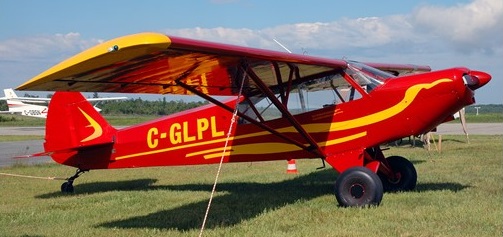
Built by Gilles Lalier, Sherbrooke, Quebec J1M0B4, Canada, in 2001, the L-CUB Super Charger certification was issued on 13 October 2006.
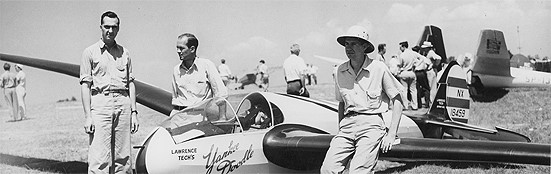
With the need for military trainers on the outbreak of World War II, Laister designed the two-place Yankee Doodle 2 from the original LK-10A / Lawrence Tech Sailplane with straight wings and automatic control hook-ups. Under the sponsorship of John Kauffmann, a St. Louis businessman, simplified versions were produced in quantity as TG-4A’s for the USAAC in 1942-43.
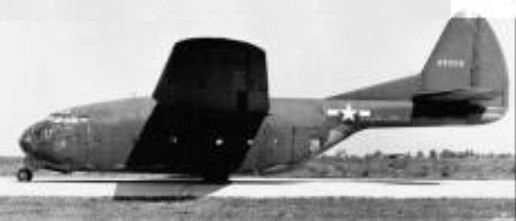
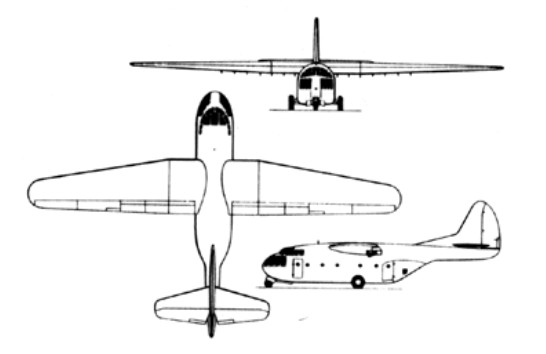
The XCG-10 is a large military glider capable of accommodating 30 troops or a freight load of 5 short tons. It is a high-wing cantilever monoplane with a deep forward fuselage tapering to a tadpole boom which supports the tail unit. At the break in the bottom lines of the fuselage clam-shell doors give access to the main hold 30 ft.(9.15m) long, 7 ft. (2.14m) wide and 8 ft. 6 in. (2.59m) high, which can accommodate a 155mm howitzer or a 2 1/2 ton truck. Structure is entirely of wood with plywood covering. The wings are fitted with Fowler-type landing flaps and have an overall span of 105 ft. (32m).
The XCG-10 and XCG-10A were two different craft. The 10A was 42 place. Although some sources say the 10 did not exist and the project was changed to 10A in design stage, the 10 was built both as a static test article and a flight test article. The internal hold size was slightly larger for the 10A to accommodate the GM 6X6 truck. The wingspan stayed the same.
Laister-Kauffman XCG-10 / XCG-10A
Crew: 2
Armament: none
 All Aero