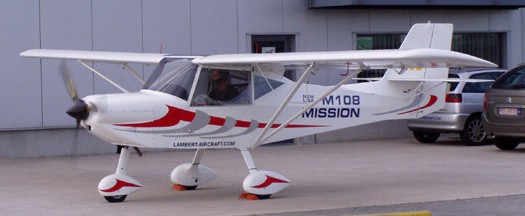
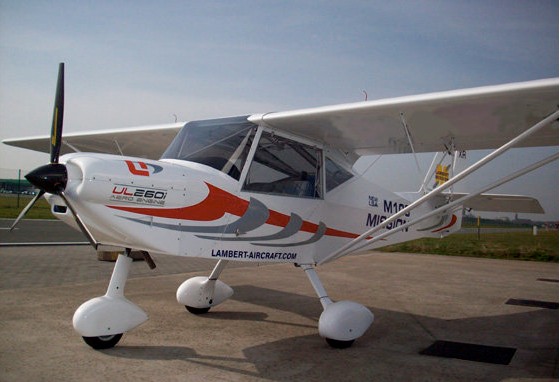
The Mission M108 Light Sport Aircraft is a two seater single engine light sport aircraft. It has an unswept untapered high wing. The fuselage provides comfortable side-by-side seating. Two upwards hinging doors provide access to the cabin. The large transparent areas of the cabin provide excellent visibility in level flight as well as in turns. Both seats are individually adjustable. Elevator and aileron control is by sticks. The aircraft is standard equipped with full dual controls.
The fuselage is a welded space frame, which is fabric covered. High strength steel tubing is used throughout. The wings are of aluminium construction and also fabric covered. Control surfaces are conventional with single slotted flaps, pushrod operated elevator and cable operated rudder and ailerons. The main landing gear consists of composite cantilever leaf springs. The Mission M108 is available as either a tailwheel or a nosewheel version.
The front mounted ULPower UL260i engine produces 85 HP at 2850 rpm and drives a three blade ground adjustable propeller. The four stroke four cylinder engine is air cooled and features FADEC (Full Authority Digital Engine Control).
With a large choice of options, instruments and avionics, your Mission M108 can be customised to meet your personal preferences. Depending on the applicable national regulations, the Mission M108 is available as a kit built aircraft or as a ready to fly factory built aircraft.
Mission M108 Engine: ULPower UL260I, 62 kW (85 HP) at 2850 rpm Wing span: 9.32 m (30 ft 6 in) Wing area: 11.8 sq.m (127 sq.ft) Aspect ratio: 7.4 Length: 6.10 m (20 ft) Height TD: 2.15 m (7 ft 1 in) Height NW: 1.95 m (6 ft 6 in) Width wings folded: 2.60 m (8 ft 7 in) Wheeltrack: 1.75 m (5 ft 10 in) Max. all up weight: 1320 lbs (600 kg)) Empty weight: 680-700 lbs (310-320 kg) Fuel capacity: 78 lt standard Fuel capacity: 110 lt long range Baggage capacity: 40 kg (90 lbs) Never exceed speed: 112 kt (210 km/h ) Max. level speed at S/L: 100 kt (185 km/h) Max. S/L rate of climb: 850 ft/min (4.25 m/s) Cruise speed: 80-85 kt (150-160 km/h) Fuel consumption: 12-15 litres/h Range (20 min res.): 460 nm (850 km) Stall speed, full flaps: 39 kts (72 km/h) T-O ground roll: 80-110 m Max. crosswind TD: 12 kt Max. crosswind NW: 16 kt Limit load factors: +3.8/-1.9 Tailplane span: 2.40 m (8 ft 0 in) Cabin width: 1.08 m (43 in)
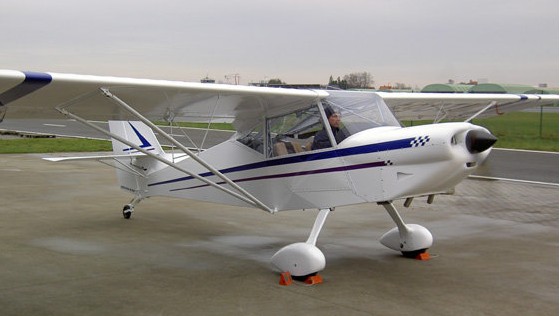
The Mission M106 is a single engine aircraft conventional configuration certified in ULM category in Belgium and France. It has an unswept untapered high wing. The fuselage provides comfortable side-by-side seating. Two upwards hinging doors provide access to the cabin. The large transparent areas of the cabin provide excellent visibility in level flight as well as in turns. Both the seats and rudder pedals are adjustable. Elevator and aileron control is by sticks. The aircraft is standard equipped with full dual controls. The Mission M106 is available as a factory built Microlight (ULM/UL) category aircraft with tailwheel or nosewheel. It is standard fitted with a UL260i engine and glass cockpit. 2009 Price: 36900 EURO The fuselage is a welded space frame, which is fabric covered. High strength steel tubing is used throughout. The wings are of aluminium construction and also fabric covered. Control surfaces are conventional with single slotted flaps, pushrod operated elevator and cable operated rudder and ailerons. The main landing gear consists of composite cantilever leaf springs. The Mission M106 is available as either a tailwheel or a nosewheel version. The front mounted ULPower UL260i engine produces 82 HP at 2800 rpm and drives a three blade ground adjustable propeller. The four stroke four cylinder engine is air cooled and features FADEC (Full Authority Digital Engine Control).
A ‘glass cockpit’ is standard in the Mission M106. All flight instruments are integrated in the EFIS. Engine instruments are displayed on the EMS. We offer a choice of two instrument panel layouts with displays of different sizes. Optionally, these avionics can be complemented with navigation and communication equipment, such as a GPS with moving map, VHF radio and ATC transponder.
Engine: UL260I, 60 kW (82 hp) at 2800 rpm Wing span: 9.32 m (30 ft 6 in) Wing area: 11.8 sq.m (127 sq.ft) Aspect ratio: 7.4 Length: 6.10 m (20 ft) Height TD: 2.15 m (7 ft 1 in) Height NW: 1.95 m (6 ft 6 in) Width wings folded: 2.60 m (8 ft 7 in) Empty weight: 260 kg / 573 lb approx. Max. all up weight: 450 kg / 472.5 kg Fuel capacity: 78 litres Baggage capacity: 40 kg (90 lbs) Max. level speed at S/L: 100 kt (185 km/h) Never exceed speed: 112 kt (210 km/h ) Cruise speed: 80-85 kt (150-160 km/h) Fuel consumption: 11-14 litres/h Range (20 min res.): 380 nm (700 km) Stall speed, full flaps: 35 kts (65 km/h / 40 mph) Max. crosswind TD: 12 kt Max. crosswind NW: 16 kt Max. S/L rate of climb: 1000 ft/min (5 m/s) Glide Ratio: 9 T-O ground roll: 80-110 m Take-off distance (50ft obstacle): 920 ft / 280 m Landing distance (50ft obstacle): 980 ft / 300 m Cabin width: 1.08 m (43 in) Tailplane span: 2.40 m (8 ft 0in) Wheeltrack: 1.75 m (5 ft 10 in) Limit load factors: +4.0/-2.0
The 1937 Twin Monocoach was a 4-5 place cabin, low-wing monoplane. Initially powered by two 90hp Lambert R-266 engines, it was later repowered with 125hp Menasco C-4.
Engines: two 90hp Lambert R-266 Wingspan: 36’0″ Length: 24’6″ Useful load: 1338 lb Max speed: 160 mph Cruise speed: 130 mph Stall: 40 mph Range: 900 mi
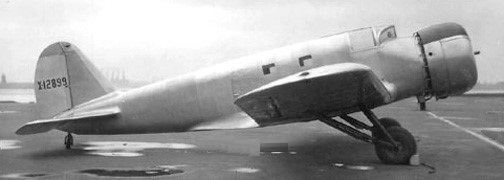
The 1935 Lambert Monocoach was a six place cabin, low-wing monoplane registered NX12899. Power was from a 400hp P&W Wasp. All-metal, only the one was built.
A US designed two seat aircraft built in Australia by Lake Macquarie Aviation. The aircraft, powered by either a Rotax 532, 582 two stroke or 912 four stroke (79hp). Specifications include a useful load of 225 kg, a gross weight of 429 kg, a cruise of 90 knots, a 1000 fpm ROC and a take off distance a 100 ft.
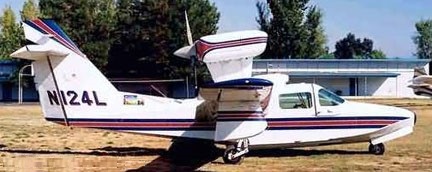
Lake Aircraft Corp marketed the Colonial Skimmer as the Lake Skimmer, and developed the aircraft into the LA4. The initial Lake prototype, the “LA-4P”, very similar to the C-2 Skimmer, performed its initial flight in November 1959; it was followed by two “LA-4A” prototypes in 1960, N1001L c/n 244 and N1002L c/n 245, which featured a 1.22 meter (4 foot) wingspan stretch and structural reinforcement. Power was a 180hp Lycoming O-360A1A pusher.
The LA-4A in turn led to the production “LA-4”, which featured a bow stretched by 43 centimeters (17 inches), with the nose gear now fully retracting. Powerplant remained the O-390-A1A. The first production model of this version flew in 1960, N261B c/n 121. Total production of the initial model of the LA-4P appears to have been about 70 aircraft, including a one-off pure seaplane with no landing gear. In 1970 Lake removed the retractable gear from some LA-4s and offered them as seaplanes with detachable beaching gear.
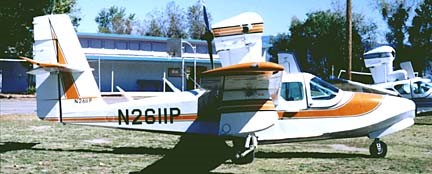
Lake LA-4 N2611P
In 1968, work began on a new model with a Lycoming IO-360-A1B engine featuring 150 kW (200 HP), with an LA-4 converted as a testbed. The “LA-4-200” went into production in 1969 and did much to raise the profile of the LA-4, with sales picking up. It featured other modest improvements, notably fuel storage in the floats, plus an optional combustion heater in a fairing above the cockpit, and also acquired the name of “Buccaneer”. Performance increased substantially, as did the price tag. Both the 180 hp and 200 hp Buccaneer versions are similar in appearance and differ only in instrument layout apart from the engine power.
Lake LA-4-200
It then generated a modestly refined version, designated the “LA-4-200EP”, the “EP” indicating “Enhanced Performance”, other interpretations being “Extended Propeller”, that being one of the features. It also had a new IO-360-A1B6 engine, same horsepower but smoother operation, a revised engine nacelle, batwings, cargo door, and fuel floats as standard equipment. An “LA-4-200EPR” was also introduced that was much the same, but with a reversible propeller. Some LA-4-180, -200, and -200EP had after-market Rajay turbochargers.
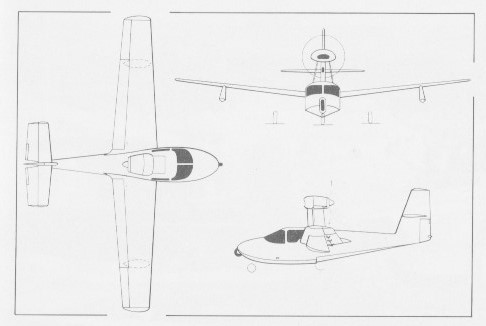
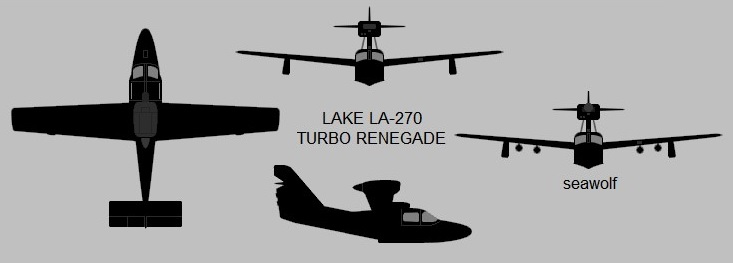
In 1984 Lake then produced the LA-250 Renegade, which featured a stretch of 1.05 meters (41 inches), permitting accommodations for four or six, with additional pop-up doors on each side of the rear cockpit; a revised and more rakish tailfin with a forward fillet of greater area; and a Lycoming IO-540-C4B5 flat-six air-cooled engine providing 185 kW (250 HP). A militarized version of the LA-250 was introduced in 1985 as the “Seawolf”, featuring four underwing pylons and radar, the radome being mounted on the front of the engine nacelle. The pylons could carry munitions including bombs and rockets, reconnaissance pods, or parachutable survival pods kitted for different environments.
Lake discontinued the LA-4 and the Seaplane and concentrated on production of the Buccaneer and the Renegade. Standard fuel tanks in the Lake were 40 gallons until someone decided that the pontoons could also be used as fuel links. The new auxiliary tanks took 7-1/2 gallons on each side, and the total capacity increased to 55 gallons. The extra 20 hp in the 200-hp Buccaneer has increased cruising speed by 12 mph and top speed by 14 mph. Allowable gross weight also increased an additional 200 pounds.
The LA-250 led in turn to the LA-270 Turbo Renegade, which was much the same but had a turbocharged TIO-540-AA1AD engine providing 200 kW (270 HP). The major visible difference was a turbocharger inlet extension at the base of the engine pylon. A militarized Seawolf version was offered as well. Sources mention a “Sea Fury”, which was an LA-250/270 with salt-water corrosion protection.
Sun Lake Renegade
The Renegade T270 is longer in the fuselage and is fitted with six seats. The model offered four to six passenger seating, improved useful load and 90 gallons of fuel on board. In 1987 turbo charging was added via the Lycoming TIO-540-AA1AB, resulting in 20 more horses to the Renegade and a ceiling of up to 23,800 ft. The Turbo 270 Renegade, which differs from previous versions in having a lengthened cabin, a turbocharged 250 shp (186 kW) Lycoming IO-540-C4B5 flat-six engine. The Seawolf is a maritime patrol version with underwing stores pylons.
Lake Aircraft’s 270 hp turbocharged Renegade has set four new world records in the light seaplane class, including an altitude record of 27,300 feet.
In 1987 the Buccaneer model was put into retirement. Latest models of the 250 and 270 hp Lakes are all marketed under the name Seafury, and incorporate improvements in corrosion protection for operation in salt water.
The LA-4 1960 base price was $26,580 and the 1968 LA-4-200 Buccaneer $31,000, rising to $53,000 in 1980. The LA-4-200EP Buccaneer $96,600 in 1983, and by 2004, $110,000-125,000. The Renegade sold for $146,000 in 1982, and $220,000 by 1986. About 135 had been built to 2005.
Twenty-four were built to 1961 and about 916 to 2005, excluding Renegade. More than 1,200 of the Lake series single-engined amphibians had sold to 1990. The LA-270T / Turbo Seafury sold for $348,000 in 1991, and $745,500 by 2001.
The four seat Lake LA 4 200EP am¬phibian, first built in 1983, has been revived by LanShe Aerospace in Florida and in 2004 was selling for US$299,000. The EP version has an IO 360 engine and a payload of around 900 lbs. It has Keelson boosters on the hull and “bat wing” wing root fillets to increase performance. The LA-270T / Turbo Seafury was priced at $348,000 in 1991, and $745,500 in 2001. The sole 1969 gearless Lake was for sale at $23,562.
The 1985 Seawolf was a military version of the LA-4-250, 2 of which reportedly were boosted to 290hp. One prototype, N1401G, was built.
The final Lake amphibian was produced in 2007. At last notice, the Lake firm was still in business, but it had been reduced to a small shop providing parts and service to the customer base.
Lake 250 Renegade Engine: Textron Lycoming TIO 540 AA2AD, 266 hp Length : 29.659 ft / 9.04 m Height: 10.007 ft / 3.05 m Wingspan: 38.320 ft / 11.68 m Aspect ratio: 8.96 Wing area: 164.043 sq.ft. / 15.24 sq.m Max take off weight: 3139.9 lb / 1424.0 kg Weight empty: 2074.9 lb / 941.0 kg Max. payload weight: 1065.0 lb / 483.0 kg Landing speed: 49 kt / 91 km/h Cruising speed: 155 kt / 287 km/h Take off distance: 879 ft / 268 m Landing distance: 607 ft / 185 m Initial climb rate: 905.51 ft/min / 4.6 m/s Service ceiling: 20013 ft / 6100 m Wing load: 19.07 lb/sq.ft / 93.0 kg/sq.m Range: 1120 nm / 2074 km Crew: 1+3
Rivard LA-4-250 Renegade / Sun Lake LA-4-250 Renegade / Sun Lake Renegade 2 1982 Engine: Lycoming IO-540-C4B5, 250hp Prop: 3 blade metal Wing span: 38’0″ Length: 28’4″ Gross wt. 3,140 lb Useful load: 1200 lb Empty wt. 1,850 lb Fuel capacity 90 USG Cruise speed: 140 mph / 122 kt Stall: 56 mph Initial climb rate: 900 fpm Ceiling: 12,500′ Takeoff run (land) 650 ft. Takeoff run (water) 1,125 ft. Landing roll (land) 475 ft. Landing run (water) 600 ft. Seats: 4-6
Sun Lake Renegade 2T Engine: Lycoming TIO-540-AA1AD Prop: 3 blade metal Wing span: 38’0″ Length: 28’4″ Fuel capacity: 90 USG Seats: 4-6


 All Aero