The 1931 XL-4 single-place cabin, high wing monoplane N11512 c/n X-141 was the XL-3 modified with stabilizing wingtip “winglets”. The wing was mounted as a parasol on top of a central pillar which also housed the pilot.
The 1930 XL-2 NX816Y c/n XL-2 had the vacuum cell mounted as a separate box on top of the fuselage. The full-cantilever mid-wing had a span of at least 25′, reportedly a modified Durand 13 airfoil. The tail consiste of twin fins and rudders. The pilot was in an enclosed cabin under the wing.
The 1928 XL-1 N3505 c/n 1 was a single-place, open cockpit low-wing monoplane powered by an Anzani engine. The apprimately 8’10” span wings were spaced away from the fuselage to allow the air to flow against the vacuum cell.
The 1949 443 Paraplane was apparently a larger, possibly high-wing, reconstruction of the Lanier Paraplane with a 180hp Lycoming O-320, again registered N9060H. The project was abandoned circa 1955 after failing to attract a market.
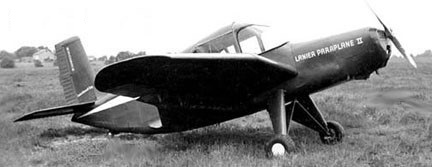
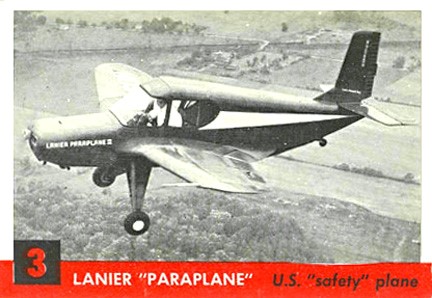
The 1949 120 Paraplane I N9060H test-bed was used by Office of Naval Research in STOL evaluation. First flown by Leo Riley, the Paraplane featured an inverted “Vacucell” gull-wing with an air scoop below and vacuum-slots on top—operated by a hand-crank in the cockpit—enabled slow flight at 19mph, take-off in 100′, a 30° climb angle and 40° descent angle, and was spin- and stall-proof.
A modified Paraplane II showed up in 1949 with a 22’6″ wing and was capable of nearly hovering.
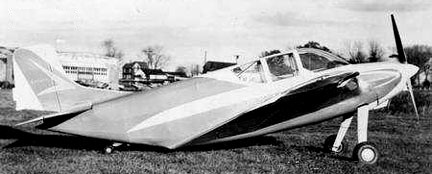
The 1958 110 Paraplane Commuter PL-8 N4157A was built for controllable slow-flight at 20-25 mph and take-off and land in 60 ft. The Paraplane Commuter 110 or 110 Paraplane Commuter PL-8 was one of the last designs stemming from Edward H. Lanier’s 1930s patents, and aircraft incorporating apertures in the upper surfaces, which claimed to give benefits in safety, lift and STOL ability.
In the early 1930s Edward H. Lanier published six US patents concerned with increased aircraft lift and stability, minimising the stall, sideslip and spin. This was to be achieved through vacuum chamber (“Vacua-cells”), initially in the upper fuselage but later in the upper wing, where the reduced pressure established by airflow over a curved surface would act on the lower surface inside the cell, providing lift. The second patent suggests that the cell should contain angled spanwise slats to prevent air entering them at low speeds and that these should be adjustable so that the cells could be closed when required. The earlier patents stress stability improvements; claims of enhanced lift begin with the fourth patent. Five Lanier Vacuaplanes were built in the 1930s, followed by three Paraplanes from about 1948, before the Paraplane Commuter 110 which first flew in 1958.
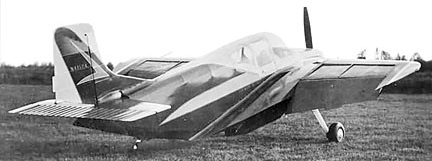
The Commuter 110 had a wing area of 111 sq ft (10.3 sq.m), large for its 20 ft 7 in (6.28 m) span, and controllable air entrance slots (“Vacua-Jets”) under the lower surface near its leading edge, passing air to the upper surface for boundary layer control. Other details of the upper surface are scarce but photographs appear to show rear hinged, single-piece slats over Vacua-cells as well as narrow open channels next to the fuselage in the very long wing root fairings. Structurally, the cantilever mid wing had strongly cranked inner sections and was tapered in plan with elliptical wing tips. The outer panels carried control surfaces which operated differentially as ailerons and together as flaps. In addition, there were split flaps under the trailing edges of the wing roots.
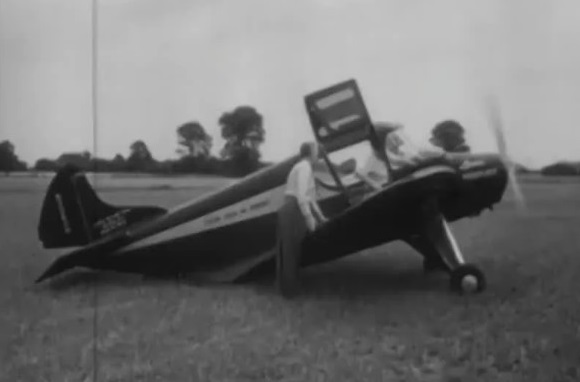
The fuselage of the Commuter 110 was a semi-monocoque structure, flat-sided and tapering upwards markedly aft of the wing roots to the tail. The pilot sat in an enclosed cockpit long enough to contain a second seat in tandem, the canopy merging into the upper fuselage at its rear. One source describes the Commuter as a single seat aircraft, another as a one or two seater. The Commuter’s empennage was conventional, with straight edged, square-tipped horizontal surfaces and a straight edged rudder with a trim tab mounted on a narrow fin with a fillet to the fuselage. There was a 150 hp (112 kW) Lycoming O-320 air-cooled flat-four engine in the nose, driving a two-blade propeller. It had a fixed conventional undercarriage with cantilever main legs mounted on the lower fuselage and a short-legged tailwheel on the sloping underside, about halfway between the edges of the root fairings and the extreme tail. The mainwheels had brakes and the tailwheel was steerable.
The Commuter made its first flight in 1958. Described as an STOL aircraft, it had respectable takeoff and landing characteristics, though no records comparing performance with open and closed Vacua-cells seems to have survived. A more recent study suggests the known figures were not exceptional given its thick wing, weight and power. Perhaps more significantly, the authors’ computed aerodynamic investigations of open or slatted upper wing surfaces, though made at very low Reynolds numbers, show no evidence that Vacua-cells enhanced wing performance.
The name, Paraplane, fell out of copyright and was adopted for powered parachutes c.2000.
Lanier Paraplane PL-8 N4157A
Lanier Paraplane Commuter 110 Engine: Lycoming O-320, 150hp Propeller: 2-bladed McCauley, 6 ft 4 in (1.93 m) diameter metal, fixed pitch Wingspan: 20’7″ (6.28 m) Wing area: 111.0 sq ft (10.31 m2) Aspect ratio: 3.8 Length: 21’5″ (6.53 m) Empty weight: 780 lb (354 kg) Gross weight: 1,280 lb (581 kg) normal Max takeoff weight: 1,400 lb (635 kg) ferrying Fuel capacity: 24 US gal (20 Imp gal; 91 L) normal, in wing tanks; 44 US gal (37 Imp gal; 166 L) for ferrying Max speed: 165 mph (266 km/h, 143 kn) Cruise speed: 151 mph (243 km/h, 131 kn) Stall: 30 mph Range: 625 mi (1,006 km, 543 nmi) normal, with 45 min res Service ceiling: 23,000 ft (7,000 m) Rate of climb: 1,500 ft/min (7.6 m/s) Take-off and landing speeds: less than 30 mph (48 km/h) Take-off and landing runs: 60 ft (18 m) Seats: 1-2
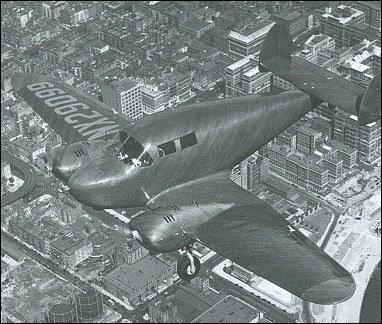
The Langley 2-4, variously described as the Langley Monoplane or Langley Twin was a twin-engine utility aircraft built in the United States and first flown in 1940. Named in honour of Samuel Pierpont Langley, the aircraft was designed by Arthur Draper and Martin Jensen to make use of non-strategic materials in its construction and thereby avoid any shortages brought about by war. Its design was conventional – a low-wing cantilever monoplane with twin tails and tailwheel undercarriage.
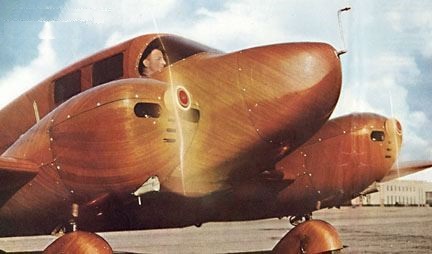
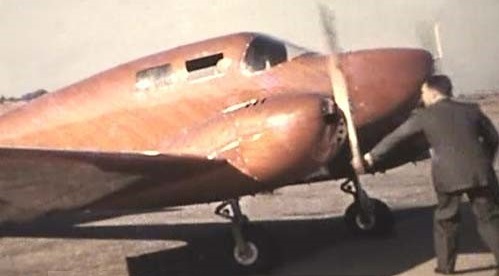
The manufacturing process, however, was unorthodox, and the aircraft’s structures were built up from mahogany veneers bent over moulds and impregnated with vinyl and phenol resins to make them hold their shape. The Vidal plastic-bonded mahogany plywood construction. The use of metal for structural elements – even in fasteners – was thereby almost completely avoided.
Two prototypes were constructed, one with 65 hp (49 kW) engines NX29099, and another (29-90 NC/N51706) with 90 hp (67 kW) engines. The second machine was purchased by the United States Navy and evaluated as the XNL-1 39056, but the navy did not order the type. The Langley was a Type Certificated airplane, achieving ATC number 755.
Once the United States entered the war, it transpired that the resins needed for construction were in far shorter supply than the metal that would have been needed to produce an aircraft by conventional means, and the project was abandoned.
The XNL-1 was sold as war surplus. The Langley was landing in Oklahoma in 1965 and after touch down the brakes locked flipping the airplane over and damaging the fuselage beyond economical repair.
John Pierce and Hurley Boehler had a Stinson 108 fuselage in their hangar without wings, so they decided to purchase the Langley and, following the accident, its wings, engine nacelles, and main undercarriage were mated to a Stinson 108 fuselage to create a one-of-a-kind homebuilt aircraft named the Pierce Arrow N6622A.
2-4-65 Engines: 2 × Franklin 4AC, 65 hp (49 kW) Length: 20 ft 8 in (6.30 m) Wingspan: 35 ft 2 in (10.72 m) Maximum take-off weight: 1155 lb Maximum speed: 135 mph (216 km/h) Cruising speed: 185 kph Stall: 50 mph Range: 400 miles (640 km) Service ceiling: 13,300 ft (4,100 m) Take-off distance: 200 ft Crew: one pilot Capacity: three passengers
2-4-90 / NL-1 Engines: 2 × Franklin, 90 hp Wingspan: 35 ft 2 in (10.72 m) Length: 20 ft 8 in (6.30 m) Empty weight: 1738 lb Loaded weight: 2850 lb Maximum speed: 138 mph Cruising speed: 117 kph Stall: 55 mph Range: 350 miles at 100 mph ROC: 695 fpm Crew: one pilot Capacity: three passengers
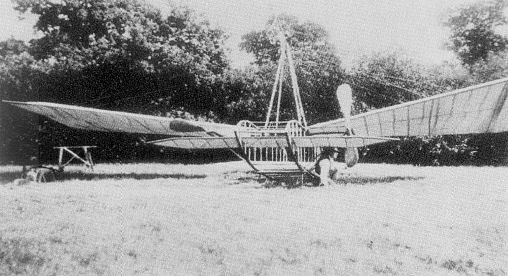
Built in 1908-1909, assembled and tested at Knockholt Cricket ground in Kent, it took off, but crashed on the first attempt and appears not to have been rebuilt. The fuselage was an open parallel girder, with curved top and bottom members meeting at both front and rear ends. Fitted with a tail plane and front elevator, there was considerable dihedral to the wings, which were braced to a tall pylon of four struts, and could be warped. The unidentified type of motor drove twin tractor propellers, apparently by shafts and bevel gearing.
Throughout the winter and spring months of 1894, work proceeded to complete No. 5 and retrofit No. 4 with a bigger set of wings. No. 5 was a large machine, with a wingspan of 13 feet 8 inches, length of 13 feet 2 inches and height of 4 feet 1 inch. Weighing 30 pounds, it was fitted with a new and more powerful single-cylinder steam engine. Trials resumed once again on October 7, 1894, after the summer layoff. The crew practiced using a new launching system. After a few throws with nonpowered “dummy” Aero¬dromes and some minor adjustments, the launcher seemed to be working perfectly. The rebuilt No. 4 was prepared for flight at once. Unlike pre¬vious attempts, the model launched perfectly, but then the wings twisted, plunging it into the water. Although it was late in the day, Aerodrorne No. 5 was read¬ied for a trial. Again, the launching system worked perfectly, but as the Aerodrome left the rail, it nosed up steeply, slowed and then slid backward into the Potomac. To everyone’s surprise, Langley was ec¬static. He thought he saw signs of pro¬gress for the first time. Over the next two months, Aerodromes No. 4 and 5 were launched numerous times. The launcher continued to work well, but the models just would not fly. By late November, the team had again re¬treated to the warmth of the Smithsonian’s shops, where serious static experiments were conducted to determine the strength of the wings. As Langley ordered, No.4 and No. 5 “were inverted, and sand was spread uniformly over the wings until its weight represented that of the machine.” Langley was shocked by the lack of stability and general weakness of the structure when loaded in that manner. More modifications were in order, including a new system of guy wiring for No.5. The changes to No.4 were so extensive that everyone felt jus¬tified in renaming it No. 6. The No.5 had a metal tube-fuselage structure that housed the engine, the boiler, and other components of the propulsion system. The wings and tail were wood-frame, covered with fine silk. The power plant was a single-cylinder, one-horsepower steam engine equipped with a double-action piston with a slide valve, and a flashtube boiler fired by a pressure burner that vaporized gasoline. The engine drove twin propellers, centrally mounted between the front and rear sets of wings, through a system of shafts and bevel gears. The aircraft weighed approximately 11kg (24.3 lb) ready for flight.
Quantico flight testing began again in early May 1895. Three attempts using No. 5 and No. 6 were considered failures. The longest time aloft was only six seconds.
After more than three years of inten¬sive work, Langley was feeling pressure from many sources to show better results. His critics were becoming more vocal. Having exhausted all the available brainpower within the Smithsonian, Langley decided to conduct an outside search for technical help. He found Au¬gustus Moore Herring.
Then came the watery failure of Aerodrome No. 6 on May 6, 1896. Soon afterward, having instructed his staff to ready No. 5 for a trial, Langley moved to a better vantage point on the shore of tiny Chopawamsic Island. This time, Edward Chalmers Huffaker was responsible for launching the machine. Forty-year-old Huffaker had earned a master’s degree in physics from the University of Virginia before becoming an aeronautical protégé of Octave Chanute. Impressed by Huffaker’s credentials, Langley had hired Edward to assist with the Aerodrome project. Later, because of Chanute’s influence, Huffaker was an invited guest of the Wright brothers for their 1901 gliding trials near Kitty Hawk, N.C.
Alexander Bell, the official observer, was on the port deck with a nervous Smithsonian photographer who had earlier missed taking a photograph of No. 6 splashing into the Po¬tomac. Langley had angrily told him not to let it happen again. When the steam pressure reached a predetermined 150 pounds, the signal was given to go. At 3:05 p.m., Aerodrome No. 5 cat¬apulted from the launch rail. Unlike earlier attempts, the throw was perfect – slightly nose high with its wings level. At first, the machine dropped three or four feet but then began to climb as it headed into a slight breeze from the north. The workmen, accustomed to hauling soaked and broken Aerodromes out of the water after a failure, were astounded to see the big drag¬onfly actually remain aloft. The machine started a gentle right turn, passing almost di¬rectly over Langley’s head. It continued flying this pattern until it reached a maximum estimated altitude of 80 feet. After about one minute and 20 seconds, the propellers suddenly stopped turning, probably from lack of steam to the engine. To every-one’s surprise, the model glided beautifully for another 10 sec¬onds before landing lightly on the surface of the bay, 425 feet from the houseboat. The Aerodrome had made three complete circles, each with an estimated diameter of 300 feet, as it drifted to the northwest. Calculations revealed that it had traveled about 3,300 feet in 90 seconds, generating a speed of between 20 and 25 mph.
The workmen retrieved the machine, then dried and care¬fully re-guyed the wings, one of which had sustained a kink. Langley believed that the shock of launching or the air pres¬sures of flight might have caused the problem. He also sug¬gested that the right-hand turn may have been caused by the wing’s misalignment. No.5 was ready to fly again within two hours. At exactly 5:10 p.m., the model was off on another successful flight. As before, the Aerodrome made three ascending circles to the right, reaching a maximum altitude of 60 feet. When the propellers finally stilled, the model pitched slightly nose down and glided ma¬jestically to a perfect water touchdown. Calculations showed it had flown about 2,300 feet.
On both occasions, the Aerodrome No.5 landed in the water, as planned, because, in order to save weight, it was not equipped with landing gear. On November 28, another successful flight was made with a similar model, the Aerodrome No.6. It flew a distance of approximately 1,460 m (4,790 ft).
The Aerodrome No.5 was transferred in 1905 from the research component of the Smithsonian to the United States National Museum, the entity of the Institution which at that time housed and cared for historical materials. The No.5 was first restored in 1975. When the aircraft was in need of restoration a second time in 1993, the wing structures were considered to be too fragile to support the new silk covering. The originals were placed in storage to preserve them and accurate reproduction wings were made for exhibition purposes. The rest of the aircraft is original.
No.5 Wingspan: 4.2 m (13 ft 9 in) Length: 4.0 m (13 ft 2 in) Height: 1.3 m (4 ft 3 in) Weight: 11.4 kg (25 lb)


 All Aero