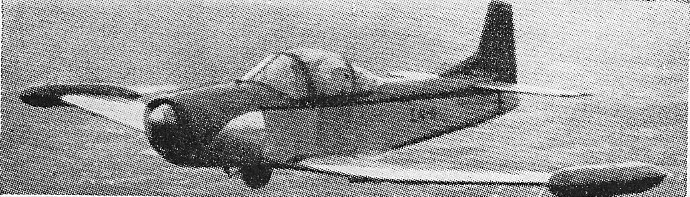
Designed by Carl Larsen in Norway in the 1950s, the LN-11 is a single seat, all-metal sport plane with retractable undercarriage.
Engine: Continental C90, 90 hp
Span: 22 ft
Length: 20 ft
AUW: 900 lb
Max speed: 165 mph
Designed by Carl Larsen in Norway in the 1950s, the LN-11 is a single seat, all-metal sport plane with retractable undercarriage.
Engine: Continental C90, 90 hp
Span: 22 ft
Length: 20 ft
AUW: 900 lb
Max speed: 165 mph
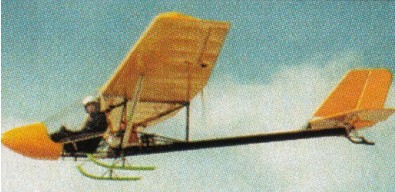
A Part 103 legal ultralight first flown in 1995, the wings are sheet dural.
Top speed: 65 mph
Cruise: 55 mph
Stall: 26 mph
Rate of climb: 1000 fpm
Takeoff dist: 150 ft
Landing dist: 100 ft
Service ceiling: 10,000 ft
Engine: Rotac 447, 30 hp
HP range: 30-40
Fuel capacity: 5 USG
Empty weight: 250 lb
Gross weight: 550 lb
Height: 4.5 ft
Length: 21 ft
Wing span: 26 ft
Wing area: 117 sq.ft
Seats: 1
Landing gear: tailwheel
Engine: Rotax 447, 40 hp
Wing span: 7.92 m
Wing area: 10.90 sq.m
MAUW: 249 kg
Empty weight: 113 kg
Fuel capacity: 19 lt
Max speed: 128 kph
Cruise speed: 80 kph
Minimum speed: 40 kph
Climb rate: 5 m/s
Fuel consumption: 7.5 lt/hr
Seats: 1
Kit price (1998): $4900
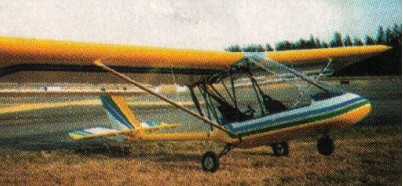
First flown in 1992.
Top speed: 100 mph
Cruise: 85 mph
Stall: 53 mph
Range: 140 sm
Rate of climb: 800 fpm
Takeoff dist: 200 ft
Landing dist: 200 ft
Service ceiling: 15,000 ft
Engine: Rotax 582, 65 hp
HP range: 48-80
Fuel capacity: 11 USG
Empty weight: 400 lb
Gross weight: 900 lb
Height: 6.5 ft
Length: 21 ft
Wing span: 32 ft
Wing area: 170 sq.ft
Seats: 2 tandem
Landing gear: nosewheel
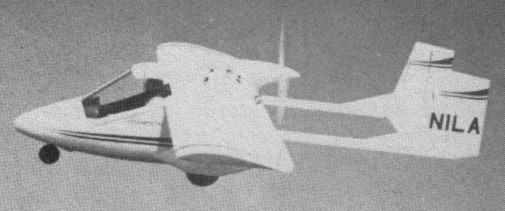
The Larkin KC-3 Skylark was a single-engine amphibious two-seater homebuilt aircraft, a pusher-style design with a single 100 hp Volkswagen air-cooled engine above and behind the fully enclosed cockpit. The booms are at¬tached to the wings and connected at the rear, between twin vertical stabilizers, by one single-elevator surface. One unique feature of the airplane’s structure is the use of a square tubular aluminum keel which is responsible for the loads from the landing gear and the main fuselage. The cockpit seats two occupants in side-by-side configuration, with a large Plexiglas canopy curving around both occupants. The landing gear is a tricycle arrangement with the nose gear positioned at the foremost point of the nose and the two main gear semi-recessed into teardrop-shaped fairings on the lower sides. For amphibious operations, there is an optional V-shaped lower hull of fiberglass which can be added.
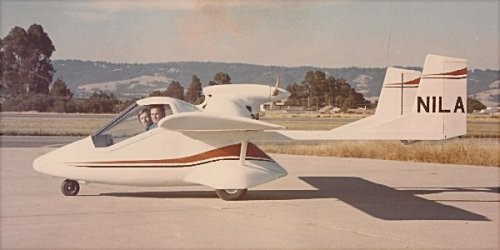
The Skylark KC-3 first flew in 1972 and was registered N1LA.
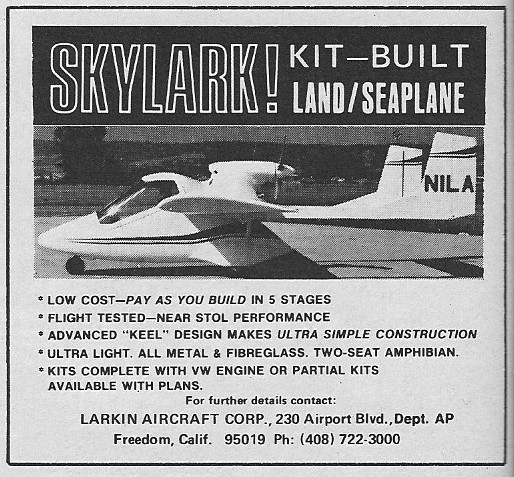
My father, Tony Austin, worked for Larkin Aircraft in the late 1960s-early ’70s. He collaborated on the engineering and fabrication of the fuselage and other structural components of the one prototype. I had opportunity as a boy to witness the Skylark’s construction and first flight, and have sat in the actual aircraft. I never flew in it as it was only ever piloted by the designer, Keith Larkin himself, to my knowledge.
Thad Austin
Engine 65-hp Volkswagen.
Wingspan 26’6”
Length 19’6”
Gross Wt. 1246 lb
Empty Wt. 790 lb
Fuel capacity 17 USG
Top speed 115 mph
Cruise 105 mph.
Stall 42 mph
Climb rate 550 fpm
Ceiling 12,000 ft
Takeoff run 600 ft
Landing roll 400 ft
Range 525 miles
Seats: 2
Arthur Lardin, W A McCurdy, E Smith, of New Castle DE, USA were all by employees of Bellanca Corp who in 1934 built the AL-1 NX12Y c/n 1 as an off-hours project.
A single place, open cockpit monoplane, power was an 85hp DH Gypsy.
In 1938 the La Porte Aircraft Co built a two place, high wing, cabin monoplane designed by Vernon Payne.
Power was a 45hp Continental A-45.
This Argentine single-seater motor glider was designed and is being built by Senor Augusto Lanzalone of Rosario in Santa Fe province, who has also formed the Asociacion Argentina de Constructores de Aviones Experimentales – Avex for aircraft like the Aulanz. Not only has Senor Lanzalone designed and built the engine for it – a 30hp Lanzalone two-cylinder two-stroke inverted inline motor of 700cc – he has evolved his own special alloy for the construction of the airframe. This is known as Alcusing, and consists of aluminium with portions of copper, nickel, magnesium, silicon and chrome; the two-blade variable pitch propeller is also made of this material.
The Aulanz is a conventional low-wing monoplane of semi-monocoque Alcusing structure, with the engine in the nose and a retractable rubber-sprung monowheel under the wing leading edge, plus a tailskid. The total fuel capacity is 20 litres (4.4 Imp gallons). By the spring of 1973 the prototype’s fuselage and tail unit were completed, and construction of the remainder had been proceeding slowly.
Span: 40 ft 8.25 in
Length: 17 ft 8.5 in
Height: 6 ft 1.75 in
Wing area: 125.9 sqft
Aspect ratio: 13.1
Max weight: 617 lb
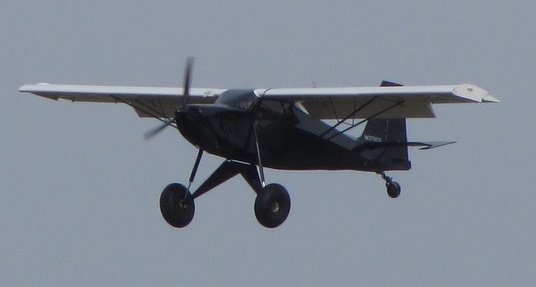
The Lanitz Escapade Two is a German ultralight aircraft, derived from the Just Escapade and produced by Lanitz Aviation of Leipzig. The aircraft was supplied as a complete ready-to-fly-aircraft.
In 1931 C R Lansing built a two place open cockpit monoplane powered by a 40hp Ford engine, registered N12830.
The 1932 LVF (XL-5) open-cockpit mid-wing monoplane NX12865 c/n XL-5 was stable enough not to slip or dive in a stall. In landing it had a tendency to favour a steep descent with control maintained at minimum forward speed.
Engine: 36hp Aeronca
Wingspan: 14’4″
Useful load: 225 mph
Max speed: 96 mph
Cruise speed: 80 mph
Stall: 30 mph
Range: 250 mi
Take-off run: 90′
Seats: 1-2
 All Aero