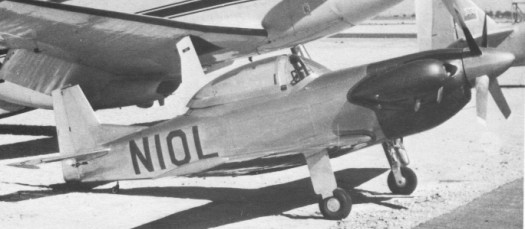
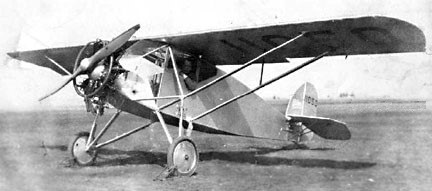
The Mini Mustang was designed and built by Mr. Charles C. Linn and despite the small dimensions, the aircraft featured a retractable undercarriage. The Mini Mustang was built to approximately 45-50% scale of the P-51. The L-1 was the first example built by Mr. Linn and it first flew on 14 January 1962. It won the 1962 EAA Most Popular Aircraft award, but was lost in an accident. To replace the L-1, Mr. Linn then constructed a second example, the L-2 (also named Linns Mustang) with the same N10L registration. This second aircraft differed slightly in having a 4-bladed (instead of 3-bladed) propeller, larger tail surfaces, a smaller engine air intake, longer canopy and it was also a bit shorter with 13.5ft (against 13.833ft). Both aircraft were powered by a 125hp Lycoming O-290-G engine. Plans were marketed for amateur construction, but maybe 2? were built.
The Schweizer SGS 2-32 also formed the basis of another quiet observation aircraft, the LTV Electrosystems L450F, which first flew in prototype form in February 1970 and was powered by a Pratt & Whitney PT6A-29 turboprop derated to 680shp.
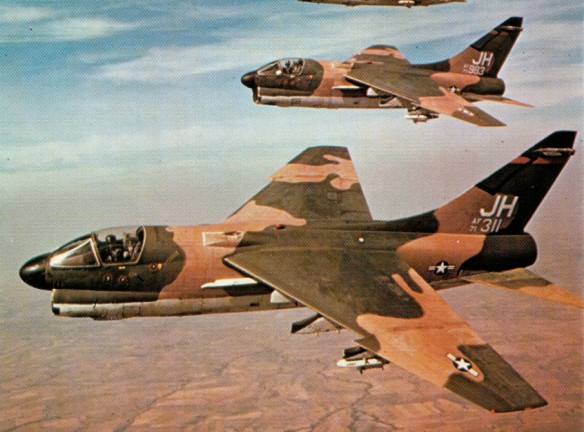
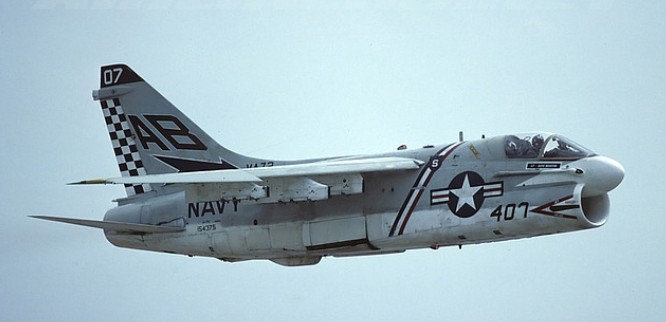
In principle, both the Navy and Marine Corps were to have replaced the Skyhawk with the winner of the VAL contest, designed to requirements issued in May 1963. Vought won this competition with the A 7 Corsair II, early in 1964, the resulting A 7A making its first flight on 27 September 1965. Powered by a single Pratt & Whitney TF30 P 6 turbofan of 11,350 lb (5 147 kg), the A 7A had an empty weight of 14,857 lb (6738 kg), a total of eight weapon pylons, and a design catapult gross weight of 32,500 lb (14 740 kg). The Corsair II was clearly going to cost far more and require more maintenance effort than the smaller, simpler Skyhawk. In addition, it may well have been that the A 7 provided capabilities that were far in excess of those demanded by the Marines for the short range close support mission. The two services therefore went their separate ways, the Navy adopting the Corsair II, while the Marine Corps funded a further stage of Skyhawk development. Produced to a US Navy specification in the 1960s for a carrier-based light attack aircraft, the Vought A-7 Corsair II was based on the earlier F-8 Crusader interceptor and first flew on 27 September 1965. The designers made the structure simpler, and by rejecting supersonic performance made it possible to use a smaller and more efficient turbofan engine and carry a much heavier load of fuel and weapons. Comprehensive electronics were added for flying and attacking surface targets at night or in bad weather. Required to operate with a larger load of conventional ordnance than the standard naval fighter-bomber of the day the Douglas A-4 Skyhawk, it enjoyed a rapid development period, and by December 1967 was in operational service over Vietnam. It can operate from rough airstrips and carry bomb loads up to 6,800kg (15,000 lb). With 12 bombs hung under the wings it can fly at 1040 km/h (646mph. The first Corsair II version, the A 7A, entered service with the US Navy in 1966. Subsequent versions, most of them with an Allison/Rolls Royce TF41 engine, have introduced further combat capabilities, including blind precision attack on surface targets and a rapid fire six barrel gun.
Three naval Corsair variants were produced before the USAF commissioned a new mode, designated A-7D. This was all extensively improved variant with a far more capable nav/attack system, as part of a completely revised avionics fit, and a licence-built Rolls-Royce Spey turbofan providing more power than the Pratt & Whitney TF30 installed in earlier aircraft. Such were the changes that the A-7D had only 25 per cent commonality with the original A-7A, Production of the A-7D totalled 459 between 1968 and 1976, the survivors operated with Air National Guard (ANG) units, some aircraft having seen service in Vietnam during 1972, flying from Thailand. Deliveries of a combat-capable trainer, the A-7K, involved 32 aircraft (31 new and a converted A-7D which acted as prototype) between 1980 and 1983, one being issued to each ANG squadron and the rest to a training group.
A-7E
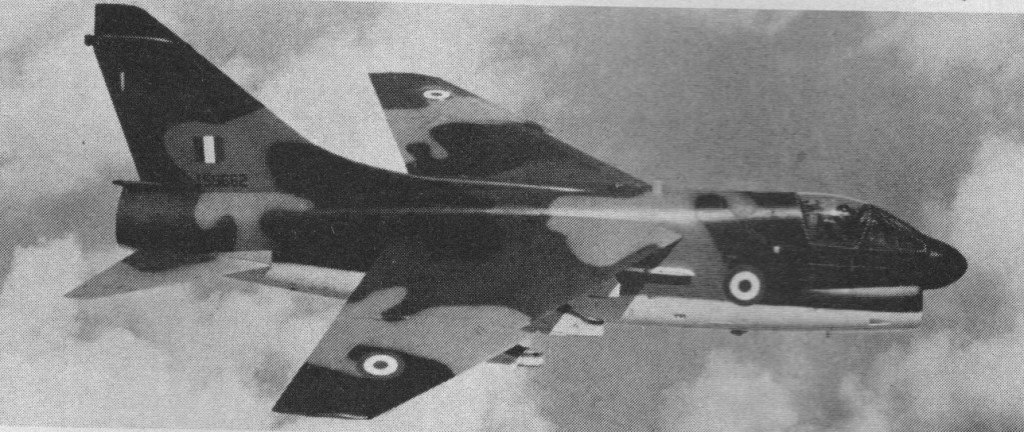
Vought flew the first example of the A 7H Corsair II, a land based version of the A 7E of which 60 had been ordered for service with the Royal Hellenic air force, on 6 May 1975.
A-7H Corsair
Land-based export versions comprised six (five new) TA-7H trainers for Greece; and 44 A-7P plus six TA-7P aircraft for Portugal, The latter variants are TF30-engined A-7As rebuilt with more capable A-7E avionics.
A 7A Corsair II Engine: Pratt & Whitney TF30 P 6 turbofan, 11,350 lb (5 147 kg), Empty weight: 14,857 lb (6738 kg) Hardpoints: 8 Catapult gross weight: 32,500 lb (14 740 kg) Bomb load: 6,800kg (15,000 lb). Max speed ext. load: 1040 km/h / 646mph.
A 7B Corsair II
A-7D Corsair II Engine: one 6804-kg (15,000-lb) thrust Allison TF41-A-2 (Rolls-Royce Spey) turbofan. Wing span 11,80 m (38 ft 9 in) Length 14.06 m (46 ft 11½ in) Height 4.90 m (16 ft ¾ in) Wing area 34,83 sq.m (375 sq ft). Empty weight: 8676 kg (19,127 lb) Maximum take-off 19061 kg (42,000 lb) Maximum speed: 1110 km/h (690 mph) SL Maximum speed: 1040 km/h (646 mph) at 1525 m (5,000 ft) with 12 227-kg (500-lb) bombs Ferry range 3670 km (2,280 miles) on internal fuel Armament: one internal M61A1 20-min rotary cannon (with 1,000 rounds); six under-wing and two fuselage pylons for over 6804 kg (15, 000 lb) of stores, including AIM-9 Sidewinder AAMs on fuselage attachments.
A-7E Corsair II Engine : TF41 (Rolls Royce RB 168-62 Spey), 66747 N / 6804 kp Length : 46.129 ft / 14.06 m Height : 16.010 ft / 4.88 m Wingspan : 38.681 ft / 11.79 m Wing area : 375.018 sqft / 34.84 sq.m Max take off weight : 42005.3 lb / 19050.0 kg Weight empty : 17571.6 lb / 7969.0 kg Max. speed : 607 kts / 1125 km/h Wing load : 112.14 lb/sq.ft / 547.00 kg/sq.m Maximum range : 2411 nm / 4465 km Range : 2411 nm / 4465 km Range (max. weight) : 918 nm / 1700 km Crew : 1 Armament : 1 MK 20mm M61 A1/1000rds, 9072kg ext. 8pts.
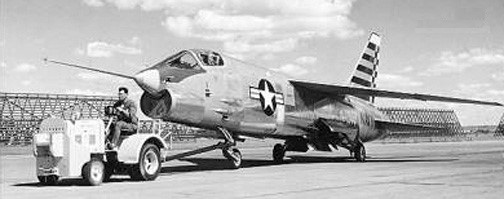
In September 1952 the US Navy issued a required for a fighter that could fly faster than the speed of sound and operate from a carrier. The RFP (Request For Proposals) was issued to eight different aircraft manufacturers. A total of 21 proposals were submitted. In May 1953 the US Navy selected the V-383 by Chance-Vought as the winner. Two prototypes were built and designated XF8U-1. Shortly after the US Navy also ordered the V-392 which would become known as the F8U-1P.
The design features a high mounted, variable incidence wing which can pivot upwards to permit lower landing speeds. Originally a dayfighter but later variant were also capable of flying all-weather operations. The Crusader is considered to be a dogfighter, equipped with four 20mm cannons as it primary weapons and two or four short range air-to-air missiles like the AIM-9 Sidewinder as secondaries.
On March 25 in 1955 the first prototype took off from Edwards AFB for its maiden flight. On this first flight the aircraft went supersonic.
The first production Vought F-8A Crusader went to the Navy’s VF-32 squadron in March 1957 and these first went to sea on board USS Saratoga.
On March 25 in 1955 the first of two prototypes (138899 & 138890) took off from Edwards AFB for its maiden flight piloted by John Konrad. On this first flight the aircraft went supersonic.
Vought XF8U-1
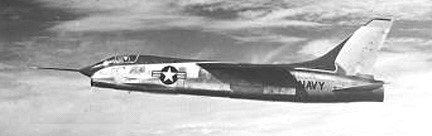
First production was F8U-1 (re-designated F-8A in 1962), first flying on 30 September 1955. 593 were built; 138899 & 138900, 140444-140448, 141336-141363, 142408-142415, 143677-143821, 144427-144625, 145318-145545, 145604-145647, and 146822-146905.
The first production Vought F-8A Crusader went to the Navy’s VF-32 squadron in March 1957 and these first went to sea on board USS Saratoga.
Vought F8U-1
F8U-1D, re-designated DF-8A, were control aircraft for Regulus missiles and the DF-8F target drone controller.
Shortly after the production of the F8U-1 started, the first unarmed photo-recon F8U-1P flew on December 17, 1956 and it was the F8U-1P that did low-level photo reconnaissance during the Cuba crisis. 144 of the 1957 F8U-1P / RF-8A were built; 141363, 1446507-144625, 145604-145647, and 146822-146901.
The F8U-1 was followed by an improved variant, the F8U-1E, which had an improved APS-67 radar system (and so a bigger plastic nose-cone), giving it limited all-weather capability. The first F8U-1E – a modified production F8U-1 – flew in early September, 1958
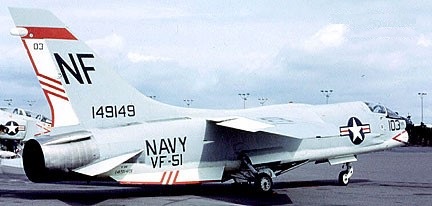
Vought F-8E VF-51 149149
A total of 218 F8U-1s and 130 F8U-1Es (145416-145545) were built before production switched in September of 1958 to the F8U-2
The YF8U-2 prototype flew for the first time on August 20, 1957. It was powered by a new and more powerful engine, a J57-P-16 with afterburner. The new engines also needed additional cooling. The F8U-2 could be fitted with up to four instead of two Sidewinder missiles. However, the four-missile armament was only very rarely carried in combat, since pilots felt that the extra weight and reduction in fuel load was not worth the two extra missiles. The F8U-2N was a limited all-weather interceptor version of the Crusader. The ‘N’ stood for night, because this version was intended to become a true night fighter. It was equipped with the even more powerful J57-P-20 engine and an approach power compensator (APC). The APC made the carrier landings a lot easier and saver. A total of 152 were built between June 1960 to January 1962 and served also with the US Marine Corps. The US Navy F-8D’s were however quickly replaced by the F-8E. The F-8E entered service in September 1961.
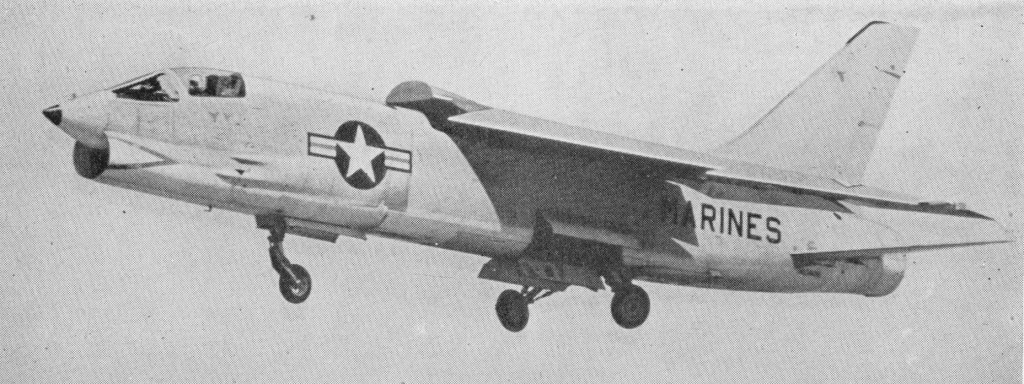
The F8U-2, F-8C, -8D, -8E, and -8J featured new fire-control and APQ-94 radar systems, and 10700 lb P&W J57-P-16/-20 engines. First flown on 20 August 1958, 625 were built; 145546-145603, 146906-147077, 147896-147925, 148627-148710, 149134-149227, 150284-150355, 150654-150683, and 150843-150932] included suffixes F8U-2N/F-8D (all-weather with APQ-83 radar) and F8U-2NE/F-8E (with APQ-94 radar); plus 42 as F-8E(FN) for the French Navy (151732-151773). The F-8E was developed further with J57-P-20 as the F-8J, with complications.
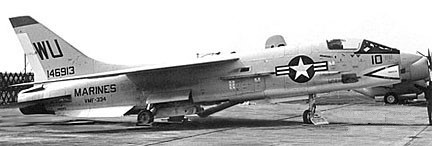
Vought F-8C USMC VMF-334 146913
The intent of the F-8J was to improve the F-8E with better radar, tail armament in the form of armor plate protection for the UHT actuators, better cruise and landing flight characteristics with 2-section leading edge droops and BLC, improved approach power compensator with a UHT rate input, improved ECM and wing pylon fuel drop tank capability. There were a few more things, like new wiring, UHF radio, and APR-30 RWR gear. But the plane was rushed to the fleet with only limited carrier-suitability testing.
Squadrons on the Ticonderoga and Bon Homme Richard got to be the carrier-suitability testers for the fleet by default.
The aircraft was woefully overweight by almost 2000lb and underpowered. With BLC on you lost about 800 lb of thrust. Flight control rigging was optimized to achieve the slowest approach speed with apparently little consideration for anything else. The result was a dangerous aircraft around the boat, especially at night. Although approach speeds were down around the 120-kt range at max trap weight, you couldn’t see over the nose, and wave-off capability was pathetic. Squadrons tried various things to deal with the poor wave-off performance.
The Tico played with “trim drag” by altering the c/g of the aircraft through fuel management. They would intentionally leave fuel in the aft cluster for this purpose. The Bonny Dick placed limits on temperatures that we could fly using 90° for day and 85° for night. (They promptly installed a thermometer that could be read in tenths, and at 84.9° at night we would launch.) We also were taught the “pulse technique” wave-off. For this you would rotate the aircraft to almost a stall while simultaneously applying full power. With the sink rate halted, you would then ease off and climb out. Imagine that maneuver at night!
To add to your worries, you could actually fly the airplane below the minimum speed required to operate the RAT (Marquardt emergency Ram-Air Turbine). The thought that you could be on final at night, operating off the RAT, and then lose all electrical power was frightening, to say the least.
Gradually, during the cruise, Navair responded to the problems and sent teams to WestPac to begin incorporating the fixes. To relieve the weight problem, armor plate in the tail was removed and the ALQ-51 was re-installed to replace the newer, but heavier, ALQ-100. Visibility over the nose was improved by changing the flight control rigging and increasing the approach speed to around 128 kts. The RATs were reworked to allow for safe operation at approach speeds. Wave-off capability was improved by incorporating a “War Emergency Thrust” throttle position — a spring was added to the leading edge of the throttle quadrant that would stop the throttle at the MRT position unless you pushed it further against the spring and into the WEP position. We were instructed to get used to using WEP by practicing during fouled-deck waveoffs until the first engine hot section inspection showed that we were destroying the engine’s burner cans. It seems that WEP was just intentionally allowing you to overspeed the engine for additional power, and it played hell on the burner cans.
The ultimate fix came with the improved J57-P-400 series engines about a year later. Eventually, Navair made all the necessary mods, and the -8J served well until its retirement. (Jack Musitano 02/01/00)
On September 18, 1962, the Crusader F8U was redesignated F-8 under the new unified Tri-Service designation scheme.
The F8U-2N first flew on 16 February 1960 and deliveries began to the US Navy commenced later that year.
F8U-2N
The F-8E or F-8FN Crusaders was the French version of this successful dogfighter and remained in service with the French Navy until the end of 1999 to be replaced by the Rafale-M. A total of 1305 Crusaders were built.
F-8E(FN)
The F8U-2NE or later designated F-8E was the final production version of the Crusader for the US Navy. It was an improvement of the F8U-2N with a new and even larger APQ-94 search and fire-control radar that gave it improved all-weather capability. The F8U-2NE differed from previous Crusaders in having a substantial air-to-ground capability. A total of 286 F-8Es were built until the end of the summer of 1964. It was the E model of the Crusader that was responsible for the greatest number of Crusader MiG kills in Vietnam
F8U-3
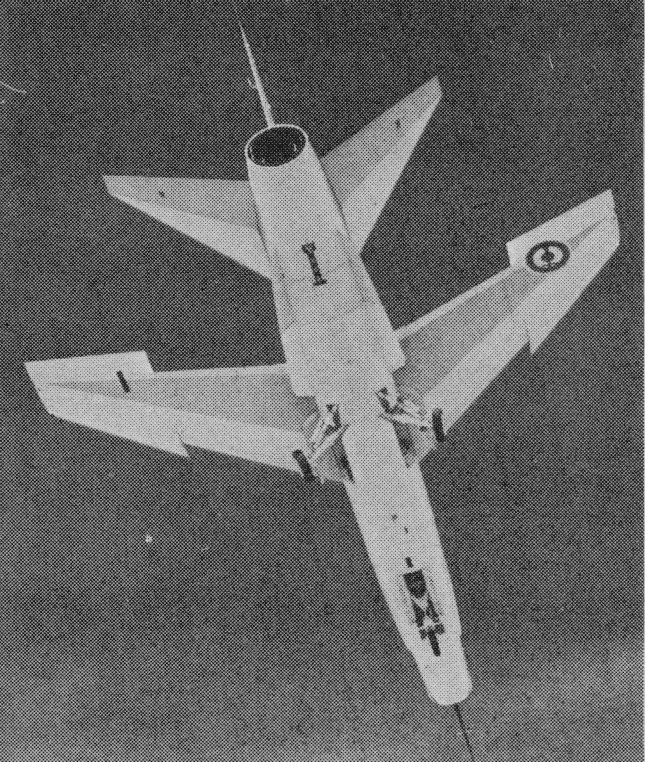
The F8U-3 first flew in early June 1958. It was distinguishable by two retractable ventral fins which improve stability at supersonic speed.
The F8U-1T (TF-8A) was a two-seat version of the original F8U-1. Although it seemed promising during 1962 it never went into full scale production because of US Navy cutbacks. The TF-8A went to Europe to attract customers, the British were at first interested but choose the F-4 Phantom. The TF-8A was sold to NASA and later regained to train Philippine pilots.
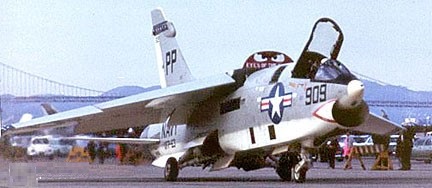
The RF-8G was a refurbished RF-8A with a modern engine, strengthened fuselage and wings, ventral fins, new navigation system and cameras. The first RF-8G re-entered service in October of 1965. Lifetime of these unarmed RF-8G photo recce crusader proved to be much longer than anticipated and in 1977 a second upgrade was done. The RF-8G remained in service with the US Navy till 1986 and thereby was the latest and longest serving Crusader in the US Navy.
Vought RF-8G at NAS Alameda, VFP-63
Starting in 1967 the F-8Ds were converted to the F-8H with a new engine. F-8Es were remanufactured as F-8J. The F-8J was the last Crusader fighter to take part in the Vietnam War. The next step was to upgrade the F-8Bs to F-8K and the F-8Cs to F-8L standards. The F-8M was supposed to be the designation for F-8As with low fly time, but there were not enough F-8A.
Crusaders were flown by the navies of France and the Philippines, the French F 8E (FN)s carrying Matra R530 and Sidewinder missiles. The US Navy operated a few modernized RF 8G Crusaders. Power for the F 8E(FN) is provided by one 18,000 lb thrust Pratt & Whitney J57 P 20 turbojet engine, which gives a maximum speed of nearly Mach 2.
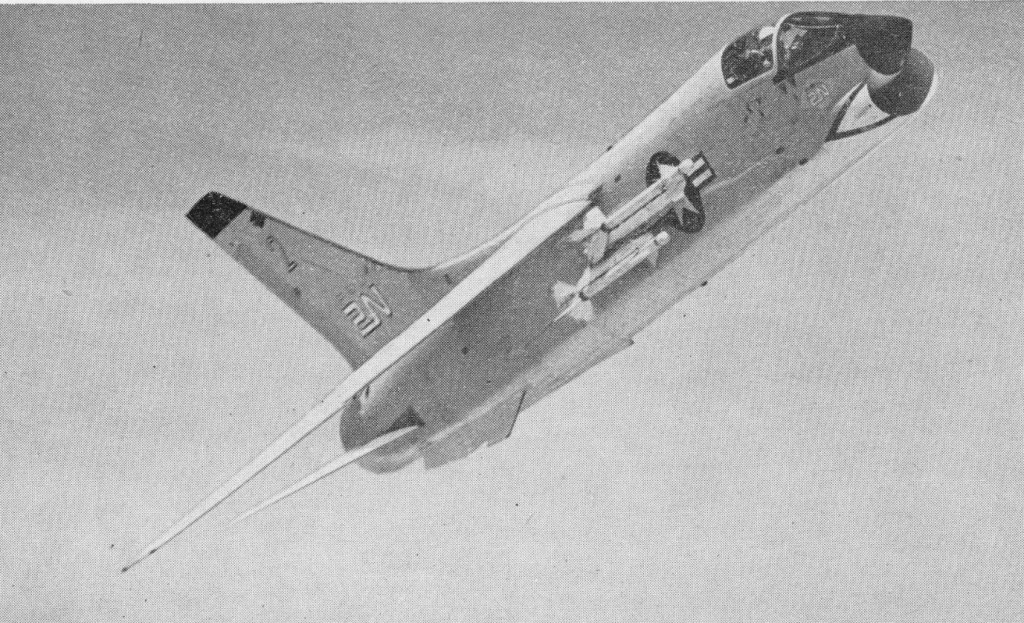
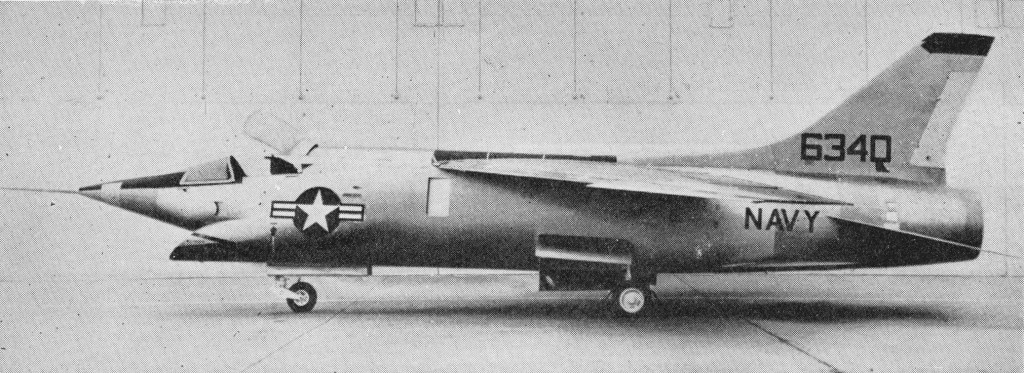
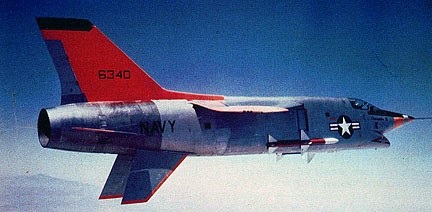
So successful was the Crusader, that a serious effort was made to create a Mach 2 development as the F8U-3 Crusader III. This bore a strong external resemblance to the baseline Crusader, but was virtually a new aeroplane characterized by the revised forward fuselage (with a pointed nosecone and forward-raked ‘sugar scoop inlet) and higher aspect ratio ventral fins that were angled down from the horizontal position for additional stability in supersonic flight. The type first flew on 2 June 1958 but the competing Mcdonnell F4H Phantom II was preferred for production.
Vought XF8U-3 Crusader III 146340
Two F8U-3 Super Crusader, or Crusader III, were built in 1958, 146340 and 146341, powered with 16500 lb P&W J75-P-5A/6 turbojets (29500 lb with afterburners). The maximum speed was never determined, as the canopy would overheat and begin turning opaque at about Mach 2.6. With acceleration still evident at that speed, test pilots felt that Mach 3.0 was attainable.
French service In 1962 the French Navy (Marine Nationale) ordered the F-8 Crusader to serve as a air superiority fighter aboard the new carrier Clemmenceau and Foch. The F-8 needed more upgrading in order to make it suitable and safe for the smaller French carriers. Improvements such as a bigger maximum angle of incidence for the wing to furthur reduce the landing speed were neccessary. A new weapon system was installed to make it capable for the French R.530 Matra missile. The variant was designated F-8E(FN) and entered service in October 1964. The French Crusader saw multiple upgrade (wings, afterburner and the R.550 Magic missile) until it was finally replaced in December 1999. When the carrier Clemmenceau was sent to the Persian Gulf during the Gulf War the Crusader was tasked with carrier protection against small vessels.
Philippine service In late 1977, the Philippines government purchased 35 ex-US Navy F-8Hs that had stored at Davis-Monthan AFB in Arizona. 25 of them were refurbished by Vought and the remaining ten were used for spare parts. As part of the deal the US would train Philippine pilots using the TF-8A. In 1988, after having intercepted a large number of Soviet bombers, all were withdrawn from service.
Awarded Collier trophy in 1957 and made the first carrier-to-carrier transcontinental flight, on 6 June 1967, and the first supersonic transcontinental flight, on 16 July 1957.
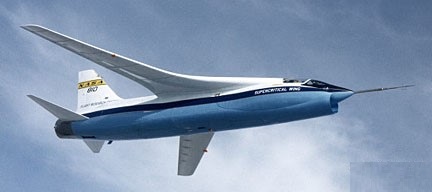
In 1971 NASA modified an F-8 as the F-8SCW to test NASA Langley’s SuperCritical Wing designed by (Richard Whitcomb) to minimize drag from shockwaves that subsequetly represented millions of dollars yearly in fuel savings and reduced air pollution as airlines switched to supercritical-wing aircraft.
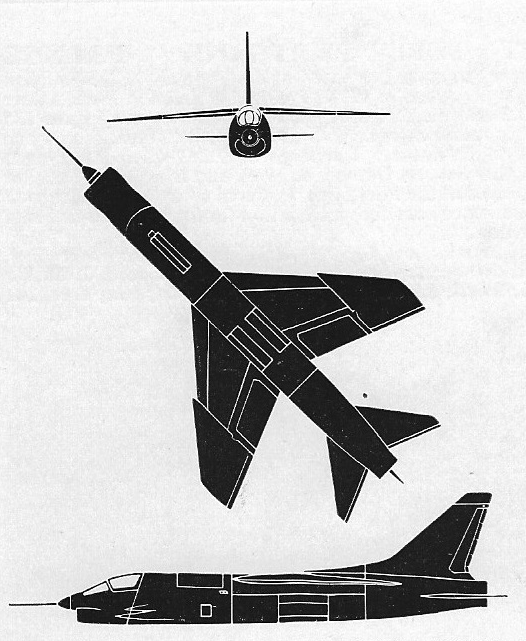
F8U-1 (F-8A) Engines: 1 x Pratt & Whitney J57-P-4A, 9,700 lb / 14,000 lb w/afterburn Wing span: 35 ft 8 in (10.87 m). Length: 54 ft 3 in (16.54 m). Height: 15 ft 9 in (4.8 m). Wing area: 350 sq.ft Wheel track: 9 ft 8 in Empty weight: 16,500 lb Max TO wt: 34,000 lb (15,420 kg) Max speed: 940 mph SL / 820 mph 36,000 ft ROC: 15,000 fpm Ceiling: 54,000 ft Armament: 4 x 20 mm cannon
F8U-1P (RF-8A)
F8U-1T (TF-8A)
F8U-1E (F-8B)
F8U-2 (F-8C) Engine: P&W J57-P-16/-20, 10700 lb (16900 lb with afterburner) Wingspan: 35’8″ Length: 54’3″ Max speed: 1120 mph Cruise: 560 mph Range: 1400 mi Ceiling: 59.000′
F8U-2N (F-8D) Engine: P&W J57-P-16/-20, 10700 lb (16900 lb with afterburner) Wingspan: 35’8″ Length: 54’3″ Max speed: 1120 mph Cruise: 560 mph Range: 1400 mi Ceiling: 59.000′
F8U-2NE (F-8E) Engine: P&W J57-P-16/-20, 10700 lb (16900 lb with afterburner) Wingspan: 35’8″ Length: 54’3″ Max speed: 1120 mph Cruise: 560 mph Range: 1400 mi Ceiling: 59.000′
F8U-3 Crusader III Engine: P&W J75-P-5A/6, 16500 lb (29500 lb with afterburners) Wingspan: 38’11” Length: 58’9″ Max speed SL: 800 mph (1457 mph at 50,000′) Cruise: 575 mph Stall: 154 mph Range: 645 mi Ceiling: 51,000′
RF-8G
F-8H 1968 F-8D modified to include external wing ordnance, increased strength fuselage, lead-launch computer, other improvements.
F-8J F-8E with larger fuselage, wings, other improvements. Engine: P&W J57-P-16/-20, 10700 lb (16900 lb with afterburner) Wingspan: 35’8″ Length: 54’3″ Max speed: 1120 mph Cruise: 560 mph Range: 1400 mi Ceiling: 59.000′
F-8K F-8C with structural changes to fuselage, wing, landing gear.
F-8L F-8B with structural changes to fuselage, wing, landing gear.
F-8M F-8A with structural changes to fuselage, wing, landing gear.
F-8E(FN) Engine: one 80 kN (19,000 lb st) Pratt & Whitney J57-P-20A afterburning turbojet Length: 16.61m (54 ft 6 in) Height: 4.80m (15 ft 9 in) Wing span: 10.72m (35ft 2 in) Take-off (’empty, equipped’) weight: 8.935 kg (19,700 lb) Max Take-Off Weight: 15.420 kg (34,000 lb) Max level speed: Mach 1.7+ / 1.827+ km/h (1,135+ mph) Service ceiling: 17,680m (58,000 ft) Armament: 4x 20mm Colt Mk 12 cannons / 84 or 144 rds each
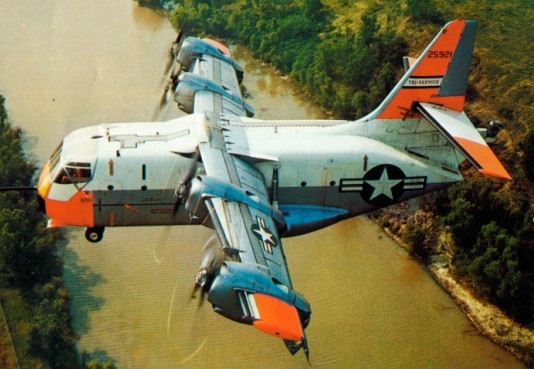
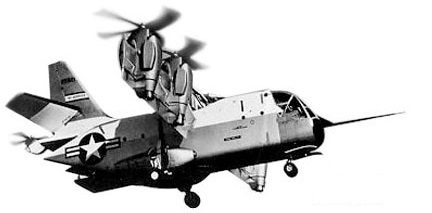
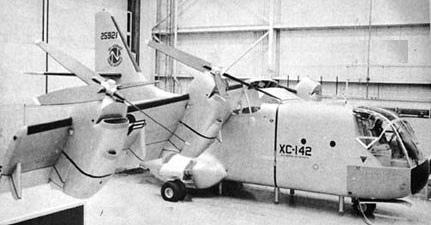
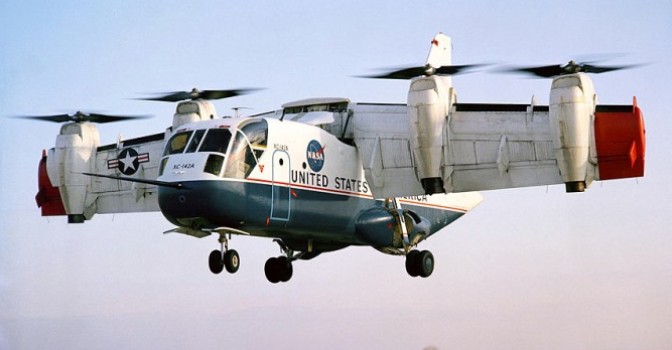
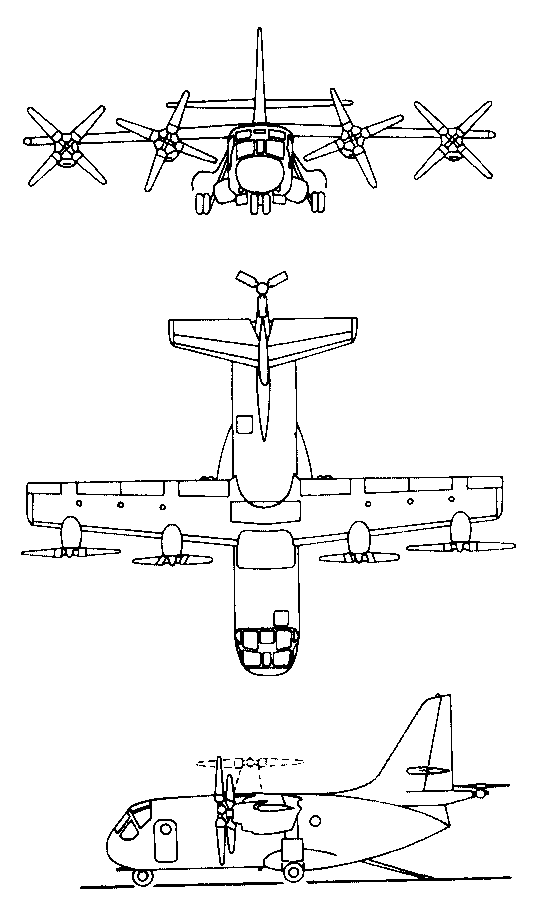
A government advisory group in 1959 recommended that a full-size V/STOL aircraft was required, with specific requirements for the Navy and Army. Previous VTOL programs had been built to illustrate a particular principle, but few of these concepts had any operational military capabilities. With the XC-142, it was decided that this system would be tested in an operational environment. It was decided that the system would fulfill requirements for all three military services. The first tri-service VTOL. In 1961, a Request for Proposal was released, and in September, the proposal from Vought-Hiller-Ryan was announced as the winner. It was also announced that the Air Force would manage the program with the cost of the program to be shared equally by each of the services. Vought Aeronautics Division of Ling-Temco-Vought was the prime contractor, with Hiller and Ryan serving as the major subcontractors. Vought subcontracted the design and fabrication of the empennage, aft section, engine nacelles, and wing to Ryan. The overall transmission system and selected components were subcontracted to Hiller, which was also responsible for the flap and aileron fabrication. The XC-142 grossed out at about 16900kg loaded with an empty weight of about 10780kg. The plane had a fuselage length just exceeding 17.7m, with a maximum height of 7.9m and a sizable wing span of 20.6m. The model carried a single tall vertical tail that provided 12sq.m of area. The wings carried large trailing double-slotted flaps the entire length of each wing and were mounted high on the fuselage. The fuselage was designed to carry significant cargo, with the cargo compartment being 9.15m in length with a 2.1m height and width. That volume equated to about 32 full-loaded troops and gear, or four tons of cargo. In addition to that capability, there was also the ability to carry 370 litres of fuel. There was also a planned capability for auxiliary tanks which would greatly add to the range.
XC-142 62-5921
Power consisted of four 3080hp General Electric T64-GE-1 engines, mounted in nacelles on the wings, which were all cross-linked together. Each drove a four-bladed 4.7m Hamilton-Standard fiberglass propeller, the tips of each practically overlapping each other. Later in the program, Hamilton Standard would provide an improved version of the propeller using the 2FF blade design, which featured a wider planform, rounded tips, and a more pronounced twist than the earlier 2EF blades. The goal of the new design was to improve aerodynamic load distribution and overcoming a static load problem. The four engines also drove a fifth propeller, a three-bladed fiberglass type, in the tail through an interconnected gear and shaft train. Therefore, power was available to turn all five propellers when one, two, or three engines were shut down. The tail propeller rotated in a horizontal plane and was declutched and braked for cruise flight. Through cross-shafting gearboxes, the rotation from each engine was brought together at the top of the fuselage. The power was then sent back to the tail rotor through a tail propeller shaft, into the tail propeller gearbox, and on to the variable pitch tail propeller. The propulsion system of the XC-142 was over powered. The plane could lose an engine on take-off and still clear a 15.25m barrier in 122m carrying a 4500kg payload. Also, with all engines operating, the plane had a rate of climb at sea level of 34.5m/s. On a hot day, even with an engine out, the XC-142 showed a climb rate of 17.8m/s. Roll control was by differential propeller pitch. Pitch control was accomplished by the eight-foot, three-bladed variable pitch tail rotor. Yaw control was provided by ailerons powered by propeller slipstream deflection, actually a second VTOL concept being employed in the XC-142. The craft main lift system in the wing was capable of rotating through 98 degrees instead of the expected straight-vertical position. The wing tilt mechanism consisted of two screw-jack actuators driven by a centrally-located hydraulic motor. The tilt was controlled by a variable rate switch on each collective lever, or by a constant rate switch. This allowed the plane to hover in a stationary mode in a tailwind condition. The trailing edge of the wings carried three-section, double-slotted flaps in three sections, with the center and outboard sections operated also as ailerons. The flaps were programmed automatically with changing wing tilt, although the pilot had an override capability. Leading edge slats were used for stall suppression, and were mounted outboard of each engine nacelle and operated automatically as a function of flap position. The vertical tail was operated as a standard rudder-and-fin set-up, which supported the slab-type unit horizontal tail assembly. A fully-powered irreversible type with artificial feel forces and powered by dual independent hydraulic systems was fitted. Dual cockpit controls, consisting of conventional rudder pedals, control sticks, and collective levers for all take-offs and landings, provided the highest technology of the system. The tail rotor was rigged to fold to the port side to reduce the storage length and protect against damage during a loading operation.
The first XC-142 was rolled out in early 1964 with its first conventional flight being made in September 1964, its first hover three months later, and the first transition from hover to horizontal flight and return on 17 January 1965. The Air Force extensively tested the XC-142’s capabilities with cargo flights, cargo, and paratrooper drops, along with desert, mountain, rescue, and carrier operations.
XC-142 62-5921
In 1966, one of the XC-142s passed operational tests to prove the model in carrier operations. In quick succession, the plane accomplished 44 short take-offs and landings, along with six vertical take-offs and landings from the USS Bennington.
The carrier trails were accomplished using the number five prototype, which was crewed by both USMC, Navy, and Army pilots. The flight regime covered VTOL operations at a variety of speeds, which occurred at wind conditions from 10 to 55km/h. A large variety of wings and flap tilt angles were used during the testing. Also, there were landings accomplished with three and six degree glide slopes. In an amazing demonstration, the plane negotiated a 360-degree turn within the width of the flight deck. That same year, one of the prototypes was also tested in an overwater pickup operation. The plane lifted a man from a life raft to determine its capability for rescue and recovery. A standard Navy horse collar sling was attached to 38m of cable and then lowered through a floor hatch just aft of the cockpit. The tests proved that there were no problems with effects of the propeller downwash or slipstream turbulence.
The program called for the building of five prototypes, 62-5921-5925, but cross-shaft problems, along with some operator errors, resulted in a number of hard landings causing damage to the complete fleet.
The most serious of the mishaps, resulting from a tail rotor driveshaft failure, caused three fatalities. The May 1967 accident took place near the Dallas, Texas, LTV plant and occurred in a heavily-wooded area where fire started after the impact. The flight plan for the ill-fated prototype included a rapid decrease in altitude from 2440m to 915m, effectively simulating a pilot rescue under combat conditions. A nose-over at low altitude followed, from which the crew could not recover. The crash aircraft was XC-142 #1 which had flown 148 times at the time of the crash. The pilots on the fatal flight were Stu Madison, Charlie Jester, and John Omvig.
Other incidents included the following:
Aircraft #2 – On October 19, 1965, this craft experienced a ground loop causing extensive damage to the wing and propeller.
Aircraft #3 – On January 4, 1966, this model made a hard landing in the vertical mode. There was significant damage to the fuselage. The wing of this plane was late mated to the Number #2 for further testing.
Aircraft #4 – On January 27, 1966, an engine turbine failure caused the overriding clutch to engage, causing extensive damage to the wing, outboard aileron, the number two nacelle, aft engine shroud, and fuselage. It was later used by NASA for further research.
Aircraft #5 – ln December of 1966, a ground accident caused major damage to the fuselage, nose, wing, and propellers. The incident was caused by pilot error who failed to activate the hydraulic system, which resulted in no brakes or nose wheel steering.
The final decision on the disposition of the aircraft occurred during the Category II Operational Suitability Program, which was conducted at the Air Force Flight Test Center. The testing consisted of 113 flights, totaling 163.9 hours, which was accomplished between July 1965 and August 1967. Three of the XC-142s also participated in a major operational test demonstration during the program, where the planes participated in demonstrations of VTOL, STOL, and movement of Jeep-mounted 106mm recoilless rifles, unloading of three-quarter ton trucks with towed 105mm Howitzers, dump trucks, and 450-kg A-22 containers. For a typical XC-142 design mission, the plane could operate with a gross weight of 16900kg, including a four-ton payload. At that weight condition, the plane could take off vertically, cruise 370km near 480km/h, hover for ten minutes, and then land. One of the limitations found in the plane, even though the overall test results were very positive, was an instability between wing angles of 35 and 80 degrees which was encountered at extremely low altitudes. There were also high side forces which resulted from yaw and weak propeller blade pitch angle controls. Another XC-142 complaint was the excessive vibration and noise in the cockpit, when coupled with an excessively high pilot workload, and which presented a considerable challenge in the cockpit. The program involved 39 different pilots flying the prototypes for a total of 420 hours.
The greatest national exposure the XC-142 received during its flight test program occurred when the #4 prototype participated in the 1967 Paris Air Show.
The only remaining XC-142, #2 62-5924 / NASA522, was on display at the Air Force Museum at Wright-Patterson Air Force Base near Dayton, Ohio.
XC-142A Crew: 2 Passengers: 24-44 Engines: 4 x General Electric T-64 turboshaft, 2095kW Wingspan: 20.6m Length: 17.8m Height: 8.0m Wing area: 49.7sq.m Empty weight: 10250kg Max speed: 667km/h Ceiling: 7620m Range with max fuel: 756km Range with max payload: 370km
The last design of the Lincoln Aircraft Corp was the parasol wing Lincoln Playboy of 1931. A two place pusher powered by a 25 hp Lincolcn Rocket engine, the aircraft could attain a top speed of 80 mph and cruis at 70 mph. The price in 1931 was US$800.
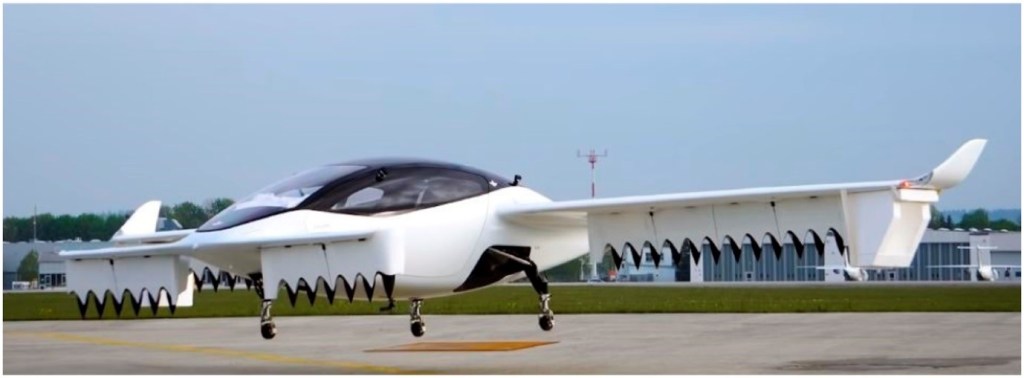
On 4 May 2019, Lilium flew its first flight of an untethered and unmanned five seat Lilium Jet at the Special Airport Oberpfaffenhofen in Munich, Germany. The full-scale prototype was powered by 36 electric ducted fans in configuration inspired by the Eagle prototype aircraft. After the first flight, which consisted primarily of hover, the Lilium Jet has expanded its flight envelope to include conversion to forward flight using the wing for lift, and several safety tests.
In April 2017, Lilium GmbH, a Germany-based start-up founded in 2015, flew the first flight of the Eagle prototype aircraft. This aircraft was unique in that it used 36 powered fans (12 in each wing and 6 in each forward canard) for lift and propulsion.
The Lilienthal Bekas (Lilienthal Snipe in English, Лиленталь Х-32 Беҝас in Russian) is a 2/3 seat, high wing single engine pusher ultralight from Ukraine.
The Lilienthal Bekas is a pod and boom, multi-purpose, pusher configuration ultralight with a high wing and low-set boom carrying a T-tail. The well glazed pod seats two in tandem and carries the constant chord wing at its top. The wing is braced to the lower fuselage by two pairs of cross braced struts and is fitted with flaps, which have a maximum deflection of 40°. A fixed, tricycle undercarriage with a castoring nosewheel is mounted on the pod. The engine is mounted at the rear top of the pod, behind the cabin; types in the 60-100 hp (45-75 kW) range may be fitted, most commonly Rotax two or four cylinder models such as the Rotax 582 or 912UL and 912ULS. The engine is cowled on some aircraft but not all. Much of the slim boom is occupied by a broad chord fin with a straight swept leading edge. On some aircraft it is extended forwards with a fillet. The rudder hinge, also slightly swept, is at the end of the boom. The tailplane is of constant chord and braced to the end of the boom by a strut on each side. The X-32 Bekas first flew in March 1993 and received its Ukrainian certification in 1995. The Rotax 582 and 912 variants were certified in 2003 and 2005 respectively. The aircraft has JAR-VLA certification.
Lilienthal Bekas X-32 RA-2096G MSN: 03180 Russia – May 30, 2020
Between 2003 and 2006, the X-32 and X-34 were marketed by JAI (Jordan Aerospace Industries) as the RumBird X-32 and GulfBird X-34. By 2009, more than 400 X-32s had been sold.
Variants:
X-32AT Bekas Sports version, certified for limited aerobatics.
X-32UT Bekas Dual control trainer version.
X-32CK Bekas Agricultural version, which may be fitted with spraybars fed from tank replacing rear seat.
X-32A Bekas Ski undercarriage.
X-32H Bekas Float undercarriage.
X-34 Bekas Widened cabin for three, with the two passengers side-by-side on a rear bench seat; 500 mm greater span and either Rotax 912S or Rotax 914 engine.
Specifications:
X-32 Engine: 1 × Rotax 912, 60 kW (80 hp) Propeller: 3-bladed VPSH 2 Donchak variable pitch pusher Length: 6.55 m (21 ft 6 in) Wingspan: 9.00 m (29 ft 6 in) Height: 2.00 m (6 ft 7 in) Wing area: 12.33 m2 (132.7 sq ft) Airfoil: NACA 4412 Empty weight: 300 kg (661 lb) Max takeoff weight: 495 kg (1,091 lb) Cruising speed: 120 km/h (75 mph; 65 kn) Stall speed: 55 km/h (34 mph; 30 kn) power off, flaps down Never exceed speed: 158 km/h (98 mph; 85 kn) Endurance: 3 hrs 20 min on normal fuel load g limits: +3.8/-1.9 Rate of climb: 5.0 m/s (980 ft/min) Crew: one Capacity: one passenger





 All Aero