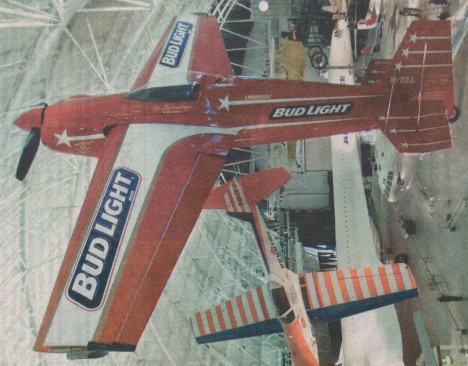
Loudenslager Laser 200
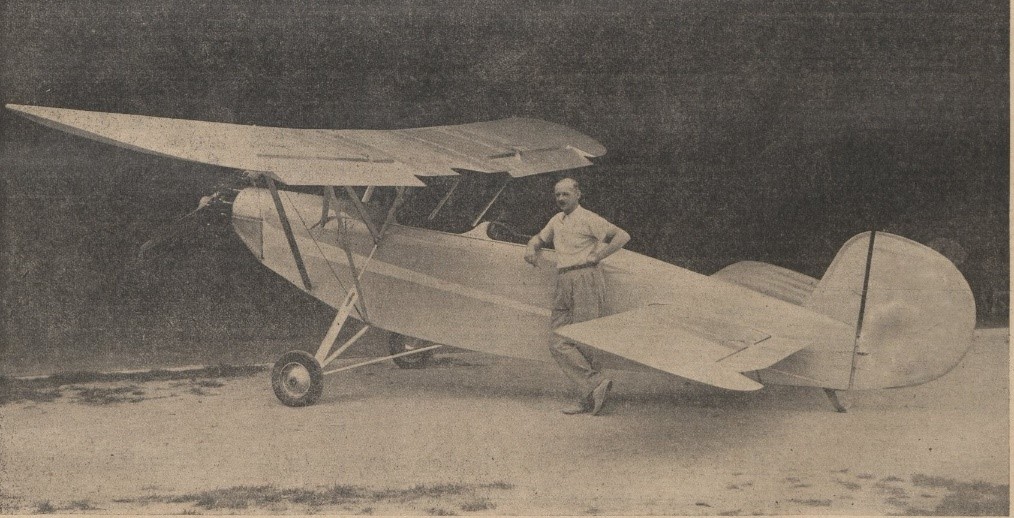
M. Louchet’s ‘Le Pyrale’, which was presented to the world on the eve of WWII – and, in consequence, was not heard of thereafter.
The 1911 Loubery biplane designed and built by Loubery in France had twin engines and three propellers.
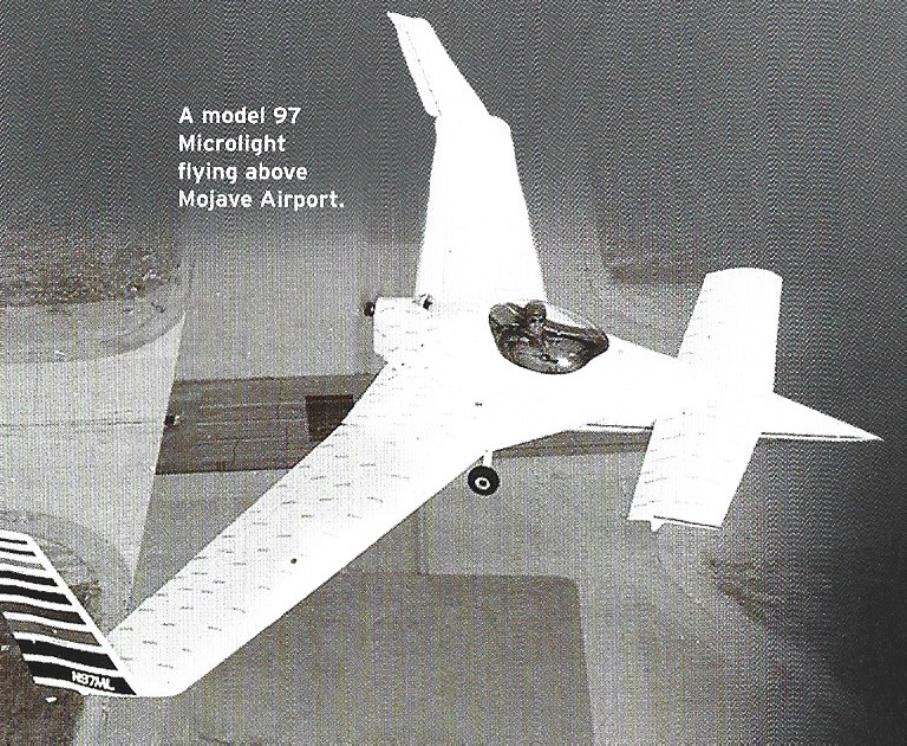
Lotus has long been known for sophisticated yet affordable sports cars, but founder Colin Chapman also aimed to build aircraft. Colin Chap¬man, founder and head of the Lotus Car company, discussed a microlight project with Alain-¬Yves Berger, who had met Colin on the motor racing circuits many years before and had remained in touch with him. Colin envisaged making a very high performance composite construction tandem two seater using a canard wing, and a four stroke engine of his own design, and had set himself some tough performance targets a design top speed of 125 mph (200 kph), fuel consumption per hour of 1. 3 US gal (1.1 Imp gal, 5.0 litre), and a selling price around £5500 for a production run of 500 aircraft.
Chapman believed that Lotus composites technology could be applied to build an aircraft that still met ultralight rules, would be cheap and easy to fly, and very attractive to buyers. After reading up on German glider technology, Chapman approached the Rutan brothers in 1982 to study the feasibility of the project and commissioned Burt to design a new type of microlight based on Rutan’s love of composites, efficiency, and the use of the “canard” wing layout for which Rutan is famous. Several designs were envisaged, one being the Rutan Model 91 ML (for MicroLight), a one-person 300 lb. ultralight aircraft, powered by two 25 hp jet engines. Despite Burt Rutan’s dismissing the idea as complicated, Chapman insisted that the new plane should be a two-seater.
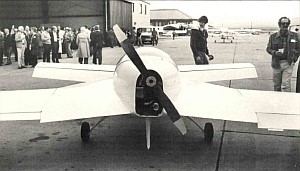
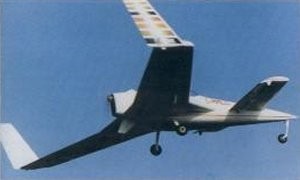
By June 1982, the final configuration was chosen out of nine different studied designs, and in December, the prototype Lotus MicroLight (Rutan Model 97M), built by Scaled Composites Inc. and appropriately registered N97ML, arrived at the Group Lotus airfield at Hethel in Norfolk, England. It was a side-by-side two-seater with a pointy nose, an enclosed cockpit, a retractable front wheel, and is of a unique design with a canard foreplane and a swept back wing, and a pusher propeller behind the cockpit. Pitch control by elevator on canard; yaw control by tip rudders; roll control by spoilerons; control inputs through stick for pitch/roll and pedals for yaw. Undercarriage has three wheels in tricycle formation; glass fibre carbon fibre suspension on main wheels. Push right go-¬right nosewheel steering. Brakes on main wheels. Composite fuselage, totally enclosed. Engine mounted below wing driving pusher propeller.
Tragically Colin Chapman, the visionary who championed the Lotus MicroLight, died December 16, 1982 at the age of 54, the day before the prototype’s first flight.
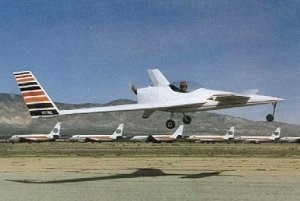
It is often said that the program was shelved by Lotus due to the death of Mr. Chapman. This was not so. Prototype trials continued with a little Italian KFM 109 ER two-stroke 23 hp engine, up to the end of the proof-of-concept phase. Specs for the Lotus MicroLight are lacking, but a 25 hp engine was originally planned for it. A Lotus engine that was being developed by Tony Rudd (a senior officer at Lotus), the 50 hp Magnum 4.5, was to have been installed in the production aircraft. The plane was assembled and flown for the first time in public in August 1983. It arrived in a crate at Hethel in August 1983, two days before the Lotus Open Day. It was assembled on Friday and Saturday, and was taxied in daylight on Saturday afternoon, and “accidentally” hopped in the dusk. Its first proper flight was Sunday morning, and the demo flight was in the afternoon for the crowds. It was now registered as G-MMLC.
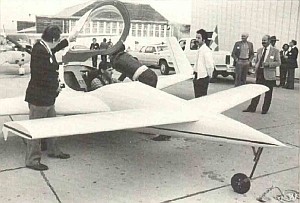
The Lotus MicroLight was apparently a technical success, but a marketing failure. Despite both Lotus’s and Rutan’s credentials, the business arrangements didn’t work out. Lotus wanted to build a business for the MicroLight, and sought backing to continue alone. When that wasn’t approved, Lotus went looking for partners and teamed up with the Eipper company to distribute it in the USA, while Malcolm Lawrence’s Aviation Composites of Thatcham in Berkshire, was to distribute it in the UK and Europe.
Lotus originally planned to build the basic structure themselves, with Aircraft Composites finishing and distributing it. It was then decided that the materials (epoxy glass) and the quality control techniques were not part of the Lotus core business, and Aircraft Composites agreed to take over the development and build, with the help of Peter Jackson’s Specialised Mouldings (a firm in motorsport). Since Lotus was struggling to cope with the aftermath of Colin Chapman’s death, the Aircraft Composites move into taking over the whole project was heaven sent. Instead, Aviation Composites used the design’s features as a basis for a different aircraft. The company employed VariEze builder Ivan Shaw, and built a similar but much heavier version, the Mercury prototype (G-INAV), which incorporated various modifications from the Rutan design and had several problems with it.
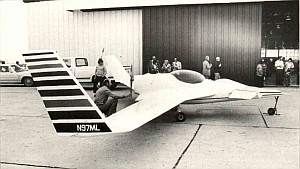
The MicroLight was de-registered and returned to the USA in 1988, but it was lost in an accident in which both the owner and test pilot of the aircraft were killed
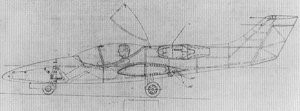

In September 1990 it was reported the name SwiftThunder was adopted for the derivative of the SwiftFury offered to the USAF’s enhanced flight screening aircraft programme. The two aircraft differ only in the tricycle undercarriage on the Swift Thunder. A three-day evaluation of the SwiftFury prototype was being made during August 1990 at the Air Force Academy, Colorado Springs, with five sorties to be flown each day.
LoPresti Fury
Engine: Lycoming IO-360-A1B6, 200 hp @ 2700 @ SL
TBO: 2000 hrs
Fuel type: 100/100LL
Propeller type/diameter: Hartzell CS/76 in.
Landing gear type: Tri/Retr.
Max ramp weight: 2300 lb
Gross weight: 2300 lb
Max landing weight: 2300 lb
Empty weight: 1450 lb
Useful load: 850 lb
Payload, full fuel: 490 lb
Usable fuel (gals.): 60
Wingspan: 29 ft. 3 in.
Overall length: 22 ft. 6 in.
Height: 7 ft. 2 in.
Wing area: 138.6 sq. ft
Wing loading: 16.6 lbs./sq. ft
Power loading: 11.5 lbs./hp
Wheel base: 12 ft. 5 in.
Wheel track: 9 ft. 9 in.
Wheel size: 6.00 x 6 in
Seating capacity: 2
Cabin width: 44 in
Cabin height: 45 in
Baggage capacity: 200lb
Cruise speed 75% power @ 8,300 ft.: 182 kt
Cruise speed 65% power @ 8,300 ft.: 175 kt
Max range (w/ reserve) 55% power: 870 nm
Fuel consumption 75% power: 10.5 USgph
Fuel consumption 65% power: 9.1 USgph
Fuel consumption 55% power: 7.7 USgph
Stall speed (flaps up): 49 kt
Stall speed (flaps down): 44 kt
Best rate of climb: 1350 fpm
Service ceiling: 21,000 ft

Designed, patented, built and flown in 1909 by Mexican aviation pioneer José Guadalupe Mejía López. During its first test on the plains of the Rosary in the city of Guadalajara, the aeroplane was pulled with a rope by an automobile and rose 4 meters before it collided with a cactus, although suffering only minor damage. López subsequently received a German-made engine of 35 hp and flew the machine a distance of 800 meters at a height of 2.5 meters, thus becoming the first Mexican to build and fly his own aircraft.


The Loose Special was built by Chester Loose, flown by Warwick Siem. Both from Davenport, Iowa.

A 1909 monoplane designed by George H. Loose of Redwood City, California. Instantly recognizable due to the peculiar curved wing design, The twin tractor propellers were designed to blow under arched, birdlike wings.
Span: 31’8″ (later 26′)
Length: 20’6″
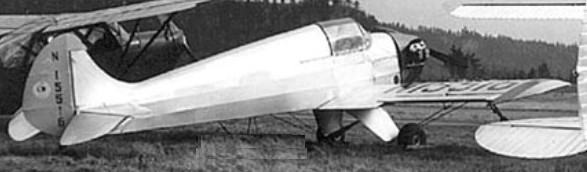
The Wimpy was designed and constructed in 1935 by Leslie Long at Cornelius, OR., USA. It had a welded-steel fuselage, tail feathers, and landing gear, and a wooden wing. It used external wire bracing, like the Fly Baby, except the flying wires attached to a bit of structure behind the tires rather than through the wheel hub.
Myron Buswell acquired the airplane in 1938 and made several modifications. The airplane left Oregon in 1957 when it was purchased by Roy Olson of San Diego, CA. Mr. Olson donated the airplane to OAHS in November 2005. Following acquisition of the original plans, OAHS Director Bill Austin began wing restoration for display.

An Oregon man named Tom Story, who built one just before World War II.
After the war, Story’s airplane was bought by another Oregon man named George Bogardus. Prior to the war, reaction against homebuilt aircraft had caused them to be banned in every state except Oregon. Bogardus wanted the CAA to implement a new certification category that would overrule the state limitations.
Bogardus modified the Story Wimpy, calling it Little Gee Bee. He successfully flew across the country several times, and his efforts helped lead to the introduction of the Experimental/Amateur-Built category.
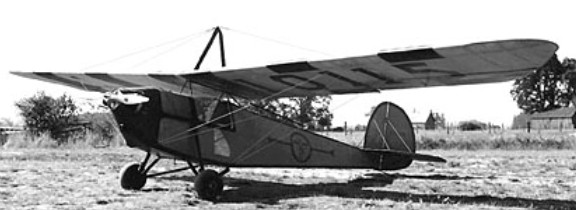
In the 1930s, Les Long designed a couple of homebuilts. The Longster was one. Long even performed a trade study with the Longster. It started out as a mid-wing aircraft, but Long did some experimentation with wing position. He tried a parasol wing, and a low-wing configuration. He decided the low wing was best.
 All Aero