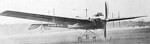
The 1911 Martin-Handasyde No. 5 was designed and built by Helmuth P. Martin and George H. Handasyde in the UK.
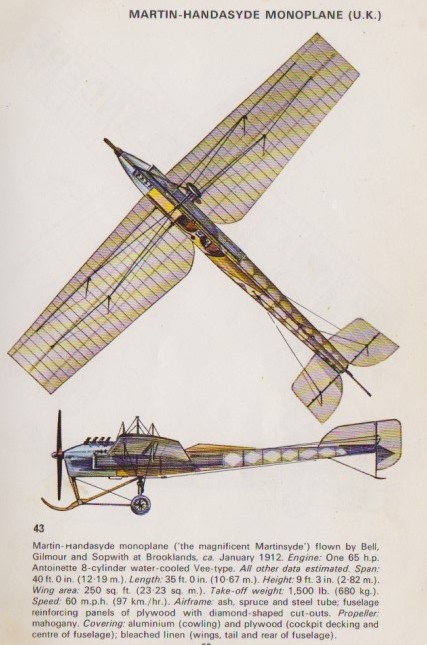
The 1911 Martin-Handasyde No. 5 was designed and built by Helmuth P. Martin and George H. Handasyde in the UK.

The 1911 Martin-Handasyde No. 4B was designed and built by Helmuth P. Martin and George H. Handasyde in the UK.
Span: 37′
Length: 33′
Weight: 800 lb
Speed: 60 mph
Price: £ 1100
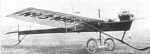
The 1910 Martin-Handasyde No. 3 was designed and built by Helmuth P. Martin and George H. Handasyde in the UK.
Span: 32′
Length: 28′
Weight: 560 lb
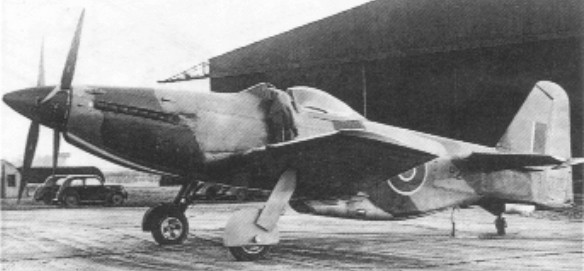
At the outset Martin considered the best decision was to build a machine virtually identical with the M.B.3, but with a Rolls Royce Griffon engine. By the end of 1942 the Griffon engined M.B.4 had been almost finished as far as drawings were con¬cerned, but it contained a number of unsatisfying compromises. Early in 1943 Martin took the decision to start again and, while making the maximum possible use of MB.3 philo¬sophy and hardware, create an optimised fighter that would have no obvious shortcomings.
The wing of the M.B.5 was similar to that of the M.B.3, though Martin reduced the armament to four 20mm Hispanos, with his own patented flat ¬feed mechanism, which met the F.18/39 specification. The wing was simpler than that of the M.B.3, with light alloy sheet structure except for the spar booms which were of laminated high ¬tensile steel. The fuselage philosophy was the same but the shape was considerably different, and the steel ¬tube longerons were joined by flanged sleeves to which the diagonal, vertical and transverse struts were secured by fork ends held by close tolerance tapered bolts. Light alloy secondary structure supported heavy section rubber mouldings against which the large skin panels were pressed by Dzus fasteners. Control surfaces were metal skinned and driven by spring tabs, and the landing gear, brakes and up/down flaps were worked by compressed air (not at 60 lb/sq in but 350, giving a lighter system).
The construction of the instrument panel itself was arranged for ease of maintenance. Mounted on a sub frame, it was designed to hinge open for access to the interior and the instruments themselves. The position of the cockpit afforded an excellent view over the nose and wing leading edges. The cockpit also included a full floor, which in 1944 was rather novel.
The pilot sat on fuel tanks of 70 and 130 Imp gal, and the Griffon 83 engine had its air intake just behind the spinner of the Botol six blade contra rotating propeller, and was cooled by a three unit radiator inter-cooler, main cooler and oil cooler ¬in a neat diffuser duct under the rear fuselage. The propeller shafts were mounted coaxially, the drive for the forward one passing through that for the rear. Contra rotation had been chosen to provide greater performance at altitude, and to permit higher power at take off than would otherwise have been feasible.
A Rolls Royce Bendix Stromberg injection carburettor was adopted, the long carburettor air intake extending up to the spinner and forming an integral part of the engine cowling; vertical ‘splitters’ ensured stiffness and reduced turbulence.
The three cooling radiators needed were placed in a diffuser duct under the rear fuselage. In the forward position was the intercooler, aft of this the main radiator and finally the oil cooler. This arrangement ensured that, when warming up, the heat from the main radiator prevented coring of the oil, and the full oil pressure was obtained within a few minutes of start¬up. Fuel was contained in two tanks of 70 and 130 imp. gallons (318 and 590 litres) situated one ahead of and one behind the pilot.
The MB.5 prototype received the serial R2496, originally allotted for the second MB.3 (which was never completed). On the morning of May 23, 1944, R2496 was ‘knocked down’ at Denharn in about an hour, placed aboard a Queen Mary road transporter and taken to Harwell.
Reassembled in just over an hour, the MB.5 was inspected and flown for the first time in the afternoon by Captain Bryan Greensted, Rotol’s chief test pilot, who had been seconded to the programme by MAP.
During the company testing Greensted found the MB.5 well thought out and was impressed by all but the directional handling. Fin and rudder modifications were swiftly made involving an extension to the fin leading edge and a larger and taller rudder. With these modifications, W/C Maurice Smith, who later briefly flew R2496 for Flight magazine found that the handling was “pleasing in every way”.
Towards the end of October 1944, after 40 hours in the air, R2496 was taken to Farnborough for demonstration by Bryan Greensted before visiting VIPs, including Winston Churchill. During this display the Griffon failed when a piston shattered. As his cockpit filled with smoke, Greensted reached up to jettison the canopy, while travelling at a speed of over 400mph (644km/h). As he did so, his arm became caught in the slipstream and was very severely dislocated. Meanwhile the canopy had clipped the tailplane causing slight damage. Greensted elected to remain aboard, however, and managed a deadstick landing. As a result of this experience, the offending hood jettison lever was repositioned.
In early 1946, with 80 hours 45 minutes flown, the MB.5 was handed over to A&AEE at Boscombe Down. The first testing report, on maintenance and accessibility was issued on March 1. Prominently at the beginning it stated, “It is considered that the general design and layout of the Martin Baker 5 is excellent, and is definitely better from the engineering and maintenance aspect than any other similar type of aircraft”. It went on “The layout of the cockpit might very well be made a standard for normal piston engined fighters” and “The time necessary for a quick turn around… would appear to be very low when compared with existing types of aircraft”.
Flight test comments passed by Boscombe praised R2496 as virtually viceless. It was found that the contra prop simplified take off and gave an immediate and powerful response to engine power changes, over a very wide speed range. Minimal engine vibration was experienced, and the cockpit noise level was low. Both the rudder and elevators were light, and control was exceptional especially near the stall, which was very gentle. Use of the trimmer was found necessary only infrequently; even at low speed with flaps down, when the aircraft became mildly tail heavy, it was not sufficient to warant moving the trimmer from its usual neutral position. The only mildly adverse comment was over a slight lateral instability caused by comparatively ineffective ailerons the rate of roll was mediocre but could be improved by use of rudder. Lt Cdr Eric M Brown, doyen of Service test pilots described R2496 as “superb”.
Flaps of the split trailing edge type are either selected up or down, no inter¬mediate position being provided, so a take off is made without flap. The mini¬mum take off for the M B V is 420yd over 50ft in zero wind. Wheels retract quickly, the only indi¬cation that they have moved and locked being that given by the warning lights. The throttle lever, placed above the pitch control, has a long quadrant and moves smoothly and positively. The pitch lever is, by comparison, rather sensitive, and a big change in rpm results from quite a small lever movement.
Engine speed is controlled over a range of roughly 1,800 rpm to 3,000 rpm, and the blades cannot be feathered. At about 8,000 ft the M B V cruised along very sweetly at about 315 mph indicated with 4 lb boost and 2,250 rpm. This is somewhat less than the recommended cruising power and the speed is at least 100 m.p.h. less than the maximum for this height.
All of the controls have spring tabs.
With flaps down, engine idling and attitude very slightly nose up, the con¬trols became pretty sloppy at 110 mph indicated at 5,000ft and the aircraft stalled very gently away to the left at just over the 100 mph.
The sole prototype MB.5 passed from hand to hand attracting praise wherever it went. In June 1946, it was demonstrated at Farnborough by S/L Jan Zurakowski. After this, the MB.5 returned to Boscombe, where the Commandant, Air Commodore Sir Henry Paterson Fraser, flew it. He found R2496 free of vice. The MB.5 was popular and unique. Later, R2496 was taken to the newly acquired Martin Baker airfield at Chalgrove. There, it was used to examine oiling problems in the propeller translation bearing between the pair of blade sets.
Martin took out a patent for the automatic oiling unit developed as a result of these trials. It continued in use in the de Havilland contra rotating propellers of the Avro Shackleton. The MB.5 was maintained in an airworthy condition, flight testing continuing into 1947, the sole prototype being scrapped thereafter.
Engine: One Rolls-Royce Griffon Mk 83 piston engine with two stage, two speed supercharger
Maximum power, 2,340 h.p. at 750ft (M gear), 2,120 h.p. at 12,250ft (S gear) with 25 lb/sq in boost
Max speed: 460mph (740kph) at 20,000 ft (740 km/h at 6,096m)
Stalling speed (assumed ISA, SL) 95 mph (153 km/h)
Range at 225 mph (362 km/h) 1,240 miles (2,000 km)
Service ceiling: 40,000ft (12,192m)
Empty weight 9,233 lb (4,188kg)
Empty wt, equipped 9,345 lb (4,230kg)
All up wt: 11,500 lb (5,216kg)
Wingspan: 35ft (10.6m)
Length: 37ft 9in (11.5m) with final tail unit
Height: 15ft (4.5m), with final tail unit
Wing area, 262.64 sq ft (24,40 sq.m)
Wing loading: 44 lb/sq ft
Armament: Four 20mm Hispano cannon with 200 rpg.

The second of the three MB.3 prototypes ordered by MAP, R2496, was intended to be Griffon powered, and was referred to as the MB.4. At the time of R2492’s crash, the necessary drawing amendments for the MB.4 were complete and manufacture had started.
It was intended to enter the competition against Specification F6/42 but the attempt was unsuccessful. However, Martin felt that he could improve on the MB.3/MB.4 concepts. R2496 was left uncompleted and work on the third intended aircraft, R2500, was not begun. Early in 1943, the difficult decision was taken to start afresh, tempered by the knowledge that the firm had received verbal assurances from MAP that if a new fighter design were produced, a contract for one prototype would be awarded, again to Specification F5/39.
With the then hand built nature of a prototype, in an experimental shop, with design adjustments made on the spot, and drawings brought into line afterwards, made resources available out of all proportion to the effort. By 1943, when work on the MB.5 had begun.
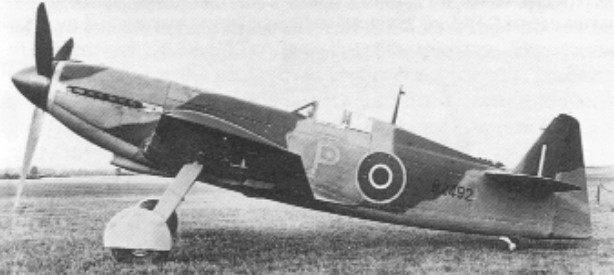
With the Spitfire and Hurricane in widespread service, the Air Ministry contemplated their eventual replacement. Specification F18/39 issued on May 1, 1939, called for a single seat interceptor armed with two cannon or eight machine guns, capable of 400mph (644km/h) at 12,000ft (3,658m) at an all up weight of 15,000 lb (6,800kg), and with a ceiling of 35,000ft (10,668m).
In the summer Martin Baker received an order for three prototypes of Martin’s new MB.3 at a total contract price of £64,000. With war imminent Martin had been asked to ‘come aboard’ and produce prototypes to contract as had established contractors in the earlier F5/34 submission.
In its fuselage structure the MB.3 was an advance on its predecessors. The skinning was of stressed light alloy and flush ¬riveted except where the numerous inspection panels were situated. The wing was completely new, its basis being a D section torsion box. A substantial light alloy spar web was adopted, with upper and lower spar booms made from laminated high tensile steel strip, the number of laminations decreasing towards the tip. The structure was covered with heavy gauge flush riveted light alloy stressed skin. The fin was reminiscent of that fitted late in the life of the MB.2. All control surfaces were fitted with torsion bar spring tabs to enhance manoeuvrability.
Martin had intended a Rolls Royce Griffon as the powerplant, this being the engine specified in F18/39. As an interim measure, the company was supplied with a Merlin ballasted to simulate the Griffon. With the advent of the Napier Sabre, which promised to give over 2,000hp (1,492kW), a second option became available and in 1941 Martin Baker was awarded a revised contract for a Napier Sabre II version of the MB.3. The Sabre drove a de Havilland three bladed constant speed propeller. Shallow ducted radiators were incorporated under the left wing (oil cooler) with the main radiator under the right wing.
The main inward retracting undercarriage of the MB.3 had an track of 15ft 5ins (4.7m). The wheels were raked so far ahead that the threat of a nose over was minimal. Undercarriage operation was by 60 lb/sq.in (27kg/2.5csq.m) pneumatic system. A second, lower pressure pneumatic system was used to operate the large split flaps which had no intermediate settings.
The intended armament consisted of six 20mm Hispano cannon, to have 200 rounds per gun. The armament was removed prior to flight trials and never tested.
The prototype MB.3, R2492, emerged from Denham in the summer of 1942, the contract completion date having been set for the previous March. Initial taxiing trials were undertaken at Denham and demonstrated a very stable ride.
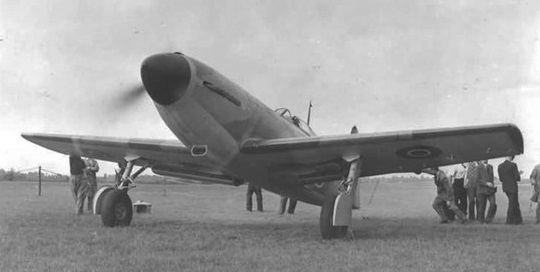
Martin received orders from the Ministry of Aircraft Production (MAP) to use RAF Wing in Buckinghamshire for flight testing and during August 1942 the MB.3 arrived at Wing in crates, Val Baker flying it for the first time on 31 August 1942. According to an eye witness, the MB.3 with its 24 cylinder sleeve valved Napier Sabre flew well for a short period but then had to make a hurried landing because of the threat of engine overheating due to inadequate radiator cooling.
In subsequent flights in early September, Baker found the MB.3 highly manoeuvrable. On September 12, 1942, Valentine Baker took off satisfactorily, but shortly afterwards the Sabre failed when a sleeve drive crank broke, resulting in immediate and total loss of power. Baker attempted a dead stick landing but after touching down in a small field, the MB.3 hit a tree stump and was destroyed; Baker was fatally injured.
After the loss of R2492, the MB.3 prototype programme came to a halt. Martin decided to start again with a new design. It had been by no means certain that the MB.3 would have secured a production contract.
Engine: One 2,020hp (1,506kW) Napier Sabre II 24 Cylinder H-¬type piston
Max speed 430 mph (691km/h)
Range 840 miles (1,351 km)
Initial climb, 4,350 ft/mm (22,09 m/sec)
Operational ceiling 34,500ft (10,515m)
Empty weight 8,500 lb (3,855kg)
All up weight 11,000 lb (4,989kg)
Wnigspan 35ft 2in (10.7m)
Wing area, 262.64 sq ft (24,40 sq.m)
Length 34ft 1 in (103m)
Height: 14ft 3in (4.3m)
Armament: Six Hispano cannon intended.
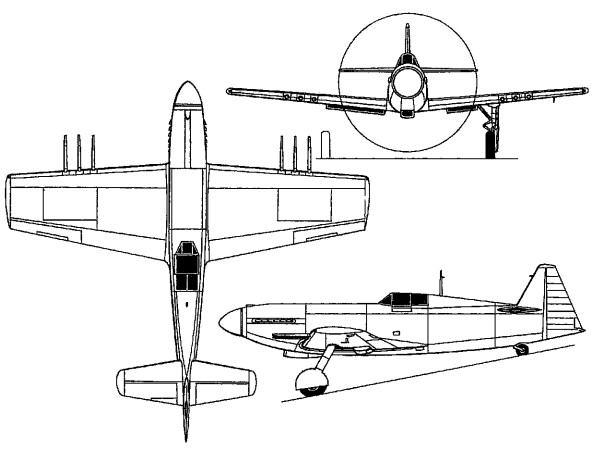
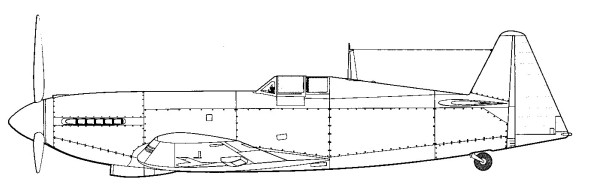
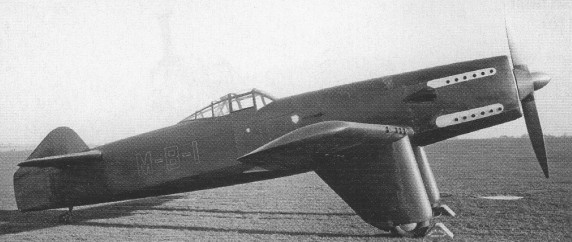
In 1935, with a company employing 35 people, Air Ministry Specification F5/34 called for a single seat monoplane interceptor armed with six or eight machine guns. A retractable undercarriage was required and an enclosed cockpit; a speed of at least 275mph (442kph) at 15,000ft (4,572m) was stipulated.
This requirement was taken up by Bristol (Type 146 835hp/622kW Bristol Perseus), Vickers (Venom 625hp/466kW Bristol Aquila), and Gloster (G.38 840hp/626kW Bristol Mercury IX). James Martin submitted the MB.2.
Funded as a private venture, Napier lent an air cooled Dagger M.3 24 cylinder upright ‘H’ type engine with a rated output of 798hp at 5,500 ft / 1675m. The Dagger was not yet fully developed and suffered from lack of power yet the particular engine (No 77101) eventually installed in the MB.2 seems never to have given any trouble. Cooling air was exhausted through a controlled outlet on the fuselage underside.
Other equipment to support the MB.2 included a fixed pitch, two bladed wooden airscrew from the Airscrew Company and Jicwood Ltd and a set of eight Browning 0.303 in machine guns, taken from the first batch manufactured under licence in Britain, in 1937. The build phase for the MB.2 began in March 1936, the month of the first flight by the prototype Spitfire.
Conceived for manufacture in large numbers by semi¬skilled workers at low cost, the M.B.2 employed a steel-tube structure with fabric skinning, and carried an armament of eight 0.303-in (7,7-mm) Browning guns in the wings. The depth of the fuselage was virtually constant from nose to tail and vertical tail surfaces were eliminated, the rudder being hinged to the sternpost behind the elevators.
The MB.2’s airframe employed the previous steel tube process, but stronger, and metal skinning was used more widely. The enclosed cockpit was placed well back and given a raised canopy with glazing fore and aft.
The canopy was hinged to starboard but could not be jettisoned. The rear glazed area of the hood enclosed an electrically operated extendible crash post which was automatically actuated when the flaps were lowered. The fuselage lines were square cut, the depth being almost constant from engine to sternpost. A tubular cradle supported the engine which had stub exhaust ports. The metal covered areas of the fuselage, forward of the aft cockpit area, were equipped with quick release inspection panels held with Dzus fasteners.
The wingspan was shorter than the fuselage length, but designed to enhance stability and control in yaw. The wing was constructed as a centre section and two outer panels. A small amount of dihedral was employed and the wing tapered slightly along the leading edge but more acutely along the trailing edge. Blunt tips were provided, together with inset ailerons. The wing carried the eight machine guns in two clusters of four, outboard of the undercarriage.
Martin elected to employ the rear fuselage as the fin, with the rudder hinged to the sternpost, the design lacking any conventional fin at all, in order to reduce weight and drag. With balancing of the fuselage keel area, the tailplane was high mounted so that the rudder could operate effectively.
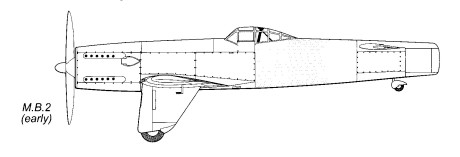
To save development time the undercarriage was fixed, with trouser fairings. To reduce drag further, Martin fitted the oil cooler in the leading edge of the port fairing. A 60 lb/sq.in pneumatic system operated the split flaps and the wheel brakes. There was no hydraulic system.
The aircraft was generously provided with inspection and maintenance access points. The engine complete could be removed and replaced in less than 90 minutes. The complete outer wing assembly could be removed in 25 minutes. The machine guns, together with their ammunition tanks, were locked in position with pins, removal via a very large access panel taking just five minutes.
The private venture MB.2 prototype was completed in July 1938, the Air Ministry making RAF Harwell available for flight tests. The MB.2 arrived late in the month, painted in a strange “air force green” livery overall, and sporting the totally unofficial identity ‘M B 1’.

Val Baker first flew this prototype on August 2, 1938, a few days after the sixth production Spitfire had been delivered to the RAF. He found that directional stability was poor. The aircraft was quickly fitted with a vestigial fin, and also at that time, allotted the civil registration G AEZD. Even with the addition of the miniature fin, Baker found the handling unsatisfactory, though he achieved a level speed of 320mph (515km/h) at a weight of 5,530 lb (2,500kg), which included guns and ammunition.
After initial company tests, the Air Ministry accepted the MB.2 for evaluation purposes, the aircraft being repainted overall deep olive green and allotted the service serial P9594. It arrived at A&AEE, then still at Martlesham Heath, during November 1938. James Martin went with the aircraft and explained to those concerned his thinking behind the configuration.
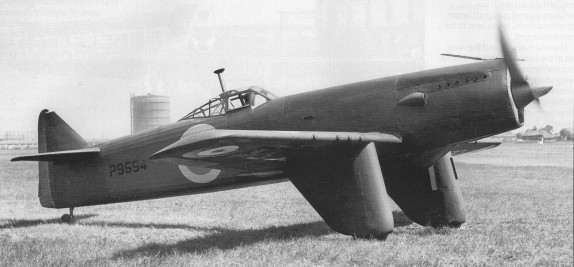
In the official A&AEE report, which was issued the following month, the MB.2 received high praise as a piece of engineering. As a flying machine it was unpopular. The ease of maintenance and accessibility drew considerable acclaim. The cockpit area attracted mixed comments. It was praised as warm and comfortable, roomy and draught free, but the unjettisonable canopy was criticised. The wind down side windows were popular but an openable direct vision panel ahead was needed. The cockpit was assessed as difficult to enter and an extra step was suggested. However, the excellent view from the cockpit drew favourable comment, as did the crash pylon.
Flap actuation also attracted criticism; the flaps were operated by a simple lever which provided full flap for landing, without an intermediate setting, and only a meagre warning light showed when they were down. The A&AEE suggested a more positive flap position indicator, and also different trimming facilities. Armament arrangements were praised; the guns were made accessible through quick release hatches and working platforms were formed into the wing upper surfaces.
The handling of the MB.2 was unacceptable to the testing authorities. The elevators were over sensitive, particularly with power off; lower gearing was suggested. Ailerons left much to be desired, being ineffective at low speeds and heavy at high speeds. The rudder layout was found to be particularly poor and produced considerable yaw even with small movements. At high power, even full left rudder could not prevent a gentle turn in the opposite direction. Stability in all three planes was thus found wanting, and consequently the MB.2 made a poor gun platform. Finally it was an uncomfortable ride for the pilot.
After the tests at Martlesham P9594 returned to Denham, where the fin and rudder were modified once more, taking on a larger and more conventional appearance. A study was also carried out to enlarge the tailplane, in order to improve pitch behaviour and encourage gliding properties. The modifications appear to have rectified the stability and control problems, for Val Baker was able in May 1939 to give an inspired demonstration at Heston, which included steep, low level turns and a dive at some 400mph (644km/h). It seems that the length of the Dagger, which might have reduced power of manoeuvre except in roll, was offset by the comparatively short wing span.
The Air Ministry purchased the only MB.2 built in July 1939 intending to use it as a test bed, the aircraft eventually returning to Denham where it was dismantled in 1941.
Engine: One 798hp (595kW) Napier Dagger M.3 24 cylinder H-¬type piston
Max speed 320mph (514km/h)
Normal range 300 miles (482km)
Operational ceiling 31,000ft (9448m)
Empty weight 3,840 lb (1,741kg)
All up weight 5,400 lb (2,449kg)
Wingspan 34ft (10.3m)
Length 34ft 6in (10.3m)
Height 12ft 3in (3.3m)
Wing area 235sq.ft (21.8sq.m)
Armament: Eight 0.303 in Browning machine guns.
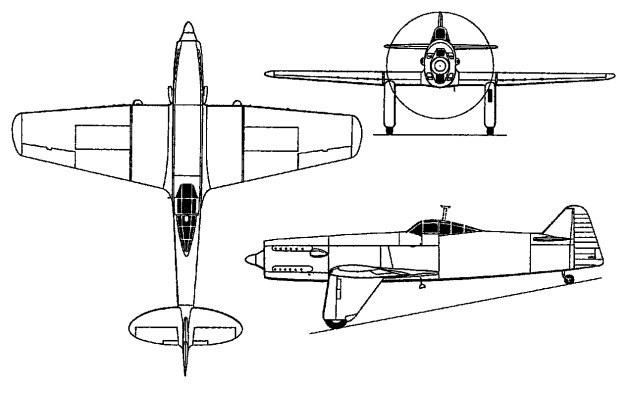
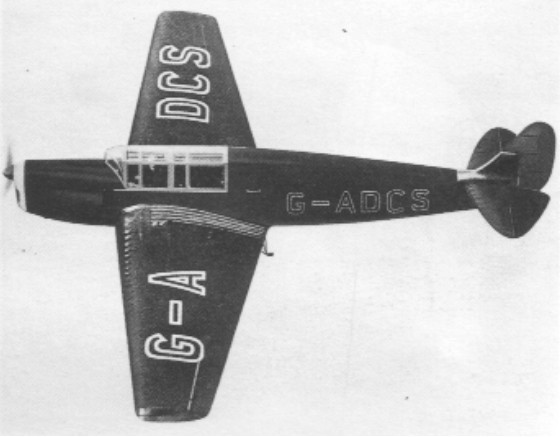
The M.B.1 was built primarily to demonstrate Martin’s original patented system of lattice-girder construction patented by James Martin in 1931. Designed during the late summer of 1934 and was a two seat low wing cabin monoplane.
The entire primary structure was built from thin gauge high tensile steel tube, cut to a precise length with a hacksaw. The tube ends were secured to each other either by brazing or (more frequently) by flattening, brazing and drilling the ends, then fastening with a bolt to a castle nut brazed inside a small cylindrical insert fixed in the adjacent tube. The advantages of this type of metal structure were simplicity and lightness of construction, versatility, and the benefit that unskilled labour could be utilised during manufacture. Martin was especially concerned that his new aircraft, known simply as the MB.1, should be straightforward to construct and maintain. Because very little light alloy was used in the manufacture, delay and cost through heat treatment and anti corrosion processes was avoided to a great extent. All the elements for the tubular structure, inserts, saddle¬-washers and castle nuts, were produced in house.
The low set monoplane wing of the MB.1 wing spar was based on three span wise thin gauge steel tube booms, two forming the aft surface, one mounted almost vertically above the other, and the third forming the leading edge. These booms became thinner, and tapered towards each other towards the wingtip. The wide base of this pyramidal spar, together with the large diameter of its component booms, provided considerable strength, especially in torsion. Inserts and bolts secured linking tubes which were used to add to the spar strength. Wing ribs constructed from brazed small diameter T.5 tube were then bolted to the spar, as were the wing stringers. Welded aluminium fuel tanks of long, thin triangular section were mounted inside the spars. The wings of the MB.1 were designed to fold, to minimise storage space, the folding procedure being a one man operation. The same method of manufacture was also used on the tail surfaces.
The rear section of the fuselage was also of bolted tube. Machined, flanged steel sleeves, attached to the longerons at focal points, provided stringers, the area being faired by light metal hoops of near oval shape. The mid and forward fuselage construction was principally of brazed tube. Evidence of Martin’s attention to systems detail was provided by the cock assemblies, for fuel supply, pump isolation and other functions which were loaded with a spring ball giving ‘feel’ when they were actuated.
The MB.1 was powered by a 160hp (119kW) Napier Javelin IIIA six ¬cylinder inverted in line engine, with electric starting, lent to Martin Baker by Napier. A fixed pitch two bladed wooden airscrew was fitted, the engine installed in a brazed tubular mounting. The practical nature of the MB.1 was particularly evident around the nose where the doping pump had connections to both the carburettor and the induction pipe, the inlet manifold being lagged and warmed, the fuel and oil filters being easily accessible.
The cowling side panels could be supported from their hinges in a horizontal position to form shields should maintenance be necessary while the engine was running.
The MB.1 was entirely fabric covered apart from the fin and the wing walkways which wore Duralurnin skins. Undercarriage arrangements were very simple and again employed tubular construction with uncomplicated shock absorber struts and low pressure tyres.
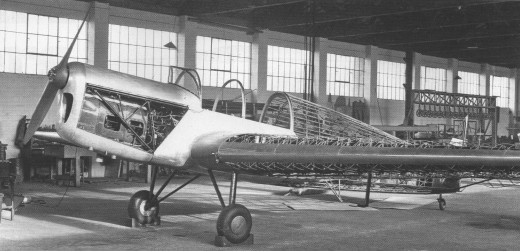
By the end of March 1935 the aircraft was completed and it was taken by road to Northolt. It was eventually given the civil registration G-ADCS, and Capt Baker took the aircraft for its first flight in April 1935, painted black overall. He found that it possessed good flying qualities and had a maximum speed of 125 mph. The company recorded that ‘DCS had “sound inherent flying qualities”.
With severe cash flow problems, only one MB.1 was built, flying for only a few hours before being placed in storage at Denham after work began on the M.B.2, but in August 1939 the M.B.1 was inspected (and rejected) byAir Ministry representatives for possible impressment into national service.
It is 99 per cent certain that it was burnt in an April 1940 fire at Denham, which destroyed the existing factory. It was definitely not lost in a fire in March 1938.
Engine: One 160hp (119kW) Napier Javelin IIIA six cylinder in¬line piston
Max cruising speed 140mph (225kph)
Stalling speed 50 mph (80kph)
Endurance 3 hrs 30 mins
Empty weight 1,5601b (707kg)
All up weight 2,3501b (1,065kg)
Wing span 37ft (11.2m)
Length 28ft 10in (8.7m)
Height 9ft 9in (2.9m)
Wing area 206sq.ft (19.1sq.m)
Martin’s first design was a side by side two-seat low wing monoplane with a Cirrus Hermes engine. The drawings for the M.1 were prepared during late 1929. Engine runs and other ground tests were made on a completed fuselage which vindicated the chosen arrangement; however, the project was not completed due to lack of funds.
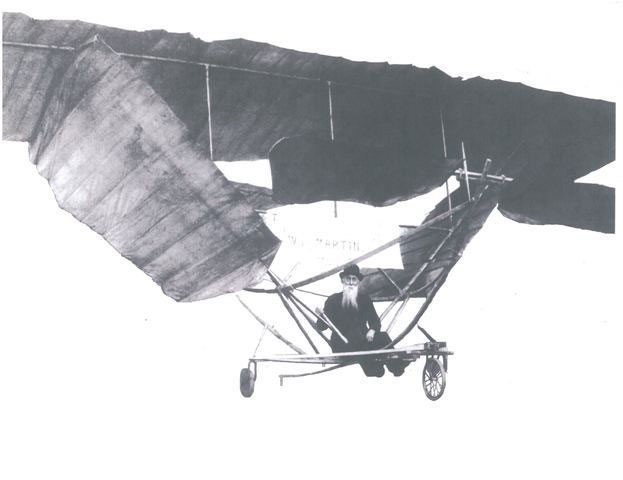
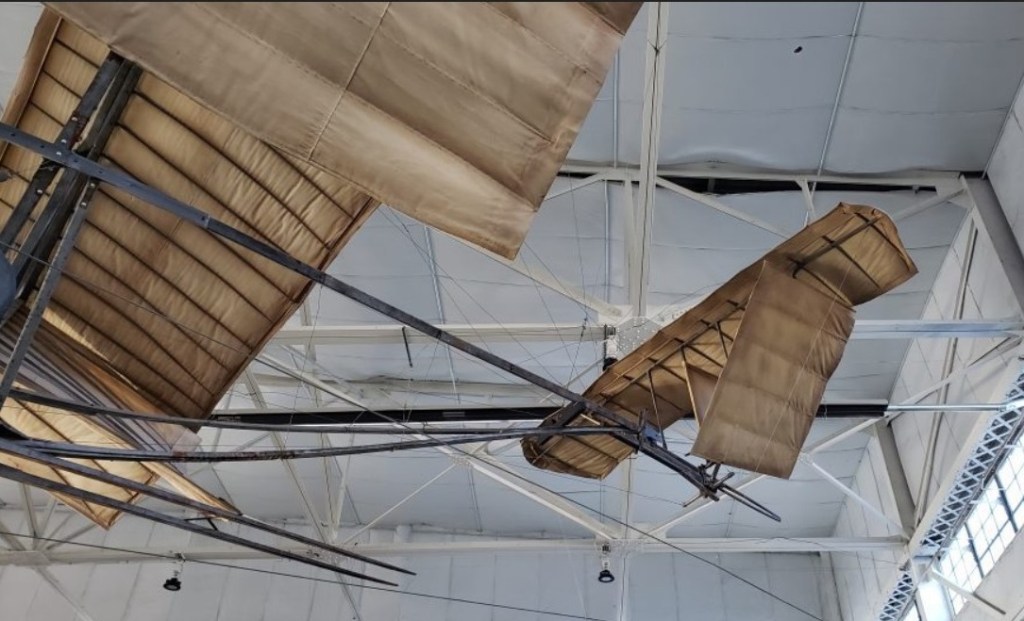
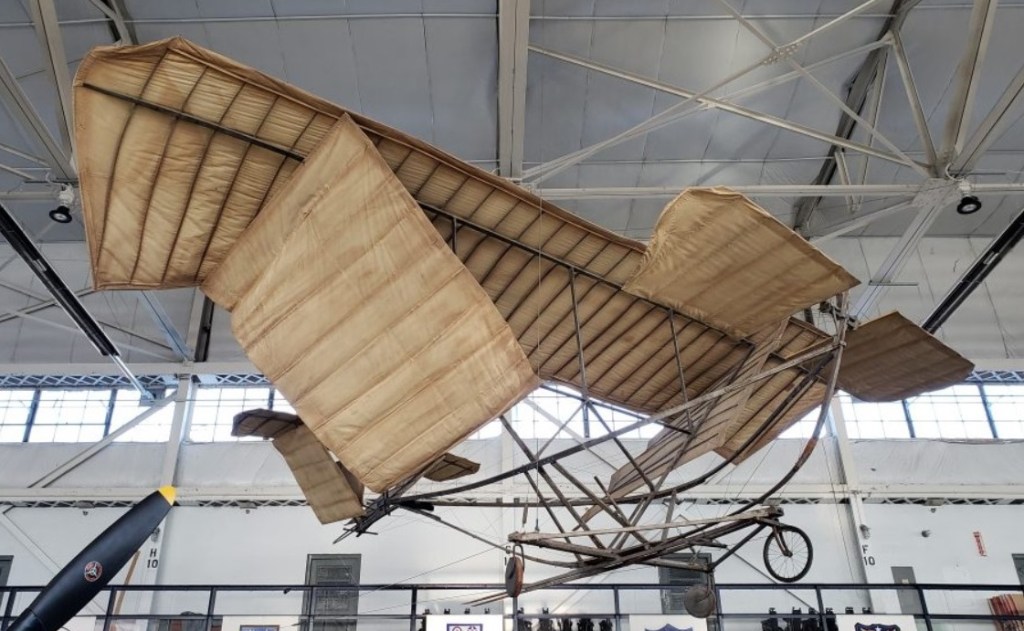
This monoplane was the first of its type in the world, and made many successful flights when towed by a horse or a Ford car. The inventor knew his aerodynamics, and his plane embodied principles of safety that have been generally adopted in plane construction.
On January 12, 1909, snow covered the fields back of the Martin farm, Canton, Ohio, and the device was hauled out and taken to the top of a hill. Old Billy, the farm horse, was hitched to the front of the plane by a long rope. Mr. Martin took his seat in the plane, son George whistled to Billy. The horse started down the hill pulling the plane behind him. It rose from the ground, reached a height of 25 feet and traveled 200 feet before the horse slackened its pace and the plane settled gently back to earth.
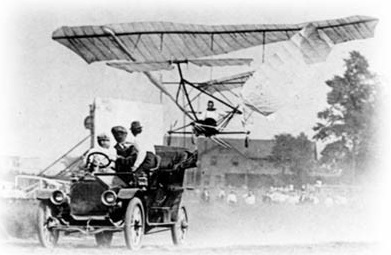
Mrs. Martin then took her seat in the plane and made several successful flights, being the first woman ever to fly in a heavier than air machine. Another son, Charles C. Martin, also went up and said that it came down like a feather. When he shut his eyes, he didn’t know when it struck snow.
Mr. Martin’s experiments had been kept secret, but the trial flights could not be hidden. Neighbors flocked to the field to see for the first time in their lives a human being sustained in the air by a heavier than air machine. Cousin Glenn L. Martin had not yet built the first plane in California.
A photographer came out to take pictures of the flights but became so excited that he failed to operate his photographic apparatus properly and all the plates were ruined!
During successive days more than 100 flights were made. All the members of the family, including the pet dog enjoyed the novel experience. One day one of the sled runners struck a bare spot on the ground and swerved the plane against a fence, damaging it slightly. The flights were suspended for a time.
William H. Martin had his eye on more than the local scene and wanted to get his plane demonstrated in the East, but was handicapped by lack of funds. William A. Hoberdier, who, with his brother, L.A. Hoberdier operated Lyric Amusement Co. of Canton, is credited with having helped finance trips to New York in the Spring of 1909.
Another milestone was established September 21, 1909, when Mr. Martin’s eight-year-old granddaughter, Blanche Martin, made several solo flights in the machine, thus demonstrating its safety. Her hops were 75 feet in length, and it was the first time a child of such age had ever taken to the air in a “heavier than air” machine.
Mr. Martin sought to obtain a motor for his plane and wrote to F.S. Lahm, noted Canton balloonist, then living in Paris. In a letter from Paris, dated March 15, 1909, Mr. Lahm told him that the only successful motor then on the market was exorbitantly priced and advised that a smaller one was to be produced soon. Some used motors were obtainable, but were unreliable.
Twenty years after the plane was built, patented and successfully flown, Mr. Martin offered it to the Smithsonian Institution. After long and careful investigation the Smithsonian institution accepted it as being the first plane of its type, and put it on display next to Lindbergh’s “Spirit of St. Louis.”
In 1936 Dennis R. Smith, when returning from a marble tournament, stopped in at the Smithsonian Institution and saw the Martin plane on display beside Lindbergh’s Spirit of St. Louis.
When he returned to Canton he met William H. Martin on the street and reported seeing his plane at the Smithsonian. Mr. Martin, then an old man of 81, with long white whiskers, and gentle and quiet spoken in manner, had the happiest moment of his life when he knew that his contributions to air pioneering had been memorialized by the preservation of his machine. His patent had run out in 1926, and he took additional satisfaction in knowing that the invention which he had patented was free for the use of all mankind.
When Harry Renkert organized the Canton Aviation Co. in 1938, and acquired the land for the airport, he named it Martin Field in honor of William H. Martin, whose farm adjoined the field.
The McKinley Presidential Library & Museum has graciously put the Martin Glider on indefinite loan to MAPS Air Museum as of February 16, 2002.

 All Aero