With the experience gained from the conversion of Motor Cadet PFA.1385, P.J.Martin began building a definitive motor glider which he call the Martin Slug.
It was given the PFA number 1388 and was to be powered by a VW engine.
With the experience gained from the conversion of Motor Cadet PFA.1385, P.J.Martin began building a definitive motor glider which he call the Martin Slug.
It was given the PFA number 1388 and was to be powered by a VW engine.
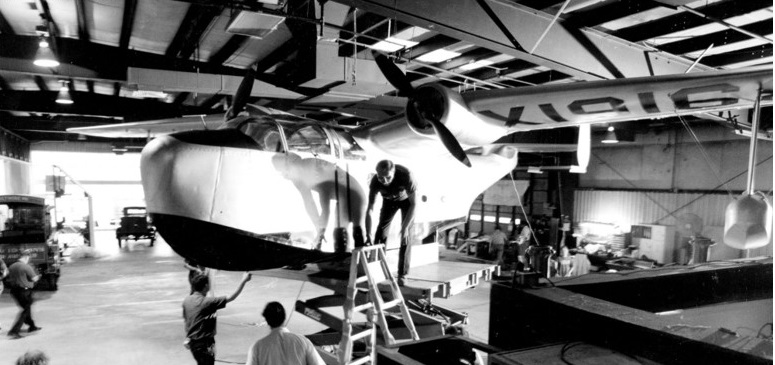
A piloted, three-eighths scale model of PBM flying boat; single-seat test aircraft built to generate aerodynamic data to design and build full-scale Martin PBM flying boat.
The construction was fabric-covered spruce plywood and aluminum.
In 1987, a dedicated and enthusiastic team of volunteers, many of whom were former Martin employees, began an exhaustive restoration of the 162A. After more than 10,000 man-hours of labor, the 162 was ready for display while on loan to the Museum of Industry in Baltimore, not far from where the “Tadpole Clipper” had been built and flown. Portions of the rear fuselage under-surface were left uncovered to illustrate some of the modifications made in the 162A’s hull during the course of its testing.
Wingspan: 43ft 5 5/8in / 13.25m
Length: 28ft 6 1/8in / 8.69m
Height: 12ft 1/8in / 3.66m
Weight: 2819.7 lb / 1279 kg
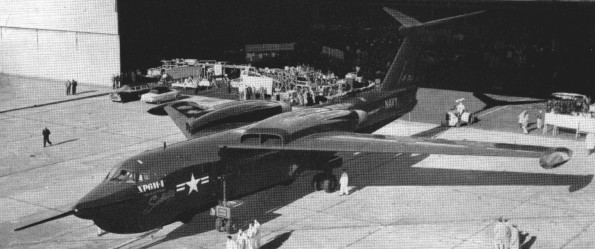
To meet a US Navy requirement for a high-performance multi-role flying-boat, Martin offered its Model 275 design. This had an all-metal hull of high length/beam ratio, mounting a cantilever high-set sharply-swept wing incorporating so much anhedral that the stabilising floats at the wing-tips could be attached permanently; the tail unit was of T-tail configuration with all-swept surfaces. Above the wing, to minimise spray ingestion, were mounted four Allison turbojet engines, and pressurised accommodation was provided for a crew of five. A beaching cradle allowed the SeaMaster to taxi in and out of the water under its own power. The P6M used a rotary bomb bay (as used on Martin’s licence-built Canberras and the XB-51). This permitted weapons release at high speeds without the drag of conventional bomb doors.
The first XP6M-1 prototype was flown on 14 July 1955, the second following on 18 May 1956. Ejection seats were fitted to the second and subsequent aircraft. These proved useful when the second SeaMaster pitched up, went into a loop and disintegrated. The original position of the engine exhausts caused stress on the rear fuselage which resulted in structural damage. The angle of the exhausts was adjusted after testing.
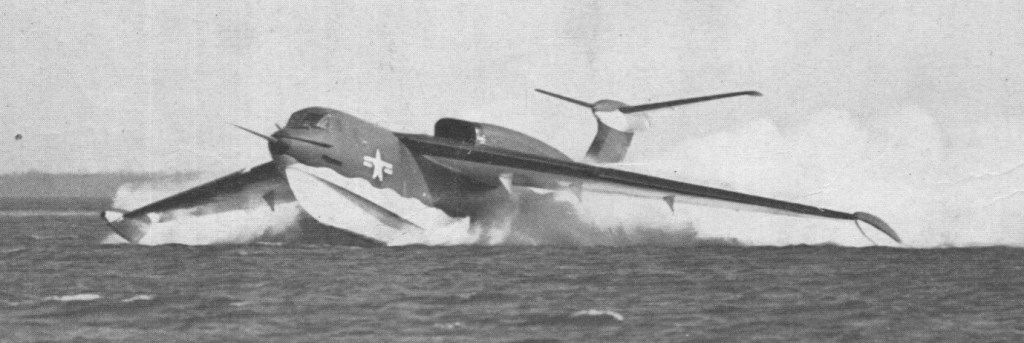
Martin received orders for six pre-production YP6M-1 boats powered by Allison J71 turbojets each developing a maximum 5897kg afterburning thrust. Successful flight testing led to an order for 24 production P6M-2 aircraft named SeaMaster, which differed primarily by having 7711kg thrust non-afterburning Pratt & Whitney J75-P-2 turbojet engines. The cockpit glazing was modified on later models to give a much better overhead and side view. However, the contract was cancelled on 21 August 1959 after only three had been built and these, together with the YP6M-1s, were scrapped at a later date. They were the fastest flying-boats ever built.
YP6M-1
Engines: 4 x J71 turbojet.
Speed: 600 mph.
P6M
Engines: 4 x Pratt & Whitney J75-P-2 turbojets, 7938kg
Wingspan: 30.48 m / 100 ft 0 in
Length: 40.84 m / 133 ft 12 in
Height: 9.45 m / 31 ft 0 in
Max take-off weight: 72575 kg / 160001 lb
Payload: 13600kg / 29983 lb
Max. speed: 965 km/h / 600 mph
Ceiling: 12200 m / 40050 ft
Range: 4830 km / 3001 miles
Armament: 6 x 12.7mm machine-guns, 1800kg of weapons
Crew: 4

The beginning of the Korean conflict on 25 June 1950 and the shortcomings of the Douglas B-26 / A-26, accounted for the urgent procurement of a light tactical bomber.
The new bomber had to be capable of operating from unimproved airfields, at night and in every kind of weather, with conventional or atomic weapons. High altitude reconnaissance was another must. For such purposes, the B-45 was too heavy; the Navy AJ-1, too slow; and the Martin experimental B-51’s range too short.
As a result of the outbreak in Korea, the Air Force reached a final decision. The desire for a night intruder was so strong that it took just a few days to set in motion the informal production endorsement of February 1951. Because of its experience with the XB-51, the Glenn L. Martin Company was recognized as the most qualified contractor to assume the domestic production of the British aircraft and to deal with the likely engineering difficulties involved in manufacturing a high-performance tactical bomber.
The new bomber became the Martin B-57, a by-product of the English Electric Canberra, the first British-built jet bomber, initially flown in 1949. Adaptation of a foreign-made aircraft to American mass production methods, as well as the use of different materials and tools, could present many difficulties. Another problem, perhaps more critical, centered on the Wright J65 turbojets, due to replace the Canberra’s two Rolls Royce Avon turbojet engines. The J65 was the U.S. version of the Sapphire, a British hand-tooled production currently scheduled for manufacturing by the U.S. Curtiss-Wright Corporation. The Air Force was fully aware of these potential pitfalls, but had no better option. It had an immediate requirement for a light jet bomber, with a 40,000-foot service ceiling, a 1,000-nautical mile range, and a maximum speed of 550 knots.
Testing of two imported Canberras revealed design faults that could affect the safety, utility, and maintenance of the future B-57. Then, one of the British planes crashed; Martin’s subcontractors could not meet their commitments; and the J65 prototype engines consistently failed to satisfy USAF requirements. In June 1952, further test flights had to be postponed for a year because of continuing engine and cockpit troubles. As a result, the Korea-bound B-57 did not fly before 20 July 1953, just 7 days before the conflict ended. Production of the crucial RB-57 was also delayed. The reconnaissance version entered service in mid-1954, after testing again confirmed that the more powerful J65 engines, added equipment, and other improvements had increased the aircraft’s weight, in turn reducing the speed, distance, and altitude of both the B-57 and the RB-57.
The program was reduced, but there was no talk of cancellation. In 1955, the B/RB-57s justified their costs when they served overseas pending the B/RB-66 deliveries which, as predicted, had fallen behind schedule. The first Martin B‑57A (the name Canberra was retained, though Night Intruder was also used) flew on 20 July 1953. In 1956, much-needed RB-57Ds joined the Strategic Air Command, and various configurations of this model satisfied important special purposes.

The main model (202 built) was the B 57B with a redesigned forward fuselage with a crew of only two seated in tandem under a giant rear hinged canopy. This attack version introduced a heavier bombload in a rotary door weapon bay, plus eight pylons under the outer wings and forward firing guns. The B 57B equipped two wings in Tactical Air Command and a wing of PACAF (Pacific Air Forces) but had mainly been passed to Air National Guard units by the early 1960s. Vietnam requirements then demanded aircraft in this class and all available B 57Bs (many had been re built into other models) were rushed to South Vietnam and used very success¬fully in the attack role and in particular as FAC (Forward Air Control) aircraft.

Delivered too late for combat in Korea, the RB-57 in May 1963 and the B-57 in February 1965 began to demonstrate under fire in Southeast Asia the basic qualities justifying the Canberra’s original selection.
RB-57 Reconnaissance Canberra Article
The original B-57A differed little externally from the English Canberra B2. The RB-57A was similar, with reconnaissance equipment.
The B-57B, with eight 0.50 in or four 20mm guns in the wings, bombs in an internal bomb bay, and underwing racks, served with the Chinese Nationalist and Pakistani air forces.
Variants include the RB-57D(A) and (B) with cameras, the RB-57D(C) and (D) electronics reconnaissance aircraft with radomes at the nose and tail and under the fuselage, and the RB-57(C) with wingtip radomes.
In 1970, other reactivated and newly equipped B-57s, known as Tropic Moon III B-57Gs, were deployed to Southeast Asia, where they made valuable contributions until April 1972. A total of 16 B 57Bs was rebuilt as B-57G (Tropic Moon) all weather and night attack aircraft with APQ 139 radar, a FLIR (forward looking infra-red), low light TV and laser ranger. The most capable aircraft of its day, the B 57G remained a mere study programme despite brilliant combat results.
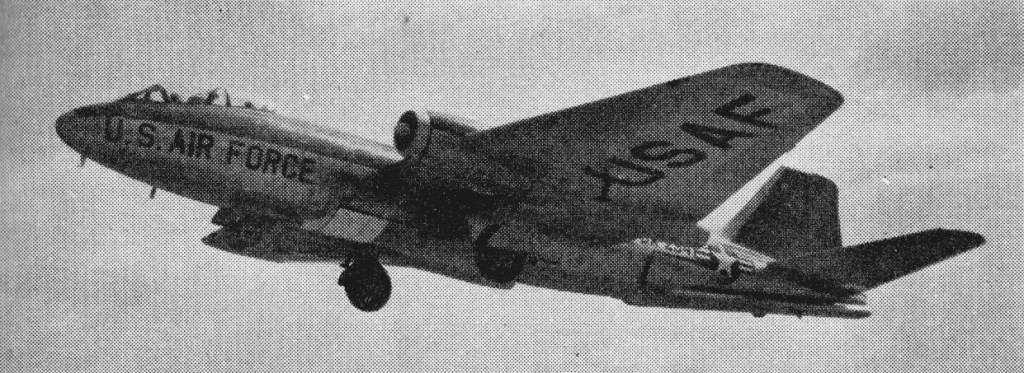
The last new-built version was the B 57E multi role attack/bomber and target tug, all 68 of which were later modified for other tasks.
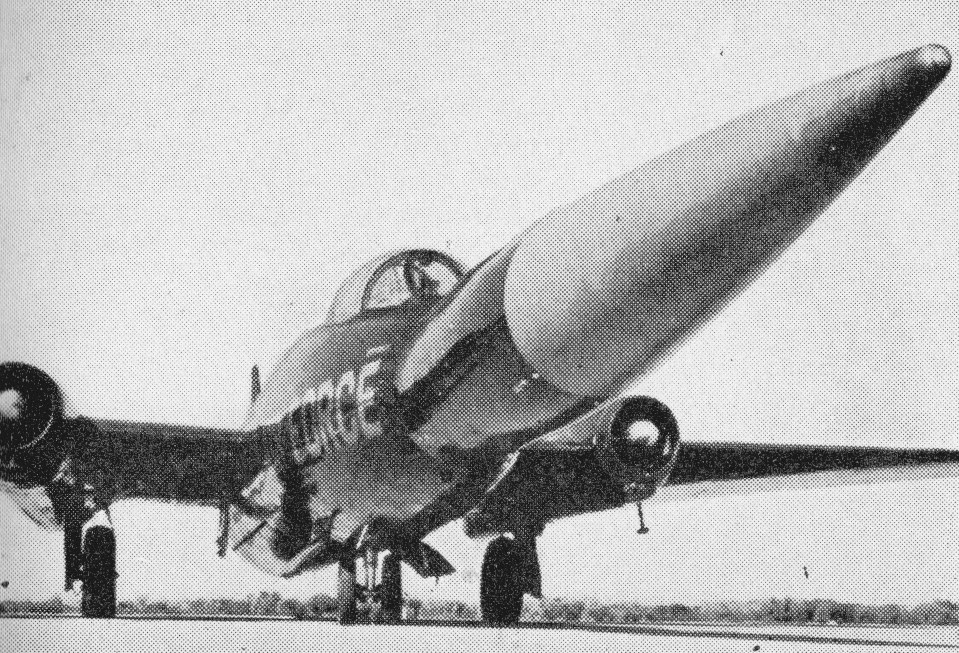
Finally, WB-57Fs, either modified RB-57Fs or former B-57Bs, were still flying high-altitude radiation sampling missions in 1973. Concurrently, EB-57Es, and related adaptations of the versatile B-57, continued to play significant roles, with no immediate phaseout in sight.

403 were built under licence by Martin (in six variants) as the B-57 and served with the US Air Force from August 1953 until 1982 in various marks and guises. At a later date a number of these were converted by General Dynamics to serve as ultra high-altitude strategic reconnaissance aircraft. These were provided with a wing span of 37.19m, two 80kN Pratt & Whitney TF33-P-11 turbofan engines (replacing the conventional power plant), plus two 14.68kN Pratt & Whitney J60-P-9 turbojets in underwing pods, and many equipment and avionics changes to fit them for their specialised role. The B-57 saw combat over Vietnam beside other Canberras from Australia.
The USAF bought 21 WB-57F aircraft, which were built by General Dynamics from existing B-57Bs and RB-57Ds. The airplanes’ ability to reach altitudes over 65,000 feet, carry payloads in excess of 4,000 lbs, and its triple spar wings made it a very capable high-altitude platform. Missions included everything from weather reconnaissance for Apollo space launches to sampling radiation in nuclear weapon test plumes.
In the late 1960s and early 1970s the Air Force decided to ground the WB-57F and depend exclusively on the U-2 for high-altitude support. The mission of monitoring nuclear test bans was better done by the WB-57F than the U-2, however. That mission was important enough that three aircraft were given to NASA to keep that capability alive, which were designated N925N, N926NA, and N928NA.
When N925N was retired and put on display at Pima Air & Space Museum in Tucson, Arizona, it that left NASA with two WB-57Fs. Another airframe joined the fleet in 2011 after been taken out of the 309th Aerospace Maintenance and Regeneration Group, (AMARG), better known as the “Bone Yard,” at Davis-Monthan Air Force Base, Arizona. The aircraft, designated N927NA, began as a B-57B, and then was one of 21 aircraft rebuilt as an RB-57F in 1964. As an RB-57F the aircraft had its wingspan increased to 122 feet and the original Wright J65 turbojets were replaced by Pratt & Whitney TF-33 turbofans, doubling both the wingspan and thrust.
N927 had been retired in June 1972 and remained on “celebrity row” at the Bone Yard until May 2011 when it was dismantled and trucked to Sierra Nevada Corporation at Centennial Airport, Colorado. After being refurbished to flying condition it was flown to Ellington AFB in August 2013.
The aircraft had been in storage for over 40 years and made its first flight in 41 years in the summer of 2013, setting a record for the longest an aircraft had sat in the Bone Yard before returning to flying status.

Based at Ellington Field near NASA’s Johnson Space Center in Houston, Texas, the WB-57F operates in NASA’s High Altitude Research Program. The aircraft provides unique, high-altitude (up to 70,000 feet MSL) airborne platforms to United States government agencies and other customers for scientific research, advanced technology development, and testing around the world.
Since 2000, the unique performance capabilities of the WB-57F aircraft and increasing costs associated with the ER-2 program have resulted in NASA allowing multiple customers to use the WB-57Fs for atmospheric and satellite sensor research. The DOD programs have gotten much broader, and N928 (and sometimes N926) have multiple customers asking us to help them develop satellite sensors.

Both aircraft were enjoying multiple customers. By June 2014, both aircraft were upgraded with global positioning satellite navigation systems, F-15 main landing gear and brakes, and the gross weight capability of both aircraft was certified from 63,000 pounds to 72,000 pounds. Ongoing upgrades to the aircraft include installation of the ACES II ejection seat system and installation of an improved, modern autopilot.
B-57B
Night intruder bomber
Engines: 2 x Wright J65-W-3 Sapphire turbojets, 7,500lb thrust
Wingspan: 64 ft
Length: 65 ft. 6 in
Loaded weight: 46,000 lb.
Max speed: over 600 m.p.h.
Ceiling: over 45,000 ft.
Max range: 3,000 miles.
Armament: 8x.50 in. machine-guns
Bombload: 6,000 lb; 8×5-in. rockets
Hardpoints: 4
Crew: 2
B 57B
Engines: two 3,275 kg (7,220 lb) thrust Wright J65 W 5 turbojets.
Maximum speed 937 km/h (582 mph) at 12190 m (40,000 ft).
Service ceiling 14630 m (48,000 ft).
Range 3700 km (2,300 miles).
Weights: empty 11793 kg (26,000 lb)
Maximum take off 24948 kg (55,000 lb)
Wing span 19.51 m (64 ft 0 in)
Length 19.96 m (65 ft 6 in)
Height: 4.75 m (15 ft 7 in)
Wing area: 89.18 m (960 sq ft).
Armament: eight 12.7 mm (0, 5 in) or four 20 mm guns; up to 2722 kg (6,000 lb), 16 underwing rockets or mixed rocket/ bomb/napalm loads.
RB-57D
Engines: 2 x Pratt & Whitney J57C, 11,000 lb
Wingspan: 106 ft
Length: 65 ft 6 in
Height: 14 ft 10 in
Max speed: 632 mph at 40,000 ft
Service ceiling: 60,000 ft
RB 57F
Engines: 2 x Pratt & Whitney TF33 P 11 turbofan, 18,000 lb (8,165 kg) st, and 2 x P&W J60 P 9 auxiliary turbojets, 3,300 lb (1,500 kg) st.
Wing span: 122 ft 5 in (37.32 m)
Length: 69 ft 0 in (21.03 m).
Height: 5.8 m / 19 ft 0 in
Max take-off weight: 20360 kg / 44886 lb
Empty weight: 13600 kg / 29983 lb
Max. speed: 880 km/h / 547 mph
Ceiling: 25000 m / 82000 ft
Range w/max.fuel: 6440 km / 4002 miles
Typical endurance: Over 10 hr
Crew: 2
Armament: None
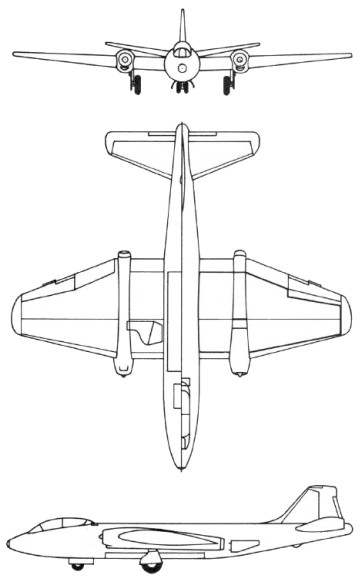

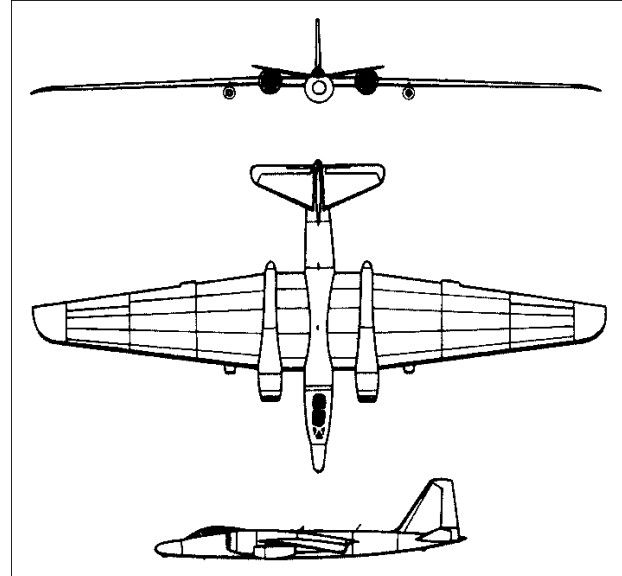

In World War lithe USAAF made widespread and effective use of the attack bomber for battlefield tasks. For post¬war service the USAAF wanted a higher-speed successor, and the specification produced two types in the Douglas XB-43 and Martin Model 234 XB-51.
The Martin was designed originally to meet a US Army Air Force requirement for a close-support bomber, being allocated the designation XA-45. However, it was developed instead as a medium bomber with turbojet power-plant and two prototypes were ordered under the designation XB-51.
The XB-51 featured a tandem-unit landing gear arrangement, a thin variable ¬incidence wing whose leading edges were swept at 35 degrees, a swept T-tail. It was powered by three 2640kg thrust General Electric J47-GE-7 or -13 turbo-jets, one pylon-mounted low on each side of the forward fuselage and the third within the rear fuselage.
Other features included pressurised accommodation for the two-man crew, provisisions for JATO (jet-assisted take-off) units, and a braking parachute.
The first of two aircraft flew in October 1949, Martin’s Director of Flight O.E. (Pat) Tibbs making the first flight, taking off from Baltimore and lading at Naval Air Test Centre at Patuxent, in a flight of 35 minutes.
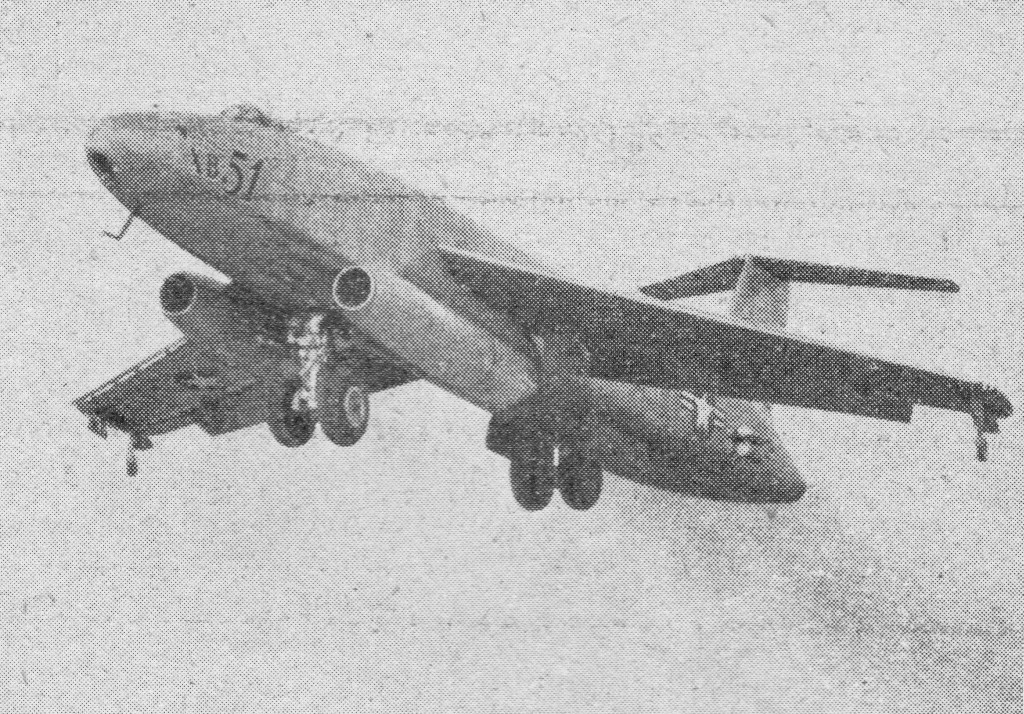
Although flight trials confirmed that the XB-51 had very good performance, they revealed that the type had poor handling qualities in the air. The XB-51 did not proceed past the prototype stage and the USAF opted instead for licence-production of the English Electric Canberra as the Martin B-57.

Engines: 3 x 2360kg General Electric J47-GE-13
Max take-off weight: 25393 kg / 55982 lb
Empty weight: 13431 kg / 29610 lb
Wingspan: 16.18 m / 53 ft 1 in
Length: 25.93 m / 85 ft 1 in
Height: 5.28 m / 17 ft 4 in
Wing area: 50.91 sq.m / 547.99 sq ft
Max. speed: 1038 km/h / 645 mph
Cruise speed: 857 km/h / 533 mph
Ceiling: 12344 m / 40500 ft
Range: 2576 km / 1601 miles


During 1944 the US Army Air Force issued its first specification for a large jet bomber. By December 1944 proposals had been received from Boeing, Convair, Martin and North American for medium bomber for tactical- and operational-level use. The Martin Model 223 XB-48 being one of the contenders to meet this requirement.

Two XB-48 prototypes were ordered, the first of them flying on 14 June 1947 as a large shoulder mounted, straight wing monoplane with the capability of carrying up to 9072kg of bombs. Power was provided by six 1701kg thrust Allison J35-A-5 turbo-jets, three mounted beneath each wing. The landing gear was of the new bicycle form with main units ahead of and behind the bomb bay. The 33.02m span Model 223 failed to achieve the performance required and failed to win a production contract.
Engines: 6 x General Electric J35-C-7, 16.7kN
Wingspan: 33.02 m / 108 ft 4 in
Length: 26.14 m / 85 ft 9 in
Wing area: 120.77 sq.m / 1299.96 sq ft
Max take-off weight: 46539 kg / 102601 lb
Empty weight: 26578 kg / 58595 lb
Max. speed: 830 km/h / 516 mph
Armament: 9000kg of bombs


The prototype of an improved Martin 3-0-3 had been flown on 20 June 1947, but with it was decided instead to develop a new Martin 4-0-4. This incorporated the wing structural revisions and introduced a pressurised and slightly lengthened fuselage, accommodating as standard a crew of three or four and 40 passengers.
The airliner was unveiled in 1949 and immediately ordered by a variety of air carriers, gaining 101 orders from TWA and Eastern. The subsequent 4-0-4 was introduced in 1950 with a fuselage 39 inches longer, slightly more powerful engines than the 202, and pressurization.
The onset of the Korean War suddenly made airplane materials significantly more expensive, and Martin found itself filling orders at a loss and stopped production.
Two or these 40-passenger transports were in service with the U.S. Coast Guard in 1955 as the RM-1, similar to the civil Martin 4-0-4 airliner.

A total of 148 of the 2-0-2, 3-0-3, and 4-0-4 types were built until 1952. Examples served well into the 1980s with commuter airlines.
RM-1
Engines: two 2,400 h.p. Pratt & Whitney R2800-34W
Span: 93 ft. 3 in.
Weight: 44,900 lb.
Max. Speed: 312 m.p.h.
4-0-4
Engines: 2 x 2400hp Pratt Whitney R-2800 CB-16
Max take-off weight: 20366 kg / 44900 lb
Empty weight: 13211 kg / 29125 lb
Wingspan: 28.42 m / 93 ft 3 in
Length: 22.73 m / 74 ft 7 in
Height: 8.66 m / 28 ft 5 in
Wing area: 80.27 sq.m / 864.02 sq ft
Cruise speed: 502 km/h / 312 mph
Ceiling: 8840 m / 29000 ft
Range: 3058 km / 1900 miles
Seats: 52

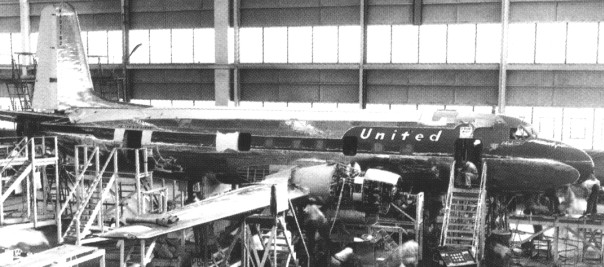
Along with the unpressurized Model 202, Martin offered a companion pressurized model, known as the Model 303. United Air Lines was the primary sponsor of the 303, having invested one million dollars of its own money in the development. In addition to the 50 slated for delivery to United, Martin also had orders from Northwest Airlines, Braniff Airways, and Pan American-Grace Airways (PANAGRA) for 59 more.
Apart from cabin pressurization, the 303 differed from the 202 in that the wing span was shortened by about 4ft (1.2m) in an attempt to gain cruise performance at the expense of takeoff and climb performance. The 303 made its first flight on July 3, 1947; however, United canceled its large order a short time later.
Because of prevailing market conditions and serious stability problems encountered with the 202 and a need to redesign the wing structure, Martin dropped the 303 program the following December with a reported loss of more than $15 million. The prototype and almost all records were then scrapped for tax purposes.
A total of 148 of the 2-0-2, 3-0-3, and 4-0-4 types were built until 1952.
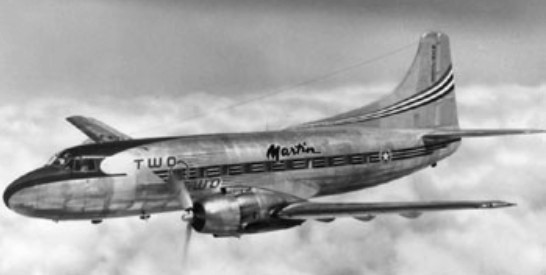
Attempting to gain a share of the post-World War II demand for civil airliners, the Glenn L. Martin Company flew on 22 November 1946 the prototype of a twin-engine 36/40-seat unpressurised transport designated Martin 2-0-2.
Power was provided by twin Pratt & Whitney 18-cylinder air cooled radial engines capable of developing a normal output of 1,800 hp, 2,100 hp for takeoff or 2,400 hp with water injection. The engines turned Hamilton Standard three-blade reversible-pitch airscrews.
The “Two- O-Two” was the first twin-engine airliner of postwar design to receive certification for airline use. Accommodations provided for a crew of three or four plus 36 to 40 passengers. A version of the 202 was outfitted with larger fuel tanks to increase its range to 2,365.
The first of these entered service in October 1947, but the loss of a 2-0-2 in 1948 as a result of wing structural failure led to modification of other in-service aircraft and production of this version was brought to an end.
When production ended in early 1953 a total of 103 had been built, this number including two supplied to the Coast Guard as staff transports under the designation RM-1G (later RM-1Z and finally VC-3A); they were subsequently transferred to the US Navy.
A total of 148 of the 2-0-2, 3-0-3, and 4-0-4 types were built until 1952.
Martin 202
Engines two 2,100-hp Pratt & Whitney R-2800 CB-16.
Wingspan: 28.42 m / 93 ft 3 in
Length: 21.74 m / 71 ft 4 in
Height: 8.66 m / 28 ft 5 in
Wing area: 80.27 sq.m / 864.02 sq ft
MTOW 19504 kg / 42999 lb
Empty wt. 26,930 lb
Top speed 311 mph.
Cruise 286 mph.
Stall 76 mph.
Initial climb rate 2,200 fpm
Range 3220 km / 2001 miles
Ceiling 33,000 ft
Takeoff distance (50′) 1,565 ft
Landing distance (50′) 1,720 ft
Seats 40.

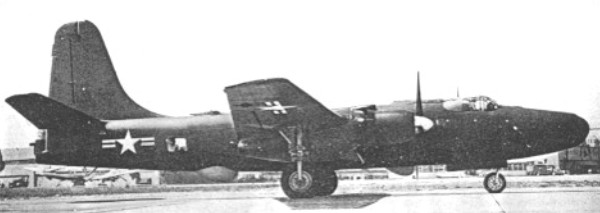
The US Navy made several attempts to gain the benefit of high over-target performance combined with long range by introducing mixed powerplant. The Martin Model 219 patrol bomber represented one of the results of such a specification, two XP4M-1 prototypes being ordered on 6 July 1944. The first was flown on 20 September 1946 as a cantilever shoulder-wing monoplane with retractable tricycle landing gear. Its powerplant comprised two 2218kW Pratt & Whitney R-4360-4 Wasp Major radial engines, but each nacelle also incorporated a 17,350kg thrust Allison J33-A-17 turbojet. After a protracted development programme 19 P4M-1 production aircraft were built, the first being delivered to US Navy Squadron VP-21 on 28 June 1950, and all served with this unit. Most of them were converted into P4M-1Q Elint aircraft, one being shot down.
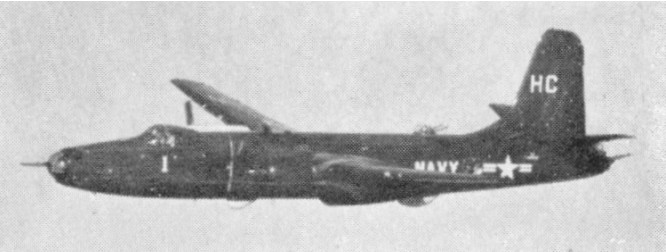
P4M-1
Engines: 2 x Pratt Whitney R-4360-20A piston engines, 2424kW + 2 x Allison J33-A-10A, 2087kg
Max take-off weight: 40000 kg / 88185 lb
Wingspan: 34.75 m / 114 ft 0 in
Length: 25.50 m / 83 ft 8 in
Height: 7.95 m / 26 ft 1 in
Wing area: 121.79 sq.m / 1310.94 sq ft
Max. speed: 660 km/h / 410 mph
Ceiling: 10545 m / 34600 ft
Range: 4570 km / 2840 miles
Armament: 2 x 20mm cannons, 4 x 12.7mm machine-guns, 2700kg of bombs
 All Aero