Mikoyan-Gurevich MiG-8 Utka

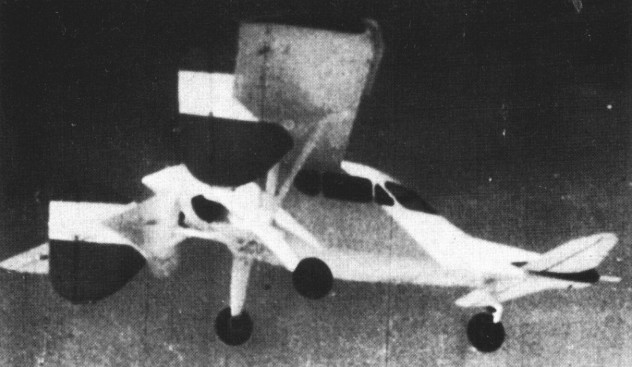
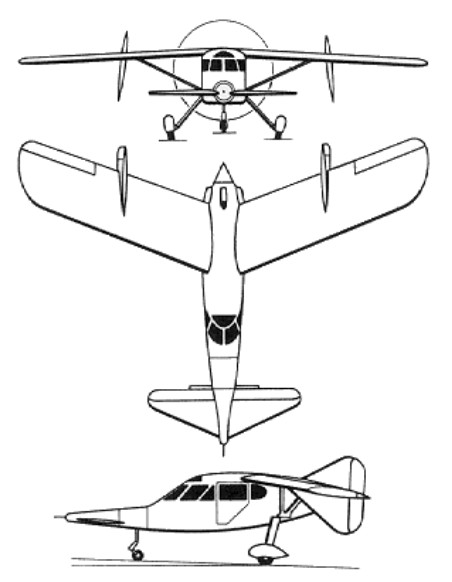
Although usually attributed to the Mikoya Gurevich design bureau and certainly assign the designation MiG-8, the Utka (Duck) three seat tail-first monoplane was apparently designed by students of the Zhukovskii Academy under the supervision of Prof G A Tokaev as a research project and built at the MiG bureau’s experimental factory.

A light high-wing canard monoplane with pusher propeller, built of wood with fabric cover, the Utka was completed and flown in 1945, intended primarily to study low-speed control problems associated with wing sweepback at low speed. The wings were swept 20 deg, carried splayed vertical surfaces at mid-span and featured leading-edge slats which occupied approximately one-third span outboard. Elevators were carried by the canard surface. The aircraft was flown in two variants, differed by location of the rudders.

Test pilots A.I.Zhukov and A.N.Grinchik flew it in the end of 1945. Apparently it performed well without any modifications.

Engine: five cylinder M-l1FM air-cooled radial, 150 hp / 81kW
Wing span: 3l ft 2in (9,50 m)
Length: 23 ft 3.5 in (7,10 m)
Wing area: 170.07sq ft (15.8 sq.m).
Max take-off weight: 1150 kg / 2535 lb
Empty weight: 640 kg / 1411 lb
Maximum speed: 127 mph (205 km/h)
Maximum endurance: 5.0 hours
Crew: 1
Passengers: 2
Mikoyan-Gurevich I-360 (SM-2)

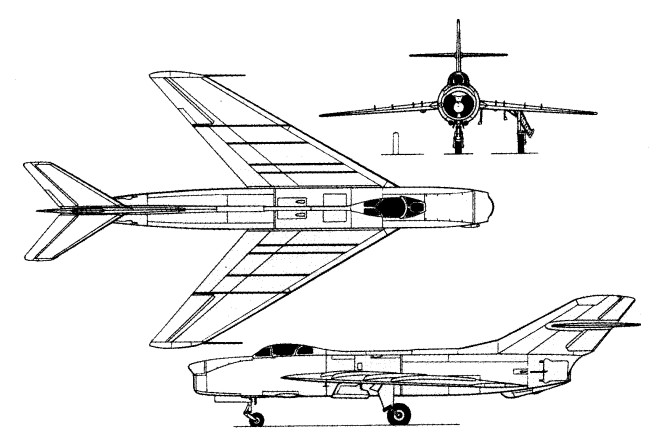
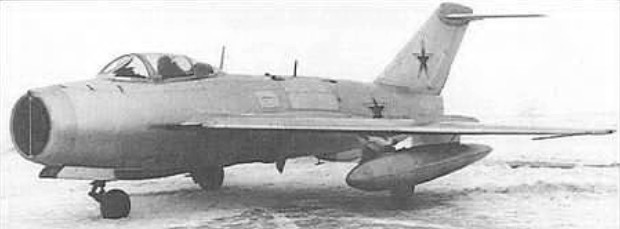
Failure to meet predicted performance and poor reliability under test had led to some disenchantment with the large Lyulka TR-3 turbojet specified for the 1950 supersonic fighter programme. In consequence, the MiG 0KB elected to initiate development of a derivative of its contending TR-3-powered I-¬350 as a back-up programme, this, the 1-360 (SM-2), having close-paired Mikulin AM-5 small-diameter turbojets but being otherwise similar.

The SM-2 single-seat fighter proposal embodying an essentially similar wing to that of the I-350 with 55° sweepback at quarter chord (60° at leading edge). Powered by two AM-5F turbojets each with an afterburning rating of 2700kg and having an armament of two 37mm N-37D cannon in the wing roots, the first SM-2 – by now assigned the official designation of I-360 – was flown on 24 May 1952.

This was unique in having a T-type horizontal tail, and, on 25 June, it attained Mach=1.04 in level flight. Subsequent testing revealed that the wing tended to blanket the tailplane at high angles of attack, and, to rectify this deficiency, the tailplane was lowered to a mid point on the fin. Flight test (as the SM-2A) revealed little improvement and the surface was then further lowered to the base of the fin (as the SM-2B), this being accompanied by some increase in the vertical tail surface area, and satisfactory handling characteristics resulting.

The trials conducted (comprising 132 flights) ended in the loss of the aircraft in 1953 as a result of tail flutter at high speed, together with those of a further prototype, the SM-9 which had joined the test programme on 27 May 1952, were considered sufficiently successful to warrant immediate preparations for manufacture of a pre-series under the designation M1G-19.

Max take-off weight: 6820 kg / 15036 lb
Wingspan: 9.04 m / 29 ft 8 in
Length: 13.90 m / 45 ft 7 in
Height: 3.95 m / 13 ft 0 in

Mikoyan-Gurevich I-350

I-350(M)

As the MiG OKB’s Izdeliye M contribution to a 1950 programme to develop a single-seat fighter powered by a single Lyulka TR-3A single-shaft turbojet which was to be committed to production as the AL-5, and capable of attaining and maintaining a speed in excess of M = l.0 in level flight, the 1-350 was flown on 16 May 1951.

Characterised by 60° wing sweepback, T-tail, and assigned the official designation I-350, one prototype was built, the M-1 with RP-1 Izumrud AI radar, a second, the M-2 with Korshun AI radar, being abandoned before completion. Armament comprised one 37mm N-37 and two 23mm NR-23 cannon.

The M-1 was flown for the first time on 16 June 1951, but the TR-3A turbojet, which was rated at 4600kg, failed shortly after take-off. The hydraulic system also failed, but the pilot nonetheless effected a successful landing.

The Lyulka¬ engined prototype was, in consequence, rebuilt with a paired Mikulin AM-5 engine installation similar to the I-360 (SM-2). The destruction of the latter under test led to a delay in the resumption of flight testing of the I-350 pending redesign of the tail assembly transferring the horizontal surfaces to the fuselage. With this change and AM-5 engines, the prototype commenced test on 18 September 1953 as the 1-350(M), but lack of afterburning prevented M = 1.0 being exceeded in level flight.

Four further flight tests were performed, but engine difficulties persisted, and, as it was obvious that the Lyulka turbojet demanded considerable further development, the I-350 programme was terminated in August 1951.

I-350 (estimated)
Max take-off weight: 8710 kg / 19202 lb
Empty weight: 6125 kg / 13503 lb
Wingspan: 9.73 m / 31 ft 11 in
Length: 16.65 m / 54 ft 8 in
Wing area: 36.00 sq.m / 387.50 sq ft
Max. speed: 1266 km/h / 787 mph
Range: 1120 km / 696 miles

Mikoyan/Gurevich I-350

Mikoyan-Gurevich I-340 (SM-1)

In the early 1950s, the MiG OKB was engaged in the simultaneous development of MiG-17 de¬rivatives and potential successors to the M1G-17. A derivative was the SM-1, or 1-340, which mated the forward fuselage, wings and tail surfaces of the MiG-17 with a new centre and rear fuselage accommodating paired 4,850 lb st (2 200 kgp) Mikulin AM-S single-shaft turbojets. Trials with the SM-1, which apparently commenced at the beginning of 1952, were largely concerned with the engine installation as similarly paired AM-5s had meanwhile been selected to power a more advanced fighter, the 1-360. In consequence, the SM-1 did not progress beyond prototype status. Earlier, in 1951, another MiG-17 airframe had been fitted with a Lyulka TR-3 axial-flow turbojet of 10,140 lb st (4600 kgp) as the S1-16, this serving as a test-bed for the I-350, and in 1953, yet a further MiG-17 airframe, the SR-2, was to be fitted with a Kliinov VK-5F centrifugal-flow turbojet of 6,834 lb st (3100 kgp), this being the ultimate Soviet development of the Rolls-Royce Nene. No performance data or weights are available for the SM-1, and overall dimensions were similar to those of the MiG-17F apart from a length of 36 ft 11 in (11,25 m) and a height of 12 ft 7.9 in (3,86 m).

Max speed: 1193kph at 1000m / 1154kph at 5000m
Time to 5000m: 0.94 min

Mikoyan-Gurevich I-320

Designed to meet the demands of a twin-engined all-weather fighter programme initiated in January 1948, the MiG OKB offered the Izdeliye R, a side-by-side two-seat swept-wing fighter with the engines in tandem. The nose intake fed a plenum chamber around the forward engine compressor, this engine exhausting below the fuselage and a duct leading back to the aft engine which exhausted via an orifice in the extreme tail. Armament comprised three 37mm N-37 cannon.

Competing with proposals from the Lavochkin and Yakovlev bureaux – all three contenders being awarded three-prototype contracts – the MiG fighter was assigned the official designation I-320.

The first prototype, the R-1 powered by two 5,005 lb st (2270 kgp) RD-45F engines, was flown on 16 April 1949.

The R-2 and R-3 were each powered by paired of 5,952 lb st / 2700kg VK-1 engines and embodied various modifications, the R-3 featuring a strength¬ened wing. The VK-1-powered prototypes could take-off and cruise on the power of either engine, and the I-320 was initially tested with Torii-A (Thorium-A) radar mounted in a cone above the air intake. This single-antenna radar which demanded manual tracking was succeeded by the basically similar but improved Korshun (Kite) radar with which the I-320 was tested during July-August 1951. Development of the I-320 was discontinued when the requirement to which it had been designed was overtaken by a more advanced one. Develop¬ment was discontinued in favour of the Yak-25 which was capable of accommodating a larger radar.

1-320 (R-1)
Engines: 2 x RD-45F, 5,005 lb st (2 270 kgp)
Max speed, 658 mph (1 060 km/h) at 14,765 ft (4 500 m)
Ceiling, 49,540 ft (15 100 m)
Endurance, 3.0 hrs
Empty weight, 16,241 lb (7 367 kg)
Loaded weight, 22,630 lb (10 265 kg)
Span, 46 ft 7 in (14,20 m)
Length, 51 ft 8 7/8 in (15,77 m)
Wing area, 443.47 sq ft (41,20sq.m)

I-320 R-2
Max take-off weight: 12095 kg / 26665 lb
Wingspan: 14.20 m / 46 ft 7 in
Length: 15.77 m / 51 ft 9 in
Wing area: 41.20 sq.m / 443.47 sq ft
Max. speed: 1090 km/h / 677 mph
Range: 1205 km / 749 miles

Mikoyan-Gurevich I-270(ZH)

Created to meet a 1945 requirement for a rocket-propelled target defence fighter, the I-270(Zh) was based broadly on the Junkers Ju 248, but was of more conventional configuration. The I-270 featured a straight, near-laminar flow wing, a conventional horizontal tail, and an ejection seat (the first in a Soviet fighter).

The first of two prototypes was initially flown in December 1946 without the rocket motor installed, being towed into the air by a Tu-2.

Only the second prototype was to be fitted with the rocket motor. This, the RD-2M-3V modified version of the 4430 lb / 2010 kgp Walter HWK 509C, developed by L Dushkin and V Glushko, was a bi-propellant dual-chamber unit with a total thrust of 3,196 lb / 1450kg of which the cruise chamber contributed 400kg. The cabin was pressurised and proposed armament comprised two 23mm cannon and eight RS-82 rockets. Calculated endurance was 4 min at maximum thrust and 85 min on the power of the cruise chamber alone.

The first powered flight was carried out with the second prototype early in 1947, and speeds of the order of 620 mph (1000 km/h) were allegedly attained in level flight. The second prototype was written off as a result of a landing crash while being flown by an NII VVS pilot.

Shortly afterwards, the first prototype was damaged in a belly landing and was not repaired, further development was discontinued.

Max take-off weight: 4120 kg / 9083 lb
Empty weight: 1546 kg / 3408 lb
Wingspan: 7.75 m / 25 ft 5 in
Length: 8.91 m / 29 ft 3 in
Height: 3.08 m / 10 ft 1 in
Wing area: 12.00 sq.m / 129.17 sq ft
Max. speed: 1000 km/h / 621 mph
Time to 32,810 ft (10 000 m): 2.37 min
Time to to 49,210 ft (15 000 m): 3.03 min

Mikoyan-Gurevich I-231

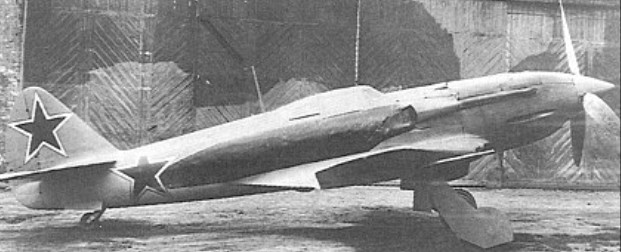
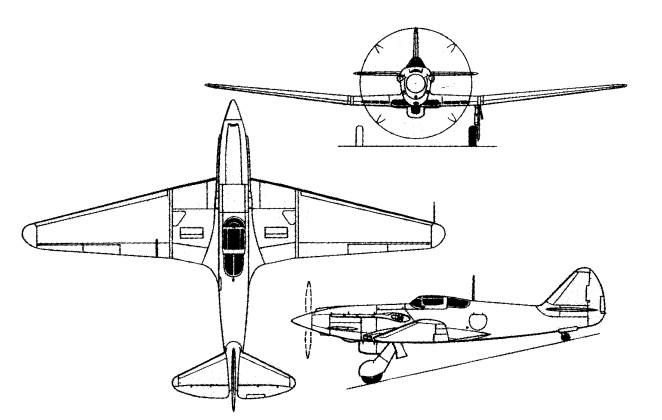
A third I-230 airframe was completed early in 1943 with an 1800hp Mikulin AM-39 12-cylinder Vee-type engine and the Izdeliye designation 2D. Apart from the tailplane which was set 20cm lower, this aircraft was basically similar to the first I-230 and retained the same armament of twin synchronised cannon. Assigned the official designation of I-231, the prototype was written off in a landing accident shortly after the completion of factory testing and further development was discontinued.

Engine: 1800hp Mikulin AM-39
Max take-off weight: 3287 kg / 7247 lb
Empty weight: 2583 kg / 5695 lb
Max. speed: 707 km/h / 439 mph
Range: 1350 km / 839 miles

Mikoyan-Gurevich I-225

By early 1944, the VP programme was of little more than academic interest, yet work continued on two further “A” series prototypes, the I-224 and I-225, which had been assigned the Izdeliye designations 4A and 5A respectively.

The I-225 was to enter flight test three months before the I-224, the first of two prototypes flying on 21 July 1944. This was powered by a Mikulin AM-42B 12-cylinder liquid-cooled Vee engine equipped with a TK-300B turbo-supercharger on its starboard side giving 2000hp for take-off and 1750hp at 7500m.

The I-225 featured an improved Shchyerbakov pressure cabin, a 64mm armour-glass windscreen, 8mm seat armour and an armament of four synchronised 20mm ShVAK cannon. The I-225 was of all-metal construction and was flown for the first time on 21 July 1944.

On 2 August, the I-225 reached 707km/h at 8500m, but two days later during its fifteenth flight, the engine of the I-225 seized at an altitude of 15m and the aircraft crashed and proved irreparable.

The second prototype was not flown until 14 March 1945 as the OKB was devoting priority to the I-250. During subsequent testing, the I-225-02, which was powered by an AM-42FB engine with similar ratings to the AM-42B, attained 726km/h which, at the time, was believed to be the highest speed attained by a Soviet piston-engined fighter. This distinction had been gained, however, by the M-108-powered Yak-3M.

I-225-01
Engine: Mikulin AM-42B 12-cylinder liquid-cooled Vee, 2000hp
Max take-off weight: 3900 kg / 8598 lb
Empty weight: 3010 kg / 6636 lb
Wingspan: 11.00 m / 36 ft 1 in
Length: 9.60 m / 31 ft 6 in
Height: 3.70 m / 12 ft 2 in
Wing area: 20.38 sq.m / 219.37 sq ft
Max. speed: 707 km/h
Ceiling: 12600 m / 41350 ft
Range: 1300 km / 808 miles

I-225-02
Engine: Mikulin AM-42FB 12-cylinder liquid-cooled Vee, 2000hp
Wingspan: 11.00 m / 36 ft 1 in
Length: 9.60 m / 31 ft 6 in
Height: 3.70 m / 12 ft 2 in
Wing area: 20.38 sq.m / 219.37 sq ft

Mikoyan-Gurevich I-224

The last of the “A” series high-altitude fighter prototypes to enter flight test, the I-224 was flown for the first time on 20 October 1944. Powered by a Mikulin AM-39B engine rated at 1750hp for take-off, driving an 3.50m diameter propeller with 40cm chord “paddle” blades, and equipped with a single TK-300B turbo-supercharger on the starboard side, the I-224 carried an armament of two synchronised 20mm ShVAK cannon.

A feature of the I-224 was its exhaust system which included four fixed rear facing ejection “chimneys”. The I-224 achieved an altitude of 14,100m during its brief flight test programme which reportedly terminated when a malfunctioning supercharger resulted in an uncontrollable engine fire.

Engine: Mikulin AM-39B, 1750hp
Max take-off weight: 3921 kg / 8644 lb
Empty weight: 3105 kg / 6845 lb
Wingspan: 13.00 m / 42 ft 8 in
Length: 9.51 m / 31 ft 2 in
Height: 3.60 m / 11 ft 10 in
Wing area: 22.44 sq.m / 241.54 sq ft
Max. speed: 693 km/h / 431 mph
Ceiling: 14100 m / 46250 ft
Range: 1000 km / 621 miles

Mikoyan-Gurevich I-222

The first of the “A” high-altitude fighter series to mate turbo-supercharger and cabin pressurisation, the I-222, or 3A, was powered by a Mikulin AM-39B-1 engine of 1750hp for take-off and had a TK-300B turbo-supercharger on its port side.

Armament consisted of two synchronised 20mm ShVAK cannon.

Reverting to the wooden monocoque rear fuselage of the I-220, the I-222 employed a Shchyerbakov-designed pressure cabin of welded dural sheet with inflatable rubber seals and pressurized by air tapped from the compressor. The cockpit was air conditioned for the first time in a Soviet fighter.

The flight test programme began on 7 May 1944, but although plans had been formulated to produce the “A” series altitude fighters in quantity, the course of the war had meanwhile virtually eliminated the threat of high-altitude Luftwaffe attack. Priorities were therefore changed and although the development programme was continued all proposals for series production were discarded.

Engine: Mikulin AM-39B-1, 1750hp
Max take-off weight: 3790 kg / 8356 lb
Empty weight: 3167 kg / 6982 lb
Wingspan: 13.00 m / 42 ft 8 in
Length: 9.60 m / 31 ft 6 in
Wing area: 22.44 sq.m / 241.54 sq ft
Max. speed: 691 km/h / 429 mph
Ceiling: 14500 m / 47550 ft
Range: 1000 km / 621 miles