In 1953 the Soviet authorities issued a requirement for a Mach 2 clear-weather interceptor with limited ground-attack capability. At this time the USSR’s Central Aerodynamics and Hydrodynamics Institute had arrived at two basic configurations for aircraft of the required performance level. Both were based on a cylindrical fuselage with a swept all-moving tailplane and a wing in the low mid-set position, but the difference came in the wing itself. One was a conventional type with a leading-edge sweep of between 580 and 620, and other a delta with 570 or 580 leading-edge sweep. The MiG bureau produced prototypes in both configurations. The Ye-50 and Ye-4.
An RD-9Ye turbojet was used in the Ye-4 with a delta wing, which first flew in December 1955. The Ye-4 was the true progenitor of the MiG-21, becoming the Ye-4/2 with airflow fences.
By early 1954, the MiG OKB was involved in a design programme with the objective of developing a comparatively lightweight interceptor fighter capable of attaining Mach=2.0 and altitudes of the order of 20,000m. At this time, the respective advantages of two favoured configurations – the thin, highly sweptback wing and the pure delta wing, both mated with slab-type horizontal tail surfaces – had still to be resolved. The OKB elected, to build aerodynamic test vehicles in parallel utilizing both configurations, the first to fly being that with the sweptback wing. Referred to as the Ye-1, this aircraft was originally to have been powered by an AM-5A turbojet. With the availability of the AM-9B engine of 2600kg and 3250kg with afterburning, the airframe was modified to take the more powerful unit, and, armed with two 30mm NR-30 cannon, was flown as the Ye-2 on 14 February 1955. As no clear advantage between the Ye-2 and the delta-winged Ye-4 was immediately obvious, an additional prototype of each configuration, the Ye-2A and Ye-5, was ordered, these having the Tumansky-developed AM-11 (R-11) engine of 3800kg and 5100kg with afterburning. The swept-back Ye-2A flew for the first time on 22 March 1956, and a pre-series of five more aircraft was built – these being provisionally assigned the designation MiG-23 – for evaluation purposes, but, in the event, the delta-winged Ye-5 was deemed to offer marginally superior characteristics and was chosen for large-scale production.
Max take-off weight: 6250 kg / 13779 lb Empty weight: 4340 kg / 9568 lb Wingspan: 8.11 m / 26 ft 7 in Length: 13.23 m / 43 ft 5 in Wing area: 21.00 sq.m / 226.04 sq ft Max. speed: 1900 km/h / 1181 mph Ceiling: 18000 m / 59050 ft
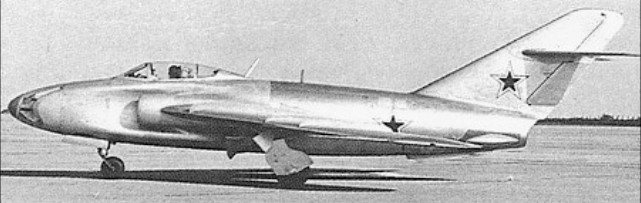
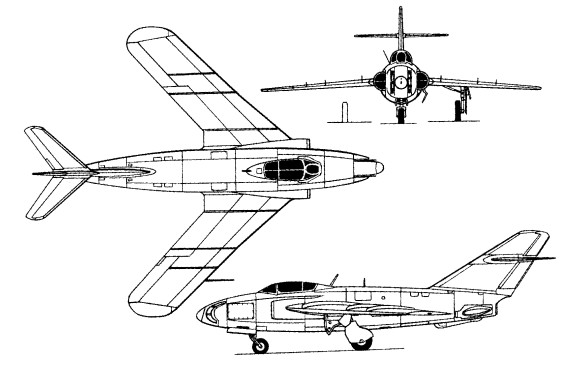
In its definitive form the ultimate extrapolation of the basic MiG-19 design, the SM-12 evolved, by a process of incremental modification, as a mixed-power point defence interceptor. As the MiG-19S was phased into service with the VVS mid-1956, the MiG OKB was continuing the refinement of the Izdeliye SM twin-engined fighter initiated in 1951 with the SM-1 (I-340). The SM-12 first saw life as an exercise in drag reduction by means of new air intake configurations, and the first of three prototypes, the SM-12/1, was essentially a MiG-19S with an extended and straight-tapered nose with sharp-lipped orifice and a pointed, two-position shock cone on the intake splitter.
The third prototype, the SM-12/3, differed from its two predecessors primarily in discarding the paired AM-9B (RD-9B) engines for two R3-26 turbojets developed from the earlier power plant by V N Sorokin. These each offered an afterburning thrust of 3600kg, enabling the SM-12/3 to attain speeds ranging between 1430km/h at sea level, or Mach=1.16, and 1930km/h at 12000m, or Mach=1.8, and an altitude of between 17500 and 18000m during its test programme. This outstanding performance prompted further development with a view to production as a point defence interceptor. Similarly powered by RS-26 engines and embodying major nose redesign with a larger orifice permitting introduction of a substantial two-position conical centrebody for a TsD-30 radar, a further prototype was completed as the SM-12PM. Discarding the wing root NR-30 cannon of preceding prototypes, the SM-12PM was armed with two K-5M (RS-2U) beam-riding missiles and entered flight test in 1957. The SM 12PM was tested with a search/track radar mounted in a conical housing in the centre of the intake, and an enlarged dorsal spine, carried two AAA Alkali air to air missiles and is claimed to have reached a speed of Mach 1.6 and an altitude of 17400 m (57100 ft), taking only four minutes to attain a height of 10000 m (32800 ft).
This was joined at the end of 1958 by yet another prototype, the SM-12PMU. This had R3M-26 turbojets uprated to 3800kg with afterburning and augmented by a Duchkin U-19D liquid rocket boost motor which took the form of a permanent ventral pack containing an RU-013 rocket motor and its propellant tanks. Developed by D D Sevruk, the RU-013 delivered 3000kg of thrust. With the aid of this rocket motor, the SM-12PMU attained an altitude of 24000m (78,740 ft) in 1958 and a speed of Mach=1.69, but the decision had been taken meanwhile to manufacture the Ye-7 in series as the MiG-21P and further development of the SM-12 series was therefore discontinued.
SM-12PM Max. speed: 1720 km/h / 1069 mph Ceiling: 17400 m / 57100 ft Range: 1700 km / 1056 miles
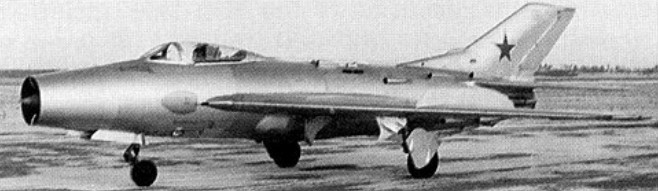
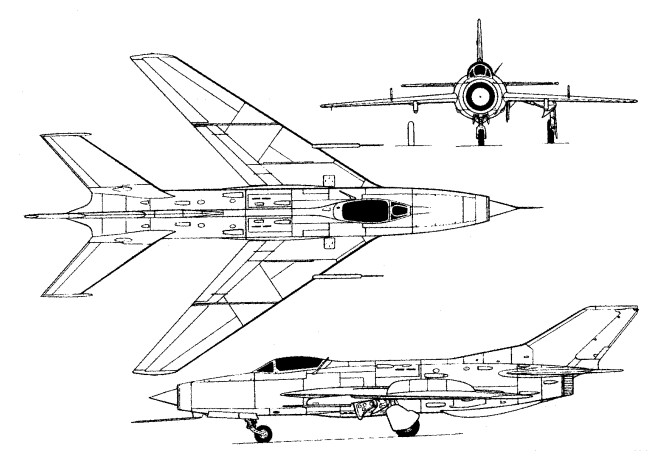
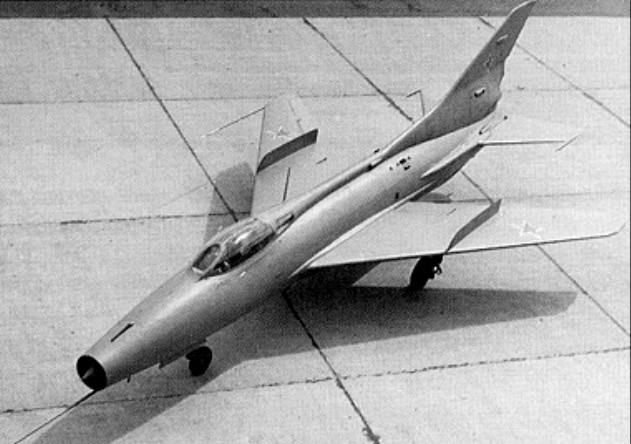
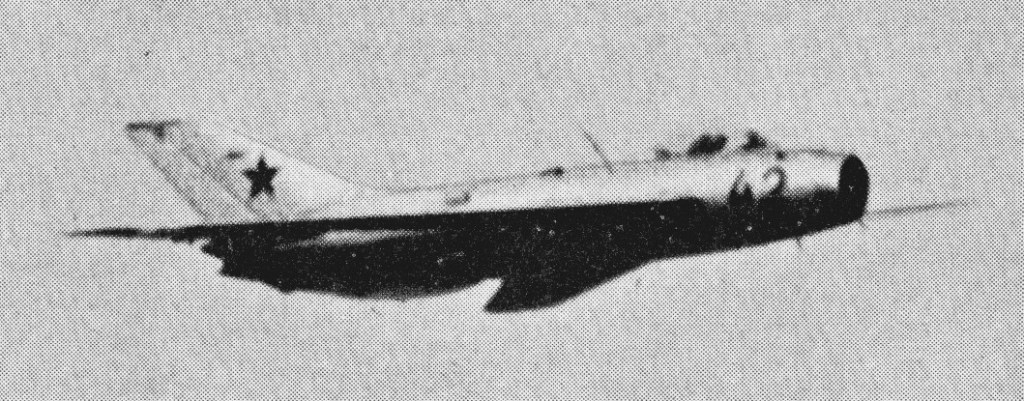
In 1953 the Soviet authorities issued a requirement for a Mach 2 clear-weather interceptor with limited ground-attack capability. At this time the USSR’s Central Aerodynamics and Hydrodynamics Institute had arrived at two basic configurations for aircraft of the required performance level. Both were based on a cylindrical fuselage with a swept all-moving tailplane and a wing in the low mid-set position, but the difference came in the wing itself. One was a conventional type with a leading-edge sweep of between 580 and 620, and other a delta with 570 or 580 leading-edge sweep. The MiG bureau produced prototypes in both configurations. The Ye-50 and Ye-4. Designed around a Tumansky AM-9Ye (RD-9Ye) turbojet with an afterburning thrust of 3800kg and a Dushkin S-155 bi-fuel rocket motor of 1300kg, the first of three prototypes, the Ye-50/1, flew on 9 January 1956. It began trials with the rocket motor on 8 June 1956.
The original Ye-50 can be regarded as a pre-prototype, for in the absence of the planned Tumanskii R-11 turbojet it was fitted with an interim composite powerplant comprising an RD-9Ye afterburning turbojet and an S-155 rocket engine; the aeroplane had swept conventional wings based on those of the MiG-19.
A year later, on 17 June 1957, the second prototype, the Ye-50/2, attained a speed of Mach=2.33 and an altitude of 25600m. The Ye-50/2 introduced some modifications to the rear fuselage and vertical tail, and the Ye-50/3 featured a lengthened fuselage nose and increased internal fuel. This last prototype was lost during flight test when its vertical tail detached. The Gor’kiy factory was ordered to build a batch of 20 aircraft, which, powered by the AM-11 engine and S-155 rocket, were to be designated Ye-50A. These were intended for operational evaluation, but none of them was built owing to a lack of rocket motors, the Dushkin OKB having meanwhile closed down.
Ye-50/1 Max take-off weight: 8500 kg / 18739 lb Wingspan: 8.11 m / 26 ft 7 in Length: 13.62 m / 44 ft 8 in Height: 21.00 m / 68 ft 11 in Max. speed: 2460 km/h / 1529 mph Ceiling: 23000 m / 75450 ft Range: 450 km / 280 miles
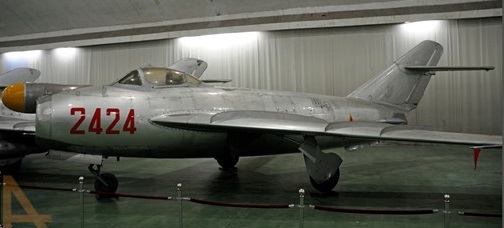
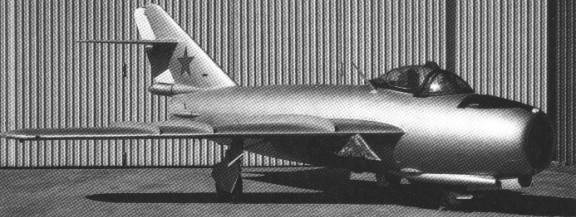
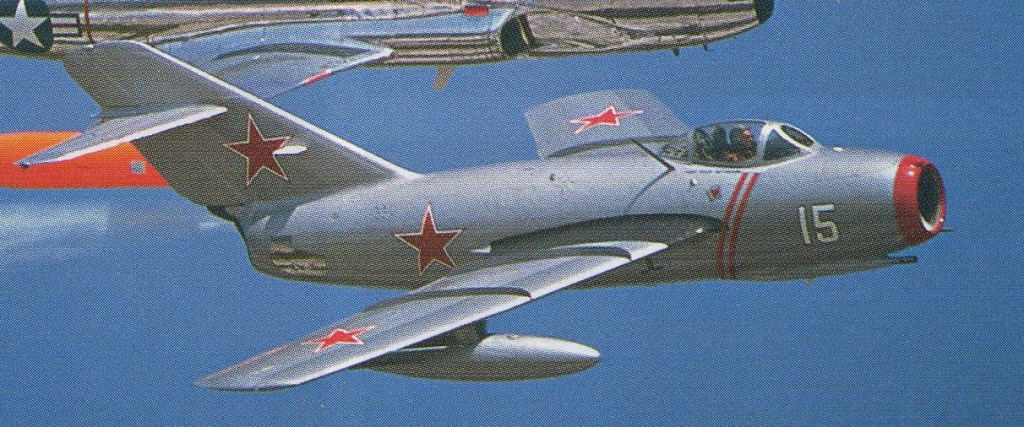
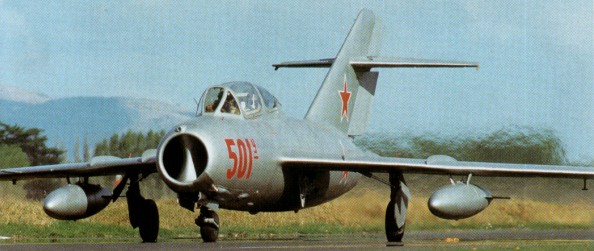
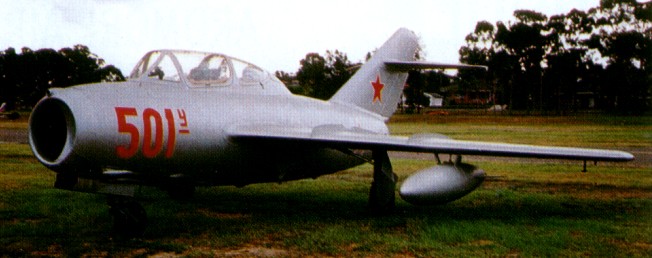
Authorization for the development of the MiG 19 to succeed the MiG 17 then entering service was granted in 1951, although design work had begun the previous year. The MiG-¬19 followed the basic layout of its predeces¬sors, the MiG-15/MiG-17 series, although twin engines were adopted, and was designed to perform similar roles single seat clear-¬weather interception, with ground attack as a secondary mission but with performance improvements all round.
The MiG-19 was on the drawing board as the I-350 before even the MiG-15 had been encountered in Korea, the five prototypes being ordered on 30 July 1951. Maj Grigori Sedov flew the first I 350 design, also known as the Type SM, on 18 September 1953 on the power of two non-afterburning AM-5 engines giving only 4,410 lb thrust each.
Despite the high wing loading and bold sweep angle of 55 (at 25% chord), the MiG-19 handled well, large fences and Fowler flaps giving satisfactory low-speed control With afterburning engines the MiG-19 became the first Russian supersonic fighter and it was put into production on a very large scale in the second half of the following year.
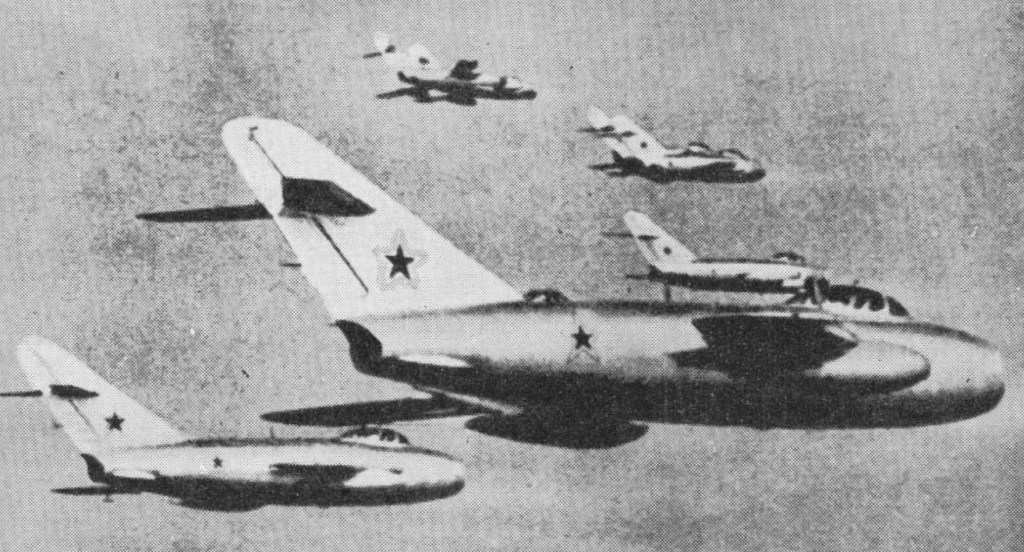
Deliveries to the Soviet air force began early in 1955, and 48 flew in formation at that year’s Soviet Aviation Day, held at Tushino. Early MiG-19s were pow¬ered by a pair of Mikulin AM 5 axial flow turbojets each producing 2250 kg (5000 lb) of thrust dry and 3040 kg (6700 lb) with after¬burning. The engines are mounted side by-¬side in the rear fuselage and fed from a divided annular intake in the nose. The three-¬spar wings are tapered and swept back by 55 deg at 25% chord, with a full chord fence on each side. Anhedral is about 4.5 deg. The large area Fowler flaps can be used at up to 800 km/h (495 mph) in combat, and lateral control in later aircraft is effected by ailerons assisted by spoilers, this arrangement having been used first on the MiG-15SD.
The area ruled fuselage has a cylindrical nose and carries a cluster of air scoops at the rear to cool the afterburners, with others on either side of the spine feeding the elec¬tronics bays. Air brakes were fitted to the fuselage sides in early models, later aircraft having an additional one mounted ventrally. The fin and fuselage mounted tailplanes are swept back.
After about 500 had been delivered the MiG-19S (stabilizator) supplanted the early model with the fixed tailplane and manual elevators replaced by a fully powered slab. At the same time the old armament of a 37 mm (1.46 in) N 37 cannon with 40 rounds in the right hand side of the forward fuselage and a 23 mm (0.90 in) NR 23 with 80 rounds in each wing was replaced by three of the new 30 mm NR-30 guns, one in each wing root and one under the right side of the nose and was fitted with two air to¬-surface weapon stations under the wings. A large ventral airbrake was also added.
Fuel is carried in four fuselage cells with a total capacity of 2170 litres (477 Imperial gal) and can be supplemented by a pair of underwing drop tanks containing 800 litres (176 Imperial gal) each. A dorsal spine housing control, running between the cockpit and the tail, was introduced into the MiG¬-19S. A fully duplicated hydraulic system was employed and the tailplane was geared electro mechanically to operate at a nearly con¬stant rate of stick force per g. An electrical system was provided to operate the tailplane in the event of hydraulic failure. The MiG-19S entered full service in the second half of 1956.
In 1956 the AM-5 engine was replaced by the newer and more powerful Tumansky RD 9Bs each rated at 2600 kg (5730 lb) dry and 3250 kg (7165 lb) with reheat, increasing peak Mach number from 1.1 to 1.3. The new fighter was designated MiG-19SF (forsiro¬vanni, increased power) which was code named Farmer C and has been built in very large numbers.
The corresponding MiG-19PF (perekhvatchik, inter¬ceptor) has an Izumrud Al radar (called “Scan Odd” by NATO) in a bullet carried on the inlet duct splitter, with the ranging unit in the upper inlet lip. The final production version was the MiG-19PM (modifikatsirovanni), with guns removed and pylons for four early beam-rider air-to-air missiles (called “Alkali’ by NATO), an all weather version fitted with the X band Scan Odd fire ¬control radar using dual pulse repetition fre¬quencies. The main antenna was housed in a bullet fairing mounted on the central intake splitter, with the complementary ranging radar installed in the upper lip.
A two seat version, the MiG¬19UTI, was also delivered.
All MiG-19s can carry the simple K-13A missile (the copy of Sidewinder, called “Atoll” by NATO) and underwing pylons can carry two 176 gal drop tanks plus two 551 lb weapons or dispensers. The Mig-19 was out of production in 1957.
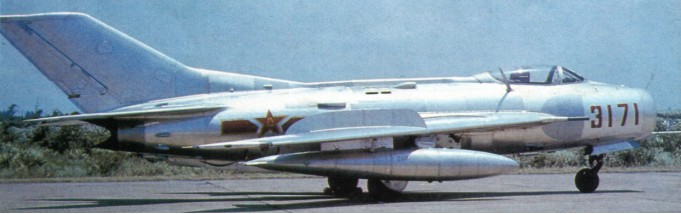
The type was supplied to China knocked-down MiGs for Chinese construction before relations soured in 1960, and the Shenyang National Aircraft Factory has copied the MiG 19S as the F 6 (first flight in December 1961). Production of the F-6 was stepped up from about 1966 and it is thought that several thousand have been built, including counterparts of the MiG-19PF and SF. F-6 became the standard equipment of the Chinese Air Force of the People’s Liberation Army from mid-1962. China has developed a number of variants of its own design. One is a tactical reconnaissance aircraft, while the TF-6 is a trainer version and the A-5 (formerly referred to as the F-9 and F-6 bis) a strike fighter with different appearance because of its pointed nose radome between the semi-circular side air intakes. The span of the A-5 has also been increased to about 10.2m. Maximum level speed of this version is estimated to be close to Mach 2.
Chinese built F 6s have been supplied to ‘friendly’ coun¬tries, including Pakistan, and are thought to incorporate indigenously developed improve¬ments. The Pakistani aircraft have performed well in periodic clashes against Western ¬supplied types and MiG 21s operated by the Indian air force.
Phased out of production in the Soviet Union during the late 1950s, the Mikoyan-Gurevich MiG-19 continued to be built in China under a licence agreement of January 1958. The J-6 (Jianjiji 6, or Fighter Aircraft Type 6) is normally credited to the Shenyang production facility, although a second assembly line is located at Tianjin. First of the Chinese production models was the J-6 equivalent of the MiG-19S/SF day fighter, this giving way to the J-6A/MiG19PF limited all-weather interceptor and the later J-6B/MiG-19PM, the latter augmenting gun and rocket armament by AA-1 ‘Alkali’ AAMs. An improved MiG-19SF, known as the J-6C and identified by a brake parachute housing at the base of the fin was in production in 1984, as was J-6Xin (‘New J-6’) which featured a sharply-pointed radome in the engine air intake for a Chinese-developed airborne gun-ranging radar. The JZ-6 (Jianjiji Zlienchaji 6) is a MiG-19R reconnaissance version equivalent with the forward fuselage cannon replaced a camera array. Despite limited Soviet production of a MiG-19UTI, Chinese requirements for a dual control trainer were met by a local design to produce the JJ-6 (Jianjiji Jiaolianji 6), with its 0.84 m (2 ft 9 in) fuselage extension. Several thousand J-6s have been built for the Chinese army and navy air forces since 1961, whilst export variants (known as the F-6 and trainer FT-6) serve in Albania, Bangladesh, Egypt, Iraq, Pakistan, Tanzania and Vietnam as interceptors and close-support aircraft. The J-6 is well liked by its pilots as a manoeuvrable fighter and stable weapons platform, Pakistan’s aircraft having been improved by the addition of a third (under-fuselage) fuel tank, US-designed AIM-9B/J Sidewinder AAMs and Martin-Baker PKD Mk 10 automatic zero-zero ejection seats.
Total production possibly exceeds 10,000, including licence-manufacture as the Lim-7 in Poland, S-105 in Czechoslovakia and F-6 in China.
The MiG 19 has also been used as a testbed in a number of experimental programmes. Under the designation SM 10 it was used for in flight refuelling trials from 1955, and in 1957 the SM 12.
SM 30 was the bureau designation of a pre-¬series MiG 19 which was used for catapult takeoff trials in 1956, and three years later the SM 50 underwent tests while fitted with RD¬9BM turbojets of 3300 kg (7275 lb) thrust each with reheat, augmented by a U 19 rocket motor producing 3200 kg (7055 lb). A maximum speed of 1800 km/h (1118 mph) was attained, and a height of 20 000 m (65 600 ft) was reached in eight minutes.
MiG-19 Single-seat fighter Engines: 2 x Mikulin AM-5 turbojets, 6.700 lb (3,040 kg) thrust (afterburner rating) Wing span 29 ft 6.5 in (9 m) Height 13 ft 2.25 in (4.02 m) Max speed (typical) 920 mph @ at 20,000 ft (M 1.3)
MiG-19 Single-seat fighter Engines: 2 x Mikulin VK-5 turbojets, 8818 lb Wing span: 36 ft 6 in Length: 44 ft 3 in Height 13 ft 6 in MTOW: 19,840 lb Max speed: 860 mph at 36,000 ft (M1.3) Max OC: 15,000 fpm Service ceiling: 58,000 ft Max range: 850 mi
MiG-19S Single-seat fighter Engines: 2 x Mikulin AM-5 turbojets, 6.700 lb (3,040 kg) thrust (afterburner rating) Wing span 29 ft 6.5 in (9 m) Length: 42 ft 11.25 in (13.08 m) Height 13 ft 2.25 in (4.02 m) Max speed (typical) 920 mph @ at 20,000 ft (M 1.3) Gross weight: 8700 kg (19180 lb)
MiG-19SF Single-seat fighter Engines: 2 x Klimov RD-9B turbojets, 7,165 lb (3250 kg) thrust (afterburner) Wing span 29 ft 6.5 in (9 m) Length: 42 ft 11.25 in (13.08 m) Height 13 ft 2.25 in (4.02 m) Initial ROC: 22,640 ft (6900 m)/min Service ceiling: 58,725 ft (17,900 m) Max speed (typical) 920 mph @ at 20,000 ft (M 1.3) Empty wt: 12,698 lb (5760 kg) Loaded wt (clean): 16,755 lb (7600 kg) MTOW: 19,180 lb (8700 kg) Max range (high. with two drop tanks): 1,367 miles (2200 km)
MiG-19 Engines: 2 x turbo-jet RD-9B(N), 31.9kN Max take-off weight: 8600 kg / 18960 lb Wingspan: 9.0 m / 29 ft 6 in Length: 12.5 m / 41 ft 0 in Height: 4.1 m / 13 ft 5 in Wing area: 23.0 sq.m / 247.57 sq ft Max. speed: 783 kts / 1450 km/h / 901 mph Service ceiling: 18600 m / 61000 ft Range w/max.fuel: 2200 km / 1367 miles Range w/max.payload: 1400 km / 870 miles Armament: 3 x 30mm machine-guns, missiles Crew: 1
MiG-19PF All-weather interceptor Engines: 2 x Klimov RD-9B turbojets, 7,165 lb (3250 kg) thrust (afterburner) Wing span 29 ft 6.5 in (9 m) Length: 44 ft 7 in Height 13 ft 2.25 in (4.02 m) Max speed (typical) 920 mph @ at 20,000 ft (M 1.3) Max range (high. with two drop tanks): 1,367 miles (2200 km)
MiG-19PM All-weather interceptor Engines: 2 x Klimov RD-9B turbojets, 7,165 lb (3250 kg) thrust (afterburner) Wing span 29 ft 6.5 in (9 m) Length: 44 ft 7 in Height 13 ft 2.25 in (4.02 m) Max speed (typical) 920 mph @ at 20,000 ft (M 1.3) MTOW: 20,944 lb (9500 kg) Max range (high. with two drop tanks): 1,367 miles (2200 km)
Lim-7
S-105
F-6 / Shenyang/Tianjinj-6C Powerplant: two 3250-kg (7,165-lb) Shenyang Wopen-6 (Tumansky R-9BF-811) afterburning turbojets Maximum speed, clean 1540 km/h (957 mph) or Mach 1.45 at 11000 m (36,090 ft) Maximum speed 1340 km/h (833 mph) or Mach 1.09 at low level Service ceiling 17900 m (58,725 ft) Empty weight 5760 kg (12,698 lb) Normal take-off weight, clean 7545 kg (16,634 lb) Maximum take-off with external stores about 10000 kg (22,046 lb) Wing span 9.20 m (30 ft 2.25 in) Length, excluding probe 12.60 m (41 ft 4 in) Height 3.88 m (12 ft 8.75 in) Wing area 25.00 sq.m (269 sq ft). Armament: three internal 30-mm NR30 cannon (one on starboard side of nose, two in wing roots); wing pylons for two 250-kg (551 -1b) bombs or four rocket packs, plus fuel tanks.
Despite termination of trials in 1951 with the SU derivative of the MiG-15 featuring paired 23mm cannon on articulated mountings, the basic concept of gun armament capable of elevation and depression for air-air use was persisted with by the MiG OKB. In 1953, flight testing of a more sophisticated development of the concept began as Izdeliye SN. A variation of the MiG-17, the SN featured lateral air intakes, the 2900kg VK-1A turbojet being fed by circular orifices against concave fuselage sides forward of the wing roots. This arrangement permitted installation of the SV-25 armament system of three 23mm TKB-495 cannon mounted asymmetrically (one to port and two to starboard) on an articulated mounting in the nose section. Operated electrically, the cannon could be elevated to 27° 26′ and depressed to 9° 48′, the complete SV-25 system weighing 469kg. Trials with the SN were discontinued owing to aiming complexities combined with advances in air-to-air missiles.
Engine: 1 x 2900kg VK-1A turbojet Take-off weight: 5620 kg / 12390 lb Empty weight: 4152 kg / 9154 lb Wingspan: 9.63 m / 31 ft 7 in Length: 12.33 m / 40 ft 5 in Height: 3.80 m / 12 ft 6 in Wing area: 22.60 sq.m / 243.26 sq ft Max. speed: 1058 km/h / 657 mph Ceiling: 14500 m / 47550 ft
Early in 1949, in parallel with work on the SD (MiG-l5bis), the MiG OKB launched a more thoroughgoing redesign of the basic MiG-15 as the SI, alias 1-330. The SI was intended to afford improved transonic behaviour, achieved by mating the existing fuselage (forward of the rear frame of the engine plenum chamber) with a lengthened rear fuselage and an entirely new wing possessing better compressibility charac¬teristics, having leading-edge sweep of 45 deg inboard and 42 deg outboard. A mark of identification was the MiG-17’s three boundary layer fences on each wing.
The Klimov VK-l engine of the SD was retained, together with the armament of one 37-mm and two 23-mm cannon. The first prototype, officially flown on 13 January 1950, allegedly attained M 1.03, but crashed in March 1950. Following the loss of the first prototype, a second and further improved prototype took over, the test programme being completed on 20 June 1951 and series production being ordered as the MiG-17. Production began with a day fighter model (NATO `Fresco-A’), which retained the VK-1 engine.
The MiG 17 was preferred to the Yak 50 and entered service with the Soviet air force in its Fresco A form during 1952. Its power¬plant was a Klimov VK 1 turbojet producing 2700 kg (5950 lb) of thrust, the same as in the MiG 15 bis, and the armament was similar: one 37 mm (1.46 in) N 37 cannon and a pair of 23 mm (0.90 in) NR 23s, aimed with the aid of a simple gyro gunsight. Air to surface armament could also be carried in the form of four UV 8 57 pods each containing eight 5.5 cm (2.16 in) S 5 rockets, two 21 cm (8.26 in) rockets, two 250 kg (551 1b) bombs or 240 litre (53 Imp gal) drop tanks. The use of steel underwing beams allowed two rocket pods or bombs to be carried inboard, with drop tanks on the outboard pylons.
Fresco B was the MiG-17P, flown as a prototype in 1951, fitted with an S band ‘Izumrud’ (Emerald) radar, known as Scan Fix in the West, with the main dish mounted on the intake splitter and the rang¬ing element housed above in the lip discardingd the 37-mm cannon in favour of a third 23-mm weapon. The fuselage was lengthened by 127 mm (5 in) and the cockpit glazing was modified to cater for additional displays. In the event, production of the MiG-17P was to be limited pending availability of the afterburning VK-1F engine.
Experimental versions included the SN, a ground attack model of the VK-1-engined fighter, which, flown in November 1953, featured lateral air intakes and twin 23-mm nose-mounted cannon which could be hydraulically elevated or depressed (± 40 deg). Another, the SP-2 flown in 1951, was a limited all-weather version with a higher-powered Korshun (Kite) search radar and a twin 23-mm cannon armament. During the course of 1953, production of the MiG-17 gave place to the improved MiG-17F.
Availability of an afterburning version of the Klimov engine, the VK-1F offering 7,452 lb st (3 380 kgp) for three minutes, resulted in the SF, which, flown in 1951, was cleared for series production as the MiG-17F Fresco C (Forsirovannyi, or, literally, “boosted”) in April 1953. Apart from a cut-back rear fuselage exposing the variable nozzle, the MiG-17F featured shorter and deeper air brakes; those on the new variants were larger than their predecessors, mounted in a different position on the fuselage and operated by external jacks.
Large-scale production of the MiG-17F was paralleled by production of the similarly-powered MiG-17PF limited all-¬weather fighter with a trio of 23-mm cannon and (from the 26th aircraft) the improved RP-5 Izumrud radar in a bullet' radome at the centre of the nose air intake and in an extension on the upper lip of the intake. Subsequently, this S-band radar was superseded by an E/F-band version ofScan Fix’, which still gave neither a large antenna nor a wide angle of scan.
In 1953, gun armament was deleted from a MiG-I7PF and provision made for a quartet of K-S (ARS-212) beam-riding missiles mounted on underwing pylons, this version entering production in 1955 as the MiG-I7PFU (Usovershenstvovanny, or, literally, “improved”).
The MiG 17PF Fresco D entered service in 1955 and was fitted with progressively improved versions of Izurnrud/Scan Fix, operating in X band as well as the original S band, and in the MiG-17PFU Fresco E variant the gun armament was replaced by four beam riding AA 1 Alkali air to air mis¬siles carried on underwing pylons projecting forward of the leading edge. Some MiG-17s were fitted out for reconnaissance, with cameras in the forward fuselage and only two guns, and the type has increasingly been used for ground attack as it was replaced in the interception role.
The MiG-17PM (Nato Farmer D) being an all weather fighter carrying only air-to-air missles as armament.
Production of the MiG-17F and MiG-17PFU continued in the Soviet Union until 1958, and licence manufac¬ture of the MiG-17F was initiated in 1957 in Poland as the LIM-5P (licencyjny mysliwiec, or “licensed fighter”), remaining in production until 1960. The MiG-17F was in service with that country’s Soviet-dominated air force in the late 1950s. The lead company, WSK-PZL-Mielec, also carried out design work on various modified versions, some greatly altered. Production continued until 1961. Dedicated reconnaissance and ground attack variants evolved designated LIM-5R and LIM-6.
Polish production of the MiG-17PF (LIM-5M) being initiated in 1959 and continuing until 1961. Dedicated reconnaissance and ground attack variants evolved in Poland were designated LIM-5R and LIM-6. Licence production was also undertaken of the MiG-17F (as the Jian5) and MiG-17PF (Jian-5A) by Shenyang in China commencing late 1956, and a uniquely Chinese tandem two-seat advanced training version was developed as the JT-5.
MiG-17 was license built China and known as Type-56, Dong Feng 101 and later is was dubbed J5 in Peoples Republic of China Air Force service. The first J5 prototype carried ‘Zhong-0101’.
J5 prototype
J5
Some Polish LIM 5P’s were modified to LIM 5M standard by fitting additional fuel tanks and a twin wheel main undercarriage with low pressure tyres which retracted into a larger wing centre section built of rein-forced plastics. A relatively small number were converted, but many others were upgraded to LIM 6 standard by introducing a braking parachute, rocket assisted takeoff units and additional stores pylons. The LIM-6, together with the LIM 6bis having modified ordnance racks and the reconnaissance LIM 6R, remained in Polish service until replaced by the Su 20 Fitter C.
LIM-5
The earlier model had been constructed as the Czech S.104.
1721 Mikoyan-Gurevich Lim-5 R 1C-17-21
Licence production was undertaken of the MiG-17F (as the Jian-5) and MiG-17PF (Jian-5A) in China commencing late 1956, and a uniquely Chinese tandem two-seat advanced training version was developed as the JT-5.
A total of 11,015 was built (including licence production). The last one was built in 1958 but the type was exported more widely than any other Soviet military aircraft. The Fresco was withdrawn from Soviet air force service in the late 1960s but soldiers on in many parts of the world, typical ground-¬attack weapons comprising 250 kg (551 1b) bombs, UV 16 57 rocket pods and S 24 rockets.
Mikoyan-Gurevich MiG-17 Engine: 1 x Klimov VK-1 turbojet, 5,952 lbs thrust Wing Span: 31 ft 7 in Length: 36 ft 5 in Height: 12 ft 6 in Light weight: 8,646 lb Loaded weight: 11,803 lb Ceiling: 52,366 ft Speed: 696 mph Range: 1,290 miles (ferry) Crew: 1 Armament: 2 x 23mm cannon, 1 x 37 mm cannon, 4 x 57mm rocket pods
MiG-17 Engine: 1 x VK-1F(N) turbo-jet Wingspan: 9.6 m / 31 ft 6 in Length: 11.4 m / 37 ft 5 in Height: 3.8 m / 12 ft 6 in Wing area: 22.6 sq.m / 243.26 sq ft Max take-off weight: 5200 kg / 11464 lb Max. speed: 1114 km/h / 692 mph Ceiling: 15000 m / 49200 ft Range: 2000 km / 1243 miles Crew: 1 Armament: 1 x 37mm machine-guns, 2 x 23mm machine-guns, bombs or missiles
MiG-17 Engine: 1 x Klimov VK-1 turbojet, 5952 lb (later models) VK-1F, 4732 lb / afterburner-7452 lb) Max speed, 692 mph (1114 km/h) at 6,560 ft (2 000 m) Initial climb, 9,252 ft/min (47 m/sec) Range (with max external fuel), 1,336 mls (2150 km) Empty weight, 8,373 lb (3798 kg) Loaded weight (clean), 11,468 lb (5202 kg) Span, 31 ft 7 1/8 in (9,63m) Length, 36ft l1 1/3 in (1l,26m) Height, l2 ft5 5/8 in (3,80 m) Wing area, 243.26 sq ft (22,60 sq.m)
MIG-17F ‘Fresco-C’ Type: single-seat fighter Powerplant: one 3400-kg (7,495-lb) afterburning thrust Klimov VK-JF turbojet Maximum speed 1145 km/h (711 mph) at 3000m (9,845 ft) Initial climb rate 3900 m (12,795 ft) per minute Service ceiling 16600 m (54,460 ft) Range (with max external fuel): 1470 km (913 sm) Empty weight: 4100 kg (9,040 lb) Maximum take-off weight: 6700 kg (14,770 lb) Wingspan 9.63 m (31 ft 7 in) Length 11.09 m (36 ft 4½ in) Height 3.35 m (11 ft) Wing area 22.60 sq.m (243.3 sq ft) Armament: three 23-mm NR-23 cannon, plus four AA-1 ‘Alkali’ missiles or up to 500 kg (1, 102 lb) of external stores.
MiG-17P Engine: 1 x Klimov VK-1 turbojet, 5952 lb (later models) VK-1F, 4732 lb / afterburner-7452 lb) Wing span: 31 ft (9.45 m) Length: 36 ft 3 in (11.05 m) Height 11 ft (3.35 m) Empty wt: 9040 lb MAUW: 14,770 lb
MiG-17PF Wing span: 31 ft (9.45 m) Length: 36 ft 3 in (11.05 m) Height 11 ft (3.35 m) Empty wt: 9040 lb MAUW: 14,770 lb
MiG-17PM Wing span: 31 ft (9.45 m) Length: 36 ft 3 in (11.05 m) Height 11 ft (3.35 m) Empty wt: 9040 lb MAUW: 14,770 lb Armament: 4 x AA-1 missiles.
The I-310(S) was designed to meet a March 1946 requirement for a high-altitude day interceptor. The Mikoyan/Gurevich, Lavochkin and Yakovlev design bureau competed for the production contract, striving to meet the specification of a Mach 0.9 top speed, high rate of climb to 10000 m (32800 ft), good manoeuvrability at this height and above, a minimum of one hour’s duration and cannon armament, combined with simplicity of design and operation.
The need for a near sonic speed demanded the adoption of wing sweep, and the design team was able to draw on the expertise of Gurevich himself, in addition to other work carried out by Russian and German engineers. A swept forward wing layout was examined but discarded in favour of the swept back solution. The aircraft was designed around the RD-10A turbojet of 1000 kg (2205 lb) thrust, based on the German Jumo 004. A Russian designed powerplant with twice the thrust was in the pipeline and was expected to become available within a year, but the Anglo Soviet trade agreement of 1946 offered a more attractive possibility. The trade pact included the supply of 25 Rolls Royce Nene turbojets, most of which were allocated to the Klimov engine design bureau or to research establishments. One was supplied to the Mikoyan/Gurevich team and the MiG 15 was redesigned to accommodate the fatter Nene, which had a centrifugal compressor compared with the axial unit or the Russian engine under development, and which also produced greater thrust. The Rolls-Royce Nene immediately went into production at No 45 production factory in Moscow, designated RD-45 after the factory.
The layout involved air fed from a bifurcated nose intake via four ducts which passed either side of the cockpit and then over and under the unbroken wing centre section. The wing, of almost parallel chord, was swept back by 35 degrees at the leading edge and was built up from two main spars skinned with light alloy. The upper surfaces carried two full chord fences on each side and large Fowler flaps, set at 20 degrees for takeoff and 55 degrees for landing, were attached to the wing, just forward of the trailing edge. The ailerons were the only power operated aerodynamic controls.
The circular section fuselage was constructed in two halves which could be separated by means of quick release bolts at the attachment point for the rear wing spar, exposing the complete engine for maintenance. Air brakes were fitted on either side of the rear fuselage. The tailplane was swept back by 40 degrees and its incidence could be adjusted manually before takeoff. Two fuel tanks in the rear fuselage carried 90 litres (19.8 Imp gal) each, but the majority was contained in a 1225 litre (269 Imp gal) tank fitted between the wing spars. The undercarriage had a wide track 4 m (13 ft 1.5 in) to allow operation from rough fields; the levered suspension mainwheels retracted inwards to lie within the fork of the front main spar.
Navigation, communication and fire-control equipment was extremely simple but this solution proved to be the correct solution when the type was blooded in combat. A gyro gunsight (copied from the British GGS Mk 2) with a maximum range of 800 m (875 yards) was used to aim the two 23 mm (0.90¬in) NS 23 cannon mounted in a pack under the nose. This arrangement was later replaced by a single 37 mm (1.46 in) N 37 cannon with 40 rounds on the right hand side and a pair of NS 23s with 80 rounds each on the left. The wing hardpoints were stressed to carry up to 500 kg (1102 lb) of bombs, although two weapons of 100 kg (220 lb) each were more usual, and rockets were also fitted. Alternatively, auxiliary fuel tanks could be carried to increase endurance.
It seems likely that the first prototype of the MiG-15, designated I 310, made its maiden flight in July 1947, but crashed during low speed trials. Several design changes were introduced as a result, including the adoption of 2 degrees of wing anhedral in place of the dihedral layout, installation of wing fences and several changes to the back end. The rear fuselage was shortened and the jet pipe cut back to reduce the amount of engine power being lost, the tailplane was removed from the top of the fin and repositioned two thirds of the way up, and the fin itself was swept back by 56 degrees. The first of two replacement prototypes, the S-01, was flown on 30 December 1947. As the I 350 prototype, it flew for the first time in September 1953.
The revised design was far from perfect – it tended to enter a spin from a tight turn, necessitating the fitting of recovery rockets but it was apparent that the layout was basically sound. The Mikoyan/Gurevich team had six months’ headway over their competitors, and this proved decisive, although both the La 168 and Yak 30 proceeded to the flight-test stage and the former entered limited production.
Reverse engineering of the Nene by Vladimir Klimov’s bureau had paralleled design development of the I-310, and as the RD-45 of 4,850 lb st (2 200 kgp), this engine powered the initial series fighter, which, as the MiG-15, was cleared for production in March 1948 (NATO Fagot), the first pre-series aircraft being delivered to the NII for evaluation seven weeks later, on 10 May.
Early production MiG-15s powered by the RD 45, copied from the Nene, reached the squadrons before the end of 1948. The RD 45F (Forsirovanny, meaning boosted), uprated from 2200 kg (4850 lb) to 2270 kg (5000 lb) thrust for take¬off, soon replaced the earlier powerplant at an early production stage. Armament comprising one 37-mm N-37 and two 23-mm NS-23KM cannon.
Production under licence was begun in Poland as the LlM-1 and in Czechoslovakia as the S-102.
Variants of the RD-45F-powered fighter included the MiG-15PB escort fighter with two 132 Imp gal (600 lt) underwing slipper tanks, the MiG-15P with a pre-series Izumrud (Emerald) radar and the MiG-15SV with faster-firing NR-23 cannon, none of these being built in quantity.
A structural reappraisal of the basic MiG-15 resulting in a 198 lb (90 kg) weight reduction, minor aerodynamic changes, upgraded equipment and a Klimov-developed VK-1 turbojet (origi¬nally designated RD 45FA) rated at 5,952 lb st (2 700 kgp) for takeoff, or 3000 kg (6615 lb) with water injection produced the MiG-15SD flown in September 1949. With some further changes (which in¬cluded modifications to the ailerons and air brakes) this was placed in production in the following year as the MiG-15bis. The engine’s external dimensions remained the same, but the mass flow was increased and the larger diameter hot end resulted in dry weight rising from 870 kg (1918 lb) in the RD 45 to 875 kg (1930 lb) in the VK 1. Fuel capacity was increased by 160 litres (35 Imp gal) and improved equipment was fitted. Perforated flaps were therefore adopted to save airframe weight, offsetting increases in other areas. Late production models of the MiG-15bis, which was the variant built in the largest numbers, carried 23 mm (0.90 in) NR 23 revolver cannon in place of the slow firing NS 23s. Polish and Czech versions were designated LIM-2 and S-103.
Lim-2
The MiG 15bis was followed by the two seat MiG-15UTI, code¬named Midget, with the instructor sitting behind and slightly above his pupil. Some fuel capacity was sacrificed, and the top speed dropped slightly. The principal production version of the basic design, with several thousand being built until late 1951, plus others licence-built in Czechoslovakia and Poland (as the LIM-3).
LIM-3
The MiG-15bis standardised on an armament of two 23-mm NR-23 cannon and one 37-mm N-37 cannon.
Limited all-weather versions with Izumrud radar included the MiG-15SP-1 and SP-2. The two seater was also used for ejection seat experiments and formed the basis of the SP 5, the first all-weather fighter variant. An Izumrud (Emerald) fire control radar (NATO code name Scan Fix) was fitted, the antenna being mounted in a bullet fairing in the centre of the intake splitter. A complementary ranging radar was installed in the top lip of the intake. The definitive all weather fighter variant, the MiG-15P, was, however, a single seater derived from the MiG-15bis.
Other experimental models were the MiG-15SU for ground attack and featuring a pack containing cannon angled to fire downward, the MiG-15bisSB (ISh) intended for the shturmovik role and the MiG-15bisS escort fighter with 132 Imp gal (600 1t) slipper tanks, reduced armament and other changes.
A reconnaissance version, the MiG-15bisR with full armament and fitted with a single nose mounted vertical camera below the gun magazines was developed for high altitude sorties over Korea and was additionally employed in Europe.
A further variant was the MiG-15SB, which had twin beams extending from the wing leading edges to carry two 100 kg (220 1b) bombs, eight 55 mm (2.16 in) rockets or auxiliary fuel tanks. Rockets were fitted to reduce the takeoff run and a braking parachute similarly shortened the landing roll.
Production in the Soviet Union ended in 1953.
On 10 March 1953, five days after a Polish pilot had defected with his MiG-15 to the Danish island of Bornholm, two Czechoslovakian MiGs attacked two American F-84G Thunderjets over Regensburg in Bavaria. One of the Thunderjets was shot down by the 23mm and 37mm cannon of one of the MiGs. The pilot ejected safely over Czechoslovakian territory.
The last RB-29 was shot down by two MiG-15s above the east coast of Hokkaido, Japan, on 4 September 1954. The aircraft allegedly flew over Soviet territory on the Pacific coast, according to the Sovies. Ten or elevel of the crew survived.
One of the most widely used jet fighters of all time, the MiG-15bis was also manufactured in China (as the Shenyang F-2, and the MiG-15UTI as the Shenyang FT-2), Czechoslovakia (Mig-15bis as the Aero Vodochody S-103 and the Mig-15UTI as the CS-102) and Poland Czechoslovakia (Mig-15bis as the PZL-Mielec Lim-2 and the Mig-15UTI as the SBLim-1) in considerable numbers and it is known to have served with close to 30 air arms throughout the world as a front-line fighter and as an advanced trainer.
Large numbers (over 1,000) of early versions were supplied to China and North Korea, entering combat in 1951. No Allied fighter could stay with it and even the technically superior F-86 had inferior climb, ceiling and high-altitude turn radius. Many thousands (14,000+) of all versions were built, and the MiG-15 remained an invaluable aircraft for air forces with little jet experience, being supplied to at least 18.
The MiG 15 took part in the first ever all jet air combat when one was destroyed by a Lockheed F 80 Shooting Star of the US Air Force over Korea on November 7, 1950, some six days after the Russian type was deployed to that theatre. The Soviet aircraft was more manoeuvrable and had a higher ceiling than its US adversaries, and the slow ¬firing but hard hitting cannon carried a heavier punch than the machine guns of the opposing fighters. The USAF’s response was to introduce the North American F 86A Sabre, which scored its first MiG kill on December 17, 1950. The North Korean and Chinese pilots could not hope to match the experience of their adversaries, and on May 20, 1951, Capt James Jabara bagged his fifth and sixth MiG 15s to become the first jet ace. The USAF alone claimed 792 MiG 15s destroyed over Korea, while the US Navy also notched up a creditable score, bringing the claimed kill to loss ratio to about 12:1.
MiG-15 Engine: 1 x Klimov RD-45F, 5,005 lb st (2270 kgp) Max speed, 648 mph (1043 km/h) at 9,845 ft (3000 m) Max initial climb, 8,268 ft/min (42 m/sec) Range (clean), 882 mls (1 420 km) at 236 mph (380 km/h) at 39,370 ft (12 000 m) Empty weight, 7,456 lb (3 382 kg) Loaded weight (clean), 10,595 lb (4 806 kg) Span, 33 ft 1 in (10,08 m) Length, 32 ft 1¼ in (10,04 m) Height, 12 ft 1 2/3 in (3,70 m) Wing area, 221.75 sq ft (20,60 sq.m).
Engine: 1 x VK-1 turbo-jet, 26.5kN / 5950 lb Wingspan: 10.1 m / 33 ft 2 in Wing area: 20.6 sq.m / 221.74 sq ft Length: 10.1 m / 33 ft 2 in Height: 3.7 m / 11 ft 2 in Empty weight: 13,249 lb Max take-off weight: 4960 kg / 10935 lb Max. speed: 1076 km/h / 669 mph Max ROC: 19,400 fpm Ceiling: 16000 m / 52500 ft Range w/max.fuel: 2000 km / 1243 miles Range w/max.payload: 1400 km / 870 miles Armament: 1 x 37mm cannon, 2 x 23mm machine-guns, 400kg of bombs or missiles Crew: 1
MiG-15P Equipment: Izumrud (Emerald) radar.
MiG¬-15PB Type: escort fighter Fuel cap: two 132 Imp gal (600 1t) underwing slipper tanks
MiG-15SV Armament: faster-firing NR-23 cannon
MiG-l5bis Powerplant: one 2700-kg (5,952-lb) thrust Klimov VK-1 turbojet / later models one 6990-lb thrust Klimov VK-1A turbojet. Maximum speed 1100 km/h (684 mph) at 12000 m (39,370 ft) Initial climb rate 3500 m (11,800 ft) per minute Service ceiling 15550 m(51,015 ft) Ferry range 2000 km (1,242 miles) Empty weight 3400 kg (7,495 lb) Maximum take-off 5785 kg(12,756 lb) Wingspan 10.08 m (33 ft 0¾ in) Length 11.05 m (36 ft 3¼ in) Height 3.40 m(11 ft 1¾ in) Wing area 20.60 sq.m (221.7 sq.ft) Armament: one 37-mm NR-37 cannon and two 23-mm NR-23 cannon, plus up to 1000 kg (2,205 lb) of external stores.
MiG-15Bis (SD) Max speed, 692 mph (1114 km/h) at 7,220 ft (2 200 m) Time to 16,405 ft (5 000 m), 2.1 min. Range (clean), 826 mls (1330 km) Empty weight, 8,115 lb (3 681 kg) Loaded weight (clean), 11,175 lb (5069 kg) Span, 33 ft 1 in (10,08 m) Length, 35 ft 7½ in (10,86 m) Height, 12 ft 1 2/3 in (3,70 m) Wing area, 221.75 sq ft (20,60 sq.m) Armament: two 23-mm NR-23 cannon and one 37-mm N-37 cannon.
Engine one 7,452-lb Klimov VK- 1F turbojet Gross wt. 12,000 lb Empty wt. 8,115 lb Max speed 668 mph Range 450 nm Ceiling 50,855 ft Seats 1-2.
MiG-15UTI Engine: LIS-2, 5500 lb thrust. Fuel cap: Internal: 1000 lt, external 2 x 400 lt. ROC: 6000+ fpm. Service ceiling: 48,000 ft. Loading: Clean, +8g, With drop tanks full, +4g. Max speed: 570 kts (M 0.92), with drop tanks, 430 kts. Stall: 110-103 kts.
MiG-15UTI Type: Two seat fighter/trainer Engine: One Klimov RD-45 turbojet, 5,005 lbs thrust Empty weight: 7,900 lb Loaded weight: 10,935 lb Wing Span: 33 ft 1 in Length: 33 ft 2 in Height: 12 ft 2 in Ceiling: 50,580 ft Speed: 668 mph Range: 1,225 miles (ferry) Armament: 2 x 23mm cannon, 1 x 37 mm cannon, 2 x 100 kg bombs or rockets
In February 1944, the MiG OKB initiated the design of a mixed-power single-seat fighter with the Izdeliye designation N. Conceived to use the so-called “accelerator”, or VRDK (Vozdushno-reaktivny dvigatyel kompressorny, or Air-reaction engine compressor), which had been developed at the TsIAM under the leadership of K V Kholshchevnikov, the N preliminary design was finished on 28 March 1944. Drawings were completed by 30 November 1944, by which time the official designation I-250 had been applied to the project, and three months later, on 26 February 1945, the first of two prototypes, the N-1, left the factory.
Primary power was provided by a Klimov M-107A (VK-107A) 12-cylinder Vee-type engine rated at 1650hp for take-off and armament was three 20mm G-20 cannon, one between the engine cylinder banks and the others flanking the engine. The VRDK consisted of an engine-driven compressor which fed compressed air via a water radiator to a mixing chamber in which fuel was introduced under pressure, the mixture being ignited in a double-walled combustion chamber and then ejected through a variable orifice. This provided 300kg of thrust for up to 10 minutes, boosting speed by 100km/h.
The first flight took place on 3 March 1945, and the VRDK was fired for the first time during the third test flight. N-1 crashed during mid-May when the permissible load factor was exceeded and the horizontal tail collapsed at low altitude, but a second prototype, the N-2, was rolled out on 26 May 1945. This lacked armament and the vertical tail was enlarged to rectify some longitudinal instability, but this prototype, too, was destroyed in an accident. In July 1945, the OKB received instructions to supervise the construction of 10 I-250 aircraft to participate in the Air Parade that was planned for 7 November 1945, barely four months later. Nine I-250s were ready on time, but inclement weather resulted in cancellation of the Parade. These aircraft, together with a further seven, were subsequently delivered to the Navy as MiG-13s, equipping an evaluation unit based at Skultye airfield, near Riga. Several of the pre-series MiG-13s were experimentally fitted with sabre-shaped propeller blades, and official NII VVS trials were conducted between 9 October 1947 and 8 April 1948. Production of the I-250 / MiG-13 had totalled 16 pre-series aircraft, and although the fighter was essentially successful, it had been overtaken by pure jet fighters and surviving examples were retired by the Navy in May 1948.
N-1 Engine: 1 x Klimov M-107A (VK-107A) 12-cylinder, 1650hp & 1 x VRDK, 300kg thrust Max. speed: 825 km/h / 513 mph Ceiling: 11960 m / 39250 ft Range: 1380 km / 858 miles Armament: 3 x 20mm G-20 cannon
N-2 Engine: 1 x Klimov M-107A (VK-107A) 12-cylinder, 1650hp & 1 x VRDK, 300kg thrust Max take-off weight: 3931 kg / 8666 lb Empty weight: 3028 kg / 6676 lb Wingspan: 9.50 m / 31 ft 2 in Length: 8.18 m / 26 ft 10 in Wing area: 15.00 sq.m / 161.46 sq ft
Assigned the Izdeliye designation F by the OKB and the initial military designation I-300(F), the first Soviet turbojet-powered fighter of indigenous design was the primary design responsibility of Aleksei T Karyev.
The I-300 was powered by paired 800kg BMW 003A turbojets, and the first prototype performed a 4m “hop” on 19 April 1946, and its first true test flight on the following 24 April. It crashed during its 19th flight, after logging 6 hrs 23 min, when a wing root fairing detached and destroyed the horizontal tail. The second and third prototypes following on 11 and 9 August respectively. These were powered by paired 1,760 lb st (800 kgp) BMW 003A turbojets, the German engines being copied and placed in production in the Soviet Union in an equally high tempo programme as the RD-20F.
On the 20th of August a directive was issued by the NKAP (People’s Commissariat for the Aircraft Industry) that 10 more aircraft be built by hand and completed by 22 October. Considered as pre-series aircraft, these were designated FS by the OKB and I-301 officially. With the decision to manufacture the fighter in series the designation MiG-9 was also assigned. The last of these was completed 63 days later, on 21 October.
The first pre-series aircraft was completed on 13 October 1946 – 54 days after issue of the directive – and flown on 26 October, subsequent production aircraft being externally similar. These were powered by paired RD-20 turbojets – reverse-engineered BMW 003As – and armament consisted of one 37mm and two 23mm cannon.
Noteworthy for the brevity of its development programme, only 14 months elapsing between inception and test, the MiG-¬9 single-seat fighter was the first Soviet turbojet-powered aircraft to fly albeit only three hours prior to the Yak-15.
A series of 50 MiG-9s was completed by 1 May 1947, these being powered by two RD-20F engines and carrying an armament of one 37-mm and two 23-mm cannon.
Two tandem two-seat prototypes were also built, the first of these, the FT-1 (I-301T), retaining the standard armament and flying for the first time in July 1947. The FT-2, which followed on 25 August 1947, had a redesigned cockpit canopy, air brakes and provision for drop tanks. This aircraft was later fitted with the first Soviet production ejection seats. The I-301 version of the MiG-9 suffered from engine stoppages above 7500m as a result of gun gas ingestion. Among attempts to eradicate this problem was the FP (I-302) which simply displaced the 37mm cannon from intake splitter to upper fuselage portside.
The 1-307 (MiG-9F) was fitted with an improved version of the BMW engine, the RD-21 of 2,094 lb st (950 kgp), this attaining a max speed of 590 mph (950 km/h).
Rearranged armament was also featured by the more extensively revised FR (I-308), the 37mm weapon being transferred to the starboard side of an entirely redesigned forward fuselage with the 23mm cannon being relocated to port. The forward fuselage embodied a forward-positioned, pressurised cockpit, air brakes and afterburning derivatives of the RD-20 turbojet developed by Kolesov. These engines, designated RD-21 (initially RD-20F) each developed 2,094 lb st (950 kgp). Although series production of the MiG-9FR was planned, work was discontin¬ued by July 1948 to permit concentration on the more advanced 1-310.
One example, the 1-305, was built for Lyulka TR-1 turbojets, but was not, in the event, flown.
Flown in July 1947, the FP was the first MiG-9 to attain Mach=0.8 under test, and an altitude of 5000m was reached in 2.7 min. Like the FP, the FR did not progress beyond prototype status, but, similarly powered to the latter, the FF (I-307) was built as a small pre-series. Flown in September 1947, the FF (externally similar to the FS) had improved pilot protection (12mm front and back armour, and a 44mm windscreen). This model attained 950km/h at sea level and reached 5000m in 2.9 min, empty and loaded weights being 3471kg and 5117kg respectively.
I-300 Engines: 2 x 800kg BMW 003A turbojets
I-300 ver 2 & 3 Engines: 2 x 1,760 lb st (800 kgp) BMW 003A turbojets
MiG-9FS / I-301 Engines: 2 x RD-20 turbojets Wingspan: 10.00 m / 32 ft 10 in Length: 9.83 m / 32 ft 3 in Height: 3.22 m / 10 ft 7 in Wing area: 18.20 sq.m / 195.90 sq ft Max take-off weight: 4963 kg / 10942 lb Empty weight: 3420 kg / 7540 lb Max. speed: 911 km/h / 566 mph Range: 800 km / 497 miles Armament: one 37mm, two 23mm cannon
MiG-9 Engines: 2 x RD-20F Span, 32 ft 9¾ in (10,00m) Length, 31 ft 11 7/8 in(9,75 m) Height, 9 ft 10 1/8 in (3,00 m) Wing area, 195.9 sq ft (18,20sq.m). Empty weight, 7,804 lb (3 540 kg) Loaded weight, 12,127 lb (5 501 kg) Max speed, 566 mph (910 km/h) at 16,405 ft (5 000 m) Time to 16,405 ft (5 000 m), 6.2 min Range (without external fuel), 572 sm (920 km) Armament: one 37-mm, two 23-mm cannon
MiG-9FT-1 / I-301T Seats: 2 Armament: one 37-mm, two 23-mm cannon
MiG-9FT-2 Seats: 2 Armament: one 37-mm, two 23-mm cannon
MiG-9FP / I-302 Armament: one 37-mm, two 23-mm cannon Time to5000m: 2.7 min
1-307 / MiG-9F Engines: 2 x RD-21, 2,094 lb st / 950 kgp Max speed: 590 mph / 950 km/h
MiG-9FR / I-308 Engines: RD-21 (initially RD-20F), 2,094 lb st / 950 kgp Armament: one 37-mm, two 23-mm cannon
I-305 Engines: 2 x Lyulka TR-1 turbojets
MiG-9FF / I-307 Max speed: 950km/h at sea level Time to 5000m: 2.9 min Empty weight: 3471kg Loaded weight: 5117kg











 All Aero