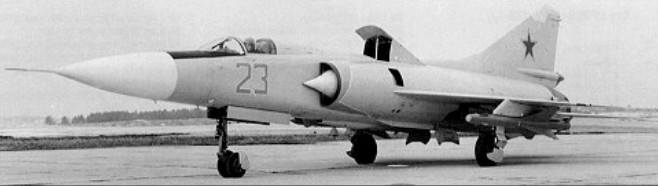
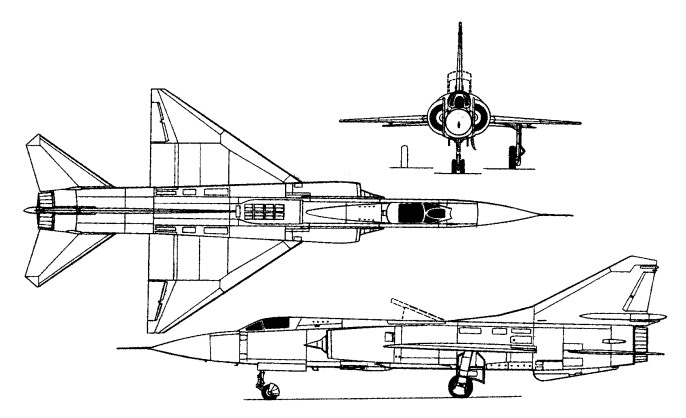
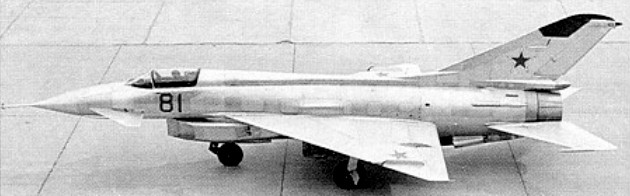
One of two parallel studies to meet a VVS requirement for a new frontal fighter capable of operating from small, austerely-equipped forward bases, the MiG-23PD – Pod’yomnye dvigateli, or, literally, “lifting engines” – or 23-01 was first flown on 3 April 1967. Featuring a 57° delta wing planform fundamentally similar to that of the MiG-21 but scaled up 73.6%, the MiG-23PD alias 23-01 featured auxiliary lift engines close to the CG. Two 2350kg Kolesov RD-36-35 engines were accommodated by a bay inserted in the centre fuselage and provided with a rear-hinged and louvred dorsal trap-type intake box and a ventral grid of transverse louvres deflecting the jet thrust during accelerating transition. A similar arrangement had been tested by the OKB in the previous year with the MiG-21PD test bed, which, with a 90cm fuselage lengthening aft of the cockpit and two RD-36-35 lift engines, had entered flight test on 16 June 1966. The primary power plant of the MiG-23PD was a Khachaturov R-27-300 of 5200kg and 7800kg with afterburning, and air was bled from the last compressor stage for flap blowing, the combination of lift engines and blown flaps reducing take-off distance to 180- 200m. Armament consisted of one 23mm GSh-23 cannon and two AAMs – one radar-guided K-23R and one IR-homing K-23T. Flight test continued until the autumn of 1967 when further development was discontinued in favour of the parallel MiG-23-11.
Engine: 1 x Khachaturov R-27-300, 5200kg – 7800kg with afterburning Max take-off weight: 18500 kg / 40786 lb Wingspan: 7.72 m / 25 ft 4 in Length: 16.80 m / 55 ft 1 in Height: 5.15 m / 16 ft 11 in Wing area: 40.00 sq.m / 430.56 sq ft
Designed to provide Frontal Aviation with a tactical fighter offering secondary ground-attack capability, and capable of meeting contemporary Western fighters on more than equal terms, the MiG-23 was designed around the primary aim of an aircraft that could operate effectively without being tied to massive concrete runways. The Mikoyan bureau is known to have adopted two approaches to this requirement: first was the Ye-23 (or Ye-230) prototype of tailed-delta configuration and incorporated high-lift devices to give STOL capability, powered by a single turbofan engine supplemented by a battery of Kolesov lift-jets amidships for VTOL operations; the alternative prototype was the Ye-231, which deleted the lift-jets and replaced the delta wing by a variable-geometry wing.
First flying in June 1967, with a decision to develop the swing-wing Ye-231 finalised probably during 1968, resulting in the pre-production MiG-23S ‘Flogger-A’ which, powered by a Tumansky R-27 turbojet with an afterburning thrust of 10200kg, first entered service for operational evaluation in 1970-71.
At about this time it must have been decided to optmise the MiG-23 as an air-combat fighter, and to develop a dedicated ground-attack parallel version, which was allocated the designation MiG-27. In consequence, aerodynamic changes were made to the MiG-23, the fuselage structure being lightened and more advanced avionics being introduced by the time the initial MiG-23M version entered service in 1973. More or less simultaneously the dedicated attack variant was developed and, while having much in common with the MiG-23, this was sufficiently different to warrant the allocation of the separate designation MiG-27.
The series production Flogger B (MiG-23M) entered service in 1973, using an R-29 engine. The High Lark radar fitted to the Flogger B gave it a limited look-down capability, improved in 1978 by the addition of an under-nose infrared sensor. The export version of the Flogger B being the Flogger E.
The MiG-23MF, known to NATO as ‘Flogger-C’, differs from other versions by having a shorter dorsal fin, new sensors and a lighter radar.
Identified by Nato are the MiG-23 Flogger K interceptor with dog¬tooth notches in the wing gloves, and the MiG¬-27 Flogger J with revised under-nose sensors and leading-edge root extensions.
There is also a MiG-23U Flogger C two-seat operational trainer, with an R-27 engine and Jay Bird radar, and featuring a longer cockpit and deeper dorsal spine.
Issued in quantity to the Soviet tactical air force, Frontal Aviation, the MiG-27 ‘Flogger-D’ has an export counterpart in the MiG-23BN ‘Flogger F’, which retains the original 125070-kg (27,557-lb) R-29 afterburning turbojet (plus variable inlets and nozzle) and twin-barrel cannon.
The Flogger G was a modified version of the Flogger B interceptor with smaller dorsal fin. The similar MiG-23BN ‘Flogger-H’, another ‘high-speed’ variant, is distinguished by two avionics pods astride the lower fuselage, forward of the nosewheel doors.
Engine: 1 x R-29B, 120.2kN Wingspan: 8.2-14.3 m / 26 ft 11 in – 46 ft 11 in Length: 16.8 m / 55 ft 1 in Height: 5.5 m / 18 ft 1 in Wing area: 27.3 sq.m / 293.85 sq ft Max take-off weight: 18000 kg / 39683 lb Empty weight: 11000 kg / 24251 lb Max. speed: 2500 km/h / 1553 mph Ceiling: 18600 m / 61000 ft Range w/max.fuel: 3000 km / 1864 miles Range w/max.payload: 960 km / 597 miles Armament: 1 x 23mm cannon, 2000kg of weapons Crew: 1
Mig-23MF Flogger B Engine: 1 x Tumansky R-29, 25,353 lb / 11,500 kg thrust Span: 46 ft 9 in / 14.25 m spread Span: 26 ft 9.5 in / 8.17 m swept Length: 59 ft 6.5 in / 18.15 m Height: 14 ft 4 in / 4.35 m Wing area: 293.4 sq.ft / 27.26 sq.m Range: 1180 mi / 1900 km Ceiling: 60,040 ft / 18,300 m Speed: 1522 mph / 2450 km Bombload: 6614 lb / 3000 kg Armament: 1 x 23 mm GSh-23L cannon Seats: 1
Mig-23 Flogger G Engine: 1 x Tumansky R-29B. Installed thrust (dry / reheat): 78.5 / 122 kN Span: 14.3 m / 8.2 m Length: 18.5 m Wing area: 27 sq.m Empty wt: 8200 kg MTOW: 18,000 kg Warload: 2000+ kg Max speed: 2.4+ Mach Ceiling: 20,000 m TO run: 900 m Ldg run: 900 m Combat radius: 1300 km Fuel internal: 5750 lt Air refuel: No Armament: 6 x AAM, 1 x 23 mm Hard points: 5
Trials in the direct-lift approach started with the MiG-21DPD to validate the basic concept, but were then taken a stage further with the Ye-230 prototype. This was built in parallel with the Ye-231 variable-geometry prototype to ensure maximum commonality for any production type resulting from the twin programmes. The Ye-230 was of tailed delta configuration, was powered by a Lyulka AL-1F-1 afterburning turbojet, and had the same type of lift engine arrangement as the MiG-21DPD, namely two turbojets (probably Koliesov units) located vertically on the centre of gravity with air drawn from above past a rear-hinged louvred dorsal door and exhausted downward through a grid of ventral transverse louvres which could be angled by the pilot to provide a forward thrust component during transition to forward flight.
The Ye-231 variable-geometry prototype was almost identical to the Ye-230 apart from its lack of lift jets and the use of variable-geometry swept wings similar to those of the General Dynamics F-111, the first operational variable-geometry warplane. Comparative trials revealed the superiority of the variable-geometry arrangement. and the Ye-231 thus became the precursor of the MiG-23 fighter, later adapted with a modified nose and simpler engine arrangements as the MiG-27 attack aeroplane.
Retaining the wing of the I-7U and designed around the 30km acquisition-range Uragan 5 radar and a pair of heavy, long-range K-8 beam-riding AAMs, the I-75 was flown for the first time on 28 April 1958.
Powered by a Lyulka AL-7F-1 turbojet offering 6240kg and 9215kg with afterburning, the I-75 flew five times before being grounded on 15 May for installation of the Uragan 5B. Testing was resumed on 25 December 1958. Although the I-75 demonstrated exceptional performance, the prototype was flown only 18 times after the resumption of the test programme, which was terminated on 11 May 1959 with the decision to adopt the competitive Sukhoi T-431 for series production (as the Su-9).
Max take-off weight: 10950 kg / 24141 lb Empty weight: 8274 kg / 18241 lb Wingspan: 9.98 m / 32 ft 9 in Length: 18.27 m / 59 ft 11 in Wing area: 31.90 sq.m / 343.37 sq ft Max. speed: 2050 km/h / 1274 mph Range: 1470 km / 913 miles
Prior to abandonment of the I-3 (I-380) without flight test owing to the Klimov bureau’s inability to develop the intended VK-3 engine to an acceptable standard for installation, a further prototype had been completed as the I-3U (I-410). Similarly intended for the VK-3 engine, the I-3U (also known as the I-5) was intended to be part of the so-called Uragan (Hurricane) automated air interception system. When, in the summer of 1956, it became evident to the MiG OKB that the Klimov engine would not be forthcoming, work began on the redesign of the aircraft to take a Lyulka AL-7F turbojet of 6240kg and 9220kg with afterburning. In this form, the aircraft became the I-7U which flew for the first time on 22 April 1957. With quarter-chord sweepback reduced from the 57 deg of the I-3U to 55 deg, the I-7U carried a pair of 30mm NR-30 cannon in the wing roots and had four wing stores stations each capable of carrying a rocket pod containing 16 57mm ARS-57Ms. On 21 June 1957, the sole prototype I-7U suffered damage as a result of the starboard undercarriage leg failing when the aircraft landed following its 13th flight. After repair, the test programme was resumed but involved only six more flights, the last of these taking place on 24 January 1958. The I-7U was then re-engined with an AL-7F-1 to become the I-75.
Further development of the basic I-3 concept with the 20,500-lb (9300-kg) thrust Lyulka AL-7F, resulted in the I-7K that first flew in January 1959 and proved capable of flight at Mach 2.35. Evolution via I-7P, and I¬7P prototypes led to the I-7SF all-weather interceptor, but this too was not ordered into production.
Max take-off weight: 11540 kg / 25441 lb Empty weight: 7952 kg / 17531 lb Wingspan: 9.98 m / 32 ft 9 in Length: 16.92 m / 55 ft 6 in Wing area: 31.90 sq.m / 343.37 sq ft Max. speed: 2300 km/h / 1429 mph Range: 1505 km / 935 miles
The I-1 led to several further developments epitomized by the I-3U (1-380) fighter-bomber beaten by the Su-22, and the I-3P (with an unknown alternative designation in the I-¬380 series) radar-equipped interceptor beaten by the Su-9. The I-3 series of fighter-bomber prototypes were powered by the 18,518-lb (8400-kg) thrust Klimov VK-3 turbojet and had about double the empty weight of the initial MiG-21 variants.
During 1953, the MiG OKB launched the design of a single-engined tactical fighter which was to utilise a wing fundamentally similar to that of the twin-engined SM-9, forerunner of the MiG-19, work on which was proceeding in parallel. Officially designated I-370 and assigned the OKB appellation of I-1, the new fighter received a Klimov VK-7 turbojet rated at 3525kg and boosted to 5235kg with afterburning. The prototype was flown for the first time on 16 February 1955, but high speed performance proved disappointing. It was therefore returned to the factory where an uprated VK-7 engine was installed, this having normal maximum and afterburning thrust ratings of 3935kg and 6270kg respectively. With a new wing, the quarter-chord sweepback of which was increased from 55 to 57 deg, the prototype was redesignated I-2 by the OKB. Limited testing of the I-2 was undertaken during which design maximum speed proved unobtainable. A further development of the basic design, the I-3 (I-380), remained unflown owing to the non-delivery of its more powerful VK-3 engine.
Max take-off weight: 8300 kg / 18298 lb Empty weight: 5086 kg / 11213 lb Wingspan: 9.00 m / 29 ft 6 in Length: 12.70 m / 41 ft 8 in Wing area: 25.00 sq.m / 269.10 sq ft Max. speed: 1452 km/h / 902 mph Ceiling: 17000 m / 55750 ft Range w/max.fuel: 2500 km / 1553 miles
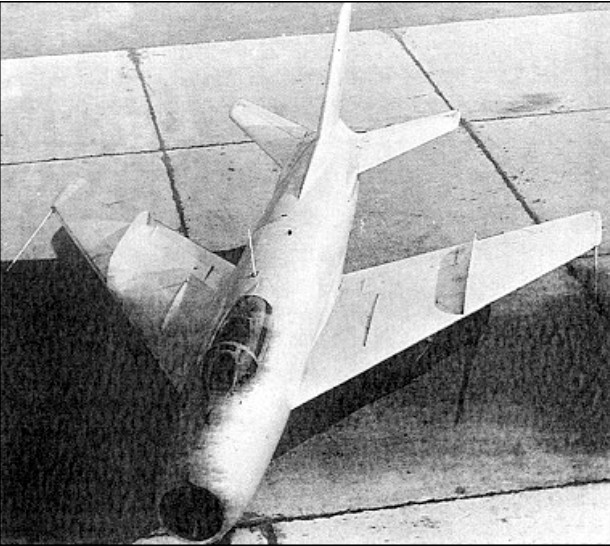
During 1961, the MiG OKB initiated work on an upgraded fighter based on the basic MiG-21PF airframe and referred to contemporaneously as the MiG-23. Assigned the OKB designation Ye-8, it featured a bifurcated ventral air intake for the R-21F engine, which, developed by N Metskhvarishvili, was rated at 4500kg and 7000kg with afterburning. A variable-incidence canard spanning 2.60m was fitted – this having been earlier tested by a Ye-6T – and it was proposed to install Sapfir 21 radar to accompany an armament of two K-13 AAMs. The first of two prototypes, the Ye-8/1, was flown on 17 April 1962, followed on 29 June by the Ye-8/2. On 11 September, the R-21F engine of the Ye-8/1 exploded at Mach=1.7 at 10000m. It was subsequently ascertained that the sixth compressor stage fan had penetrated the engine casing and had then continued on to destroy the starboard aileron. At this time, the Ye-8/2 had effected 13 flights, but the programme was abandoned.
Max take-off weight: 8200 kg / 18078 lb Wingspan: 7.15 m / 23 ft 5 in Length: 14.90 m / 48 ft 11 in Wing area: 23.13 sq.m / 248.97 sq ft Max. speed: 2230 km/h / 1386 mph Ceiling: 20000 m / 65600 ft
Designed in the 18 months following the Korean War, the Mikoyan-Gurevich bureau concentrated on a small day interceptor of the highest possible performance. Prototypes were built with both swept and delta wings, both having powered slab tailplanes, and the delta was chosen for production. At least 30 preproduction aircraft had flown by the time service delivery started.
The definitive prototypes with R-11 engines were the Ye-2A with swept wings and the Ye-5 with delta wings, these flew in May and June 1956 respectively, and were soon involved in comparative trials that showed the tailed delta configuration to have slight performance and operational advantages. The Ye-5 therefore became the basis for the Ye-6 prototype that was used to eradicate the various propulsion and flight-control problems besetting the programme, and in 1958 production was authorized of the MiG-21 fighter. The initial production version (NATO Fishbed-A) was built in only limited numbers from 1958. Power was provided by a Tumansky R-11 turbo-jet engine rated at 50kN (with after-burning). The initial MiG-21 included Fowler flaps, fully powered controls, upward ejection seat fixed to the rear of the front-hinged canopy (which incorporated the whole front of the cockpit enclosure except the bullet-proof windshield) to act as a pilot blast-shield, and internal fuel capacity of only 410 gal. Armament was two 30 mm NR-30 in long fairings under the fuselage, the left gun usually being replaced by avionics.
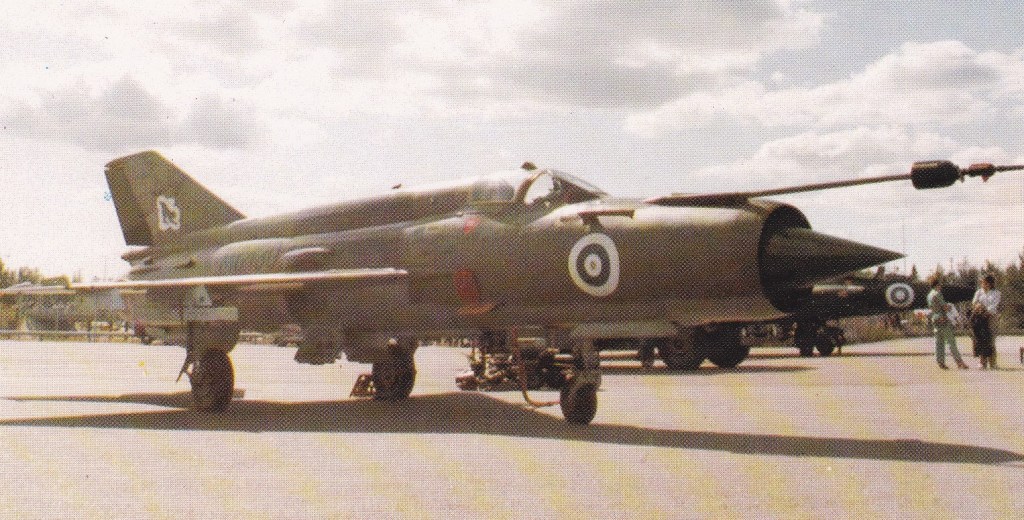
The Soviet Union had developed the K-13 (NATO Atoll) infra-red homing air-to-air missile and two pylons for two K-13 were fitted to the more powerful MiG-21F of 1959. The F became known to NATO as Fishbed-C and was a short-range clear-weather fighter (one 30mm cannon only) powered by a 56.4kN / 12,676lb st (with afterburning) Tumansky R-11. This had radar ranging, 515 gal fuel, broader fin, upward-hinged pitot boom attached under the and two dorsal blade aerials. In most 21 Fs the port cannon is removed, to save weight and provide space for the electronic pack serving two K 13A air to air missiles (AAMs), simple copies of Sidewinder called Atoll by NATO, carried on underwing rails. As the 21F matured, the fin was increased in chord and the braking parachute moved to a cylindrical box at the base of the rudder, while various aerials betrayed the presence of such standardized electronics as the UHF/VHF in the fin cap, rear warning radar (Sirena 3) and SRO series SIF/IFF (called Odd Rods by NATO). Exports began in April 1963 with the F-12 for Finland and F 13 for India (which called it Type 74) and Iraq. Czech-built aircraft (still called 21F) did not have the rear-view windows in the front of the dorsal spine. The F was also the type supplied to China in 1959 and used as the pattern for the Chinese-built F-8. As the oldest active variant it was also the first exported or seen in the West.
MiG-21F
In 1964 it was reported the unit cost to India was $500,000. India lost two of its first six in a mid-air collision in December 1963 and a second batch of six was scheduled for June 1964 delivery.
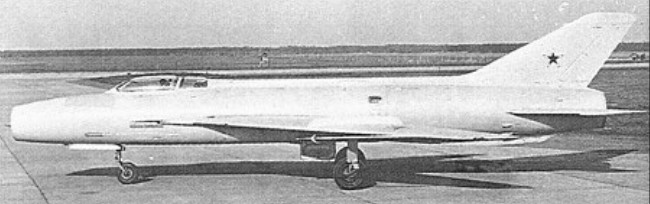
The MiG-21 programme spawned its own series of developments through various prototypes, and there were also a number of experimental and record-breaking prototypes such as the Ye-33 version of the MiG-21U operational conversion trainer used for climb and altitude records for women pilots; the Ye-66 version of the MiG-21F used for a speed record; the Ye-66A with a U-2 rocket in a belly pack for an altitude record, the Ye-66B with twin rockets; the Ye-76 version of the MiG-21PF for a number of women’s records; the Ye-8 with a powered canard foreplane to validate such a feature for the proposed MiG-2lSht attack fighter; the MiG-21DPD with two direct-lift jets in an extra fuselage bay on the centre of gravity, and the A-144 with a scaled-down version of the wing proposed for the Tupolev Tu-144 supersonic airliner. Trials in the direct-lift approach started with the MiG-21DPD to validate the basic concept.
1961 Soviet Aviation Day fly-past
At Tushino in 1961 the prototype was displayed of what became the 21PF, with inlet diameter increased from 27 in to 36 in, completely changing the nose shape and providing room for a large movable centre-body housing the scanner of the R1L AI radar. Other changes included deletion of guns (allowing simpler forward airbrakes), bigger mainwheels (causing large fuselage bulges above the wing), pitot boom moved above the inlet, fatter dorsal spine (partly responsible for fuel capacity of 627 gal) and many electronic changes.
Fishbed E is the NATO name for the C or D version with extra broad fin, relocated brake chute and restored gun armament in the form of the GP 9 belly pack housing the GSh 23 twin barrel 23 mm (0.90 in) gun, with predictor sight and simple radar ranging. The MiG 21FL, from lokator (locator), has the R2L (Spin Scan B) radar. Extra broad fin and relocated chute are standard, as is the F2S¬300 engine, but not SPS or ATO rockets. India calls this the Type 77, and it was the first version made under licence by Hindu¬stan Aeronautics, some 100 being assembled from Soviet parts in 1966 70 and about another 96 with increasing Indian content in 1970 73. The 1964 MiG-21PF ‘Fishbed-D’ was the first of a new series with search/track radar to improve all-weather capability. It has an uprated engine with afterburner and rocket ¬assisted take-off.
The MiG-21F ‘Fishbed-C’ paved the way for the MiG-21PF ‘Fishbed-D’ of 1960 with the uprated R-11F engine and an enlarged inlet to allow the incorporation of R1L ‘Spin Scan-A’ radar in the centrebody, the MiG-21PFS ‘Fishbed-E’ with blown flaps and a ventral pod carrying a 23mm GSh-23L two-barrel cannon.
A further development, the MiG-2IPFM ‘Fishbed-F’ incorporating all the sequential improvements of earlier models, was soon superseded by the MiG-21PFMA ‘Fishbed¬ J’ which is a multi-role aircraft with four underwing pylons and a GSh 23-mm twin-barrel gun. It also carries four radar-homing ‘Atoll’ air-to-air missiles.
All PF had an uprated engine, late models had take-off rocket latches and final batches had completely, new blown flaps (SPS) which cut landing speed by 25 mph and reduced nose-up attitude for better pilot view. The FL was the export PF (L = lokator, denoting R2L radar) with even more powerful engine. Like the F models rebuilt in 1963-4, this can carry the GP-9 gunpack housing the GSh-23 23 mm twin-barrel gun, has a still further broadened vertical tail and drag-chute repositioned above the jetpipe. The PFS was the PFP with SPS blown flaps, while the PFM was a definitive improved version with another 19 in. added to the fin (final fillet eliminated), a conventional seat and side-hinged canopy, and large flush aerials in the fin. One-off versions were built to prove STOL with lift jets and to fly a scaled -analogue- of the wing of the Tu-144 SST.
From the MiG 21PFM stemmed a 1966 model, the PFMA, called Fishbed J. This was a supposed multi role version with four underwing pylons, provision for a belly tank or GP 9 gunpack, either ‘Jay Bird’ radar or infrared versions of K 13A and with three tank fitted pylons to offset the reduced internal fuel capacity of 2600 litres (572 Imp gal), despite the new deep dorsal spine giving an almost straight line from canopy to fin. Other changes included a zero/zero seat (ejector seat usable at zero height and zero speed), improved weapon aiming subsystem with alpha (angle of attack) sensor in a fairing on the left side of the nose, and pitot boom offset to the right. The -J featured an internal GSh-23L cannon.
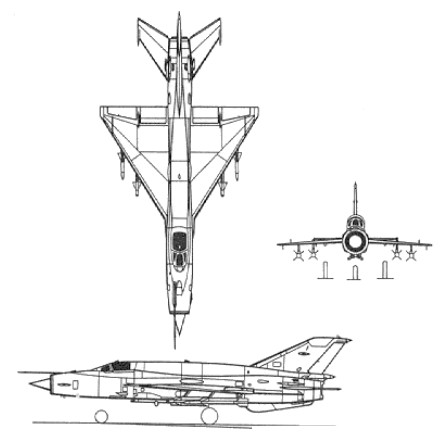
The PFMA, made in huge numbers, and since 1973 has been built in India as Type 88, produced by Hindustan Aeronautics in 1973 78. The R-13 turbojet was introduced about 1970 in the multirole MiG-21M Fishbed J. After 1971 production switched to the re-engineered third-generation MiG-2lbis Fishbed L, with more internal fuel and updated avionics. The MiG 21MF is the all weather fighter/bomber variant of the MiG 21 family. It is derived from the MiG 21 F, but is much heavier, more powerful and equipped with a large avionics suite. The original reconnaissance model was the MiG-21R Fishbed H (based on the MiG21PFMA which introduced the large dorsal spine, a common feature of the ‘Fishbed’), produced in several sub-types with equipment ranging from basic internally-mounted optical cameras (occupying the area previously used to accommodate the integral twin-barrelled GSh-23 23-mm cannon armament) to an external pod system known to house forward and oblique cameras plus infra-red linescan apparatus. Powered by a single Tumansky R-11 turbojet, all variants of the MiG-21R can also operate with wingtip-mounted electronic countermeasures pods. More recently, the principal ‘Fishbed H’ reconnaissance derivative was the MiG-21RF which is essentially similar to the MiG-21MF in relying on the Tumansky R-13-300 engine offering greater power and featuring increased airflow despite being no larger. Sensor packages and equipment are probably the same as those incorporated in the earlier MiG-21R variant.
(23+99) Mikoyan-Gurevich MiG-21 US 01685134 – marked 215
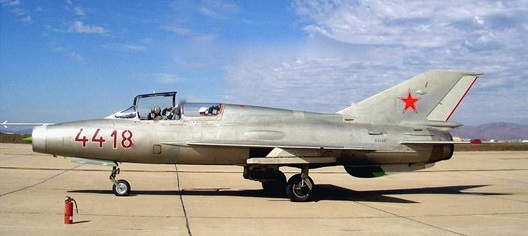
Other versions include the MiG-21U, MiG-21UM, and MiG-21US NATO code name Mongol two-seat operational trainer and the ‘Fishbed-K’ which had modifications to the airframe of the basic ‘MF’ type. The Mongol A was a conversion of the Fishbed C, while the Mongol B had broad chord fin of the later single seat variants.
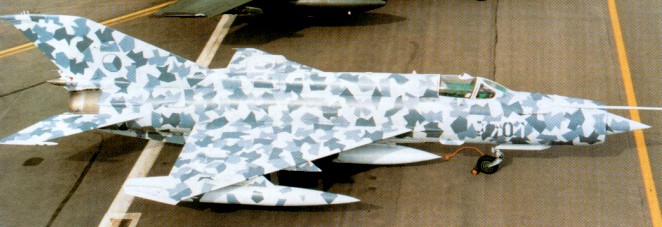
The first of the third-generation types was the MiG-21bis ‘Fishbed-L’ with a stronger yet lighter airframe and updated avionics.
The 1987 final MiG-21bis ‘Fishbed-N’ has the 73.6kN-thrust Tumansky R-25 turbojet and provision for more modern weapons. Indian licence manufacture was scheduled to end early in 1987. Also licence built in China as the Shenyang J-7 types (F-7 for export).
Code-named Mongol and called Type 66 in India, the U is the tandem trainer, the US has SPS flaps and UM the R-13 engine and four pylons. Many other versions have been used to set world records. About 10,000 MiG-21s have been built, and among users are Afghanistan, Algeria, Bangladesh, Bulgaria, China, Cuba, Czechoslovakia, Egypt, Finland, East Germany, Hungary, India, Indonesia, Iraq, North Korea, Poland, Romania, Syria, Vietnam and Yugoslavia.
In 1963 pilots assigned to test India’s MiG-21’s claimed to have reached mach 2. Previously rated at mach 1.7, this implied the USSR was supplying R37F engines estimated at 13,00 lb thrust with afterburner as used in the E-66 world speed record holder. The Indian government had asked USSR for other “modifications” and had received seven so far. Indian production was planned to begin by the end o 1965.
Over 15 variants were developed and more than 8000 aircraft were produced. Pakistan is still taking delivery of improved versions of the F-7, produced by China, to replace its Chinese F-6 aircraft (basically an improved version of the MiG-19). The MiG-21-93 is one of the upgrades for the Fishbed, especially Indian MiG-21s are or will be upgraded to this version. Also IAI introduced an upgrade package, called the MiG-21-2000, Elbit refurbished and updated Romanian MiG-21s to the MiG-21 Lancer standard.
Produced from 1959 to 1985, not including the Chengdu J-7 variant, 10,645 were produced in the USSR, 657 in India, and 194 in Czechoslovakia.
MiG-21F (Fishbed-C) Engine: Tumanski R37F (4500/6000kp) Length: 44.16 ft / 13.46 m Height: 14.764 ft / 4.5 m Wingspan: 23.458 ft / 7.15 m Wing area: 247.572 sqft / 23.0 sq.m Max take off weight: 17088.8 lb / 7750.0 kg Weight empty: 12017.3 lb / 5450.0 kg Max speed: 1145 kts / 2120 km/h Service ceiling: 57415 ft / 17500 m Wing load: 69.09 lb/sq.ft / 337.0 kg/sq.m Maximum range: 999 nm / 1850 km Range (max. weight): 648 nm / 1200 km Crew: 1 Armament: 1 MG 30mm, 2x Atoll A/AM
MiG-21FA Engine: 1 x Tumansky single-shaft turbojet with afterburner Wing span 23 ft 5½ in (7.15 m).
MiG-21FL Engine: 1 x Tumansky R-11-G2S-300 single-shaft turbojet with afterburner, 13,668 lb (6200 kg) Wing span 23 ft 5½ in (7.15 m)
MiG-21PF (Fishbed-D) Radar inlet centrebody Powerplant: one 60.00 kN (22,110 lb st) Tumanskii R-11 F2-300 turbojet with afterburning Fuselage length 12.285m (40 ft 3½ in) Height 4.806m (15 ft 9 in ) Wing span 7.154m (23ft 5½ in) Take-off weight (clean) 7,750 kg (17,085 lb) Max Take-Off Weight estimated 8,800 kg (19,400 lb) Max level speed at 13,000m (42,650 ft) Mach 2.05 or 2,175 km/h (1,353 mph) Max level speed at sea level Mach 1.2 or 1,300 km/h (809 mph) Service ceiling 19,000m (62,320 ft) Armament: 2 R-13R (AA-2 Atoll) IR air-to-air missiles or two rocket pods, with each up to 16 57mm unguided rockets, carried on two underwing pylons and one 490 liter (129 gal) drop tank carried on the centre line
MiG-21PFS (Fishbed-E) Engine: 1 x Tumansky R-11-G2S-300 single-shaft turbojet with afterburner, 13,668 lb (6200 kg) Wing span 23 ft 5½ in (7.15 m).
MiG-21PFM (Fishbed-F) Blown flaps Engine: 1 x Tumansky R-11-G2S-300 single-shaft turbojet with afterburner, 13,668 lb (6200 kg) Wing span 23 ft 5½ in (7.15 m).
MiG-21PFMA (Fishbed-J) Type: single-seat fighter Engine: 1 x Tumansky R-11-G2S-300 single-shaft turbojet with afterburner, 13,668 lb (6200 kg) Wing span 23 ft 5½ in (7.15 m).
MiG-21 Fishbed K Engine: 1 x Tumanski R-13-300, 14,550 lb / 6600 kg thrust Empty weight: 12,302 lb / 5580 kg Wingspan: 23 ft 5.5 in / 7.15 m Length: 51 ft 8.5 in / 15.76 m Height: 13 ft 5.5 in / 4.10 m Wing area: 247.6 sq.ft / 23.0 sq.m MTOW: 20,723 lb / 9400 kg Speed: 1385 mph / 2230 kph Ceiling: 50,000 ft / 15,250 m Range: 460 mi / 740 km Bombload: 3307 lb / 1500 kg Armament: 1 x 23mm GSh-23L cannon Seats: 1
MiG-21PFMA Engine: Tumanski R-11F2S-300, 13,668 lb. Wingspan: 23 ft 5.5 in / 7.15 m Length: 51 ft 8.5 in / 15.75m MTOW: 20,725 lb / 9400 kg Max speed: 1335 mph / 2150 kph Ferry range: 1118 sm / 1800 km Armament: 1 x 23 mm cannon (200 rds), up to 2000 kg external load.
MiG-21M Engine: 1 x Tumansky single-shaft turbojet with afterburner Wing span 23 ft 5½ in (7.15 m)
MiG-21MF Fishbed-J Engine: 1 x Tumansky R-13-300 single-shaft turbojet with afterburner, 14,550 lb (6600 kg) Wing span 23 ft 5½ in (7.15 m) Length (excluding probe): 48 ft ½ in (14.6 m) Height: 14 ft 9 in (4.5 m) Empty wt: 12,346 lb (5600 kg) MTOW: 21,605 lb (9800 kg) Maximum speed: 1,285 mph (2070 km/h, Mach 2.1) Initial ROC (clean): 36,090 ft (11,000 m)/min Service ceiling: 59,050 ft (18,000 m) Range (high, internal fuel): 683 miles (1100 km) Maximum range (high, three tanks) 1,118 miles (1800 km)
Mikoyan Gurevich OKB MiG 21 MF Engine: Tumanski R-11, 637650 N / 65000 kp Length: 45.932 ft / 14.0 m Height: 14.764 ft / 4.5 m Wingspan: 23.458 ft / 7.15 m Wing area: 247.572 sqft / 23.0 sq.m Max take off weight: 20727.0 lb / 9400.0 kg Max speed: 1204 kts / 2230 km/h Wing load: 83.85 lb/sq.ft / 409.0 kg/sq.m Range: 972 nm / 1800 km Crew: 1 Armament: 2x MG 23mm/100rds, 2-4 Atoll o. 1000kg / 4 St.
MiG-21SMT/SMB (Fishbed-K)
MiG-21bis-A (Fishbed-L) Engine: Tumansky R37F (4500/6000kp) Wing span: 23 ft 5.5in (7.15 m) Length: 45.932 ft / 14.0 m Height: 14.764 ft / 4.5 m Wing area: 247.572 sqft / 23.0 sq.m Max take off weight: 19514.3 lb / 8850.0 kg Weight empty: 12017.3 lb / 5450.0 kg Wing loading: 78.93 lb/sq.ft / 385.0 kg/sq.m Max speed: 1145 kts / 2120 km/h / M 2.11. Initial climb rate: 29527.56 ft/min / 150.00 m/s Service ceiling: 57415 ft / 17500 m Range: 999 nm / 1850 km Crew: 1 Armament: 2x ext. 500kg zB 2x Atoll A/A
MiG-21bis-B (Fishbed-N) Powerplant: one 69.61 kN (25,650 lb st) Tumanskii R-25-300 turbojet with afterburning Fuselage length 12.285m (40 ft 3½ in) Height 4.10m (13 ft 5½ in) Wing span 7.154m (23ft 5½ in) Take-off weight (clean) 8,725 kg (19,235 lb) Max Take-Off Weight 10,400 kg (22,925 lb) Max level speed at 13,000m (42,650 ft) Mach 2.05 or 2,175 km/h (1,353 mph) Max level speed at sea level Mach 1.4 or 1,450 km/h (902 mph) Service ceiling 17,800m (58,400 ft) Armament: one 23mm GSh-23L two-barrel cannon with 200 rounds; 1500 kg (3,307 lb) of disposable stores, Hardpoints: five (including centre line)
MiG-21bisF Fishbed N Single seat multi-role fighter Engine: Tumanskii R-25, 16,535 lb / 7500 kg Wingspan: 23 ft 5 in / 7.15m Height: 13 ft 5 in / 4.10 m Wing area: 247.58 sq.m / 23.00 sq.m Empty weight: 22,464 lb / 5200 kg Max TOW: 17,549 lb / 7960 kg Max speed: 1385 mph / 2229 kph / M2.1 at 36.090 ft / 11,000m Iniial rate of climb: 57,900 fpm / 17,675 m/min Service ceiling: 50,030 ft / 15,250m Eange: 721 miles / 1160 km Armament: 1 x 23mm twin barrel cannon Bombload: 4409 lb / 2000 kg
MiG-21R Type: single-seat reconnaissance Wing span 23 ft 5½ in (7.15 m).
MiG-21RF Type: single-seat tactical reconnaissance aircraft Powerplant: one Tumansky R- 3-300 turbojet, 6600-kg (14,550-1b) afterburning thrust Maximum speed at sea level 1300 km/h (810 mph) or Mach 1.06 Maximum speed at altitude 2230 km/h (1,385 mph) or Mach 2.1 Service ceiling 17500 m (57,400 ft) Range with maximum fuel 1670 km (1,038miles) Maximum take-off weight 9400 kg (20,723 lb) Wimgspan 7.15 m (23 ft 5 ½ in) Length 15.76 m (5 1 ft 8 ½ in) Height about 4.06 m (13 ft 4 in) Wing area 23.00 sq.m (247.6 sq ft).





 All Aero