A single-seat very-light multipurpose pusher monoplane (first flown in 1990 as MAI-89 prototype), also available in autogyro and training glider forms.
Monoplane
Moscalev SAM-9 Strela

It was that VM Molotov’s international espionage system had received information about the development in the United States of a low aspect ratio aircraft designed by the Russian émigré Glukhariev. When asking the TsAGI about the subject, the scientists from this institution could not give an objective answer, since they generally worked on more conventional designs. About six months later the information reached Stalin, who paid great attention to aviation and decided that behind that news there must be an important aeronautical development. Suddenly someone remembered about Moscaliev’s shelved project “Sigma”. It was decided without fail to call him to Moscow.
After exposing the characteristics of the “Sigma” project and defending the theory of the development of aircraft with this scheme and reactive engines as a way to achieve high speeds, Moscaliev received the task of building an aircraft analogous to the “Sigma” in the OKB-31 and submit them for state testing. The TsAGI was ordered to carry out experimental work in the wind tunnel on a scale model and the additional task of beginning studies and developing a low aspect ratio model. Its construction was assigned to the specialist of the TsAGI Kamniemostski.
For Moscaliov’s new plane, two 140 hp Renault 4 pi engines were purchased and the decision was made to name the model Moscaliev SAM-9 “Strelá” (Arrow) (Russian: Москалёв САМ-9 «Стрела»), due to the shape of its fuselage in the plane. Moscaliev was given two and a half months to get the prototype ready. The short time was motivated by Stalin ‘s interest and the need of the TsAGI to give a quick response.
The conceptual project of the new aircraft was developed by Moscaliev still in Moscow . For this purpose, Professor Cheremujin ‘s office at the TsAGI was lent to him and he was assigned cartoonists and copyists. This project was ready in just three days.
The general composition of the new aircraft was approved by TsAGI Victor Pavlovich Gorski. In general, the “Strelá” kept the wing shape of the “Sigma” but lacked the horizontal surfaces at the wing tips, presenting a conventional empennage with rudder.
It was agreed to work in parallel in two directions: the creation of a mock-up for the development of the tests at TsAGI, under Gorski’s tutelage, and the construction of the aircraft at the Voronezh Aviation Technology under the direction of Moscaliev. The construction of the aircraft without having received the checks from the TsAGI represented a great risk, but the short time allotted to the task did not allow another sortie. Moscaliov ‘s OKB was isolated to dedicate itself exclusively to this new task, which had a strategic character and for that reason it worked with a high level of secrecy. In the agreed two and a half months the new aircraft was found finished. In the numbering of the company it became known as SAM-9.
The SAM-9 “Strelá” was entirely in wood with plywood and fabric covering.
The triangular shaped wing with elliptical sides and rounded base had a very low aspect ratio with an aspect ratio of 0.975. It was also characterized by the use of a very thick profile (RAF-38 modified) that started right from the nose. The wing structure consisted of three spars and box-type ribs with plywood covering. The control surfaces was carried out by means of cables.
The wing trailing edge was made up of two large-area control surfaces, which served as elevators. By reaching unequal angles these surfaces could also be used as spoilers.
The fuselage was integrated into the wing with a smooth transition and ended in a large-area empennage.
The landing gear was of the conventional type with a tail skid. The main undercarriage was cantilever type and fairings, featured unique balloon wheels.
The pilot was located in a closed cabin located on the wing with transparent cover. The power plant consisted of a 140 hp MV-4 engine (licensed version of the French Renault 4 pi) moving a 2.2 meter diameter Ratier wooden propeller.

The prototype was ready for the beginning of the summer of 1937. By that time, the necessary calculations and static resistance tests had been carried out. In parallel, tests were carried out in the TsAGI wind tunnel under the direction of VP Gorski. The results obtained allowed fine-tuning the details of the aerodynamic calculation, stability, definition of the center of gravity and the ideal size for the control surfaces.
It was decided to carry out the tests of the prototype in a remote airfield, used as a reserve base for long-range bomber aviation and located about 10 kilometers from Voronezh. As a test pilot, AN Gusarov was selected, who since the end of 1936 had left his position as head of the flight group of the Voronezh flying club and joined OKB-31.
Ground tests began on July 27. The new aircraft responded acceptably to the controls, behaving well in turns on the runway, increasing speed quite well and maintaining course without difficulty with the tail off the ground. The pilot was astonished to see that at a speed of only 70 – 80 km/h the plane voluntarily detached itself from the ground.
The factory test evaluation commission included the pilot, Moscaliov himself and a group of specialists made up of LB Polukarov, SA Zavyalov, NA Marietski and Dolgov. In August this commission was reinforced with the arrival of a government commission from Moscow. After once again reviewing the documentation, it was decided to proceed with the development of the tests. Due to the lack of a standard to define the structural resistance of this new concept, Professor VN Belyayev was asked to review the calculations and the results of the static tests, in order to give the go-ahead for the start of the flights.
After Belyayev’s positive assessment, it was decided that the flight tests would be entrusted to experienced test pilot Boris Nikolayevich Kudrin, who had previously tested unconventional configuration aircraft produced by Cheranovski and other Soviet builders.
Arriving at the site, Kudrin watched the plane for a long time, checking its parts. He reviewed the calculations and finally told the commission that he would not only not fly the plane, he would not even conduct ground tests on such a strange device. According to Moscaliev ‘s own words in his memoirs, the pilot Kudrin stated that he would not fly in an airplane “… that not only did not have a tail, but also lacked wings”
After several discussions, it was decided to continue the tests with factory pilot AN Gusarov, who gladly agreed to fly the prototype. Soon tail-up racing around the track began again. These were successful if one discounts an incident in which, during a race on the runway, the pilot stepped on the pedals and the plane suddenly went into a spin and overturned. Luckily neither the aircraft nor its pilot received damage due to the low speed and the grass on the runway. The plane was returned to its position on the wheels and the pilot, after starting the engine, headed towards the starting point. As a result of this incident, steel tube protection was added to the cabin deck.

Finally, the first flight was authorized, which was carried out by Gusarov on August 7, 1937. Around 10:30 a.m., after raising the tail of the plane, reaching about 150 km/h, it took off about 20 meters from where the commission was, making a dangerous turn that almost placed the planes in a vertical position to the ground, to then straighten out. After a flight of about 1,200 – 1,500 meters, the plane touched down.
Despite the pilot’s opinion that he maintained control over the plane at all times, the commission considered that the flight could have ended in a catastrophe and only the pilot’s expertise saved the plane. As a result it was decided to continue the tests in Moscow.
The aircraft was transferred on the bed of a truck to the TsAGI NII, located at the Central Aerodrome in Moscow. The tests this time were started from scratch. The races around the track were carried out by practically all the LIS pilots – Korzinshikov, Chernavski, Rybko, Ribushkin and even the LIS boss NF Kozlov, but no one showed up wanting to fly it. During these evaluations, well-known USSR test pilots such as Gromov, Alexeyev, Stefanovski and Chkalov were present, who expressed doubts about the flight possibilities of the plane, which increased the misgivings of the pilots to raise it. Finally, Gusarov decided to try again.
The flight was carried out with extreme care. The plane rose about one meter from the ground and after testing the operation of the ailerons it landed. Realizing that the model could fly and was capable of responding to commands, the SAM-9 executed several short, low-altitude jumps flown by Chernavski, Rybko , Ribushkin and others.
Nikolai Stepanovich Rybko was selected as test pilot who started the systematic flight program. Starting with short duration flights, he gradually increased the range until he achieved more than 1 kilometer. On August 27, Rybko reported that he was ready to carry out a real test flight that was carried out the following day and in which the plane failed to increase the altitude, so the pilot was forced to land at the neighboring Aeroclub Central aerodrome, in Tushino. The reason for the lack of height was the requirement of the new scheme for angles of attack greater than 22º to achieve ascent, motivated by the low engine power.
In the month of September a new flight was carried out, which was completely successful. The next flights of the SAM-9 were carried out already in winter on Lake Plesheyevo on skis and later again in Moscow. The tests lasted until the middle of 1938 and in them the performance of the airplane was fixed, despite the fact that it was understood that with a Wheel undercarriage the results should be superior.
In August 1938 the “Strelá” was returned to the OKB with a detailed report of the conclusions about his scheme and the request to solve a small problem of oscillations that appeared to fly at low speeds. Due to the secrecy of the project, the plane was packed in a big box and moved by train to Factory No.18.
After small modifications that included increasing the empennage area by 30% and installing vertical surfaces at the tips of the wings, further tests were carried out by AN Gusarov, which yielded a top speed of 343 km/h.
At the end of these flights and following orders from Moscow, the SAM-9 “Strelá” plane, which had already fulfilled its mission, was destroyed.
SAM-9 “Strela”
Power plant: 140 hp MV-4
Prop: 2.20 m diameter Ratier
Wingspan: 3.55 m
Wing area: 13.00 m²
Length: 6.15m
Empty weight: 470 kg
Maximum takeoff weight: 630 kg
Wing loading: 48.5kg/m²
Power load: 4.5kg/hp
Fuel + oil load: 60 + 10kg
Maximum speed: 310 km/h
Landing speed: 102km/h
Service ceiling: +1500 m
Landing run: 100m
Take-off run: 200m
Accommodation: 1

Moscalev SAM-25
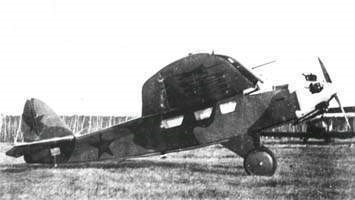
In parallel with the development of the RM-1 interceptor, Moscaliev ‘s OKB was engaged in the design of a new version of the SAM-5-2bis transport, which was designed as a staff liaison and light transport aircraft.
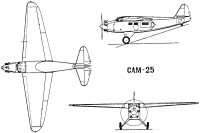
The Moscaliev SAM-25 (Russian: Москалёв САМ-25) six-seat aircraft was modified with a new, more mechanized wing with TsAGI R-2s profile, featuring leading and trailing edge flaps. The leading edge flaps were automatically engaged when the aircraft reached certain angles of attack. The ailerons could be used together with the flaps during takeoff and landing, which gave it excellent characteristics in these operations. Despite the low power of the 140-hp M-11E engine, the aircraft guaranteed an excellent speed of 230 km/h and a load capacity of 505 kg. The rest of its characteristics fully matched those of the SAM-5-2bis and SAM-14 aircraft.
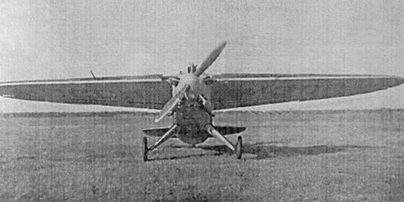
In the spring of 1943 the prototype was ready for state tests, which were carried out at the range of the Air Landing Troops.
At this time there was a difficult situation with the guerrilla groups from Belarus. The fascists had created non-regular groups in that region, formed in many cases by Soviet traitors who looted and plundered villages and towns, terrorizing and massacring the civilian population. The civilian settlers ran to the forests in search of support from the guerrillas. This resulted in the guerrilla camps being filled with civilians, mainly women, children and the elderly, which worsened the situation of these forces, as they lost their mobility and found it difficult to feed and maintain all those people. To assess the situation created from Moscow, the official Schervakov flew there, who, after analyzing the situation, informed Stalin that it was necessary to proceed without delay.
This was the cause of the urgent request to Moscaliev to proceed with the construction of 50 AM-14 gliders with great urgency.
Stalin ordered Schervakov to return to Moscow, but the task was beyond the reach of any of the VVS planes.
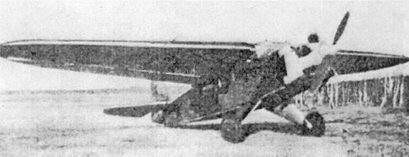
Only the SAM-25, which was being tested, had excellent takeoff characteristics, with a run of only about 40 meters, which suggested a chance of success. The SAM-25 also had excellent range. On this plane the pilot A. Dabajov managed to pick up Schervakov and transport him to Moscow.
The SAM-25 aircraft was evaluated positively and the Landing Air Forces (VDV) raised their need for an aircraft like this, with takeoff and landing characteristics close to that of the German Fieseler Fi-156 Storch. The VDV command requested an urgent delivery of a series of aircraft to be built at Factory No.499 in 1944, which at that time had the productive capacity for its production. The request was not approved and the head of the NKAP 11 directorate, IV Kulikov, who called Moscaliev to Moscow and forbade him to take the request from the military. This decision marked the fate of the new model.
Developments of the basic model as a night bomber, attack plane and ambulance did not go beyond the drawing board, mainly due to the end of the war.
SAM-25
Engine: 140 hp M-11E
Wingspan: 11.49 m
Wing area: 21.86 m²
Length: 8.02m
Height: 3.86m
Empty weight: 846 kg
Maximum weight: 1280 kg
Power load: 5.5 kg/hp
Fuel load: 95 kg
Oil load: 10 kg
Maximum speed SL: 228 km/h
Maximum speed at altitude: 170 km/h
Cruising speed: 168 km/h
Practical range: 1760 km
Service ceiling: 4850 m
Payload: 6-7 passengers
Crew: 1
Moscalev SAM-11 Bekas
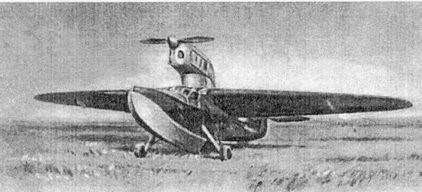
The SAM-11 training amphibian was developed in parallel with the Moscaliov SAM-10 and was designed with the same powerplant, the Bessonov MM-1 inverted linear engine. Its origins are based on a Naval Fleet Aviation (AVMF) request made to Moscaliev, which was originally scrapped due to the absence in Voronezh of a surface on which to test.
The Moscaliev SAM-11 Bekas (Russian: Москалёв САМ-11 «Бекас») amphibian was designed for training and liaison.
The designation SAM-11 in the OKB-31 and the name “Bekas” (Woodcock or Chocha), follows a custom of those years of assigning names of seabirds to flying boats.
Specialists from the naval department of TsAGI participated in the general configuration and a scale model was tested.
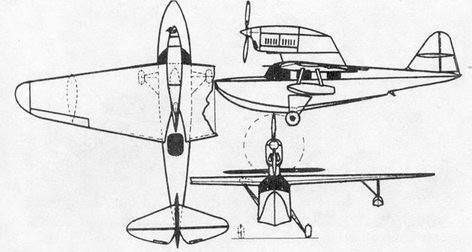
The SAM-11 amphibian was designed as a two-seat monoplane with a high cantilever wing with fixed stabilization floats on the wing consoles. All construction was made of wood. To speed up work, the wing and tail unit were taken from the Moscaliev SAM-10 with minor modifications such as openings to collect the wheels.
The double hull was built in wood with a waterproof resin coating and fabric. The use of wood and the need for reinforcement made the SAM-11 about 200 kg heavier than the SAM-10.
The powerplant consisted of the Bessonov designed 220 hp MM-1 inverted 6-cylinder inline engine, driving a tractor propeller and was located on a faired strut located directly above the fuselage.
The main landers of the landing gear were in the form of consoles that pivoted on the sides of the fuselage to be collected inside the wing by means of a pneumatic system. With the wheels retracted into the wing, the landing gear was exposed as studs, so they were carefully faired. The wheels and structure of the landers were generally similar to those used on the Moscaliov SAM-5-2bis. The tail unit was fixed and was located at the rear of the second rediente.
The monoplane-type tail had stabilizers located high on the empennage.
The cockpit housed two pilots with dual control and featured access through the deck and a drop-down door located on the port side. The passenger cabin had a capacity for 2-3 passengers and access to it was through an opening located in the upper part of the hull, behind the wing.
In general, the SAM-11 had a small load capacity, only 306 kg, with a weight delivery of only 22%, but this was not a limitation considering its conception as a training and liaison aircraft for the VMF.
The prototype was completed by Voronezh Institute of Technology by the end of July 1938 and flight tests began in mid-August.
The first flights in a wheeled configuration were successfully carried out by the factory test pilot AN Gusarov. Takeoff and landing tests were performed directly on the runway of the OKB-31 at the factory. During these flights the aircraft demonstrated excellent air handling and good control. The only negative point was the behavior during the approach glide to the runway, when tbufting appeared, which was soon solved by slightly modifying the engine mount. Despite its amphibious configuration, the aircraft demonstrated good speed.
Since the beginning of the flights, a search had been made for a surface of water with the necessary conditions, which was found in the vicinity of Voronezh. They wanted to avoid having to take the plane to the Black Sea (where the naval LII was located) without having carried out at least some initial tests of the model’s behavior in water beforehand.
Finally the necessary site was found, a small lagoon not far from the city and large enough to carry out the operations. Tests on water, on the recommendation of the contractor, would be carried out by test pilot P. Ya. Yakovlev, belonging to the Naval Fleet Aviation Flight Research Center (LII VVS VMF). First, the lagoon was explored from the ground and from the air in a Polikarpov Po-2. Later, a group of OKB-31 workers went to the lake to guarantee the necessary conditions: clearing the road to the water, setting up tents for specialists, signage, among others. Lastly, the SAM-11 plane was transferred.
The tests were carried out successfully despite the poor conditions. The SAM-11 took off and landed easily in the water. It was impossible to test the behavior with waves.
Upon returning to Voronezh, the model began to be prepared for the state tests, which were to take place in Sevastopol, at the LII VVS VMF. Finally the plane was sent there together with a group of OKB-31 collaborators, under the direction of LV Polukarov.
The state tests were carried out in the period September-October 1940. As test pilot was selected P. Ya. Yakovlev. The tests on the sea differed considerably from the tests carried out in the calm lagoon and from the first flights with maximum load a tendency to raise splashes was observed, which had to be solved by adding horizontal surfaces to the sides of the bow that deflected the water flow out.

The tests went smoothly. In the conclusions it was highlighted that the SAM-11 responded to the requirements of a training amphibian and its serial production was requested, also pointing out some difficulties, which had to be corrected in the modified model with a new MV-6 power plant, which would serve basis for series production.
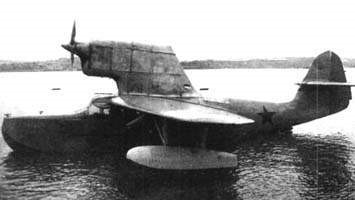
The second prototype, known as the SAM-11bis, rectified the findings made during state testing and introduced a new MV-6 inverted-in-line-6 powerplant, which was the engine selected for series production.
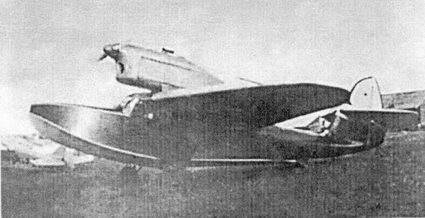
Unfortunately, the change of engine, like the Moscaliov SAM-10 bis, did not improve performance, mainly due to the absence of a suitable propeller. The tests were carried out with a fixed-pitch wooden propeller, which due to the higher revolutions of the MV-6 engine, decreased its effectiveness. It was proposed to install a French Ratier metal propeller on the model, but this change was never made.
The SAM-11bis model was not produced for the same reasons as all other models designed to use Renault engines produced in the USSR under license by MV. These engines proved not to be prepared to operate in the harsh winter conditions of the USSR and in 1939 they were taken out of production.
The OKB-31 collective had also worked on a military version in which the second cabin was fitted out to house an artilleryman who operated a pair of ShKAS machine guns. This version had no development.

SAM-11
Power plant: 1 x 220 hp MM-1
Wingspan: 11.49 m
Wing area: 20.20 m²
Length: 8.74m
Empty weight: 1094 kg
Normal takeoff weight: 1400 kg
Wing loading: 64.5 kg/m²
Power load: 6.4 kg/hp
Load capacity: 2 passengers or 306 kg
Maximum speed at sea level: 225 km/h
Maximum speed at 2400 m: 240 km/h
Takeoff speed: 100 km/h
Landing speed: 85km/h
Service ceiling: 5600 m
Accommodation: 2
SAM-11bis
Powerplant: 1 × 220 hp MV-6
Wingspan: 11.49 m
Wing area: 20.20 m²
Length: 8.74m
Empty weight: 1030 kg
Normal takeoff weight: 1350 kg
Wing loading: 62.0 kg/m²
Power load: 6.2 kg/hp
Load capacity: 2 passengers or 320 kg
Maximum speed at sea level: 217 km/h
Maximum speed at 2400 m: 240 km/h
Landing speed: 85km/h
Service ceiling: 5600 m
Time to 3000m: 17.2min
Time to 5600m: 1h 03min
Range: 900km
Landing run: 110m
Take-off run: 200m
Accommodation: 2
Moscalev AM-14 / Antonov AM-14
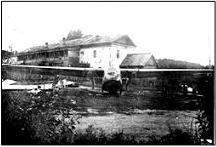
In September 1941 the Germans were approaching Voronezh, but even under these circumstances the aviation factory continued to deliver Il-2 assault aircraft to the front. At the beginning of September 1941, the decision was made to evacuate Factory No. 18 and OKB-31 led by Moscalev.
The new production base was established in the Siberian village of Zavodoukovsk, located in the Tyumen Oblast, where a new factory was organized that was numbered 499. AS Moscalevwas selected as director and main constructor.
Some time later the factory began to deliver the Antonov A-7 7-seater landing glider productions and a little later the A-2 training gliders, from the same manufacturer.
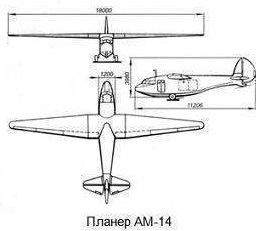
At the end of 1942 A. S. Moscalevwas given the task of modernizing the A-7 glider. The task envisaged the development of an enlarged version with capacity increased to 14 people, which was renamed AM-14 (Antonov – Moscalev14 seats, in Russian Антонов / Москалёв АМ-14). The prototype was built in Factory No. 499 in 1943.
Modifications to the base model included lengthening the central region of the fuselage by 670 mm, increasing the wing area and tailplane span, and increasing the diameter of the wheels.
After the tests, which were carried out successfully, Factory No. 499 began serial production of the model.
At the end of May 1943, A. S. Moscalev was tasked with urgently producing 50 AM-14 landing gliders at Factory No. 499, to be used in a supply mission to Belarusian guerrillas in the Minsk region. The gliders had to be prepared to carry fuel, weapons and ammunition, including cannon. The request established a delivery time of only 25 days for the 50 gliders and its fulfilment was personally followed by Stalin.
The glider launch operation over Belarus was kept a great secret, so for the Germans it was totally unexpected. This operation was led by the Air Landing Troop Headquarters and was planned to be carried out at night. Ilyushin DB-3F and Lisunov Li-2 towed gliders Moscalev and Gribovski pairs, releasing about 50 to 60 km from the target. The guerrillas had prepared surfaces for landing and at the agreed time they lit bonfires as signalling. This operation was successful and allowed the Belarusian partisans to achieve significant successes against the fascist groups.
For their contributions to support the partisans, the designers OK Antonov, AS Moscalev and VK Gribovski received the 1st level “Guerrilla of the Great Patriotic War” medal, which was one of the few exceptions for the delivery of this medal to personnel from the deep rear.
AM-14
Wingspan: 18.0 m
Wing area: 29.10 m²
Aspect ratio: 11.2
Length: 11.20 m
Empty weight: 1080 kg
Wing loading: 84 kg / m²
Surface of the horizontal plane: 3.97 m²
Vertical plane surface: 3.24 m²
Spoiler area: 2.7 m²
Glide ratio: 18
Crew: 1
Carrying capacity: 14 soldiers equipped
Moscalev SAM-23
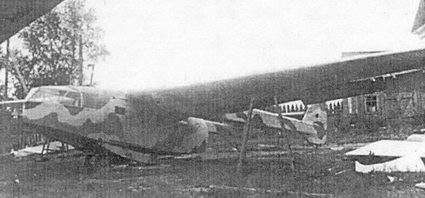
The Moscalev SAM-23 Москалёв САМ-23 (second use of the name) glider designed as transport landing capable of carrying 22 soldiers or light military vehicle and was designed in OKB of Moscaliov, taking into account the experience in the operation of the AM-14.
The SAM-23 featured a monoplane structure with a high cantilever wing with a double tail cone, ending in a double empennage and a short central nacelle.
The cockpit and the cargo cabin were located in the fuselage. The rear cover of the fuselage could be removed to allow loading. The SAM-23 allowed the transport of 22 equipped soldiers, a tank, a light vehicle or a cannon with its crew.
The glider’s landing gear consisted of two skis with shock absorbers and two landing pads on the tail. Take-off was carried out by means of a wheelbarrow that was released when the glider separated from the ground.
Construction of the prototype at Factory No.499 was completed in 1944 and it successfully passed state tests. The serial production of the model was not authorized since the glider with similar tasks Tsybin / Koliesnikov TsK-20 was already being produced in series at that time.
SAM-23
Wingspan: 16.5 m
Wing area: 38.00 m²
Aspect ratio: 7.2
Length: 12.5 m
Carrying capacity: 20 equipped soldiers or a light car
Crew: 1
Moscalev LT / SAM-23 Bloja

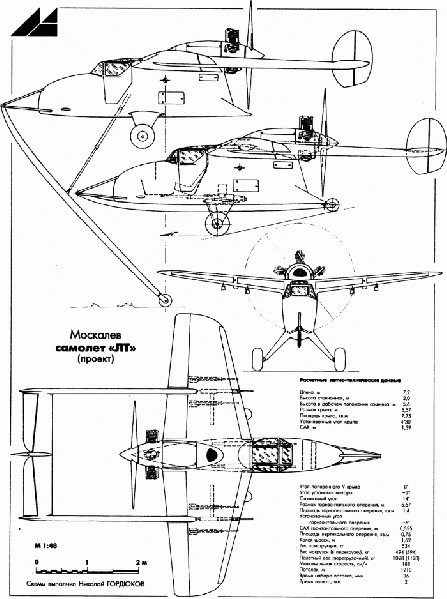
During the Great Patriotic War A. Moscaliov developed more than landing gliders. In the archives of the TsAGI branch of Novosibirsk, a project of an attack aircraft known as the flying tank or LT (according to the initials of Letayushaya Tanquietka, in Russian: ЛТ) with an M-11 engine. Sometimes called “Bloja” (Fly). In the records of the Moscaliov OKB this aircraft was known as SAM-23 (in Russian: САМ-23), a name that would later be used for a landing troop transport glider.
The development of this aircraft was carried out at Factory No.499 by the constructor Nekrasov.
The project was ready by the end of May 1942 and on September 14 it was handed over to the TsAGI for evaluation. In the project’s descriptive memory, “the behavior of the plane on the ground… ” was written, which has allowed speculation that a prototype had been built.
This airplane was designed with the objective of destroying armor and forces, as well as the destruction of ground defences.
The LT was designed as a 6.8 meter long, twin-fuselage, high-wing monoplane single-seat airplane. The fuselage was built on a structure of welded tubes with a duralumin coating.
The wing featured an RP profile with a single spar and was made of wood, covered with plywood and fabric. The wing featured flaps on the leading edge and the full span of the trailing edge to facilitate take-off on short runways.
The LT was powered by an M-11 radial engine located in the upper rear of the fuselage, driving a driving propeller.
The pilot was located in a cockpit at the front of the nacelle, which allowed excellent visibility. The entire cabin was armored with 3mm plates on the sides and 4.5mm on the front. The pilot’s seat featured armor similar to that of the Ilyushin Il-2. The cockpit windshield also featured transparent shielding. Access to the cabin was through a car-type door located on the left side.
At the end of each tail cone, it was joined by the horizontal stabilizer in the center of which the oval-shaped empennage was located with the rudder.
The landing gear was fixed and of the conventional type, with a tail skid. The wheels of the main landers were inflatable with dimensions 470 x 210 mm.
The armament consisted of two ShVAK 20 mm cannons, located in the fuselage on both sides of the cockpit and 200 shots per muzzle (500 in the overloaded version). Two ShKAS machine guns with 1500 (2000) rounds and 4-6 RS-82 reactive rockets located on external supports under the wings or 400 kg of bombs. With full load the takeoff weight reached 1128 kg. By calculations, with a more powerful engine like the M-34. The armor, the offensive load, could be increased, raising the takeoff weight to 1500 kg.

The tactics for using the LT included flight following the terrain at a height of 4-5 meters. This was accomplished through the use of a pole attached to the nose. The end of this structure traveled brushing against the irregularities of the terrain.
It was considered that flying at that height, at a speed of 150 – 180 km / h it would be quite difficult for the enemy to shoot down. The ground troops could do little due to the high speed and for the fighters it would be at a height where they were ineffective. On the other hand, the small dimensions of the LT allowed it to operate from highways or roads, even moving along them until approaching the target.
The SAM-23 could be used to carry out attacks on defensive ground positions following normal dive methods from heights of 1000 – 1200 meters.
Designed to work in large formations the LT had to be characterized by its low price, the use of a cheap engine and large productions and the simplicity of the piloting, to be able to prepare large numbers of pilots.
The project did not receive the approval of the TsAGI, fundamentally considering that the pilot was poorly defended by the thin armor. It was also alleged that flying at such a low altitude required too much stress on the pilot to avoid the unevenness of the terrain and keep the plane from crashing.
SAM-23 or LK
Engine: M-11, 100 hp
Wingspan: 5.57 m
Wing area: 7.75 m²
Length: 6.8 m
Height: 2.00 m
Empty weight: 534 kg
Maximum takeoff weight: 1128 kg
Top speed: 188 km / h
Endurance: 2 hours
ROC: 34 m / sec
Ceiling: 1210 m
Accommodation: 1
Armament: two ShVAK cannons and two ShKAS machine guns
Bombload: 400 kg
Moscalev SAM-13

This design was conceived with the OKB from the beginning as a military aircraft and, despite the low engine power, the project augured a good future due to the good performance obtained from the calculations and the low production cost.
The Moscaliev SAM-13 (Russian: Москалёв САМ-13) was designed around two 220 hp Renault MV-6 engines fore and aft and armed with four Ultra-ShKAS machine guns.
After submitting the conceptual designs, the NKAP department 7 decided to approve its inclusion in the group of experimental developments, since the MV-6 engine was not intended for military use. The evaluating commission decided that the design was novel and presented interesting solutions that could later be used in real fighters with high-powered engines.
The configuration selected for the SAM-13 comprised a low wing-set fuselage entirely in wood with a plywood covering.
The wing had a trapezoidal shape in plan, with rounded ends. The wing mechanization included offset ailerons. From the forward wing spar two bars extended backwards which joined behind the propeller cone in an oval stabilizer in which the elevators were located and from whose center the empennage rose.
The SAM-l3 was fitted with a retractable tricycle undercarriage, the forward unit was stowed aft, while the main units, attached to the forward spar of the wing at the tail cone area, were retracted into the fuselage.
The cockpit was located between both engines. Behind the engine were also located the fuel tank and the flight equipment. The rear propeller featured a mechanism that allowed it to be stopped in a horizontal position in emergencies, to allow the pilot to leave the plane.
In general, the Moscaliov SAM-13 was characterized by its small size and its clean lines.
By the end of 1939, the evaluation commission led by Colonel Kvitko met and the main topic of discussion revolved around the high value of the speed obtained as a result of the calculations. This speed of 700 km/h was considered not very objective for an airplane powered by 220 hp engines. Actually the calculations were made based not on the MV-6 engines, but on the French Renault Bengali 6 with Ratier metallic variable pitch propellers. Finally, after not a few discussions, the model of the SAM-13 was approved and the construction of the prototype began at Factory No.18.

The armament comprised two synchronised 7,62-mm guns in the forward fuselage and a similar weapon in the forward end of each tailboom.
By the end of 1939 the prototype was finished, which was delivered in the spring of 1940 to carry out factory flight tests. ND Fikson was selected as test pilot, V. Galitski was singled out for the TsAGI, and engineer Pushkin for the leadership of the NKAP.
Factory tests went smoothly. After the period of runs and jumps the flights began. The pilot Fikson was satisfied with the results, assessing the stability and control very positively. The speed at sea level was established with the gear extended and reached 560 km/h. Problems with the retraction of the forward landing gear prevented it from obtaining the expected speed, reaching only 607 km/h. These results made it possible to think that with the gear collected and at the optimal working height of the engine, the goal of the calculated 700 km/h could be achieved.
These flights also evidenced the need for long takeoff and landing runs due to the small wing area and low payload capacity.
The tests were not completed. After the seventh flight, the instruction was received from Moscow to suspend them until the wings and tail were tested in the TsAGI , with the aim of verifying the possible appearance of Flutter. It was also decided that the rest of the plane’s tests would be carried out at the TsAGI, so the plane had to be sent to that institution, together with a group of OKB-31 specialists.
In the TsAGI a new commission for the evaluation of flights was created. As test pilot ML Galai was selected. The OKB-31 group of workers was led by LB Polukarov and included NA Morietski, SA Zabyalov and Dovgi.
The results of the tests of the Flutter in the TsAGI T-101 tunnel showed that the design was capable of withstanding speeds of up to 800 km/h and were followed by a new period of taxiing and runway tests, carried out by Galai.
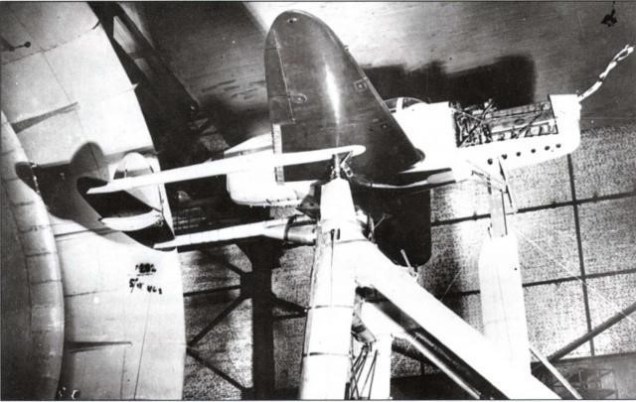
By that time, the TsAGI had finished installing a new high-speed wind tunnel model T-104. It was proposed to test there in a plane with a pilot and the engines working, with the aim of establishing the effectiveness of the model. These tests were completed in the spring of 1941 and the results were considered so secret that they were not even communicated to their designers.
A short time later Moscaliov was called to the office of AS Yakovlev, where he was informed that by government decision the tests of the model would be cancelled. The weak armament and the little capacity of the plane to increase it were argued. Then the war started.
All materials and documentation linked to this model were destroyed.
SAM-13
Powerplant: 2 × 220 hp Renault Bengali 6
Span. 23 ft 11 1/3 in (7,30 m)
Wing area, 96.88 sq ft (9.00m sq.m)
Length, 25 ft 4 in (7,68 m)
Empty weight: 745 kg
Maximum takeoff weight: 1183 kg
Wing loading: 131 kg/m²
Power load: 7 kg/hp
Max speed reported: 323 mph (520 km/h) at 11,485 ft (3 500 m)
Maximum speed at 5000 m est: 680 km/h
Maximum speed at sea level est: 463 km/h
Landing speed: 125 km/h
Practical range: 850 km
Service ceiling: 10000 m
Accommodation: 1
Armament: Four 7.62 mm Ultra-ShKAS machine guns.

Moscalev SAM-7 Sigma
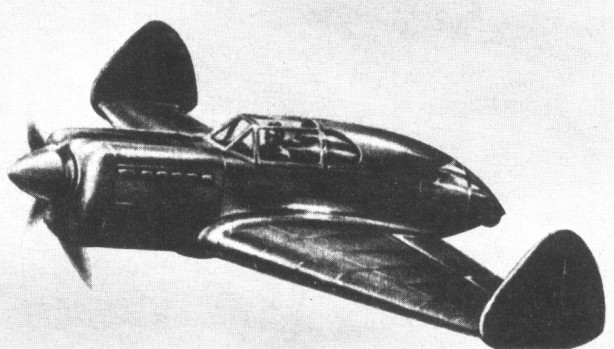
As part of the “Sigma Project” about 1934 Moscaliov began work on the development of a new model of unconventional design designated SAM-7 “Sigma” (Russian: Москалёв САМ-7 «Сигма»). with M-34 engine. The work in the RDD delayed a little the projection work of the model. This was the main task of the OKB of Factory No.18 at that time. The SAM-7 was designed as a two-seat escort fighter designed in a tailless configuration.
The SAM-7 was constructed entirely in metal. The steel structure was covered by thin sheets of 1.5 – 2.5 mm.
The aircraft featured a relatively short fuselage with swept wings terminating vertical surfaces, operated as rudders. The entire wing trailing edge featured control surfaces that were used as elevators. The outer sections additionally operated as conventional ailerons. The selected wing profile was the R-11a with a thickness of 12% at the root and 10% at the wingtips.
The fuselage ended in a cockpit for the gunner, who operated two machine guns located in a mobile turret. Under normal conditions this cabin remained closed in order to improve aerodynamics. During combat the cover was opened and the turret moved to the rear, allowing an excellent firing range. Two ShKAS synchronized machine guns were located in the engine.
The cockpit was located just behind the M-34R 850 hp V-12 linear engine. With this powerplant the expected speed for the SAM-7 at 4,000 meters was 600 km/h. The absence of a reducer in the M-34 engine made it necessary to use a 4-blade wooden propeller. The SAM-7 had the center of gravity at 13 – 15% of the chord, but tests showed excellent stability.
The cooling system included evaporative radiators located in the wings, plus a conventional type retractable auxiliary radiator, located behind the downward opening pilot seat, to be used in low speed operations (landings, takeoffs and taxiing). on the track).
The landing gear was of the conventional type, retractable towards the inside of the wing by turning it and with hydraulic shock absorbers. Landers were attached to the forward spar of the wing. The tail skid was practically hidden in the fuselage.
The prototype was built between 1934 and 1935 at Factory No.18 Voronezh and the factory tests were carried out successfully, although for precautionary reasons they only included tests of taxiing and small flights in a straight line.
At the same time that Moscaliev was developing the SAM-7, at the Kharkov Aviation Factory KA Kalinin was developing the K-12 or VS-12 bomber, also known as “Zhar Ptitsa” or Firebird. This M-22 twin-engined medium bomber also featured a trapezoidal-shaped R-11a airfoil.
Taking advantage of the delay caused by the development of the RDD, the Kalinin K-12 was delivered to state tests some time before. The first flight carried out by the test pilot of the NII VVS P. M. Stefanovski, was a total failure, mainly due to the ignorance of the characteristics of an airplane with this scheme.
The SAM-7 was eventually found ready for state testing at the NII VVS, but GUAP’s decision to cancel all flights soon followed. The cause was the similarity to the unsuccessful K-12.
Despite the fact that the SAM-7 had a 20º wing camber on the leading edge, which should have eliminated the defect shown by the K-12, the evaluation of the latter’s flights concluded that the tailless scheme was unreliable and he had no prospects. However, flights by factory pilots in K-12 and SAM-7 aircraft showed that the tailless scheme was capable of flying and being controlled in flight.
SAM-7 “Sigma”
Engine: 1 × 750 hp M-34
Wingspan: 9.60 m
Wing area: 20.00 m²
Length: 7.00m
Empty weight: approx 1000 kg
Maximum takeoff weight: 1480 kg
Wing loading: 74 kg/m²
Power load: 2.0 kg/hp
Speed at sea level: 435 km/h
Maximum speed at altitude: 500 km/h
Landing speed: 138km/h
Practical range: 800 km
Practical ceiling: 9200 m
Armament: Four 7.62 mm ShKAS machine guns.
Accommodation: 2

Mosca-Bystritsky MB / Mosca-B bis
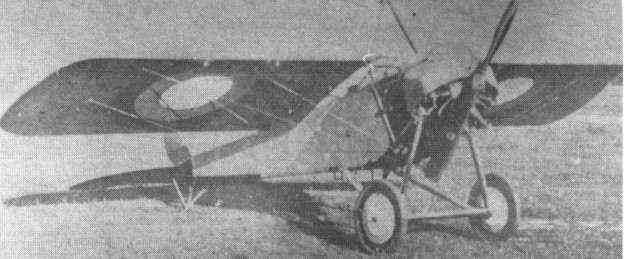
First original design was the Mosca MB, first flown in July 1915, a single-seat high-wing monoplane fighter evolved from the Morane J. During the course of 1916, the MB Mosca-Bystritsky (Moskva-MB) developed a single-seat fighter derivative of its two-seat reconnaissance monoplane. Appreciably smaller and more powerful than the two-seater, the Mosca-B bis fighter retained such features as wing warping for lateral control and detachable flying surfaces permitting the aircraft to be towed along roads. Powered by either an 80 hp Le Rhône or Clerget rotary engine, the Mosca-B bis was delivered both with a 7,7-mm unsynchronised forward-firing machine gun with propeller-mounted steel bullet deflectors and with a similar weapon mounted above the cockpit and firing clear of the propeller disc. A total of 50 Mosca-B bis fighters had been built up to 1918, and a few additional aircraft of this type were reportedly built after the revolution.
Max speed, 81 mph (130 km/h)
Time to 3,280 ft (1000 m), 35 min
Empty weight, 710 lb (322 kg)
Loaded weight, 1,074 lb (487 kg)
Span, 25 ft 11 in (7,90 m)
Length, 20 ft 1/8 in (6,10 m)
Wing area, 12917 sq ft (12,00 sq.m)
 All Aero