Motor Gliders Inc Buzzard Light Plane / MG-1 / Snyder Buzzard

Designed by Bud Snyder, the Buzzard Light Plane, or MG-1, of 1930 was a two-place, open, high-wing monoplane. Essentially a motorized glider with a pylon-mounted parasol wing and a pusher motor. It was fabric covered except for a dural-covered plywood fuselage bottom.

Purchased by Curtiss-Wright and is assumed to be the basis for, or at least a major influence on, the 1931 Curtiss-Wright CW-1 Junior.

The design was revived in 1983 as the kit-form, Zenoah-powered Ritz Standard A by Gerry Ritz, Wartrace TN.

Engine: 34hp ABC Scorpion
Wingspan: 35’0″
Length: 19’3″
Max speed: 70 mph
Cruise: 60 mph
Stall: 28 mph

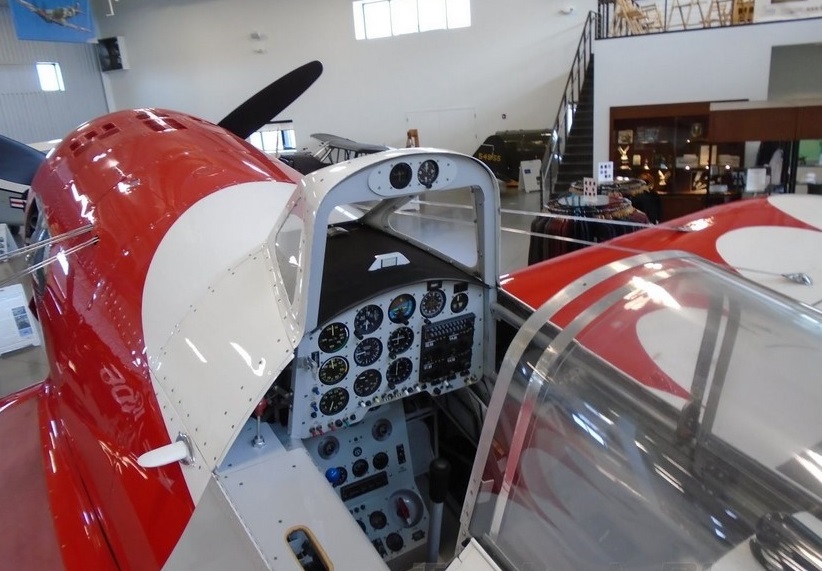
Moss Gee Bee QED

In 2002, aircraft builder Jim Moss set out to recreate the Gee Bee QED. Starting with the basic original plans, Moss’ recreation incorporated several modifications including wider landing gear, lengthened wings, a 20% larger vertical fin, and the installation of a 1425 hp. Wright R-1820 engine which replaced the original 650 hp. P&W R-1690.

The construction of the QED II took place between 2002 and 2013 and encompassed in excess of 50,000 man hours to build.

The aircraft was advertised for sale at $499,000 in October 2021.

Gallery

Wright R-1820-56, 1425 hp

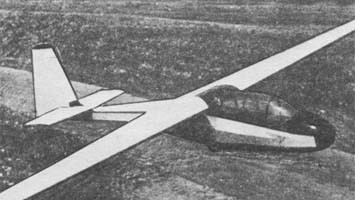
MAI MAI-68 Pushinka

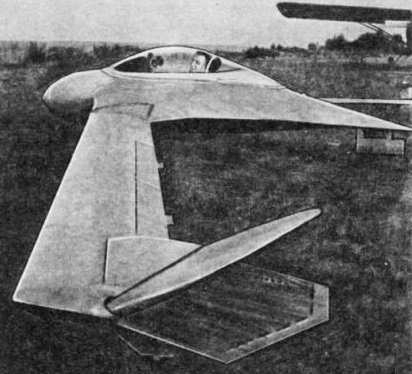
In 1970, following studies carried out by Alexei Ivanovich Pietsuj’s group in relation to tailless gliders, student VP Pushkin carried out a project of a new model with this configuration. It was a development of the concept outlined with the previous MAI-63. Named MAI-68 it was nicknamed “Pushinka” (Russian: МАИ-68 «Пушинка») in honour of its designer.

Professors GS Sadiekov, LA Matvieyev and VI Figurovski participated in the process of creating the new model. The general direction was in charge of AI Pitsuj.

The glider was designed as a single-seater basic training device in order to be able to compare its performance to those of similar models with the classic scheme. It was decided to apply an integral construction in which the fuselage, wings and tail were fused into a single structure.

The construction was metallic with fabric covering. The structure of the glider was built with aluminum profiles.

The aircraft featured a fluted wing with variable thickness and variable line of lights along the wingspan as well as the long arm of the steering and rudders.

The selected wing profile was the R-Sh with a constant thickness of 15.5 throughout the wingspan. The force structure is composed of two spars of similar thickness between which the wing ribs were located. The wing leading edge was coated with 0.5 mm thick duralumin sheets.

The wing shape, in conjunction with the K-shaped structure of the short wing-end stabilizers, ensured the necessary longitudinal and lateral stability as well as good manoeuvrability. The location of the wing-end stabilizers had a positive influence on wing flow, significantly reducing the creation of vortices in this area.

Single-spar ailerons were attached to the wing structure at three points.

The alligator-type wing-end rudders ensured longitudinal control if operated integrally. When operating the pedals, these surfaces were opened independently, acting as aerodynamic brakes. By operating a single pedal, the resistance at this wing end allowed control of the rotation of the apparatus.

The control system was operated by cables.

The landing gear consisted of a main wheel with a front ski and stabilization straps on the wing.

The cabin, for a single crew member, had a well-equipped instrument panel with an airspeed indicator, altimeter, artificial horizon and variometer. The transparent cover had an opening to the right. To improve downward visibility, the lower nose region and forward fuselage were coated with clear acrylic.

The MAI-68 experimental glider was built by V. Pushkin between 1968 and 1970. Ground tests began in July 1970, which were followed by flight tests at the MAI aeroclub aerodrome.

The test flights were developed by club director IG Yermakov. The “Hercules III” series tensioner was used for the launch.

During the ground tests it was possible to verify the effectiveness of the rudders, as well as the good stability and ease of control of the glider. The first short flights showed an acceptable longitudinal and transverse stability, as well as a marked delay in the reaction of the rudders. To eliminate this phenomenon, the opening surface of the elevator shafts was increased, achieving an increase in the effectiveness of these structures and allowing the development of the first flights at heights of 250 – 300 meters.

Tests of the glider at the MAI continued until 1972. In total they comprised 12 jumps at heights of 1 – 2 meters from the ground, 26 flights at 40 – 70 meters and four flights at 250 – 300 meters. A towed flight was made by a Yakovlev Yak-12.

The tests were continued at the TsAGI between 1973 and 1974. The flights, carried out by VN Vladimirov, were carried out at the Glider Station airfield. At this stage it was possible to measure the benefits and develop a series of mathematical models that verified the coincidence with the project calculations.

It was possible to establish a minimum glide speed of 45 km / h and an aerodynamic quality of 21. The effectiveness of the large lower surface of the center plane during takeoffs and landings was highly valued.

After testing the MAI-68, its designer VP Pushkin worked in the aeronautical industry and in this period he designed and built two other devices with this scheme, which showed excellent indicators and performance.

MAI-68 Pushinka
Wingspan: 10.00 m
Wing area: 10.2 m²
Aspect ratio: 8.54
Length: 5.00 m
Empty weight: 86 kg
Normal weight: 170 kg
Wing loading: 16.7 kg / m²
Minimum speed: 45 km / h
Maximum glide ratio: 21
Accommodation: 1

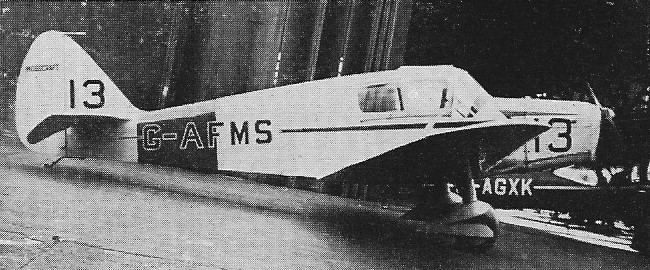
MAI MAI-63

In 1958 a group of students from the faculty of aeronautical construction of the Moscow Aviation Institute (MAI) came together to create a construction bureau to build aircraft in a flying wing configuration. In this group the students A. Krivomlin, M. Alexandrov, Yu stood out. Belov, A. Bielosviet, V. Irinarjov, S. Kurilienko, Ye. Mizinov and V. Novikov among others.

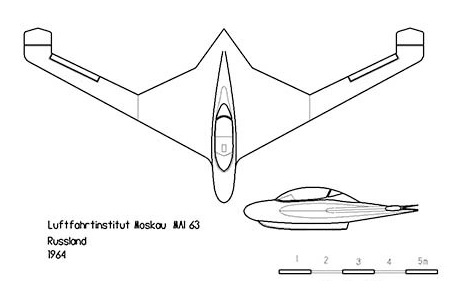
The research carried out and the technical solutions of the LK-MAI would be used as the basis for the development of a new flying wing glider, which was called MAI-63 (Russian: МАИ-63).

The work began in the autumn of 1962 with the participation of members of the MAI sports aviation club under the direction of the head of the scientific-research sector AI Pitsuj. All the construction work was done by the students themselves.

The glider design featured a low elongation centroplane with a rhomboid shape in the plane to which consoles were attached with 30º inflection on their leading edge. The sagging of the centerplane and the consoles was the same. Aerodynamic blades were located where the fuselage was attached to the consoles.

The large swelling of the wings made it possible to locate double-surface elevator rudders (“crocodile” type) on the trailing edge of its extremities. This location guaranteed an adequate balance of the apparatus even with the flaps extended. The ailerons, located on the trailing edge, were of the conventional type.

The glider lacked a horizontal empennage. Longitudinal control was performed by a combination of the elevator rudders. When the left pedal was depressed, the surfaces on the left side opened up, increasing the resistance at that end, and the aircraft turned to the left. By keeping the pedals in a neutral position, both surfaces joined to form a single rudder.

The cockpit was designed to accommodate a semi-reclining pilot and was covered with a bubble-type lantern.
The entire construction was made of metal. The wing design had a laminar profile. The covering of the centroplane and the wing up to the middle of the chord was made of duralumin and from there on in fabric.

The landing gear was unicycle type with the wheel located on the axis of the device and conveniently fairing. In the rear area there was a amortized skate. Stabilization supports with small wheels were placed under the wing tips.

In 1963 the project for the new glider was ready and in that same year construction began in the workshops of the laboratories of the MAI aircraft construction and projection chair. The prototype was ready for 1964.
In the construction of the model stood out V. Rytsariev, G. Bespalov, O. Tischenko, Ye. Volkov, A. Turik, S. Turchkov, V. Fatyanov, V. Vasiliev, and V. Pushkin.

All the turning and milling jobs were developed by students. Many of them had the necessary qualifications and were masters of the sport in model aircraft. This made the job easier.

The 5th year student Yu. Shirokov, who designed the centroplane and the cockpit, was still in his school years champion of Moscow in model aircraft; V. Pushkin had attended various professions.

Structural strength calculations were developed by M. Stolyar, O. Derzhavin, V. Voronin, and V. Kuznietsov. As a consultant, Ye acted. S. Voit.

The MAI-63 tests were developed in Alferiev in 1964 and were in charge of AI Pietsuj. Several towed flights
were made approaching take-off speed, piloted by AI Pietsukh. Structural strength problems led to the decision no flights were done.

After the first tests, several corrections were made to the apparatus: the wing structure was reinforced and modifications were made to the landing gear.

In 1965, MAI-63 was modified to a motor-glider installing on a pole erected over the central part of the glider an air-cooled EP-760 23 HP, five-cylinder, two-stroke radial engine. The engine was designed by Polyakov specifically for motor-gliders and light aircraft. The modified glider got the designation MAI-63M. Tests were conducted at the flying club’s airport. The engine during the trial taxi runs was unstable so the powered version of the glider was never flown.

MAI-63
Wingspan: 12.60 m
Wing area: 9.00 m²
Aspect ratio: 17.5
Wing profile: Laminar
Empty weight: 126 kg
Normal weight: 200 kg
Wing loading: 22.2 kg / m²
Best glide ratio: 35
Descent speed: 0.61 m / s
Accommodation: 1

MAI MAI-56

The glider was designed in response to a request from the DOSAAF Central Committee as a development of the PAI-6 glider, but project manager Alexei Ivanovich Pietsuj proposed an entirely new construction.

The MAI-56 (Russian: МАИ-56) was designed in 1956 as a two-seater training glider and was developed by the collective of the aircraft construction and projection chair at the Moscow Aviation Institute (MAI). The group of designers was made up of IV Kachanov, Ye. S. Voit, AA Liebiedinski and VA Manucharov under the direction of AI Pietsuj. An important group of students also joined this work.

The engineer AA Liebiedinski was assigned to the construction and all the calculations and plans were developed by students.

The MAI-56 featured a high cantilever wing structure and two-seater capacity, but unlike previous models, the fuselage was designed around a skeletal structure built with welded steel tubes with little lateral section covered with fabric.

The landing was made on a central wheel in the lower fuselage, which had a wooden skid at the front.
Stabilization straps were located under the wings.

The wing and tail were constructed entirely of wood with the use of steel fasteners. The wing was equipped with airbrakes.

The wing structure was designed with a single spar: the wings had a trapezoidal shape in the plane with some negative sagging. The wingtips were covered with plywood and worked by twisting. The louvered three-point ailerons featured aerodynamic and weight compensation.

The stabilizer and keel were covered with plywood. All surfaces had cable control.

The cockpit with two-seater capacity in tandem was closed by means of a transparent cover in line with the fuselage, with lateral opening towards the right. The bow fairing was attached to the cockpit deck, facilitating access to the cockpit for the pilot. The second crew member was located above the center of gravity of the model. In order to improve visibility from this second position, the wing leading edge, at the junction point with the fuselage, was made of transparent acrylic.

To improve the operation of the MAI-56, a trailer truck for transport was designed, which could be installed on a light car. The MAI-56 was generally superior to gliders of its Czechoslovakian “Pioner” type or its national “Primoriets” version, which was mass produced in the USSR. The Czechoslovakian glider had an aerodynamic quality of 17.5 against the 21 of the MAI-56, obtained thanks to the absence of wing braces and cleaner aerodynamic shapes.

The construction of the prototype was carried out in the UPM workshops of the MAI.

The first flight of the MAI-56 took place in August 1958 with the main constructor AI Pietsuj at the controls. The test program was carried out between May and September 12, starting the manufacturing tests, which took place at the airfield of the airfield the DOSAAF of Yegorievk having as pilot Pietsuj.

The pilots who participated in the tests gave a very positive evaluation of the model and recommended its series production. The test report was approved by the chairman and aeronautical constructor AS Yakovlev.

In addition to the drag tests from a Yakovlev Yak-52, four flights were made during the tests using drag from a motorcycle and six from a car. The MAI-56 glider passed the tests without difficulty. The piloting technique was considered simple and suitable for athletes of all categories, but the expected series production would never come to fruition.

Many MAI students completed their course and diploma work on topics related to the projection and development of the MAI-56. The consultations with the students were made by Professors Ye. S. Voit, IV Kachanov and AA Liebiadinski.

MAI-56
Wingspan: 15.60 m
Wing area: 18.10 m²
Aspect ratio: 13.1
Length: 7.61 m
Empty weight: 237 kg
Maximum weight: 273 kg
Wing loading: 21.9 kg / m²
Glide ratio: 21
Accommodation: 2

MAI ASK

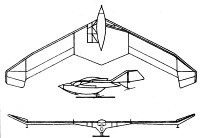
A flying wing, the MAI ASK was displayed publicly in 1964, developed by the Moscow Aviation Institute, powered by an 80-hp piston engine with a pusher prop mounted above the wing. It weighed 970 lb, cruises at 137 mph, has a 5 hour range, lands at 68 mph, spans 16.4 ft, is 17 ft long. Has a tricycle undercarriage and bubble canopy.