A version of the US AkroTech Giles G-202 two-seat kit-built aerobatic competition aircraft and trainer.
Monoplane
Mudry CAP 20
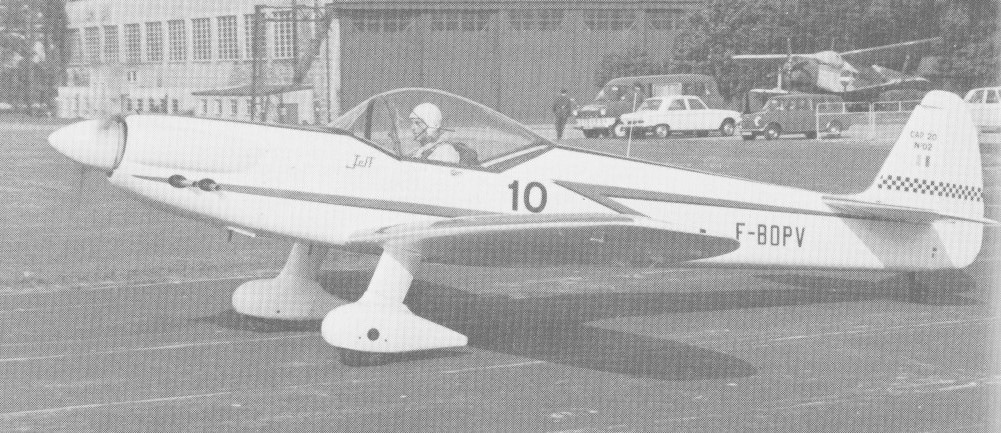
The CAP 20 is a single seat derivative of the CAP 10.
The CAP 20A is a single seat derivative of the CAP 10 with a no dihedral wing and lengthened landing gear.
The CAP 20B is a modified CAP 20A with new wings and larger ailerons.

The CAP 20L is a shorter airplane than its predecessor, the 20, and it seems to benefit from a much increased rudder area. Lightened for competition (hence the L designation, for leger), the CAP 20L also has a new wing design.

Mudry CAP 10
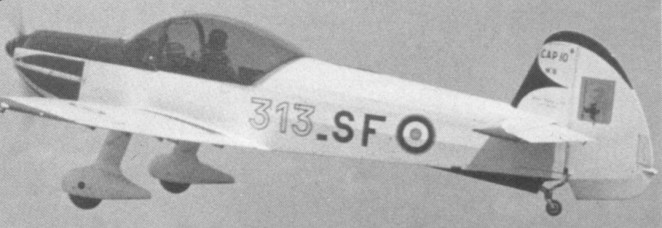
The CAP 10 was developed by CAARP and first flown in 1968.
The CAP 10 aerobatic trainer is a side-by-side monoplane, powered by a 190 hp injected Lycoming engine.
The construction is all wood with a cotton-covered rear-fuselage. (By law, all fabric must be replaced every 3 yrs in France). In 1967 they were priced at US$30,000 with no radio or gyros.
Production of the CAP.10B lightweight, fully aerobatic piston-engined primary trainer continued, and 88 have been delivered to military customers by 1987.
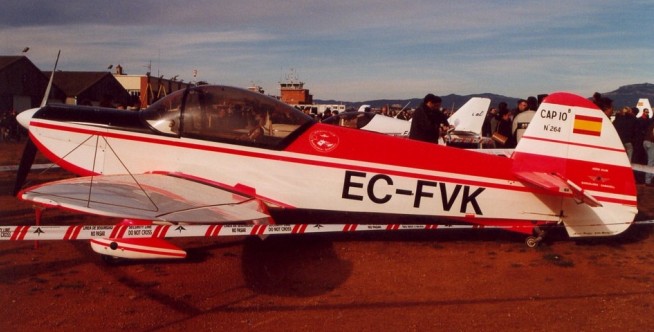
Total production exceeded 220 aircraft by 1997, and a glider-towing version, the CAP.10R, was available.
CAP 10
Engine: Lycoming IO-360-B2F
Wing span: 26 ft 5 in / 8,06 m
Length: 23 ft 11 in / 7.30 m
Empty weight equipped: 1168 lb / 530 kg
MTOW aerobatic: 1666 lb / 756 kg
MTOW utility: 1829 lb / 830 kg
Max cruise 75%: 129 kt / 149 mph / 240 kph
ROC SL: 1180+ fpm / 360+ m/min
Service ceiling: 18,050+ ft / 5500+ m
Range: 647 nm / 745 mi / 1200 km
Seats: 2 side-by-side
Baggage: 44 lb / 20 kg
Cabin max width: 3 ft 5 in / 1.054 m
CAP 10B
Engine: Lycoming AEIO-360-B2F, 180 hp
TBO: 1400 hrs
Prop: Hoffmann 2-blade, 67-in
Seats: 2
Length: 23 ft
Height: 7.5 ft
Wingspan: 26.4 ft
Wing area: 117 sq.ft
Wing aspect ratio: 5.96
Maximum ramp weight: 1829 lb
Maximum takeoff weight: 1829 lbs
Standard empty weight: 1200 lbs
Maximum useful load: 629 lbs
Maximum landing weight: 1829 lb
Wing loading: 15.6 lbs/sq.ft
Power loading: 10.1 lbs/hp
Maximum usable fuel: 246 lbs
Best rate of climb: 1600 fpm
Service ceiling: 16,400 ft
Maximum speed: 146 kt
Normal cruise @ 65% pwr @ 8000 ft: 139 kt
Fuel flow @ normal cruise: 51 pph
Endurance at normal cruise: 4.6 hrs
Stalling speed clean: 50 kt
Stalling speed flaps down: 44 kt
Turbulent-air penetration speed: 126 kt
Fixed tail wheel under carriage
Mudrovcich Pearce 1903 replica
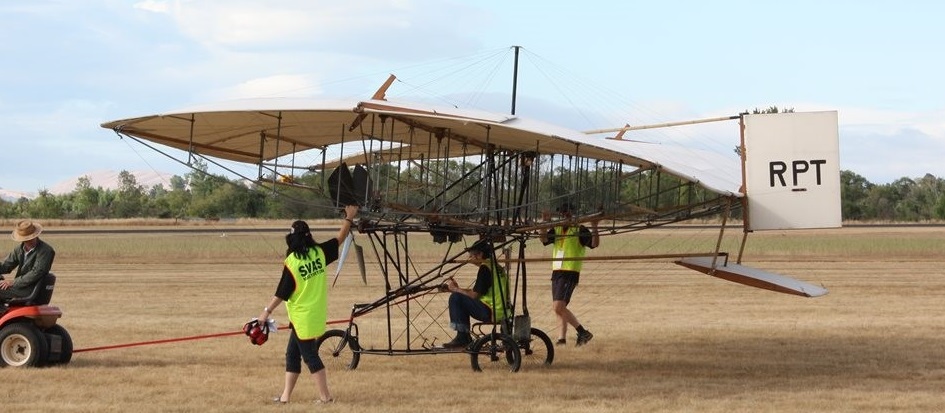
Aucklander Ivan Mudrovcich, a retired automotive engineer, has spent the past 10 years building a replica of the Canterbury farmer’s controversial aircraft, which some say pre-dated the first flight of the Wright brothers in December 1903.
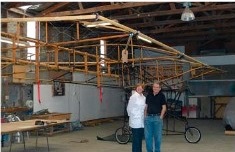
The fuel has to be mixed from kerosene, ethanol and paraffin to replicate what was used more than 100 years ago.
“Richard Pearse had to go to the chemist to buy his fuel,” said Mr Mudrovcich. Once it has started, its running time is short and the engine gets dangerously hot. “We’ve had eight minutes out of it. We have a rule after it has run that we don’t go near it for a quarter of an hour,” he said.
When not in use, the dismantled aircraft is stored at home. “I keep it in the garage at home. I also keep parts of it under the bed, in the living room, everywhere,” he said.
The replica takes up most of a small hangar at Hood Aerodrome and consists of an engine on a wooden tricycle undercarriage. The 13m wingspan is made of bamboo and steel tubes covered with linen. It is registered as a microlight and has a licence number, ZK-RPT. Whether it can actually fly is unknown.
“We haven’t explored its capabilities and we are reluctant to fly it here. We will be firing it up and maybe taxiing it,” said pilot Neville Hay. “Never fly higher than you can jump.”
Serial: 002
MSW Aviation Votec Evolaris
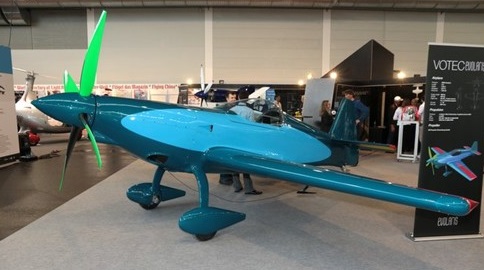
The steel tube hull with carbon fiber covering is for the first time a divisible, also made of carbon fiber, wing. The plug-in wing halves allow for rapid assembly and dismantling, as well as the simple transport of the aircraft in a specially designed transport trailer.
At the AERO 2017 MSW presented the project Evolaris, an electric aerobatic plane with an empty weight of 500kg and 221Kw electric motor power.
Engine: Evo220, 221 kW / 300 hp
Wing span: 6.27m
Length: 6.0m
Wing area: 7.58 sq.m
Empty weight: 500kg
MTOW: 650kg
Roll rate: 460 ° / sec
Load: +/- 10g
Stall speed: 65mph
Never exceed speed: 270mph
Endurance: 20min + 5min reserve
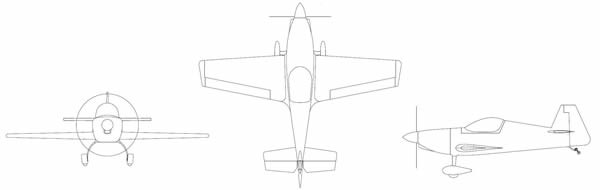
MSW Aviation Votec 252T
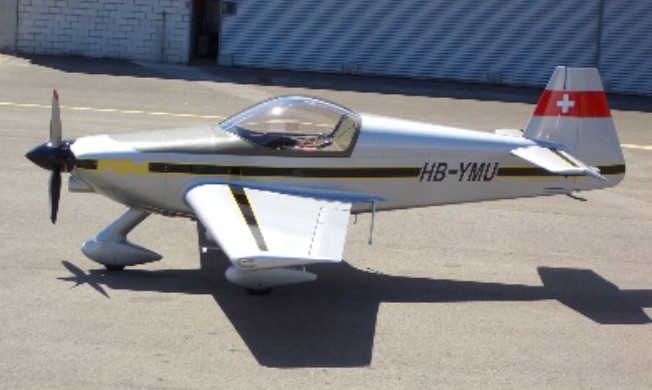
The Votec 252T is a side-by side seat single engine kitbuilt light-sport development of MSW’s earlier tandem seat Votec 322 aircraft. The prototype, powered by a modified Lycoming IO-540-J3A5 flat-six engine, marries the wooden wings and empennage to a new, carbon fibre fuselage, though a carbon fibre wing is under development. All flying surfaces are straight tapered and square tipped, the wing low mounted and the tailplane located on the upper fuselage; the rudder extends down to the keel. The ailerons are balanced with external spades.
The Votec 252T has a cabin over the wing, with baggage space behind the seat, under a single piece canopy. It has a fixed tricycle undercarriage with fuselage mounted cantilever legs and with speed fairings on all wheels. The nosewheel casters; there is a small tailskid for rudder protection.
Designed by MSW Aviation and built by Wassmer Aviation in Switzerland, the first prototype flew on 26 June 2009, by October 2011 only the first prototype had flown. A second prototype with a 260 kW (350 hp) Lycoming AEIO-580 engine, redesignated the Votec 352T, was under development but had not flown by October 2011.
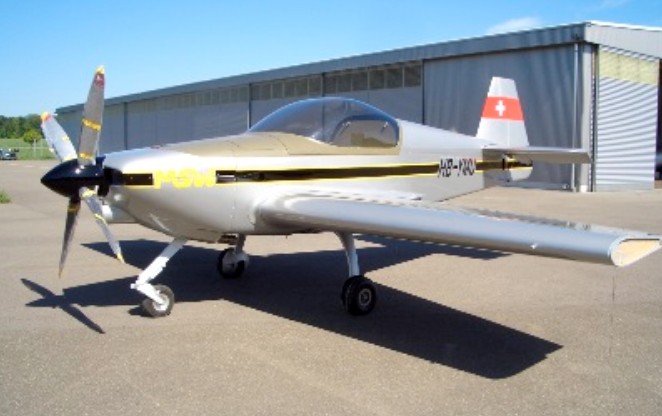
252T
Powerplant: 1 × Lycoming AEIO-540-X, 190 kW (250 hp)
Propellers: 4-bladed MT-Propeller MTV-14 constant speed, 1.95 m (6 ft 5 in) diameter
Length: 6.75 m (22 ft 2 in)
Wingspan: 7.70 m (25 ft 3 in)
Height: 2.20 m (7 ft 3 in)
Wing area: 11.28 sq.m (121.4 sq ft)
Aspect ratio: 5.3
Empty weight: 630 kg (1,389 lb)
Max takeoff weight: 950 kg (2,094 lb)
Fuel capacity: 166 kg / 365 lb / 240 lt
Cruising speed: 306 km/h (190 mph; 165 kn)
Stall speed: 106 km/h (66 mph; 57 kn)
Never exceed speed: 433 km/h (269 mph; 234 kn)
Range: 1,398 km (869 mi; 755 nmi)
g limits: +8/-8
Rate of climb: 17.8 m/s (3,500 ft/min) maximum from sea level
Landing and take-off runs: 300 m
Crew: one
Capacity: one passenger
MSW Aviation Votec 322
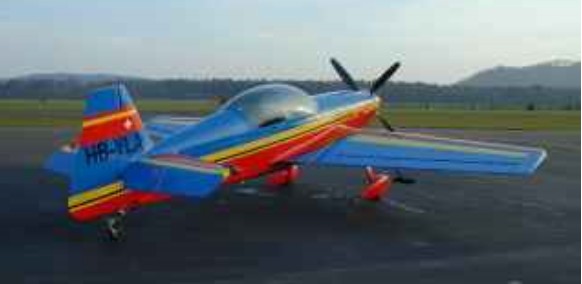
After 3 ½ years in the workshop of MSW Aviation AG in Wohlen came the first designs for the new kit airplane. A goal was to build in Switzerland an aerobatic aircraft. The prototype HB-YJY first flew on 6 April 2001 in Buochs, Switzerland. After 1 ½ years, the intensive test flight phase was completed without any incidents in November 2002.
On 9 April 2003 the second VOTEC 322 was completed, HB-YLA SN003. The airplane was built in approx. 12 months. Technically the airplane was revised and optimized, which led to that the machine approx. 30 kg lighter than the prototype YJY. HB-YLA was introduced to the public at the AERO 03 in Friedrichshafen.
The VOTEC 322 performs on the level of the Sukhoi and Cap. Weighing approximately 650 kg, it is powered by a 330 HP Lycoming engine. The maximum speed is 400 km/h. Accelerations of 10 G’s are problem-free in the ergonomic cabin layout for the pilot, with a cruising speed of 300 km/h and a range by approx. 1000 km. The span is 7,30 m.
The airplane was available in kit form for home building building.
M-Squared Breese DS
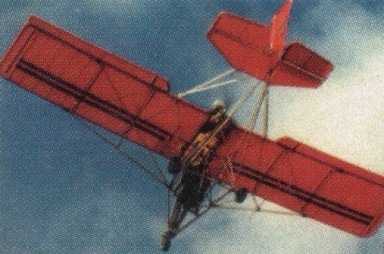
The Breese DS and Breese 2 models are LSA legal.
Breese DS
Cruise: 65 mph
Stall: 34 mph
Range: 150 sm
Rate of climb: 625 fpm
Takeoff dist: 425 ft
Landing dist: 300 ft
Engine: Rotax 582, 65 hp
HP range: 42-75
Fuel capacity: 16 USG
Empty weight: 485 lb
Gross weight: 1000 lb
Length: 21.6 ft
Wing span: 30 ft
Wing area: 168 sq.ft
Cockpit width: 60
Seats: 1 in
Landing gear: nosewheel
Breese SS
Engine: Rotax 447, 42 hp
HP range: 42-65
Cruise: 46 mph
Stall: 24 mph
Range: 130 sm
Rate of climb: 975 fpm
Takeoff dist: 75 ft
Landing dist: 50 ft
Fuel capacity: 16 USG
Empty weight: 330 lb
Gross weight: 650 lb
Length: 19 ft
Wing span: 30 ft
Wing area: 168 sq.ft
Seats: 1
Landing gear: nosewheel
Breese 2
Engine: Rotax 503, 48 hp
HP range: 42-75
Cruise: 51 mph
Stall: 27 mph
Range: 150 sm
Rate of climb: 925 fpm
Takeoff dist: 80 ft
Landing dist: 60 ft
Fuel capacity: 16 USG
Empty weight: 335 lb
Gross weight: 650 lb
Length: 19 ft
Wing span: 30 ft
Wing area: 168 sq.ft
Cockpit width: 60 in
Seats: 1
Landing gear: nosewheel
M-Squared Sport 1000 / Sprint 1000
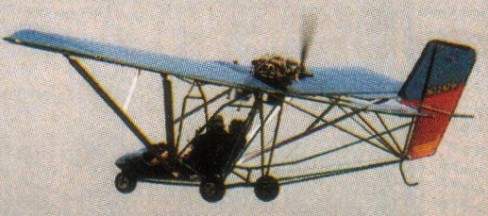
Designed in 1996.
The Sport 1000 is LSA legal.
Sport 1000
Engine: Rotax 582, 65 hp
HP range: 50-115
Cruise: 74 mph
Stall: 39 mph
Range: 260 sm
Rate of climb: 625 fpm
Takeoff dist: 425 ft
Landing dist: 300 ft
Fuel capacity: 16 USG
Empty weight: 625 lb
Gross weight: 1000 lb
Length: 21.6 ft
Wing span: 32.7 ft
Wing area: 180 sq.ft
Cockpit width: 50 in
Landing gear: nosewheel
Sprint 1000
Cruise: 58 mph
Stall: 27 mph
Range: 110 sm
Rate of climb: 650 fpm
Takeoff dist: 135 ft
Landing dist: 60 ft
Engine: Rotax 582, 65 hp
HP range: 50-115
Fuel capacity: 16 USG
Empty weight: 465 lb
Gross weight: 1400 lb
Wing span: 32.8 ft
Wing area: 180 sq.ft
Landing gear: nosewheel
Mrozinski 1912 Eindecker
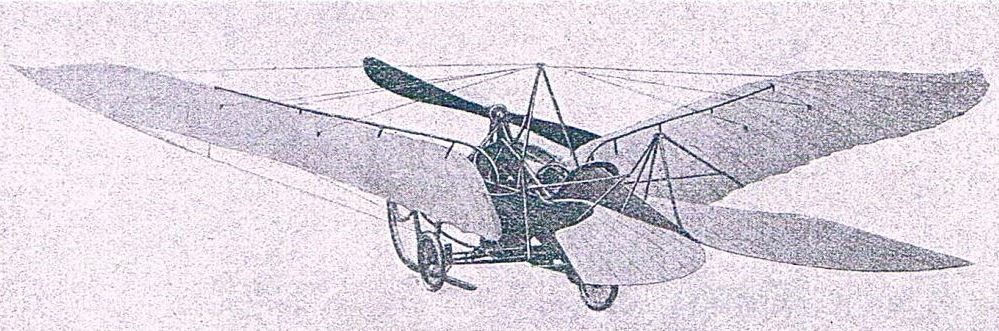
“Sport Eindecker ohne Seitensteuer” (sport monoplane without vertical tail plane), built by Bernard Mrozinski (of Polish birth), Berlin-Wilmersdorf. It flew in 1912.
Engine: 20 h.p. Anzani.
Length 7 m
Span 10 m
Wing area 20 sq.m
Weight 300 kg
 All Aero