Northrop P-61 Black Widow

The Northrop P-61 Black Widow began in August 1940, at the height of the Blitz on London. During this time, the US air officer in London, Lt. Gen. Delos C. Emmons, underwent a briefing on British progress on radar. British scientists and engineers were at that time working on the early versions of AI (Airborne Interception) radar sets which could be carried aboard airplanes, enabling them to detect and intercept other airplanes in flight without having to rely on ground installations.

Northrop P-61 Black Widow Article

At the same time, the British Purchasing Commission that was shopping for aircraft in the USA announced that they urgently required a night fighter that would be capable of stopping the German bombers that were attacking London by night. Such a fighter would have to be able to stay on station above London all night, which meant at least an 8-hour loiter time. In addition, the night fighter needed to have sufficient combat altitude in order to take on the bombers when they showed up.

When General Emmons returned to the USA, he reported that the British had an urgent need for night fighter aircraft, and that American industry might be able to supply that need. A preliminary specification was drawn up by the Emmons Board and was passed on to Air Technical Service Command at Wright Field in late 1940. Because of the heavy weight of the early AI radar and because of the high loiter time required, a twin-engined aircraft was envisaged.

Northrop Chief of Research Vladimir H. Pavlecka happened to be at Wright Field at that time on an unrelated project, and was told of the Army’s need for night-fighters. However, he was told nothing about radar, only that there was a way to “see and distinguish other airplanes”. He returned to Northrop the next day. On October 22, Jack Northrop met with Pavlecka and was given the USAAC’s specification. At this time, no other company was known to be working on night fighters, although at about this time Douglas was starting work on their XA-26A night fighter and the AAC were considering the A-20B as an interim night fighter.

Northrop’s proposal was a twin-engined monoplane powered by a pair of Pratt & Whitney R-2800 Double Wasp air-cooled radial engines mounted in low-slung nacelles underneath the wings. The nacelles tapered back into twin tail booms which were connected to each other by a large horizontal stabilizer and elevator. The long fuselage housed a crew of three. The crew consisted of a pilot, a gunner for the nose turret, and a radar operator/rear turret gunner. Each turret housed four 0.50-inch machine guns. A tricycle landing gear was fitted. Estimated weights were 16,245 pounds empty, 22,654 pounds gross. Height was 13 feet 2 inches, length was 45 feet 6 inches, and wingspan was 66 feet. These dimensions and weights were more typical of a bomber than a fighter.

On November 14, Northrop presented this revised design to the USAAC. An additional gunner’s station was fitted. Nose and tail turrets of the original version were replaced by twin 0.50-in machine guns in the belly, and four 0.50-in machine guns in a dorsal turret. The crew was now up to four-a pilot, a radar operator, and two gunners. The airborne intercept radio was moved to the nose.

The design was revised still further on November 22. The belly turret was deleted, and the crew was changed back to three-pilot, gunner, and radar operator. The pilot sat up front, and the gunner sat immediately behind and above the pilot. The gunner was to operate the turret via remote control, using a special sight attached to a swiveling chair. A “stepped-up” canopy was used to provide a clear field of view for the gunner. The rear fuselage with its clear tail cone provided the radar operator with an excellent rearward view which enabled him to act as a tail gunner if the plane happened to be attacked from astern. Optionally, the dorsal turret guns could be “locked” into the forward-pointing position, so that they could be fired by the pilot. The belly guns were deleted, and four 20-mm cannon were to be fitted in the wings. This design was formalized into Northrop Specification 8A (or NS-8A), dated December 5, 1940.

Incorporated into the night fighter design was the Zap wing and Zap flap, named after Edward Zap, a Northrop engineer. These were attempts to increase the maximum lift coefficient and to decrease the landing speed by the use of improved lateral control and lifting devices

NS-8A was submitted to Wright Field. The Army was generally pleased with the design, but they suggested some changes. A letter of quotation prepared by Northrop for two experimental prototypes was presented to Materiel Command on December 17, 1940. Northrop signed the formal contract on January 11, 1941. A contract was let on January 30, 1941 for two prototypes and two wind-tunnel models. On March 10, 1941, a contract was issued for 13 YP-61 service test aircraft, plus one engineless static test airframe.

The mockup was ready for inspection in April of 1941. At that time, it was decided to move the four 20-mm cannon from the outboard portion of the wings to the belly. This was done to improve the ease of maintenance and to make the airflow over the wing smoother. The internal fuel capacity was increased from 540 gallons in two tanks to 646 gallons in four self-sealed tanks built into the wings.

In the meantime, development of the A/I radar had proceeded at a rapid pace. Radar development in the United States had been placed under the control of the National Defense Research Committee. The NDRC’s Microwave Committee in turn had established the Radiation Laboratory at the Massachusetts Institute of Technology. The Radiation Laboratory was to handle the development of the XP-61’s airborne interception (AI) radar. The designation of the radar was AI-10. The AI-10 radar was given the military designation SCR-520, where SCR stood for “Signal Corp Radio” (some references have this as standing for “Searchlight Control Radar”). The Western Electric corporation was assigned the responsibility of refining the design and undertaking the mass production of the radar.

In October 1941, a pedestal-type mount for the turret guns was substituted for the General Electric ring-type mount.

A letter of intent was initiated on December 24, 1941, which called for 100 P-61 production aircraft and spares. Fifty more were ordered on January 17, 1942. The order was increased to 410 aircraft on February 12, 1942, fifty of which were to be diverted to the RAF under Lend-Lease. The RAF order was eventually cancelled.
The XP-61 flew at Northrop Field for the first time on May 26, 1942, piloted by contract test pilot Vance Breese. It was powered by a pair of Pratt & Whitney R-2800-10 radials of 2000 hp each. In keeping with its nocturnal role, it was finished in black overall, befitting its popular name that was taken from the poisonous North American spider. Wingspan was 66 feet, length was 48 feet 10 inches, and height was 14 feet 2 inches. Weights were 19,245 pounds empty, 25,150 pounds gross, and 28,870 pounds maximum. The aircraft was equipped with only a mockup of the top turret, as General Electric had not yet been able to deliver the real thing because of the higher priority of other projects.

The XP-61 had a maximum speed of 370 mph at 29,900 feet, and an altitude of 20,000 feet could be attained in 9 minutes. Service ceiling was 33,100 feet, and maximum range was 1450 miles.

In mid-June 1942, a new horizontal tail was designed to complement the full-span flaps. Eventually, the Zap flaps were completely eliminated because of their high cost and complexity of manufacture, and spoilers were added to supplement the conventional ailerons. The spoilers were located in the rear one-third of the wing, and were one of the most successful innovations introduced during the entire Black Widow program. Operating in conjunction with the conventional ailerons, the spoilers provided the desired rolling moment at speeds even below the stalling speed. Although the spoilers were fully capable of providing all necessary lateral control on their own, the ailerons were nevertheless still left on the airplane if only to provide “warm fuzzies” to pilots who were used to conventional ailerons.

On May 25, 1942, an agreement was reached between Northrop and the USAAC to produce 1200 P-61s at a government facility in Denver, Colorado. By the end of July, that order had been cut down to 207 aircraft and it was decided that the Northrop facilities at Hawthorne were to be used after all.

The thirteen YP-61s were delivered during August and September of 1943. In order to reduce vibrations from firing the 0.50-inch turret machine guns, some YP-61s were fitted with only two turret guns. The assignments of the YP-61s were varied. Some stayed at Northrop for flight testing and factory training of maintenance personnel. Some went to Wright Field in Ohio for service testing. Others went to Florida where they underwent operational suitability testing.

The YP-61s initially did not have any airborne interception radar fitted, but the SCR-520, a preproduction version of the SCR-720 which was to go into the production P-61A, was installed.
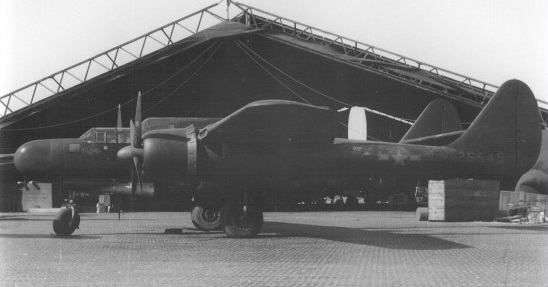
Northrop P-61A-5NO 42-5549, 9th AF

It made its operational debut in the South Pacific in the summer of 1944 and was the standard USAAF night fighter at the end of the war. Unlike other USAAF fighters such as the P-47 Thunderbolt or P-51 Mustang, the Black Widow did not chalk up a particularly impressive number of kills, because by the time of its entry into service, the Allies had already established almost overwhelming air superiority over virtually all fronts, and enemy aircraft were rather few and far between, especially at night.

The F-15A two-seat strategic reconnaissance variant first flew in 1946.

A total of 706 aircraft were built.

Gallery

P-61A
Engines: 2 x Pratt & Whitney R-2800-10, 2000 hp
Wingspan: 66 ft / 20.12 m
Length: 48 ft 11 in / 14.92 m
Height: 14 ft 8 in / 4.49 m
Empty weight: 24,000 lb / 10,886 kg
Max loaded weight: 32,400 lb / 14,696 kg
Max speed: 366 mph / 590 kph
ROC: 2200 fpm / 670 m/min
Service ceiling: 33,000 ft / 10,060 m
Range max fuel: 500 mi
Armament: 4 x 20mm M-2 cannon (belly), plus in first 37 A: 4 x 0.5in dorsal

P-61B
Engines: 2 x Pratt & Whitney R-2800-65 Double Wasp, 1491kW / 2219 hp
Wingspan: 20.12 m / 66 ft 0 in
Length: 15.11 m / 49 ft 7 in
Height: 4.47 m / 14 ft 8 in
Wing area: 61.53 sq.m / 662.30 sq ft
Max take-off weight: 16420 kg / 36200 lb
Empty weight: 10637 kg / 23451 lb
Max. speed: 589 km/h / 366 mph
ROC: 2200 fpm / 670 m/min
Ceiling: 10090 m / 33100 ft
Range: 2173 km / 1350 miles
Range max fuel: 2800 mi / 4500 km
Bombload: 6400 lb
Armament: 4 x 20mm M-2 cannon (belly), plus in last 250 B: 4 x 0.5in dorsal
Crew: 3

P-61C
Engines: 2 x Pratt & Whitney R-2800-73, 2800 hp
Wingspan: 66 ft / 20.12 m
Length: 49 ft 7 in / 15.1 m
Height: 14 ft 8 in / 4.49 m
Empty weight: 24,000 lb / 10,886 kg
Max loaded weight: 40,300 lb / 18,280 kg
Max speed: 430 mph / 692 kph
ROC: 3000 fpm / 914 m/min
Service ceiling: 41,000 ft / 12,560 m
Range max fuel: 2800 mi / 4500 km
Bombload: 6400 lb
Armament: 4 x 20mm M-2 cannon (belly), 4 x 0.5in dorsal

F-15
2 seat strategic reconnaissance
Engines: 2 x Pratt & Whitney R-2800-73, 2800 hp
Wingspan: 66 ft / 20.12 m
Length: 50 ft 3 in / 15.3 m
Height: 14 ft 8 in / 4.49 m
Empty weight: 22,000 lb / 9979 kg
Max loaded weight: 28,000 lb / 12,700 kg
Max speed: 440 mph / 708 kph
ROC: 3000 fpm / 914 m/min
Service ceiling: 41,000 ft / 12,560 m
Range max fuel: 4000 mi / 6440 km
Armament: none

Northrop N9M

N-9MB

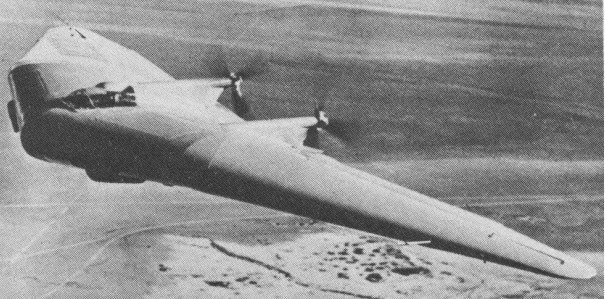
Faced with the distinct possibility of a British defeat in the war in Europe, America’s most pressing need in 1941 was for a bomber with intercontinental range which could strike Germany and return home. The US Army gave the go ahead for an aircraft which spanned 52.4 m (172 ft), had a gross weight of 78,845 kg (165,000 lb) and could carry a 23,225 kg (51,200 lb) bombload. Four 3000 hp Pratt & Whitney Wasp Major engines driving contra rotating pusher propellers powered the aircraft which had a crew of 15 and was to have been defended by 20 remotely controlled 12.7mm (0.5 in) machine guns.

Northrop N9M Article

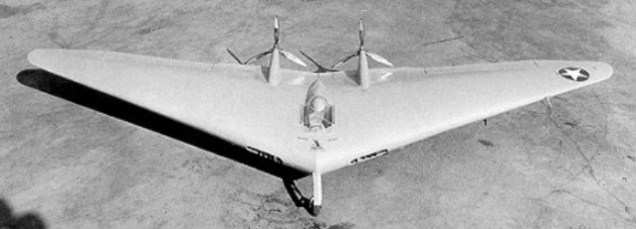
By mid 1941 Northrop was well advanced with a far more ambitious design based on the encouraging results obtained with the N-1M. This design was for a flying wing bomber.

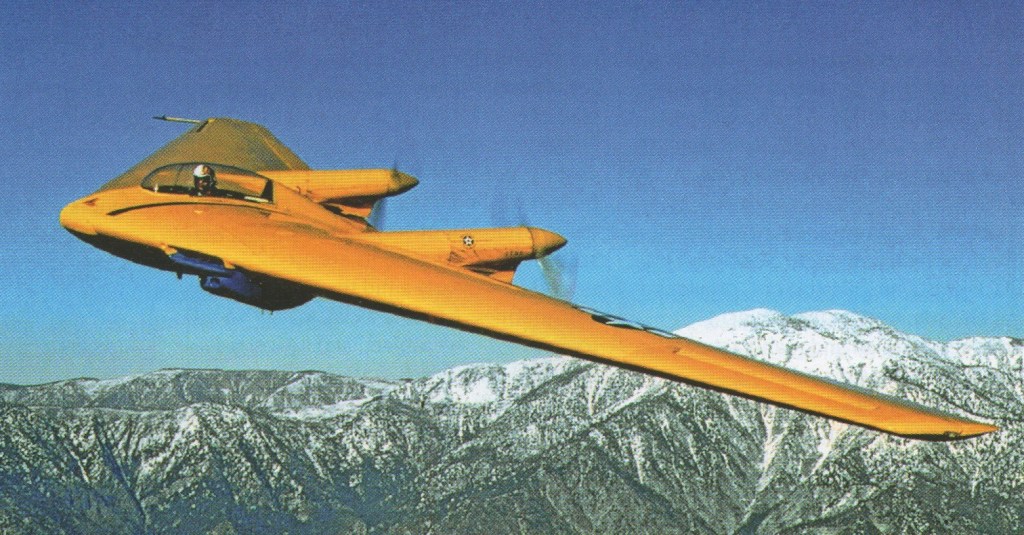
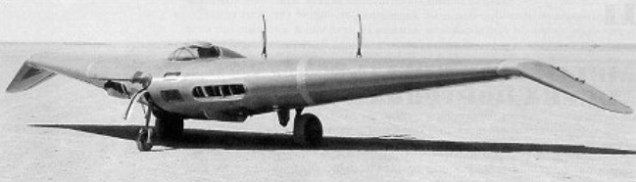
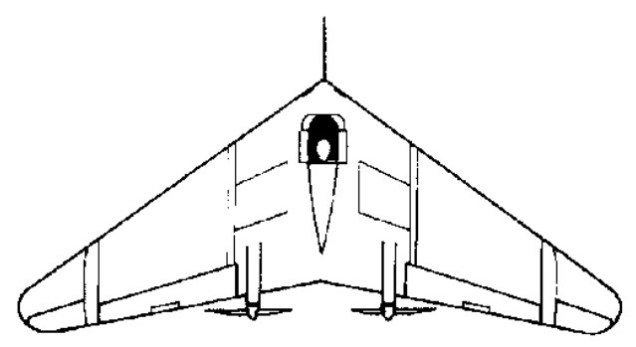
The scale model of the bomber was designated N 9M. This was approximately a one third linear scale of the great bomber, and thus weighed about 1/27th as much, the actual weight being of the order of 7,100 lb. The first two aircraft, and the third (designated N 9M A), had two 275 hp Menasco Buccaneer engines driving pusher propellers positioned midway between the thrust lines of the four propellers of the bomber; the fourth aircraft, designated N 9M B, had two 300 h.p. Franklins. The fact that four aircraft were needed is explained by the sheer volume of work that had to be accomplished. Not only was the definitive form of surface system controls and flaps far from settled, but there were also extensive development programmes for autopilot and other systems, while concurrently exposing the aircraft to the hands of the greatest possible number of Army test pilots in order both to acquire critical feedback from the customer and also allay a whole string of fears about how all wing aircraft behaved.

N9MB

The first N 9M was flown on December 27, 1942. After about 30 encouraging hours it crashed, killing the pilot. Nobody had the slightest indication of what happened. Northrop could not find evidence of in flight failure and decided the pilot must have got into a spin at low level. The other three N 9Ms gave no trouble at all, and in the course of many hundreds of hours were stalled and spun even with c.g. at the aft limit.

A three-year test programme was flown from Muroc Army Air Base, providing much data and giving pilots experience in the handling and performance of flying wings, and the autopilot for the XB-35 was developed in an N-9M. All N-9Ms had retractable landing gear and varying colour schemes; the first two were all yellow, the third (N-9MA) was blue on top and yellow underneath, while the fourth (N-9MB) had the colour reversed. The colours identified the top or bottom of the aircraft during observations of the flight programme.

Gallery

N 9M A
Engines: two 205kW / 275 hp Menasco Buccaneer

N-9MB
Engines: 2 x Franklin 224kW / 300 hp
Max take-off weight: 3200 kg / 7055 lb
Wingspan: 18.3 m / 60 ft 0 in
Length: 5.3 m / 17 ft 5 in
Wing area: 46 sq.m / 495.14 sq ft
Crew: 1

Northrop N-3PB

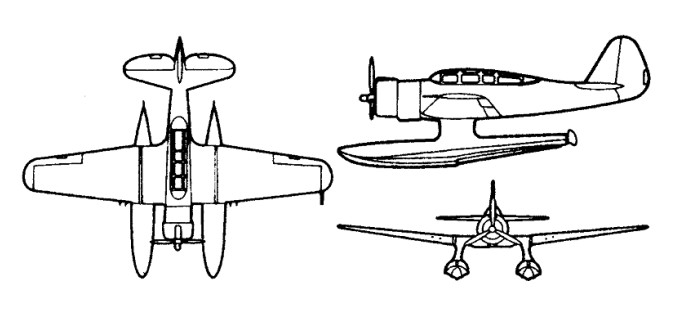
In 1940 Northrop received an order from a Norwegian Buying Commission for the design and construction of a single-engine monoplane patrol bomber with twin floats. The Norwegian order covered 24 aircraft, and in less than eight months the Northrop N-3PB prototype flew, on 1 November 1940, powered by an 895kW Wright Cyclone GR-1820 radial engine. It attained a speed of 414km/h and was then claimed to be the world’s fastest military seaplane.

Norway was invaded by the Germans shortly after the contract had been awarded, and the N-3PBs were delivered to a unit of the Royal Norwegian Naval Air Service, operating as an RAF unit from unimproved coastal sites in Iceland on anti-submarine patrol and convoy escort duties. All maintenance had to be performed in the open, often under extremely harsh environmental conditions, and during 19 months of 1941-42 several were lost during water landings in severe arctic weather, but there were no losses due to enemy action.

An aircraft was destroyed as late as 1965, in the collapse of a snow-laden hangar, but in the early 1980s an N-3PB was located and restored in Norwegian colours by the manufacturers.

Northrop N-1M

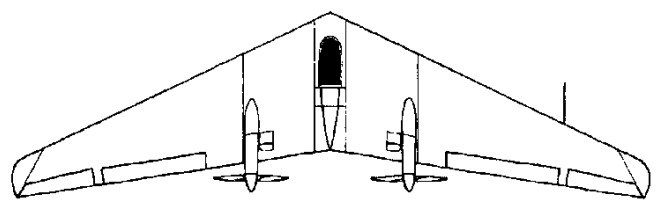
Northrop began to build one flying wing in 1939, designating it N 1M (Northrop model Mock up). Essentially it was just a 38 foot stressed skin wing, with a very fat section (and as much camber underneath as on top) and a slightly swept back shape. The upper surface had very slight dihedral, so that there was quite sharp dihedral on the underside, but the tips sloped sharply downwards so that the ailerons, which were entirely out¬board of the kink, could also serve as rudders. On the trailing edge were powerful elevators incorporating trim¬ming tabs. The pilot sat close to the centre of gravity, his head projecting above the upper surface under a small canopy and his forward vision being improved by four small windows in the remarkably fat leading edge. Just outboard of these windows were intakes for the cooling air for the two 65 hp Lycoming engines, which were buried in the wing and drove pusher propellers through 10 foot shafts housed in fairings which made no contribu¬tion to lift but which Northrop could not avoid. The N 1M rode on a short wheelbase retractable tricycle landing gear, with a long fixed tailwheel added to, keep the propellers from touching the ground.

Northrop bore most of the costs of building it himself, but in view of its long term importance he did not invite the press in to have a look at it. Indeed he had already come to the conclusion that the ideal role for an all wing machine was that of a long range bomber, and had discussed the possibility with the Army Air Corps and with the top technical staff at Wright Field. They were extremely interested, and it was agreed that the N-1M should be kept under wraps.

In May 1940 the completed machine was painted bright yellow, registered as NX 28311 and trucked by night from the plant at Hawthorne to the very new Army test base at Lake Muroc out in the remote Mojave Desert.
Pilot Vance Breese tried taxying and then, on July 3, cautiously lifted off and held the yellow wing as close to the ground as he could as someone said, “to make the crash a bit easier”. Northrop’s comment was “It looks like we have a plane with a twenty foot ceiling”, but of course Breese later made proper flights which on the whole were remarkably successful. There was no catastrophic accident, and the N-1M explored a wide range of configurations with different planform, dihedral, tip shape, c.g. location and, most important of all, control system. Soon it was flying much faster with 117 h.p. Franklin 6AC 264 F2 engines driving three blade v p propellers.

The N 1M really flew extremely well, in the hands of several pilots (notably Moye Stephens), and the only persistent difficulty was the cooling of the engines. Ordinary flying had by mid 1941 become a safe and routine operation, with the whole design envelope, including stalls and spins, fully explored in 200 flights. The only control “problem” was that it took a long time to find the best arrangement to control yaw (weathercocking of the nose, for example, due to asymmetric thrust). The original idea of using the ailerons on the down turned tips to serve as rudders was not wholly adequate, and eventually Northrop considered the best answer was to eliminate the kinked tips and make the ailerons in the form of split upper and lower halves which could be opened to act as a powerful brake. With just one aileron thus opened there would be an extremely potent yawing moment amply capable of holding any asymmetric condition.

The N-1M has survived in the US National Air and Space Museum.

N-1M
Engine: 2 x Lycoming, 48kW / 65 hp
Max take-off weight: 1360 kg / 2998 lb
Wingspan: 11.6 m / 38 ft 1 in
Length: 5.2 m / 17 ft 1 in
Wing area: 28 sq.m / 301.39 sq ft
Crew: 1

Northrop FT-1 / FT-2 / BT-1 / BT-2

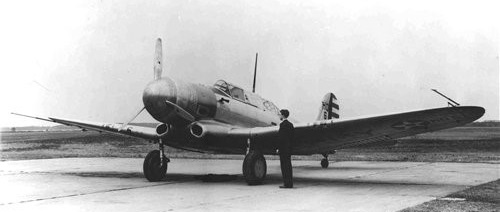
While Northrop was working on the YA-13/XA-16 developments of the Gamma, the company was also testing a scaled-down version for the US Navy under the designation Northrop XFT-1. This was one of two Northrop prototypes which failed to attract production orders, the other being the Type 3-A of 1935. Both were all-metal fighters, the XFT-1 with fixed landing gear being intended for the US Navy. Powered originally by a 466kW Wright XR-1510 radial, it was later re-engined, as the XFT-2, with a 485kW Pratt & Whitney R-1535, but crashed three months later, in July 1936.

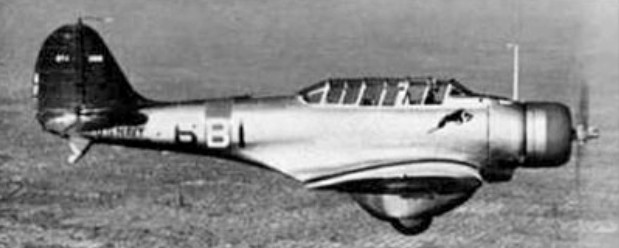
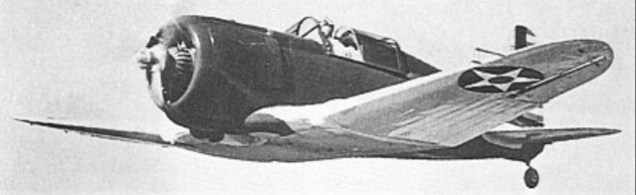
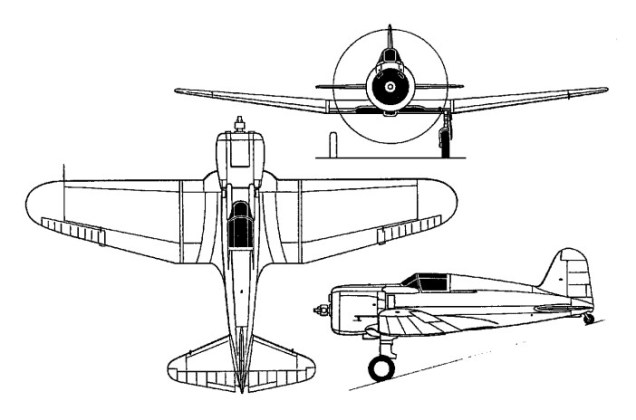
The Northrop 3-A was a similar design for the US Army, but differed from the navy aircraft in having retractable landing gear and a modified canopy. Developed alongside these prototypes was the XBT-1, which had semi-retractable landing gear, and this entered production as the BT-1 torpedo-bomber, the first of 54 being delivered in April 1938. The BT-1 had a 615kW Pratt & Whitney R-1535 Twin Wasp Junior radial engine, but one aircraft was modified as the BT-2 to have revised landing gear and a 597kW Wright XR-1820 Cyclone. With other modifications this was to become the Douglas SBD Dauntless as the original Northrop Corporation had by then become the El Segundo Division of Douglas.

Northrop 3A

Based on the design of the XFT, the Model 3A was developed as a contender in the US Army’s Materiel Division competition for a successor to the P-26 in service with the USAAC. A low-wing all-metal semi-monocoque monoplane with fully-retractable main undercarriage members and an enclosed cockpit, the Model 3A was powered by a Pratt & Whitney SR-1535-6 Twin Wasp Junior 14-cylinder radial engine rated at 700hp for take-off. It had provision for one 7.62mm and one 12.7mm gun in the fuselage. Completed in July 1935, it was briefly tested at Wright Field where it was found to be somewhat unstable and prone to spinning. Returned to the manufacturer for modification, the Model 3A was under test over the Pacific on 30 July, but failed to return, no trace of the aircraft nor its pilot ever being found. The design of the Model 3A was subsequently sold to Chance Vought Aircraft which further developed it as the V-141.

3A
Max take-off weight: 1769 kg / 3900 lb
Wingspan: 10.21 m / 33 ft 6 in
Length: 6.78 m / 22 ft 3 in
Height: 2.77 m / 9 ft 1 in
Wing area: 17.37 sq.m / 186.97 sq ft
Max. speed: 434 km/h / 270 mph

Northrop XFT

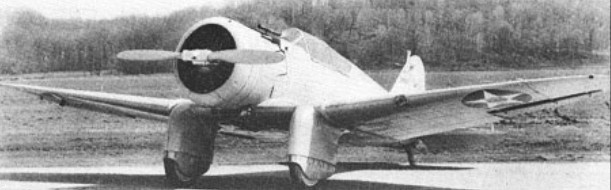
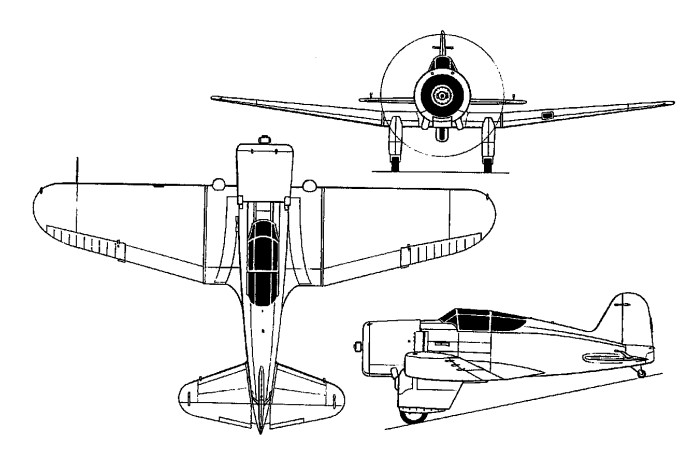
Despite some scepticism concerning the practicability of the monoplane configuration for the shipboard fighter, the US Navy’s BuAer issued a second requirement for such a warplane on 24 January 1933, the first having been issued seven weeks earlier and for which the Boeing Model 273 was designed and built (as the XF7B-1). To meet the later but essentially similar requirement, a contract was let to Northrop for a prototype assigned the designation XFT-1.

A single-seat all-metal cantilever monoplane with split flaps, spatted main undercarriage members and an enclosed cockpit, the XFT-1 was designed by a team led by Ed Heinemann. Powered by a Wright R-1510-26 14-cylinder radial rated at 600hp at sea level and 625hp at 1830m, and carrying two 7.62mm cowl guns, the XFT-1 first flew on 16 January 1934.

The US Navy was critical of its manoeuvrability, its tendency to spin out of certain manoeuvres, its low speed characteristics and its landing speed. During the course of initial tests, an XR-1510-8 engine affording 650hp at 2590m was substituted for the -26, and, in April 1936, the XFT-1 was returned to the manufacturer for more extensive modification. A Pratt & Whitney R-1535-72 Twin Wasp Jnr 14-cylinder radial rated at 700hp for take-off and 650hp at 2285m was installed, this having a long-chord cowling; the vertical tail surfaces were enlarged, and the mainwheel spats were revised.

Redesignated XFT-2, the fighter was now 118kg heavier in empty condition, speed and climb performance were marginally improved, but manoeuvrability and low speed characteristics were worse. It was pronounced unairworthy by the US Navy and crashed on 21 July 1936 while being returned to its manufacturer.

XFT-1
Max take-off weight: 1704 kg / 3757 lb
Empty weight: 1120 kg / 2469 lb
Wingspan: 9.75 m / 31 ft 12 in
Length: 6.43 m / 21 ft 1 in
Height: 2.87 m / 9 ft 5 in
Wing area: 16.44 sq.m / 176.96 sq ft
Max. speed: 378 km/h / 235 mph
Range: 1570 km / 976 miles

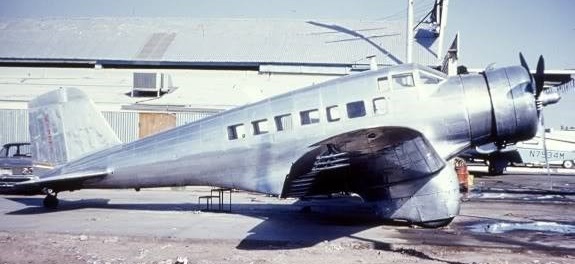
Northrop Delta / RT-1

While the Gamma was being developed, Northrop was working on a nine-seat transport, which was basically a new fuselage married to Gamma wings. Unfortunately for Northrop, the US 1926 Air Commerce Act was amended to prohibit the use of single-engine aircraft for carrying passengers by night, or over rough terrain where emergency landings could not be made. Consequently, airline use for its intended role was nonexistent in the USA, although three had been sold before the new regulation was announced. Eight others were used as executive transports, and one was bought by Swedish AB Aerotransport, which subsequently acquired a second.

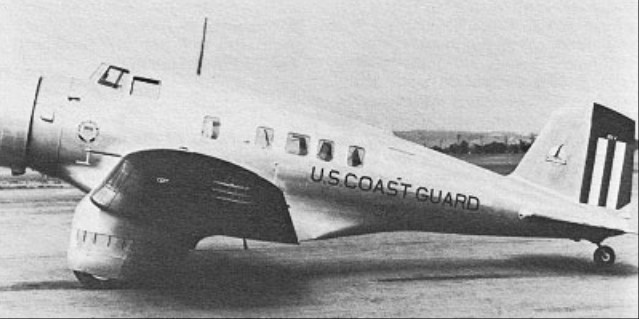
The US Coast Guard operated a Delta under the designation RT-1, as the Secretary of the Treasury’s personal aircraft.

The last Delta was supplied to Canada as a pattern aircraft for assembly in that country by Canadian Vickers, who built 20 of various marks with both wheel and float landing gear. Deltas were flown with various engines, including the 529kW and 548kW Wright SR-1820, 485kW, 492kW and 522kW Pratt & Whitney Hornets.

Northrop Delta 1D NC13777 s/n 28

Northrop Gamma 2C / Gamma 2F / A-13 / A-16 / A-17 / A-33 / Nomad / 8A / Douglas A-33

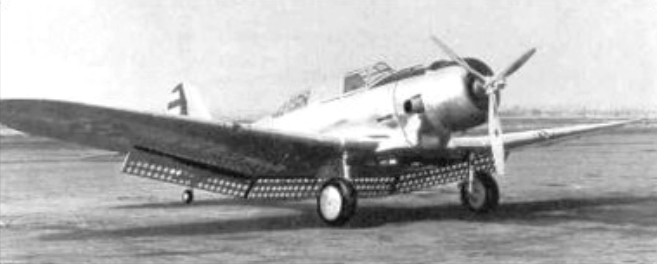
Northrop used the Gamma transport as the basis of a private-venture design for a light attack bomber, identifying this as the Northrop Gamma 2C which, powered by a 548kW Wright SR-1820F radial engine, was acquired for evaluation by the US Army Air Corps in June 1934 under the designation YA-13. Subsequently re-engined with a 708kW Pratt & Whitney R-1830 Twin Wasp, this aircraft was redesignated XA-16 (Northrop Gamma 2F).

Following tests of the YA-13 and XA-16, Northrop received $2 million contract for 110 attack bombers designated A-17, but because testing of the XA-16 had shown that the aircraft was over-powered, the Gamma 2.F was re-engined with a 559kW Pratt & Whitney R-1535 Twin Wasp Junior, serving as the prototype for the A-17. Following the incorporation of several other modifications, the first of 109 production A-17 aircraft was delivered in December 1935.

A contract was received in the same month for an improved A-17A, introducing retractable tailwheel landing gear and the 615kW Pratt & Whitney R-1535-13 engine. Some 129 were built, initially by Northrop, but in 1937 Douglas acquired the remaining 49% of Northrop Corporation’s stock, and it was the Douglas Company which completed production of these aircraft. Of the total, 93 served with the USAAC for only 18 months, then being returned to Douglas for sale to the UK and France. The Royal Air Force received 60, designating them Nomad Mk I, and all were transferred to the South African Air Force.

Northrop A-17А

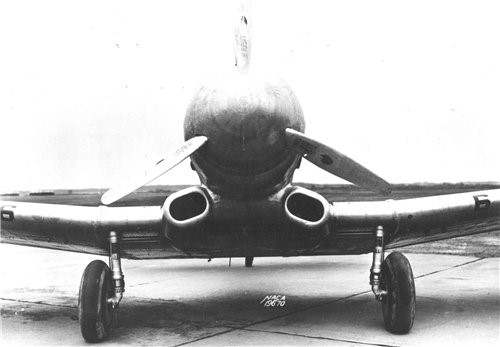
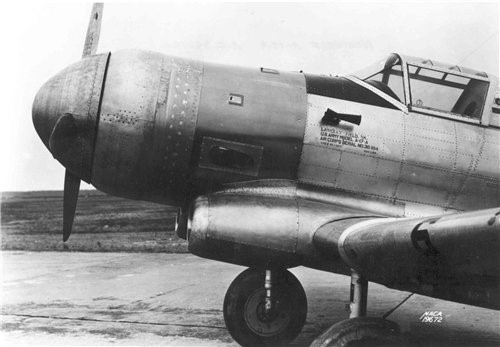
An experiment with the Northrop A-17 aircraft in 1940 consisted in changing the way the air was taken to cool the engine to which the air is fed through special channels at the root of the wing.

Northrop A-17А

These air intakes, even supported by a special suction fan (hot air was emitted through special blinds from above), turned out to be completely inadequate to supply the required air volumes. Ground tests gave normal temperature only at idle speed and without load. Any attempt to increase the amount of power led to a rapid overheating of the engine.

Northrop A-17А

Douglas also built this aircraft for export under the designation Douglas Model 8A, supplying them to Argentina, Iraq, the Netherlands and Norway. In 1939 the first SAAB built 8A-1 was completed (as the B5).

Early in 1940, the Norwegian government ordered 36 8A-5s which not had been delivered before Norway was invaded by the Germans. Completed between October 1940 and January 1941, the aircraft were delivered to a training center in Canada that had been set up for the Norwegian government-in-exile, named “Little Norway” at Toronto Island Airport, Ontario.

The 8A-5 was powered by a 1,200 hp (895 kW) Wright R-1820-87 engine, with four wing mounted 0.30 in machine guns, two 0.50 in machine guns in pods below the wing, a rear-firing flexibly mounted 0.30 in gun, and the ability carry up to 2,000 lb of bombs.

A-33/Model 8A-5

After the loss of two aircraft and a reassessment of the training needs now met by the use of other aircraft, the remaining 34 Model 8A-5Ps were sold to Peru. However, 31 were repossessed by the Army Air Corps at the start of World War II. These aircraft, designated A-33, were used for training, target tug, and utility duties. Serial numbers: 42-13584/13601; 42-109007/109019

A-17A
Engine: 1 x Pratt & Whitney R-1535-13 radial, 615kW
Max take-off weight: 3421 kg/ 7542 lb
Empty weight: 2316 kg / 5106 lb
Wingspan: 48 ft 8.5 in
Length: 9.65 m / 31 ft 8 in
Height: 3.66 m / 12 ft 0 in
Wing area: 33.63 sq.m / 361.99 sq ft
Max. speed: 354 km/h / 220 mph
Ceiling: 5915 m / 19400 ft
Range: 1175 km / 730 miles
Armament: 5 x 7.62mm machine-guns, 4 x 45kg bombs

Douglas A-33
Powerplant: 1 × Wright GR-1820-G205A Cyclone, 1,200 hp (890 kW)
Propeller: 3-bladed variable-pitch propeller
Wingspan: 47 ft 9 in (14.55 m)
Airfoil: root: NACA 2215; tip: NACA 2209
Wing area: 363 sq ft (33.7 m2)
Length: 32 ft 6 in (9.91 m)
Height: 9 ft 4 in (2.84 m)
Empty weight: 5,510 lb (2,499 kg)
Gross weight: 8,600 lb (3,901 kg)
Max takeoff weight: 9,200 lb (4,173 kg)
Maximum speed: 248 mph (399 km/h, 216 kn) at 15,700 ft (4,800 m)
Service ceiling: 29,000 ft (8,800 m)
Time to altitude: 10,000 ft (3,000 m) in 5 minutes 48 seconds
Guns:
4 × forward-firing .30 cal (7.62mm) 1919 Browning machine guns, 500rpg
2 × forward-firing .50 cal M2 Brownings in gun pods, 200rpg
1 × .30 cal (7.62mm) 1919 Browning machine gun in rear cockpit, 1,000 rounds
Bombs: 2,000lb max load
Internal: Up to twenty 20 lb (9.1 kg) bombs in internal racks
External: Eight hardpoints under the fuselage, four outboard hardpoints can take 500 lb (230 kg) bombs, all eight can carry 100 lb (45 kg)
Crew: 2

Northrop Gamma 2 / UC-100

In January 1932 John Northrop and Donald Douglas formed the Northrop Corporation and the first aircraft from the new corporation was the Northrop Gamma, several of which were built to special order for record-breaking flights and research work. The first two aircraft, a Gamma 2A and a Gamma 2B, were powered respectively by a 585kW Wright and 373kW Pratt & Whitney Wasp radial. Both were delivered at the end of 1932, the first to Texaco who loaned it to Frank Hawks for record-breaking flights.

Gamma NR12265 was built for Lieutenant Commander Frank Hawks of the Texas Company, as a long-range, high speed mail transport in 14/2/33. Named Texaco Sky Chief, it was flown out to the Antarctic via South America to assist with the search for Lincoln Ellsworth when he and pilot Herbert Hollick-Kenyon were declared missing in late 1935. Later sold to “Gar’ Wood and renamed Kinjockety II, it exploded in midair during the 1936 Bendix Trans¬continental Race.

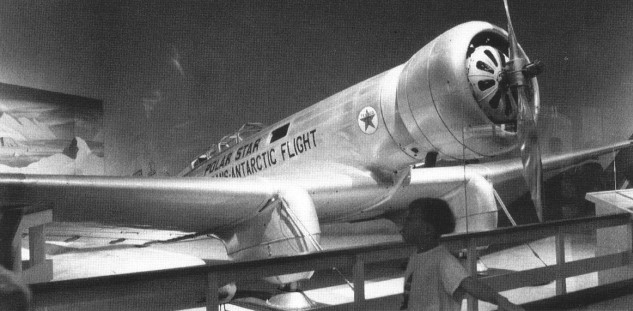
The second, 2B NR12269, being the first to fly after being completed in August 1932. Sold in early 1933 to millionair explorer Lincoln Ellsworth, it was shipped to the Antarctic in late 1933 and test flown on skis by Bernt Balchen before being damaged in an unseasonable ice breakup. The aircraft was back in Dunedin, New Zealand, on 28/1/34 for transshipment on to California for repairs. Returned to the United States after the successful trans polar cap flights between 23/11 and 9/12/35, the Gamma was presented to the Smithsonian on 25/4/36.

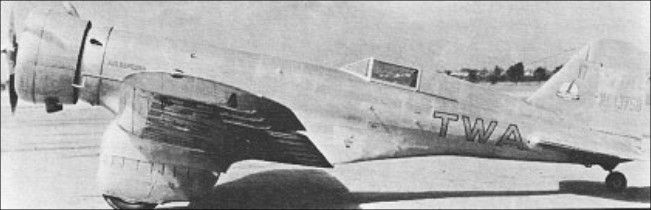
TWA bought three Gamma 2D aircraft with 529kW Wright Cyclone engines as single-seat mailplanes in 1934. The second was later re-engined with a 578kW Wright and was used by Texaco to test oil temperatures and flows before being sold to the US Army Air Corps, which designated it UC-100.

A number of Gammas were delivered to individual customers, including two to the UK, a 2E for the Aeroplane & Armament Experimental Establishment and a Gamma 2L, the last to be built, was used by the Bristol Aeroplane Co. as a test-bed for its Hercules engines.

The Chinese government ordered 24 Gamma 2E aircraft as light bombers, with 529kW Wright engines. They could carry a 726kg bombload and had four 7.62mm forward-firing machine-guns in the wings, and one rearward-firing in the rear cockpit. A further 25 Gamma 2Es were assembled in China from components provided by Northrop.

Engine: Pratt & Whitney Wasp, 500 hp
Seats: 2
Range: 2000 miles