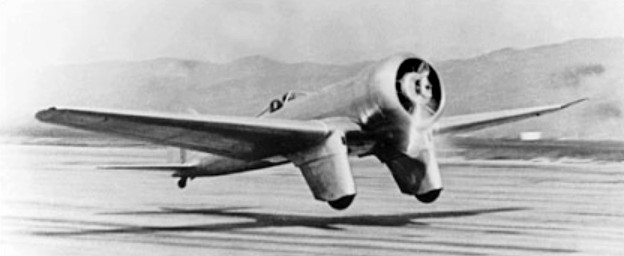
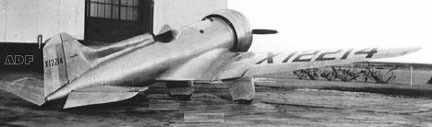
In 1931 Northrop built the prototype of an all-metal low-wing sporting monoplane X/NC12214, the Beta (ATC 2-401), a two-seater with a 119kW Menasco Buccaneer inline engine.
Designed by Don Berlin, a dorsal fairing and canopied cockpit were later added. An advertisement in Dec 1932 Aero Digest quoted a $5,000 sale price.
Stearman-Northrop Beta 3D with dorsal fairing NX12214
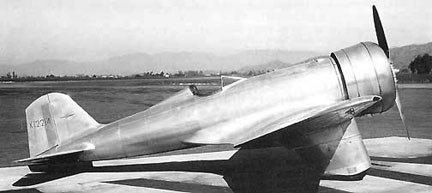
It was converted to single-seat high-speed mailplane configuration in 1933 and fitted with a 300 hp / 224kW Wright Whirlwind radial engine, in which form it became the first aircraft of such power to exceed 200mph / 322km/h. Reported speeds up to 212 mph were reached.
Damaged in a landing accident on 16 January 1933, it was rebuilt by Stearman for planned testing of various wing flaps, but destroyed in a crash on 5 June 1934.
Stearman-Northrop Beta 3D NX12214
Beta 3D Engine: 300hp P&W Wasp Jr Wing span: 32’0 Seats: 1
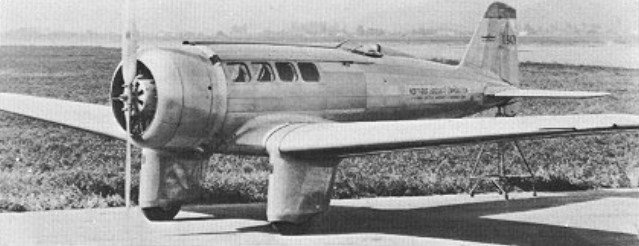
Northrop’s first aircraft for his new company was known as the Flying Wing but of more immediate consequence was the next design, the Northrop Alpha, an all-metal seven-seat single-engine low-wing monoplane. In 1929 Avion Corporation became the Northrop Aircraft Corporation, a division of United Aircraft and Transport Corporation of which Boeing was also a part.
First flown in 1930, Trans Continental and Western Air Inc, (later to become Trans World Airlines) ordered five Alphas with 313kW Pratt & Whitney Wasp engines and began services on 20 April 1931 from San Francisco to New York, with 13 intermediate stops, the journey taking just over 23 hours.
The Alphas were configured for three passengers and 211kg of mail and cargo, for mail flying was a plum contract at that time, but regularity and reliability was required. To achieve all-weather and night-flying capability, the Alphas had the most modern radio and navigation equipment, and for winter operations became the first commercial type to be fitted with Goodrich rubber de-icer boots on wing “and tail surface leading edges.
Thirteen of the 17 Alphas built saw service with TWA, and three were supplied for evaluation to the US Army Air Corps where, had production orders been given, they would have been designated C-19.
Various configurations carried the designations Alpha 2, Alpha 3, Alpha 4 and Alpha 4-A, and a number of changes were made between individual aircraft as late modifications were made retrospectively to earlier aircraft, including fitting of streamlined ‘trousers’ over the original rather utilitarian landing gear.
The 1931 Alpha 3 was certified under ATC 2-335. The 1931 Alpha 4 (ATC 451) prototype was built at Northrop, the rest at Wichita. Eleven were built, of which 7 were modified from Northrop Alpha 2 and 3. ATC 2-371 was for Alpha 4 NC127W powered by a 420hp Wasp installation.
The 1932 Alpha 4A (ATC 461) was a single-place cargo conversions of Alpha 4. Ten were built.
The last conversion was the Gamma 4-A, an all-cargo aircraft which could carry 567kg; the Gamma 4 and Gamma 4-A had a 336kW Wasp engine and most of the earlier aircraft were similarly retrofitted.
The last surviving Alpha, the third built, served with the US Assistant Secretary of Commerce for Aeronautics, the Ford Motor Company, National Air Transport (part of United Airlines) and TWA. It was re-acquired by the airline in 1975 and superbly restored before being placed in Washington’s Smithsonian Institution National Air and Space Museum.
Alpha 3 Engine: 420hp P&W Wasp Seats: 3
Alpha 4 Engine: 450hp P&W Wasp Wingspan: 43’10” Length: 28’5″ Useful load: 1900 lb Max speed: 177 mph Cruise: 155 mph Stall: 62 mph Range: 650 mi
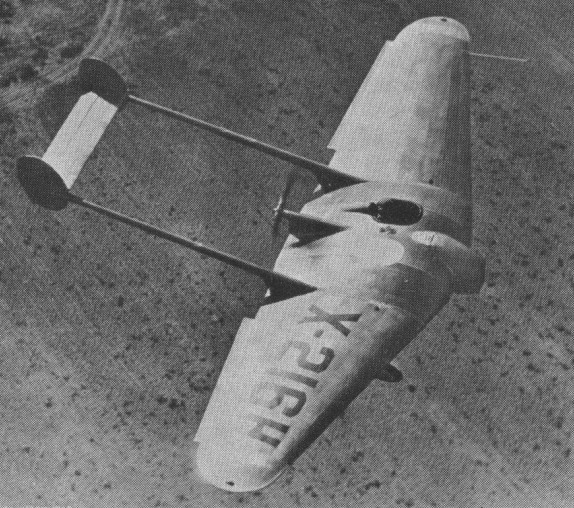
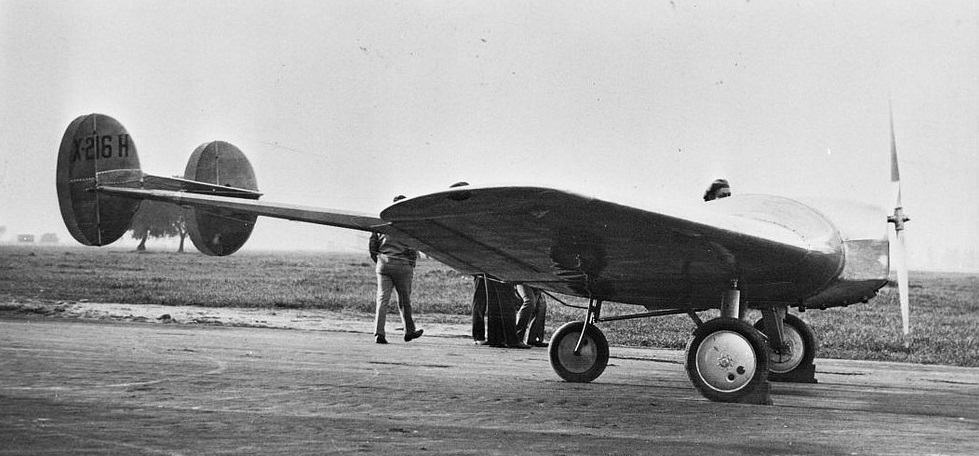
Jack Northrop in 1928 wanted to “do his own thing”, which was to start investigating all wing aircraft, He decided to keep a tail, for the time being. So the Northrop Flying Wing, with experimental registration X 216H, was intended to solve only some of the problems. The wing was a fairly conventional shape, apart from the thick centre section so that the pilot and passenger could sit comfortably inside it on each side of the centre line. The whole structure was a duralumin cellule with multiple spars and a stressed skin. To the rear projected an extremely, light pair of duralumin monocoque tail booms carrying a twin finned tail, the whole assembly weighing less than half as much as a conventional rear fuselage and tail. The main wheels were well forward under the leading edge, and under the trailing edge was a large steerable tailwheel.
The 90 hp / 67kW Menasco Pirate engine was carried just ahead of the leading edge, with cooling air ducted to an outlet near the trailing edge. Northrop was deeply concerned to secure smooth airflow over his flying wings and never again put a propeller in front of one.
The aircraft, built by Northrop’s newly formed Avion Corporation (later the Northrop Aircraft Corporation), initially driving a pusher propeller but modified later to tractor configuration.
Courtesy John Frazer
X 216H flew perfectly well. Reports say it flew well and was 25% faster than anything else in its class. It had conventional controls, and Northrop wanted to explore alternative arrangements and ultimately take the giant step of removing the tail, but he was prevented by financial and business difficulties.
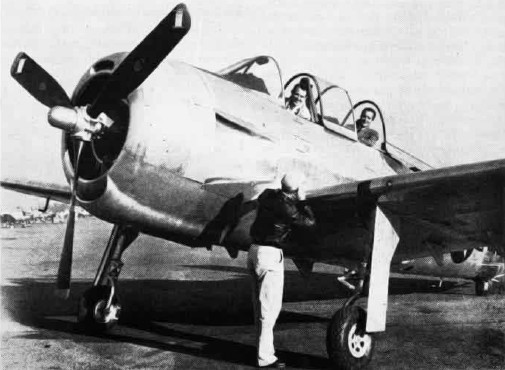
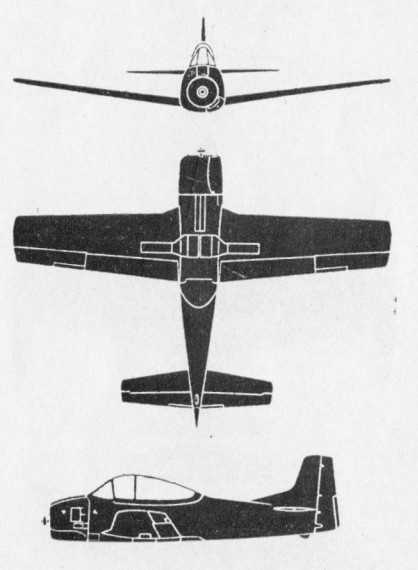
The North American XSN2J-1, also known by the company designation NA-142, was developed for the United States Navy by North American Aviation as a replacement for the SNJ Texan as an advanced scout-trainer.
Designed in competition with the Fairchild XNQ, the XSN2J-1 first flew on 15 February 1947, two aircraft being evaluated by the Navy (121449 and 121450) as XSN2J-1. Neither aircraft were considered satisfactory in evaluations; in addition, restrictions on the Navy’s budget meant that the aircraft could not be ordered at the time, and the program was cancelled in 1948.
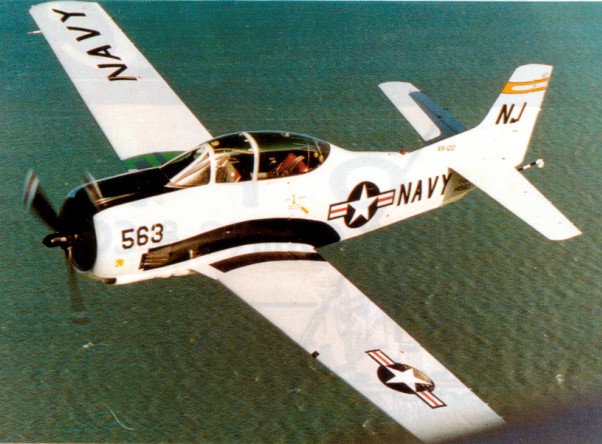
The similar T-28 Trojan would later be ordered to fill the Navy’s requirement for a new trainer.
Clambered over an SN2J in the junk pile behind Service Test at NAS Patuxent, MD in late ’49. Nice looking bird. John W. Bradford, Jr.
Engine: 1 × Wright R-1820-78 Cyclone, 1,100 hp (820 kW) Propeller: 3-bladed Wingspan: 41 ft (12 m) Wing area: 236 sq ft (21.9 sq.m) Length: 32 ft (9.8 m) Empty weight: 5,500 lb (2,495 kg) Gross weight: 7,500 lb (3,402 kg) Maximum speed: 270 mph (435 km/h; 235 kn) Cruise speed: 190 mph (306 km/h; 165 kn) Range: 1,600 mi (1,390 nmi; 2,575 km) Service ceiling: 30,000 ft (9,100 m) service Crew: Two (student and instructor)
During and immediately following WWII, NAA developed the next generation, high performance, advanced trainer to serve as a successor to the NAA T-6/SNJ Texan. The result was the T-28 Trojan series.
First flown on 26 September 1949 as the XT 28A, the Trojan was put into production as the T-28A two-seat basic trainer for the USAF. Power was provided by a 596kW Wright R-1300-1 radial engine. 1,194 “A” models were built with the Aero Product 2-blade propeller. The Air Force used these aircraft for training and various other roles from 1950 to 1956. The “A” model also replaced the Mustang fighters in the reserve units until 1959.
Ordered into production by the USAF in 1950 as the T-28A, the US Navy evaluated the T 28A in 1952 and decided that the Wright Cyclone R1300, with 800 hp and a two bladed propellor left the aircraft under-powered for carrier operations.
In 1952, the Navy contracted with NAA to build 489 T 28Bs, an improved version. The T-28B was the initial US Navy version fitted with a 1425 hp / 1,062kW Wright R-1820-86 engine, Hamilton Standard 3-blade propeller, belly mounted speed brake, and a two-piece sliding canopy (as fitted to late production T-28A). 489 “B” models were built and used from the middle 50’s to the middle 80’s.
T-28B
The T-28C was built for the Navy starting in 1955. The T-28C is equipped with a tail hook, a smaller diameter propeller, and other minor changes to allow aircraft carrier landings. 299 “C” models were manufactured with production ending in 1957.
In 1958 many T-28As were declared surplus and North American designed a modification scheme to convert the into two-seat utility aircraft, under the name Nomad. The main change involved replacing the original 800 hp Wright R-1300 engine with the more powerful R-1820. Supplementary modifications were drawn up to convert the Nomad into a military light strike-reconnaissance aircraft.
In 1959, several hundred surplus “A” models were shipped to France and were modified with the 1,062kW R-1820-56S engine, structural improvements, and armament for combat use, by Sud Aviation for the French Air Force. Sud-Aviation were given a contract for 135 conversions of ex-USAF T-28As under licence to PacAero, who had taken over the Nomad conversion programme from North American. These aircraft are commonly referred as Fennec, T-28S (Sud), or T-28F. After success in combat in Algeria in the early sixties, they continued to serve France and several other countries for many years.
Sud-Aviation Fennec
Similar to the FENNEC but converted by various contractors in the U.S., the T-28D-5 also started as a surplus “A” model. Almost 250 “D” models were supplied to U.S. and other forces fighting in Southeast Asia. Additionally, “B” & “C” models, known as the T-28D-10, were also modified and used in combat.
During the early 1960s the United States Tactical Air Command (TAC) was directed to develop a counter-insurgency (COIN) force tailored to train friendly air forces to fight in limited wars against guerrilla forces. As a result of this directive TAC began evaluating existing aircraft types to find an available and inexpensive aircraft that could be modified for use as a COIN aircraft.
This decision resulted in the T-28D which was basically a rebuilt T-28A with a more powerful engine, six underwing hardpoints, and strengthened wings. The T-28D was powered by a 1425hp Wright Cyclone R-1820-56S nine cylinder air cooled radial engine, driving a three blade Hamilton Standard propeller. To allow the T-28D to perform in its intended role of tactical fighter-bomber, the wings were strengthened to enable the aircraft to carry a variety of under wing stores up to 4,000 pounds.
Between early 1961 to late 1969, North America received a total of thirteen production contracts covering conversion of a total of 321 T-28As to the AT-28D configuration.
By December 1963 the USAF had converted 700 T-28B’s to counter-insurgency roles.
The first T-28Ds to see action were assigned to the 4400 Combat Crew Training Squadron (CCTS). In October 1961 President Kennedy authorised deployment of a detachment from the 4400 CCTS to Vietnam under the code name Farm Gate. The detachment was to train South Vietnamese pilots in the T-28 and was authorised to fly combat missions, providing there was a South Vietnamese national in the rear cockpit.
The South Vietnamese Air Force (VNAF) found the T-28D to be well suited to their needs. The short field performance and ease of maintenance made the Trojan ideally suited for forward basing in small detachments, allowing a rapid response to enemy activities. The T-28D served with the VNAF until the increasing anti-aircraft capabilities of the Viet Cong made it necessary to replace the Trojan with a more powerful and faster fighter bomber.
Despite modifications to strengthen wings to carry up to 4000 lb bombload, at least three T-28 crashes in strikes against Viet Cong may have resulted from structural failure. This contributed to T-28 withdrawals from Vietnam.
After its withdrawal from combat in Vietnam during 1964, T-28Ds continued to serve with the USAF in Thailand until 1972. T-28Ds were assigned to the 60th Special Operations Squadron (SOS), 56th Special Operations Wing in the fighter-bomber role flying missions over Laos and Cambodia. T-28Ds were also supplied to the air forces of Thailand, Cambodia and Laos.
The T-28D proved itself in combat to be an excellent gun and bomb platform, and was able to withstand a surprising amount of battle damage. The Trojan was well liked equally by its pilots and hard working ground crews. As in all previous T-28s, maintenance crews appreciated the fact that the T-28 was rugged, easy to maintain and required very few maintenance hours per flight hour.
In 1964 William Driver of Piqua, O., claimed an altitude jump record for spot parachutists by leaving a T-28 at 33,400 ft, landing 18 ft from his target on Boulder Airport.
Many T 28Ds were operated in the Congo and Vietnam, and have equipped the Thai Air Force, with the French as the Fennec as well as with the Argentine Navy. T 28Ds served with the air forces of Bolivia, Ethiopia, Kampuchea, South Korea, Laos, Taiwan, Thailand, the United States and Zaire.
In civilian use, the T-28 continues to gain in popularity. It looks, sounds, and performs comparable to a WWII fighter at a fraction of the cost. With its two roomy cockpits, tricycle landing gear, huge flaps, and superb flying characteristics, general aviation pilots can learn how to operate this aircraft. In addition, maintenance and parts availability remains reasonable with plenty of technical support available.
With 2,450 hp Lycoming T55 turboprop, underwing attachments for 4,000 lb. of weapons, and a long range fuel tank in place of the rear crew member’s position, the YAT 28E was a conversion of the T 28 piston engined basic trainer.
In 1958 North American modified one T-28, as NA-260 Nomad, to a general-purpose prototype plane. Pacific Airmotive Corp converted surplus North American T-28 to the general-purpose Nomad in 1958.
NAA T-28A Engine: Wright R-1300-1, 7-cylinder radial, 800 hp Propeller: Aero Products 10′ 2-blade, constant speed Wing Span: 40′ 1″ (12.23 m) Length: 32 ft (9.76 m) Height: 12′ 8″ Wing area: 269.1 sq.ft / 25.0 sq.m Empty, 5,111 lb (2318 kg) Loaded weight, 7,463 lb (3642 kg) Fuel capacity: 125 USgallon G Loading: +4.5, -2 Normal cruise: 180 mph at 35 USgph Max speed, 285 mph (458 kph) at 5,800 ft (1768 m) Service ceiling: 36089 ft / 11000 m Initial climb, 2,030 fpm (10.3 m/sec) Range: 1,055 mls (1698 km) Controls: Dual
T-28B Engine: Wright Cyclone R-1820-¬86, 9-cylinder radial, 1425 hp / 1063kW Propeller: Hamilton Standard Hydromatic 3-blade, constant speed Wing Span: 40 ft 8 in (12.4m) Length: 32′ 9″ Height: 12′ 7″ Wing area: 24.90 sq.m / 268.02 sq ft Empty weight: 2914 kg / 6424 lb Normal Gross Weight: 8600 lbs. G Loading: +4.5, -2 Controls: Dual Max. speed: 552 km/h / 343 mph Ceiling: 10820 m / 35500 ft Range: 1706 km / 1060 miles Normal cruise: 235 mph at 50 Usgph Fuel capacity: 177 USgallon Endurance: 3 hr w/res Rate of climb: 3000+ fpm Crew: 2
T 28C Engine: Wright Cyclone R-1820, 9-cylinder radial, 1425 hp Propeller: Hamilton Standard Hydromatic 3-blade, constant speed Wing Span: 40 ft 8 in (12.4m) Length: 32′ 9″ Height: 12′ 7″ Normal Gross Weight: 8600 lbs. Empty weight: 6400 lb G Loading: +4.5, -2 Controls: Dual Normal cruise: 235 mph at 50 Usgph Fuel capacity: 177 USgallon Endurance: 3 hr w/res Rate of climb: 4,200 fpm Ceiling: 35,000 ft Maximum speed: 343 mph Range: 1060 miles Stall speed: 67 kts Hard points: 6
T-28D Trojan Engine: Wright R-1820-86A Cyclone 1,425hp Propeller: Hamilton Standard Hydromatic three blade constant speed Fuel: Aviation Gasoline 100 Octane Wingspan: 40′ 1″ / 12.19 m Length: 32′ 10″ / 10.0 m Wing Area: 271.2 sq. ft / 25.19 sq. m Height: 12′ 8″ / 3.86 m Empty weight: 6,251 lbs / 2.811 kg Normal Gross Weight: 8600 lbs. Armament: Up to 4,000lb (1,813kg) of external stores including gun pods Maximum Speed: 340 knots / 391 mph / 629 km/h Cruise Speed: 200 knots / 230 mph / 370 km/h BAS G Loading: +4.5, -2 Controls: Dual Normal cruise: 235 mph at 50 Usgph Fuel capacity: 177 USgallon Endurance: 3 hr w/res Rate of climb: 3000+ fpm Armament: 2 x 0.5in mg Hardpoints, wing: 6
Fennec Engine: Wright Cyclone R-1820, 9-cylinder radial, 1425 hp Propeller: Hamilton Standard Hydromatic 3-blade, constant speed Wing Span: 40 ft 8 in (12.4m) Length: 32′ 9″ Height: 12′ 7″ Wing area: 271 sq.ft Empty weight: 6615 lb Normal Gross Weight: 8600 lb MTOW: 9370 lb Fuel capacity: 177 USgallon Max speed: 340 mph at 18,000 ft Normal cruise: 235 mph at 50 USgph at 15,000 ft Endurance: 3 hr w/res Service ceiling: 36,480 ft Rate of climb: 3000+ fpmI Max range: 1180 mi Hardpoints: 2 Bombload: 4 x 300 lb G Loading: +4.5, -2 Controls: Dual
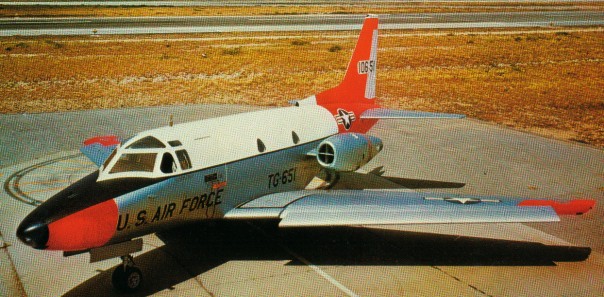
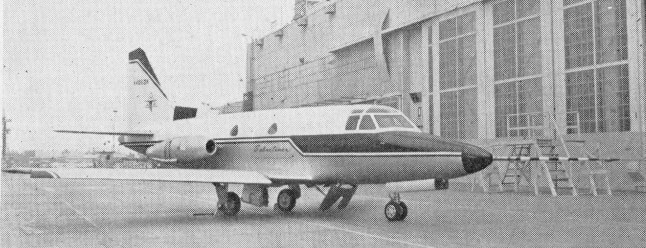
The NA-246 Sabreliner started its life as a private venture in the mid 1950s to meet the USAF’s UTX requirements for a combat readiness trainer and utility aircraft. Announced on 27 August 1956, It was laid out with a six-seat interior and to be flown by a two-man crew, the civil-registered prototype was completed in May 1958, although the lack of suitable engines delayed the first flight, which took place at Los Angeles, until 16 September, under the designation T 39. The initial powerplant comprised two 1134kg thrust General Electric YJ85 turbojets and, thus powered, the prototype completed its military evaluation programme at Edwards Air Force Base in December 1958.
In October 1958 the Sabreliner won its first order, for seven NA-265 or T-39A aircraft with 1361kg thrust Pratt & Whitney J60 engines. Production of the highly successful T 39 series commenced in 1958, and 213 were purchased by the Air Force and the Navy. All military models of the T-39 series were certificated to civil airworthiness standards, beginning with the T-39A on 23 March 1962.
The commercial version of the T 39, known as the NA-265-40 Sabreliner / Sabre 40, was type certificated on 17 April 1963 and was one of the first jets available to business aviation. It is larger and more rugged and powerful than jets that have been designed solely for civilian use. Its speed by jet standards is modest with a cruise of 489 knots. The aircraft maintained its popularity throughout the 1960s and 1970s as improvements were made to the airframe and powerplants.
In 1965 North American increased the Sabreliner’s gross weight by beefing up landing gear and re-qualifying wheels. The modification allows the twin-jet to carry full fuel with nine people and baggage aboard totalling 18,650 lb. The previous max was 17,760 lb. Changes were offered free to Sabreliner owners.
One of the unusual features that the Sabreliner was automatic leading edge slats. The slats added impressive low speed handling qualities to the bizjet.
Gone are the slats, however, from a Sabreliner 60. The stretched Sabre 60, introduced in 1969, is powered by two 3,300 pound thrust P&W JT12A 8 turbojets, the same engine that was used in the Dash 8 JetStar.
The Rockwell Sabreliner 65 is essentially a fanjet, supercritical wing version of the Sabre 60. Its engines are Garrett AiResearch TFE 731-3s, which the factory may also retrofit to Model 60s and the even earlier Sabre 40s. Its IFR range was just under 2,500 nautical miles. The first production lot of Sabre 65s was sold at an average equipped price of $3,250,000.
Both the 74 and 60 models were fitted with thrust reversers to aid in shorter landings and assist in braking on icy or wet runways.
75A
The Sabre 75A, with its expanded cabin height and higher gross weight, uses two General Elec¬tric CF700 2D2 turbofans identical to the 4,315 pound thrust powerplants employed on the Falcon 20. The 75A model features square windows, a ‘stand-up’ cabin and a long span tailplane.
In 1978 Rockwell International’s Sabreliner 80A made a first flight from St. Louis. The new business jet is a modified version of the Model 75A, with a supercritical wing.
Civil production of all models, including the final model, the Sabreliner 65A, totalled well over 600 aircraft when the last aircraft came off the line in 1981.
Rockewell International’s Sabreliner Division was acquired in 1983 by the specially formed Sabreliner Corporation of St Louis, Missouri to continue product support. Type Certificate A2WE was reissued to Saberliner Corp in 1983 to cover active Model 265s. At the end of 1990 the company completed the design of a new version of the Sabreliner designated the Model 85. This has a supercritical wing incorporating winglets, a fuselage stretch of 1.5m, and more powerful TFE731-5 turbofan engines, but further development would require a risk-sharing partner.
NA-246 Sabreliner / T-39 Engines: 2 x General Electric YJ85 turbojets 1134kg thrust
T-39 Engines: 2 x P&W Wing span: 44 ft 5 in (13.54 m) Length: 43 ft 9 in (13.34 m) Height: 16 ft 0 in (4.88 m) Max TO wt: 17,760 lb (8055 kg) Max level speed: 595 mph (958 kph)
NA 265-65 Sabreliner 65 Engines: 2 x Garrett TFE 731-3R-1D, 3700 lbs / 1678kg thrust Seats: 10 Length: 14.30 m / 46 ft 11 in Height: 4.88 m / 16 ft Wingspan: 15.37 m / 50.5 ft Wing area: 380 sq.ft Wing aspect ratio: 6.7 Maximum ramp weight: 24,000 lbs Maximum takeoff weight: 10886 kg / 24,000 lbs Standard empty weight: 13,350 lbs Maximum useful load: 10,650 lbs Zero-fuel weight: 16,250 lbs Maximum landing weight: 21,755 lbs Wing loading: 63.2 lbs/sq.ft Power loading: 3.2 lbs/lb Maximum usable fuel: 8644 lbs Best rate of climb: 3540 fpm Certificated ceiling: 13715 m / 45,000 ft Max pressurisation differential: 8.8 psi 8000 ft cabin alt @: 45,000 ft Maximum single-engine rate of climb: 950 fpm @ 127 kts Single-engine climb gradient: 452 ft/nm Single-engine ceiling: 25,000 ft Maximum speed: 513 kts Normal cruise @ 43,000ft: 430 kts Fuel flow @ normal cruise: 1090 pph Stalling speed clean: 117 kts Stalling speed gear/flaps down: 81 kts Turbulent-air penetration speed: 225 kts
Sabreliner 65A
Sabreliner 75A Engines: 2 x General Elec¬tric CF700-2D2, 4315 lb Seats: 8/10 Wing loading: 68.11 lb/sq.ft Pwr loading: 2.53 lb/lb Max TO wt: 22,800 lb Operating wt: 13,600 lb Equipped useful load: 9200 lb Payload max fuel: 1820 lb Zero fuel wt: 15,620 lb Range max fuel/cruise: 1985 nm/4.0 hr Range max fuel / range: 1897 nm/ 4.6 hr Service ceiling: 45,000 ft Max cruise: 489 kt Max range cruise: 417 kt Vmc: 92 kt Stall: 105-113 kt 1.3 Vso: 137 kt ROC: 4500 fpm SE ROC: 1050 fpm @ 190 kt SE Service ceiling: 24,000 ft Cabin press: 8.8 psi Fuel cap: 7380 lb Takeoff run (balanced) 4,420 ft Landing roll 2,525 ft
Developed to USAF General Operational Requirement 38 for an intercontinental bomber to replace the Boeing B-52.
At one time the order was cut back to a single prototype containing no military equipment. In 1960 the US Government decided to order 12 fully operational B-70s. In March 1961, the contract awarded on 4 October 1961 was again cut back to three aeroplanes, intended mainly for research, although the third was later cancelled.
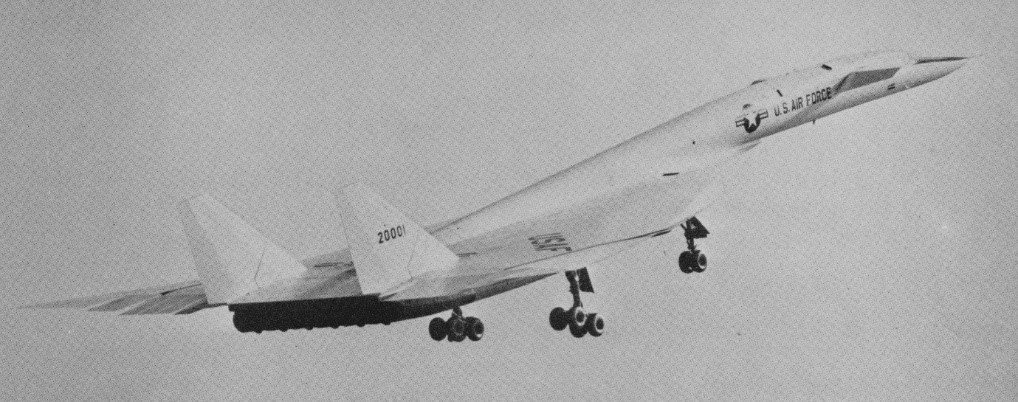
The North American XB-70 Valkyrie first flew in prototype form on 21 September 1964. When the first prototype flew it was simultaneously the longest (56.4 m/185 ft), fastest (Mach 3+), most powerful and costliest aircraft ever built, US$2000 million, and weighing 305 tonne (300 ton). Piloted by North American test pilot Alvin S. White and USAF Col. Joseph F. Cotton the first take-off took a 5000 ft ground roll and 30 seconds to get airborne. During the 65 min flight from Palmdale to Edwards Air Force Base the main wheels failed to retract and number three J93 GE engine over-revved. The aircraft flew to 16,000 ft and 375 mph. Locked rear wheels on the left main gear ground themselves down to metal on touch-down.
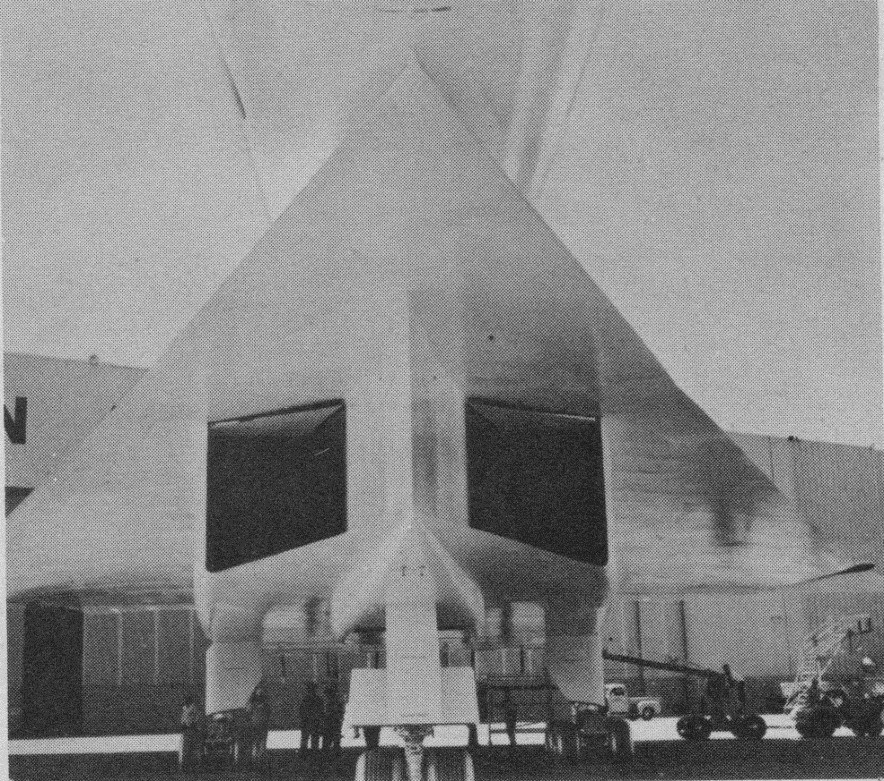
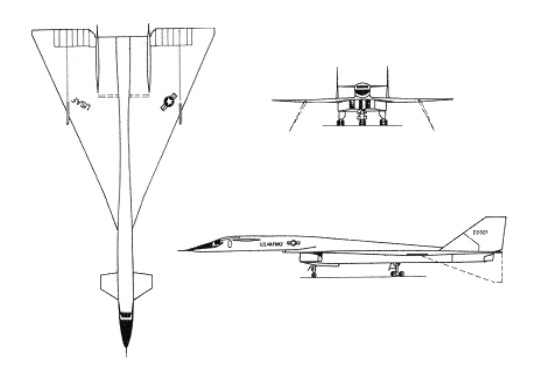
A delta-winged canard design, the airframe made extensive use of contemporary ‘exotic’ alloys to overcome the problems associated with kinetic heating. The wings were swept back at 65 degrees 34 minutes on the leading edge, and were covered with brazed stainless steel honeycomb panels welded together to produce an extremely strong yet heat-resistant whole. Similar construction was used for the huge rectangular moveable engine duct under the centreline, the twin vertical tail surfaces (30 ft high) and part of the fuselage. The advanced aerodynamics of this elegant yet menacing warplane were based on a large delta wing from whose centre grew a slim forward fuselage complete with canard foreplanes.
The powerplant comprised six 31,000-lb (14.062-kg) thrust General Electric YJ93-GE-3 afterburning turbojets in a 30 ft long ducted arrangement under virtually the full chord of the delta wing. To slow entering airstream from Mach 3 to less than Mach 1 the designers created a series of shock patterns which employ the vertical splitter, then additional breaks within the splitter duct. Finally hydraulically operated panels vary final throat area to meet varying conditions.
The wings outer portions were arranged to hinge downward in flight under hydraulic power to improve stability and maneuverability. An anhedral angle of 25 degrees was used for low-altitude supersonic flight, increasing to 65 degrees for high-altitude flight at Mach 3. Six power hinge actuators on each lower outer surfaces during high speed flight. Each hinge has hundreds of closely meshed gears of hard H-11 steel.
Control was provided by a combination of flaps on the canard foreplanes, no fewer than 12 wide-chord elevons across much of the trailing edge of the wings outboard of the variable-geometry engine exhausts, and large rudders on each of the vertical surfaces. The canard slab surfaces provide trim control while keeping drag low, their rear section deflecting down as flaps. Control of so complex an aerodynamic platform moving at high supersonic speeds was effected with the aid of a three-axis stability-augmentation system.
The landing gear consists of 2 tons of wheels, tires and brakes. A brake control device employs a fifth wheel on the main gear, comparing the amount of slippage between braked wheels and the fifth wheel with coefficient of friction between tires and runway surface, predicts skid point, and automatically regulates
The windshield moves along with a variable-position nose ramp. During subsonic operation the forward edge of the windshield can be lowered for better visibility. Dark spots above the cockpit area and on the canard surfaces are crane lift points.
The first prototype was flown by Alvin S. White and Colonel Joseph F. Cotton on 21 September 1964. The take-off from Palmdale runway required 5000 ft and less than 30 sec roll. During the flight the undercarriage failed to retract, one of the six engines failed, and a brake locked which burned out half of the left main gear supports. The flight was held to a maximum of 375 mph and 16,000 ft for the flight of just over one hour.
The first flight had been so long postponed and the entire project downgraded to only two prototypes. By the flight, the first US had spent $1.34 billion on its development. $92 million was then allocated to see the two prototypes through the flight program. Both XB-70’s were programmed for a 180 hr flight test schedule, including experiments for NASA. It first achieved its design speed of Mach 3 on 14 October 1965.
NASA’s Flight Research Center spent $2,000,000 on instrumentation on the No.1 aircraft. Areas of study included flutter of skin panels and internal noise levels; heating of structures in such areas as windshield, fuel tanks and crew compartment.
The improved second prototype flew on 17 July 1965, but was lost in a mid-air collision on 8 June 1966. The surviving aircraft carried out a number of test programmes, including work in connection with the US supersonic transport programme, but on 4 February 1969 it was flown to retirement at the US Air Force Museum, Wright Patterson AFB, Dayton, Ohio.
Even before the first prototype flew, however, technological developments in air defence had made the XB-70 obsolete. In 1963 the U.S. government ended the XB 70 development programme and turned the prototypes over for research purposes although one of the XB 70s was lost on 8 June 1966. The surviving XB 70 is now a museum piece.
Engines: 6 x General Electric YJ93-GE-3 afterburning turbojets, 31,000-lb (14.062-kg) Wing span: 105 ft 0 in (32 m) Length: 196 ft 0 in (59.74 m) Max TO wt: 530,000 lb (240,400 kg) Max level speed: M3 / 3218 km/h / 2000 mph Height: 9.1 m / 29 ft 10 in Wing area: 565.0 sq.m / 6081.60 sq ft Ceiling: 21336 m / 70000 ft Range w/max.fuel: 12000 km / 7457 miles Crew: 2
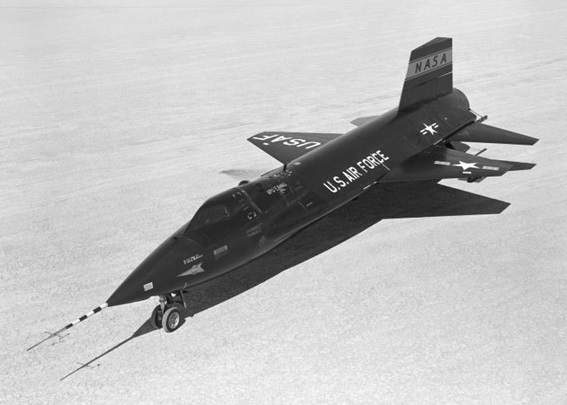
The X-15 was a hypersonic research aeroplane, a rocket-powered type air-launched by an adapted B-52 bomber within a programme that yielded important results in flight at very high speed and extreme altitudes. The objective was an aeroplane capable of flying at 4,500 mph (7,240 km/h; nearly Mach 7) and reaching an altitude of 250,000 ft (76,200 m). North American Aviation won the design contest and was awarded a development contract on 30 September 1955.
The aircraft was designated X 15 and was designed around a Thiokol (Reaction Motors) XLR99-RM-2 single-chamber throttleable XLR99 liquid-¬fuel rocket engine capable of delivering a thrust of more than 60,000 lb (27,215kg) for a period of several minutes. Like X 1, the X 15 was to be air launched, since fuel could not be expended in getting the X 15 off the ground and up to operating altitudes.
The X-15 was built largely of titanium and stainless steel, covered mostly with a so-called ‘armour skin’ of Inconel X nickel steel alloy to withstand temperatures ranging from 1200 deg F to –300 deg F, with heating rates of 30 BTU per sq ft of surface area per second. Far higher temperatures were recorded by the X-15A-2 after this type had been fitted with Emerson Electric T-500 ablative material to provide a capability for comparatively steep (and therefore high ¬friction) angles of re-entry after apogee in the interface between the troposphere and space. This capability to operate on the edges of space demanded a reaction control system for orientation of the aeroplane in these virtually airless regions: a rocket system was used for this stem, with four nozzles in the wingtips and eight more nozzles in the nose to provide three-dimensional manoeuvre capability.
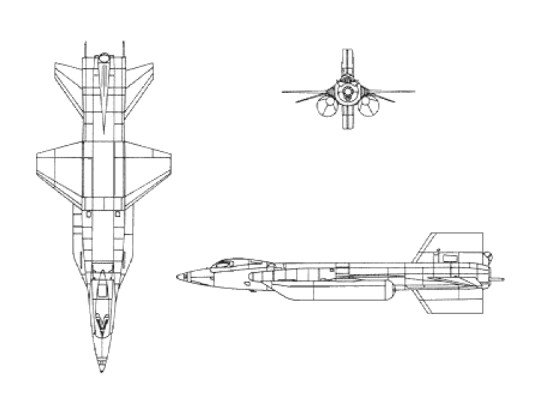
Two Boeing B 52s were modified as carriers for the X 15s, three of which were ordered. With a span of only 22 ft (6.70 m) for the slightly swept¬back trapezoidal wings the X 15 had a gross weight at launch of over 31,000 lb (14,060 kg), of which more than 18,000 lb (8,165 kg) was accounted for by the liquid oxygen and anhydrous ammonia rocket propellants.
In September 1957, the first one rolled out of the factory. Six months later, in March 1959, the X-15 made its first captive flight and, three months after that, its first glide flight.
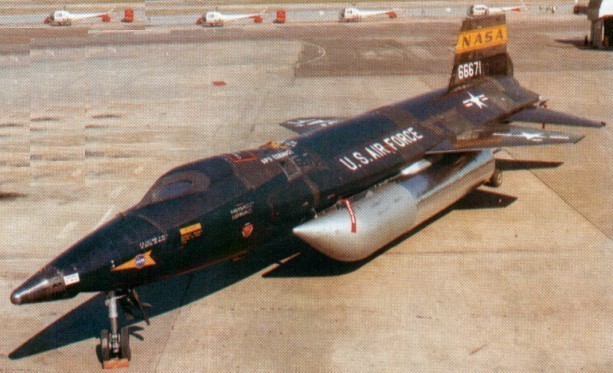
When the first X 15 free flight was made on 8 June 1959 the aircraft was fitted with lower powered engines, as the XLR99 was not then ready. Carried aloft by an NB-52, the X-15 was piloted by Scott Crossfield. With two XLR11 RM 5s, giving a combined thrust of about 33,000 lb (15,000 kg), the first powered flight was made by the second X 15 prototype (56-6671) on 17 September 1959, a speed of Mach 2.11 and altitude of 52,341 ft being achieved. From that point on, both the speed and the altitude reached by the X 15s climbed steadily, with Mach 3 being reached in November 1961 after the XLR99 engine had been fitted in the second prototype. By December 1963 the X 15s had reached a speed of Mach 6.06, had encountered a skin temperature of 1,320 degrees F and reached an altitude of 314,750 ft (95,936 m).
In June 1959, in the X-15s very first free flight, Crossfield’s landing was a little touchy due to the pitch damper failure and pilot-induced oscillation.
On 17 September 1959, Scott Crossfield took the X-15 through the paces of its first powered flight. In its second powered flight three months later, also flown by Crossfield, the vehicle’s nose gear door failed due to a rough landing on Rogers Dry Lake. According to the official report, the structural failure occurred on landing “due to design flaw and excessive propellant weight,” but the NASA engineers at Edwards knew otherwise and North American then adopted the special approach theory for landing. This involved a 360 degree spiralling descent starting at about 40,000 ft, right above the desired touchdown point on the runway. From that ‘high key’ position, the pilot moved into a 35 degree bank (usually to the left) while maintaining an airspeed of 285-345 mph. At roughly 20,000 ft after some 180 degrees of the spiral had been completed, the X-15 reached the ’low key’. At this point, the aircraft was headed in the opposite direction of the landing runway and was about four miles abeam of the touchdown point. From the low key, the turn continued through the other 180 degrees until X-15 lined up with the runway at about a five mile distance. The rate of descent through the spiral averaged over two miles per minute, which meant it took on average about three minutes to go from high key to that point where the X-15 was ready to head straight for landing.
Neil Armstrong’s second X-15 flight, and his first for research purposes, came just before noon on Friday 9 December 1960, also in the number one airplane. Flight 1-19-32 first tested the X-15’s newly installed ‘ball nose’. Until this flight, the X-15 had a front mounted boom with vanes to sense airspeed, altitude, angle of attack, and angle of sideslip in a free aerodynamic flow field. At such high altitudes and high speeds, the X-15 would melt its nose boom, destroying measurement data. The ball nose sphere could be cooled from the inside by liquid nitrogen.
Equidistant from the circumference were sensor ports in the middle of the ball as well as on the top and bottom. The ball moved automatically in pitch and yaw to keep the pressure equal on both of the ports, pointing the centre hole directly into the free flow. The angle of the ball movement amounted to the airplane’s angle of attack. Similarly, the ball nose received precise indications of angle of sideslip and dynamic pressure, which then gave airspeed.
Flight 3-4-7 piloted by Neil Armstrong on 5 April 1962, reached Mach 4.12 and 180,000 ft to test the MH96 reaction controls. The test flight spanned 181.7 miles in a little over 11 minutes before landing at Rogers Dry Lake. Flight 3-4-8, on Friday 20 April 1962, by Neil Armstrong, was to test the MH-96 system limit, or ‘g limiter’, to prevent the pilot from exceeding 5g. The flight reached 207,500 ft. Ballooning creates some control problems at the altitude and made an extended trip back. Neil Armstrong’s X-15 flight on 27 June 1962 resulted in the highest Mach number every attained in the X-15 program – Mach 5.74 or 3989 mph.
North American X-15 No.2, damaged in November 1962 in a hard landing at Mud Lake, Nevada, was completely rebuilt, ready to fly in May 1964. Most noticeable difference in X-15-2 from other models is the addition of two 22 ft fuel tanks of 38in diameter on the lower sides of the fuselage. Carrying liquid hydrogen and anhydrous ammonia, they extend burning time of the Thiokol 58,000 lb thrust YLR-99 rocket engine from 88 seconds to 146 seconds. With additional length of powered flight X-15-2 should top previous marks of 4104 mph and 354,200 ft altitude. Both set by NASA Chief Test Pilot Joe Walker.
The tanks drop off when the plane reaches Mach 2, are recoverable by parachute. Extra fuel, weighing 13,500 lb, plus other modifications, bring X-15-2’s take-off weight to 25 ton, eight ton more than the others.
The outer half of the right wing is detachable so that various structural material can be tested in flight. The plane will carry a ramjet engine slung from the tail to test hypersonic airbreathing propulsion. Liquid hydrogen ramjet fuel is stored in two internal tanks.
Cameras have been installed for ultra-violet star photography at altitude above 40 miles, beyond the ozone layer which filters out most ultra-violet rays.
The fuselage is 29in longer than other X-15’s, nose and main landing gear has been lengthened to 39.5in ground clearance, oval windshields installed to withstand higher temperatures, and ablative material added to skin surfaces to suppress heating of the basic structure.
Projects to be performed by all three X-15’s were expected to require another 100 flights running well into 1968.
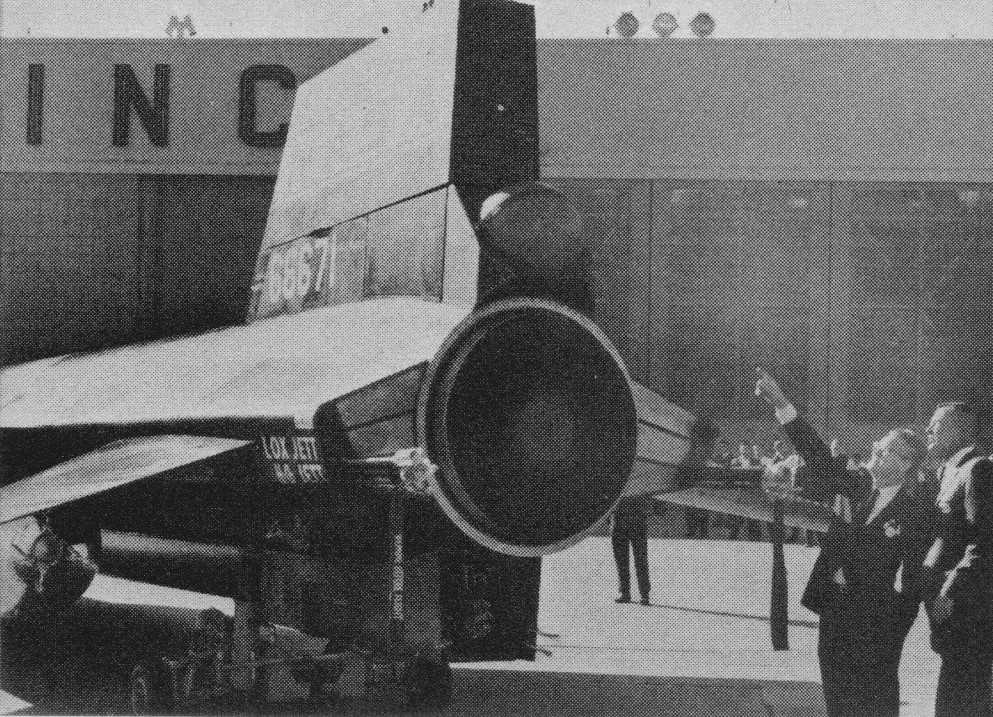
The X-15A-2 propulsion system is Thiokol Chemical’s Reaction Motors Division’s YLR99 rocket engine. Even its 58,000 lb thrust can be upped through externally-mounted ramjet engines. The YLR99 operates on liquid oxygen and anhydrous ammonia which is fed into the thrust chamber by a turbopump driven by hydrogen peroxide. The ball above the engine exhaust chamber (tail slot) will contain pressurised helium which will be used to expel liquid hydrogen fuel in testing of the ramjet engines.
X-15A-2
In an experiment in 1964, an X-15 attempted a photo mission from 100,000 ft while speeding at 3290 mph over Edwards AFB (Calif). The purpose was to determine effect on camera and film of extremely high temperatures encountered at that speed, and clarity of photos for reconnaissance use.
With Major William J. “Pete” Knight at the controls, the modified X-15A-2 set an unofficial speed record of 4,520 mph (Mach 6.70) on 3 October 1967. This would be the fastest flight of the X-15 program.
X-15A-2
Before the end of 1961, the X-15 had attained its Mach 6 design goal and flown well above 200,000 feet; by the end of 1962 the X-15 was routinely flying above 300,000 feet. The X-15 had already extended the range of winged aircraft flight speeds from Mach 3.2 to Mach 6.04, the latter achieved by Bob White on 9 November 1961.
On 9 November 1962, the second X-15 crashed while executing an emergency landing on Mud Lake near Edwards AFB. Pilot Jack McKay was seriously injured but later returned to flight status. The X-15 itself was nearly a write-off, but eventually the Air Force and NASA decided to rebuild it to a slightly different configuration. The fuselage was lengthened 29 inches and external drop tanks were added to accommodate additional propellants. It was hoped this would allow the X-15A-2 to achieve at least Mach 7 while testing experimental scramjet engines. This first flew on 28 June 1964. On 22 August 1963 Joseph A. Walker, NASA test pilot, took the o.3 X-15 for a world altitude record of 351,000 ft. It was the fifth flight into space for the plane and the third for Walker. He covered 315 miles in 10 minutes. Walker released a 30-inch balloon from the plane’s tail then towed it 100 yards behind to measure air density in space. The aircraft reached a speed of 3614 mph and a climb angle of 48 degrees, the steepest yet. It used 18,000 lb of fuel in 83 seconds. Walker and the X-15 then held the world speed record of 4104 mph for winged aircraft.
In 1965 Joe Engle flew an X-15 to 78,000 ft and 3511 mph on an 8 min flight to simulate surface heating characteristics. A sheet of brown silicon rubber glued on the lower tail was expected to reduce temperature at that point from 800deg to 400 deg F.
Using an ablative coating to provide additional heat protection, Major Pete Knight took the X-15A-2 to Mach 6.72 (4,520 mph) and an altitude of 354,200 ft / 107,960m on 3 October 1967, the fastest piloted flight of the X-Plane program. This is the highest recorded speed yet achieved by man in an aeroplane capable of being controlled in normal flight. Due to damage resulting from this flight, the aircraft was retired and subsequently transferred to the Air Force Museum.
The aircraft proved remarkably flexible as a research tool. In fact, most of the later flights used the X-15 as a carrier vehicle for other experiments rather than as a research aircraft in its own right. An assortment of experiments were carried, including micrometeorite collection pods, missile detection systems, samples of insulation destined for the Saturn launch vehicle, and a wide variety of others.
After 177 flights (some report 199), the last on 24 October 1968, the X-15 programme was terminated in 1968. Of the three X-15s manufactured, one crashed while returning from space, killing test pilot Major Michael J. Adams, and one survives in the National Air and Space Museum.
Crossfield flew the X-15 a total of 13 times before North American turned it over to NASA-Air Force-Navy partnership. Two of Crossfield’s flights were in the number one airplane, the rest in number two. The highest speed he reached in any of them was Mach 2.9, the highest altitude 88.116 ft, and the furthest distance was 114.4 miles.
The NASA and other pilots were Joe Walker, Jack McKay, Robert White USAF, Neil Armstrong USN, Cmdr Forrest Petersen USN.
Engine: 1 x Reaction Motors XLR-99 rocket engine, 253.7kN Max take-off weight: 15422 kg / 34000 lb Wingspan: 6.7 m / 22 ft 0 in Length: 15.8 m / 51 ft 10 in Height: 4.1 m / 13 ft 5 in Wing area: 18.6 sq.m / 200.21 sq ft Max. speed: 7297 km/h / 4534 mph Ceiling: 107960 m / 354200 ft Crew: 1
First of the “Century fighters”, the prototype F-100 flew on 25 May 1953 piloted by George Welch. Powered by a Pratt & WhitneyJ57 turbojet and augmented by an after¬burner, it flew faster than sound on its maiden flight.
Originally known as the “Sabre 45”, because of its 45-degree swept wing, the F-100 is a completely new design and was the first U.S.A.F. operational aircraft to fly supersonic in level flight. In very large-scale production as standard U.S.A.F. day fighter in 1955. Established World Speed Record of 755.15 mph on 29 October 1953.
The whole F-100 structure is immensely strong and rigid; so much so that assembly jigs are rendered unnecessary, the parts being simply put together. The wing interior is largely taken up by huge forgings, machined into honeycombs or grids; some of the outer skins are machined from sheet of no less than 3in original thickness. There was talk of the aircraft being made by Commonwealth (Australia) and Canadair.
The F-100 has an all-moving tailplane and inset ailerons, each in two sections, and automatic leading-edge slats. Ailerons were located inboard and flaps were omitted. Flaps were on the F-100D and F only. An air-brake is under the centre fuselage. The tricycle undercarriage has single wheels on each main unit ad twin wheels on the nose unit. The mains retract inward into the fuselage and nose wheels retract rearward.
The initial production version was the F-100A, a single-seat day fighter powered by a 43.15kN J57-P-7 or P-39 engine. Armament comprised four 20mm M-39E cannon plus external stores on six under-wing hardpoints.
F-100A Super Sabre
By May 1954, the U.S.A.F. had accepted delivery of a fair number of F-100As, but some had already been damaged or written-off in accidents. The F-100A was grounded in November 1954 because of transonic control problems. The height of the rudder had been reduced by some 18in and a corresponding amount added to the fin. The F-100 lands at nearly 180 mph. There are no landing flaps, but the ventral airbrake can be used on the approach.
North American F-100A Super Sabre
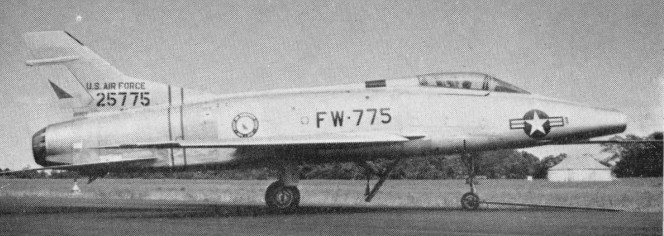
The F-100A production model first flew on 29 October 1951. 203 of the F-100A and RF-100A were built, the last 35 having an 11,700 lb thrust J57-P. The RF-100A was a photo-reconnaissance conversion of the F-100A with a deeper camera-carrying front fuselage.
RF-100A 53-2600
The 1956 F-100B designation was not applied as it was extensively redesigned as the F-107.
The F-100C (NA-214, -217, -222) appeared as a single-seat fighter bomber with strengthened wings, up to 3,402kg of bombs on eight underwing hardpoints, in-flight refuelling capability and 75.62kN (with afterburning) Pratt & Whitney J57-P-21A turbojet engine. First flown on 17 Jnuary 1955, 476 were built. An F-100C set the first world speed record to exceed Mach 1 on 20 August 1955 at 822.135mph.
The TF-100C of 1956 was a planned two-place trainer version modified from F-100C 54-1960, which instead became a prototype for the F-100F. Only the one was built.
TF-100C 54-1960
The similar F-100D (NA-223, -224, -235, -245) introduced design refinements, including a taller fin, landing flaps; supersonic autopilot, low-level bombing system, and could be armed with four Sidewinder or two Bullpup missiles, or 3,402kg of external weapons in addition to its standard four 20mm cannon.
F-100D 55-2851
First flown on 24 January 1956, 1274 F-100D were built.
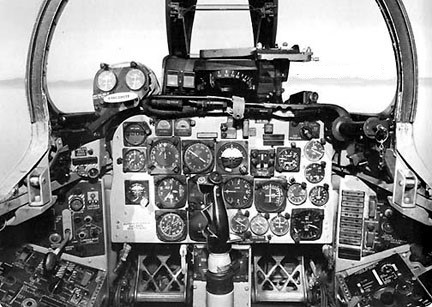
F-100D cockpit
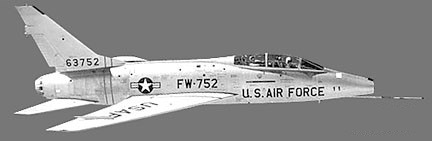
The final version built was the F-100F (NA-234, -255, -261, -262), first flown on 1 March 1957. It was a lengthened tandem two-seat operational trainer and tactical attack aircraft, armed with two 20mm cannon and capable of carrying 2,722kg of external stores. A total of 339 were built.
F-100F 56-3752
Operation Julius Caesar, involving the first flight by jet fighter aircraft over the North Pole, was conducted on 7 August 1959 with the landing of two USAF F-100F fighters at Eielson, Alaska AFB, southeast of Fairbanks, Alaska. The flight from Wethersfield, Essex, was completed in 9 hr 37 min.
Total production was 2294 aircraft when the line closed in October 1959.
After cancelling all airshows for two big summer months the Airforce Thunderbirds reverted back into F-100s in August 1965 to complete the season. They had started in Republic F-105s but a series of accidents throughout the Air Force grounded all Thunderchiefs.
F-100 Engine: 1 x P+W J-57-P-21 turbo-jet, 66.7kN Max take-off weight: 12700 kg / 27999 lb Empty weight: 9500 kg / 20944 lb Wingspan: 11.6 m / 38 ft 1 in Length: 14.3 m / 46 ft 11 in Height: 4.9 m / 16 ft 1 in Wing area: 35.8 sq.m / 385.35 sq ft Max. speed: 1216 km/h / 756 mph Ceiling: 15250 m / 50050 ft Range: 920 km / 572 miles Armament: 4 x 20mm machine-guns, 2720kg of bombs and missiles Crew: 1
North American F 100 Super Sabre Engine: Pratt & Whitney J-57-P-21A, 75645 N Length: 46.982 ft / 14.32 m Height: 14.665 ft / 4.47 m Wingspan: 38.747 ft / 11.81 m Max take off weight: 34839.0 lb / 15800.0 kg Max. speed: 751 kt / 1390 km/h Service ceiling: 45013 ft / 13720 m Range: 1304 nm / 2415 km Crew: 1 Armament: 4 mg. 3402 kg bombs
F-100A Super Sabre Engine: 10,000 lb. thrust Pratt & Whitney J57-P-7 turbojet, with afterburner. Wingspan: 36 ft. 7 in Length: 45 ft. 3 in Loaded weight: approx. 27,000 lb. Max. speed: over 760 m.p.h. Ceiling: over 50,000 ft. Range: over 1,000 miles. Armament: 4×20 mm cannon, Crew: 1.
F-100C Engine: Pratt & Whitney J57-P-21A, 16,950 lb w/afterburner Wingspan: 38 ft 9.25 in Wing area: 385.2 sq.ft Length: 54 ft 3 in Height: 16 ft 2.25 in Wheel track: 12 ft Fuel capacity: 987 Imp.Gal External fuel: 2 x 208 Imp.Gal + 2 x 187 Imp.Gal Armament: 4 x 20mm cannon Hardpoints: 6 External load: 6000 lb
F-100D Engine: Pratt & Whitney J57-P-21A afterburning turbojet, 17,000 lb / 7711 kg Wingspan: 38’10” / 11.82 m Wing area: 385.0 sq.ft / 35.77 sq.m Length: 47’2″ / 14.36 m Height: 16 ft 3 in / 4.95 m Wheel track: 12 ft Empty weight: 21,000 lb / 9525 kg MTOW: 34,832 lb / 15,800 kg Fuel capacity: 987 Imp.Gal External fuel: 2 x 208 Imp.Gal + 2 x 187 Imp.Gal Max speed: 864 mph / 1390 kph / M1.3 at 35,000 ft / 10,670 m Cruise speed: 565 mph Initial ROC: 16,000 fpm / 4877 m/min Range: 600 mi / 966 km Service ceiling: 46,000 ft / 14,020 m Armament: 4 x 20 mm cannon Hardpoints: 6 Bombload: 7500 lb / 3402 kg
F-100F Engine: Pratt & Whitney J57-P-21A, 16,950 lb w/afterburner Wingspan: 38 ft 9.25 in Wing area: 385.2 sq.ft Length: 57 ft 3 in Height: 16 ft 2.25 in Wheel track: 12 ft Fuel capacity: 987 Imp.Gal External fuel: 2 x 208 Imp.Gal + 2 x 187 Imp.Gal Armament: 2 x 20mm cannon Hardpoints: 6 External load: 7500 lb Seats: 2



















 All Aero