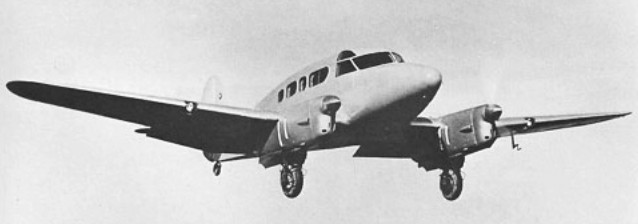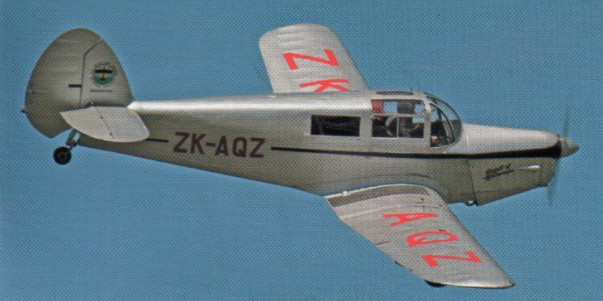
Percival P.84 Jet Provost / Hunting Jet Provost

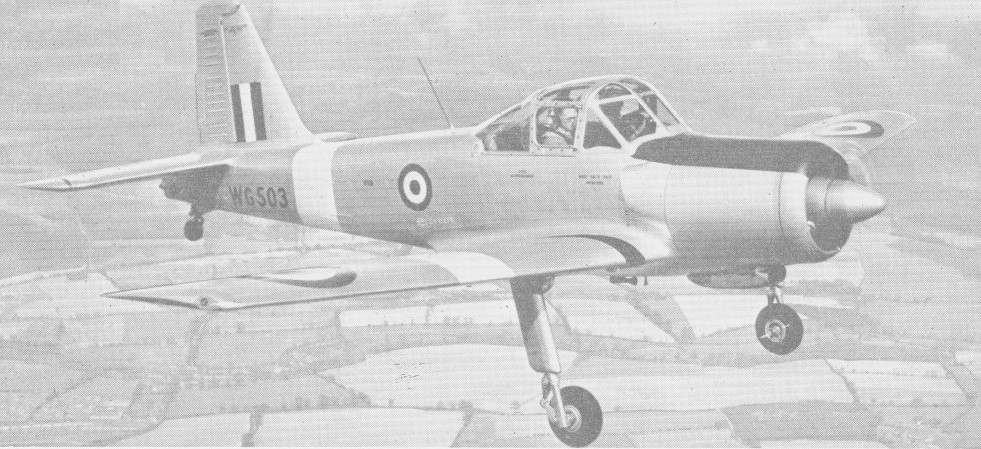
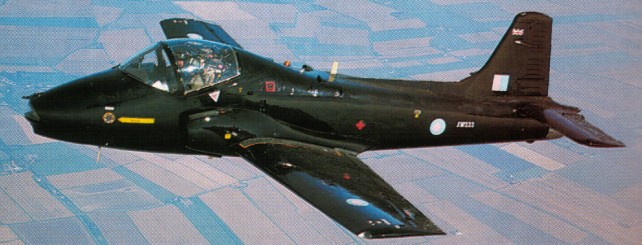
A gas turbine development of the Provost, Jet Provost first flew on June 26 1954, powered by a 1,640 1b. Armstrong Siddeley Viper ASV.5 jet engine. Initially the Jet Provost appeared without a dorsal fin, which was fitted for a while and then removed and replaced by a long ventral fin. Another modification was the sweeping forward of the leading edge wing roots just outboard of the cheek intakes.

Percival P.84 Jet Provost Article
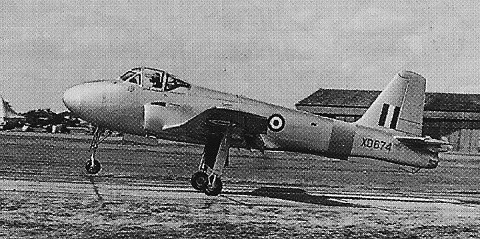
Prototype number one XD674 – Farnborough 1954

After trials, it went to No. 2 Flying Training School at Hullavington for the first all-through (Jet Provost to Vampire) jet flying training course. Production deliveries began in 1959.

Early versions had the prototypes long, stalky undercarriage, but from the 11th aircraft a shorter one was introduced.
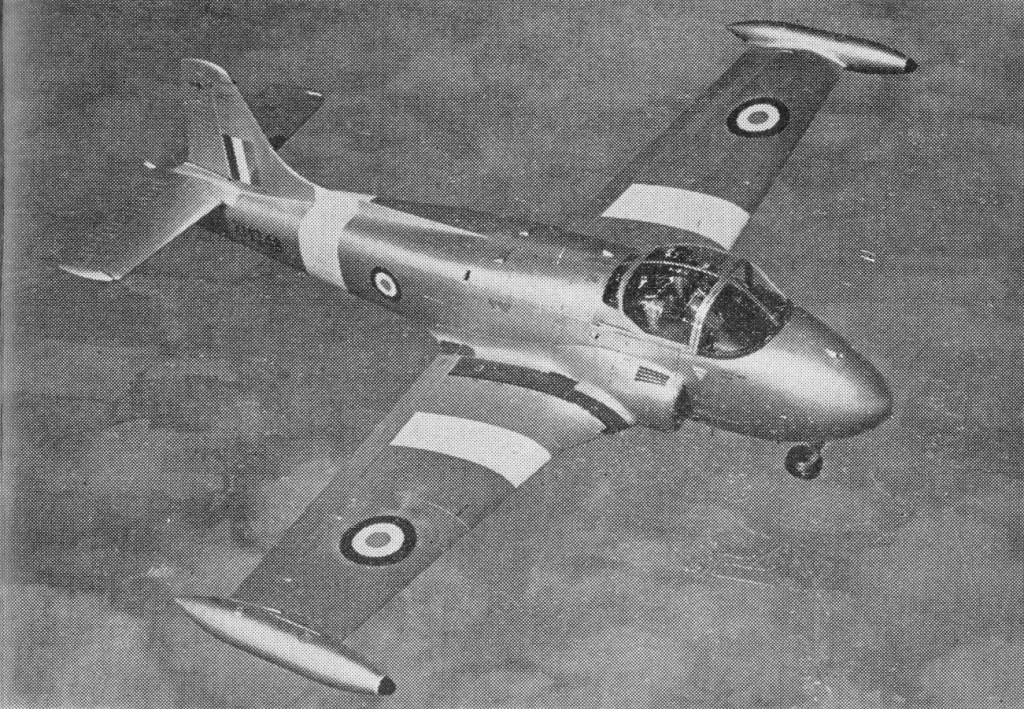
The T.3 was the basic trainer for the Royal Air Force until the mid-1970s, when the up-graded T.4 was introduced.

The Jet Provost T.3, together with the more powerful T.4, with an up rated Viper ASV.11 with 2,500 lb thrust, for night, instrument and formation flying, plus aerobatics, served with the RAF, the T.4 entering service in 1961.
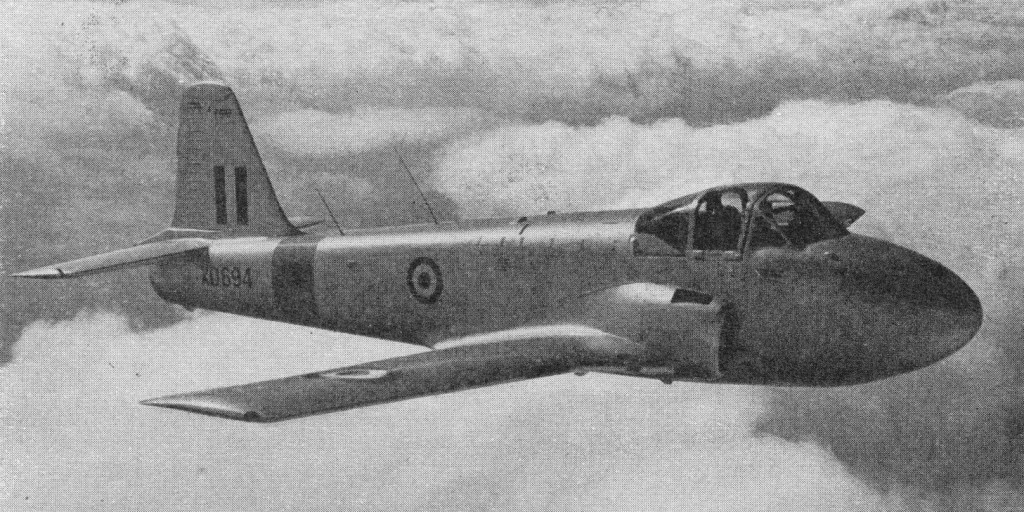
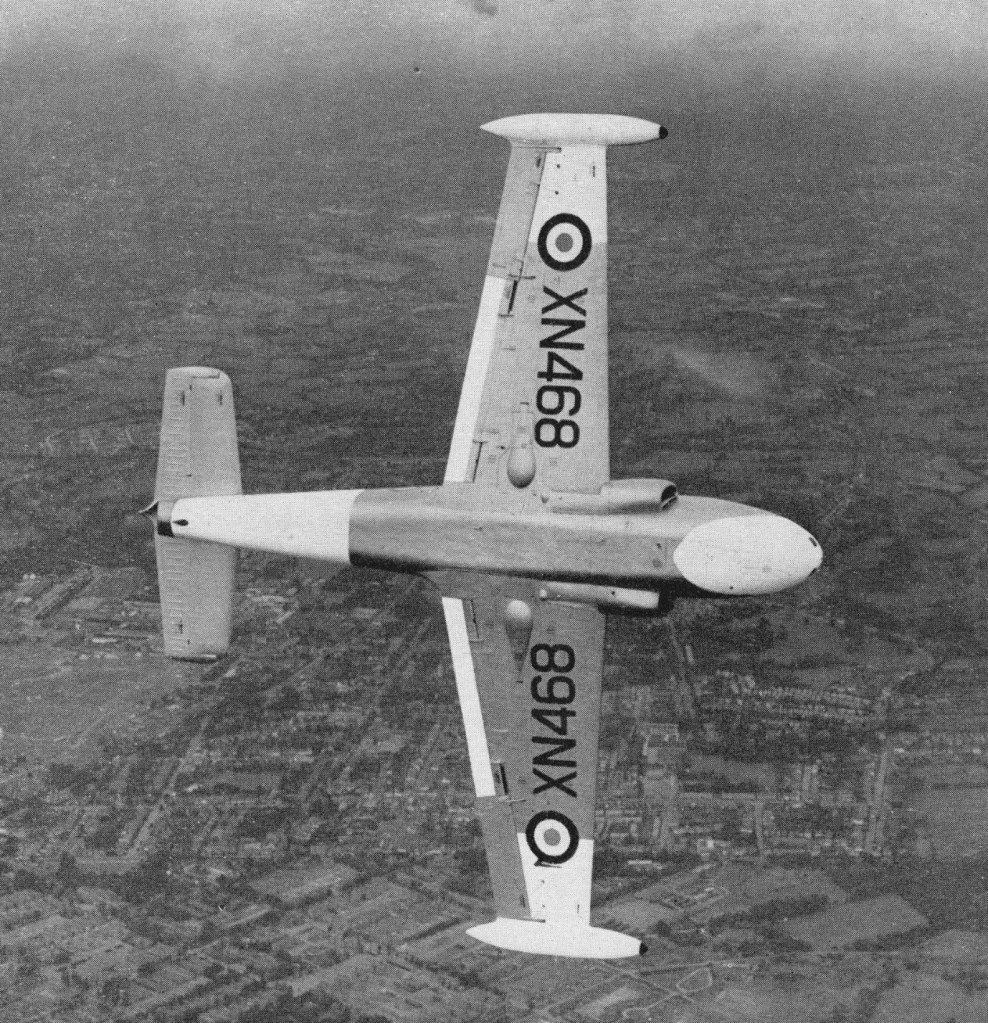
T.3
T.4

In 1964 the original designers of the Jet Provost responded to the need for a pressurised version and began private work on the design. The Jet Provost T5 differed externally from earlier versions by a re-designed hood and a more bulbous shape to accommodate the pressurised cockpit.

The prototype T5 made its first flight on 28 February 1967. A total of 110 Jet Provost T5s were produced for the Royal Air Force and the first was handed over to the Central Flying School on 3 September 1969. Between 1973 and 1976, ninety-three were modified by an upgrade in avionics equipment and became T5As.

The rough grey coating on the wing of the aircraft was applied in order to break up the smooth airflow and give an early indication of the onset of a stall as the T5’s original clean wing design gave the pilot little prior warning.

Export versions were the T.51 and 52.

The T.5 was further developed into the BAC 167 Strikemaster.

Gallery

T.3
Engine: 1 x 1,750 lbs.t. (822 kgp) Bristol Siddeley Viper 102

T.4
Engine: Bristol Siddeley Viper 201, ASV8 or ASV11, 2500 lb
TO dist: 1030 ft
Ldg dist: 1415 ft
Time to 30,000ft: 13.3min
Wing span: 36 ft 11 in (11.25 m)
Length: 32 ft 5 in (9.88 m)
Height: 10 ft 2 in (3.11 m)
Wing area, 213.7 sq.ft (19.8 sq.m)
Empty wt: 4,650 lb (2 110 kg)
Max TO wt: 7400 lb (3356 kg)
Max speed, 411 mph (661 kph) at 20,000ft (6096 m)
Cruise, 280 mph (451 kph)
Initial climb, 3,950 fpm. (20 m/sec)
Range: 1075 km / 668 miles
Crew: 2

T.4A

T.5
Engine: RR Viper 201, 2500 lb thrust
Length: 33.99 ft / 10.36 m
Height: 10.171 ft / 3.1 m
Wingspan: 35.335 ft / 10.77 m
Wing area: 213.127 sq.ft / 19.8 sq.m
Max take off weight: 9122.1 lb / 4137.0 kg
Weight empty: 5490.5 lb / 2490.0 kg
Max. speed: 382 kts / 708 km/h
Service ceiling: 36745 ft / 11200 m
Wing loading: 42.85 lb/sq.ft / 209.0 kg/sq.m
Range: 782 nm / 1448 km
Crew: 2
Armament: 2 MG 7,62FN/550rds, 1000kg (8x ext.)

T.5A
Engine: RR Viper 202
Cruise: 310 kts.

Hunting Percival P.84 Jet Provost

Percival P.66 Pembroke / President

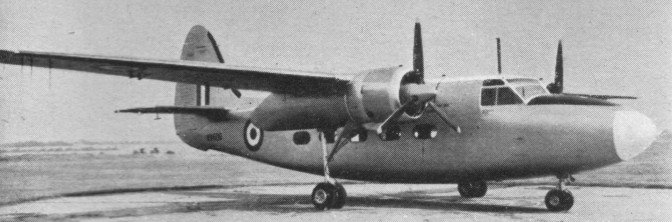
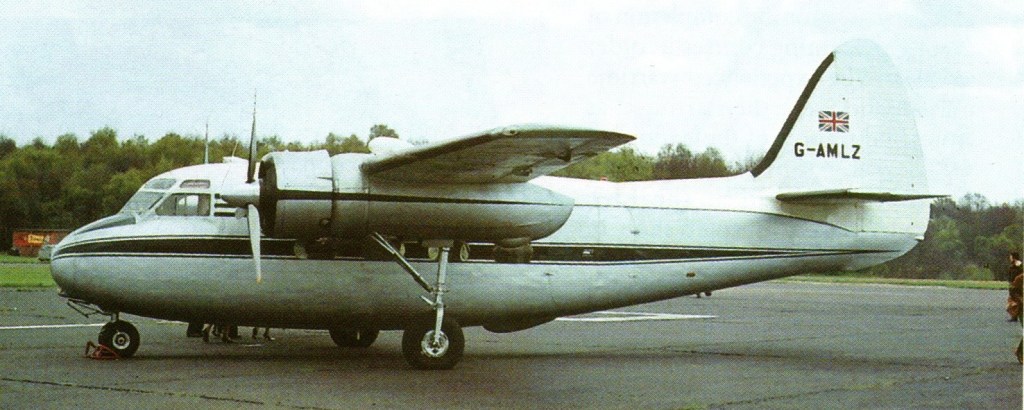
The Percival Pembroke was a British high-wing twin-engined light transport aircraft built by the Percival Aircraft Company, later Hunting Percival.

The Pembroke was a development of the Percival Prince civil transport. The Pembroke is basically an eight seat Service transport developed from the Prince 3 and Sea Prince, with increased span and rearward facing passenger seats. The prototype flew on 21 November 1952.

Percival P.66 Pembroke Article

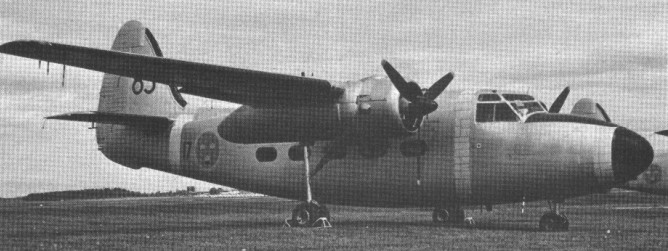
Production for the RAF and the Air Forces of Belgium, Southern Rhodesia and Sweden was complete in early 1958. Sixteen Pembroke C.52s were obtained by the Swedish Air Force in 1955 and designated Tp-83s.

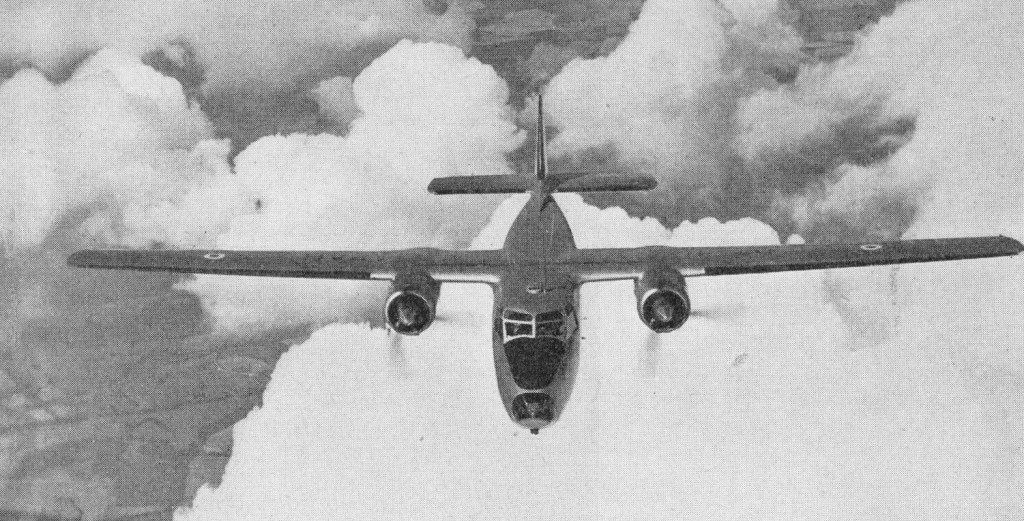
The Pembroke C.1 were used as eight seat communications aircraft and a version with a clear-view nose and camera stations in the main cabin fr air survey and photography was in service in the Belgian Air Force in 1956.

Belgian Air Force Pembroke
Pembroke C.52

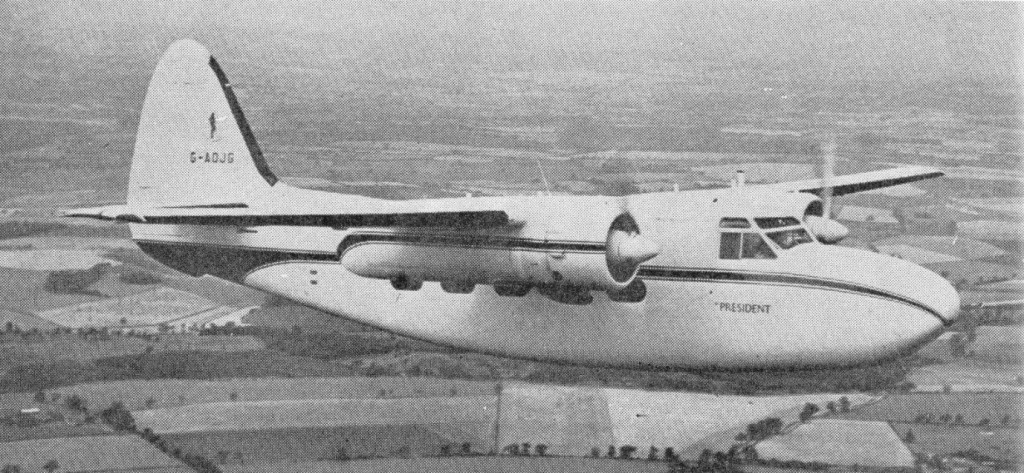
A civil version known as the Prince Series 5 was under development. Appearing as the President, the first airline order for Presidents was placed in 1957 by a Spanish local operator.

President

Gallery

Percival Pembroke C Mk.1
Engine : 2 x Alvis Leonides 127, 533 hp
Length : 46 ft 0 in / 14.02 m
Height : 16.076 ft / 4.9 m
Wingspan : 64 ft 6 in / 19.66 m
Max take off weight : 13503.4 lb / 6124.0 kg
Max. speed : 162 kt / 300 km/h
Service ceiling : 21982 ft / 6700 m
Range : 999 nm / 1850 km
Crew : 2 + 8

Percival P56 Provost

Designed by Percival Aircraft before it became part of the Hunting Group in 1954, the Provost was selected as the standard RAF trainer in the early 1950s having been designed to fulfil the requirements of specification T.16/48. A cantilever low wing monoplane with fixed tailwheel landing gear and powered by an Alvis Leonides 126 engine, it provided side by side seating for instructor and pupil.

The Percival P.56 Provost was the last piston-engined basic trainer used by the RAF. The prototype WE522 first flew on 23 February 1950 and was powered with a Cheetah 17 radial engine, as was the second prototype.

Percival P56 Provost Article

The third prototype was powered with the tightly cowled Alvis Leonides nine-cylinder radial. Both the earlier aircraft were re-engined and all the production T Mk 1 aircraft used the Alvis engine. This 11.9-litre supercharged engine is a smaller than usual 550-hp radial; the higher power is achieved by running at high revolutions (3,000 rpm) and +8 lb/sq inch of boost. Cruise power of 330 hp is at 2,600 rpm at 11,000 ft (RAF settings). A three-blade constant speed propeller is driven through a reduction gear, and it has side-by-side seating under a sliding canopy.

In 1953, the RAF introduced two new trainers into service, the piston engined Percival Provost T.1, which replaced the Prentice, and the jet powered DH Vampire T.11 which replaced the Harvard and the Meteor T.7 with the Advanced Flying Schools. As the RAF Prentice replacement, the Percival P.56, which became the Provost, powered by a 240 hp Cheetah 18 engine, its top speed was 178 mph at 2,500 ft. Entering service under the designation Provost T Mk 1, the aircraft were first delivered to the Basic Training Squadron of the Central Flying School of the RAF at South Cerney.

In armament training form it is fitted with two 7.9 mm. machine guns with 1,200 rounds of ammunition and a camera gun, and carrying three 60 lb rocket projectiles beneath each wing. Despite this load the Provost was rolled with abandon and climbed inverted under the continuous running of its Alvis Leonides engine. Alternative armament of the Provost is two 250 lb. bombs or eight 25 lb. bombs on light series racks or eight 25 lb. bombs plus four 60 lb. R.P.s.

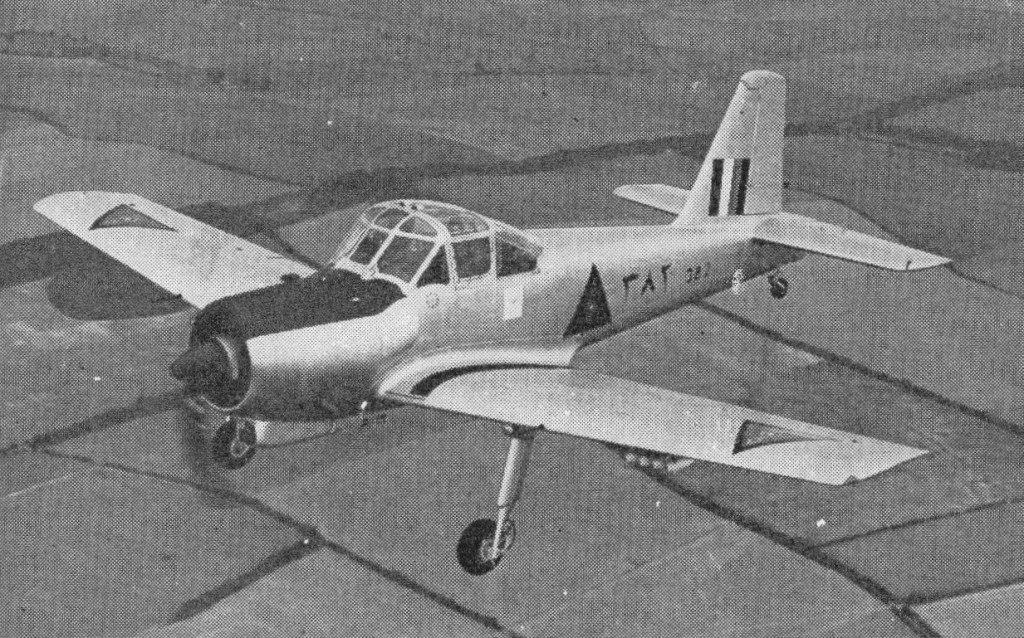
T.Mks.51, 52 and 53 are export versions serving with six air arms. Mks.52 and 53 carry light armament. As the T.53, the type was also supplied to Burma, Iraq and the Sudan, while the T.51 and T.52 were used by Eire and Rhodesia/Zimbabwe.

Iraqi armed Provost

When production ended in 1959, a total of 461 had been built, including a number armed with machine guns and bombs. They also served in the air arms of Sudan, Malaysia and Muscat.

The last active RAF Provost was retired in 1969, some going to training establishments as instructional airframes, with only a few of these eventually reaching civilian operators.

Gallery

T Mk 1
Engine: Alvis Leonides 126, 550 hp / 410kW
Span, 35 ft 2 in (10.9 m)
Length, 28 ft 8 in (8.8 m)
Height: 3.70 m / 12 ft 2 in
Wing area, 214 sq.ft (19.8 sq.m).
Empty weight, 3,350 lb (1521 kg)
Max take off weight, 4,400 lb (1996 kg)
Max speed, 174 kt / 200 mph / 322 kph at 2,300 ft (700 m)
Cruise, 177 mph (283 kph) at 11,500 ft (3510 m)
Initial climb, 2,200 fpm (11.18 m/sec)
Service ceiling: 7620 m / 25000 ft
Range, 650 mls (1046 km)
Crew: 2

Percival P.50 / P.54 Prince / Sea Prince

The 1948 Percival Prince was a British light transport of the early post-war period. It was a twin-engine, high-wing, cantilever monoplane of all-metal stressed-skin construction; the undercarriage was of retractable, tricycle type. The design of the Prince followed on from the solitary Merganser.

Percival Prince Article

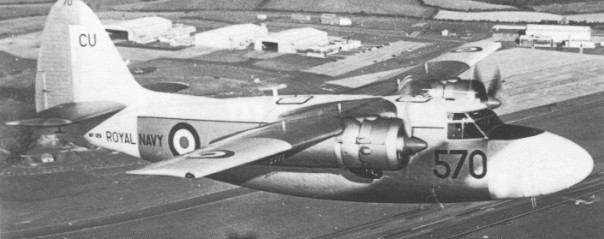
Further development of the type led to the Survey Prince survey aircraft and the Sea Prince. The official designation of the Naval communications version of the Percival Prince was given as Sea Prince C.2.

August 1950

An improved version of the Prince 3 with an increased wingspan and engine and undercarriage modifications was developed for the Royal Air Force as the Percival Pembroke. The Percival Prince 5 the transport variant of the Pembroke.

Sea Prince T.1

Gallery

Prince C.Mk.1

Prince Surveyor

Percival Prentice

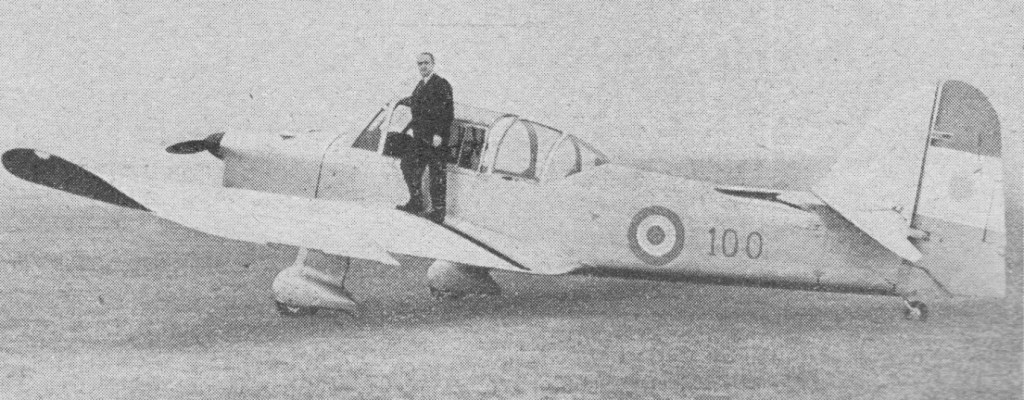
In 1949 Percival celebrated the 100th Prentice for the Argentine Air Force built and tested at Luton. In addition to being the RAF’s standard trainer, they were used by the Indian Air Force and the Lebanese Air Force.

100th Prentice for the Argentine Air Force

The Prentice 3, intended for the Indian Air Force, has a 344 hp Gipsy Queen 70-2 engine. The empty weight is 3427 lb, but the all-up weight remains at 4000 lb aerobatic and 4200 lb normal. The maximum speed is 171 mph at 5000 ft.

During 1958, Aviation Traders obtained a CoA for their four seat touring version of the Prentice.

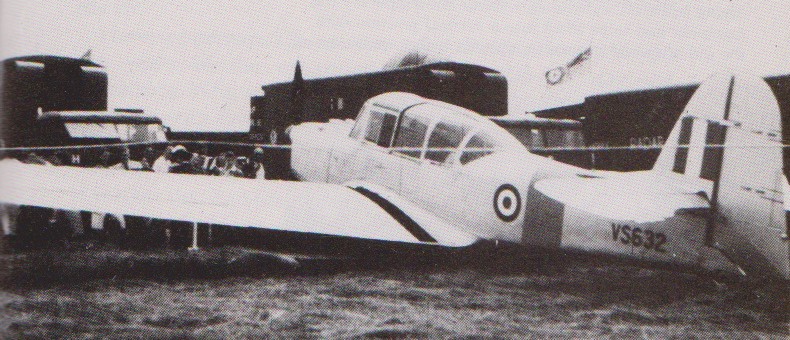
The Prentice T.Mk.I certification is by UK Manufacturer’s Type Record.

Percival Prentice T Mk I VS632

Engine : DH Gipsy Queen 51, 292 hp
Length : 31.234 ft / 9.52 m
Height : 12.795 ft / 3.9 m
Wingspan : 45.997 ft / 14.02 m
Max take off weight : 3790.4 lb / 1719.0 kg
Max. speed : 134 kt / 249 km/h
Service ceiling : 17995 ft / 5485 m
Range : 432 nm / 800 km
Crew : 2

Percival EP.9 / Lancashire EP.9 Prospector

Lancashire Prospector

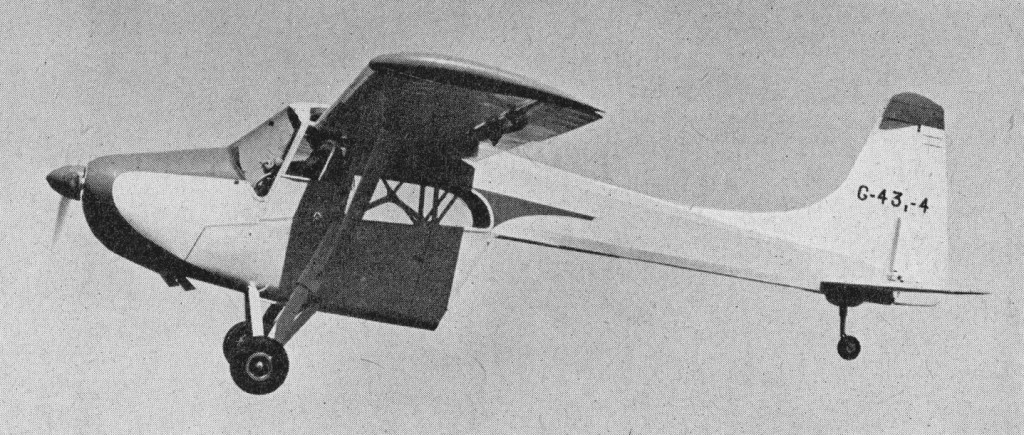
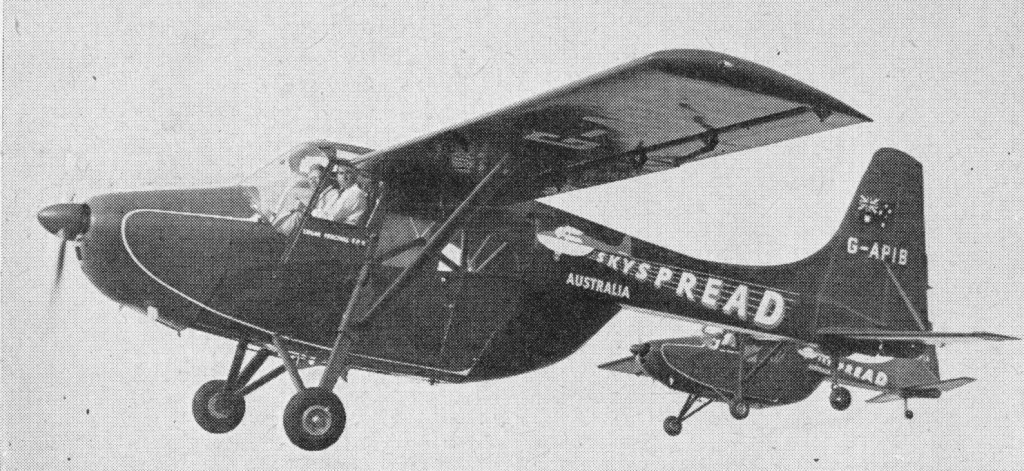
In 1959, Edgar Percival founded Edgar Percival Aircraft Limited at Stapleford in the United Kingdom and built as a private venture a high wing utility aircraft known as the EP 9. It was intended for use as a light transport and top dressing aircraft with a 170 Imp.Gal tank.

The prototype first flew on 21 December 1955 piloted by Edgar Percival, and construction of the first group of twenty aircraft commenced soon after. Edgar Percival built twenty-one EP9s fitted with the 270hp Lycoming GO-480-B engine.

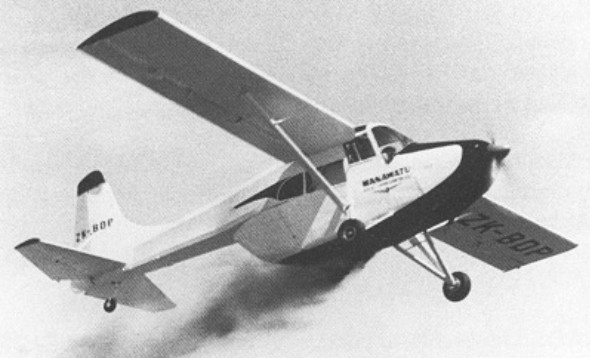
Aircraft were sold to Australia, Canada, France, Tasmania, and a single example to New Zealand.

Two Percival EP.9s were delivered at the end of 1957 to Skyspread Pty Ltd in Australia.

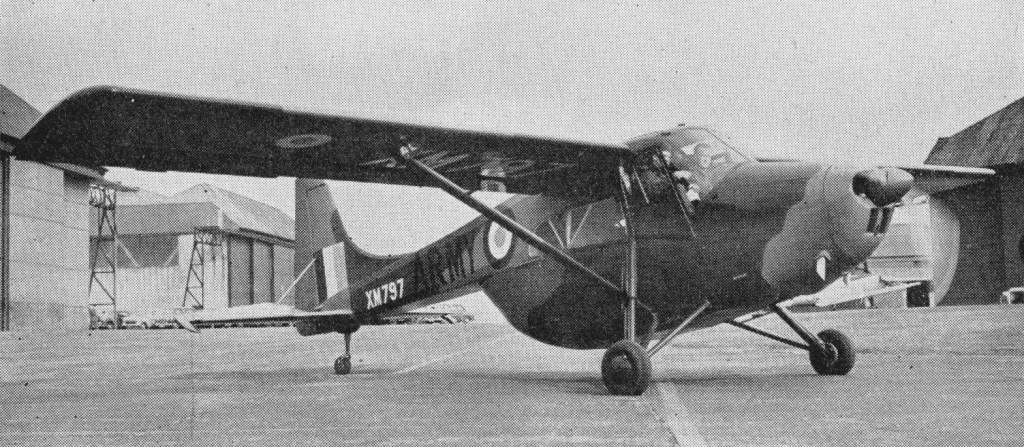
The British Army purchased two in 1958 for evaluation, and they served for several years before being declared surplus and disposed of on the civil market.

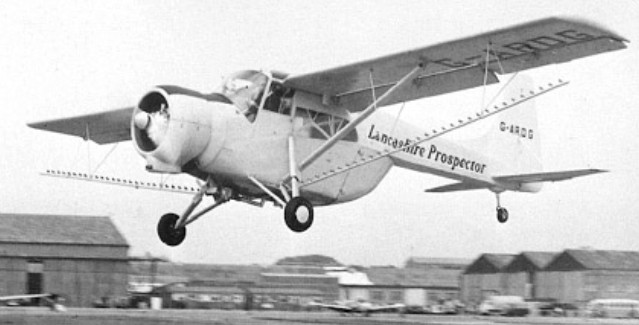
The last aircraft was not com¬pleted by him and was finished by the Lancashire Aircraft Company who then went on to build four more aircraft. The rights for the EP.9 were acquired by Samlesbury Engineering Ltd in 1958, including assembled and partly assembled aircraft. The EP.9 was renamed the Lancashire Prospector EP.9 and three built with Lycoming engines. Lancashire built aircraft standardised on the Lycoming GO-480 295 hp engine.

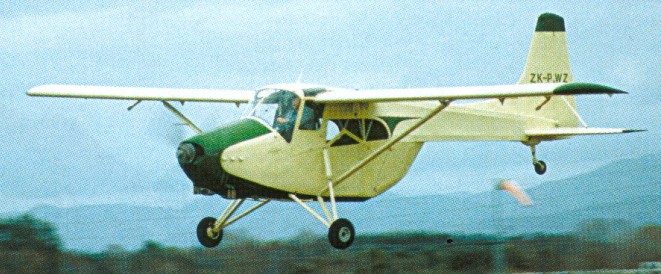
The first of these was registered G-APWZ on 5-11-1959. It first flew on 23-02-1960 and attained its C of A on 22-04-60. Lancashire named the aircraft the Prospector and five aircraft were fitted with a 295 hp Lycoming GO-480-G1A6 and a three-bladed propeller before production ceased in 1960.

Kingsford Smith Aviation Services in Australia converted a number of aircraft to take the 375 hp Armstrong Siddeley Cheetah 10 during 1961-62.

The last aircraft built (G-ARDG) was fitted with a 375 hp Armstrong Siddeley Cheetah 10 and was dubbed the Prospector 2. In all, only twenty-seven aircraft ever flew.

Certification is by UK Manufacturer’s Type Record.

Gallery

EP-9
Engine: Lycoming GO-480-B, 265 hp
Max wt: 3675 lb
Payload: 1550 lb
Max speed: 137 mph
Cruise: 123 mph
T/O dist: 585 ft
T/O dist. 50 ft: 900 ft
ROC: 940 fpm

Lancashire Prospector
Engine: Lycoming GO-480-G1A6, 295 hp
Prop: 3 blade
Wingspan: 43 ft 6 in
Length: 29 ft 9 in
Height: 8 ft 9 in
Wing area: 227.6 sq.ft
Empty weight: 2072 lb
Loaded weight: 3980 lb
Max speed: 146 mph
Max cruise: 142 mph
Econ cruise: 120 mph
ROC: 960 fpm
Norm range: 580 mi
Ferry range: 1180 mi
Seats: 6

Lancashire Prospector 2
Engine: Armstrong Siddeley Cheetah 10, 375 hp

Lancashire E.P.9

Percival P.16 Q.6 Petrel

A communications aircraft / feederliner of 1937.

Percival P.16 Q.6 Petrel Article

Engine : 2 x De Havilland Gipsy Six, 202 hp
Length : 32.251 ft / 9.83 m
Height : 9.744 ft / 2.97 m
Wingspan : 46.654 ft / 14.22 m
Wing area : 278.034 sq.ft. / 25.83 sq.m
Max take off weight : 5501.5 lb / 2495.0 kg
Weight empty : 3501.5 lb / 1588.0 kg
Max. speed : 170 kt / 314 km/h
Cruising speed : 152 kt / 282 km/h
Service ceiling : 20997 ft / 6400 m
Wing load : 19.89 lb/sq.ft / 97.0 kg/sq.m
Range : 652 nm / 1207 km
Crew : 2
Payload : 2-4pax

Percival P28 Proctor

Proctor V

The Proctor as a type dates back to 1939, being designed as a radio trainer and light communications machine for the Royal Air Force by A.A.Bage. A development of the pre-war Vega Gull with Percivals incorporating RAF design requirements into the Vega Gull airframe, the Proctor was produced in five versions – Mks I to III being three seaters for the RAF, while Mks 4 and 5 (Arabic mark numbers replaced Roman in 1948) were four seaters, and incorporated folding wings, the last variant being targeted at the immediate post war civil market, a purely post-war civil version of the RAF’s Mk.4.

Percival Proctor Article

In all, 246 Mk.1s were built by Percival, at Luton.

The Mks II and IIIs for the Navy had a quick release dingy installed in the wing centre sections.

A total of 200 Mk.2s and 436 Mk.3s were built. All by F.Hills & Sons at Manchester.

Percival P34A Proctor 3 OO-JDB (c/n RAF H211)

In 1943, the Mk. III fuselage was redesigned and strengthened to accommodate two side-by-side pairs and the windscreen and cabin windows were enlarged. This was originally known as the Preceptor but was renamed Mk.4. The added visibility from the Mk.4 enabled carrier deck landing trials to be undertaken. Eight pre-production aircraft and 250 production aircraft were built by F.Hills & Sons at Manchester.

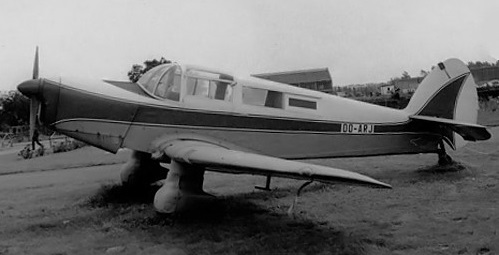
Percival P31C Proctor IV OO-ARJ (c/n H642)

The Proctor V is a civil version of the Proctor IV. The Proctor 5 is a low-wing cantilever monoplane of all-wood construction powered by a six cylinder de Havilland Gipsy Queen II engine driving a two-bladed, variable pitch propellor with constant speed control. The fabric covered wings fold upwards and rearwards to lessen hanger area. Access to the engine is easy with large cowl flaps either side hinging upwards to reveal the whole engine. Fuel is contained in two tanks just outboard of the centre sections and a 5 gallon oil tank is located on the right side in front of the fuel tank. The undercarriage – fixed cantilever with compression springs coupled with oil dampers and recoil springs – is fully covered by “trousers” and most of the wheels by “spats.

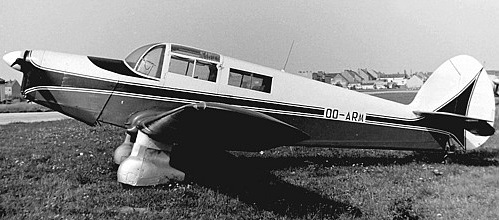
Series production of the Mk.V began at Luton in May 1946, with three converted from Mk.4s, and 150 newly built. All were powered by a DH Gipsy Queen II of 208 hp, providing a maximum speed of 160 mph, a cruising range of some 500 miles and a ceiling of 14000 feet.

Percival P.44 Proctor V OO-ARM (c/n AE84)

Of the hundreds built for RAF use, 225 Mk. 1, 2, and 3 found their way onto the civil register to join at least 150 Mk.5s specially made for the civil market at Percival’s Luton plant. Some continued in service with the RAF until 1955.

The one and only Mk.6 was built as a floatplane for the Hudson Bay Trading Company of Toronto, Canada. It was basically a Mk.5 fitted with floats and a Gipsy Queen 32 engine of 250 hp.

More than 1200 Proctors were produced. The airworthiness design standard of the Percival Proctor was A.P. 1208, dated November 1937 for the Proctor III and October 1938 for the Proctor IV. The design organisation with Type Responsibility Authorisation in 2011 was Tenecia Ltd, at Coventry Airport.

Gallery

Mk.I
Engine: De Havilland Gipsy Queen II, 210 hp
Wing span: 39 ft 6 in 12.04 m
Wing area: 202.04 sq.ft / 18.77 sq.m
Length: 25 ft 10 in
Height: 7 ft 3 in / 2.21 m
Max take off weight: 3501.5 lb / 1588.0 kg
Weight empty: 2370.4 lb / 1075.0 kg
Max speed: 165 mph
Range: 660 miles
Cruising speed: 121 kt / 225 km/h
Service ceiling: 13993 ft / 4265 m
Wing loading: 7.43 lb/sq.ft / 85.0 kg/sq.m
Crew: 2

Mk.II
Engine: De Havilland Gipsy Queen II, 210 hp
Max speed: 165 mph
Range: 660 miles
Wing span: 39 ft 6 in
Length: 25 ft 10 in
Height: 7 ft 3 in

Mk.III
Engine: De Havilland Gipsy Queen II, 210 hp
Max speed: 165 mph
Range: 660 miles
Wing span: 39 ft 6 in
Length: 25 ft 10 in
Height: 7 ft 3 in

Mk.4
Engine: De Havilland Gipsy Queen II, 210 hp
Max speed: 157 mph
Range: 500 miles
Wing span: 28 ft 2 in / 8.59 m
Length: 25 ft 10 in
Height: 7 ft 3 in / 2.21 m
Max take-off weight: 1588 kg / 3501 lb
Service ceiling: 4265 m / 14000 ft

Mk.5
Engine: De Havilland Gipsy Queen II, 208 hp
Max speed: 220 mph
Cruise: 124 mph
Vne: 200 mph
Range: 520 miles
Ceiling: 14000 ft
Wing span: 38 ft 6 in
Length: 38 ft 1 5/8 in
Fuel cap: 40 Imp.Gal
MAUW: 3500 lb
Height: 7 ft 3 in

Mk.6
Engine: De Havilland Gipsy Queen 32, 250 hp

Percival P.6 Mew Gull

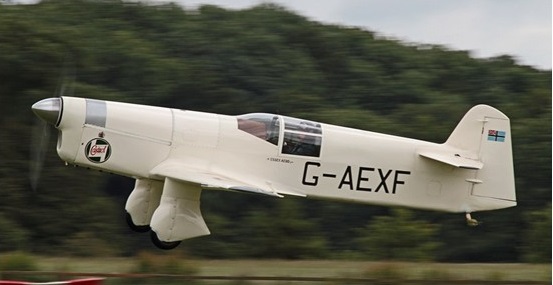
The Percival Mew Gull G-AEXF was designed by Captain Edgar W. Percival and produced in 1936. This clean, low-winged monoplane, with a finely streamlined cockpit cover and a spatted undercarriage, was designed for racing and six were built.

Percival P.6 Mew Gull Article

Alex Henshaw exchanged his de Havilland Leopard Moth for a Mew Gull in 1937, and achieved the fastest times in many air races and won the Folkestone Aero Trophy in the same year.

During this period Alex met Jack Cross of Essex Aero Ltd who made mechanical and structural alterations to XF in order to win the 1938 King’s Cup. The effect was a dramatic increase in performance and resulted in winning success in the King’s Cup at a speed of 380.2km/h (236.25mph).

Alex Henshaw in Mew Gull

Alex then decided to attempt the solo records on the England to Cape Town route. He set off from Gravesend on 5 February 1939 and after four days returned having broken all records on this route. They remain unbroken to this day for an aircraft in this class. Each leg took 39 hours 23 minutes at an average speed of approximately 334.7km/h (208mph).

The Mew Gull was sold in the late summer of 1939 to a Frenchman. XF remained hidden from the Germans throughout the Second World War occupation of France. It then passed through a number of different owners before eventually being bought by Robert Fleming in 2002.

Mew Gull G-AEXF ‘displayed’ at Reflectaire Museum at Squires Gate on 20 February 1971, prior to restoration by Tom Storey

In 2008 XF was still operated by The Real Aeroplane Company at Breighton in Yorkshire.

Gallery

Engine: 165 hp Napier Javelin
Length: 18.23 ft (5.56m)
Wing span: 24 ft (7.32m)
Weight empty: 1,000 lb (450 kg)
Max speed: 195 mph (314 kph)
Range: 550 miles (885 km)
Seats: 1