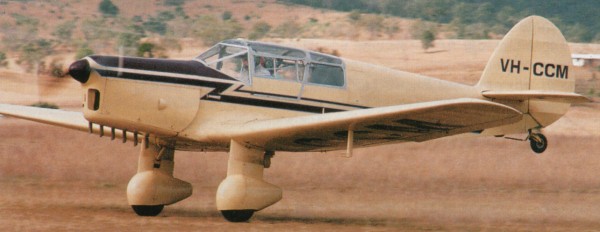
The prototype Gull G-ABUR flew in 1932 as a 3 seat touring aircraft, all wooden construction, powered by a 130hp Cirrus Hermes IV. The aircraft was designed by Australian Edgar Percival and constructed by Lowe-Wylde British Aircraft Company at a small glider factory Maidstone, Kent. The following year the prototype was re-engined with a Napier Javelin II, and its speed and performance was further improved. Edgar Percival flew it in races in England and it was later written off in Rhodesia during a speed record attempt to the Cape.
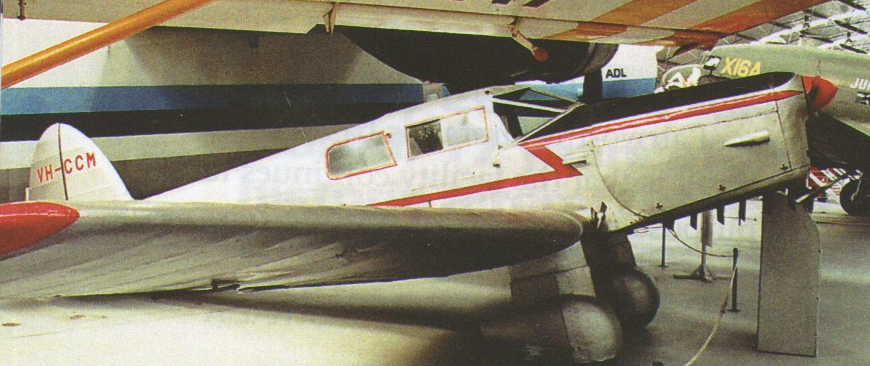
The first production model was the Percival “D” Series Gull, 29 built by George Parnall and Company at their works at Yate, Gloucestershire under contract to Percival Aircraft Co Ltd. They were designated D.1 or D.2 depending on engine installed, top/side hatch cockpit entry and tripod undercarriage legs, but were all called Percival Gull IV. In 1934 Percival Aircraft Co Ltd established its own works at Gravesend Airport, Kent. Here 19 type D.3 Gulls named the Percival Gull VI were built, featuring side opening cockpit doors and single leg undercarriage with spats, powered by a 200hp Gipsy Six.
Gull Six VH-CCM
Gull Six Engine: de Havilland Gypsy Six I, 184 hp at 2,100 rpm / 205 hp at 2,350 rpm. for takeoff. Propeller: two-bladed fixed-pitch Wingspan: 36 feet, 2 inches (11.024 meters) Length: 24 feet, 9 inches (7.544 meters) Height: 7 feet, 4½ inches (2.248 meters) Empty weight: 1,170 pounds (530.7 kilograms) Gross weight: 2,050 pounds (929.9 kilograms). Max speed: 178 miles per hour (286.5 kilometers per hour) Service ceiling: 16,000 feet (4,876.8 meters) Range: 700 miles (1,126.5 kilometers). Crew: 1 Passengers: 2
Emile Percevants’ “Metalloplan” pusher canard monoplane bicycle was displayed at the “stand de l’aviette” of the 1913 Salon de la Locomotion Aérienne (Paris). Although the Metalloplan company did not have much luck with aircraft, it seems they made successful business manufacturing bikes and motorbikes, and were active at least into the 1950s.
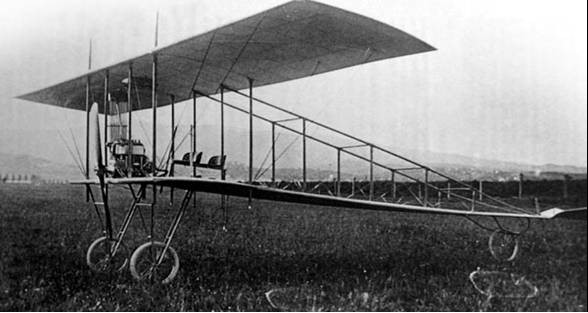
Slavoljub Penkala was interested in flight and decided to buld his own airplane, pretty much making it up as he went along. He patented it in late 1909 and the plane was ready for its first flight by June 1910. The funding came from Penkala’s own income from his pen and pencil factory, and a lot of the work and ideas also came from Dragutin Novak, who joined Penkala earlier the same year.
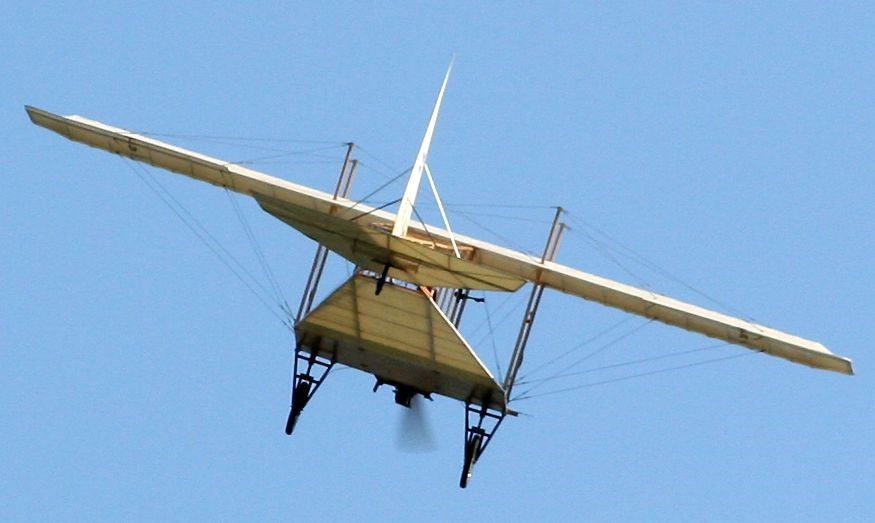
The Leptir (English: Butterfly)was a single engine, sesquiplane aircraft with conventional landing gear. The open girder fuselage provides an unusually long distance to the tail surfaces, compared to modern aircraft. The flat bottom surface of the fuselage was covered, forming a long thin triangular surface intended to provide lift, which was not functional in level flight. The aircraft was tail heavy with a center of gravity at 70 percent of wing chord.
The first flight occurred on 22 June 1910 with pilot Dragutin Novak. The 1910 Leptir II featured modifications to include skids. The aircraft was crashed several months later.
The CA-10 replica was built in 2010 and known as the Cvjetkovic CA-10 Penkala, bearing the registration of 9A-XCA. It was powered by an 80 hp (60 kW) Rotax 912 with the center of gravity moved forward for safety.
Cvjetkovic CA-10 Penkala
Penkala Biplane Propeller: 2-blade Wingspan: 11 m (36 ft 1 in) Length: 11 m (36 ft 1 in) Empty weight: 330 kg (728 lb) Crew: 1
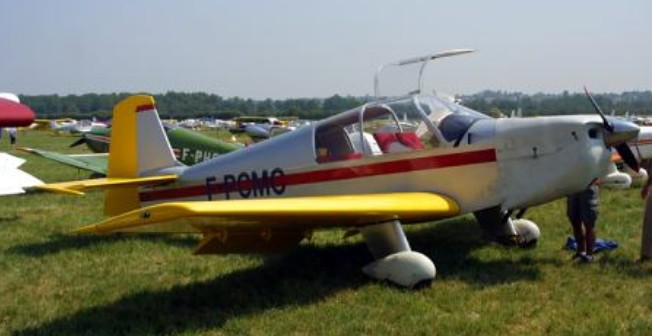
The Peña Dahu, named for the legendary French mountain animal, is a French amateur-built aircraft that was designed by Louis Peña of Dax, Landes and made available in the form of plans for amateur construction.
First flown on 9 May 1996, the Dahu is intended for mountain flying, aero-towing gliders and touring. It features a cantilever low-wing, a four-seat enclosed cockpit, fixed conventional landing gear and a single engine in tractor configuration.
Peña Dahu
The Dahu is made from wood. Its 9 m (29.5 ft) span wing has an area of 15 sq.m (160 sq ft) and mounts flaps. The recommended engines range in power from 120 to 200 hp (89 to 149 kW) and include the 160 hp (119 kW) Lycoming O-320, 180 hp (134 kW) Lycoming O-360 and the fuel-injected 200 hp (149 kW) Lycoming IO-360 four-stroke powerplants. When equipped with a 120 hp (89 kW) engine the gross weight is limited to 900 kg (1,984 lb) instead of 1,200 kg (2,646 lb).
Peña Dahu
Plans were available in 2012, the 2011 price was €600.
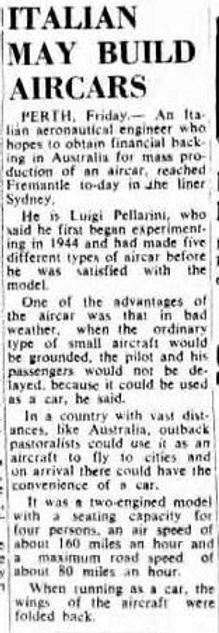
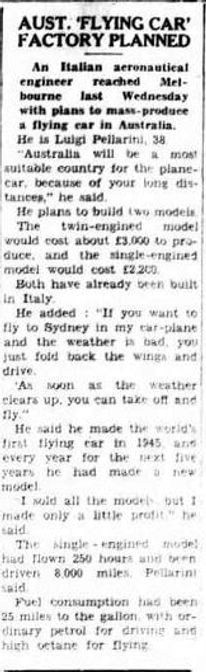
Luigi Pellarini was about 30 years old when in 1944 he partnered with Carrozzeria Colli, a Milan motor vehicle and coach-building company, to build his first prototype flying car, the PL 1.
He kept improving his prototypes and put out a new and improved model each of the next several years. L’Ala, an Italian magazine, published a description of his PL-2C, dubbed the Aerauto, in its October 1946 issue.
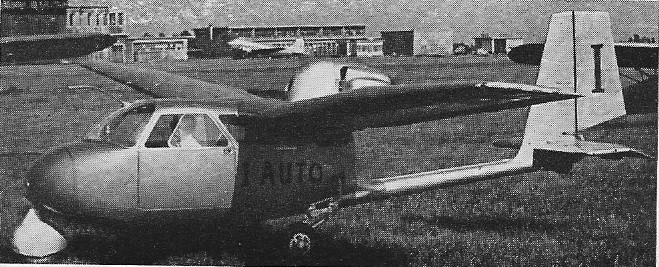
The PL 2 C is an entirely metal touring aircraft, with folded wings, its dimensions are about 2.20 m width for 6 m of length it can easily move on normal roads, always with the propeller thrust.
The PL 2C structure is the fuselage, with a real chassis, consisting of a tubular beam in welded sheet steel and durall bodywork. On the beam are welded the castle in tubes that support the wing and the engine, as well as all the controls, the undercarriage, the seats and the empennages.
There durall fairing covers the front of the beam and provides a to connect the wing to the engine and to the beam, as well as to form the cabin equipped with two side doors and is easily removable. The wing is cantilever monoplane divided into a fixed centre, and in two collapsible semis. The folded wing remains suspended with the front attachment to the central trunk of the wing. Structure the wing is entirely durall and the cover is 8/10 mm. The attachments are steel. Rivets were widely used in the wing tubulars, rather than bolts. The ailerons have a metal frame in durall and a cover in canvas; they can be simultaneously lowered so as to work as flaps. The horizontal plane is of a similar structure to the wing; there fixed part (whose incidence is adjustable in flight with handwheel) is covered in durall. The vertical plane, split, is structurally similar to the horizontal. The undercarriage is tricycle with low pressure wheels, the rear wheels are equipped with brakes, while the front is connected to the pedals for steering.
The prototype engine is a 60-hp Valter that drives a fixed propeller. The controls are of the usual bar and pedal type, the instrument panel the usual equipment of instruments, the brake is a pedal. The cost is 460,000 L without engine.
The following year’s PL-3C also got magazine coverage, this time in Wing.
The Aerauto PL3 C is a small-powered tourism aircraft, single engine, high wing with propeller and tricycle undercarriage. It is a two-seater side by side, with the possibility of a third place. The fuselage beam, in high strength steel sheet with a circular section, formed by two half-shells welded is of simple and easy construction, it represents the longitudinal frame of the aircraft and comes to it welded directly, support for controls, undercarriage, ribs for the support of the fairing, engine frame that also makes to the connection to the wing.
The power train consists of a Walter Micron III engine from 80hp air-cooled, operating a two-bladed propeller with variable pitch. The motor is installed behind the side member of the central trunk, raised from the tail beam in order to allow the propeller rotation. It is supported by the same framework in pipes of welded steel that supports the wing. The tail is built with two side members covered in durall sheet and canvas. The rudders are statically balanced. The undercarriage is tricycle with independent rear wheels and wheel front adjustable.
The aircraft is equipped with the regulatory instrumentation for in-flight and the landing light, installed at the bow of the aircraft, taillights and signalling etc are powered by a 12V battery.
The PL-4 was publicly known as the Aerauto AER-1. L’Ala had a more consumer-oriented article in its July 15, 1948 issue.
PL-5C Aerauto
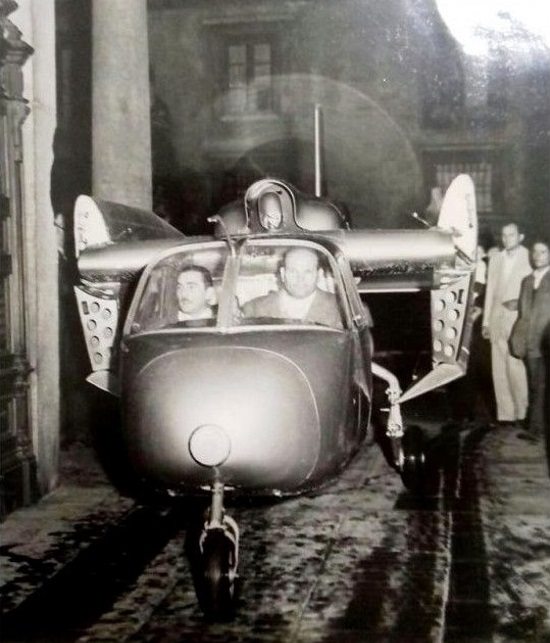
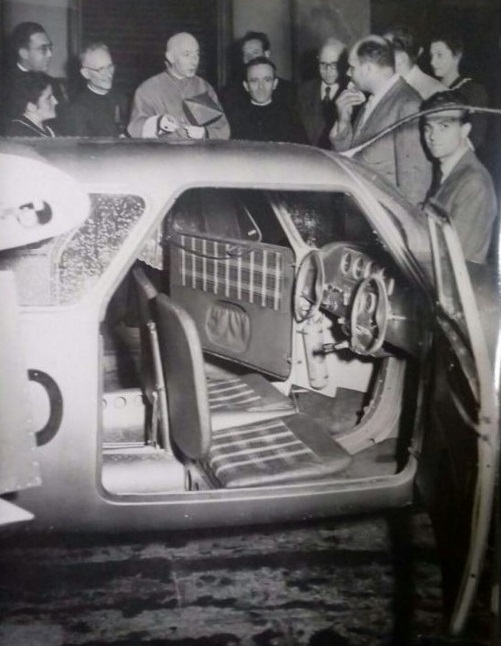
By 1949, Pellarini thought that his new model, the PL-5C, was ready for the public. Piloted by Leonardo Bonzi and Maner Lualdi, the Aerauto drove and flew across Italy from late 1949 to early 1950, 1800 km in the air and 2200 km on the ground, stopping at Turin, Florence, Pisa, Rome, Naples, Bari, Ancona, Rimini, Venice, Treviso, Vicenza and Milan. The Aerauto would fly to a location outside of a city, fold up its wings, and drive into the city proper, exactly as a commercial flying car was supposed to work. At the end, Pellarini grandly presented the Aerauto to the Archbishop of Milan, Cardinal Schuster.
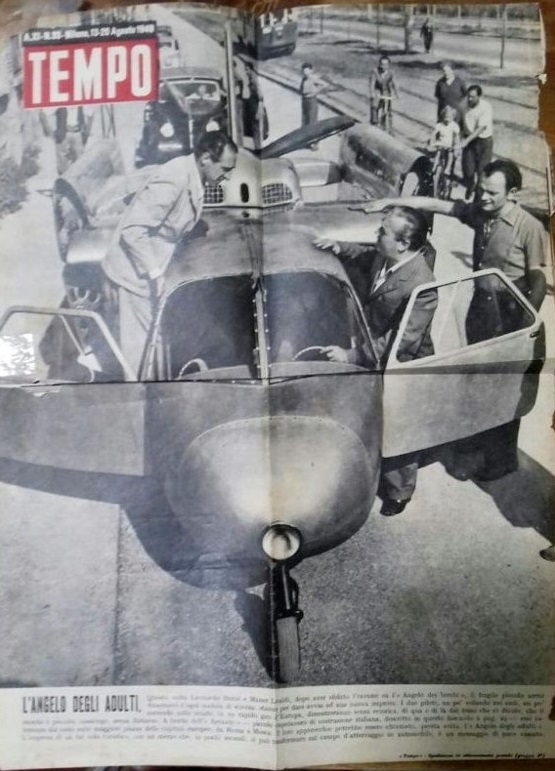
Naturally, this great stunt garnered even more publicity, with Tempo magazine displaying a picture of the Aerauto, Pellarini, Bonzi, and Lualdi on a public street, taking up no more room than the cars behind them.
A British Pathé newsreel documented the Aerauto on the ground and in the air.
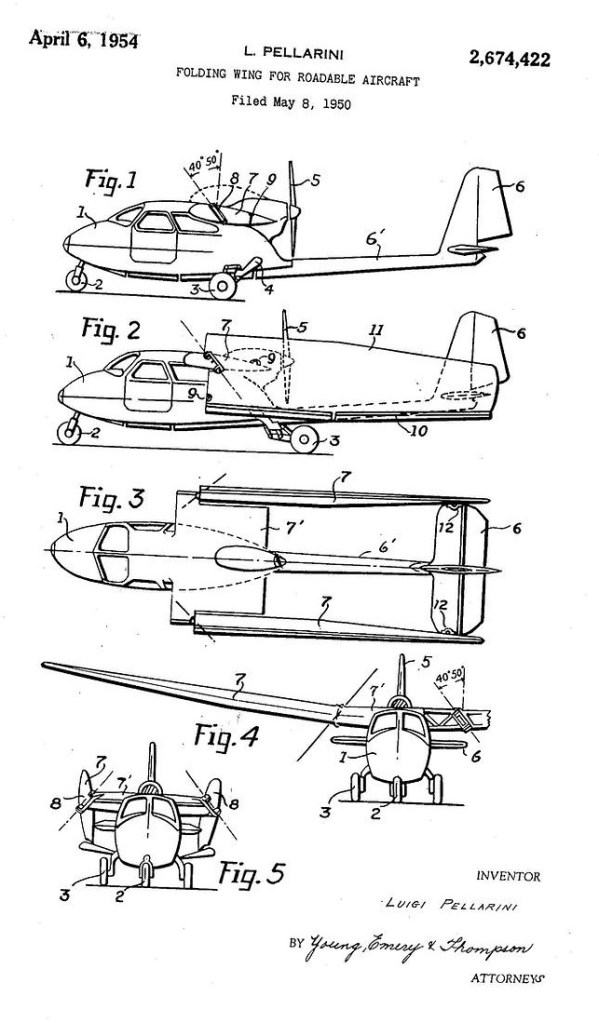
Pellarini immediately filed a U.S. patent application for a “Folding Wing for Roadable Aircraft,” which was granted after much delay in 1954.
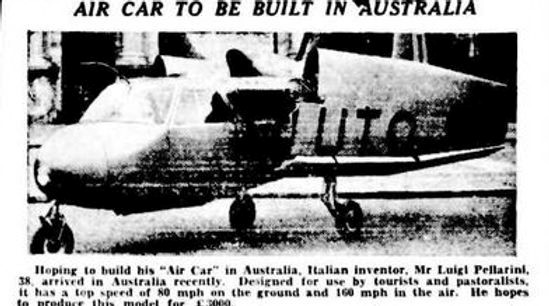
Flying cars are hard to sell at the best of times, and with Italy’s economy in 1950 Pellarini got no orders at all. He gave up and emigrated to Australia. The Australian press showered him with articles as soon as he arrived.
PL 2C Wingspan: 9,80m Wing area: 12sq.m Length: 5,70m Height: 1,60m Empty weight: 340kg Payload: 210 kg Total weight: 550kg Wing load: 45.8kg / sq m Maximum speed: 190 kph (at 2000m) Cruise: 160kmh Stall: 70kmh Road speed: 60kmh Ceiling: 4000m Range cruise: 600km Max range: 750km Take-off dist: 120m Landing dist: 60m Fuel consumption: 15 lt/ hr
PL-5C Engine: 85 hp Continental C85 Max speed: 112 mph Cruise: 100 mph ROC: 535 fpm Service ceiling: 13.120 ft Range: 500 mi Empty weight: 1012 lb Loaded weight: 1540 lb Wingspan: 33 ft 5.5 in Length: 20 ft 4 in Height: 5 ft 9 in
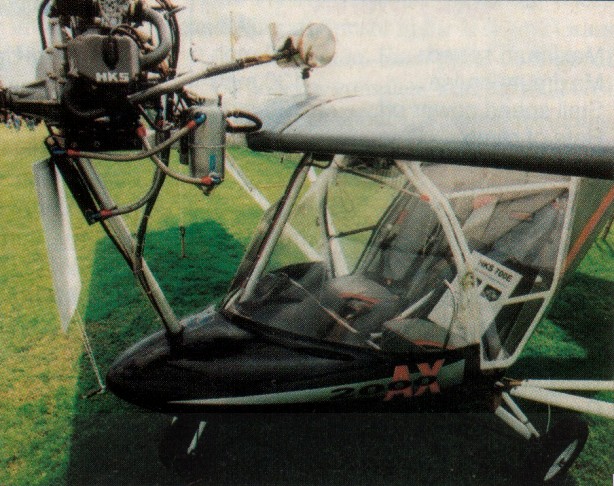
Publicly owned Pegasus Aviation bought the rights to the French edition of a highly modified Weedhopper. Some of these alterations were completed to bring the machine to a contemporary description. Others were done srictly to meet the demands of British certification under BCAR-S.
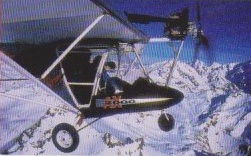
The AX2000 (previously known as the AX-3, for 3 axis) is now a fully enclosed, conventional three axis machine.
H-Power introduced the AX2000 to the US at Oshkosh 1997.
In 1998 the Rotax 582 powered version cost £17,619.
Engine: HKS 700, 60 hp Wing span: 10.3 m Wing area: 15.6 sq.m MAUW: 390 kg Empty weight: 202 kg Fuel capacity: 64 lt Max speed: 145 kph Cruise speed: 105 kph Minimum speed: 50 kph Climb rate: 3 m/s Seats: 2 Fuel consumption: 7.5 lt/hr Certification: BCAR S





 All Aero