UK
Built Satellite three-seat light aircraft with vee tail and pusher propeller in 1949. The first aeroplane constructed entirely of magnesium sheet, it was powered by a Gipsy Queen engine, but did not fly and was subsequently broken up. Fuselage of the second prototype was used in the Firth helicopter.
Monoplane
Plane Driven PD-1 / PD-2
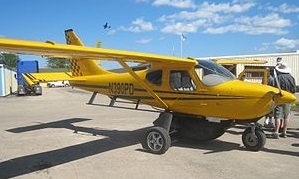
The Plane Driven PD-1 is a modification to the Glasair Sportsman 2+2 to convert it into a practical roadable aircraft. Trey Johnson, a homebuilt aircraft built the PD-1, intended to be an aircraft first, and a car second. The approach uses a mostly stock aircraft with a modified landing gear “pod” that carries a separate engine for road propulsion.
The engine pod carries a separate engine for road travel with its own fuel tank. The wheels are driven through an automatic transmission with a reverse gear. The lightweight fuselage coupled with a low power engine allows 25 miles per US gallon (9.4 L/100 km; 30 mpg imp) fuel economy with 5 US gallons (19 L) of usable fuel. The aircraft is registered in Washington State as a motorcycle due to its 3-wheel configuration.
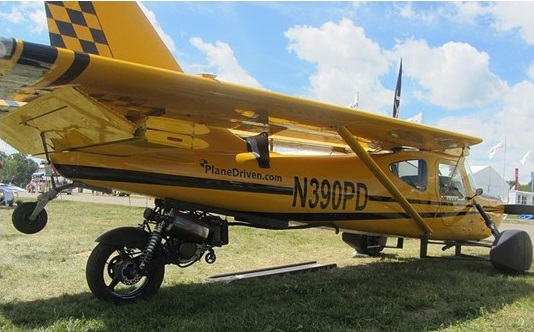
The PD-1’s wings fold along its sides, and the main landing gear and road engine pod slide aft along special rails, creating a driving configuration. The driving configuration compensates for the rearward center of gravity created by the folded wings, and provides additional stability for road travel.
The wings are hinged to allow them to rotate and fold back against the rear fuselage of the plane. The horizontal stabilizer is also hinged to reduce the width of the vehicle in road travel mode.
The prototype was constructed using Glasair’s two weeks to taxi program. It was started on March 29, 2010, and the modified prototype was test flown by July 21, 2010.
The vehicle can cruise at a speed of up to 140 mph in normal flight even with the road engine sitting as dead weight.
The prototype was displayed at the Experimental Aircraft Association Airventure airshow in 2010. The company’s second generation refinement was code named the PD-X, with intention of building a marketable aircraft based on the PD-X test results.
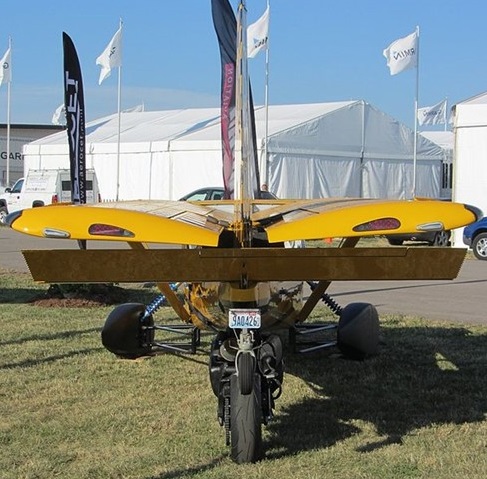
A second generation version of the PD-1 using the same Sportsman airframe as the PD-1, the PD-2, uses two forward mounted wheels with suspension in a conventional landing gear layout. A single rear wheel is mounted aft on the pod containing the second engine for road use. An updated pod was developed using a 50 hp four cycle engine with casters that fits into the baggage compartment. A custom lightweight four-piece carbon-fiber ramp can be used to load the pod without lifting. Gas milage is 24mpg in ground use.
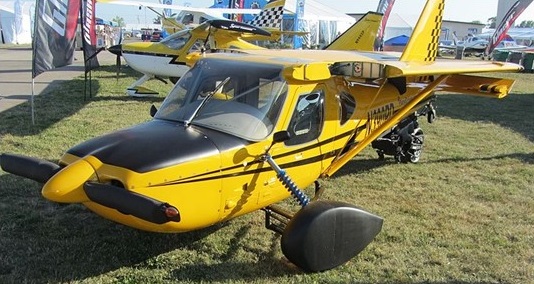
PD-1
Engine: 1 × Lycoming IO-390, 210 hp (160 kW)
Engines: 2 × 500cc Yamaha Phazer 4 Cycle, 80 hp (60 kW) each
Wingspan: 35 ft (11 m)
Wing area: 131 sq ft (12.2 m2)
Aspect ratio: 9.1
Length: 23 ft (7.0 m) 24 feet 8 inches with wings folded
Fuel capacity: 50 US gallons
Cruise speed: 122 kn (140 mph; 226 km/h)
Capacity: 2 persons
Plan PF.204
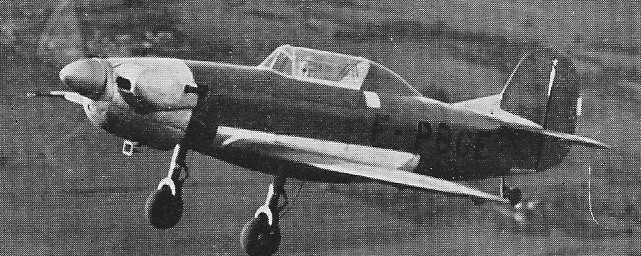
Designed by M. Max Plan, the PF.204 single-seat racing and sport monoplane was flown for the first time on 5 June 1952, powered by a 75 hp Minie 4 DC 32.
The PF.204 is of all-wood construction with plywood skin and has a fixed cantilever undercarriage with light alloy fairings.
Only one prototype may have been built.
Engine: 75 hp Minie 4 DC 32.
Wingspan: 18 ft
Loaded weight: 792 lb
MTOW: 1100 lb
Length: 17 ft 6 in
Max speed: 130 mph
Cruise: 99 mph
ROC: 394 fpm
Endurance: 2 hr 30 min at full pwr
Plage-Court Torpedo
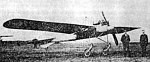
After the unsuccessful Plage I, its designer Emil Plage continued his works in Berlin and in 1911 he designed there, together with Max Court a very elegant and aerodynamically well developed for its time monoplane aircraft. Built by Kühlstein Wagenbau, Germany, it made first flight in autumn 1911 and was met with interest from German military authorities which run its further trials.
In the next year Plage and Court built slightly upgraded version of the aircraft, which made numerous flights, including successful participation in several air contests, until it crashed in October 1912.
Torpedo I
Span: 38′
Length: 25’11”
Plage Lublin R-X / R-XIII / R-XIV / R-XV / R-XIX / R-XXI / R-XXIII
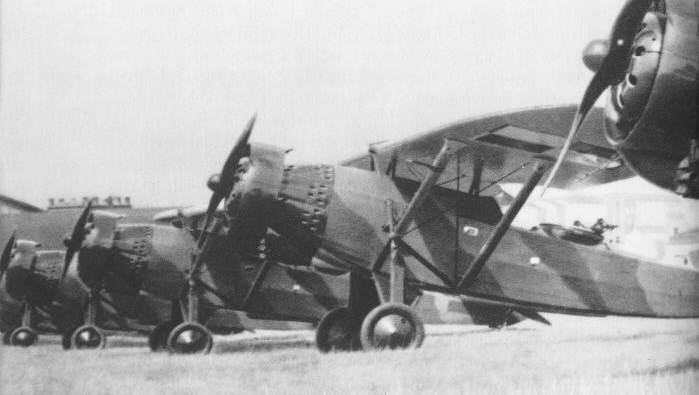
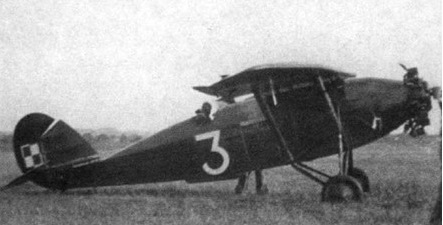
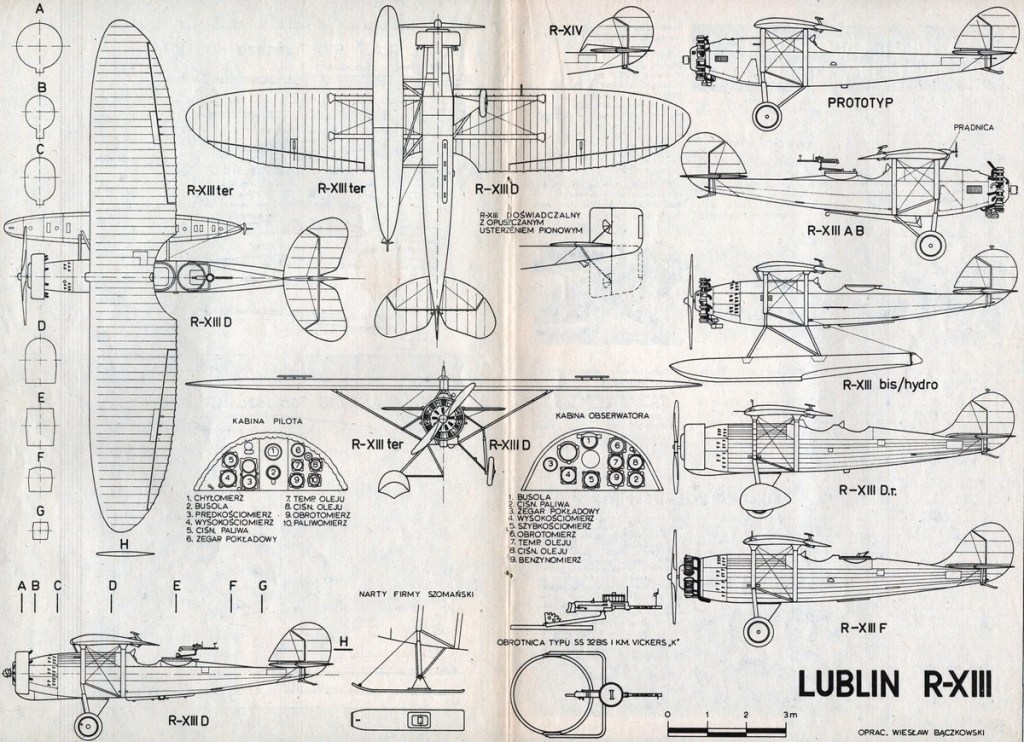
The Lublin R-XIII was the main Polish army-cooperation plane (observation and liaison plane) of the Polish Air Force, designed in the early-1930s in the Plage i Laśkiewicz factory in Lublin. In 1927, the Polish aviation authorities announced a contest for an army-cooperation plane (in Polish: samolot towarzyszący, literally: “acompanying plane”). In Polish doctrine it was a close reconnaissance, observation and liaison aircraft, operating from casual airfields, providing big Army land units with information about the enemy. According to its requirements the aircraft was to use a Wright 220 hp engine, armed with a machine gun, have a speed of 170 kph and short takeoff and landing. The PZL state factory proposed the PZL Ł-2, built in a series of 25 aircraft, while private factory Plage i Laśkiewicz in Lublin proposed the Lublin R-X, designed by Jerzy Rudlicki. It was flown on February 1, 1929. Five aircraft were built for the Air Force as R-Xa, and one was built as a long-distance sports plane. The third competitor was the PWS-5t2.
The contest was won by the R-X, having the shortest take-off and landing, and good performance, but the factory was ordered to develop design further. At that time, Rudlicki was working upon an unarmed trainer aircraft R-XIV and an observation aircraft R-XV. Both were new designs, basing upon the R-X construction. Number XIII was initially omitted in designations as “unlucky”. In February 1930, the Polish Air Force ordered 15 of R-XIV. The first serial plane was built in June 1930, without an earlier prototype, and all were delivered by July 1931. The R-XIV was a two-seater, parasol wing aircraft, with a 220 hp radial engine and fixed landing gear. The crewman sat in open cockpits in tandem. The R-XV was not ordered, but the Air Force demanded instead, that two R-XIV should be armed with an observer’s machine gun, for testing. The first, number 56-1, had a wing with short chord as R-XIV and reduced vertical stabilizer, a raised tubular, arc półobrotnice machine gun, and rear fuselage was flat from the top. First flown in June 1931, but in July of that year, during rehearsals in IBTL, as a result of intense acrobatics the joystick fixing pin was beheaded. The pilot, deprived of control, parachuted, and the aircraft made a normal landing on a field and stopped in a ditch. The R-XIII No. 56-1 became the model for a series of Lublin R-XIII. The second was Lublin R-XIV No. 54-15. The aircraft received km T0.7 turntables and rounded up the rear fuselage. Thus armed, the R-XIV, fitted also with other minor modifications, most notably a changed shape of a tail fin, became the first prototype of the army-cooperation plane and was designated the Lublin R-XIII. The first five machines were designated R-XIIIA and naturally differed from the prototype. In the spring of 1932 the aircraft was put on 54-15 floats and became the prototype for a future series of such machines. 54-15 aircraft became the prototype serial Lublin R-XIIIB.
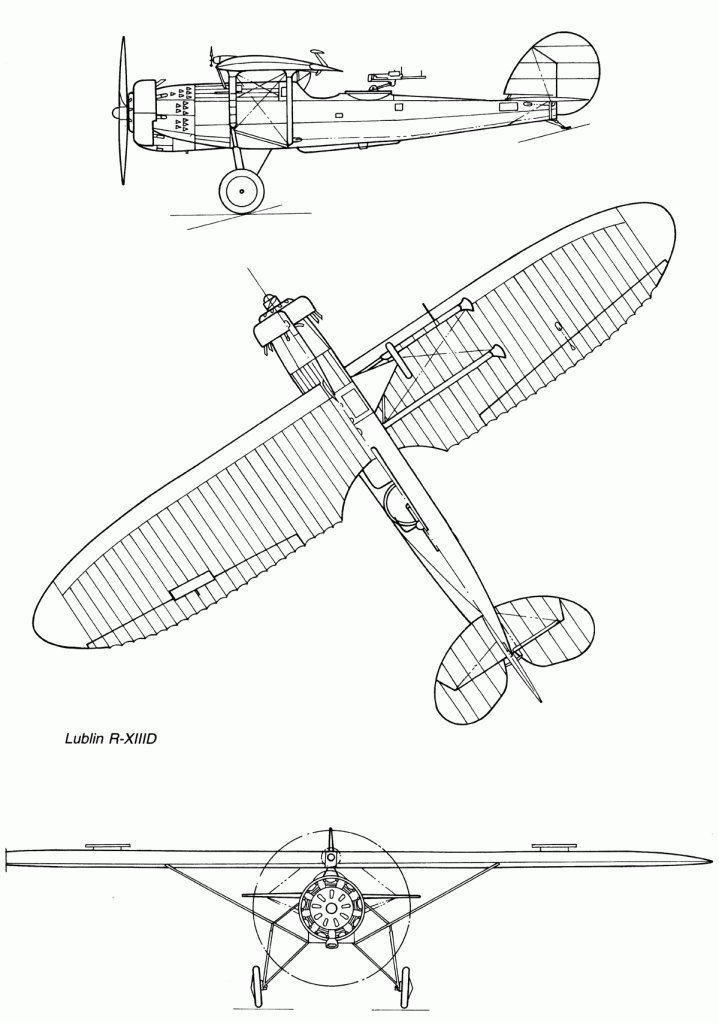
The aircraft was of mixed construction (steel and wood) and a monoplane, conventional in layout, with braced high wings, canvas and plywood covered (the front part of the fuselage was metal covered). A conventional fixed landing gear, with a tailskid was fitted. The Crew of two sat in tandem in an open cockpit, with twin controls. The observer had a 7.7 mm Vickers K or Lewis machine gun on a ring mounting (rarely, 2 machine guns). The aircraft could be fitted with racks for small bombs of 12–25 kg. A 9 cylinder air-cooled Wright Whirlwind J-5 radial engine (produced in Poland) with 162 kW (220 hp) nominal power and 176 kW (240 hp) take-off power (on 22 aircraft R-XIIIF, 250 kW (340 hp) engine Skoda G-1620A Mors-I wad fitted). A Two-blade wooden or metal propeller was also fitted. A 200 liter Fuel tank in the fuselage could be dropped in case of fire emergency (R-XIV – 135 liter tank).
The Lublin R-XIII drew attention from abroad. Requests for a proposal were received from Romania, Aero Club of Belgium and Spain in 1931. Sales did not eventuate.
On July 21, 1931, 50 R-XIII aircraft were ordered. The first series of 30 were designated R-XIIIA, the next 20 were R-XIIIB. Both variants differed mostly in a type of a machine gun ring mounting. The first serial R-XIII was built on June 7, 1932. By March 11, 1933, all were given to the Air Force.
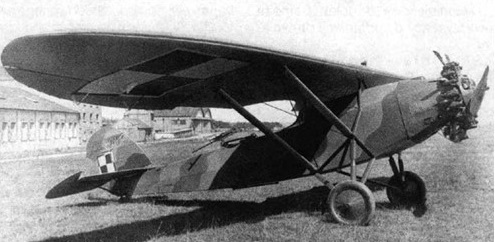
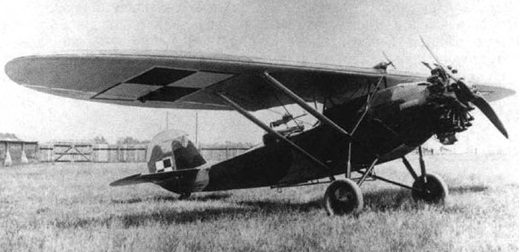
The first 5 units built as R-XIII (No. 56-2 to 56-6) were identical with the prototype 56-1 for the Department of Aeronautics. They were XIIIS-R, or according to one source, reconstructed version of the four-XIIIB R, R-XIIIc one and three R-XIIID. These airplanes were then transferred Aeroklubowi Polish Republic. One of these aircraft (No. 56-51) was converted to version rally marked initially Lublin R-XXIII and later Lublin R-XIIIDr. Later, it was modified for the R-XIIIB. Another 25 aircraft of the turntable TO-7, received the designation R-XIIIB (numbers 56-7 to 56.32), and another 20, also designated R-XIIIB (numbers 56-33 to 56-52), received a turntable Rudlickiego R-2. A total of 49 units were built. In 1933, four of the R-XIIIB were delivered to military flying clubs. The aircraft received the following civil designation SP-AFD (# 56-12), SP-AND (# 56-13), SP-ANF (# 56-20) and SP-AKK (# 56-48).
On 12-28 April 1933 two civilian R-XIII took part in the rally on the Balkan route Warsaw-Lwów- Czerniowce- Jassy- Bucarest Sofia- Belgrad- Zagrzeb- Vienna- Bratysława- Praga- Brno- Warsaw.
In December 1932, on request of the Department of Aeronautics, Eng. J. Rudlicki prepared a draft of a modified R-XIII, designated Lublin R-XXI. The engine was a Polish PZL G-1620 “Mors II.” In September 1932 the Department of Aeronautics ordered two prototypes R-XIII also with the Mors engine, designated Lublin R-XIII and Lublin R-XIIIF.
In September, 1932 the Department of Aeronautics ordered 120 R-XIII, including 50 R-XIIIc 70 and R-XIIID. 48 were built in R-XIIIC variant with minor modifications (No. 56-52 to 56-99), delivered in May 1933-January 1934, then 95 were built in a most numerous R-XIIID variant. It introduced visible changes, like a Townend ring on a radial engine, and a new engine cowling with adjustable shutter. It also had new type of a machine gun ring mounting, besides the length of the aircraft increased by 0.25 m. On January 9, 1932 an order was placed for three R-XIIIbis / hydro with wooden floats – for naval aviation. The planes were built in 1932 and at the end of the year transferred to the customer. The aircraft had removable undercarriage, allowing them to use airfields.
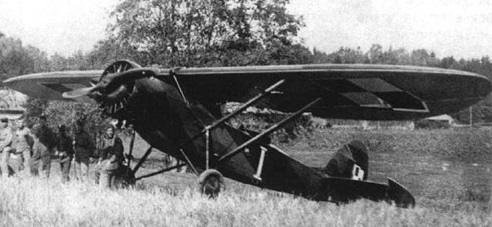
In February of 1934 the number of aircraft was increased from 120 to 170, including 48 R-XIIIc prototype R-XIII and prototype XIIIF R-95, R-XIIID and 25 aircraft of the G-1620 engine version.
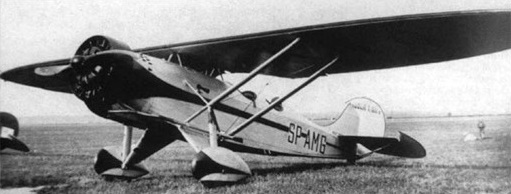
The first R-XIIID (No. 56-102) was submitted to the IBTL tests in February, 1933 and then two more aircraft. They received civil registration SP-ANE, -ANG, – AMG. The first six of the D series were converted for displays in 1933. The aircraft left from Warsaw on September 3 to go to Moscow to participate in the celebrations of the 16 anniversary of the October Revolution, but due to the difficult weather conditions only flew to Minsk and then the visit was postponed. R-XIIID (numbers from 56-102 to 56-196) were supplied the army in by March 2, 1934. From the middle of the series the mounted turntables were type SS-32 bis. Three copies of R-XIIID without the turntable, were received in 1934 by the Aero Club of the Polish Republic. The Flight Training Center at Deblin had four R-XIIID converted to blind flying in the field. During repairs, older models A, B and C were modified to R-XIIID standard as well.
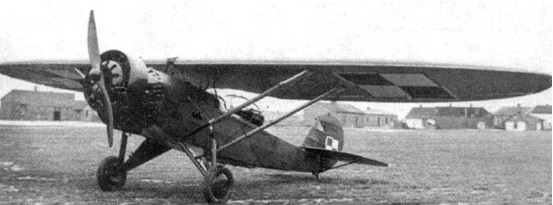
In 1933, Jerzy Rudlicki proposed a new design R-XXI, for a new contest for R-XIII successor, but it was not accepted (the contest was won by the RWD-14 Czapla). However, some of the R-XXI features, like the higher and rounded in cross-section fuselage and a changed tail fin shape, were found in later R-XIII variants. A single prototype of the R-XIIIE was built in 1934, fitted with a more powerful 360 hp engine Gnome-Rhone 7K Titan engine, but it was not produced. Another variant, the R-XIII-F introduced new, Polish-designed 340 hp engine Skoda G-1620A Mors-I engine. It had no Townend ring on cylinders of the radial engine. After one prototype (no. 56.101), a series of 50 R-XIII-F’s were ordered in 1934. After seven aircraft had been delivered, the Polish aviation authorities refused to buy a further 18 nearly-completed aircraft, as they were planning to completely nationalize the aviation industry in Poland. As a result, the Plage i Laśkiewicz factory went bankrupt in late 1935, and it was next nationalized under the name LWS (Lubelska Wytwórnia Samolotów – Lublin Aircraft Works). The 18 R-XIIIF, were them bought at scrap price, were completed, and the next series of 32 was built. All R-XIII-F’s were delivered to the Polish Air Force by 1938. However, only 26 of them were completed with Mors engines (and these were mostly used for training or staff liaison), while 32 had standard 220 hp Wright engines, lowering their performance to R-XIII-D level.
In the early 1930s the R-XIII was quite a successful plane for its purpose. It had a very short take-off (68 m for R-XIIIA) and landing, enabling it to operate from rough fields and meadows. However, only some of R-XIIIs were equipped with a radio and a camera, which lowered their usefulness. In 1932-1936 they were used in three-aircraft liaison platoons, being the basic Polish army-cooperation plane. In 1937 they were formed into army-cooperation escadres (eskadra towarzysząca), in 1939 reformed into observation escadres (eskadra obserwacyjna). In 1939 some of the R-XIII’s were replaced by the RWD-14b Czapla, which was not much more modern. A planned replacement was a modern LWS-3 Mewa, but it was not introduced prior to the outbreak of war.
Four R-XIIIB were adapted for passenger transport as the R-XIII (sztabowy).
In 1931, one R-XIV was tested on floats, as a seaplane. Since tests came out well, the Polish Navy designated it R-XIII bis/hydro and ordered the next three (nos. 700-703). On 5 May 1933, the Navy ordered 10 R-XIII ter/hydro with KZA type floats, which was a seaplane variant of R-XIIID (nos. 704-713). In the spring and summer of 1934, these machines entered service with Squadron Pinsk River Flotilla, based in Pinsk.
Finally, on 26 May 1934 the Navy bought 6 R-XIIIG seaplanes, differing in details from a previous variant – among others, a metal propeller (nos. 714-720). They were delivered by April 1935. All variants could also be easily converted to wheeled landing gear.
One machine of this series was modified, designated R-XIIIDr, with a rear cabin for passenger transportation. The aircraft was originally intended for the long trip to Australia, so in addition to enlarged fuel tanks, it had a Sperry attitude indicator and other navigation equipment. Flight range of the airplane was 2,500 km. However, May 10, 1933 during a routine test flight of the aircraft involved in an accident.
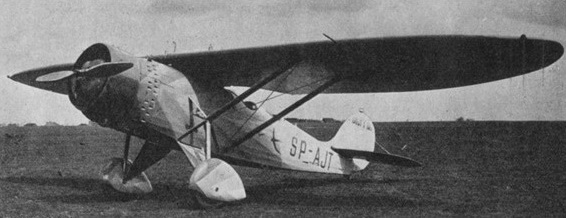
In April 1933, one R-XIIIB was converted to a long-distance sport plane R-XIIIDr, named Błękitny Ptak (the Blue Bird), meant for a flight to Australia. The main difference was additional fuel tanks that allow a 2,000 km range, a Townend ring, metal propeller and radio. It was crashed in 1935 in Siam by Stanisław Karpiński. Several aircraft were converted to civilian sport ones, used in Polish Aero Clubs.
In preparation for the Challenge 1934, six R-XIIIB were adapted for blind flying training with higher closed trainee cabin. These were designated R-XIIIt. Completed by June and July 1934, these aircraft were used by the Polish team for the Challenge, practicing at Warsaw. They made Warsaw-Paris and Paris-Warsaw without landing on the route. The aircraft were returned to the Air Force.
Two more R-XIIIB were converted into a version of the R-XIIIt. Probably at the Training Centre of Aviation in Deblin three or four copies of the R-XIIID also converted. Approximately 17 R-XIIIt were built, including 11 from R-XIIIB, and five from XIIIc R-1 and F-XIIID. Several copies of the R-XIII unarmed version served on 1 5 Squadron Aviation Regiment in Warsaw.
Several military R-XIII were also used to tow gliders, using a special frame with a hook, attached to a fuselage. In May 1933 at the Warsaw International Airport, an R-XIII demonstrated simultaneous towing of three Hall 3 gliders. At the beginning of 1938. They adapted one R-XIII attempts to drop trays of military supplies. Tests carried out in the ITL and 6 GB were successful. Some were converted to simple liaison aircraft, removing armament and mounting a windscreen in the second cabin.
In 1932 the prototype Lublin R-XIII (No. 56-1) was reconstructed to an experimental variant R-XIX and equipped with a “tail Rudlickiego” or “butterfly tail” designed by Eng. George Rudlickiego. It was not accepted by the authorities, despite it had better field of machine gun fire.
In 1934 Eng. Jerzy Teisseyre patented the idea of a vertical tail the drop in flight, in order to increase the field of fire from the position of a rear gunner. To test this idea, in 1935 Eng. J. Teisseyre and Eng. August Bobek Zdaniewski developed structure for the tail and in 1935 PWS built it on a Lublin R-XIIIB. The tail worked properly and, when lowered became an easier way out of a spin. The aircraft underwent IBTL tests and completed successfully. After the tests the aircraft was restored to its original form.
In the Naval Air Squadron, 11 R-XIIIter and R-XIIIG floatplanes were used in 1939. One of them made a night bombing raid on Danzig on September 7, searching in vain for Schleswig-Holstein. On September 8 all planes were bombed, while stationed on the sea near Hel on the Hel Peninsula. On the eve of the Invasion of Poland in September 1939, the Polish Air Force had about 150 R-XIII. Of these, 49 were in combat units, 30 in reserve, about 30 in training units and about 40 in repair workshops. In combat units, the R-XIII’s were used in 7 observation escadres (out of 12), with each escadre having 7 aircraft. The 16th Escadre was the C-in-C reserve, while the others were distributed among the Field Armies. The R-XIII was no match for any of the Luftwaffe fighters, bombers or even reconnaissance aircraft, being much slower, and armed with only one machine gun, but despite this they were actively used for close reconnaissance and liaison tasks.
1933-39 there were a total of 288 aircraft R-XIII and R-XIV, including 15 R-XIV, 20 float R-XIII and 253 R-XIII of land (of which 244 220 hp engines). During 1932-1936 created 33 platoons liaison after 3 planes each. In the autumn of 1937. They reorganized the air units, combining the two platoons in the squadron, while eliminating some of them. In 1937-1938, the R-XIII equipped 18 squadrons: 13, 16 and 19 squadron Observation 1 GB in Warsaw, 23, 26 and 29 Squadron 2 GB in Krakow, 33, 36 and 39 Squadron 3 EN in Poznan, 43, 46 and 49 squadron 4 GB in Torun, 53, 56 and 59 squadron 5 GB in Lublin and 63, 66 and 69 squadron 6 EN in Lviv. In addition, it assigned to squadron staffs at 1 GB, IBTL, LSSiB, CWOL / OSL, CWPL and CWTL in Bydgoszcz, and ET in different regiments. During this period, together with airplanes in training and reserve aviation, there were 225 aircraft R-XIII. Since 1936 the R-XIII were to be gradually replaced by the RWD-14 “Czapla”. The delay production RWD-14 resulted in 1939 only five squadrons R-XIII rearmed for “Herons”. Also in 1939, the first LWS-3 “The Seagull” were manufactured which were to replace all the R-XIII in squadrons.
By the end of August 1939. R-XIII remained only 7 squadrons accompanying 5 squadrons equipping the summer of 1939. In the RWD-14 “Czapla” and 6 disbanded at the end of August. In September 1939 16 Observation Squadron was part of the aviation dispositional Supreme Commander. The remaining squadrons were part of the Army Aviation 26 EO in the aviation Army “Kraków” 36 eo – Army “Poznan”, 43 and 46 eo – Army “Pomerania”, 56 eo – Army “Carpathians”. In addition, single copies were in regular or improvised units 63 Squadron Observatory, Pluto Liaison Prime Minister, Pluto Liaison Commander in Chief Air, 3 Platoon Liaison Army Krakow, 11 Platoon Liaison Army Modlin, Team Air Command of the Defence of Warsaw, III Pluto Squadron Exercise Observers SPL Deblin Airbase Małaszewicze, Pluto Liaison Fighter Squadron Ułęż and Group Dubno.
In 1939, the Polish Air Force had 150 R- XIII, including 50 R-XIIID and R-XIIIc in combat units, 30 – in flight schools, 30 in reserve, and 40 to be repaired. About 40 R-XIII from combat units were destroyed during the campaign, but only some of these were shot down by the German aircraft or flak. During the campaign, 9 aircraft were given to observation escadres as replenishment. Some planes were also used in wartime improvised units from different air bases.
Aircraft with 56 and 59 squadrons of observation 5 EN took part in exercises with the Pinsk Flotilla in 1938, and 23 and 26 observation squadrons took part in the operation Zaolzie within SGO “Śląsk” (21.11-12.121938 r.) in 1939.
In the Naval Air Squadron, 11 R-XIIIter and R-XIIIG floatplanes were used in 1939. One of them made a night bombing raid on Danzig on September 7, searching in vain for Schleswig-Holstein. On September 8 all planes were bombed after two sorties, while stationed on the sea near Hel on the Hel Peninsula.
Among the R-XIII involved in the fighting, approximately 40 were destroyed (and 7 aircraft fell victim to friendly fire), and about 10 combat aircraft and 7 from other units were withdrawn to Romania. 23 R-XIII and XIV-R (including R-XIV No. 54-6, R-XIIIF 58-31, 58-47). Information on aircraft evacuated to Romania are very divergent, they are given numbers: 8, 22, 28 and 33 copies. In Romania, they were used for training until 1944. 19 were destroyed on 16-18 September in order not to captured. A number of aircraft were bombed by the Germans in air bases or burned by withdrawing Poles. One R-XIIID (56-158) landed near Yampol and was captured by Soviet troops. Another plane flew to Slovakia, and another – in Hungary. More than a dozen R-XIII were captured by the Germans.
R-XIII conducted 474 reconnaissance flights and 107 liaison.
In total, 15 R-XIV and 273 R-XIII were built, including 20 seaplanes.
R-XIII
prototype (conversion of R-XIV, no. 56.1)
Engine: Skoda Wright J5 Whirlwind, nominal power 162 kW (220 hp) / take-off power 176 kW (240 hp).
Wingspan: 13.25 m
Wing area: 24.5 m 2.
Length: 8.20 m
Height: 2.76 m
Empty weight: 870 kg
Useful load: 430 kg
MTOW: 1300 kg
Max speed: 185 km / h
Cruise speed: 165 km / h
Stall: 85 km / h
ROC: 4.3 m / s
Ceiling: 4120 m
Range: 600 km
R-XIII prototype 54.15
Engine: Skoda Wright J5 Whirlwind, nominal power 162 kW (220 hp) / take-off power 176 kW (240 hp).
Wingspan: 13.20 m
Wing area: 24.5 m 2.
Length: 8.46 m
Height: 2.76 m
Empty weight: 890 kg
Useful load: 400 kg
MTOW: 1290 kg
Max speed: 178.4 km / h
ROC: 3.35 m / s
Ceiling: 4100 m
R-XIIIA
first production version / army cooperation aircraft
30 produced from 1931 (nos 56.2-56.31)
Engine: Skoda Wright J5 Whirlwind, nominal power 162 kW (220 hp) / take-off power 176 kW (240 hp).
Wingspan: 13.25 m
Length: 8.20 m
Height: 2.76 m
Wing area: 24.5 m 2.
Empty weight: 890-910 kg
Useful load: 394-400 kg
MTOW: 1290 to 1304 kg
Max speed: 177-180 km / h
Cruise speed: 146-155 km / h
ROC: 3.3-3.5 m / s
Ceiling: 4120-4100 m
Range: 600 km
Armament: one 7.92-mm Vickers F machine gun
Bombload: Antek SW 16×10.
Radio: RKL / D or Ava N2L / 0
Crew: 2
R-XIIIB
army cooperation aircraft / with an improved turret
20 produced from 1932 (nos 56.32-56.51)
Engine: Skoda Wright J5 Whirlwind, nominal power 162 kW (220 hp) / take-off power 176 kW (240 hp).
Wingspan: 13.25 m
Length: 8.20 m
Height: 2.76 m
Wing area: 24.5 m 2.
Empty weight: 890-910 kg
Useful load: 394-400 kg
MTOW: 1290 to 1304 kg
Max speed: 177-180 km / h
Cruise speed: 155 km / h
ROC: 3.3-3.5 m / s
Ceiling: 4120-4100 m
Range: 600 km
Armament: 1 or 2 moving machine guns Vickers K or Lewis observer cal. 7.92 mm.
Bombload: Antek SW 16×10.
Radio: RKL / D or Ava N2L / 0
R-XIIIC
army cooperation aircraft / with differences on the equipment
48 produced from 1933 (nos. 56.52-56.99)
Engine: Skoda Wright J5 Whirlwind, nominal power 162 kW (220 hp) / take-off power 176 kW (240 hp).
Wingspan: 13.25 m
Wing area: 24.5 m 2.
Length: 8.20 m
Height: 2.76 m
Empty weight: 890 kg
Useful load: 400 kg
MTOW: 1310 kg
Max speed: 180 km / h
Cruise speed: 160 km / h
ROC: 3.5 m / s
Ceiling: 4100 m
Range: 600 km
Armament: 1 or 2 moving machine guns Vickers K or Lewis observer cal. 7.92 mm.
Bombload: Antek SW 16×10.
Radio: RKL / D or Ava N2L / 0
R-XIIID
standard variant of army cooperation aircraft
95 produced from 1933 (nos 56.102-56.196)
Engine: Skoda Wright J5 Whirlwind, nominal power 162 kW (220 hp) / take-off power 176 kW (240 hp). Wingspan: 13.2 m
Wing area: 24.50 m2
Length: 8.5 m
Height: 2.8 m
Empty weight: 956 kg (2,108 lb)
Loaded weight: 1,332 kg (2,930 lb)
Wing loading: 54.36 kg/m2
Maximum speed: 187 km/h
Cruise speed: 155-165 km / h
Stall: 80 – 90 km / h
Range: 600 km
Service ceiling: 4,300 m
Rate of climb: 4.12 m/s
Crew: 2 – Pilot and observer
Armament: 1 or 2 moving machine guns Vickers K or Lewis observer cal. 7.92 mm.
Bombload: Antek SW 16×10.
Radio: RKL / D or Ava N2L / 0
R-XIIIE
one prototype of 1934 with 360 hp Gnome-Rhone 7K Titan engine (no. 56.100)
R-XIIIF
army cooperation aircraft with modified fuselage, part with 340 hp Skoda G-1620A Mors-I engine
58 produced from 1934 (nos. 56.101, 58.01-58.57)
Armament: 1 or 2 moving machine guns Vickers K or Lewis observer cal. 7.92 mm.
Bombload: Antek SW 16×10.
Radio: RKL / D or Ava N2L / 0
R-XIII bis/hydro
seaplane, 4 produced from 1931 (nos. 700-703)
R-XIII ter/hydro
seaplane, 10 produced from 1934 (nos. 704-713)
R-XIIIG
seaplane, 6 produced from 1934 (nos. 714-720)
R-XIIIDr
long-distance sport conversion, 1 made (no. 56.51)
R-XIIIt
trainer conversion, at least 12 made
R-XIV
trainer, 15 produced from 1930 (nos. 54.1-54.15)
R-XV
army cooperation variant of R-XIV, not built
R-XIX
one prototype with V-tail of 1932 (no. 56.1)
R-XXIII
Original designation of the R-XIIIDr.
Plage Lublin R-XI
A five-passenger monoplane
Pivot 1911 monoplane / Pivot-Koechlin
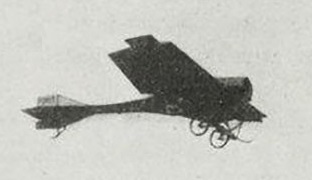
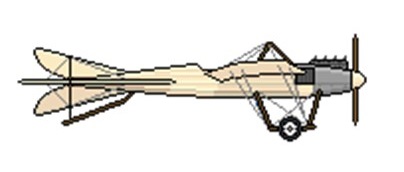
The 1911 Pivot-Koechlin monoplane was designed by Pivot and Koechling, built by Audineau in France.
A more streamlined version of earlier Koechlin designs. It was flown by Weiss at the 1911 Turin meeting.
Span: 32’10”
Length: 25’9″
Speed: 68 mph
Pitts Li’l Monster
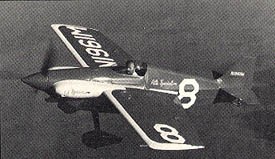
Curtis Pitts built “several” of the Goodyear-type racer. Possibly 7 or 8 including N97M Miss Dayton and N1961M Li’l Monster.
The Monster was built around 1947 or ’48 (even Curtis is unsure exactly when the plane was completed), and the aluminum wing, steel tube fuselage frame midget was designed around two things: The 190 cubic inch C-85 engine and the 5 ft 5 in Phil Quigley (the cockpit section was established by setting Phil up against the wall and chalk lofting his form!). Quigley was an accomplished race pilot and mechanic who did most of Curtis’s development testing and racing in the early 1950s. The Monster with Phil at the controls raced a bunch in the Goodyear events of the era with a modicum of success.
Probably, the plane was last raced at Cape May, New Jersey, during the disastrous 1971 air races. Fastest recorded lap speeds were just over 240 mph.\
After Curtis sold the aircraft, it passed through several hands before coming to rest in Oklahoma where James Dulin owned and flew the racer for almost 20 years. Detailed accounts of every Dulin flight accompanying the log books indicate nearly 400 hours logged in cross-country flights from Florida to California. Records also indicated two complete rebuilds as the result of almost identical hangar flooding instances. Clevenger subsequently acquired the Monster (autumn 1989) and set about restoring the craft to its current condition.
The Monster had been in storage in Oklahoma for almost 15 years before the airplane was hauled back to North Carolina.
The aircraft was restored.
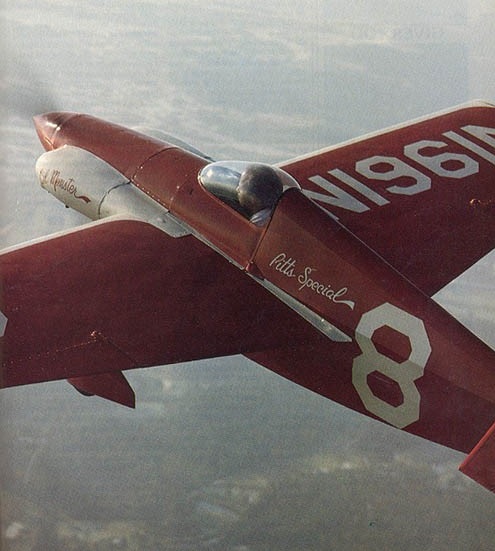
With the aircraft fueled, I climbed in and over the wing, anxious to see how I’d fit in the Quigley-size cockpit. I slid my feet forward under the main spar while lowering myself down inside the 20-inch wide (!) fuselage. Something hung my feet up before I got my feet all the way in and I fumbled around unsuccessfully trying to get fitted into the cockpit. It suddenly dawned that there was no obstacle at all. I had run up against the rudder pedals! I didn’t think I’d actually fit but, once in with my knees up around my elbows and my back pressed hard against the rear spar carry through, I found I could reach the needed controls – barely. This is definitely an aircraft built for 15-minute flights.
The much-advanced timing made starting difficult, but once started, the “hopped up” C-85 ran great – for about 30 seconds. We spent another 15 minutes propping before we got the engine running again. This time the engine ran for a whole minute before quitting. Back in the hangar we went and off came the cowling, carb and fuel lines. Cleaned and checked, we reinstalled the units as the sun set. We pushed the plane back outside and it purred like a kitten. Just enough for the little light left and a quick flight around the pattern.
I taxied to the far end of the 3000 ft grass runway where I ran the engine at full power for a good minute before convincing myself it woud run well enough to continue as planned. The right mag checked a little rough but not bad and all else was in order. Lined up, I shoved the power in quickly and the C-85 responded well, gradually pulling the little racer faster and faster through the tall grass. The tail came up on its own at about 900 feet down the runway – just as we entered the lumpy midfield region.
Directional control was easy, thanks to the “dew wet” grass and the little racer handled the rough ground quite nicely – that is until a large ground swell launched us into the air about three seconds too early.
I wasn’t quite sure the wing would bite and, being unsure about the stall characteristics, elected to let the aircraft settle back to the runway to accelerate just a bit more. The next bump launched us again into the air – this time in good aerodynamic shape so we could continue.
The aircraft accelerated low over the runway – the rpm steadily increasing with airspeed.
Approaching the end of the runway, I started a slow climbing turn back overhead the field, now shrouded in the long shadows of dusk. Three minutes later I leveled at 4500 feet, just in time to catch a last glimpse of the sun setting behind the mountains to the west. A quick bit of slow flight revealed no bad habits and the stall, although unannounced, broke straight and clean down around 75 indicated.
A mediocre flyby and chandelle set me up on downwind, trying to slow the plane to 90 – a good number for the first approach and landing. I turned base and found a full rudder sideslip necessary to keep the airplane from accelerating through 120. I had forgotten how clean some of these midgets are! Crossing the threshold low and flat, the airspeed hovered around 85-90. As the aircraft settled toward the grass, slight back pressure eased the descent and set the attitude at what I found was pretty close to three point. A little stick force reversal during the flare left me just a bit higher than I would have liked and the airplane shuddered its protest and dropped the last eight inches or so.
The rollout was short (I guess about 800 feet) and easily controlled directionally. A relatively successful flight although a post flight inspection revealed excessive blowby through the number four exhaust valve. A “midnight plus” valve grinding exercise followed – only to be rewarded with an unsatisfactory engine run at one in the morning. The blowby was back, stronger than ever and we could only guess that the “seat” was the real problem but without the appropriate grinding stones and equipment we (against our better judgment) skipped the process.
Wednesday morning with cylinder in hand we went off to the local valve grinding shop. Five hours later the cylinder was reinstalled. This time the compression checked out and two successful flights were undertaken – well, almost successful. The right mag was getting progressively worse and definitely not worth chancing a 2 1/2 hour trip south. The rest of the day was spent pouring through mag coils and condensers, trying to match the 20 year old mags. We were fortunate to find the appropriate replacement parts and managed one successful flight late in the evening. By unanimous agreement, we resolved to quit while ahead.
The next morning dawned cool and clear. One of the truly CAVU days when even the weather briefer don’t have much to say. Fueled to capacity (22 gallons) and with baggage and pilot filling the cockpit, the Monster and I climbed lazily in the still morning air to 6500 feet. I set the power at what sounded about right and watched the airspeed needle settle on 160 mph. At this altitude the plane was truing almost 170.
Fuel burn couldn’t be more than 6 1/2 gallon per hour, giving me almost three hours of endurance. I should be able to make the 350-mile trip to St. Augustine easily non-stop, although my butt was already offering serious objections.
The 50-mile plus visibility eliminated navigation as a worry and left the fuel system was my only concern. It’s kind of an odd system: One fuselage tank (eight gallons) and two wing tanks (seven gallons apiece), each with their own on/off valve running to a single “T” at the gascolator. Only the fuselage tank has any sort of quantity gauge (a simple manometer). With all three valves open (you’d better hope you never have to reach them in flight) the fuel feeds pretty quickly from the main (fuselage) tank – until the head pressure equalizes in all three tanks. The fuel then feeds relatively equally from all three. Trouble is: If, for some reason, the wings don’t feed then you are left with about two gallons with which to divert. Not a whole lot to say the least. I’m still not sure how I reasoned this out or why it worked, but if I pitched the nose up 30 degrees for several seconds, the main refilled rapidly to about 3/4. The method worked several times so I accepted it as fact.
With the fuel system under control and navigation almost too easy, I had a pleasant opportunity to just enjoy flying the aircraft. Response to control was definitely not as sharp as the Cassutt; softer, more relaxing really. Less deliberate and more gentle, well-harmonized and for sure more stable – particularly in yaw. The vertical surface (rudder and fin) act as one – probably because your feet are jammed hard against the rudder pedals. Aerodynamicists call this “stick fixed” stability (as opposed to stick free) and almost always makes for more stable response along that axis. This makes flying the airplane a whole lot less fatiguing on the long hauls.
The Monster was rigged well in pitch and, as is often the case with airplanes of similar genre, no elevator trim is supplied or required.
The truly enjoyable part of the flight lasted only 20 minutes or so, after which time my body decided it had had enough of this esoteric experience and began to object – vehemently! Never had I flown such an ergonomically uncomfortable airplane. Crammed fore and aft was bad enough but the narrowness of the cockpit allowed absolutely no twisting motion or side-to-side shifting. The plane’s only redeeming comfort feature was headroom. Unfortunately, the only way I found to take advantage of this was to PlO the aircraft through the sky, alternately lifting and lowering my scrunched self on and off the floorboards. The things I have to do to fly something different!
I don’t think I would ever be so happy to see St. Augustine. Two hours and twenty minutes left me seriously numb and aching for days afterward. Somehow though, the look on Curtis’ face when he first saw the resurrected Monster made the effort seem not all that bad. In fact, the pain went away.
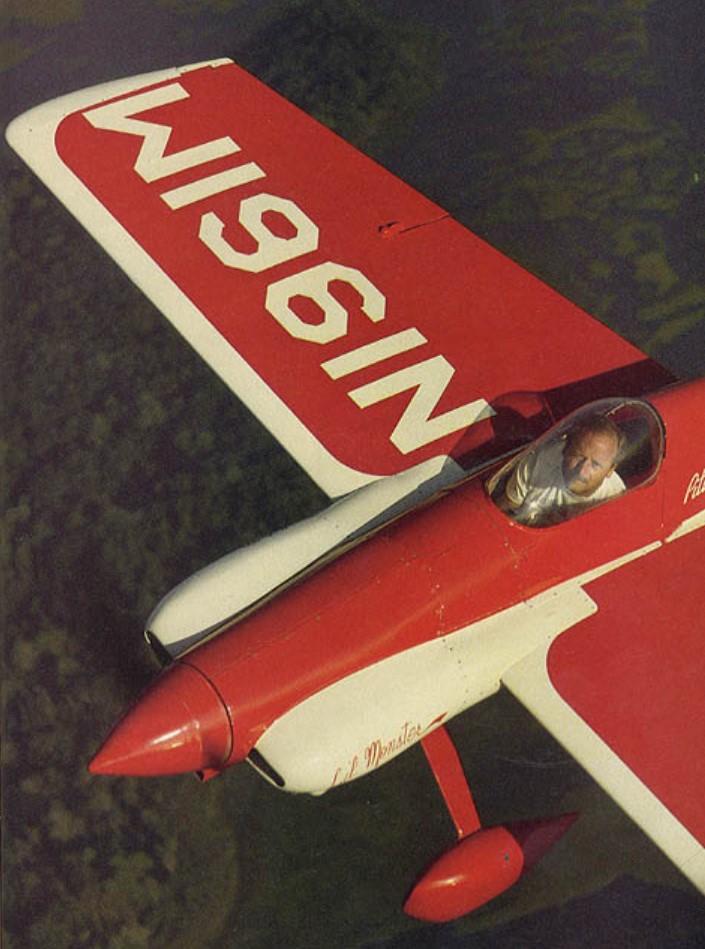
Engine: Continental C-85, 85hp
Seats: 1
Pitts Miss Dayton
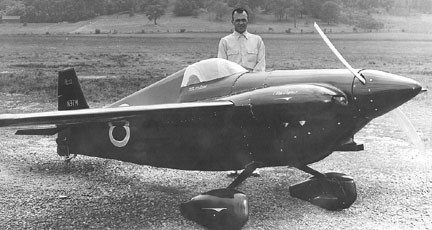
Curtis Pitts built “several” of the Goodyear-type racer. Possibly 7 or 8 including N97M Miss Dayton and N1961M Li’l Monster.
Engine: Continental C-85, 85hp
Pitts Big Hickey
Among other one-off projects, he also built a two-seat sport monoplane called the Big Hickey.

