The Poage Eindekker was built by Jack Poage, of Churchville MD. USA, circa 1971. Registered N101SC, it was a single-place cabin, mid-wing monoplane, aerobatic aircraft.
Monoplane
P.M. & T. Honeybird
Single seat single engined high wing monoplane with conventional three axis control. Wing has unswept leading and trailing edges, and constant chord; conventional tail. Pitch control by elevator on tail; yaw control by fin mounted rudder; roll control by quarter-span spoilerons; control inputs through stick for pitch/roll and pedals for yaw. Wing braced from below by struts; wing profile NACA 23015; 100% double surface. Undercarriage has three wheels in tail dragger formation; suspension on tailwheel and axle flex/ rubber suspension on main wheels. Push right go right tailwheel steering connected to yaw control. Aluminium tube framework, with pod. Engine mounted below wing driving pusher propeller.
Pod made from Keviar/Carbon fibre. Composite construction wing uses aluminium tubing to British HT30TF specification, Styrofoam, and wood veneer covering.
The Honeybird is a sophisticated pod: it is non structural and is attached to an aluminium framework.
Although the Honeybird is a microlight by definition, it is being built under the aegis of the British homebuilders association, the PFA, whose engineering requirements insist on gravity rather than pumped fuel feed. The main fuel tank is therefore in the wing, with a reserve situated aft of the pilot.
The Honeybird is basically a homebuilt, which in 1982 had yet to make its first flight.
Engine: NGL WAE 342, 30hp at 6800rpm
Micro V belt reduction
Power per unit area 0.23 hp/sq.ft, 2.5 hp/sq.m
Fuel capacity 3.6 US gal, 3.0 Imp gal, 13.6 litre in main tank; 4.8 US gal, 4.0 Imp gal, 18.2 litre in reserve
Length overall 18.5 ft, 5.64 m
Height overall 6.5ft, 1.98m
Wing span 32.5ft, 9.91m
Constant chord 4.0ft, 1.22m
Dihedral 3 deg
Sweepback 0 deg
Tailplane span 7.0ft, 2.13 m
Fin height 4.0ft, 1.22m
Total wing area 130 sq.ft, 12.1 sq.m
Total spoileron area 3.0 sq.ft, 0.28 sq.m
Wing aspect ratio 8.1/1
Wheel track 7.0ft, 2.13m
Tailwheel diameter overall 4 inch, 10 cm
Main wheels diameter overall 12 inch, 30 cm
Empty weight 2601b, 118kg
Max take off weight 510 lb, 231kg
Payload 250 lb, 113kg
Max wing loading 3.92 lb/sq.ft, 19.1 kg/sq.m
Max power loading 17.0 lb/hp, 7.7kg/hp
Load factors +6.0 design
Never exceed speed 109mph, 175kph
Max cruising speed 68mph, 109kph
Stalling speed 34mph, 55 kph
Best glide ratio with power off 15/1
Pletnyov Zhuravlic
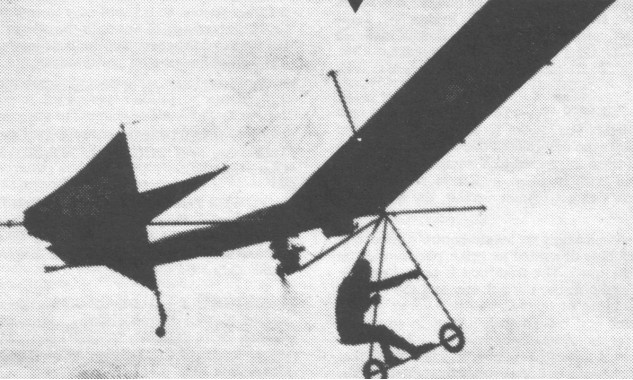
A single seat single engine, high wing mono¬plane with hybrid control circa 1983. Wing has unswept leading and trailing edges, and constant chord; cruciform tail. Pitch control by weight shift; yaw control by fully flying rudder; no separate roll control; control inputs through weight shift for pitch/yaw/roll. Wing braced from above by kingpost and cables, from below by cables; wing profile single ¬surface. Undercarriage has three wheels in tail dragger formation. Metal tube framework, without pod. Engine mounted below wing driving pusher propeller.
It appears to have a rudder to assist the weight-shift in yaw, a combination which is sufficient to class the Zhuravlic as a hybrid, but it is not clear whether a similar arrangement is used for pitch control or whether the pilot relies solely on weight shift for up/down control.
No details are given of the power unit, except that it is of 350 cc and is coupled to a two blade propeller.
Wing span 31.5 ft, 9.60 m
Engine: 350 cc
Empty weight 121 lb, 55 kg
Max level speed 37.5 mph, 60 kph
Best glide ratio with power off: 30/1
Take off distance 66ft, 20m
Landing distance 33ft, 10m
Service ceding 6600ft, 2000m
Player 1941 monoplane
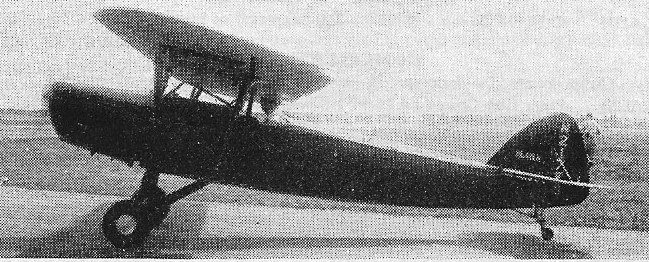
The 1941-built Player monoplane N21778 was fabric covered geodetic construction. Design based on Long Longster and Corben Super Ace plans published in Mechanix Illustrated. Wing modified from a Long Longster, tail from a Curtiss-Wright Junior. Fuselage was first of Player’s geodetic incorporations.
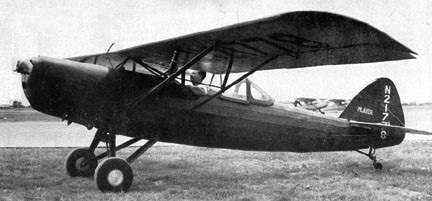
Canopy cockpit. Later repowered with 65hp Continental A-65. Still flying in the 1960s
c.1936
Engine: 45hp Ford A
Seats: 1
Engines: Continental A-65, 65 hp
Span: 30 ft 0 in
Length: 10 ft 0 in
AUW: 740 lb
Max speed: 95 mph
Cruise: 87 mph
Platzer Lilienthal Doppeldecker
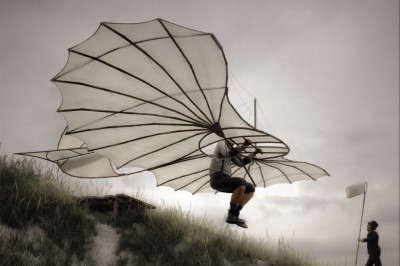
Michael Platzer built a Lilienthal Doppeldecker Replica, and it was flown in front of hundreds of spectators on the Wasserkuppe “Kleiner Westhang”.
Photographed at the 1978 first “Otto Lilienthal Memorial” at the Wasserkuppe.
Wing area: 10 m²
Wing span: 7.6 m
Hang glider weight: 18 kg
Platzer P.4 Motte
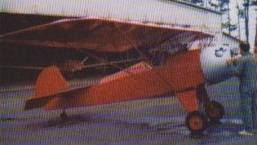
In 1981 Michael Platzer designed and built Germany’s first legal ultralight with three axis control, the P.4 Motte. It has a spaceframe fuselage and dural tube wings.
A parasol UL, the Motte was rebuilt and fitted with a converted Nissan Micra automobile engine.
P4 Motte BR
Engine: Rotax 462, 52 hp
Wing span: 8.2 m
Wing area: 11.4 sq.m
MAUW: 285 kg
Empty weight: 170 kg
Fuel capacity: 40 lt
Max speed: 145 kph
Cruise speed: 125 kph
Minimum speed: 50 kph
Climb rate: 4 m/s
Certification: Vz
Seats: 1
Fuel consumption: 13 lt/hr
Plan price (1998): 1000 DM
Platzer
1998-2010: Michael Platzer, Am Rohleiber 20, D-34302 Ellenberg, Germany.
In 1981 Michael Platzer designed and built Germany’s first legal ultralight with three axis control, the P.4 Motte.
Platz Glider
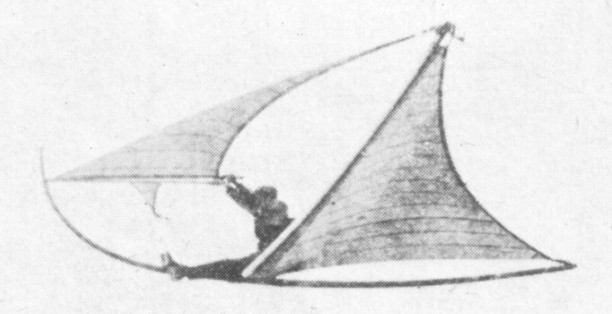
In Germany, just after the end of World War I, the 1919 Versailles treaty imposed a ban on powered flight. As a result there was a rapid increase of interest in gliding. Rheinhart Platz, the chief designer for Fokker’s after June 1916, perceived a role for a glider that was cheap to buy, costing less than “one good pedal cycle”, and cheap to maintain, while being robust and capable of being transported, by train or otherwise, and rapidly erected by one man.
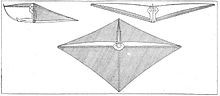
In the winter of 1922/23 Reinhold Platz designed and constructed a glider. The idea occurred during a sailing trip on the Schelde. To a certain extent sailing on water can be compared (aerodynamically) with gliding. After several tests with small and large models, Platz constructed a full size glider. Its fuselage comprised a curved steel tube with a circular section wooden beam inserted through it at the rear. The wing spars were two wooden masts which were inserted into two receptacles welded to the fuselage tube near the pilot’s seat. The “main sail”, or wing, was attached to these two masts. The two separate forward jibs were attached to jib masts, which could be moved by the pilot simultaneously or separately as required. By moving the two jibs up or down, longitudinal control was obtained. By moving one jib up and the other down, lateral control was possible. They were initially hinged together at their leading edges, but later the hinge point was moved rearwards towards the aerodynamic centre to reduce pilot load and separated only behind the hinge.
Since there were no ribs, the airfoil was determined by the airflow and the pilot, as for the sloop’s jib. The main wing, a single surface stretched between the spars and the extreme tail, also had its camber determined by the airflow, like the mainsail of the sloop. Both wing sheets were produced by sewing together narrow strips of material; the longitudinal joints between them are prominent in some back lit, better quality images.
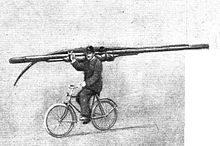
The glider had a wing span of 6.60 metres and weighed 40kg. It could be assembled by one man within 15min, and dismantled within 10min. The Platz could be disassembled into a 3,300 mm (130 in) × 350 mm (14 in) × 250 mm (10 in) pack, weighing 40 kg (88 lb) in fifteen minutes and reassembled in ten. Transport by bicycle, with care, was possible.
Free flight trials began some 50 flights without pilots and with increasing loads (up to 75 kg (165 lb)) into strengthening wind and eventually over sandhills as high as 25 m (82 ft). With a pilot in place, the glider was then flown tethered like a kite, first flying in February 1923. Several people, with weights up to 100 kg (220 lb) flew it this way, all reporting that forewing control loads were low. In February 1923 it was free flown in a moderate wind over 10 m (33 ft) dunes. Platz decided that the dunes did not provide usable soaring, their next goal, after which the experiments would end. He noted that, whilst his design could not compete with the best conventional gliders, it had met the initial targets outlined above and thought it or something similar would be of great value, seemingly content to leave others to judge his design.
Modern copies have since been built.
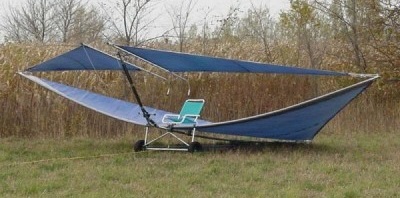
Wingspan: 6.60 m (21 ft 8 in)
Wing area: 16.0 m2 (172 sq ft)
Empty weight: 40 kg (88 lb)
Crew: One
Platel 1909 monoplane
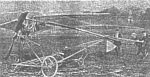
The 1909 Platel monoplane was designed by Platel in France.
Span: 19’8″
Length: 23′
Weight: 328 lb
Planet Aircraft Satellite
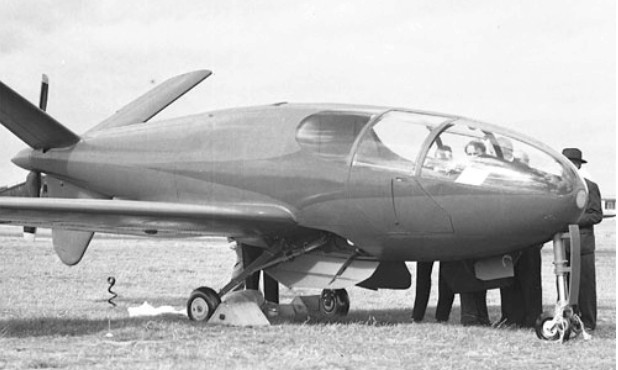
A three-seat light aircraft with vee tail and pusher propeller, the Planet Satellite was powered by a Gipsy Queen 32 via an extension shaft. The first aeroplane constructed entirely of magnesium sheet, and with retractable tricycle undercarriage.
Designed and built by J.N.D.Heenan of Croydon, UK, in 1948, the Satellite appeared at the 1948 Farnborough Airshow. Construction of the prototype G-ALOI c/n 1 was completed at Redhill,
Chronic vibration problems brought attempts at flight to a close at Blackbushe in 1949. After a period of store at Redhill it was broken up in 1958.
A second prototype, c/n 2, was built and used in the construction of the Firth helicopter G-ALXP.
Engine: Gipsy Queen 32
Wingspan: 33.08 ft
Length: 26.03 ft

