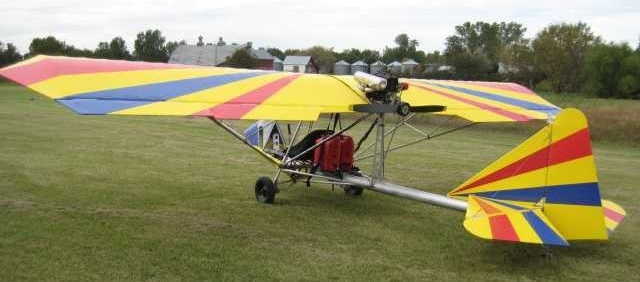
A 1926 glider for basic flight instruction. The Poppenhausen 1926 design was similar to the light gliders of that days, but it was larger and capable of carrying two persons.
Length: 23.524 ft / 7.17 m Height: 5.84 ft / 1.78 m Wingspan: 47.9 ft / 14.6 m Crew: 2
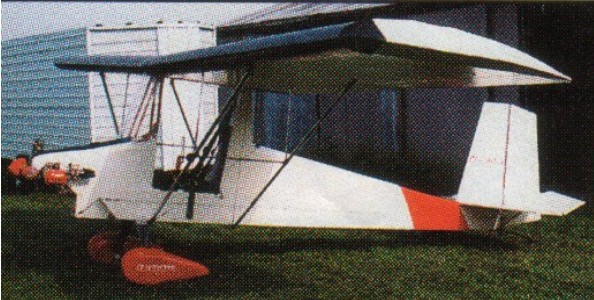
In 1980 Edward Popejoy built a high-wing, open cockpit monoplane registered NX2933. It was loosely based on Pietenpol, but considerably larger and faster. Specially outfitted for aerial photography with internal and external camera mounts.
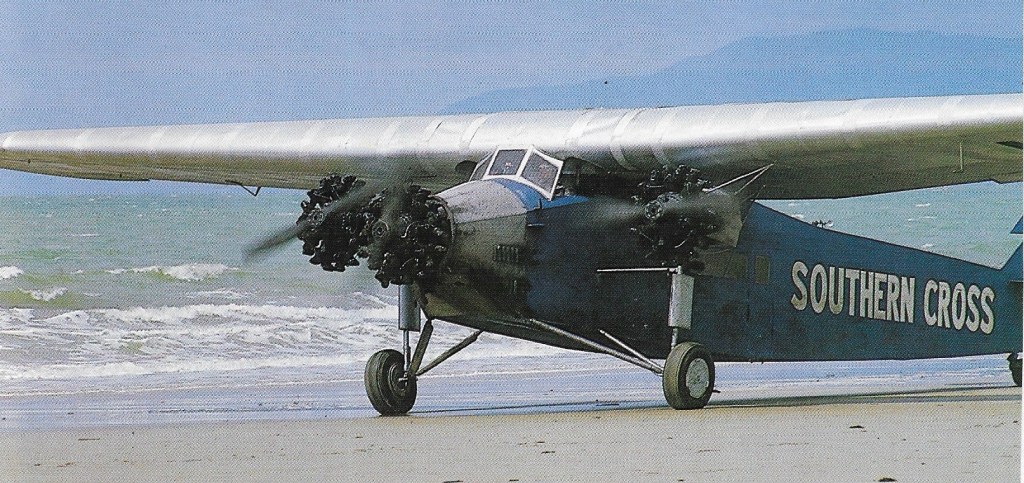
The plane’s replica was the project of South Australian flying instructor John Pope, who created the plane as a travelling history lesson that would fly around the country. Southern Cross is a flying close replica of the famous record breaking Southern Cross Fokker FV11B of Sir Charles Kingsford Smith from the 1920s and 1930s.
Built in South Australia in the period 1980 to 1987 as a tribute to Smithy, the aircraft toured Australia during the 1988 Bicentenary raising money for the Royal Flying Doctor Service registered VH-USU.
She is a faithful replica built to modern standards using the traditional aircraft construction of steel tubing and timber with doped Irish Linen for the fuselage and an all wooden (spruce and plywood) wing. She is the largest “exact replica” aircraft in the world and has the largest one piece wing ever made in Australia.
Aircraft Research and Development Unit was tasked to carry out the test flying of a replica of the 1926 Fokker Tri-Motor as flown by Australian aviation pioneer, Sir Charles Kingsford-Smith. The purpose of the test programme was, firstly, to ensure safe operation of the aircraft throughout its proposed flight envelope and, secondly, to provide data to allow the issue of a Certificate of Airworthiness or Permit to Fly. The trial included a cockpit and systems assessment as well as an evaluation of the aircrafts flight and ground handling characteristics. Airborne assessments covered stability and control characteristics, stall characteristics, general aircraft performance, asymmetric power characteristics and an evaluation of the aircrafts take-off and landing performance and handling. The flight characteristics of the test aircraft were found to be similar to those expected from an original Fokker VIIb-3M. Consequently, the aircraft could not meet some modern certification requirements. Notwithstanding this the aircraft was found to be generally safe and airworthy provided it was operated by experienced pilots in daylight Visual Meteorological Conditions and that the main recommendations of this report are adopted.
The aircraft first flew in 1987 and during the 1988 Bicentenary she toured around Australia as a fund raising exhibit for the Royal Flying Doctor Service. The aircraft was a major drawcard to the 1988 Bicentennial Air Show and many thousands of people saw her. In 1990 the aircraft even ventured to New Zealand for air show appearances.
After 555 hrs flying tine, on the 25th of May 2002 it had an accident at Parafield South Australia when she lost a main wheel on takeoff. Landing on the one good wheel and the tail, the pilot kept the damaged wheel off the ground by keeping its wing high in the air. When the aircraft stopped the high wing came down and snapped off around 3 metres from the wing tip. HARS bought the damaged plane in 2000.
After considerable negotiation HARS acquired the aircraft from the SA Government in 2010. It is being restored to full airworthy status.
Engines: 3 x Jacobs R-775 A2, 300 bhp Wing span: 22.1 m Length: 14.3 m Height: 4.3 m Maximum takeoff weight: 5,700 kg Cruising speed: ~155 km/h (max ~185 km/h) Ceiling: 8,500 ft Endurance: 7.5 hr Crew: 2 x pilots
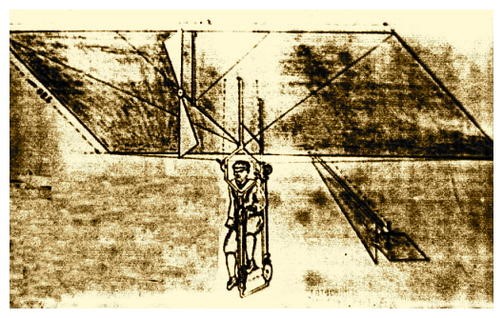
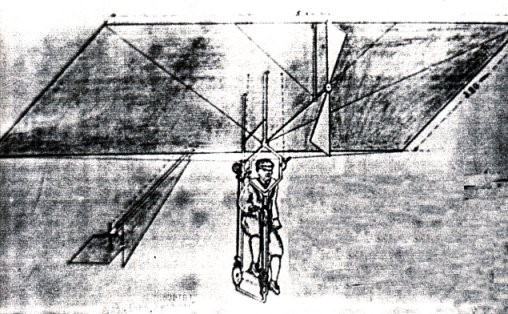
The first attempt to create the planes in Cuba dates back to 1893, when the leader of Cuban independence Jose Marti Patriot was approached Arturo Comas Pons, Cuban agronomist and journalist, to create a flying machine “to make it applicable to uses of war “, steel and aluminum.
Former Director of the Hanriot factory at Rheims, Ponnier founded his own company around 1912 and built a monoplane which Emile Vedrines flew into second place in the 1913 Coupe Internationale d’Aviation at Reims, achieving 123mph (198km/h).
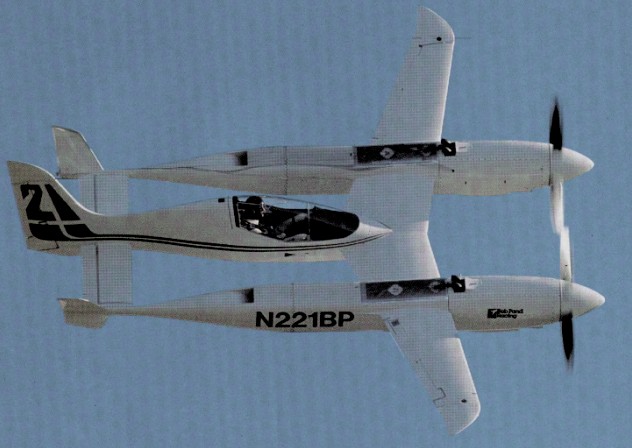
In 1988 Robert Pond (who derives a comfortable income from the manufacture of floor-cleaning products) contracted Burt Rutan’s Mojave, California, Scaled Composites, for the design and production of a prototype new-generation racing plane. Scaled engaged Nissan subsidiary Electramotive, a motorsport engine developer in Vista, California, to provide engines and gearboxes for the airplane. Rutan wanted to keep his pilot away from fuel, oil and hot coolant which meant a fuselage separate from the engine nacelles. The weight of the pilot’s pod is low, since it is supported at both ends and serves no structural purpose other than to hold up the pilot. The interference drag between the wing and the pod is nil. But most important, the pilot is as far away as he can be from the hazards of the powerplants. The airplane’s structure is mostly of graphite composites, often in the form of a sandwich with plastic foam cores. A special epoxy is used for compatibility with the engines’ methanol fuel. Despite its tiny size – 25-foot span and 20-foot length—and advanced materials, the Pond Racer is a dense little airplane, weighing 4,500 pounds ready to fly. Its useful load is only 650 pounds.
Liquid-cooled, with a single overhead cam, two valves per cylinder, and 3.2-liter (200-cubic-inch) displacement, the Electramotive VG30 engines are based on the Nissan V-6 block used in the 300ZX and Maxima automobiles. Though their blocks are very compact, the engines use up a lot of space once the turbochargers and radiators and associated ducting are included (in fact, the complete installed powerplant weighs around 700 pounds versus 350 for the basic engine). They are packed incredibly tightly into the two-foot-diameter, five-foot-long nacelles. The engines are mounted solidly to the airframe and the cowling skins are a load-bearing part of the engine mount, permitting the gap between spinner and cowling to be little more than a knife-slit. More than a year was spent developing a gearbox to bring the engine’s 8,000-rpm operating speed down to a propeller-friendly 2,000.
The engines are electronically controlled. There are manual backups, but normally the throttle and prop controls move potentiometers, whose signals arrive, digitized, at each engine’s two Intel microcontroller chips along with temperature and pressure data from almost two dozen other sources. The microcontrollers consult schedules containing the desired boost and the duration and timing for the spark and injection, and adjust those parameters for each power stroke.
At the same time, airframe and powerplant data are recorded every two seconds, and can be dumped at the end of each flight to a computer and instantly displayed in graphical form. Technicians can then use the data drawn from each run to modify the laws governing engine operation until the optimum is achieved.
To deliver 1,000 hp, the engines must be boosted to 110 in. Hg and turn at 8,000 rpm. They must run continuously at that setting for the 15 minutes of a race, although they never gave more than about 600hp.
On March 22, 1991, the first flight was described as a “no-brainer”. It took several flights to get the engines working well at moderate power, and even late in August they were still chronically misfiring and undergoing constant readjustment. One source of difficulty is that the engine control computers don’t monitor one variable important to airplanes though not to race cars: air density. With a wing loading of over 70 psf, touchdown is at a hot 120 knots.
The original intention had been to remove some or all of the angled “butterflies” at the tips of the horizontal stabilizer after flight-test demonstrated sufficient directional stability. Now they may be moved to a horizontal position instead, since the airplane has so little static margin that it requires no trimming between 140 and 250 knots.
A major source of trouble during testing has been the methanol fuel. Not a petroleum product, methanol, like alcohol, is derived from plant fermentation. It has about half the specific impulse of gasoline, which means that twice as much of it must be burned to produce a given amount of power. But it also burns over a far wider range of mixtures, so that engine cooling can be supplemented simply by pumping a lot of excess methanol through the engine. What doesn’t burn in the cylinders emerges from the exhaust pipes as a roaring plume of flame familiar to drag-race buffs. Methanol also doesn’t detonate, and that is what allows it to run at the astronomical levels of boost necessary to pull 1,000 hp out of an engine having fewer cubic inches than that of a Cessna 152. Methanol has very unfriendly relations with many materials. “It eats us alive,” Dick Rutan says. After repeated episodes of corrosion and oil contamination, it became standard operating procedure to drain the fuel systems after each flight and refill them with aviation gasoline in order to protect components from the methanol. Even if Burt Rutan scored a bull’s-eye in flying qualities, there are still other major uncertainties waiting to be resolved. One is the reliability of the engines while being operated continuously at 1,000 hp. Another is handling qualities at top speed; because the engines can’t be opened up, the Racer has not yet been flown above 333 KIAS (357 knots true airspeed). Yet another unknown is the efficiency of the propellers. Four-blade and 80 inches in diameter, they are King Air props modified by Hartzell to specifications developed by John Roncz, a longtime consultant of Rutan’s who also designed the wing and tail airfoils for the Racer. Their knife-thin tips are designed to run at 98 percent of the speed of sound—not a regime in which propellers are routinely used. The other question mark is airframe drag. Although the Racer is small, it is complex in shape, with many intersections and much internal cooling flow whose drag is difficult to estimate. At 460 knots, air will slam into it like cinder blocks, with a force of 600 pounds per square foot. At that speed a small surplus of drag could mean the difference between success and failure for the whole project.
Its bulky fuel load notwithstanding, the Pond Racer turned out to be a tiny airplane only 20 feet long, with a wing span of slightly more than 25 feet. It weighs 4,000 pounds when fully fueled. Scaled Composites, Rutan’s company in Mojave, Calif., finished the racer’s airframe in June 1989, but the engines and gearboxes took another year and a half to be completed. During that time the Rare Bear pushed the official speed record to 528 mph one mph faster than Rutan’s hoped for top speed.
At Reno 1991, a connecting rod punched through the left engine’s oil pan, dumping lubricant on the hot exhaust pipes and causing a fire. Race pilot Rick Brickert triggered the Pond Racer’s Halon fire extinguishing system, which smothered the blaze, then flew the craft to a one engine landing. After Reno, the racer was transferred from Mojave to Pond’s home airport at Palm Springs, Calif., to await further development.
N221BP appeared at Reno in 1991-93, qualified at 400mph.
Destroyed in a forced landing crash in 9/14/93, killing pilot Rick Brickert.
Engines: 2 x Electromotive-Nissan VG-30 GTP, 600 hp Wingspan: 25’5″ Length: 20’0″ Useful load: 640 lb
In 1923, in the wake of the Castar, Paul PONCELET designed a second aircraft, this time two-seater, sponsored by Jean-Baptiste Richard, for participation in the Daily Mail competition, which was to take place in Lympne, Kent, England, on October 12 and 13, 1923.
Jean-Baptiste Richard was the representative of the Handley-Page Company in Belgium and also of the ADC Ltd (Aircraft Disposal Company) which liquidated the English planes and engines surplus from the war of 14-18. He was the first assignee of the right to install and operate an aerodrome at Saint-Hubert (Belgium) in May 1925, a right that he will cede in the following months to José ORTA (who was the owner of the aerodrome and constructor – aircraft finance).
Paul Poncelet was the head of the wood construction workshop of SABCA (Société Anonyme Belge de Constructions Aéronautiques) and the machine was built in the workshops of this company which did not hesitate to encourage its executives in technical innovation projects. in the field of aviation.
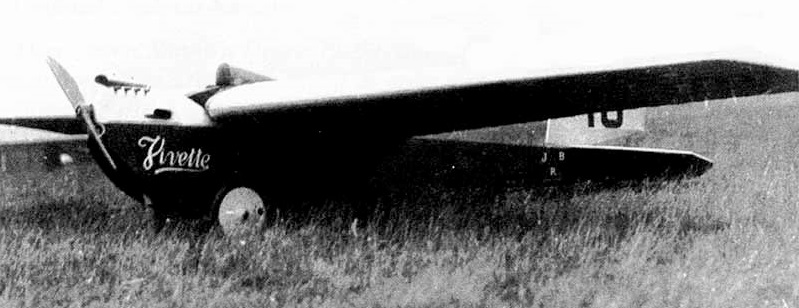
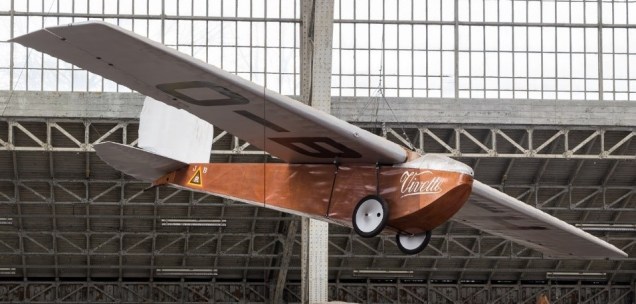
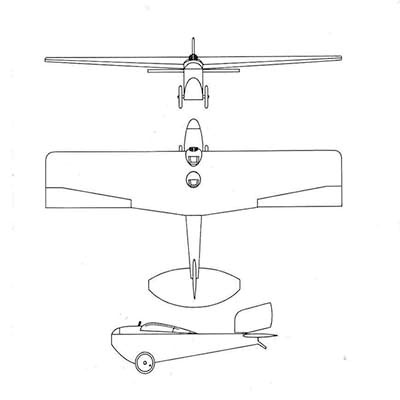
The aircraft was called Vivette, in homage to Jean-Baptiste Richard’s daughter, Geneviève, who was nicknamed Vivette by her family. The Vivette is an airplane derived directly from the Castar, to which Paul Poncelet has made some significant modifications. The fuselage, thinner than that of the Castar, was shortened by about twenty centimeters, and a second station could be installed in tandem by a circular cutout in the thick wing. The fuselage is completely clad in thin plywood.
The wingspan of the cantilever wing was 1.80 meters, bringing the wing area to 24 m² so as not to increase the wing loading compared to that of the Castar single-seater. The Poncelet Vivette made its first flights in the hands of Victor Simonet at the end of the summer of 1923. and, although not quite ready, was entered by its owner JB Richard (“That very good friend of England “as said in the magazine” The Airplane “of October 17, 1923) at the Lympne competition (England) at the end of September 1923 with Lieutenant Baron Kervyn de Lettenhove as pilot. The fuselage is thinner than that of the Castar, and the lander
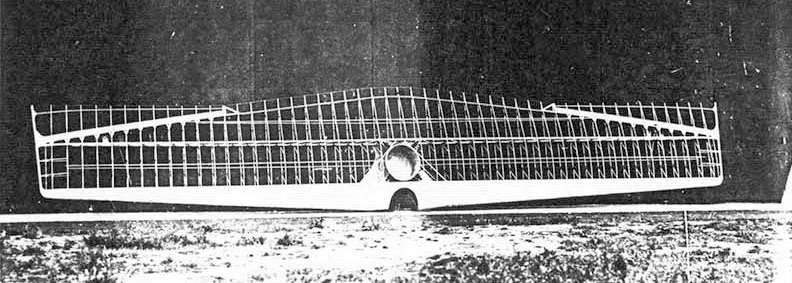
Structure of the Vivette’s wing – Note the hole in the rear seat of the two-seater
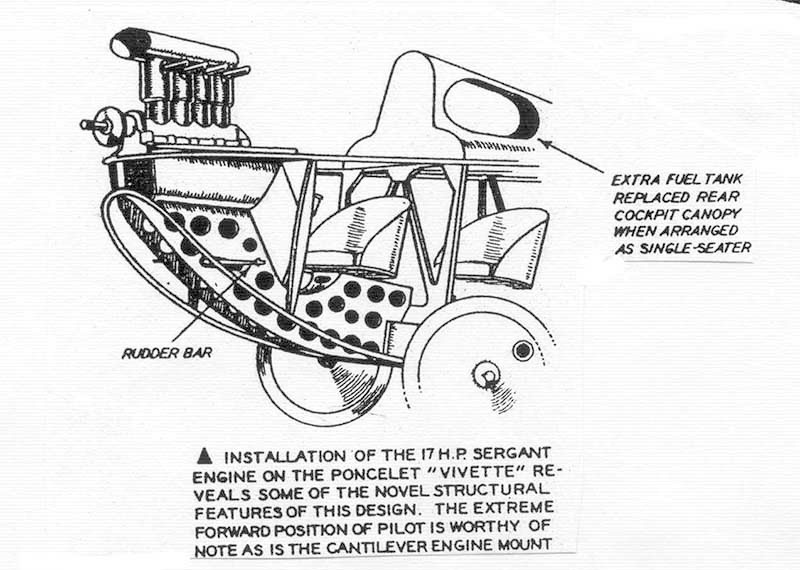
It can be configured as a glider, single-seater or two-seater, by adding a second seat directly behind the pilot’s seat, in place of the fuel tank.
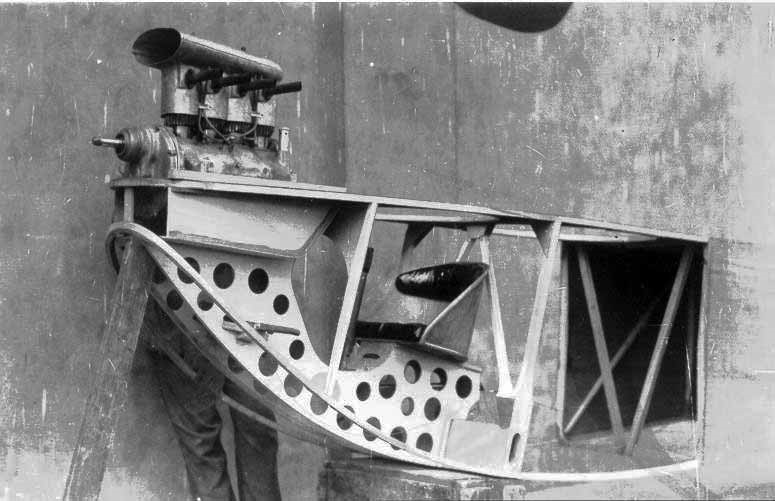
But it was easily converted into a aircraft with the installation of a Sergant engine, 4 cylinders in line, 780 cc, developing a power of 17.5 hp at 3500 revolutions / minute.
In the motor version, the rear seat was removed and a fuel tank could be installed on the wing.
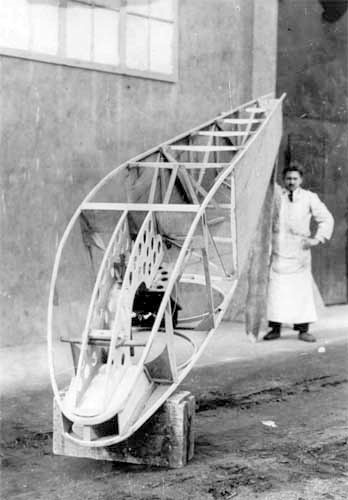
Structure of the front of the fuselage -The Sergant engine is in place
The British Royal Aero-Club organized in October 1923, in Lympne, Kent (England), a richly endowed competition, reserved for moto-aviettes (light planes equipped with low-power engines). Three prizes were contested: a distance competition with given consumption, a speed competition and an altitude competition.
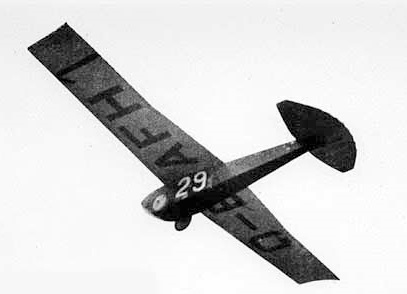
La Vivette made its first flights in the hands of Victor Simonet at the end of the summer of 1923. The aircraft was registered O-BAFH with certificate n ° 88 dated October 1, 1923, very shortly before its departure for Lympne.
The motorized gliders of Paul Poncelet, Castar and Vivette were registered for the Lympne 1923 meeting by Jean-Baptiste Richard and J.A. de Ro, respectively, but only for the altitude competition. The Vivette went to England on its own, flying over the English Channel piloted by baron Kervyn de Lettenhove, together with the Castar piloted by Victor Simonet. Competition number 16.
But during the competition, piloted by lieutenant baron Kervyn de Lettenhove, she had no luck: she was damaged during a take-off: When he started to rise, the pilot turned slightly to the left, but at the same moment a gust of wind lifted the right wing. This caused a sudden slip and a violent shock of the left wheel. Another gust lifted the tail of the craft which ended up on its back. Fortunately, the pilot got off without injury. A special feature of these airplanes is the position of the fuel tank, which is located just behind the pilot’s head, serving as protection for the latter in the event of an impact. In fact, during the accident, the tank played its protective role.
The Vivette accident on takeoff: the left wing touched the ground under the effect of a gust of wind, and the aircraft turns over, without damage to the pilot. He is brought back to the hangars still in its back position.
On the return from Lympne, two-seater flights were successfully carried out, with Victor Simonet as pilot, and Mr. Demonty, technical director of SABCA as passenger.
An article in Flight of December 27, 1923, indicates that: “On November 26 (1923) the Belgian light monoplane Poncelet” Vivette “carried out several flights with pilot and passenger, although its engine had a displacement of less than 800 cc” The Vivette began a series of records on November 23, 1923 by making a eleven-minute flight at an altitude of twenty meters with Victor Simonet as pilot and Mr. Demonty (technical director of SABCA) as passenger: The total weight of the machine exceeds 380 kg. With a bearing area of 24 sq,m, the weight per square meter is 15 kg and the weight per HP exceeds 25 kg, which is a world record.
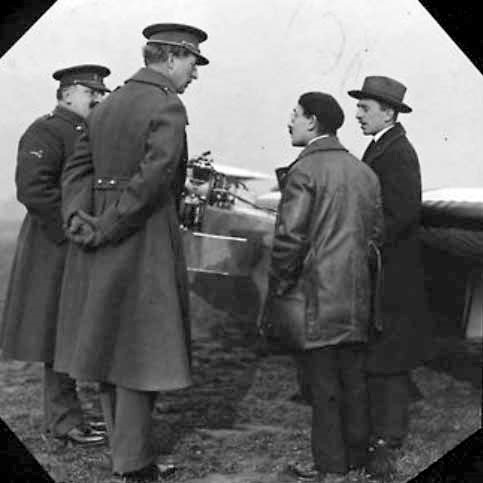
Visit of King Albert I of Belgium – Évère Aerodrome, November 20, 1923 From left to right: Major Smeyers, King Albert Iier, Paul Poncelet, Lieutenant Simonet and Kervyn de Lettenhove. The hood was removed, showing the Sergant engine. A plywood panel seems to have been replaced and “Vivette” has not been repainted yet?
“From a correspondent we have received the accompanying illustrations of Belgian light planes and of a visit paid by King Albert to the aerodrome to inspect these machines. This special royal visit took place on November 20, when the following four Belgian light ‘planes were present : The Poncelet “Castar” type, familiar from Lympne; the Poncelet “Vivette,” equally well known; the EMA biplane, designed and built by the Military Aviation School; and the Jullien SABCA monoplane, built by the Societe Anonyme Belge de Construction Aeronautique . His MAJESTY showed great interest in the construction of the machines explained to him by the various constructors, and was much impressed by the flying qualities of the different types, especially admiring the sharply-banked turns and the good speed range. “
From left to right: Major Sweyers (?), King Albert 1st, van Opstal (pilot) and Mathieu Demonty
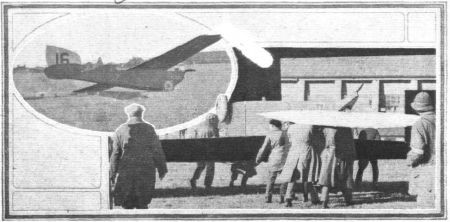
It was in 1925, in Vauville, that the Vivette won its laurels by participating in the Experimental Congress as a glider [competition number 29]. Commander MASSAUX established a world record for the duration of flight without an engine with 10 hours 19 minutes and 43 seconds, and won the “Petit Parisien” cup for a 52-kilometer engineless flight, with 52 turns.
Duration bonus of 800 francs for each flight: July 26, 1925: Poncelet Vivette (Cdt Massaux), 10:19:43 a.m. (world record) July 28, 1925: Poncelet Vivette (Cdt Massaux), 2 h 3 m 15 s August 1, 1925: Poncelet Vivette (Cdt Massaux), 4:29:21 a.m.
The Vivette in flight, glider version – Vauville 1925
The glider was donated by J.-B. Richard to the Air Museum (Brussels) in July 1926. The aircraft was cancelled by the Aeronautical Administration on January 31, 1931.
It was restored in 1995, in the workshops of Roger Poncelet (grandson of Paul), under the patronage of SABCA, on the occasion of the company’s 75th anniversary. It has since been exhibited in the aviation hall of the Royal Museum of the Armed Forces and of Military History in Brussels, in glider configuration.
Engine: Sergant Type A, 17.5 hp Wingspan: 13,0 m Wing area: 24 sq.m Length: 6,30 m Height: 1,50 m Empty weight: 140 kg Wing loading: 9-10 kg/sq.m Max speed: 95 km/h