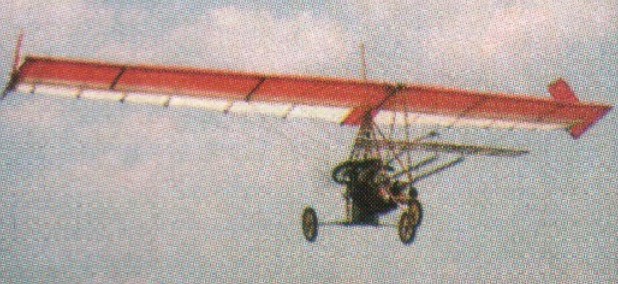
This canard (tail-first) microlight is based on the Manta Fledge hang-glider and several versions have been developed in the United States by Pterodactyl Limited. The latest version to be developed, is the Ascender. The Ascender differs from the earlier Ptraveler in that the engine drives the propeller through a belt-drive reduction system. The Pterodactyl gives the impression of a large size because of the high wing and larger wheels than other types. First built in 1981. A monowing with an all-flying canard control surface and wingtip winglets. All control surfaces are movable. Control features are similar to Ptraveler. Weight shift is not necessary but can affect trim. Sink rate can be increased by using the canard as an air brake in the full-up position. A mixer stick deploys the winglets and canard. Construction con¬sists of aluminum tubing, with stainless steel cable and aircraft hardware used throughout. Dacron sailcloth covers the wings and winglets. Stitts Poly-fiber covers the canard. With optional bridle and release, the No Pturkey can be used to air-tow gliders.
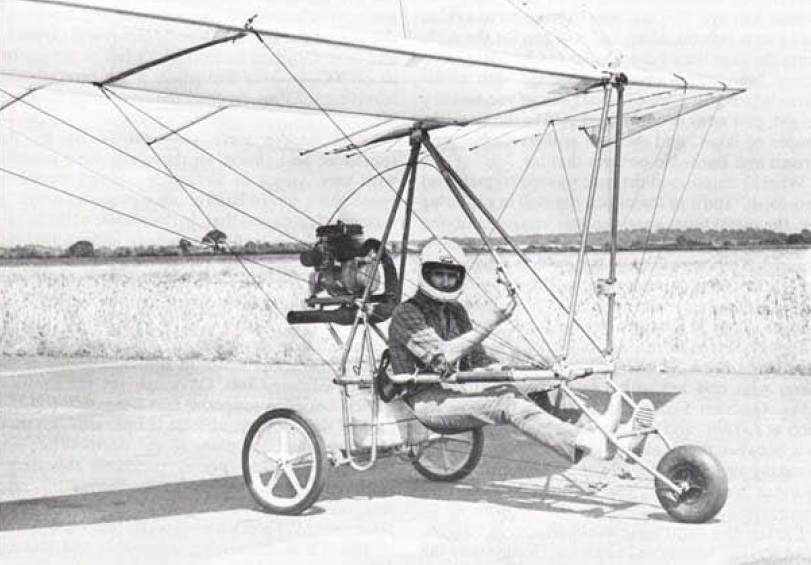
In 1982 it was succeeded by the Ascender II, which has the benefits of a wider track, shock absorbers of laminated glass fibre in the main axles and a nosewheel increased in diameter from 14 to 16 inch (36 41 cm). The price in May 1983 is $5242.
Another version, the Ascender II+, has an enlarged framework for the heavier pilot and appeared the same year. It has a reinforced structure and makes use of larger diameter tubing. In addition, it has as standard the double capacity fuel tank, which is only an option on the Ascender II. Price for the Ascender II+ in May 1983 is $5536, as a kit requiring some 75 h assembly time.

Three axis, nosewheel steering and para¬chute options are available as on the Ptravel¬er, and in addition the Ascender buyer is offered an optional rigid seat, made of glass fibre and weighing some 5 lb (2.3 kg) more than the swing seat it replaces.
The Ascender II+2 is the same as the Ptraveler except: Side by side two seater. Bungee suspension on nosewheel and glass fibre suspension on main wheels. Given the increased strength of the Ascender II+ airframe com¬pared to that of the standard single seaters, it was inevitable that the Watsonville company would sooner or later use it as the basis of a two seater, and this duly appeared in October 1982 as the Ascender II+2. Before putting the Ascender II+2 into production, Jack McCormack and Robyn Solair from Ultralight Flyer magazine set off on the by now traditional proving trip in the Ascender II+2 prototype, this time travelling 1025 mile (1649 km) to the Mexican frontier and back.
In the US, the Ascender II+2, like all other two seaters, is classified as an experimental aircraft rather than an ultralight, though Jack prefers to play down the legal restraints by describing it as a single seater with a sidecar. Kits are available to convert an Ascender II+ into an Ascender II+2, the modification being extremely simply by virtue of the II+’s already enlarged frame, which allows the change to be made by simply adding the second seat (six bolts) and repositioning the throttle centrally. In all other respects the two aircraft are identical and, like the single¬-seater, the II+2 can have optional three axis control, nosewheel steering and a parachute system.
By August 1983 the FAA had inspected the Pterodactyl Ascender II+2 and approved it as an amateur-built aircraft kit. Prior to this, builders needed local approval for amateur registration.
A prototype two seater known as the Double Dactyl had appeared, but that particular dual machine never got into production.
Production was taken over by Freedom Fliers and by 1995, DFE Ultralights.
Ascender
Engine: 430 cc / 30 hp Cuyana 2-cylinder Two-stroke
Wing Span: 33 ft
Wing Area: 162 sq. ft. (canard: 11 sq.ft.)
Aspect ratio, 6.5
Overall length, 14 ft
Cruise Speed: 36-45 mph
Stall speed: 23mph
Max. Rate of climb: 1,000 fpm
Empty weight: 215 lbs
Max. pilot weight: 230 lb
Usable payload (include fuel), 265 lb
Wing loading, 2.75 lbs/sq.ft
L/D power-off glide ratio, 9:1
Takeoff roll distance, 75 ft
Fuel capacity, 5 Usgal
Range at cruise, 100 mi
Range: 130 miles
Ascender II
Engine: Cuyuna 430R, 30 hp at 5500 rpm
Propeller diameter and pitch 54 x 27 inch, 1.37 x 0.69 m
V belt reduction, ratio 2.0/1
Power per unit area 0.19hp/sq.ft, 2.0hp/sq.m
Fuel capacity 5.0 US gal, 4.2 Imp gal, 18.9 litre
Length overall 16.8 ft, 5.08 m
Height overall 9.1ft, 2.77m
Wing span 33.0ft, 10.06m
Mean chord 5.5 ft, 1.65 m
Chord at tip 4.5 ft, 1.34 m
Total wing area 173 sq.ft, 16.1 sq.m
Main wing area 162 sq.ft, 15.1 sq.m
Canard area 11.0sq.ft, 1.0sq.m
Main wing aspect ratio 6.7/1
Nosewheel diameter overall 16 inch, 41 cm
Main wheels diameter overall 20 inch, 51 cm
Empty weight 218 lb, 99 kg
Max take off weight 465 lb, 211kg
Payload 247 lb, 112kg
Max wing loading 2.87 lb/sq.ft, 13.9 kg/sq.m
Max power loading 15.5 lb/hp 7.0 kg/hp
Load factors; +4.4, 3.3 ulti¬mate
Max level speed 55mph, 88kph
Never exceed speed 55 mph, 88 kph
Max cruising speed 45mph, 72kph
Economic cruising speed 35mph, 56kph
Stalling speed 24 mph, 39 kph
Max climb rate at sea level 1000 ft/min, 5.1 m/s
Min sink rate 425ft/min, 2.2 m/s
Best glide ratio with power off 8/1
Take off distance 80 ft, 25 m
Landing distance 50ft, 15 m
Service ceiling 21,000ft, 6400 m
Range at average cruising speed 120 mile, 193 km
Ascender II+
Engine: Cuyuna 430R, 30 hp at 5500 rpm
Propeller diameter and pitch 54 x 27 inch, 1.37 x 0.69 m
V belt reduction, ratio 2.0/1
Power per unit area 0.19hp/sq.ft, 2.0hp/sq.m
Fuel capacity 10.0 US gal, 8.3 Imp gal, 37.9 litre
Length overall 16.8 ft, 5.08 m
Height overall 9.1ft, 2.77m
Wing span 33.0ft, 10.06m
Mean chord 5.5 ft, 1.65 m
Chord at tip 4.5 ft, 1.34 m
Total wing area 173 sq.ft, 16.1 sq.m
Main wing area 162 sq.ft, 15.1 sq.m
Canard area 11.0sq.ft, 1.0sq.m
Main wing aspect ratio 6.7/1
Nosewheel diameter overall 16 inch, 41 cm
Main wheels diameter overall 20 inch, 51 cm
Empty weight 235 lb, 107 kg
Max take off weight 535 lb, 243kg
Payload 300 lb, 136kg
Max wing loading 3.30 lb/sq.ft, 16.1 kg/sq.m
Max power loading 17.8 lb/hp 8.1 kg/hp
Max level speed 60mph, 97kph
Never exceed speed 65 mph, 105 kph
Max cruising speed 50mph, 80kph
Economic cruising speed 40mph, 64kph
Stalling speed 27 mph, 43 kph
Max climb rate at sea level 900 ft/min, 4.6 m/s
Min sink rate 475ft/min at 30mph, 2.4 m/s at 48 kph
Best glide ratio with power off 8/1
Take off distance 90 ft, 27 m
Landing distance 50ft, 15 m
Service ceiling 18,000ft, 5490 m
Range at average cruising speed 200 mile, 322 km
Ascender II+2
Engine: Engine: Cuyuna 430R, 30 hp at 5500 rpm
Propeller diameter and pitch 54 x 27 inch, 1.37 x 0.69 m
V belt reduction, ratio 2.0/1
Power per unit area 0.19hp/sq.ft, 2.0hp/sq.m
Fuel capacity 5.0 US gal, 4.2 Imp gal, 18.9 litre
Length overall 16.8 ft, 5.08 m
Height overall 9.1ft, 2.77m
Wing span 33.0ft, 10.06m
Mean chord 5.5 ft, 1.65 m
Chord at tip 4.5 ft, 1.34 m
Total wing area 173 sq.ft, 16.1 sq.m
Main wing area 162 sq.ft, 15.1 sq.m
Canard area 11.0sq.ft, 1.0sq.m
Main wing aspect ratio 6.7/1
Nosewheel diameter overall 16 inch, 41 cm
Main wheels diameter overall 20 inch, 51 cm
Empty weight 250 lb, 113kg
Max like off weight 750 lb, 340kg
Payload 500 lb, 227kg
Max wing loading 4.63 lb/sq.ft, 2.1 kg/sq.m
Max power loading 25.0 lb/hp, 11.3 kg/hp
Max level speed 60 mph, 97 kph
Max cruising speed 50 mph. 80kph
Economic cruising speed 40mph. 64kph
Stalling speed 32mph, 51 kph
Max climb rate at sea level 400ft/min, 2.0m/s
Take off distance 200ft, 60m
Landing dis¬tance 50ft, 15m
Service ceiling 12,000ft. 3660 m
Range at average cruising speed 82 mile, 132 km
Ascender III-A
Engine: Zenoah G25, 22 hp
Height: 9.1 ft
Length: 12.3 ft
Wing span: 33 ft
Wing area: 162 sq.ft
Weight empty: 165 lb
Gross: 425 lb
Fuel cap: 5 USG
Speed max: 55 mph
Cruise: 40 mph
Range: 150 sm
ROC: 400+ fpm
Take-off dist: 125 ft
Landing dist: 50 ft
Service ceiling: 18,000 ft
Seats: 1
Landing gear: nose wheel
Ascender III-B
Engine: Cuyuna 430, 32 hp
HP range: 25-45
Height: 9.1 ft
Length: 16.8 ft
Wing span: 33 ft
Wing area: 173 sq.ft
Weight empty: 215 lb
Gross: 425 lb
Fuel cap: 5 USG
Speed max: 55 mph
Cruise: 40 mph
Range: 150 sm
ROC: 1000 fpm
Take-off dist: 80 ft
Landing dist: 50 ft
Service ceiling: 18,000 ft
Seats: 1
Landing gear: nose wheel
DFE Ascender III-B
Engine: Rotax 277, 28 hp
Wing span: 10 m
Wing area: 16 sq.m
Weight empty: 108 kg
Gross: 210 kg
Fuel cap: 19 lt
Speed max: 90 kph
Min speed: 45 kph
ROC: 5 m/s
Seats: 1
Kit price 1998: US$6750
Ascender III-C
Engine: Cuyuna 430, 32 hp
HP range: 25-65
Height: 9.1 ft
Length: 16.8 ft
Wing span: 33 ft
Wing area: 173 sq.ft
Weight empty: 235 lb
Gross: 535 lb
Fuel cap: 5 USG
Speed max: 55 mph
Cruise: 40 mph
Range: 150 sm
ROC: 1000 fpm
Take-off dist: 90 ft
Landing dist: 50 ft
Service ceiling: 18,000 ft
Seats: 1
Landing gear: nose wheel
Ascender III-T
Equipped for towing.